Year: 2019

05 Dec 2019

Einride to launch commercial pilot of driverless electric pods with Coca-Cola European Partners

Autonomous robotic road-riding cargo pod startup Einride has signed a new partner for a commercial pilot on Sweden’s roads, which should be a great test of the company’s electric driverless transportation pods. Einride will be providing service for Coca-Cola European Partners, which is the official authorized bottler, distributor, sales and marketing company for Coca-Cola branded products in Sweden.

The partnership will see Einride commercially operating its transportation system between Coca-Cola European Partners’ warehouse in Jordbro outside Stockholm, and retailer Axfood’s own distribution hub, transporting Coca-Cola brand products to the retailer ahead of sending them off to local retail locations in Sweden.

Coca-Cola European Partners is looking to this partnership as part of its goal to continue to reduce emissions, since Einride’s system could potentially cut CO2 output by as much as 90% compared to current in-use solutions. This pilot is set to take place over the next few years, according to the two companies, and Einride says it hopes that it’ll be able to be on the road as early as some time next year, pending approval from the authorities since it’s a trial that will take place on public roads.

Einride announced $25 million in new funding in October, and has been running trials of the T-Pod electric transport vehicle it created on public roads since May.

05 Dec 2019

Airbnb officially bans all unauthorized house parties

One month after Airbnb confirmed plans to verify all of its listings, the home-sharing giant has announced additional efforts to protect its hosts and guests.

Airbnb will provide “clear and actionable enforcement framework” for scenarios including excessive noise, major cleanliness concerns, as well as unauthorized guests, parking and smoking. The company, expected to go public next year, is also banning all “open-invite” parties and events from locations booked on its platform.

Unauthorized parties have long been banned from Airbnb homes. The new policy seeks to halt certain guests from hosting events not approved by hosts, such as a recent Halloween party hosted at a California Airbnb rental in which five people were killed.

Finally, Airbnb is launching a new hotline for mayors and city officials to discuss Airbnb’s new policies with the company.

“While home sharing is a time-honored tradition in many cultures around the world, the rise of digital platforms like Airbnb has brought it within reach of more people than ever before,” Airbnb’s vice president of trust Margaret Richardson writes in today’s announcement. “In turn, Airbnb has worked to collaborate with cities around the world and with our host and guest communities to ensure we are creating a framework that allows millions of people to trust one another.”

Airbnb, founded in 2008, has long avoided verifying listings and incorporating stricter guest standards, instead looking to its thousands of hosts to devise individual house rules. As the company matures and crafts its pitch to Wall Street, we can expect to see additional updates to its policy to protect hosts, guests and communities.

Early last month, Airbnb said all properties would soon be verified for accuracy of photos, addresses, listing details, cleanliness, safety and basic home amenities. All rentals that meet the company’s new standards will be “clearly labeled” by December 15, 2020, Airbnb chief executive Brian Chesky noted in a company-wide email last month. Beginning this month, Airbnb will rebook or refund guests who check into rentals that do not meet the new accuracy standards.

The company last month also outlined plans to launch a 24/7 Neighbor Hotline to give guests access to a real Airbnb employee from any location at any time. The company will fully roll-out the service next year.

Airbnb’s Richardson developed the above changes alongside Charles Ramsey, a retired police commissioner and co-chair of President Obama’s Task Force on 21st Century Policing, and Ronald Davis, the former director of the U.S. Department of Justice Office of Community Oriented Policing’s Services.

05 Dec 2019

Future iPhones could drop charging ports altogether

Here’s a little early Christmas present for you. Apple analyst extraordinaire Ming-Chi Kuo is out with his latest Apple opus. Per usual, it’s got a lot of fascinating nuggets, this time projecting as far as 2021 in its look at iPhones to come.

Let’s skip right to that bit, shall we? It seems that 2021 may be the year Apple finally drops the Lightning cable. That would, of course, be good news, given that the port is…how to put this nicely…pretty objectively terrible. Apple, of course, already swapped it out on the iPad Pro for the far-more-ubiquitous-and-generally-better-in-every-way USB C.

What’s even more interesting here, however, is the suggestion that it won’t be USB C there to pick up the pace. 9to5Mac notes that the report suggests a 2021 iPhone would “provide the completely wireless experience.” The implication here being that the charging port drops altogether on the high-end device (like the iPad, it would be more of a gradual sunsetting across the line, starting with the premium model). 

Meizu, notably, tried something similar this year with the very gimmicky (and pricey) Zero. The handset completely dropped ports, speakers and buttons from the equation, as a sort of logical conclusion of broader smartphone trends. For a majority of users, however, I suspect wireless charging is going to have to get some serious speed gains before they’re ready to ditch wired charging altogether.

Interesting tidbits for 2020 include the arrival of several iPhones, arriving in 5.4, 6.1 (x2) and 6.7-inch varieties. All of the above will reportedly sport 5G, with cameras and size being the primary differentiation. The OLED devices will reportedly adopt a similar form factor as the now-ancient iPhone 4, per the report.

05 Dec 2019

Chirp debuts a faster, feature-filled Twitter app for Apple Watch

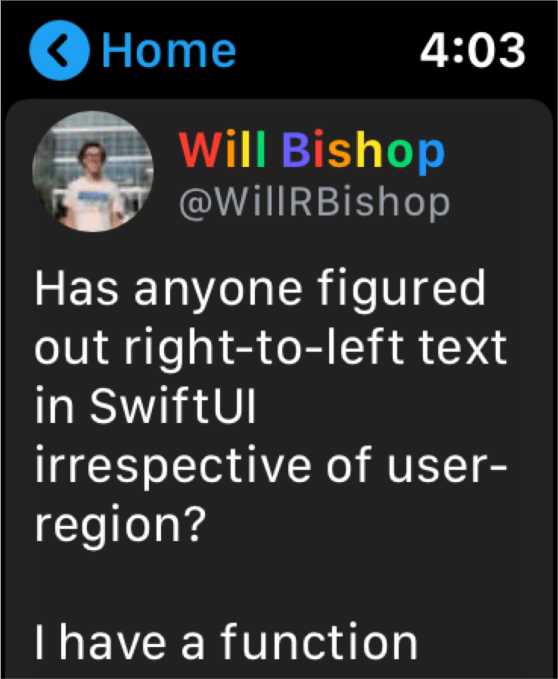
Chirp, a Twitter client preferred by hundreds of thousands of Apple Watch users, is getting its biggest upgrade since its arrival last year. Now redesigned for watchOS 6, the new version of Chirp includes a rebuilt timeline feature that allows you to endlessly scroll through tweets much more quickly than before, along with other enhancements like support for iOS 13’s dark mode and a way to add colors to your Twitter username.

The app was first introduced to fill the void created when Twitter pulled its own Apple Watch app back in 2017 in favor of using Apple Watch’s notifications platform instead.

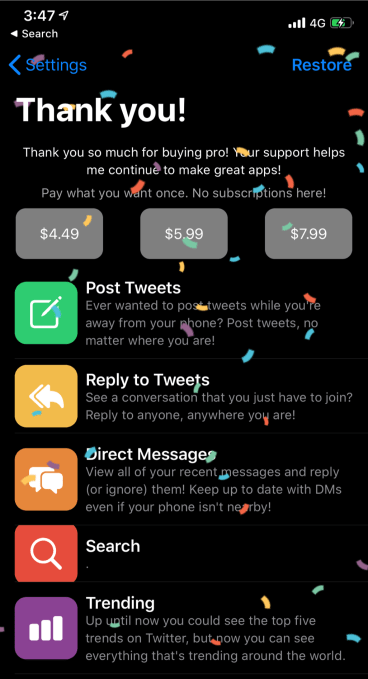
Chirp, meanwhile, lets users access a real Twitter client from their Watch’s small screen, which included a way to view your Home Timeline, Twitter Trends, @ Mentions, Direct Messages, and more. Some features — like the ability to Direct Message or compose tweets from your Apple Watch — are only available to Chirp Pro paying users, though.

Chirp Pro is a user-friendly “pay what you want” feature that lets you chip in at either $4.99, $5.99 or $7.99 to upgrade the app and doesn’t require a subscription. To date, Chirp has 294,000 downloads and only around 5% conversions.

The new version, Chirp 2.0, hopes to encourage more upgrades as it enhances the Twitter-on-your-wrist experience with a redesigned timeline that endlessly scrolls faster and more reliably than before, and includes an improved video player, image grids, and more.

“The inspiration for rewriting the timeline came from when I was fortunate enough to attend WWDC 2019 as a scholar,” explains Chirp developer Will Bishop. “During the keynote, Apple announced SwiftUI, a new framework that allowed developers to develop their user interfaces much faster than ever before. However, not only did it increase the speed, it opened up a whole new way to create apps for the Apple Watch,” he explains.

“Prior to SwiftUI, all user interface on Apple Watch was drag-and-drop which, while convenient, has some major drawbacks. So feeling inspired from this announcement, I left the keynote hall and immediately began working on reimplementing the timeline with SwiftUI,” he says.

[gallery ids="1920687,1920686,1920682,1920680,1920684"]

Direct messages were updated, too, and now include images and tweets that were shared through the private messaging feature.

Chrip 2.0 also introduces support for live complications on Apple Watch. That means you can see recent tweets right on the watch face, and tap on them to be redirected back to the Chirp app to reply, like or retweet. This feature is also available only to Pro users.

Another enhancement lets you add a little flair to your Twitter username by making it colorful — a feature that was inspired by a user’s request. Included as a one-off in-app purchase, it’s $1 for Pro users or $2 for non-Pro users to take advantage of this option. Bishop attributes the pricing decision to the backend work required to implement the feature on his part. It also makes for an additional revenue stream, by being available to those who don’t want to pay for the pro version of the app.

However, Bishop notes that the option will be available for free during Pride month (June) so everyone can make their username rainbow-colored, if they choose.

In addition, Chirp 2.0 is now available in a number of languages, besides English, including Chinese (simplified), Danish, German, Hungarian, Italian, Japanese, Portuguese, Russian, and Spanish (Latin America.)

The app itself is a free download from the iOS or Apple Watch App Store. 

05 Dec 2019

AI-enabled assistant robot returning to the Space Station with improved emotional intelligence

The Crew Interactive Mobile Companion (or CIMON for short) recorded a number of firsts on its initial mission to the International Space Station, which took place last November, including becoming the first ever autonomous free-floating robot to operate aboard the station, and the first ever smart astronaut assistant. But CIMON is much more than an Alexa for space, and CIMON-2, which launched aboard today’s SpaceX ISS resupply mission, will demonstrate a number of ways the astronaut support robot can help those working in space – from both a practical and an emotional angle.

CIMON is the joint-product of a collaboration between IBM, the German Aerospace Center (DLR) and Airbus, and its aim is to design and develop a robotic assistant for use in space that can serve a number of functions, including things as mundane as helping to retrieve information and keep track of tasks astronauts are doing on board the station, and as wild as potentially helping to alleviate or curb the effects of social issues that might arise from settings in which a small team works in close quarters over a long period.

“The goal of mission one was to really to commission CIMON and to really understand if he can actually work with the astronauts – if there are experiments that he can support,” explained IBM’s Matthias Biniok, project manager on the Watson AI aspects of the mission. “So that was very successful – the astronauts really liked working with CIMON.”

“Now, we are looking at the next version: CIMON-2.” Biniok continued. “That has more capability. For example, it has better software and better hardware that has been improved based on the outcomes that we had with mission one – and we have also some new features. So for example, on the artificial intelligence side, we have something called emotional intelligence, based on our IBM Watson Tone Analyzer, with we’re trying to understand and analyze the emotions during a conversation between CIMON and the astronauts to see how they’re feeling – if they’re feeling joyful, if something makes them angry, and so on.”

That, Biniok says, could help evolve CIMON into a robotic countermeasure for something called ‘groupthink,’ a phenomenon wherein a group of people who work closely together gradually have all their opinions migrate towards consensus or similarity. A CIMON with proper emotional intelligence could detect when this might be occurring, and react by either providing an objective, neutral view – or even potentially taking on a contrarian or ‘Devil’s advocate’ perspective, Biniok says.

That’s a a future aim, but in the near-term CIMON can have a lot of practical benefit simply by freeing up time spent on certain tasks by astronauts themselves.

“Time is super expensive on the International Space Station,” Biniok said. “And it’s very limited, so if we could save some crew time with planning that would be super helpful to the astronauts. CIMON can also support experiments – imagine that you’re an astronaut up there, you have complex research experiments going on, and there’s a huge amount of documentation for that. And if you are missing some information, or you have a question about it, then you have to look up in this documentation, and that that takes time. Instead of doing that, so you could actually just ask CIMON – so for example ‘what’s the next step CIMON?, or ‘why am I using Teflon and not any other materials?’

CIMON can also act as a mobile documentarian, using its onboard video camera to record experiments and other activities on the Space Station. It’s able to do so autonomously, too, Biniok notes, so that an astronaut can theoretically ask it to navigate to a specific location, take a photo, then return and show that photo to the astronaut.

This time around, CIMON will be looking to stay on the ISS for a much longer span than version one; up to three years, in fact. Biniok had nothing specific to share on plans beyond that, but did say that long-term, the plan is absolutely to extend CIMON’s mission to include the Moon, Mars and beyond.

05 Dec 2019

Inside VSCO, a Gen Z-approved photo-sharing app, with CEO Joel Flory

Long before Instagram toyed with removing “likes,” VSCO, an Oakland-based photo-sharing and editing app, built a community devoid of likes, comments and follower counts. Perhaps known to many only because of this year’s “VSCO girl” meme explosion, the company has long been coaxing the creative community to its freemium platform. Turns out, if you can provide the disillusioned teens of Gen Z respite from the horrors of social media — they’ll pay for it.

VSCO is on pace to surpass 4 million paying users in 2020, up from 2 million paying users in late 2018, the company said. Approaching $80 million in annual revenue, VSCO charges an annual subscription fee of $19.99 for access to a full-suite of mobile photo-editing tools, exclusive photo filters, tutorials and more. For no cost, users can access a handful of basic VSCO filters, standard editing tools and loads of content published by other users in VSCO’s photo feed.

In recent months, the company’s Oakland headquarters has swelled to 150 employees, an increase of 50% from 2018, with a new office in Chicago expected to fit several dozen more. The company, which counts 100 million registered users to date, has also recently inked a partnership with Snap. Together, they’ve launched Analog, VSCO’s first-ever Snapchat lens, in a deal that hints at a future acquisition. Needless to say, VSCO co-founder and chief executive officer Joel Flory is feeling pretty optimistic ahead of his company’s eighth birthday.

“When you walk into a museum, you don’t see the net worth of the artist,” Flory tells TechCrunch. “You don’t see how many people have walked through the museum. There’s not a space for people to write comments and leave stickers. It’s a moment. It’s for you. You get to sit in front of a piece of work, a piece of art. And does it move you? Does it speak to you? Are you able to learn something from it? Does it inspire you to go do something? How can we create a space in which you could do that online? That was our initial insight.”

Flory, a 40-year-old former wedding photographer, wears a grey Oakland Roots sweatshirt and a black Oakland Athletics hat when I meet him at VSCO’s offices on Oakland’s Broadway Avenue in November. He doesn’t look like the Gen Z whisperer I expected to meet, and his responses to my questions about the “VSCO girl” meme paint a picture of a CEO who’s inadvertently connected with a generation 20 years his junior. “It’s a sense of caring about the environment and kind of caring about causes that have a meaning and impact,” Flory said of “VSCO girls,” who have more-oft been described as 21st century valley girls or “annoying, white hopeless romantics.”

On one hand, we were ahead of the curve. But I think we were just being true to who we are. VSCO CEO Joel Flory

Regardless of Flory’s ability to decode Gen Z, VSCO continues to be beloved by millions of teenagers and young adults worldwide. Without selling ads or customer data, VSCO has developed a sustainable subscription-based business and written a new playbook for social media businesses in a world where Facebook’s advertising-based model is king. For those fed up with platforms that have facilitated bullying and failed to prioritize privacy, VSCO may be a protective corner of the internet.

“The creator always wins, the community always wins, who’s paying us wins and VSCO wins,” Flory said. “It sounds simple, but this creates a business model in which our business is not extracting value from any one group to give to someone else. It’s this direct relationship with who’s paying us.”

VSCO CEO Joel Flory speaks to attendees while teaching phone photography class during The Wall Street Journal Tech Live conference in Laguna Beach, California, U.S., on Tuesday, Oct. 22, 2019. Photographer: Martina Albertazzi/Bloomberg via Getty Images

A sense of belonging

Hot off the heels of a rare moment in the spotlight, VSCO, reportedly valued at $550 million, is ripe for a new round of funding. Flory, naturally, remained mum on any plans to sell the company or raise additional capital. But he was ready and willing to speak to the company’s untraditional path and the unique connection it has fostered with its users.

Flory tells me 75% of VSCO’s registered users and 55% of its paying subscribers are younger than 25, giving the company a small foothold into the most coveted demographic. On top of that, the hashtag #VSCO has been viewed 4 billion times on the immensely popular video sharing app Tik Tok, again according to the company’s own statistics, and another 450 million times on Instagram. With 80 million monthly active users Facebook had 2.45 billion monthly active users as of September, for context VSCO is by no means a competitor to Facebook, Facebook-owned Instagram, Snap or Twitter. What it is, however, is a leader in the new era of social media, in which users demand more transparent, equitable relationships with social platforms.

“[Gen Z] knows what each platform is good for and what the downfalls of each are,” Flory said. “They are actively making investments in creativity and in their mental health, and they are seeking out a space where they can be who they are. And the fact that they’re even talking about mental health, anxiety, depression and compare culture — it took me so long in life to be able to articulate what I was feeling … They’re putting their money and time in brands and causes that they care about. And so for us, that’s why I think we’ve seen a lot of our growth.”

Flory and VSCO co-founder Greg Lutze, a long-time creative director-turned-chief experience officer, began building VSCO, an acronym for Visual Supply Co., in 2011. Facebook was more than six years old and mere months from hitting the 1 billion monthly active user milestone when VSCO launched its first product, a photo-editing plug-in for Adobe Lightroom and Photoshop. Instagram, for its part, was a burgeoning photo-based social network that had launched the year before to “ignite communication through images.” Unlike Facebook’s Mark Zuckerberg, who famously created Facebook in his Harvard dorm room, or Instagram’s founding CEO Kevin Systrom, a former Google employee, Flory and Lutze had absolutely no experience in the tech or startup world. The pair banded together to build something focused around the creative community — not to construct a venture-backed startup.

[gallery ids="1920273,1920274,1920275,1920276"]

“We wanted to provide the tools for you to express yourself and then a space for you to do that, one that was void of the pressures around likes and comments that create this compare culture, which wasn’t even prevalent yet,” Flory said. “Now we’re seeing this played out on a large scale. So on one hand, we were ahead of the curve. But I think we were just being true to who we are.”

The business is growing in a way that we’ve never seen before. VSCO CEO Joel Flory

After launching VSCO as an Adobe plug-in, improved camera capabilities on smartphones motivated the business to change course. In the spring of 2013, the business launched its mobile app, a free photo-editing tool with in-app purchases and an affiliated community. The app reached 1 million downloads one week later and would eventually adopt a freemium model to earn money from its power users. Since its app launch, VSCO has remained a top-five grossing photo app on Apple’s App Store.

VSCO’s Oakland offices.

New opportunities

Though seldom mentioned on the venture capital and startup blogs, VSCO is indeed supported by VC dollars. Before its subscription revenue could sustain the business, the company brought in $70 million in VC funding from Accel, Glynn Capital Management, Obvious Ventures, Goldcrest Investments and others, closing its most recent round in 2015.

Flory and Lutze never sought venture funding. The former photographer and creative director didn’t have connections to venture capitalists or an in at a particular firm. Instead, Accel partners Vas Natarajan and Ryan Sweeney approached VSCO with “a thesis around the importance of design and creativity in the future,” Flory said, and quickly formed an alliance. Today, VSCO isn’t profitable, though it has been in the past, Flory said. It did, however, operate at “near break-even” last year — an accomplishment today as startups often lose hundreds of millions of dollars on an annual basis. With a valuation of $550 million, which Flory would neither confirm or deny, VSCO plans to invest heavily in growth next year.

As for the “VSCO girl” meme explosion, largely a mockery of white middle-class, social-media-savvy teenagers, it provided a jolt of publicity for a nearly decade-old company lost in the shadow of the giants. Though the meme entered the internet’s zeitgeist many months ago, the company is still riding a wave of press (and likely downloads) tied to its popularity. For many, the VSCO girl was their first encounter with VSCO, while for others, the photo-editing and sharing tool has been a fixture of their home screen for years.

As Instagram explores hiding likes in a bid to promote user health and other social media companies realize the importance of safety, security and mental wellness, VSCO may see its unique identity fade. Regardless, Flory says he wants other platforms to realize the impact of likes: “I honestly hope everyone thinks about what’s good for people’s mental health and builds more products that have a positive impact than a negative impact.”

Instagram’s experiments aside, VSCO is gearing up for another banner year, packed with plans for new features and products entirely. In our chat last month, Flory mentioned video design, publishing and editing, as well as illustration, as areas of interest for the now established photo-editing tool.

“The business is growing in a way that we’ve never seen before,” Flory said. “And what it’s doing is opening all of these new areas of opportunity. We’re focused on not only how you create content and how you edit content, but ultimately, how you tell a story with that content.”


05 Dec 2019

After criticism, Homeland Security drops plans to expand airport face recognition scans to US citizens

Homeland Security has confirmed it will not expand face recognition scans to U.S. citizens arriving and departing the country, days after it emerged the agency proposed making the scans for citizens mandatory.

The department, whose responsibility is border protection and immigration checks, said in a government filing that it it wanted to “amend the regulations to provide that all travelers, including U.S. citizens, may be required to be photographed upon entry and/or departure.”

The American Civil Liberties Union criticized the move, saying it had “profound privacy concerns” despite promises from the government that it had no plans to expand the face recognition checks to Americans.

Currently, U.S. citizens are allowed to opt-out of face recognition scans at the airport, but foreign nationals and visitors are required to have their faces scanned when arriving or leaving the U.S., where the systems are installed.

Homeland Security says the scans are to help crack down on illegal immigration and visa overstays.

A spokesperson for Customs & Border Protection, which filed the proposal, said the agency has “no current plans to require U.S. citizens to provide photographs upon entry and exit from the United States,” and that it “intends to have the planned regulatory action regarding U.S. citizens removed from the unified agenda next time it is published.”

The agency spokesperson said CBP “initially considered” including U.S. citizens in its face recognition checks at airports and other ports of entry “because having separate processes for foreign nationals and U.S. citizens at ports of entry creates logistical and operational challenges that impact security, wait times and the traveler experience.”

“Upon consultation with Congress and privacy experts, however, CBP determined that the best course of action is to continue to allow U.S. citizens to voluntarily participate in the biometric entry-exit program,” the spokesperson noted.

Just yesterday, CBP said it met with privacy experts and that it was “committed to keeping the public informed about our use of facial comparison technology,” said CBP’s John Wagner.

A source with knowledge of the meeting said privacy advocates warned the government against expanding face recognition scans for U.S. citizens, citing privacy risks.

05 Dec 2019

Waymo robotaxi app arrives on the App Store

Hailing one of Waymo’s self-driving minivans is about to get a little easier.

One year after launching its Waymo One self-driving car service in the Phoenix area, the company is launching an app on iOS, the latest signal that the company is inching towards large-scale commercial service. Now, Phoenix residents can download the Waymo app to their iPhone and sign up to ride in one of the company’s self-driving vehicles directly from the device.

Waymo, which spun out to become a business under Alphabet, launched a limited commercial robotaxi service called Waymo One in the Phoenix area in December 2018. The Waymo One self-driving car service, and accompanying app, was only available to Phoenix residents who were part of its early rider program, which aimed to bring vetted regular folks into its self-driving minivans.

In April, the company put its app on the Google Play store. Now, one year after Waymo One launched, it has finally made its way to the App store. The company has made improvements to the app over the past several months, including simplifying how rides are ordered to speed up the process. Users can honk the car’s horn from the app, a feature that Waymo says gives riders, including those with low vision, another way to find their car at pickup.

All of these steps are bringing Waymo closer to fuller commercial service that will include driverless vehicles. Until recently, all hailed self-driving Waymos had a human safety driver behind the wheel. The company began in November to put fully driverless vehicles into the fleet.

Technically, Waymo has had Android and iOS apps for some time. Interested riders would only gain access to the app after first applying on the company’s website. Once accepted to the early rider program, they would be sent a link to the app to download to their device.

There are still caveats to the announcement. The ability to download and sign up for the service won’t give users the kind if instant access they might expect. This isn’t Uber or Lyft. Instead, potential riders will be added to a waitlist. Once accepted, they will be able to request rides in the app. Riders will first be invited to join the Waymo early rider program, which requires signing a non-disclosure agreement, fbefore moving into the public arm of Waymo One. Once on Waymo One, participants can invite guests and talk publicly about their experience.

05 Dec 2019

SpaceX successfully launches re-used Dragon cargo capsule for its third trip to the Space Station

SpaceX has launched its nineteenth resupply mission to the International Space Station (ISS) on behalf of NASA. The launch took place at 12:29 PM EST (9:29 AM PST) from Cape Canaveral in Florida, with a Falcon 9 blasting off with a Dragon cargo capsule on top carrying around 5,200 lbs of payload destined for the ISS.

The Dragon cargo craft used in this launch has actually made this trip twice before – first in 2014, and then in 2017. Both times after returning it was recovered from the Atlantic Ocean and refurbished by SpaceX in order to fly again. SpaceX has designed as much of its space launch system as possible for reusability, and the Dragon spacecraft, which return from the ISS loaded up with cargo sent back by the astronauts living and working on the space station is a perfect candidate for re-use.

SpaceX also recovered the first-stage rocket booster of the brand-new Falcon 9 used in this launch, landing the spent rocket component on its floating drone ship in the Atlantic Ocean.

Next, the Dragon capsule will make its way to the Space Station, where it’s set to rendezvous on Saturday. It’ll dock with the station with the help of the robotic Canadarm2, and then spend around four weeks at the station, being unloaded and then loaded back up with 3,800 lbs or return cargo, which includes the results of experiments conducted on the station that researchers on the ground will study further.

Payloads being delivered on this mission includes a range of experiments, like beer brewing equipment sent up by Budweiser, a parking space that’ll live outside the station for mission-critical robots, and an updated version of the CIMON robotic astronaut assistant.

05 Dec 2019

Apple says its ultra wideband technology in newer iPhones appear to share location data, even when the setting is disabled

This week, security reporter Brian Krebs asked why the newest iPhone 11 Pro appeared to be sending out a user’s location even when the user disabled Location Services in their phone’s settings, in conflict with Apple’s privacy policy and the express wishes of the user.

Apple told Krebs it was “expected behavior” and that there were no security implications, but failed to say assuage fears of a location-leaking bug.

Krebs came to a logical conclusion. “It seems they are saying their phones have some system services that query your location regardless of whether one has disabled this setting individually for all apps and iOS system services,” he wrote.

He wasn’t wrong. The technology giant now has an explanation — two days after Krebs’ article went up and more than half a day after the company declined to comment on the matter.

Newer iPhones — including the iPhone 11 Pro which Krebs used — come with ultra wideband technology, which Apple says gives its newer handsets “spatial awareness” to understand where other ultra wideband devices are located. Apple only advertises one such use for this technology — users wirelessly sharing files over AirDrop — but it’s believed it may become part of the company’s highly anticipated upcoming “tag”-locating feature, which has yet to be announced.

“Ultra wideband technology is an industry standard technology and is subject to international regulatory requirements that require it to be turned off in certain locations,” an Apple spokesperson told TechCrunch. “iOS uses Location Services to help determine if iPhone is in these prohibited locations in order to disable ultra wideband and comply with regulations.”

“The management of ultra wideband compliance and its use of location data is done entirely on the device and Apple is not collecting user location data,” the spokesperson said.

That seems to back up what experts have discerned so far. Will Strafach, chief executive at Guardian Firewall and iOS security expert, said in a tweet that his analysis showed there was “no evidence” that any location data is sent to a remote server.

Apple said it will provide a new dedicated toggle option for the feature in an upcoming iOS update.

But Strafach questioned why Apple hadn’t explained the situation better to begin with.

Apple could have said something days ago, immediately squashing rumors with a simple explanation. But it didn’t. That absence of explanation only welcomed speculation. Credit to Krebs for reporting the issue. But Apple’s lack of response made this a far bigger issue than it ever had to be.