Year: 2019

16 Sep 2019

Get popcorn for iOS 13’s privacy pop-ups of creepy Facebook data grabs

Privacy-minded changes to smartphone operating systems which foreground the background activity of third party apps are helping to spotlight more of the surveillance infrastructure deployed by adtech giants to track and profile human eyeballs for profit.

To wit: iOS 13, which will be generally released later this week, has already been spotted catching Facebook’s app trying to use Bluetooth to track nearby users.
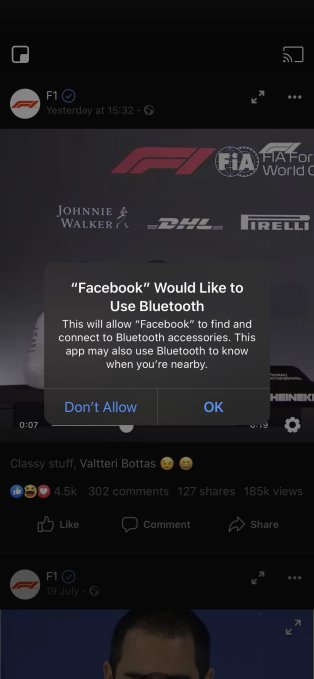
facebook BT

Why might Facebook want to do this? Matching Bluetooth (and wif-fi) IDs that share physical location could allow it to supplement the social graph it gleans by data-mining user-to-user activity on its platform.

Such location tracking provides a physical confirm that individuals were (at very least) in close proximity.

Combined with personal data Facebook also holds on people, and contextual data on the nature of the location itself — a bar, say, or a house — there’s a clear path for the company to make inferences about the nature of the relationship between the people who it’s repurposed short range wireless tech to determine are in close contact.

For a company that makes money by serving targeted ads at humans there are clear commercial reasons for Facebook to seek to intimately understand people’s friend networks.

Facebook piggybacking on people’s use of Bluetooth for benign purposes like pairing devices so that its ad business can ‘pair’ people is the sneaky modus operandi that iOS 13 has caught in the act here.

Ads are Facebook’s business, as CEO Mark Zuckerberg famously told the senate last year. But it’s worth noting the social network giant recently sought to push into the dating space — giving it a fresh, product-based incentive to pry into where and with whom humans are spending their time.

Algorithmic matchmaking based on cold signals like shared interests (in basic Facebook currency this might mean stuff like liking the same pages and events) is of course nothing new.

Yet mix in hot-blooded signals gathered by watching who actually mingles with whom, where and when — by repurposing Bluetooth to harvest interpersonal interactions via tracking people’s physical movements — and Facebook can take its curtain-twitching surveillance of human behavior to the next level.

The path of least resistance to tracking people’s movements is if Facebook app users are opting in to location tracking on their devices. Which means users enabling Location Services — a location tracking feature on smartphones that covers GPS, Bluetooth and crowd-sources wi-fi hotspots and mobile cell towers.

Unsurprisingly, then Facebook Dating requires Location Services to be enabled to function. The company confirmed to us that the Facebook app prompts dating users to enable Location Services if they haven’t already. Facebook also told us it doesn’t use wi-fi or Bluetooth to determine a person’s precise location if a user has Location Services turned off.

It also made a point of emphasizing that users can switch Location Services off at any time. Just not if they wish to use, er, Facebook Dating…

As per usual the company is tangling separate purposes for data processing in a way that denies people a meaningful choice over protecting their privacy. Hence Facebook dating users get to ‘choose’ between being able to use the service; or being able to blanket-deny Facebook the ability to track their physical movements. Like it or lump it.

iOS 13’s new privacy pop-ups to call out background app activity are a clear response to such disingenuous methods by an industry Apple CEO Tim Cook has dubbed the data industrial complex — putting a degree of control back in the hands of the user, who gets a third choice of manually disallowing Bluetooth proximity tracking (in the above example).

Android 10 has also recently expanded the location tracking controls it offers users — with the ability to only share location data with apps while you use them. Though Google’s OS lags far behind what Apple is now offering with these granular pop-ups.

Facebook has responded to awkward (for it) privacy changes incoming at the smartphone OS level by putting out an update on location services last week — where it seeks to get ahead of the deluge of data-grab warnings that iOS users of the Facebook app are likely to experience as they update to iOS 13.

Here it tries to spin Apple’s pro-active foregrounding of apps’ background tracking tactics via push notifications as “reminders” — in just one amusing rebrand.

But in a truly shameless contradiction Facebook also goes on to claim that: “You’re in control of who sees your location on Facebook” (because it says users can make use of the Location Services setting on a phone or tablet to deny tracking) — before admitting that switching off Location Services doesn’t actually mean Facebook will not track your location.

Just because you’re signalling very clearly to Facebook that you don’t want your location to be collected by Facebook doesn’t mean Facebook is going to respect that. Hell no!

“We may still understand your location using things like check-ins, events and information about your internet connection,” it writes. (For a clearer understanding of Facebook’s use of the word “understand” in that sentence we suggest you try substituting the word “steal”.)

In a final shameless kicker — in which Facebook almost appears to be trying to claim credit for smartphone OSes building more privacy features in response to its data grabs — the company seeks to finish on a forward-gazing note, per its preferred crisis PR custom, writing: “We’ll continue to make it easier for you to control how and when you share your location.”

Facebook dishing out misleading qualifications (e.g. “easier”) that whitewash the extent of its rampant data grabs is nothing new. But how much longer it can hope to rely on such flimsy figleaves to cover its privacy sins as the winds of change come rattling through remains to be seen…


16 Sep 2019

Beekeeper raises $45M Series B to become the ‘Slack for non-desk employees’

Beekeeper, the Switzerland and U.S.-based startup that provides a mobile-first communications platform for employers that need to communicate with blue-collar and service-oriented workers, has raised $45 million in Series B funding.

The round was co-led by Thayer Ventures and Swisscanto Invest by Zürcher Kantonalbank, with participation from previous backers including Atomico, Alpana Ventures, Edenred Capital Partners, Fyrfly, Hammer Team, investiere, HighSage Ventures, Keen Venture Partners, Samsung NEXT, Swiss Post, and Swisscom.

Targeting non-desk employees, including those working in hospitality, manufacturing, and retail, Beekeeper’s mobile-first platform is designed to replace more arcane communication methods, such as pen and paper and consumer messaging apps like WhatsApp.

The potential market is said to be big, too, with more than 80% of the world’s workers thought not to be sat at a desk and therefore arguably in need of a “Slack for non-desk employees,” which is how Beekeeper pitches itself. The company reckons 1.7 billion non-desk workers globally are either unconnected or poorly connected by a “patchwork” of consumer and enterprise applications.

Beekeeper’s clients include Hyatt Hotels, Dollar General, Domino’s Pizza. Heathrow Airport and SeaBoard Foods.

Meanwhile, with today’s Series B, Beekeeper’s says it plans to bridge the gap between knowledge workers and their non-desk counterparts, and further expand its offering with new features and integrations. On the product roadmap, for example, is a way for companies to be able to customise the Beekeeper experience via a “marketplace” of additional apps and integrations with systems such as Workday.

16 Sep 2019

Mitto, the payment card and app for ‘Gen Z’ teens, raises €2M seed round

Mitto, a debit card and app designed for “Generation Z” teens, has raised €2 million in seed funding.

Backing the round is Spanish bank Banco Sabadell via its innovation and venture arm InnoCells, along with Athos Capital, and Spanish social media influencers “AuronPlay” and “Wismichu”, amongst others.

Claiming to plug a gap in existing payment solutions for Generation Z (from 14 years old), Mitto offers a digital wallet and/or physical card for spending online or offline. Parents can send instant money to their children by topping up the wallet and get an overview of their “purchasing” profile.

In turn, the idea is that children gain a degree of financial independence by using Mitto and better understand their spending habits. More broadly, Mitto says it want to help develop financial literacy amongst Gen Z kids.

“Despite being born digital, Gen Z today don’t have easy access to a tool to use digital money,” says Mitto co-founder Marcos Cuevas. “Mitto is born to fix this by allowing them to own a digital wallet and virtual and physical cards. At the same time, we allow parents to educate and support financially their children in their first steps using a digital financial product”.

Cuevas says that the longer term mission of Mitto is to deliver the best payment solution experience for Generation Z and to help them understand the impact their spending has on the planet — as lofty as that sounds.

“We are committed to helping this new generation to change their mind about finance, to succeed by giving them the tools to understand their purchasing habits and — in the future — the impact of their decisions in the world, and how they can help to make it more sustainable,” he adds.

To that end, Mitto says the funding will allow it to further invest in its product and partnerships to become “the financial platform of choice” for Generation Z.

The Spanish fintech wants to launch its proposition in other European and Latam countries where it says demand exists. It claims a waiting list of more than 80,000 users in several countries and says it currently has 150.000 registered users.

Meanwhile, directly-comparable competitors include GoHenry and Osper in the U.K., and Current, Step, and Greenlight in the U.S., to name a few.

16 Sep 2019

Leeto helps works councils manage perks

French startup Leeto provides a service for French works councils, better known as comités d’entreprise. The fintech startup lets you hand out perks to employees using a simple web service combined with a payment card.

Leeto recently raised a $2.2 million funding round (€2 million) from Founders Future and various business angels, such as Thomas Rebaud (Meero), Benjamin Netter (October) and Vincent Luciani (Artefact).

If you’re not familiar with French works councils, every French company with more than 50 employees has to elect representatives to defend the interests of employees — starting in 2020, companies with more than 11 employees will have a works council. They act as the interface between members of the board and employees, and they vote on strategic moves.

In addition to that role, companies have to hand out a small budget to the works council every year. Works councils can then reimburse cultural or sports activities, hand out gift cards for Christmas, give movie tickets, etc.

And Leeto wants to manage that budget in particular. Many companies currently have a cumbersome process. You have to send receipts of your yoga lessons, find a store that accepts your gift cards… It’s even worse for representatives as they have to order paper gift cards and make sure everyone picks up their gift cards at their desk.

Leeto is a software-as-a-service the lets you manage all that from a web browser. You can add employees and then grant them perks.

Later this year, every employee will get a prepaid Mastercard that the works council can top up and manage. For instance, representatives can hand out €500 a year for vacation and cultural activities. Employees can then use this card to pay for a Netflix subscription, train tickets, museum tickets and more. It works a bit like Lunchr, but for works councils.

If employees go on vacation and forget their card, they can also upload eligible expenses to get reimbursed even if they paid with a personal card.

On the works council’s side, Leeto wants to make it easier to manage accounting and send notifications to employees. Leeto currently costs €3 per employee per month, but that’s directly taken from the budget of the works council so employees don’t pay that.

15 Sep 2019

How to get people to open your emails

We’ve aggregated the world’s best growth marketers into one community. Twice a month, we ask them to share their most effective growth tactics, and we compile them into this Growth Report.

This is how you’re going stay up-to-date on growth marketing tactics — with advice you can’t get elsewhere.

Our community consists of 600 startup founders paired with VP’s of growth from later-stage companies. We have 300 YC founders plus senior marketers from companies including Medium, Docker, Invision, Intuit, Pinterest, Discord, Webflow, Lambda School, Perfect Keto, Typeform, Modern Fertility, Segment, Udemy, Puma, Cameo, and Ritual .

You can participate in our community by joining Demand Curve’s marketing webinars, Slack group, or marketing training program. See past growth reports here and here.

Without further ado, onto the advice.


How can you send email campaigns that get opened by 100% of your mailing list?

Based on insights from Nick Selman, Fletcher Richman of Halp, and Wes Wagner.

  • First, a few obvious pieces of advice for avoiding low open rates:
    • Avoid spam filters by avoiding keywords commonly used in spam emails.
    • Consider using email subjects (1) that are clearly descriptive and (2) look like they were written by a friend. Then A/B your top choices.
    • Include the recipient’s name in your email body. This signals to spam filters that you do in fact know the recipient.
  • Now, for the real advice: Let’s say 60% of your audience opens your mailing, how can you get the remaining 40% to open and read it too?
    • First, wait 2 weeks to give everyone a chance to open the initial email.
    • Next, export a list of those who haven’t opened. Mailchimp lets you do this.
    • Important note: The reason many recipients don’t open your email is because it was sent to Spam, it was buried in Promotions, or it was insta-deleted because it looked like spam (but wasn’t). The goal here is to resuscitate these people. You have two options for doing so:
    • (1) Duplicate the initial email then selectively re-send it to non-openers. This time, use a new subject (try a new hook) and downgrade the email to plain text: remove images and link tracking. De-enriching the email in this way can help bypass spam filters and the Promotions tab.
    • (2) Alternatively, export your list of non-openers to a third-party email tool like Mailshake (or Mixmax).
      • First, connect Mailshake to a new Gmail account on your company domain.
      • Next, configure Mailshake to automatically dole out small batches of emails on a daily schedule. Let it churn through non-openers slowly so that Gmail doesn’t flag your account as a spammer.
      • Emails sent through Mailshake are more likely to get opened than emails sent through Mailchimp. Why? Mailshake sends emails through your Gmail account, and Gmail-to-Gmail emails have a greater chance of bypassing Spam and Promotions folders, particularly if the sender doesn’t have a history of its emails being marked as spam.

15 Sep 2019

Get the word on product-market fit from leads at Instagram, Tinder, Uber, and Okta at Disrupt SF

Every founder knows you gotta find market fit.  Almost no one gets it right on the first try, which means iterating quickly and decisively is the difference between greatness and the void.

On the Extra Crunch stage at TechCrunch Disrupt SF, we have a jam-packed panel filled with leading product builders  to discuss just how founders should think about launching and iterating their products.

First, we have Ravi Mehta, chief product officer at dating app Tinder . Before Tinder, he was a product director at Facebook and a vice president of product at TripAdvisor, in addition to a host of other product-related roles. Mehta brings years of consumer products experience to the panel, and will talk about the specific needs of social and network-based products.

Second, we have Manik Gupta, chief product officer at transportation and delivery company Uber . Before becoming product chief, he led Uber’s Marketplace and Maps products, and spent years at Google as a leading PM for Google Maps. He brings a deep background on building popular consumer apps, and also instrumenting those apps with location and consumer data.

Third, we have Diya Jolly, chief product officer of identity management platform Okta . Before Okta, she led product for Google’s home products like Nest as well as YouTube’s monetization efforts, and also held product roles at Microsoft and Motorola. She brings a hybrid background in enterprise and consumer product design, and will be able to speak about the varying challenges different types of users bring to bear on a product.

Finally, we have Robby Stein, a director of product management at Instagram where he leads the consumer team in charge of Stories, Feed, Messaging, Camera, and Profile. Before Facebook/Instagram, he held a senior product role at Yahoo, which acquired his startup Stamped, and was also a PM at Google. He brings a cross-over product perspective between startups and larger tech companies that will enrich our conversation.

We’re amped for this conversation, and we can’t wait to see you there! Buy tickets to Disrupt SF here at an early-bird rate!

Did you know Extra Crunch annual members get 20% off all TechCrunch event tickets? Head over here to get your annual pass, and then email extracrunch@techcrunch.com to get your 20% discount. Please note that it can take up to 24 hours to issue the discount code.

15 Sep 2019

Original Content podcast: ‘The Family’ investigates the links between a secret evangelical group and American power

“The Family” is a new documentary series on Netflix, based on the work of journalist Jeff Sharlet — whose books promise to expose “the secret fundamentalism at the heart of American power” and “the fundamentalist threat to American democracy.”

Sarah Perez joins us on the latest episode of the Original Content podcast to discuss the series series, which offer a fascinating glimpse at a secretive group of evangelical Christians known only as The Family. Their most high-profile activity involves organizing The National Prayer Breakfast, an even that attracts major political figures, including every U.S. president since Eisenhower.

While the series opens with extensive, sinister and often cheesy reenactments showing Sharlet’s introduction to The Family, later episodes offer a broader perspective, interviewing figures who are part of or remain sympathetic to the organization, and pressing Sharlet on whether his view on The Family is correct.

Ultimately, “The Family” seems more interested in raising questions — about a specific organization and about the broader role of Christianity in American politics — than it is in answering them. It’s an admirable stance, but one might leave viewers a bit unsatisfied when they reach the end of the five-episode series.

In addition to our review, we also discuss Apple’s announcement of pricing and a November 1 launch date for its TV+ streaming service.

You can listen in the player below, subscribe using Apple Podcasts or find us in your podcast player of choice. If you like the show, please let us know by leaving a review on Apple. You can also send us feedback directly. (Or suggest shows and movies for us to review!)

And if you want to skip ahead, here’s how the episode breaks down:
0:00 Intro
0:53 Reader feedback
3:30 Apple TV+ pricing and launch date
16:59 “The Family” review

15 Sep 2019

Please get your digital affairs in order

I really wish I hadn’t had cause to write this piece, but it recently came to my attention, in an especially unfortunate way, that death in the modern era can have a complex and difficult technical aftermath. You should make a will, of course. Of course you should make a will. But many wills only dictate the disposal of your assets. What will happen to the other digital aspects of your life, when you’re gone?

There are several good guides to “digital wills” and one’s “digital legacy” out there, including e.g. handling your Facebook and Google accounts, and I encourage you to both go to those links and research the subject further. A few things seem particularly worth noting, though.

One is that this is yet another reason to use a password manager such as LastPass or 1Password. That in turn becomes an itemized list of your online accounts, and comes with a built-in recovery mechanism which can be used to pass them on to your survivors and/or heirs. LastPass (my password manager of choice) actually has a detailed guide to “preparing a digital will for your passwords,” and third-party guides to using 1Password for this purpose exist as well.

Another is the problem of two-factor authentication. What happens in case of an accident which also destroys your phone or Yubikey? Or if your heirs can’t get past your phone password? Do yourself and them a favor: create 2FA backup codes, and add them to your password-manager emergency-recovery kit.

The more technical you are, the more complex your digital affairs are. For most people we’re just talking about email, social media, and photos. But for technical people, and in particular developers, things get more complicated. Do you own domains? Do your heirs even know you own domains, and who the registrar is? Are they technical? If not, by the time they figure that out, the domains may well have expired. Do you have services running on AWS or GCP or Digital Ocean? Do you have private GitHub repos, or public ones with a nontrivial number of stars / forks / issues / wiki pages? Do you administer a Slack workspace?

If you find yourself nodding along to the above, you may want to identify a separate “technical executor” and give them some guidance regarding what you want done with all of the above. Even if they have access, nontechnical people may not really understand that guidance. A little advance work can make it substantially easier for those tasked with taking care of your affairs.

Finally, what about any cryptocurrency you might personally hold? Generally, cryptocurrency wallets come with some sort of recovery seed. Is yours in a safety-deposit box somewhere? Do your heirs know it’s in a safety-deposit box somewhere? If you want to pass your bitcoins on to them, you’re probably going to have to let them know. (Obviously there is a security trade-off here; depending on how much we’re talking about, you may wish to be more or less cautious about this.)

So, to summarize: Do further research on digital wills, and construct one. Use a password manager, which acts as an itemization of your online accounts, and ensure your heirs can access its emergency recovery key. Provide them 2FA backup codes as well, and recovery seeds for your cryptocurrency wallets if any. Identify a technical executor as and if appropriate. Also — and this is pretty key — make sure that a few trusted people know you’ve done all this. Won’t do them much good otherwise.

You may well even have occasion to thank yourself for it, in case of some hardware loss or disaster. Regardless, your heirs will definitely thank you. None of us think that we’ll meet our demise randomly, without warning — but I’m here to tell you, from grim recent experience, it does happen. Be prepared.

15 Sep 2019

Week in Review: Apple games the system

Hey all. This is Week-in-Review, where I give a heavy amount of analysis and/or rambling thoughts on one story while scouring the rest of the hundreds of stories that emerged on TechCrunch this week to surface my favorites for your reading pleasure.

Last week, I talked about shifting Facebook user habits and their play to take down Tinder.


Screen Shot 2019 09 10 at 2.41.57 PM

The big story

This week, Apple launched some new products, but really the only big surprises were how aggressively the company is moving with pricing their subscription products. The Apple TV+ product and Apple Arcade gaming subscriptions will both be launching this fall for $4.99.

The prices were aggressive. Given the costs of Apple News+ and Apple Music, most people might have expected the services to strike $9.99. While TV+ is striking a low price to take on entrenched streaming competitors, the pricing of Apple Arcade is particularly interesting because Apple is trying to boldly shift how games are priced.

Subscribers get access to 100+ games on Arcade, with new games added monthly. The games are exclusives and they are ad-free and micro-transaction free. In a lot of ways, this subscription is seeking to undo many of the mobile gaming monetization trends it helped create, but it seems unlikely they can put Pandora back in the box.

Getting gamers on a discovery platform like this could be great for indie devs looking for eyeballs, but that’s only if the economics work out, something that depends on Apple throwing an awful lot of money at the problem.

While Apple News+ divvied up $9.99 among Apple and hundreds of publishers, it was an easier sell because publishers saw it as an entirely new class of customers for digital products that they were already creating and monetizing elsewhere. For developers bringing their titles to Arcade exclusively, that $4.99 is the whole pie for all parties involved, and even if Apple is fully or partially funding the titles, the whole model seems predicated on Apple spending through the process of acquiring customers.

While original content TV-streaming and music-streaming are avenues that Apple has had to ride up against a clear competitor, there isn’t a particularly successful mobile gaming subscription product out there. Apple has always claimed to skate to where the puck is going with its hardware products, but they have been late on services for the most part, with Apple Arcade it could be different, but turning back the clock won’t be easy.

Send me feedback
on Twitter @lucasmtny or email
lucas@techcrunch.com

On to the rest of the week’s news.

(Photo by Zhang Peng/LightRocket via Getty Images)

Trends of the week

Here are a few big news items from big companies, with green links to all the sweet, sweet added context:

  • Alibaba’s Jack Ma officially retires
    To Americans, Jack Ma may just be another Chinese tech billionaire, but the Alibaba founder is a larger-than-life entrepreneur, which makes his retirement a huge development. The retirement is no shock, as Ma had long teased his departure from the Chinese online retail giant. Read more here.
  • Uber lays off hundreds
    Uber is having an interesting public debut, but the ridesharing giant is opting to consolidate a bit as it aims to shrink its losses. The company announced this week it is laying off 435 employees. Read more here.
  • New Apple hardware
    Apple made some services announcements this week, but they also dropped some hardware updates. What we saw were probably the most iterative iPhone and Watch updates that we’ve ever seen. The always-on display of the Apple Watch will keep you tilting your wrist left often to see the time and the crazy triple-camera module on the iPhone 11 Pro will bring some new functionality to the camera. Read more here.

(Photo by Justin Sullivan/Getty Images)

GAFA Gaffes

How did the top tech companies screw up this week? This clearly needs its own section, in order of badness:

  1. America takes aim at Google:
    [49 states and the District of Columbia are pushing an antitrust investigation against Google]
  2. Apple makes “improvements” to anti-competitive App Store algorithms:
    [Apple tweaks its App Store algorithm as antitrust investigations loom]

Disrupt SF

Our biggest event of the year is right around the corner and we’re bringing in some of the most important figures in the tech industry. Here’s who’s coming to Disrupt SF 2019.

In addition to taking in the great line-up of speakers, you can roam around Startup Alley to catch the more than 1,000 companies showcasing their products and technologies. And of course the Startup Battlefield competition that launched the likes of Dropbox, Cloudflare and Mint will once again be one of the biggest highlights of Disrupt SF.

Sign up for more newsletters in your inbox (including this one) here.

14 Sep 2019

After conquering smartphones, PopSocket sets its sights on beverages

In its first half-decade of existence, PopSocket has grown into one of the most popular — and imitated — smartphone accessories on the market. In 2018 alone, the company generated $90 million in profit. Not to bad for a little Colorado-based upstart.

So, where does an utterly dominated accessory maker go from here? Beverages, naturally. Delish was the first to report the existence of the PopThirst line. You may well have missed it in the wake of this week’s iPhone news. I was on a plane with limited WiFi access, I swear. Whatever the case, the weird little retractable phone holder that has captured the world’s imagination $15 at a time is now headed for the lucrative field of refreshments. 

It’s an odd evolution of the brand, to be sure. But why not strike while the iron (and coffee) is hot? I know plenty of people who swear by the phone accessory, and the pop-out gripper looks to fit pretty well on a matching koozie for hot and cold beverages, alike. Pop it on a can of LaCroix to find yourself on the cutting edge of the 2016 zeitgeist.

The cupholders feature a wide range of styles, from leopard print to camo. They’re up for pre-order on Popsocket’s page for $15 a pop. They’ll go on sale Sept 15.