Year: 2019

05 Dec 2019

Uniform Teeth raises $10 million for its teeth-straightening operations

Uniform Teeth, the teeth straightening startup that helped me figure out I needed a root canal, has just raised a $10 million round of funding led by Canaan Ventures. This brings Uniform Teeth’s total funding to $14 million.

With the new funding, Uniform Teeth plans to open up two more locations, one in Seattle and one in Chicago early next year. Uniform Teeth currently operates two locations in San Francisco. By the end of next year, Uniform Teeth plans to open more locations throughout the U.S.

The startup takes a One Medical-like approach in that it provides real, licensed orthodontists to see you and treat your bite. Ahead of the first visit, patients use the Uniform app to take photos of their teeth and their bite. During the initial visit, patients receive a panoramic scan and 3D imaging to confirm what type of work needs to be done.

The reason Uniform Teeth requires in-office visits is because 75 percent or more of the cases require additional procedures.

“There really is a need that is not being addressed in the market,” Uniform Teeth CEO Meghan Jewitt told TechCrunch. “We see so much of the activity in the space targeting simple vanity cases, but that’s just a small fraction of the market. We’re focused on the moderate to full-spectrum cases, which is like 75% of the market.”

Uniform Teeth faces a number of competitors, most notably SmileDirectClub and Candid. SmileDirectClub, which went public amid concerns from dental associations in August, provides an at-home teeth-straightening service. In its S-1, SmileDirectClub addressed those concerns as risk factors, saying, “national and state dental associations have issued statements discouraging use of orthodontics using a teledentistry platform.”

Uniform Teeth’s in-person approach doesn’t allow it to reach as many customers as the likes of SmileDirectClub and Candid, but perhaps customers will opt to meet with an orthodontist in person rather than not at all.

05 Dec 2019

Figma launches Auto Layout

Figma, the design tool maker that has raised nearly $83 million from investors such as Index Ventures, Sequoia, Greylock and Kleiner Perkins, has today announced a new feature called Auto Layout that takes some of the tedious reformatting out of the design process.

Designers are all too familiar with the problem of manually sizing content in new components. For example, when a designer creates a new button for a web page, the text within the button has to be manually sized to fit within the button. If the text changes, or the size of the button, everything has to be adjusted accordingly.

This problem is exacerbated when there are many instances of a certain component, all of which have to be manually adjusted.

Auto Layout functions as a toggle. When it’s on, Figma does all the adjusting for designers, making sure content is centered within components and that the components themselves adjust to fit any new content that might be added. When an item within a frame is re-sized or changed, the content around it dynamically adjusts along with it.

Auto Layout also allows users to change the orientation of a list of items from vertical to horizontal and back again, adjust the individual sizing of a component within a list, or re-order components in a list with a single click.

[gallery ids="1920503,1920504,1920505"]

It’s a little like designing on auto-pilot.

Auto Layout also functions within the component system, allowing designers to tweak the source of truth without detaching the symbol or content from it, meaning that these changes flow through to the rest of their designs.

Figma CEO Dylan Field said that there was very high demand for this feature from customers, and hopes that this will allow design teams to move much faster when it comes to user testing and iterative design.

Alongside the launch, Figma is also announcing that it has brought on its first independent board member. Lynn Vojvodich joins both cofounders, Danny Rimer, John Lilly, Mamoon Hamid and observer Andrew Reed on the Figma board.

Vojvodich has a wealth of experience as an operator in the tech industry, serving as EVP and CMO at Salesforce.com. She was a partner at Andreesen Horowitz, and led her own company Take3 for 10 years. Vojvodich also serves on the boards of several large corporations, including Ford Motor Company, Looker, and Dell.

“I’ve never brought on an investor that I haven’t heavily reference checked, both with companies that have had success and those who don’t,” said Field. “A good board can really help accelerate the company, but a challenging board can make it tough for companies to keep moving.”

Field added that, as conversations progressed with Vojvodich, she continually delivered value to the team with crisp answers and great insights, noting that her experience translates.

05 Dec 2019

Spotify Wrapped expands to include your favorite music from the decade, plus podcaster metrics

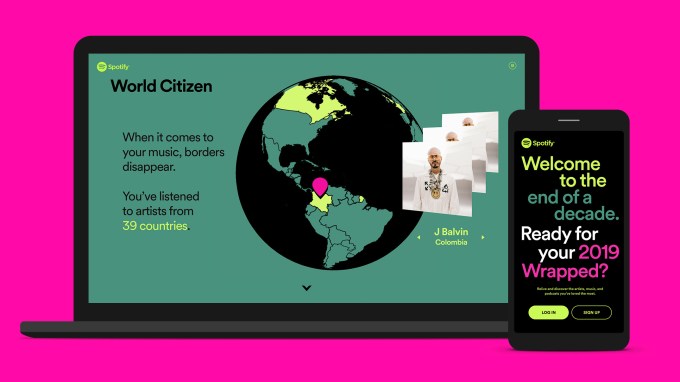
Spotify’s annual “Wrapped” feature, which allows listeners to look back on their favorite music from the year, is expanding in 2019 to include a whole decade’s worth of favorite tunes, the company announced today. In addition, the feature is for the first time being made available to podcasters, in addition to Spotify users and Spotify artists.

“Wrapped” has become one of Spotify’s more anticipated releases among those who use the service regularly, as it allows users to explore their own top songs, top artists, top genres and minutes listened for the year. Many users also like to share their “Wrapped’s” findings on social media, like Facebook, Instagram, Twitter, and Snapchat.

As 2019 draws to a close, Spotify is offering its annual version of the personalized “Spotify Wrapped,” as well as a new one that showcases your listening history through the last decade. That means your Wrapped will include the songs, artists, albums, and podcasts you discovered on Spotify in 2019, as before, plus the artists you streamed over the past decade, through a “My Decade Wrapped,” option.

Notably, Spotify’s chief rival Apple Music last month launched its own multi-year retrospective, with “Replay,” a personalized playlist of your top songs by year. Replay is very much like Wrapped, except that it includes playlists for every year you’ve subscribed to Apple Music, retroactively.

Spotify’s launch of “My Decade Wrapped” is clearly meant to be a competitive offering.

This year, the feature is for the first time being integrated directly in the Spotify app, in addition to being available on the web at spotify.com/wrapped, as before. It’s also now highlighting how global users’ listening habits are, by showing your top artists on a world map.

Spotify Premium subscribers, meanwhile, will have access to more personalized data stories and insights, including things like the numbers of artists discovered and the top artist they discovered. Besides being a fun point of reference for Spotify users, this sort of data can help to reinforce the company’s brand message — that Spotify is more than just another streaming music app. It aims to demonstrate that it can actually help users discover new music, not just offer them an easy way to play the songs and artists they already know.

The final product, including now both the “2019 Wrapped” and “My Decade Wrapped,” can be posted to social media with the provided share card that summarizes your top tracks, artists and listening history.

Also new this year is an expansion of “Wrapped” to podcasters.

Already, Spotify artists had their own version of “Wrapped” which allowed them to discover how their music reached fans around the world, available through the Spotify for Artists dashboard. This year, podcasters will get their own “Wrapped” accessible through Spotify for Podcasters, the company says.

This feature will allow podcasters and their team to look back at their show and audience’s growth over the past year, and easily see which were the top episodes. They can also see their year over year gains in followers, their top country for audience growth, number of fans who have the show as their top podcast, the four related podcasts their fans also listen to, and more. Essentially, it’s a new way of packaging up analytics that podcasters already access, but looking back at the full year.

This information can also be posted to social media through the included “share” care, which includes the total number of episodes produced, the total number of hours produced, and the podcasters’ top two countries.


05 Dec 2019

Design may be the next entrepreneurial gold rush

Ten years ago, the vast majority of designers were working in Adobe Photoshop, a powerful tool with fine-tuned controls for almost every kind of image manipulation one could imagine. But it was a tool built for an analog world focused on photos, flyers and print magazines; there were no collaborative features, and much more importantly for designers, there were no other options.

Since then, a handful of major players have stepped up to dominate the market alongside the behemoth, including InVision, Sketch, Figma and Canva.

And with the shift in the way designers fit into organizations and the way design fits into business overall, the design ecosystem is following the same path blazed by enterprise SaaS companies in recent years. Undoubtedly, investors are ready to place their bets in design.

But the question still remains over whether the design industry will follow in the footprints of the sales stack — with Salesforce reigning as king and hundreds of much smaller startup subjects serving at its pleasure — or if it will go the way of the marketing stack, where a lively ecosystem of smaller niche players exist under the umbrella of a handful of major, general-use players.

“Deca-billion-dollar SaaS categories aren’t born everyday,” said InVision CEO Clark Valberg . “From my perspective, the majority of investors are still trying to understand the ontology of the space, while remaining sufficiently aware of its current and future economic impact so as to eagerly secure their foothold. The space is new and important enough to create gold-rush momentum, but evolving at a speed to produce the illusion of micro-categorization, which, in many cases, will ultimately fail to pass the test of time and avoid inevitable consolidation.”

I spoke to several notable players in the design space — Sketch CEO Pieter Omvlee, InVision CEO Clark Valberg, Figma CEO Dylan Field, Adobe Product Director Mark Webster, InVision VP and former VP of Design at Twitter Mike Davidson, Sequoia General Partner Andrew Reed and FirstMark Capital General Partner Amish Jani — and asked them what the fierce competition means for the future of the ecosystem.

But let’s first back up.

Past

Sketch launched in 2010, offering the first viable alternative to Photoshop. Made for design and not photo-editing with a specific focus on UI and UX design, Sketch arrived just as the app craze was picking up serious steam.

A year later, InVision landed in the mix. Rather than focus on the tools designers used, it concentrated on the evolution of design within organizations. With designers consolidating from many specialties to overarching positions like product and user experience designers, and with the screen becoming a primary point of contact between every company and its customers, InVision filled the gap of collaboration with its focus on prototypes.

If designs could look and feel like the real thing — without the resources spent by engineering — to allow executives, product leads and others to weigh in, the time it takes to bring a product to market could be cut significantly, and InVision capitalized on this new efficiency.

In 2012, came Canva, a product that focused primarily on non-designers and folks who need to ‘design’ without all the bells and whistles professionals use. The thesis: no matter which department you work in, you still need design, whether it’s for an internal meeting, an external sales deck, or simply a side project you’re working on in your personal time. Canva, like many tech firms these days, has taken its top-of-funnel approach to the enterprise, giving businesses an opportunity to unify non-designers within the org for their various decks and materials.

In 2016, the industry felt two more big shifts. In the first, Adobe woke up, realized it still had to compete and launched Adobe XD, which allowed designers to collaborate amongst themselves and within the organization, not unlike InVision, complete with prototyping capabilities. The second shift was the introduction of a little company called Figma.

Where Sketch innovated on price, focus and usability, and where InVision helped evolve design’s position within an organization, Figma changed the game with straight-up technology. If Github is Google Drive, Figma is Google Docs. Not only does Figma allow organizations to store and share design files, it actually allows multiple designers to work in the same file at one time. Oh, and it’s all on the web.

In 2018, InVision started to move up stream with the launch of Studio, a design tool meant to take on the likes of Adobe and Sketch and, yes, Figma.

Present

When it comes to design tools in 2019, we have an embarrassment of riches, but the success of these players can’t be fully credited to the products themselves.

A shift in the way businesses think about digital presence has been underway since the early 2000s. In the not-too-distant past, not every company had a website and many that did offered a very basic site without much utility.

In short, designers were needed and valued at digital-first businesses and consumer-facing companies moving toward e-commerce, but very early-stage digital products, or incumbents in traditional industries had a free pass to focus on issues other than design. Remember the original MySpace? Here’s what Amazon looked like when it launched.

In the not-too-distant past, the aesthetic bar for internet design was very, very low. That’s no longer the case.


05 Dec 2019

Justice Dept. charges Russian hacker behind the Dridex malware

U.S. prosecutors have brought computer hacking and fraud charges against a Russian citizen, Maksim Yakubets, who is accused of developing and distributing Dridex, a notorious banking malware used to allegedly steal more than $100 million from hundreds of banks over a multi-year operation.

Per the unsealed 10-count indictment, Yakubets is accused of leading and overseeing Evil Corp, a Russian-based cybercriminal network that oversaw the creation of Dridex. The malware is often spread by email and infects computers, silently siphoning off banking logins. The malware has also been known to be used as a delivery mechanism for ransomware, as was the case with the April cyberattack on drinks giant Arizona Beverages.

The Russian hacker is also alleged to have used the Zeus malware to successfully steal more than $70 million from victims’ bank accounts. Prosecutors said the Zeus scheme was “one of the most outrageous cybercrimes in history.”

Justice Department officials, speaking in Washington DC with their international partners from the U.K.’s National Crime Agency, said Yakubets also provided “direct assistance” to the Russian government in his role working for the FSB (formerly KGB) from 2017 to work on projects involving the theft of confidential documents through cyberattacks.

Prosecutors said Evil Corp was to blame for an “unimaginable” amount of cybercrime during the past decade, with a primary focus on attacking financial organizations in the U.S. and the U.K.

“Maksim Yakubets allegedly has engaged in a decade-long cybercrime spree that deployed two of the most damaging pieces of financial malware ever used and resulted in tens of millions of dollars of losses to victims worldwide,” said Brian Benczkowski, assistant attorney general in the Justice Department’s criminal division, in remarks.

The State Department announced a $5 million reward for information related to the capture of Yakubets, who remains at large.

In a separate statement, Treasury secretary Steven Mnuchin said the department issued sanctions against Evil Corp for the group’s role in international cyber crime, including two other hackers associated with the group — Igor Turashev and Denis Gusev — as well as seven Russian companies with connections to Evil Corp..

“This coordinated action is intended to disrupt the massive phishing campaigns orchestrated by this Russian-based hacker group,” said Mnuchin.

Read more:

05 Dec 2019

Volvo invests in autonomous vehicle operating system startup Apex.AI though its VC arm

Volvo is making an investment in Palo Alto-based Apex.AI, a startup working on developing a robotic operating system qualified for use in production automobiles. Apex.AI, founded by automated systems engineers Jan Becker and Dejan Pangercic, raised $15.5 million in a Series A last November, and revealed that its focus is on developing an enterprise-focused version of the Robot Operating System open-source middleware.

Apex.AI currently lists two products on its home page: Apex.OS and Apex.Autonomy. The former aims to provide a set of simple-to-integrate APIs that can give automakers and others access to fully certified autonomous mobility technology, while the latter is more focused on specific elements and components for those looking to make use of specific elements of autonomous technology including perception, localization, path planning and more.

Volvo Group Venture Capital acting CEO Anna Westerberg, who is also the automaker’s SVP of Connected Solutions, said in a press release announcing the news that Volvo Group is “excited to invest in a company that enables easier development of safety-certified systems.” In providing systems that comply with industry-standard safety requirements, Apex.AI could potentially help speed the process of getting autonomous driving systems into production vehicles, across both its commercial and consumer offerings.

The financial details of the investment were not disclosed, with publicly-traded Volvo Group saying only that it “has no significant impact” on the overall company’s “earnings or financial position,” which doesn’t mean much except that it’s not material enough to require a detailed disclosure just now. That still could mean a lot of money coming in for Apex.AI, given the relative yardstick of ‘material’ for a huge multinational automaker, and a two-year old Silicon Valley startup.

05 Dec 2019

Apostrophe raises $6 million to let you see a dermatologist from your phone

Ben Holber and Ryan Hambley grew up together. Hambley, the son of a dermatologist, always had clear skin. But Holber struggled with acne from the time he was a teenager. The two saw first-hand the difference it makes to have a dermatologist on demand. Apostrophe was born.

Apostrophe, a new startup that makes it easier to get Rx acne medications and treatments, has today announced the close of a $6 million seed round led by SignalFire, with participation from FJ Labs.

Apostrophe connects users with board certified dermatologists, who then develop a personalized Rx treatment plan for those patients. Apostrophe has a vertically integrated mail-order pharmacy, which facilitates the distribution of those treatment plans.

The goal is to eliminate the hassle of trips to the dermatologist, long waits in the waiting room and the general displeasure of visiting a pharmacy.

Apostrophe contracts with a physicians group to provide the dermatologists to patients, but has no direct employment relationship with the doctors themselves. Holber explained that, given Apostrophe’s positioning as a pharmacy, it’s best to keep dermatologists at arms length from Apostrophe, and vice versa, to make sure that all parties are incentivized solely by the health of the patient.

When users sign up, they’re asked to provide photos and fill out a questionnaire. The Apostrophe platform does some assistive organization and facilitates communication, but the tech is not involved in any diagnostic analysis. Holber said that the decision to stay away from incorporating machine learning in the diagnostic process was a difficult but important one.

“In a world of a million offerings online, when you have real personalization and a real personal interaction, there is a huge premium on that,” said Holber. “There is a ton of value in knowing someone is on the other side really looking at your stuff, and who’s there to answer a question.”

Thus, Apostrophe is laser focused on the connection between dermatologists and patients through asynchronous text conversations, rather than using data and machine learning to replace the dermatologist.

Holber added that the “machine of the dermatologist’s brain is actually really fast,” noting that it takes just a few seconds for a good dermatologist to assess the issue and develop a treatment plan.

Customers pay $20 for the original consultation, and that $20 is then applied as a credit toward purchase of the suggested Rx treatment plan, which is personalized by Apostrophe. The company makes its money off of its pharmaceutical business.

Apostrophe has raised a total of $6.5 million since launch.

05 Dec 2019

300M-user Imgur launches Melee, a gaming meme app

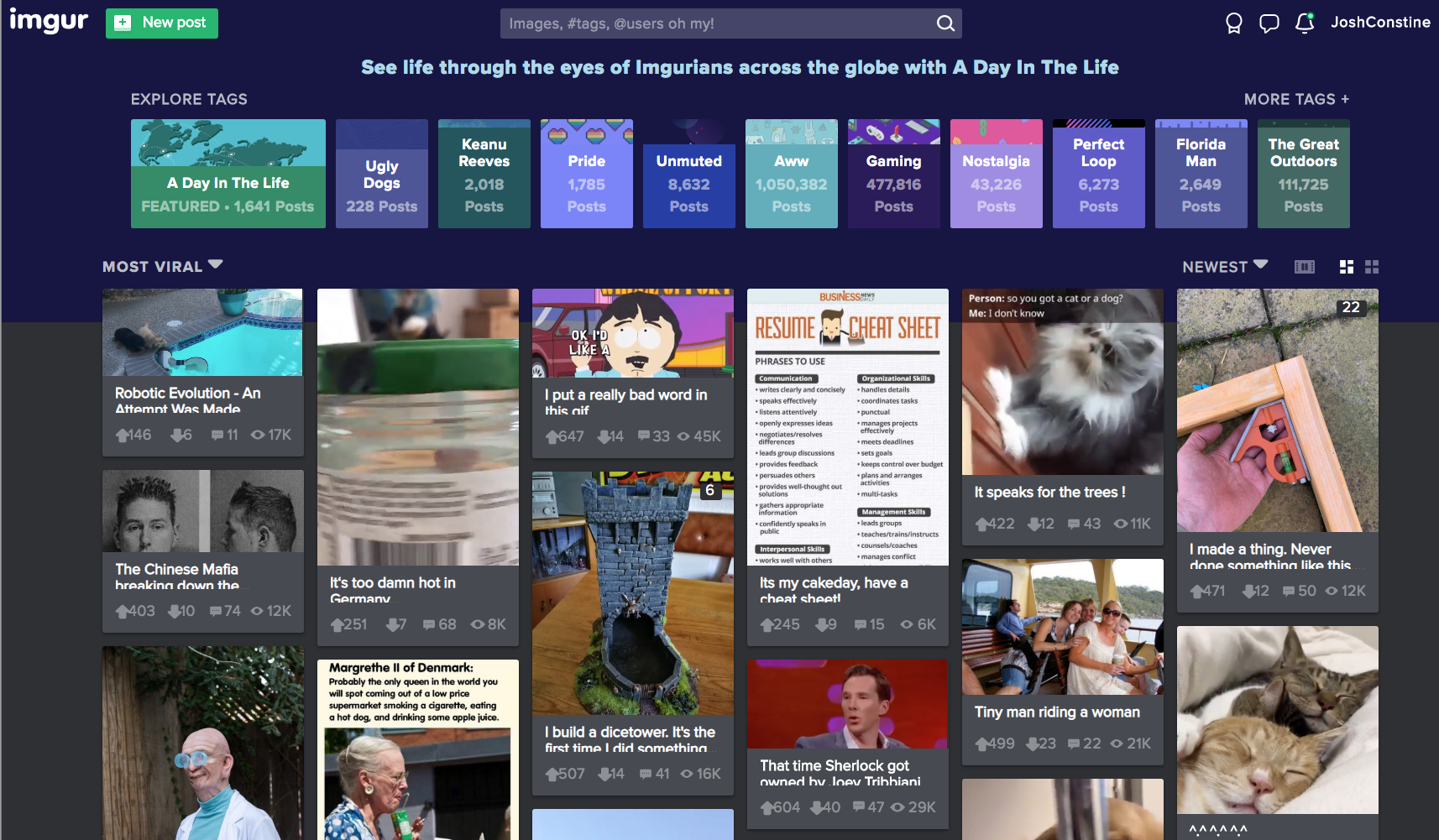
10 years after debut, 300 million monthly user Imgur is one of the last massively popular yet unpersonalized home pages on the internet. Since everyone sees the same upvoted posts when they open Imgur, it creates a shared experience full of inside jokes and running gags. But while you can switch to a feed of topics and creators your follow, Imgur has focused on a one-size-fits-all approach over catering to niche audiences.

The gaming community deserved better, and Imgur needed to seize this opportunity. Video and board game tags were the most popular on Imgur, with 46% of users following them. Esports, Twitch, and streaming stars like Ninja have gone mainstream. And there’s a whole world of esoteric memes about absurd in-game moments, highlights from epic wins, and commentary about the industry. That stuff gets diluted and buried on cross-functional apps like Imgur, is tough to easily browse on Reddit, and often times content about all games is mashed together even though you might only play certain ones.

Imgur

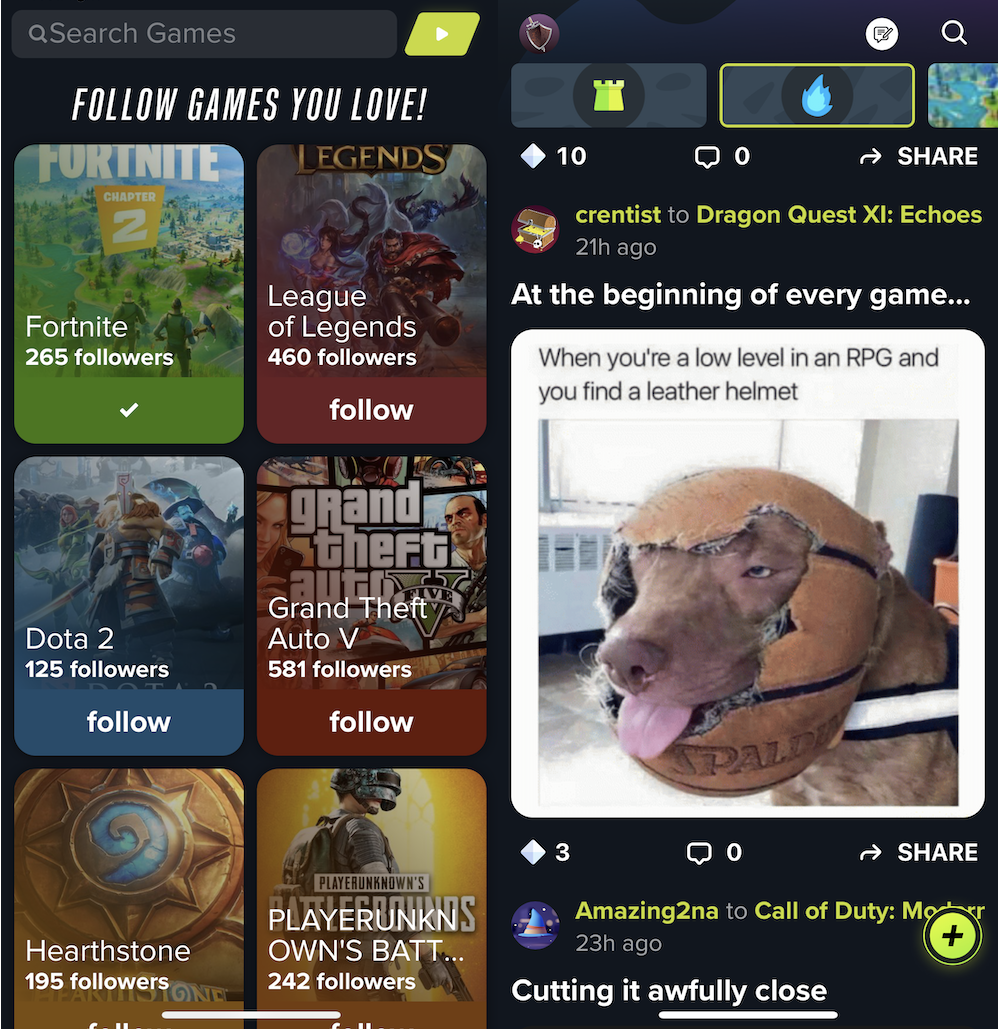
That’s why today, Imgur is launching Melee, the company’s first app beyond its flagship product. Melee lets users subscribe to the games they love to get a feed of memes and gameplay clips. It’s an elegant way to prevent you from seeing jokes you don’t understand or feats of skill you don’t care about. You can also scroll through a popular posts feed if you’re curious about unfamiliar games. Melee debuts today on iOS with an Android version coming in Q1 2020 and a desktop version down the road.

Gamers are constantly taking recordings and screenshots of the games they’re playing” Imgur founder and CEO Alan Schaaf tells me. “But we found that there’s no place for gamers to share those clips. We want to give these highlights a home.” If 92% of surveyed Imgurians consider themselves ‘gamers’, and the average one already spends 30 minutes per day on Imgur despite it being a general purpose image sharing network, there was clearly room to build something just for them.  Schaaf says “Imgur is interested in building things that the Internet wants.”

There’s an immediate in-group feel when you play with Melee. Whether you’re into Fortnite, Smash Bros, or Dungeons & Dragons, you can find your people to geek out with. There’s certainly already forums on Reddit, Memedroid, and elsewhere dedicated to specific games, but those can get a bit exhausting. Melee keeps things spicy by combining content about your picks in one feed. It’s actually a savvy way to browse any genre of memes. I could see Melee expanding into letting you follow your favorite TV shows, movies, and bands…or someone else might with a copy of its format.

I was glad to hear that Imgur took safety seriously with Melee after stumbling into building messaging into its main app without proper protections in 2016. It has multiple layers of community and staff moderation, will remove obscene content, and won’t tolerate bullying. That’s critical in the gaming space that has a nasty habit of turning toxic. If Imgur can keep things on the rails, it plans to monetize Melee with the company’s expertise in display ads.

Eventually, Schaaf hopes Melee can also help up-and-coming game streaming stars find a following, since on Twitch and YouTube they’re often overshadowed by the biggest stars. “If you start a stream today, you have virtually no chance of attracting an audience and competing in this market. Streamers need a place to post their gameplay in order to grow their audience on streaming platforms” Schaaf tells me. “Melee is that place.” He plans to add more robust profiles and ways for broadcasters to promote their streams in 2020. Viewers will benefit as Melee lets them bypass watching a multi-hour stream just for the best parts.

Imgur remains one of the biggest internet communities no one talks about, despite being a top 15 most popular site in the US according to Alexa. Schaaf bootstrapped the company from his bedroom and beyond for the first 5 years before taking a $40 million Series A in 2014 from Andreessen Horowitz. Now it’s focusing on becoming a more lucrative business. The startup took a $20 million funding round from strategic partner Coil which is going to help Imgur launch a premium subscription tier to its free site.

Imgur started at the end of the web era, and took years to build a full-fledged mobile app. Melee is truly mobile first, and offers a lifeboat to Imgur in case its original tribe disperses. It’s a smart way to harness the massive untapped energy of gamers, the way Instagram harnessed our newfound phone cameras. Finally, meme culture is getting purpose-built social networks.

05 Dec 2019

GM, LG Chem to invest $2.3 billion in EV battery joint venture

GM Chairman and CEO Mary Barra said Thursday morning that the automaker is forming a joint venture with LG Chem to mass produce battery cells for its electric vehicles.

The two companies said they will invest up to a total of $2.3 billion into the new joint venture that will include establishing a battery cell assembly plant on a greenfield manufacturing site in the Lordstown area of Northeast Ohio that will create more than 1,100 new jobs.

“With this investment, Ohio and its highly capable workforce will play a key role in our journey toward a world with zero emissions,” Barra said. “Combining our manufacturing expertise with LG Chem’s leading battery-cell technology will help accelerate our pursuit of an all-electric future. We look forward to collaborating with LG Chem on future cell technologies that will continue to improve the value we deliver to our customers.”


05 Dec 2019

GV spinout Plexo Capital closes $42.5 million fund

Plexo Capital, the fund founded by former GV Partner Lo Toney, has closed its first fund of $42.5 million. The plan is to invest in both startups and emerging VC funds, with 60% to 65% of the capital going toward venture capital funds as a limited partner, and 35% to 40% going directly to startups, Toney told TechCrunch.

In addition to investing as LPs, Plexo Capital will make direct investments in some startups that are funded by firms where Plexo has an LP position.

While Plexo Capital plans to invest in all types of startups and founders, its thesis is that “women and people of color inherently have differentiated networks and a different lens to evaluate deals,” Toney said in a statement. “This is very important at the seed stage, as it leads to a deal flow that is differentiated, and enables us to pursue deals that require an intimate understanding of certain problems or market opportunities in the absence of an abundance of data. Women and people of color bring this to the table.”

The fund’s investors include Alphabet, Intel Capital, Cisco Investments, the Royal Bank of Canada, Kapor Capital, the Hampton University Endowment and the Ford Foundation.

Before launching Plexo Capital, Toney incubated the fund inside GV for a couple of years. For GV, this was a way for the fund to source additional deals. Moving forward, GV will continue to have a working relationship with Plexo Capital.

“One of our aims at GV is to increase access to differentiated deal flow,” GV Managing Partner David Krane said in a statement. “In 2018, Lo and I worked together to build this strategy into an independent fund. We’re proud of everything Lo and his team are building at Plexo Capital, and we’re excited to see the impact of this work with a diverse set of investors and entrepreneurs.”