Year: 2019

04 Dec 2019

What we know about Qualcomm’s next-gen Snapdragon 865 and 765 chips

Qualcomm’s holding its big annual get-together this week in Hawaii, portioning off Snapdragon news, piece by piece. Yesterday’s event was the big unveiling of the Snapdragon 865 and 765, the chips that will power most of next year’s premium and mid-tier handsets, respectively.

Today, the components came into sharper focus. Expect more from both tomorrow, as well, as the company continues to milk them for the multi-day event, but we’re starting to get a pretty solid picture of what these chips will be able to do.

Let’s start top-down with the 865. Expect the premium chip to start showing up in announcements around CES and MWC, if past years’ road maps are any indication. As anticipated, 5G is one of the key focuses. After all, 2020 is generally believed to be when 5G-driven purchases will start helping to right long-flagging smartphone sales.

No integrated 5G has been announced for the chip. Instead, it will work in tandem with Qualcomm’s 5G modem, the X55. Keep in mind, there are still going to be plenty of non-5G alternative flagships released in the next calendar year. For starters, the devices are bound to be prohibitively expensive. Also, in many markets, 5G coverage will be spotty, at best. Unfortunately, however, it seems that manufacturers will have to buy them as a pair.

Notably, there’s support for a wide range of 5G frequencies. That’s necessary, because carrier approach to 5G has been pretty piecemeal. It varies a good deal from carrier to carrier — and in the case of some, like T-Mobile, a good deal within the carrier.

AI’s the other big marquee bit. Again, no surprise. It’s been an increasingly important aspect of smartphone evolution for several years now. That’s powered by a fifth-gen AI chip that doubles the performance of its predecessor.

There’s also on-board support for wake word listening for use with the likes of Alexa and Assistant, at low power. Imaging improvements include support for 200 megapixel photos and 8K, along with much-improved speeds. On the display/gaming front, there’s now support for 144Hz refresh rates.

The arrival of the 765, meanwhile, highlights Qualcomm’s ambitions to speed up 5G adoption across a wider range of devices. The new chip, which features an option with integrated 5G, could certainly help on that front, keeping cost and power usage down.

Expect devices to start arriving in early 2020.
04 Dec 2019

How to build or invest in a startup without paying capital gains tax

Founders, entrepreneurs, and tech executives in the know realize they may be able to avoid paying tax on all or part of the gain from the sale of stock in their companies — assuming they qualify.

If you’re a founder who’s interested in exploring this opportunity, put careful consideration put into the formation, operation and selling of your company.

Qualified Small Business Stock (QSBS) presents a significant tax savings opportunity for people who create and invest in small businesses. It allows you to potentially exclude up to $10 million, or 10 times your tax basis, whichever is greater, from taxation. For example, if you invested $2 million in QSBS in 2012, and sell that stock after five years for $20 million (10x basis) you could pay zero federal capital gains tax on that gain. 

What is QSBS, and why is it important?

These tax savings can be so significant, that it’s one of a handful of high-priority items we’ll first discuss, when working with a founder or tech executive client. Surprisingly, most people in general either:

  1. Know a few basics about QSBS;
  2. Know they may have it, but don’t explore ways to leverage or protect it;
  3. Don’t know about it at all.

Founders who are scaling their companies usually have a lot on their minds, and tax savings and personal finance usually falls to the bottom of the list. For example, I recently met with someone who will walk away from their upcoming liquidity event with between $30-40 million. He qualifies for QSBS, but until our conversation, he hadn’t even considered leveraging it. 

Instead of paying long-term capital gains taxes, how does 0% sound? That’s right — you may be able to exclude up to 100% of your federal capital gains taxes from selling the stake in your company. If your company is a venture-backed tech startup (or was at one point), there’s a good chance you could qualify.

In this guide I speak specifically to QSBS on a federal tax level, however it’s important to note that many states such as New York follow the federal treatment of QSBS, while states such as California and Pennsylvania completely disallow the exclusion. There is a third group of states, including Massachusetts and New Jersey, that have their own modifications to the exclusion. Like everything else I speak about here, this should be reviewed with your legal and tax advisors.

My team and I recently spoke with a founder whose company was being acquired. She wanted to do some financial planning to understand how her personal balance sheet would look post-acquisition, which is a savvy move. 

We worked with her corporate counsel and accountant to obtain a QSBS representation from the company and modeled out the founder’s effective tax rate. She owned equity in the form of company shares, which met the criteria for qualifying as Section 1202 stock (QSBS). When she acquired the shares in 2012, her cost basis was basically zero. 

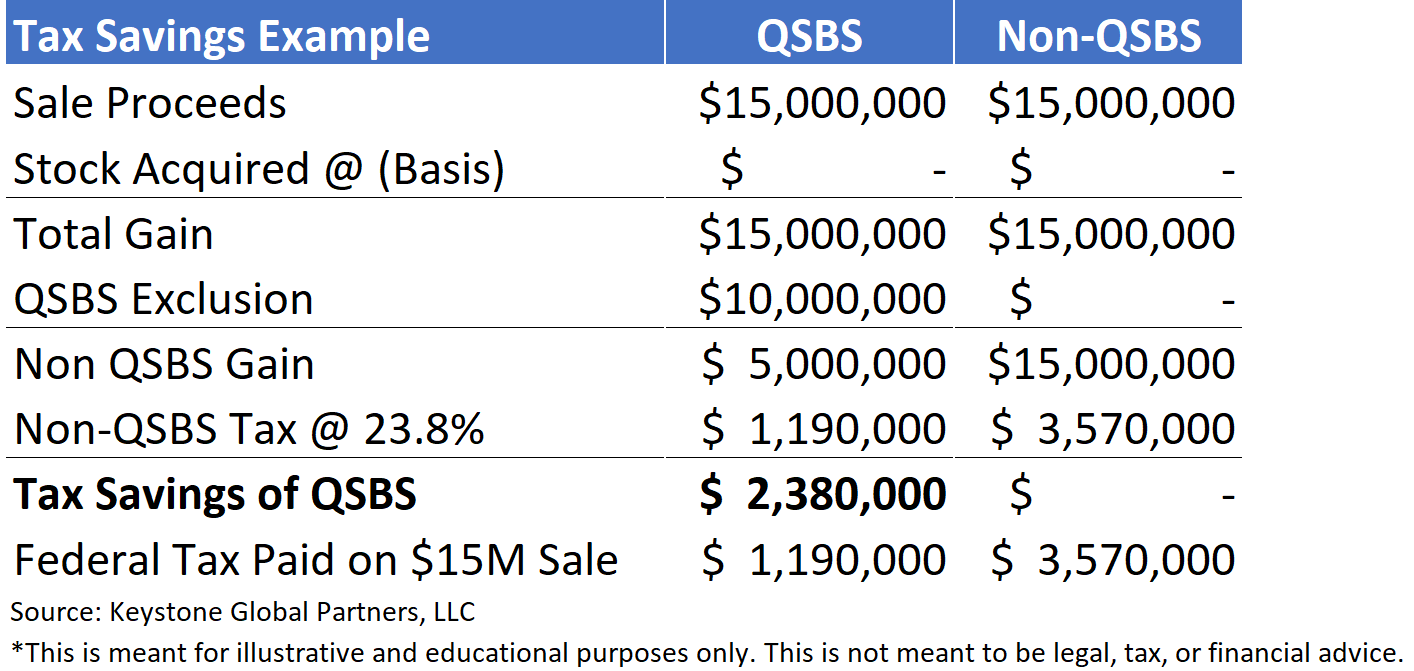
A few months after satisfying the five-year holding period, a public company acquired her business. Her company shares, first acquired for basically zero, were now worth $15 million. When she was able to sell her shares, the first $10 million of her capital gains were completely excluded from federal taxation — the remainder of her gain was taxed at long-term capital gains.

This founder saved millions of dollars in capital gains taxes after her liquidity event, and she’s not the exception! Most founders who run a venture-backed C Corporation tech company can qualify for QSBS if they acquire their stock early on. There are some exceptions. 

qsbs tax savings example

Do I have QSBS?

A frequently asked question as we start to discuss QSBS with our clients is: how do I know if I qualify? In general, you need to meet the following requirements:

  1. Your company is a Domestic C Corporation.
  2. Stock is acquired directly from the company.
  3. Stock has been held for over 5 years.
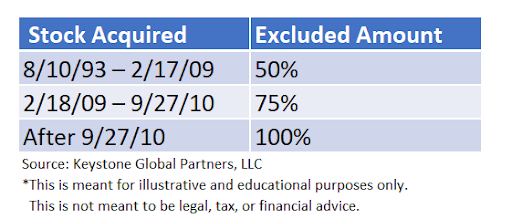
  4. Stock was issued after August 10th, 1993, and ideally, after September 27th, 2010 for a full 100% exclusion.qsbs stock acquired
  5. Aggregate gross assets of the company must have been $50 million or less when the stock was acquired.
  6. The business must be active, with 80% of its assets being used to run the business. It cannot be an investment entity. 
  7. The business cannot be an excluded business type such as, but not limited to: finance, professional services, mining/natural resources, hotel/restaurants, farming or any other business where the business reputation is a skill of one or more of the employees.

When in doubt, follow this flowchart to see if you qualify:

04 Dec 2019

The Urban.Us and BMW Mini accelerator focused on urban innovation names its latest cohort

URBAN-X,  the accelerator program focused on companies developing technologies to increase the sustainability, resiliency, and efficiency of cities, has selected seven companies for its latest cohort.

Operating as a partnership between BMW’s Mini brand and the early-stage investment fund Urban.us since 2017, the accelerator has backed 51 companies which have raised over $100 million in the three years since its initial launch.

“Mini aims to inspire entrepreneurship, design and collaboration with innovative minds, and this ambition comes to life through URBAN-X,” said Esther Bahne, Mini Head of Brand Strategy & Innovation.

Co-investors who have come in to invest behind the accelerator include: Fred Wilson, Brad Burnham, Edgar Bronfman Jr., BMW i Ventures, Draper Associates, Fontinalis Partners, Ekistic Ventures, Wireframe Ventures, Fifth Wall Ventures, Samsung NEXT, Story Ventures, Kairos, UL Ventures, Mark Cuban, Point 72 Ventures and Robert Bosch Venture Capital.

Some of the largest investments to date have been in companies like Blueprint Power, which raised $4 million for its technology which provides energy efficiency and demand response tools connecting real estate portfolios to the power grid; Roadbotics, a roadway monitoring to optimize maintenance spending for cities, utilities and construction firms, which raised $11.4 million; and Versatile Natures, which provides safety and budget management tools for construction sites.

The latest companies to be accepted into the accelerator are:

  • ChargeLab: an electric vehicle charging management service for businesses, utilities, individuals,  and governments

  • CoInspect: a service that automates the entire food safety & quality management workflow for restaurants and food processing facilities.

  • Eva: a provider of charging stations for healthcare and emergency responders operating cargo drones and associated vertical take off vehicles.

  • Firmus: a machine learning-based software toolkit to expedite the construction design review process.

  • Hades: the developer of software to evaluate sewer and flood prevention infrastructure.

  • Metalmark: a new materials developer for highly efficient catalytic decomposition of air pollutants.

  • UsurpPower: the creator of a marketplace for sustainable finance for renewable power generation.

“URBAN-X, Urban Us and MINI are deeply committed to advancing the low carbon, resilient, high density future of our cities through technology, investment and mentorship,” said Shaun Abrahamson, URBAN-X Investment Committee and Managing Partner at Urban.Us, in a statement. “Startups are critical to playing an outsized role in reimagining the core sectors of our cities — like transportation, real estate and energy — and we’re thrilled to invest in this new class of creative and entrepreneurial minds.”

04 Dec 2019

A Sprint contractor left thousands of US cell phone bills on the internet by mistake

A contractor working for cell giant Sprint stored on an unprotected cloud server hundreds of thousands of cell phone bills of AT&T, Verizon and T-Mobile subscribers.

The storage bucket had more than 261,300 documents, the vast majority of which were phone bills belonging to cell subscribers dating as far back as 2015. But the bucket, hosted on Amazon Web Services (AWS), was not protected with a password, allowing anyone to access the data inside.

It’s not known how long the bucket was exposed.

The bills — which contained names, addresses and phone numbers, and many included call histories — were collected as part of an offer to allow cell subscribers to switch to Sprint, according to Sprint-branded documents found on the server. The documents explained how the cell giant would pay for the subscriber’s early termination fee to break their current cell service contract, a common sales tactic used by cell providers.

In some cases we found other sensitive documents, such as a bank statement, and a screenshot of a web page that had subscribers’ online usernames, passwords and account PINs — which in combination could allow access to a customer’s account.

U.K.-based penetration testing company Fidus Information Security found the exposed data, but it wasn’t immediately clear who owned the bucket. Fidus disclosed the security lapse to Amazon, which informed the customer of the exposure — without naming them. The bucket was subsequently shut down.

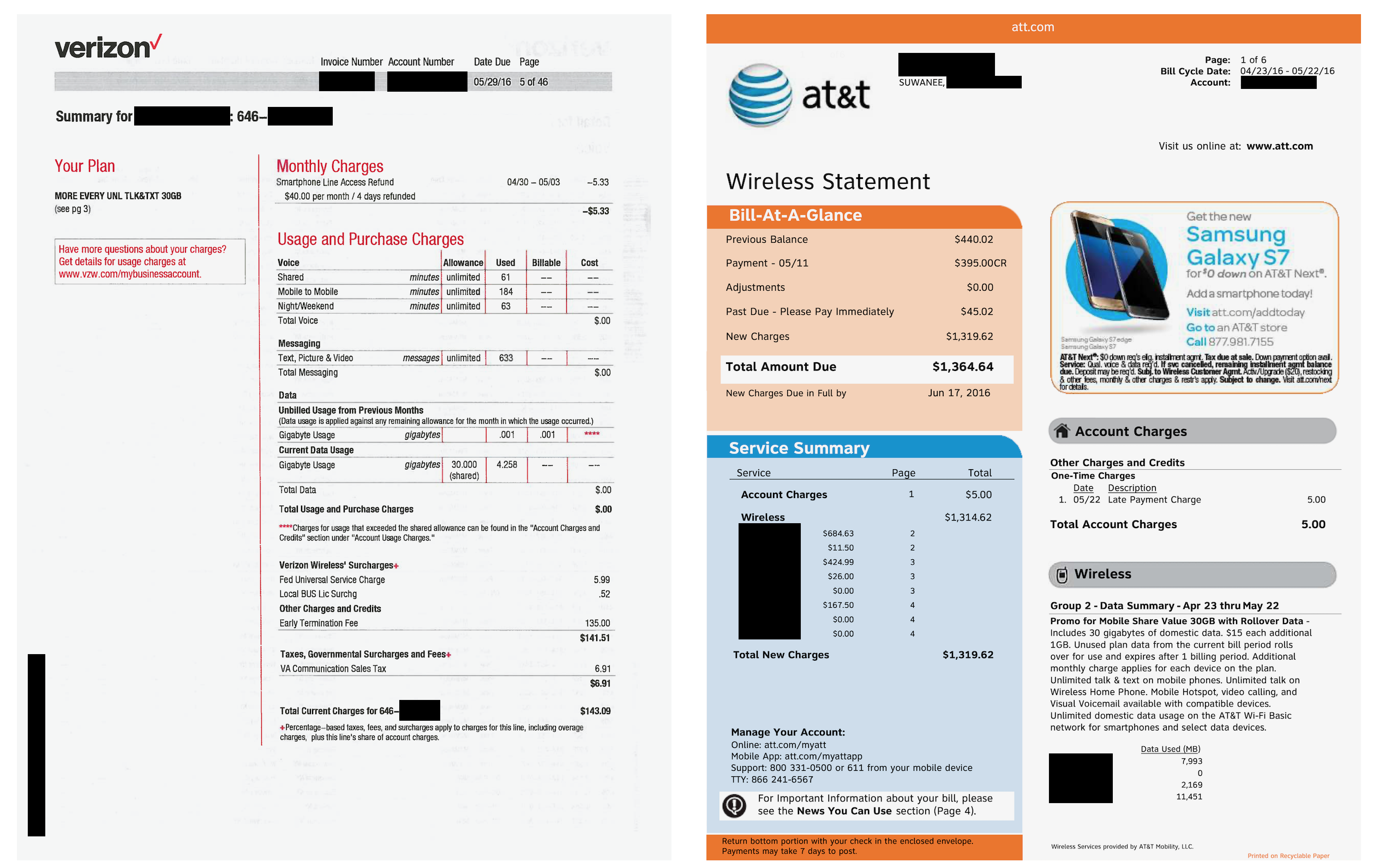
A Verizon and AT&T phone bill from two customers. (Image: supplied)

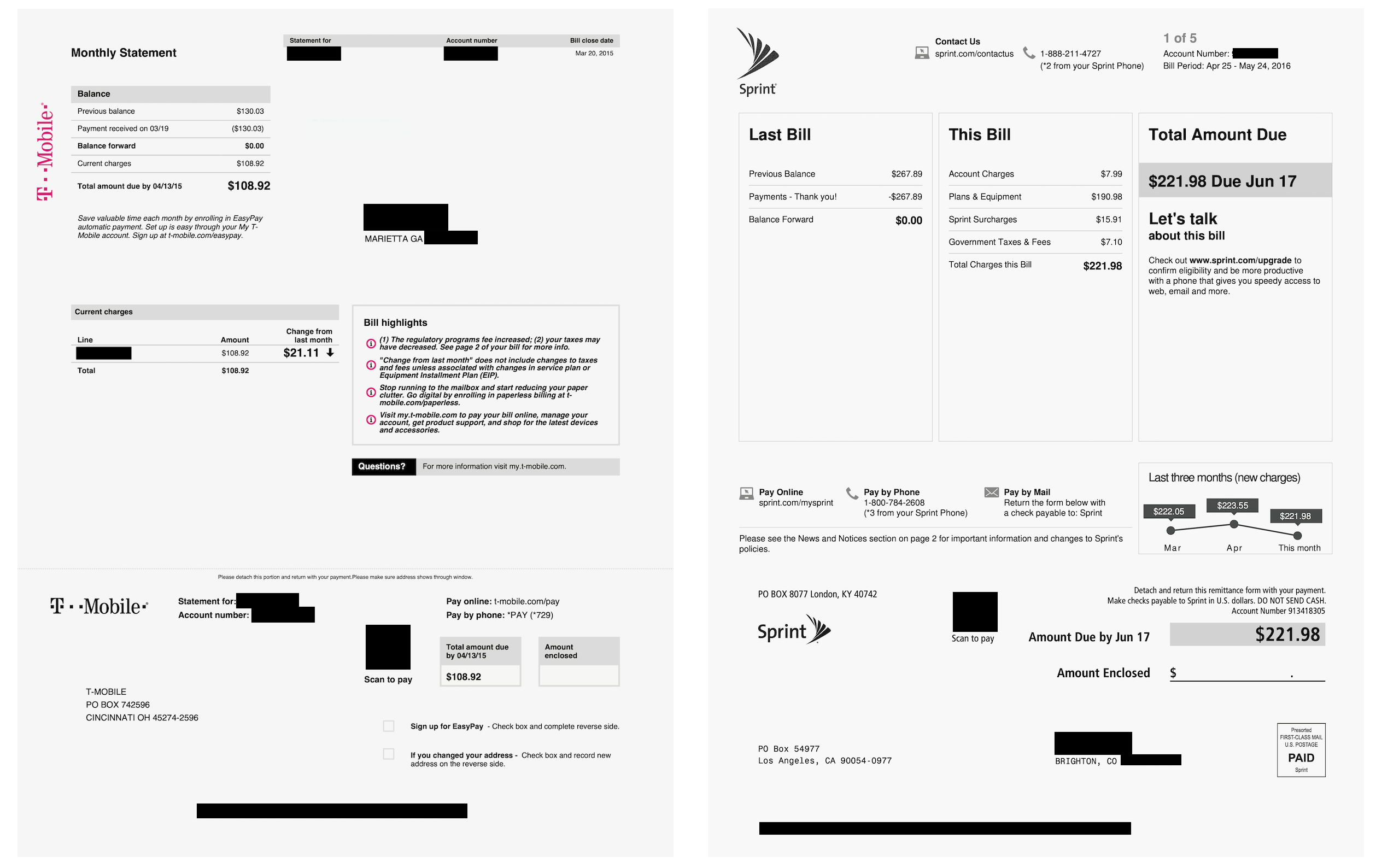
A T-Mobile bill found on the exposed servers. A handful of Sprint bills were also found. (Image: supplied)

After a brief review of the cache, we found one document that said, simply, “TEST.” When we ran the file through a metadata checker, it revealed the name of the person who created the document — an account executive at Deardorff Communications, the marketing agency tasked with the Sprint promotion.

When reached, Jeff Deardorff, president of Deardorff Communications, confirmed his company owned the bucket and that access was restricted earlier on Wednesday.

“I have launched an internal investigation to determine the root cause of this issue, and we are also reviewing our policies and procedures to make sure something like this doesn’t happen again,” he told TechCrunch in an email.

Given the exposed information involved customers of the big four cell giants, we contacted each company. AT&T did not comment, and T-Mobile did not respond to a request for comment. Verizon spokesperson Richard Young said the company was “currently reviewing” the matter and would have details “as soon as it’s available.” (TechCrunch is owned by Verizon.)

When reached, a spokesperson for Sprint would not disclose the nature of its relationship with Deardorff nor would they comment on the record at the time of writing.

It’s not known why the data was exposed in the first place. It’s not uncommon for AWS storage buckets to be misconfigured by being set to “public” and not “private.”

“The uptrend we’re seeing in sensitive data being publicly accessible is concerning, despite Amazon releasing tools to help combat this,” said Harriet Lester, director of research and development at Fidus. “This scenario was slightly different to usual as it was tricky to identify the owner of the bucket, but thankfully the security team at AWS were able to pass the report on to the owner within hours and public access was shut down soon after.”

We asked Deardorff if his company plans to inform those whose information was exposed by the security lapse. We did not immediately receive a response.

Read more:

04 Dec 2019

These new data sources are creating high-impact tools for investors

Venture capitalists tout themselves as frontier technology investors, but most of us are using the same infrastructure tools we’ve used for the past 20+ years — Excel and recent college grads searching Google .

We’ve seen some modest progress in people upgrading from Excel to Google Sheets, along with the use of CRM and cloud-based storage services, but according to Sebastian Soler, who oversees data science at Lux Capital, less than 5% of American VCs have a full-time team member who’s focused on technology.

“While the arguments for adopting the latest technology are now too compelling to ignore, finding the required budget for specialized tools can often prove to be a major challenge, especially for smaller managers,” said Tim Friedman, founder of PEStack. “Comprehensive market data can cost upwards of $25k for a leading service, portfolio monitoring can be double that, add in front office tools and you’re quickly into six-figure sums. My advice is: there are now more products than ever which focus on quick implementation and offer a lot of functionality at a fraction of the cost of some of the larger legacy providers.

TotemVC* is one example of a high-quality solution that offers a powerful platform with a transparent, affordable monthly rate. One piece of advice would be to use a service like [PEStack’s] free Vendor Profiles platform to identify viable providers and build up a shortlist. We also track sample clients so that our users can see what their peers are using. I would always advise managers to talk to other professionals to get the real inside scoop on which products work well, how painful the implementation was, and how good the ongoing support is.”

Jonathan Balkin, founder of Lionpoint Group, observed that the highest-impact technology initiative for a new PE/VC fund is typically to configure and enforce usage of a CRM system. The next most impactful initiative is usually to create an easy-to-use LP portal.

04 Dec 2019

Daily Crunch: Google’s founders step back

The Daily Crunch is TechCrunch’s roundup of our biggest and most important stories. If you’d like to get this delivered to your inbox every day at around 9am Pacific, you can subscribe here.

1. Google CEO Sundar Pichai is taking over as CEO of Alphabet

Founders Larry Page and Sergey Brin announced that Google CEO Sundar Pichai will be replacing Page as the CEO of parent company Alphabet. In addition, Brin is stepping down from his role as Alphabet’s president.

Rather than framing this as a departure, the pair suggested that they’ve “never been ones to hold on to management roles when we think there’s a better way to run the company” and that they remain “deeply committed to Google and Alphabet for the long term, and will remain actively involved as Board members, shareholders and co-founders.”

2. Plex launches a free, ad-supported streaming service in over 200 countries

Although there are plenty of similar offerings on the market, what makes Plex’s new streaming service unique is its broad availability — unlike many competitors, Plex has structured its deals in order to stream content outside the United States.

3. Toyota leads $50M investment in autonomous shuttle startup May Mobility

May Mobility has 25 autonomous low-speed shuttles spread out between Detroit; Grand Rapids, Michigan; and Providence, Rhode Island. As part of the deal, Toyota has picked the startup as one of its “autonomous driving providers for future open platforms.”

4. Progressive VCs and private equity are using tech and analytics to revolutionize investing

HOF Capital’s David Teten says private equity and venture capital investors are copying their counterparts in the hedge fund world by trying to automate more of their jobs. (Extra Crunch membership required.)

5. Kustomer raises $60M for its omnichannel-based CRM platform

The New York-based company has been on a growth tear and has raised more than $161 million in the last 18 months. CEO Brad Birnbaum said the valuation is now “definitely above $500 million,” but he declined to be more specific.

6. Instagram still doesn’t age-check kids. That must change.

Josh Constine argues that user growth at all costs is no longer acceptable: It’s time for Instagram to step up and assume responsibility for protecting children, even if that means excluding them. (In fact, after this post was published, Instagram announced that it would in fact require birth dates from all new users.)

7. Reddit’s monthly active user base grew 30% to reach 430M in 2019

The most-upvoted post this year referenced Reddit’s fundraise from China’s Tencent, which led Reddit’s $300 million Series D. Users were concerned at the time the investment would lead to Chinese censorship, leading them to flood the site with images that would be forbidden in China.

04 Dec 2019

Finally, an official Craigslist app

Fancy websites and services come and go, but Craigslist endures. And now one of its main shortcomings is fixed: there’s an official app. Currently available for iOS and in beta for Android, the app provides a true-to-form Craigslist experience: useful, unfussy, and anonymous.

There isn’t much to say about the app beyond that it faithfully replicates the website, down to the color scheme. All categories of posts are available to browse or search; you can favorite things, save searches, and change the way results look. Different categories have their pertinent settings, so when you look for a car you’ll get odometer, model year and so on the way you do on the site.

No account is required at all to browse listings or contact sellers, and conveniently all their contact info pops up easily, letting you email, text, or call as desired.

Obviously the web app is still perfectly serviceable, and some may even prefer it. But it’s nice to have a native app, if only to deter the imitation Craigslist apps that piggyback on the popularity of the original no-frills listings.

The app was released yesterday and is already climbing the charts. Grab it today and start looking for free furniture!

04 Dec 2019

Nintendo’s Switch just had its best sales week in the US

Nintendo today noted that the Switch just had its best-ever week of sales week in the States. Over the course of Thanksgiving week, the three-year-old console moved more than 830,000 units. That brings the system up to a combine 17.5 million units in the U.S., by Nintendo’s count. It’s pretty impressive momentum for a mature console.

Back in late October, the Switch hit the 15 million mark in the States. It continues to sit atop the console sales charts posted by analytics firms like NPD. The numbers, of course, were juiced by both the upcoming holidays, the addition of the the new, lower-price Switch Lite and various Black Friday offers that bundle in things like a free copy of Mario Kart 8 Deluxe.

The system is expected to get another major boost outside of the U.S., which a forthcoming launch in China. Nintendo is teaming up with Tencent to deliver the system to a potentially massive market at around $300 a pop. Preorders in the country opened today, with sales starting on December 10, along with a trio of Mario titles.

As of late-September, the system has sold in excess of 40 million units globally — a healthy upgrade from its lukewarmly received predecessor, the Wii U, which only managed to move 13.5 million in its lifetime. The Switch still has some catching up to do with the eight-year-old 3DS, which has sold 75.5 million copies, globally. 

04 Dec 2019

YouTube warns creators of subscriber count declines amid purge of closed accounts

YouTube is warning creators they may see their subscriber numbers decline this week as the result of a purge that will remove closed accounts from YouTube metrics. Closed accounts could refer to those that were willingly shut down by users or those that YouTube shut down for policy violations — like spam or abuse, for example.

The company informed creators of the possible loss of subscribers via a message on its Help site community forum, Twitter feed, as well as through a notification on YouTube Creator Studio, its dashboard for channel management.

It explains that a purge like this is routine and a part of YouTube’s ongoing efforts to ensure the site stays free from spam and abuse. But while the removals may lead to a creator’s subscriber numbers dropping, YouTube says this shouldn’t have an impact on a channel’s watch time.

Creators who are affected by the purge will see the changes to subscriber accounts appear in their YouTube Analytics for December 3 through December 4. To view the exact numbers of closed accounts that are removed from a channel, creators have to click on the “See more” menu in YouTube Analytics, then select “Closed Accounts” from “Subscription Source.”

Purges like this are not popular with most creators because subscriber numbers determine whether or not they become eligible for certain monetization tools, like channel memberships or merch shelf, for instance. It’s also a factor as to whether creators can join the YouTube Partner Program (YPP). For smaller creators just nearing the 1,000-subscriber threshold for entry into YPP, even a small drop in subscriber counts can impact their ability to monetize.

For that reason, many smaller creators are asking fans to double-check to ensure they’re still subscribed as they believe purges like this remove legitimate accounts from their fan base, not just spam and closed accounts.

According to social media posts from creators, the impacts of the purge seem to vary wildly by channel. Some only report losing a few subscribers, others say they lost thousands.

This isn’t the first time YouTube has purged subscribers. Last December, it warned creators it would be removing a significant number of spam accounts over a 2-day period which would lead to large declines in subscriber numbers.

04 Dec 2019

GitGuardian raises $12M to help developers write more secure code and ‘fix’GitHub leaks

Data breaches that could cause millions of dollars in potential damages have been the bane of the life of many a company. What’s required is a great deal of real-time monitoring. The problem is that this world has become incredibly complex. A SANS Institute survey found half of company data breaches were the result of account or credential hacking.

GitGuardian has attempted to address this with a highly developer-centric cybersecurity solution.

It’s now attracted the attention of major investors, to the tune of a $12 million in Series A funding, led by Balderton Capital . Scott Chacon, co-founder of GitHub, and Solomon Hykes, founder of Docker also participated in the round.

The startup plans to use the investment from Balderton Capital to expand its customer base, predominantly in the US. Around 75% of its clients are currently based in the US, with the remainder being based in Europe, and the funding will continue to drive this expansion.

Built to uncover sensitive company information hiding in online repositories, GitGuardian says its real-time monitoring platform can address the data leaks issues. Modern enterprise software developers have to integrate multiple internal and third-party services. That means they need incredibly sensitive “secrets”, such as login details, API keys, and private cryptographic keys used to protect confidential systems and data.

GitGuardian’s systems detect thousands of credential leaks per day. The team originally built its launch platform with public GitHub in mind, however, GitGuardian is built as a private solution to monitor and notify on secrets that are inappropriately disseminated in internal systems as well, such as private code repositories or messaging systems.

Solomon Hykes, founder of Docker and investor at GitGuardian, said: “Securing your systems starts with securing your software development process. GitGuardian understands this, and they have built a pragmatic solution to an acute security problem. Their credentials monitoring system is a must-have for any serious organization”.

Do they have any competitors?

Co-founder Jérémy Thomas told me: “We currently don’t have any direct competitors. This generally means that there’s no market, or the market is too small to be interesting. In our case, our fundraise proves we’ve put our hands on something huge. So the reason we don’t have competitors is because the problem we’re solving is counterintuitive at first sight. Ask any developer, they will say they would never hardcode any secret in public source code. However, humans make mistakes and when that happens, they can be extremely serious: it can take a single leaked credential to jeopardize an entire organization. To conclude, I’d say our real competitors so far are black hat hackers. Black hat activity is real on GitHub. For two years, we’ve been monitoring organized groups of hackers that exchange sensitive information they find on the platform. We are competing with them on speed of detection and scope of vulnerabilities covered.”