
Year: 2019

04 Dec 2019

Korean e-commerce leader Coupang hires Alberto Fornaro as its new chief financial officer

Korean e-commerce giant Coupang has a new chief financial officer. The company announced today that it has hired Alberto Fornaro, who previously served the same role at International Gaming Technology (IGT PLC), the multinational gaming machine company. Fornaro succeeds Richard Song, who joined Coupang in 2011 and is retiring.

Coupang is Korea’s largest e-commerce platform. In 2018, its annual revenue was 4.42 trillion won, an increase of 65% from the previous year. The company says its sales are increasing more than 60% year over year and it currently has more than $10 billion in gross merchandise volume. Founded in 2010, the company has raised $3.4 billion so far, including $2 billion from SoftBank Vision Fund announced in November 2018.

Fornaro’s career spans South Korea, Europe and the United States. Before IGT PLC, he was Doosan Infracore Construction Equipment’s global CFO and president of Europe, the Middle East and Africa. He has also held financial leadership positions at CNH Global, NV/Fiat Group and Italian banks Cassa Di Risparmio Di Perugia and Credito Italiano.

Fornaro told TechCrunch in a phone call that at Coupang he will be able to draw on his experiences in a wide range of industries, for example IGT’s focus on technology and Fiat’s complex fulfillment infrastructure. “E-commerce is a relatively new industry and Coupang is a revolutionary in the retail industry,” he said.

Despite speculation that Coupang is working towards an IPO, founder and chief executive officer Bom Kim told TechCrunch that the company is focused on executing its growth strategy within Korea, which is poised to become the world’s third-largest e-commerce market after China and the United States.

“We’re excited to have Alberto join us and bring in additional leaders, because the company is scaling very rapidly,” says Kim. “It’s a very large and very fast-changing company. We need our hiring and leadership team to grow in-line with not only our growth rate, but the ambitions we have for our customers and business.”

“Alberto shares this real passion for revolutionizing the customer experience and for having an impact on millions and millions of customers,” he added.

When asked if WeWork’s failed IPO has affected Coupang, since SoftBank Vision Fund is also a major investor in the commercial real estate startup, Kim said “the short answer is no, it hasn’t really. SoftBank has been a great investor, but like any investor in the company, what happens to the investors, good or bad, positive or negative, doesn’t really impact the company or our mission and strategy, and it hasn’t impacted our execution against that strategy.”

One of the Coupang’s strategies is launching new verticals enabled by its end-to-end fulfillment and logistics infrastructure. For example, it recently began focusing on electronics and more on-demand delivery programs, including dawn delivery (or items ordered at night for delivery early the next morning) and Rocket Fresh for groceries, which help it compete with domestic rivals like Gmarket.

Kim said Coupang’s emphasis is on offering as many items for on-demand delivery as other major e-commerce companies do for their regular shipment options.

“We’re scaling very rapidly, have made aggressive investments and now we’re scaling the investments that we’ve made,” he said. “Alberto will play a critical role on our leadership team to not only scale out and improve the customer experience, but also to leverage economies of scale, to find ways to further lower prices for our customers.”
04 Dec 2019

Instagram finally launches 13+ age checkups

Instagram is done playing dumb about users’ ages. After 9 years, Instagram is finally embracing more responsibility to protect underage kids from the problems with social media. It will now ask new users to input their birthdate and bar users under 13 from joining. However, it won’t be asking existing users their age, so Instagram will turn a blind eye to any underage kids already amongst its 1 billion members.

Instagram will later start using age info to offer education about settings and new privacy controls for younger users. It’s also adding the option to only allow people you follow to message you, add you to a group, or reply to your Story.

Yesterday we published an opinion piece noting that “Instagram still doesn’t age-check kids. That must change” after receiving no-comments from Instagram after mobile researcher Jane Manchun Wong spotted Instagram prototyping an age check feature. As the code she found indicated, Instagram will keep your birthday and date private, and sync it with your Facebook profile if you link your accounts together.

Instagram had fallen far behind in protecting underage users. It’s relied on ignorance about users’ ages to avoid a $40,000 fine per violation of the Child Online Privacy Protection Act that bans services from collecting personal info from children under 13.

Facebook, Snapchat, and TikTok already require users to enter their birthdate as soon as they start the signup process. TikTok built a whole seperate section of its app where kids can watch videos but not post or comment after it was fined $5.7 million by the FTC for violating COPPA.

This is a good first step for Instagram. But it should consider how it can do more to verify the ages users enter and keep out those who don’t belong exposed to strangers across the app.

04 Dec 2019

Reddit’s monthly active user base grew 30% to reach 430M in 2019

In a year-end retrospective released this morning, Reddit says its user base grew 30% this year to reach 430 million monthly active users, as of the end of October. Its users also contributed 199 million posts, 1.7 billion comments, and 32 billion upvotes, the company says.

Last year, Reddit reported 330 million monthly active users — bigger than Twitter.

Monthly comments and monthly views were also up on an annual basis in 2019, with increases of 37% and 54%, respectively.

The most-upvoted post this year referenced Reddit’s fundraise led by China’s Tencent, which in February led Reddit’s $300 million Series D, valuing the site at $3 billion. Users were concerned at the time the investment would lead to Chinese censorship, which led them to flood the site with images that would be forbidden in China. One of these, a photo of “tank man” at Tienanmen Square, then became the most-upvoted post with 228,000 upvotes.

Meanwhile, the most upvoted AMA (Ask Me Anything) post on the site was with Bill Gates, which received 110,000 upvotes.

Reddit also noted a number of trends across its over 100,000 active communities, including sizable increases in its top 50 beauty and style communities, which grew 63+% and 52%+ year-over-year, respectively. To some extent, these increases were driven by the blogger beauty feuds — for example, the r/beautyguruchatter community jumped up by 87% year-over-year. The r/skincareaddiction community was the most popular beauty community, reaching over 1 million subscribers, Reddit says.

Wedding-focused Reddit communities also grew, with r/weddingsunder10k up by 109% and r/bridezillas up by 852%, year-over-year. Family and parenting communities grew by 87% year-over-year.

The top 50 food communities grew 35% year-over-year, and several spirits-focused communities grew — like r/tequila (+99%), r/whiskey (+52%), r/vodka (+44%), r/bourbon (+27%), and r/winemaking (+16%). The top 50 fitness/wellness communities grew by 30%.

News was also a big focus on Reddit this year, with the top 50 news communities growing by 17% year-over-year. The company in 2018 first introduced its “news” tab to drive more traffic to timely articles. This appears to have worked, given the increases. This year, top stories included Robert Mueller’s hearings, the current impeachment inquiry, the Hong Kong protests, climate change and more. r/politics remained the top news community.

Elsewhere on the site, the top 50 entertainment communities grew by 27%, the top 50 sports communities grew 34%, and te top 50 gaming communities grew 42%.

The full report has even more data and details.

One thing Reddit’s year-end review didn’t delve into, however, was its hard numbers around pageviews or revenue. Reddit was said to be on track to reach $119 million in U.S. ad revenues this year, according to a forecast from eMarketer, which would give it a 0.1% share of the U.S. digital ad market. By 2021, the analysts estimated it would more than double those revenues to $261.7 million, to claim a 0.2% share. Mobile is expected to account for 57% of revenues in 2019.


04 Dec 2019

Dataiku is now worth $1.4 billion following secondary round

Enterprise AI company Dataiku has announced some changes in its capitalization table. CapitalG (formerly Google Capital), Alphabet’s growth equity investment fund, is investing in the startup by buying out some of Serena Capital’s shares.

Serena Capital has been an investor in Dataiku since 2014. “Serena was looking for a bit of liquidity. They invested in Dataiku when the valuation was 100 times less than what it is following today’s transaction,” Dataiku co-founder and CEO Florian Douetteau told me.

Serena is still keeping a stake in Dataiku and a board seat. CapitalG has acquired those secondary market shares at a valuation of $1.4 billion.

Dataiku helps enterprise clients turn large data sets into actionable insights using machine learning. The company connects to various storage systems and databases, such as Hadoop, NoSQL or image sets.

You can then use Dataiku to clean your data set, create segments and build a machine learning model. The company then lets you run your own model.

Dataiku has always been focused on bringing data science to more people — not just data scientists. If you’re a business analyst, you can take advantage of Dataiku’s visual coding tool to get insights from your data sets.

The company has been switching to a Kubernetes-powered infrastructure, which lets you scale up your Dataiku infrastructure by spinning up more containers and scale it down when you’re done.

Dataiku now generates half of its revenue in the U.S. Clients include big enterprise clients, such as General Electric, Sephora and Unilever.

“We’re very product-centric. We want to handle the data science cycle from start to finish with a single product,” Douetteau said. “This strategy alone makes us stand out.”

04 Dec 2019

Toyota leads $50 million investment in autonomous shuttle startup May Mobility

May Mobility, a Michigan-based startup that is operating autonomous shuttle services in three U.S. cities, has has raised $50 million in a Series B round led by Toyota Motor Corp.

The funding, which comes less than a year after May Mobility raised $22 million, will be used to expand every aspect of the company, including its AV shuttle fleet as well as its engineering and operations staff.

May Mobility has 25 autonomous low-speed shuttles spread out between Detroit and Grand Rapids, Michigan and Providence, Rhode Island — the three cities it operates in. The startup wants to build that number up to 25 vehicles per city, co-founder and COO Alisyn Malek told TechCrunch. That fleet size improves the economic picture for the startup and begin to meaningfully impact transportation in that city.

This latest round does more than provide May Mobility with capital. The startup, which launched in 2017, has has gained a customer as well. Toyota has picked May Mobility as one of its “autonomous driving providers for future open platforms,” according to the startup.

Toyota and May Mobility didn’t share specifics of about what this partnership will lead to. But it will likely pair the startup’s autonomous vehicle technology with the Toyota e-Palette, a platform the automaker unveiled in 2018 at CES, the annual tech trade show in Las Vegas.

The e-Palette was presented as a concept vehicle, but really it’s a platform that fits into Toyota’s vision for mobility ecosystem that will transition from a company that just produces and sells cars to one that handles all aspects of moving people and things from point A to point B.

The e-Palette is designed for flexibility. The platform, which theoretically will be outfitted with autonomous vehicle technology, could be used as a shuttle, for delivering packages to customers or even as a roving mobile shop.

May Mobility will be working with Toyota to identify market opportunities, Malek said, adding that the company will be one of the automaker’s primary partners in co-development to bring those platforms out to market.

“They really believe in the transportation-as-a-service work that we’re doing and want to support that,” Malek said.

04 Dec 2019

Kustomer raises $60M for its omnichannel-based CRM platform

Kustomer, a CRM startup that’s taking on the likes of Zendesk, Salesforce, and many other bigger and older providers, has closed yet another round of funding — no less than its third fundraise of the year — as it continues to double down on its new approach to managing customers in today’s digital world.

The New York-based company has picked up another $60 million, a Series E led by new investor Coatue with participation from existing investors Tiger Global Management and Battery Ventures. Other investors in the company include Redpoint Ventures, Cisco Investments, Canaan Partners, Boldstart Ventures and Social Leverage.

CEO Brad Birnbaum — who co-founded the company with Jeremy Suriel (the two worked together across a range of other places including Airtime, Salesforce and AOL) — said the valuation is now “definitely above $500 million” but he declined to be more specific.

The New York-based company has been on a growth tear and has raised more than $161 million in the last 18 months (this $35 million raise and this $40 million raise were the other two 2019 rounds), and it has now racked up a total of $173.5 million in outside funding since it was founded in 2015.

“We’re exceeding all our business metrics and so we’re rapidly investing in the business,” Birnbaum said of the recent quick succession of funding rounds. A focus for the company will be to put more into its R&D and product development, also to use the funding to support the opening of its first European office in Q1 of next year.

Kustomer works with a variety of retailers and has seen a boost in its business with the proliferation of direct-to-consumer brands which — by foregoing the traditional retail channel — have found themselves needing to build out their own customer service operations. Current customers in that category are a who’s who of some of the more successful in the wider D2C trend: they include Glossier, Ring, ThirdLove, Rent the Runway, Sweetgreen, Glovo, Away, and UNTUCKit.

In addition to those, Birnbaum said Kustomer has been working with government agencies, B2B companies and Fortune 50s, “a pretty diverse group.”

Companies like Zendesk and Salesforce built their businesses around the concept of really useful tools for customer service agents to use in largely traditional environments, where phone, email and possibly web-based chat made up the majority of inbound contact from customers.

But in the grand tradition of building something new from the ground up that reflects new digital patterns among consumers, rather than trying to tweak legacy products to be more updated, Kustomer has taken a different route with an “omnichannel” concept: the idea is to be able to capture conversations anywhere, whether it’s social media channels, messaging apps or — yes — phone, email and website chat, and bring them into a single customer view.

This is different from much of what is on the market today, he said, where different channels will generate different tickets, statuses and resolutions.

“We are the only company doing proper omnichannel, where you have a single threaded conversation that allows you to converse with customers in any channel you support,” he said. “To do that in a single threaded conversation sounds obvious, but I would challenge you to find others doing it the same way we do.”

A new version of its CRM platform, which will be coming out soon he said, will see Kustomer moving deeper into what he described as “RPA-like” business process automations. These are not just basic business rules based on key words, but a wider set of algorithms that can understand what a customer is asking and start to action a set of mundane but routine tasks that customer service agents have to do regularly, such as reordering an item of clothing in a different size. It packages these and other AI-based functions together in a technology set it calls KustomerIQ.

“AI is a big area of focus for us,” he said.

While Kustomer had already raised a lot of money in recent times, there was another reason that the startup chose to take more: the investor itself.

Birnbaum describes Coatue as “one of the most modern and prolific investors, and by that I don’t mean the cash but their network and people, which are tremendous.” The idea is that Coatue is making many introductions and opening doors for Kustomer as it continues to scale.

“Kustomer’s differentiated, omnichannel approach is fundamentally reshaping the industry standard as trends in customer service continue to shift and consumers seek increasingly personalized interactions with brands,” said Coatue Co-Founder Thomas Laffont, who is now on the startup’s board. “We look forward to working with Brad and his team as they continue to execute their strategic growth plan.”

04 Dec 2019

Delphia wants to turn your data into investment capital through collective action

A lot of companies talk about the value of your data, and about helping you get more control over the information you share, but Toronto-based Delphia is unique in aiming to build a viable, sustainable and scalable way to take a person’s data and turn that into real monetary gain. It’s not aiming to do this by putting a price tag on your social graph – instead, Delphia wants to pool the resources of a large group of individuals to derive real economic power through collective action.

“If you’re going to create a solution that effectively captures the value from our data, then it has to be one where we are going to aggregate it together, act as an act as a collective,” explained Delphia CEO Andrew Peek in an interview.

Other attempts, Peek notes, have often focused on individual data in terms of its value to advertisers – and in that arrangement the value of an individual’s data is actually quite low. Delphia, by contrast, is looking to the capital markets, and hopes to replicate and improve upon a model that has and continues to work. Hedge funds and other large institutional investors use machine learning algorithms based on user data all the time, but users don’t have any active participation in this process, either in terms of the data they contribute or in terms of reaping any significant reward.

Delphia wants to change that, by launching an app that will allow individuals to opt in to doing this kind of investment themselves, working together with other users. Users will also go beyond what these hedge funds can accomplish by actively providing additional info on top of what’s available via their passive participation through traditional online signals, which should translate to an advantage in investments.

“We ask you a series of questions every day, usually pertaining to current events,” Peek says. “So, Apple puts up the new AirPods, or Nike puts up the Colin Kaepernick ad – something’s happening every day. For us, that’s an opportunity to engage. But once we do, like, we really want to learn a little bit more about you. So there’s a handful of questions, those generate points. And then there are also points that you generate from connecting accounts: That could be connecting anything from a Twitter profile, to a Venmo account, to your phone’s location history to your Amazon purchase history – YouTube, Reddit, etc.”

This data will help Delphia make strategic picks in the stock market on behalf of their overall user base. It’ll collect fees, but will redistribute half of those back to its users who are investing their data, something which Peek notes will allow people to participate without even putting in any money. Users can also contribute funds, however, as with a traditional investment vehicle – though Delphia will be strictly focused on retail investing at launch, while it works on the trickier issue of institutional investment with regulators. For now, operating in a retail investment environment means all of its users can participate without any special requirements.

As mentioned, Delphia’s model requires that there’s a certain volume of users on the platform participating before it can work as designed by the data scientists on the team, who have published academically regarding the company’s model. That’s why they’re kicking off their public launch today with a sign-up page, with the goal of achieving a critical mass of 100,000 pre-registered users before officially launching their app. They’ve also built the calculator below, which is designed to show how their model will work based on the volume of users they sign-up, as compared to more traditional retail investment advisor and robot-advisors.

Delphia’s model is definitely ambitious, and it also requires a lot of trust on the part of users, something Peek freely admits. The difference, he says, is that their model only works so long as they continue to earn that trust, since users have to continue to participate to ensure their advantage remains in place. It’s also worth noting that there doesn’t seem to be any realistic way of putting the genie back in the bottle when it comes to data generation and sharing, but Delphia’s vision does re-introduce an element of control, as well as a way for those who might be locked out of traditional stock market investing to participate in generating true economic power.

04 Dec 2019

Plex launches a free, ad-supported streaming service in over 200 countries

Plex today is launching its own ad-supported streaming service, a rival to The Roku Channel, Tubi, Crackle, Vudu’s Movies on Us, and others that offer a way to stream movies and TV for free without a subscription. The service will feature several thousand movies and shows from studios like MGM, Warner Bros. Domestic Television Distribution, Lionsgate, and Legendary — deals which were previously announced leading up to today’s launch.

Though there are plenty of similar offerings on the market, what makes Plex’s new streaming service unique is its broad availability. Unlike many competitors, Plex has structured its deals in order to stream content outside the U.S. Plex told TechCrunch the majority of its content will stream in some 220 countries worldwide. This immediately makes it the largest ad-supported video service, in terms of reach — if you’re not counting platforms for user-generated video, like YouTube.

Like other free streaming services, Plex’s free content won’t require a subscription or any other commitments, but will instead be fully supported by ads.

Today, the service will feature both pre-roll ads and traditional ad breaks, but Plex promises an ad load that’s 50%-60% less than what you’d otherwise find on broadcast television. Currently, Plex is leveraging ad network partnerships to sell these ads, but says it may move into direct sales in 2020.

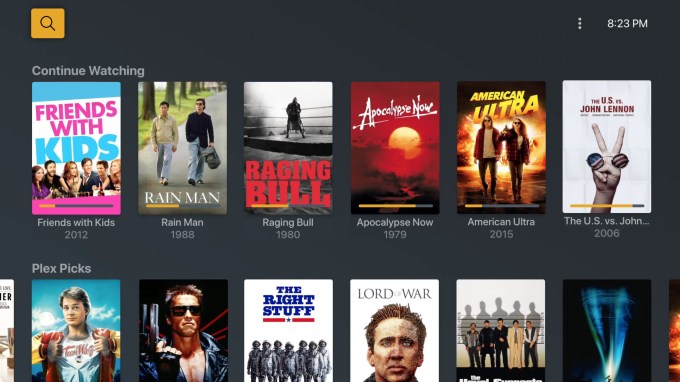
The service itself lives right within Plex’s media organization software. This app has evolved over the years to become more than just a DIY media player for home media. Today, Plex organizes your own media collections alongside podcasts, web shows, streaming news, and music courtesy of a TIDAL partnership. The free, ad-supported content will now appear on the Plex sidebar under a new “Movies & TV” heading.

In this section, the content is organized in a somewhat Netflix-style layout with image thumbnails for easy browsing and hubs for finding popular, trending or genre-specific content, for example.
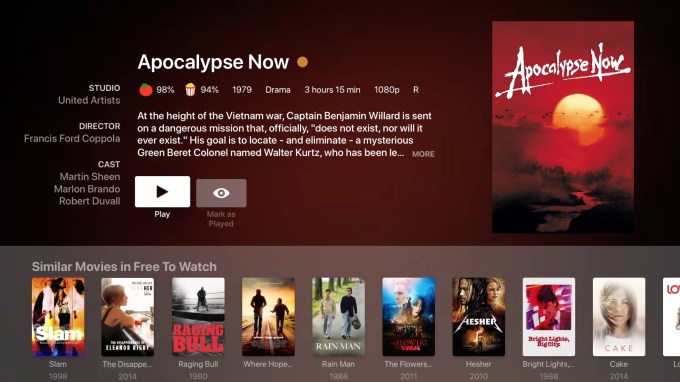

Plex has also introduced several editorially curated hubs as well as those personalized to the user, based on their cross-platform, cross-content watch history.

In total, there are around 70 different hubs that could potentially show up here, Plex says.

Meanwhile, clicking through to each title will show you details like genre, rating, year, length, description and even critic scores and audience ratings from Rotten Tomatoes, among other metadata. The titles will stream in 1080p and you can mark items as played, as you can with personal media.

Sample titles available at launch include a number of classics, cult classics, and even award winners, like Rain Main, The Terminator, Overboard, Frequency, Evil Dead (1 & 2), Teen Wolf, plus music concerts and documentaries featuring Taylor Swift, Nicki Minaj, Deadmau5, and more.

The content is available across Plex platforms, including Roku, Apple TV, Android TV, smart TVs,
Android and iOS mobile platforms, Xbox, PlayStation, Amazon Fire TV, and others.

“Plex was born out of a passion for media and entertainment, and offering free ad-supported premium movies and TV shows is just the latest step in our mission to bring all your favorite content together in one place,” said Keith Valory, CEO of Plex, in a statement. “What started more than a decade ago as a passion project to make accessing media on connected devices easier has evolved into the most comprehensive streaming platform in the industry, used by millions of people around the world,” he added.

TechCrunch first broke the news regarding Plex’s plans to enter the ad-supported movies market back in January, when it described a strategy similar to that of The Roku Channel.

Today, Plex has 15 million registered households using its service. Though the service is profitable, the percentage of customers who pay for its advanced features through a Plex Pass subscription is much smaller. That’s driven Plex to find new ways to generate revenue from its free users — and ad-supported content is an obvious choice, in that case.

04 Dec 2019

Pandora’s revamped, more personalized app rolls out to all users

Pandora’s redesigned mobile app experience is today available to all users, following a limited rollout that began in October. The update expands on Pandora’s personalization capabilities with the addition of a new “For You” tab offering an entirely unique experience for each Pandora user, along with more station customization features, and other changes. Pandora hopes the features will help it better compete with rivals like Spotify and Apple Music in the months ahead.

Personalization has become a key selling point for today’s streaming music services. And though Pandora led in this area in years past thanks its Music Genome, thumbs up and down signaling buttons, and its personalized stations, it has since ceded ground to Spotify whose bevy of algorithmically-updated playlists, led by Discover Weekly, have addicted users to its service.

This revamped Pandora app is a way for the now SiriusXM-owned company to fight back by highlighting what it does have that others don’t.

For example, the new “For You” tab gives Pandora a place to showcase its exclusive content like its music-and-podcast combos, called “Pandora Stories,” and its dozens of SiriusXM talk shows that became Pandora podcasts following the company’s acquisition.

Pandora also recently announced a multi-year deal with Marvel to create a “substantial number” of exclusive podcasts for its service, both scripted and unscripted, along with live events and more. And it will run many of Marvel’s podcasts before they can be heard elsewhere. These, too, will be featured in the new “For You” tab.

SuperbrowseHeroStatic 002

Other new content coming to “For You” will include exclusive custom playlists from LeBron James, Rob Gronkowski, Odell Beckham Jr., and Angel McCoughtry; Pandora’s year-end review feature called Playback 2019; Pandora’s Top Thumb Hundred 2019 playlist; its ten-year retrospective playlist, Top Thumb Hundred Songs of 2010-2019; and new content from Drake.

The tab also gives Pandora a way to puts more of the focus on its unique personalization capabilities which allow users to listen to music by genre, mood, activity, trending, new releases and more.

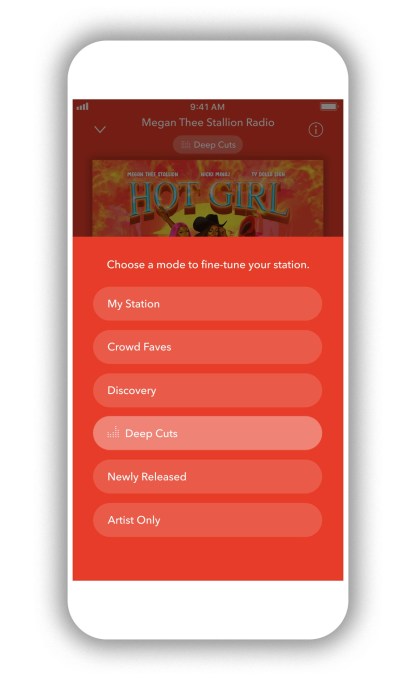
The update brings the “Pandora Modes” feature to mobile, as well, following its launch on the web earlier in the year. This lets users customize Pandora Stations by tweaking them to play just the most popular songs (“crowd faves”), the deep cuts, the new releases, artist-only tracks — or you can put the station into a “discovery” mode to be introduced to more artists you may like.

PandoraModes BlogImage

Pandora says that already more than double the number of users are engaging with “For You” versus the traditional “Browse” experience the tab replaces, following the October launch. In addition, those users are engaging with the personalized content they find in “For You” three times more than the content they find through traditional browsing. Presuming these metrics hold up as “For You” launches broadly, it could give Pandora’s app a competitive advantage — something the company needs as its user numbers and listening hours fall.

Pandora closed Q3 with 63.1 million monthly active users, down from 68.8 million the year prior. Its active users were also down on a quarterly basis, from 64.9 million at the end of Q2. Meanwhile, listening hours were down from 3.59 billion in Q3 last year to 3.32 billion in Q3 2019. Gross profit, however, grew 7% year-over-year to reach $970 million.

The company plans to kick off a new brand campaign starting today to showcase its new visual identity and tagline, “life is better with sound.” The ads will feature artists like  Taylor Swift, Dua Lipa, Lizzo, H.E.R., Maren Morris, Normani, Tones & I, Halsey, Little Simz, Post Malone, Snoh Allegra, and others. Pandora will also host experiential events related to this, including a live-streamed Halsey concert in New York’s Times Square and a larger concert still to come.

“This campaign is all about showing our listeners that Pandora is still the service they know and love, but it looks and feels a whole lot different — a whole lot better. The product is at the center, and we are highlighting the personalized, on-demand content Pandora users want, but may not know we have,” said Brad Minor, VP of Brand Marketing, Creative, & Communications at Pandora. “We’re celebrating our listeners in their everyday lives and demonstrating how Pandora has the unique ability to transform each moment by adding the exact right soundtrack at the exact right time,” Minor added.

The “For You” tab and other features are rolling out to all users at all tiers of Pandora’s service including its free, ad-supported option, Pandora Plus, and Pandora Premium.

04 Dec 2019

Flow raises $37M to simplify international e-commerce

Flow, a startup that helps brands and retailers build a cross-border e-commerce business, has raised $37 million in Series B funding.

CEO Rob Keve said that thanks to the magic of social media and digital marketing, many direct-to-consumer brands are reaching consumers around the world. However, the actual shopping experience for those consumers often leaves a lot to be desired — even if there are international purchase options, the shipping is usually slow or expensive, and the site might also fail to integrate with local payment services.

Keve said that he and CTO Mike Bryzek co-founded the Hoboken, New Jersey-based startup to solve this problem: Flow sits on top of existing e-commerce platforms, so that the shopper’s experience (whether that’s a website, app or distributed buy button) is automatically tailored to their location, with local pricing and payment options.

Plus, thanks to Flow’s relationships with carriers, international shipping should be timely and affordable. And even if a business already has international shipping deals and distribution centers, they can still use Flow to manage the logistics.

Founded in 2015, the company said it’s now seeing 200% year-over-year client growth, with customers including online brands like MVMT Watches, as well as omni-channel businesses like MZ Wallace and Charles & Colvard.

With this new funding, Flow has raised around $55 million total. The Series B was led by New Enterprise Associates, with participation from American Express Ventures and Latitude Ventures. NEA Venture Partner Liza Landsman (former president of Jet.com) is joining Flow’s board of directors.

“Cross-border shopping is a rapidly growing area of e-commerce, and more companies are investing in their cross-border strategy to capture that international demand,” Landsman said in a statement. “Flow is a premier vendor in this space, and their platform delivers strategic advantages for brands and retailers entering or expanding into international markets. Our team is excited to support Flow’s rapid growth.”

Keve told me that Flow will use the money to expand its sales and marketing team, and to improve the product. For example, he said he wants to continue developing the artificial intelligence that Flow uses to classify products (necessary for calculating duty and tax costs).

He also said he wants to continue building out Flow’s services business. While it’s important for the company to offer “a turnkey platform,” the technology is also “married” to Flow’s expertise about the strategies that work in each country.

“There’s services and knowledge that is very country-specific and even category-specific,” Keve said. “That is always going to be a matter of consulting and advising and sharing best practices … We will continue to be investing in that layer of expertise.”