Year: 2019

24 Aug 2019

Y Combinator Demo Day, revenue-based VC funding, Pivotal, Dell, Tumblr, WeWork, and more

Editor’s note

Due to bad travel logistics (thanks SFO), I wasn’t able to get the mid-week edition of the Extra Crunch roundup newsletter out. Sorry about that. Instead, here is everything we published this week on Extra Crunch in one fell swoop — and my, we covered a lot of ground. Hope you enjoy some great weekend reading.

Y Combinator Demo Day Coverage-a-palooza

Much like the equinoxes that synchronize Earth’s calendar, Y Combinator’s biannual demo days are a key fixture of the Silicon Valley calendar. This year was no different, with 166 companies presenting from the summer batch (and occasionally from previous batches if they chose to delay their presentation).

We had a full squad on site not only covering the 84 companies from day one and 82 companies from day two, but our team also put their collective heads together to identify the top companies from each set exclusively for Extra Crunch members.

The 11 best startups from Y Combinator’s S19 Demo Day 1

Read our favorite 11 startups from day one, which included:

PopSQL provides collaborative SQL query editing. You can store SQL queries you run regularly, grouping them into folders that can be kept private or shared amongst your team. Version history tracks changes so it can be reverted if/when something breaks. It currently has more than 100 paying companies, and is making $13K per month. It plans to build a marketplace for apps that run on top of your company’s database.

Why it’s one of our favorites: SQL database queries can be a nightmare, especially if they’re not something you’re used to dealing with every day. PopSQL lets you hammer on queries collaboratively until they’re working exactly as you want — then you can save them for future use and share them amongst your team members. And when you’ve spent the last 45 minutes trying to figure out why your query isn’t working only for a team mate to fix it in thirty seconds, you can use version control to see exactly what they changed. PopSQL says its product has already found customers in companies like Instacart, Redfin, and DoorDash.

Our 12 favorite startups from Y Combinator’s S19 Demo Day 2

Read our favorite 12 startups from day two, which included:

Business Score is helping companies automate background checks on other businesses. The startup is looking to stamp out tired manual processes that largely mean picking up the phone and scouring documents. The single API taps data sources across the web to build out real-time profiles that can help customers scan businesses in an effort to prevent fraud, qualify leads and onboard new clients.

Why it’s one of our favorites: Though it’s yet another startup in the batch catering to other startups, we thought Business Score stood out. The company integrates with thousands of data providers to help companies verify other startups and enterprises they are considering doing business with, using a system they’ve dubbed “the business passport.” There’s an opportunity here to create a tool essential to company-building across industry.

YC is doubling down on these investment theses in its most recent batch

Finally, amidst all the zany craziness of watching 166 companies present over two days (there should be a YC company for unmelting your brain), our venture capital reporter Kate Clark stepped back to assess what all the various companies in the batch indicated about the accelerator’s strategy these days.

YC knows its sweet spot: enterprise SaaS. One might go as far as to say it’s transitioning into a full-on SaaS incubator. Why? Because one of the greatest advantages of going through YC is the network of alumni companies you can tap into. Many successful B2B companies have emerged from the program, raised boat loads of venture capital funding and rocketed to the moon (hello Stripe, Brex, Gusto and Atrium). With that in mind, YC is doubling down on its resources for startups that sell products to other startups, which brings us to our first piece of news.

YC chief executive officer Michael Seibel and president Geoff Ralston announced this week that the accelerator has implemented something called CTO and HR demo days. In short, CTO and HR demo days are an opportunity for B2B startups to pitch their products to YC alum companies’ CTO and/or head of HR. Seibel and Ralston said 60 CTOs attended the event, as well as 30 HR heads. In total, 42 startups presented and we’re guessing a bunch of those companies booked a few customers.
24 Aug 2019

The new Disney+ streaming service is oriented around fans and families

You can tell a lot about a service by what it prioritizes on its home screen. With the new Disney + service the focus is initially organized by fan base, with different silos for the company’s various studios and the fans that follow them.

As the company gets the service off the ground — and casts about for content to stuff it with — curation is increasingly important. Over the course of my conversation with the Ricky Strauss, who’s overseeing Disney’s streaming service, “quality over quantity” was the mantra.

I spent some time reviewing the app and its features at the D23 expo and it seems the emphasis of quality over quantity in content didn’t necessarily extend to the app itself. The user interface and controls — at least on the AppleTV version that was used in my demonstration — were a little clunky.

While there’s going to be a rich content library of old and new titles — Disney, Pixar, Marvel and Star Wars classics and a mix of Fox content (chiefly “The Simpsons”) featured prominently on the home screen — other content is going to be a little bit more difficult to find.

Navigation over to the sidebar is required to find the new Disney+ original series (including the acquisitions like the “Diary of a Female President” series that Disney ordered earlier in the year. And don’t even bother trying to find any media from Hulu — or Hulu itself.  There are no plans to integrate any Hulu content or Fox properties that now fall under the auspices of Disney or its underlying studios (that includes the mutant corner of the Marvel Comics world that now fall under Disney’s purview after the Fox deal).

Family friendly fare for Disney means that the service (as previously reported) won’t have any media that would warrant a rating above PG-13. There won’t be a whiff of anything remotely as bloody or graphic as “Deadpool” on Disney’s streams.

While there aren’t a number of robust parental controls (since the content is designed to be more family friendly than the average streaming service) there is a kids’ mode designed for ages seven and below.

In the kids mode shows are organized by character, because that’s the way children (many of whom are pre-literate) relate to the medium. The screen for kids is also brighter and in kids accounts, the autoplay feature is turned off (the default for the streaming services is that autoplay is on for adults).

Initially the service will be available in several languages at launch through subtitles and dubbing with plans to be as inclusive as possible when the service rolls out in each of the countries it will be operating in. And eventually Disney wants the streaming service to be available everywhere.

The $7-a-month price tag will enable families to get four simultaneous streams, all the videos will be in 4K, UHD and HDR with an ability for a family to set up seven different user profiles. As CNet noted, this is in sharp contrast to Netflix, which only allows for five profiles and enables simultaneous streaming only at a higher price point.

Given the broader functionality, it’d be more apt to compare Disney+ to Netflix’s premium $15.99 per month service, rather than its basic $8.99 price point. Disney+’s content library and family friendly pitch also make it a compelling offering for families with young children.

Each profile can be designated with the Disney avatar of your choice. The service also won’t be dropping its original episodes all at once, preferring to serialize the entertainment — more like a traditional network.

For Disney, which owns Marvel, LucasFilm, as well as its own catalog of live action and animated shows through the now 36-year-old Disney Channel, and the film libraries of Pixar and the Walt Disney Co. the successful launch of Disney+ is nothing less than the future of the company.

At D23, the company’s fan service expo, that was incredibly apparent.

24 Aug 2019

Driving Volkswagen’s all-electric ID Buggy concept

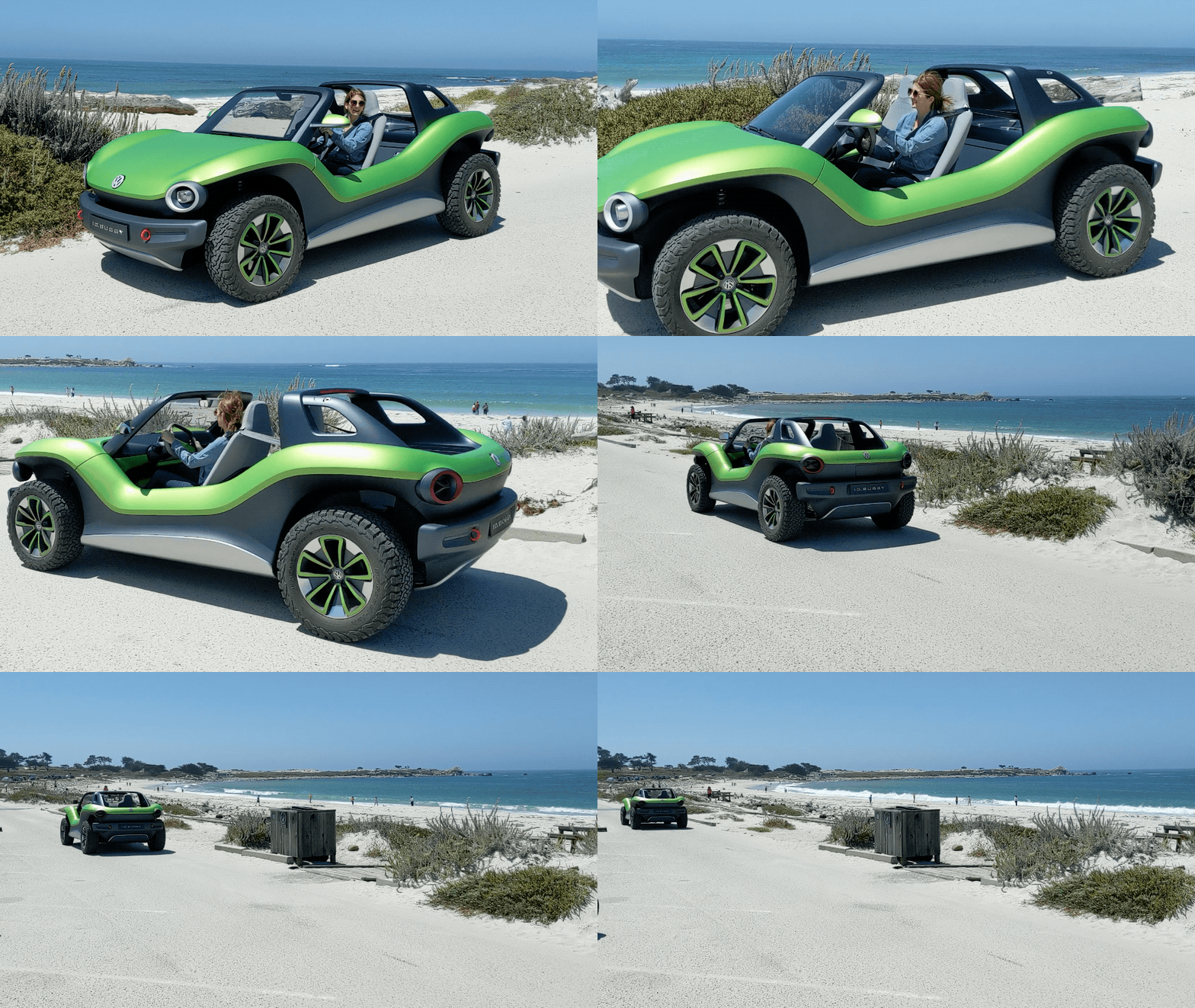
The VW electric ID Buggy concept is delightful and bright, stout and smiling. It’s a vehicle fit for the sunshine and sand dunes, or perhaps a less committing slow roll along the beach.

And so my first drive in a prototype of the all-electric buggy — along the coast near Spanish Bay in Monterey, Calif., — was tinged with sadness. After all, the ID Buggy is just a concept. It’s not meant for this world. At least not right now.

There is still a chance that the ID Buggy will make it to production. VW is already in talks with “at least one company” to bring the buggy into production, TechCrunch confirmed.

The global debut of the ID Buggy concept at the 89th Geneva International Motor Show in March was meant to showcase VW’s electric future and demonstrate the versatility of its modular electric drive toolkit chassis, or MEB. The MEB, which was introduced in 2016, is a flexible modular system — really a matrix of common parts — for producing electric vehicles that VW says make it more efficient and cost-effective.

The first vehicles to use this MEB platform will be under the ID brand, although this platform can and will be used for electric vehicles under other VW Group brands such as Skoda and Seat. (The MEB won’t be used by VW brands Audi or Porsche, which are developing their own platform for electric vehicles.)

VW has shown off several ID concepts. Some of these, like the ID Crozz and ID Buzz are going into production. A production version of the Crozz is coming to the U.S. at the end of 2020. Others, like this buggy, are not currently on the production track.

kirstenbuggy

Driving the ID Buggy Drive

The ID Buggy is simple, and that’s exactly what it should be. No clutter or whiz-bang creature comforts. Instead, this leisure vehicle inspired by the 1960s era Meyers Manx has no roof or doors — although a tarpaulin can be stretched between the windscreen frame and the Targa bar as a sun sail or light weather protection. Without doors, the driver climbs in, and with relative ease, depending on one’s general fitness and flexibility.

The ID Buggy towers over its inspiration — the iconic Meyers Manx buggy that became popular among the California beach-and-surf culture of the 1960s.

The ID Buggy was also a quieter, smoother ride than the Meyers Manx. I also spent some time in a classic bright red buggy with a four-speed manual transmission and gas engine that might have been a touch carbureted. While the Manx roared as I shifted into first and peeled away, the electric ID Buggy was silent and smooth as it rolled out of the sandy parking lot.

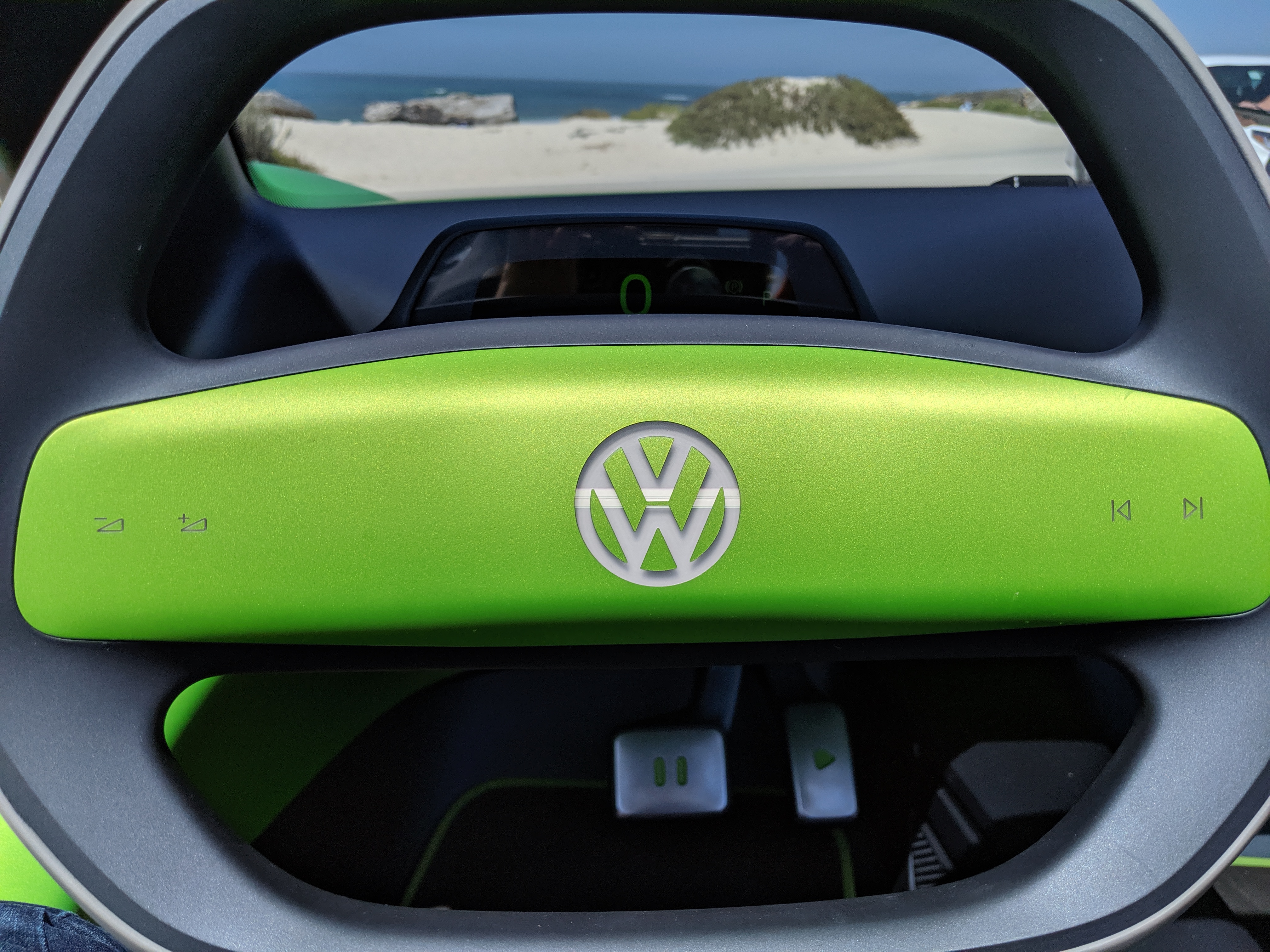
vw id buggy wheel

The main detail inside the ID Buggy is the lack of features and do-dads. The hexagonal steering wheel, shown above, isn’t littered with toggles; there are just a couple of controls on the crossbar. A small integrated stock to the right side of the steering wheel allows the driver to move the vehicle into drive, reverse and park. A digital instrument cluster provides the basic information like speed.

Even the brake and accelerator pedals continue this stripped-down design story. 

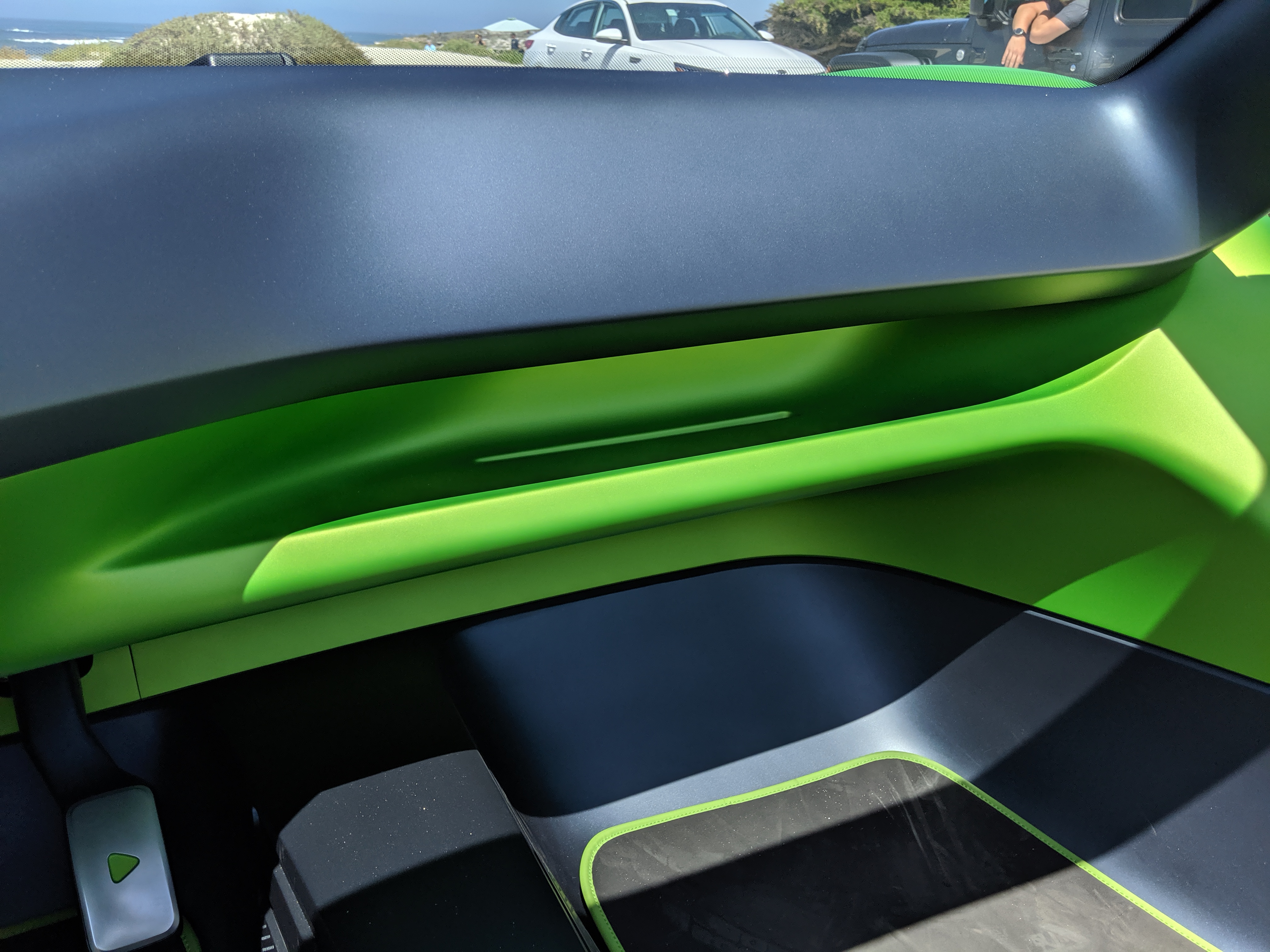
The dashboard and the passenger area are just as void of features. This lack of “stuff” is more about function than form, although the matte green and textured grey blue at the bottom does make a visual statement. The ID Buggy is meant to be driven in the elements, rain or shine. And so designers made the interior waterproof.

vw buggy dash

Under the ID Buggy’s body is where the good stuff lives.

The rear-wheel drive buggy is outfitted with an electric motor that produces 201 horsepower and a maximum torque of 228 pound-feet. It has a 62-kilowatt-hour battery that can travel 155 miles (under the WLTP standard) on a single charge. There is not an EPA estimate for the range. It can accelerate from a standstill to 62 miles per hour in 7.2 seconds.

Unfortunately, this prototype had a kill-the-thrill speed limiter on it, scuttling my plans for a zippy ride along the coast.

Still, the ID Buggy offered a fun and easy, breezy ride. It handled the curves of the roads with ease and its wide body and higher rear end provided a sense of security even while driving amid other much larger passenger cars.

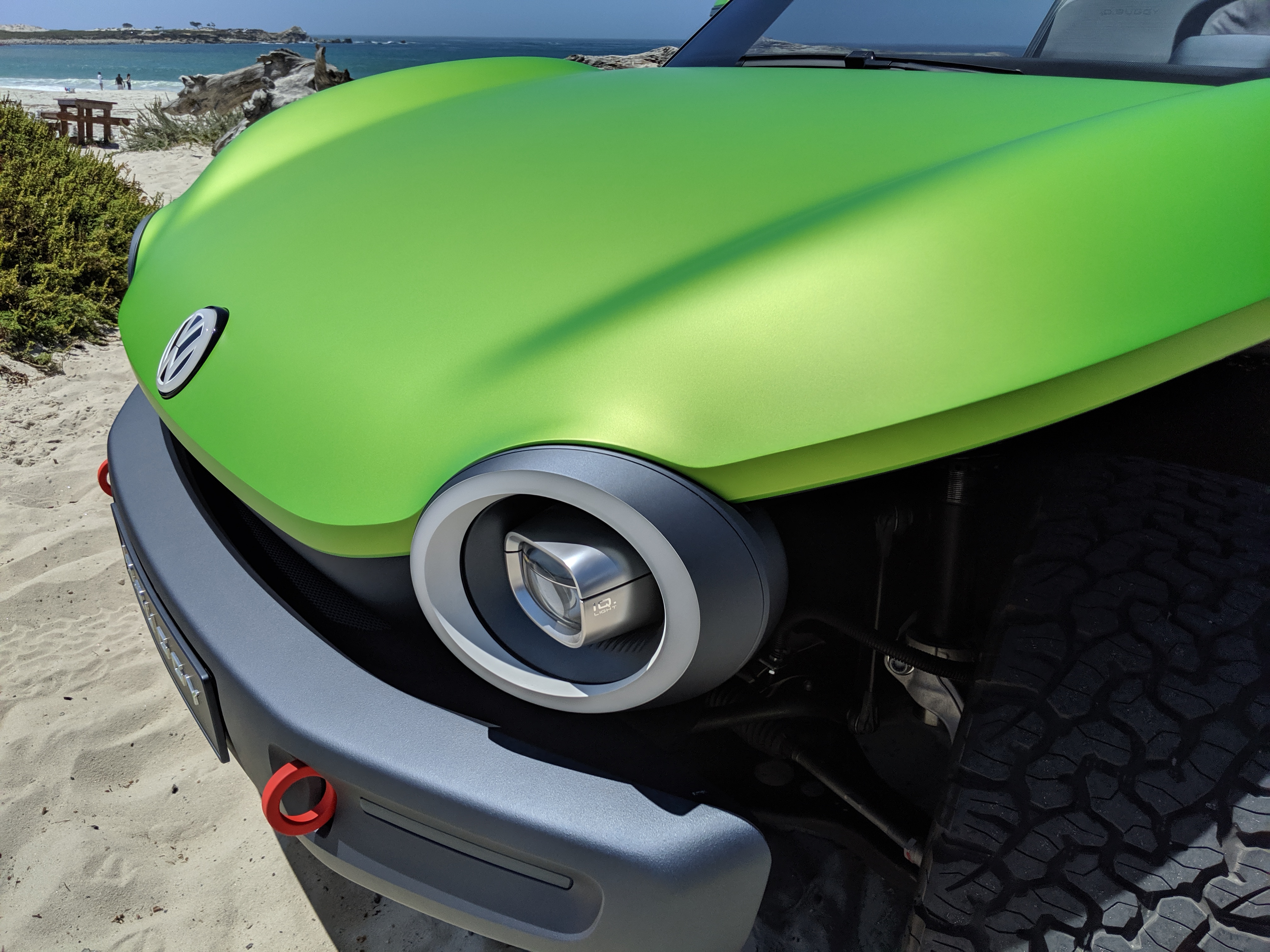
vw buggy id front

Building the ID Buggy

It’s unclear what company, or companies, are in talks to produce the buggy. VW wouldn’t give names; not even the ocean breeze and cloudless sky or the endless supercar eye candy were enough to loosen the lips of VW employees during Monterey Car Week.

It’s possible that this unnamed company is e.Go Mobile. VW announced in March that e.Go Mobile would be its first external partner to use its MEB electric platform to launch other EVs in addition to Volkswagen’s model range. A dedicated vehicle project is already being planned, VW said at the time.

A VW spokesperson told TechCrunch there’s no decision about which car will be produced under this partnership with e.Go Mobile. It could be the buggy; it could also be some other vehicle.

And then there’s Ford. Earlier this year, the two automakers announced a partnership that includes Ford producing electric cars based on the MEB developed by Volkswagen.

The VW folks on the ground in Monterey did express hope that a third party does build the buggy, or a modified version of it. As one spokesperson later told TechCrunch, “As the drive in Monterey showed, the Buggy is a great ambassador for Volkswagen and for e-mobility. I am sure it would find a lot of customers.”

In the end, the ID Buggy is a sleek cruiser rather than a beach bomber like the 1960s original. It successfully demonstrates the versatility around VW’s electric platform. After all, Volkswagen foresees critical parts in the ID Buggy used to power multiple consumer electric vehicles in the near future. And it’s a fair assumption the ID Buggy’s production cousins will have a bit more gadgets, including silly things like doors.

24 Aug 2019

Startups Weekly: Diamond-encrusted disruption

Hello and welcome back to Startups Weekly, a weekend newsletter that dives into the week’s noteworthy startups and venture capital news. Before I jump into today’s topic, let’s catch up a bit. Last week, I wrote about the flurry of IPO filings. Before that, I noted the differences between raising cash from angels vs. traditional venture capitalists.

Remember, you can send me tips, suggestions and feedback to kate.clark@techcrunch.com or on Twitter @KateClarkTweets. If you don’t subscribe to Startups Weekly yet, you can do that here.

What’s new

Venture capitalists look for companies poised to disrupt markets untouched by innovative technology. Believe it or not, a very small percentage of jewelry shopping is done online, which means there’s a big opportunity — for the right team — to bring jewelry buyers and sellers to the 21st century.CVC Stones 02

Enter Pietra, a new startup that’s just raised $4 million in a round led by Andreessen Horowitz’s Andrew Chen (Substack & Hipcamp investor). Robert Downey Jr.’s VC fund Downey Ventures and Will Smith’s fund Dreamers Fund also participated, as did Hollywood manager Scooter Braun, Michael Ovitz and supermodel Joan Smalls.

I spoke to the founding team, which includes Uber alum Ronak Trivedi and Ashley Bryan, who hails from fashion e-commerce site Moda Operandi. The pair bring a healthy mix of technology and fashion expertise to the mix. Trivedi tells TechCrunch he’s drawn on his Uber experience to recruit engineers from top tech companies and to advocate for fast growth. Meanwhile, Bryan has leveraged her fashion industry connections to establish relationships with luxury designers.

 “Fashion is typically really under-resourced in terms of tech,” Bryan tells TechCrunch. “[The fashion industry] is great at the creativity part but it’s tough, especially with jewelry because you really have to put up a lot of capital.”

Pietra’s plan is to create a high-end marketplace for consumers to connect with jewelry designers. To do this, the team has adopted the standard marketplace approach, taking a 30% marketplace fee from sellers, as well as a 7% fee from buyers commissioning jewelry on the platform.

“Whether you do custom jewelry or engagement jewelry or you do jewelry for celebrities like Drake, you can come on Pietra and connect with a global marketplace,” says Trivedi.

The jewelry market is expected to be worth more than $250 billion by 2020, according to McKinsey research. And where there’s a billion-dollar market, there are VCs. 

“Even though gemstones and jewelry have been at the center of art, commerce, and culture since the dawn of human civilization — going from stone jewelry created 40,000 years ago in Africa to the trade routes between East and West to Fifth Avenue in New York to the Instagram feed on your phone — the technology for discovering, designing, and purchasing jewelry online hasn’t evolved much at all,” writes a16z’s Chen, who overlapped with Trivedi during his Uber tenure.

Pietra completed its official launch this week. It has 100 designers on the platform and counting, along with what the founders say is a lengthy waitlist.

hands signing check 1

In other news

This week I published a long feature on the state of seed investing in the Bay Area. The TL;DR? Mega-funds are increasingly battling seed-stage investors for access to the hottest companies. As a result, seed investors are getting a little more creative about how they source deals. It’s a dog-eat-dog world out there and everyone wants a stake in The Next Big Thing. Read the story here.

Demo Day

Y Combinator graduated another batch of 200 companies this week. We were there both days, taking notes on each and every company. To make things easy on you, I’ve put together the ultimate YC reading list:

Here’s a look at some of the profiles we’ve written on the S19 companies:

Listen

We recorded two great episodes of Equity, TechCrunch’s venture capital podcast, this week. The first was with YC CEO Michael Seibel, in which he speaks to trends at the seed stage of investing, changes at the accelerator program, including its move to San Francisco and more. You can listen to that one here. Plus, we had on Unusual Ventures co-founder and partner John Vrionis, who talked to us about direct listings versus IPOs and the future of DoorDash and Airbnb. You can listen to that one here.

Equity drops every Friday at 6:00 am PT, so subscribe to us on Apple PodcastsOvercast and Spotify.

Tips for B2B startups

Contributors Tyler Elliston and Kevin Barry share advice for B2B companies: “Over the years, we’ve seen a lot of B2B companies apply ineffective demand generation strategies to their startup. If you’re a B2B founder trying to grow your business, this guide is for you. Rule #1: B2B is not B2C. We are often dealing with considered purchases, multiple stakeholders, long decision cycles, and massive LTVs. These unique attributes matter when developing a growth strategy. We’ll share B2B best practices we’ve employed while working with awesome B2B companies like Zenefits, Crunchbase, Segment, OnDeck, Yelp, Kabbage, Farmers Business Network, and many more.” Read the full story here. (Extra Crunch membership required.)

24 Aug 2019

Graphcore founder Nigel Toon to talk about AI chips at Disrupt Berlin

It’s easy to forget that Silicon Valley starts with ‘silicon’, and that there would be no technology innovation without innovation at the silicon level. And Graphcore is well aware of that as the Bristol-based company is designing its own dedicated AI chipset. That’s why I’m glad to announce that Graphcore co-founder and CEO Nigel Toon is joining us at TechCrunch Disrupt Berlin.

Graphcore has managed to attract a ton of attention from day one. Originally founded in 2016, the startup has raised more than $300 million from top investors, such as Sequoia Capital, BMW, Microsoft, Samsung and a ton of others.

The company last raised a $200 million Series D round led by Atomico and Sofina. It values the company at $1.7 billion.

So what is the magic product behind Graphcore? The startup’s flagship product is an Intelligence Processor Unit (IPU) PCIe processor card combined with a software framework. Essentially, it lets you build your own AI applications more efficiently. Those dedidacted AI chips should perform better than repurposed GPUs.

Tobias Jahn, principal at BMW i Ventures, summed it up pretty well in a statement for the Series D round: “The versatility of Graphcore’s IPU – which supports multiple machine learning techniques with high efficiency – is well-suited for a wide variety of applications from intelligent voice assistants to self-driving vehicles. With the flexibility to use the same processor in both a data centre and a vehicle, Graphcore’s IPU also presents the possibility of reduction in development times and complexity.”

It seems crazy that a tiny startup is competing directly with giant chip companies, such as Nvidia, AMD, Intel, Qualcomm, etc. But this isn’t Nigel Toon’s first company. He has been the CEO of Picochip and Icera, two companies that have been sold to Intel and Nvidia.

Graphcore believes that there’s an underserved niche with a lot of potential. And it feels like there’s a race to create the most efficient AI chip. So I can’t wait to hear Nigel Toon’s take on that race.

Buy your ticket to Disrupt Berlin to listen to this discussion and many others. The conference will take place on December 11-12.

In addition to panels and fireside chats, like this one, new startups will participate in the Startup Battlefield to compete for the highly coveted Battlefield Cup.


Graphcore (graphcore.ai) is a new silicon and systems company based in Bristol, UK and Palo Alto, USA that has developed a new type of processor, the Intelligence Processing Unit (IPU), to accelerate machine learning and AI applications. Since its founding in 2016, Nigel has secured over $300m in funding and support for the company from some of the world’s leading venture capital firms including Sequoia Capital, Foundation Capital and Atomico, from major corporations including BMW, Bosch, Dell, Microsoft and Samsung and from eminent Artificial Intelligence innovators.

Nigel has a background as a technology business leader, entrepreneur and engineer having been CEO at two successful VC-backed processor companies XMOS and Picochip (sold to Nasdaq:MSPD, now Intel), a founder at Icera (sold to Nasdaq: NVDA) and VP/GM at Altera (Nasdaq: ALTR, sold to Intel for $17Bn) where he spent over 13 years and was responsible for establishing and building the European business unit that he grew to over $400m in annual revenues. Nigel was a non-executive director at Imagination Technologies PLC until itsacquisition in 2017 and is the author on 3 patents.

24 Aug 2019

Confirmed: Disney is making an Obi-Wan series with Ewan McGregor

The rumors have been suggesting it for a while now, and fans have been pretty much begging for it… and it’s happening: Ewan McGregor will return to the role of Obi-Wan for a new Disney+ series.

Disney dropped the news at a panel during D23 this evening, almost immediately after premiering the trailer for its other live action Star Wars series, The Mandalorian.

Details are still remarkably light. There’s not even an official name for the series yet. Beyond McGregor’s involvement, the only details mentioned are that the scripts are written.

24 Aug 2019

Here’s the first trailer for the upcoming Disney+ Star Wars series, The Mandalorian

It’s here!

About ten months after we learned that Jon Favreau would be heading up a Star Wars series called “The Mandalorian” on Disney’s soon-to-launch streaming service Disney+, we have the first full trailer. It premiered this evening during the Disney+ panel at the D23 conference.


Everyone involved had stayed relatively hush-hush about the series until now, with only a couple of details mentioned with its announcement. We knew it takes place about five years after Return of the Jedi — so a few decades before Force Awakens. Favreau had also said that it follows “the travails of a lone gunfighter in the outer reaches of the galaxy” — which we later learned would be played by Pedro Pascal (perhaps best known as Oberyn Martell from Game of Thrones.)

According to the New York Times, Disney is dropping “roughly $100 million” to produce the first 10 episodes.

The Mandalorian is set to debut alongside Disney+ on November 12th, 2019.


23 Aug 2019

Vape lung has claimed its first victim, and the CDC is investigating

A person has died from what the Centers for Disease Control and Prevention speculate is a vaping-related condition. Nearly 200 other cases of varying severeness have been reported nationwide, described by the CDC as “severe unexplained respiratory systems after reported vaping or e-cigarette use.”

No information was provided about the deceased other than that they were an adult living in Illinois, and that they had died of some sort of pulmonary illness exacerbated or caused by vaping or e-cigarette use. Others affected in that state have been between 17-38 and mostly men, the CDC doctor added on a press call earlier today.

As little is known for sure about this growing problem, the team was hesitant to go beyond saying there was good reason to believe that these cases were all vaping-related, although they differ in some particulars. They have ruled out infectious disease.

The CDC’s acting deputy for non-infectious diseases, Dr Ileana Arias, explained on the call after expressing their condolences:

CDC is currently providing consultations to state health departments about a cluster of pulmonary illnesses having to do with vaping or e-cigarette use… While some cases appear to be similar and linked to e-cigarette product use, more information is needed to determine what is causing the illnesses.

In many cases patients report a gradual start of symptoms, including breathing difficulty, shortness of breath and/or hospitalization before the cases. Some have reported gastrointestinal illnesses as well… no specific product has been identified in all cases nor has any product been conclusively linked to the illnesses

Even though cases appear similar, it isn’t clear if these cases have a common cause or if they are different diseases with similar presentations.

An FDA representative on the call said that his agency is also looking into this, specifically whether these are products that fall under its authority. It’s possible they were imported, for example, or sold under the table.

Everyone involved is still in the information-gathering phase, as you can tell, but it’s apparently serious enough that they felt the need to make this announcement. Meanwhile they are asking doctors to report cases they suspect might be related.

“Right now states are leading their own specific epidemiologic investigations and we’re providing assistance as needed,” explained the CDC’s Dr. Josh Schier. “CDC is working on a system to collect, aggregate, and analyze data at the national level to better characterize this illness.”

As the mechanism is unknown, it’s unclear what the actual danger is. Is it some byproduct of the nicotine cartidges, or THC ones? Is it the vapor itself? Is it only at certain temperatures or concentrations? Is it directly affecting the lungs or entering the bloodstream? No one knows yet — all they’ve seen is an sudden uptick in respiratory or pulmonary issues where the sufferer also uses vaping products.

The CDC’s Dr Brian King went into a bit more detail on the possibilities, explaining that while no specific chemical can be said to be the problem, that’s more for a want of study, not a want of potentially harmful chemicals.

“We do know that e-cigarettes do not emit a harmless aerosol,” he explained. “There’s a variety of harmful ingredients identified, including things like ultrafine particulates, heavy metals like lead and cancer causing chemicals. And flavoring used in e-cigarettes to give it a buttery flavor, diacetyl, it’s been related to severe respiratory illness.”

“We haven’t specifically linked any of those specific ingredients to the current cases but we know that e-cigarette aerosol is not harmless,” King concluded.

He also suggested, in response to a question why we were suddenly seeing lots of these cases, that the problems have been occurring all this time but only recently have hospitals and other organizations done the due diligence as far as linking them to e-cigarette use.

Few studies have been done on vaping’s potential health effects, and none on long-term effects, since the devices only recently gained popularity — well ahead of the possibility of regulation and years-long studies.

Research published just last month from Yale found that Juul vape pens produced chemicals not listed on the package, some of which are known to be irritants.

“People often assume that these e-liquids are a final product once they are mixed. But the reactions create new molecules in the e-liquids, and it doesn’t just happen in e-liquids from small vape shops, but also in those from the biggest manufacturers in the U.S.,” said Yale’s Hanno Erythropel in a news release.

That vaping works as a way to quit smoking — which we know is absolutely disastrous to your health — seems clear. But it remains to be seen exactly how much less of a risk vaping offers.

If you use vaping products and have been experiencing coughing, shortness of breath, fatigue, or chest pain, tell your doctor.

23 Aug 2019

Disney introduces “She Hulk”, “Moon Knight” and “Ms. Marvel” to Disney+ streaming service

As part of its big reveal of the slate of shows coming to Disney+ streaming service, Marvel head Kevin Feige introduced three new shows that would be joining the Marvel pantheon: “She Hulk”, “Moon Knight” and “Ms. Marvel” as part of the expanded Marvel Universe.

Ms. Marvel tells the story of teenager Kamela Khan, who was Marvel’s first Muslim character to lead her own series. A Pakistani-American from New Jersey, Khan can changer he shape.

Moon Knight is based on the character Marc Specter who is a mercenary left for dead in the Egyptian desert who is imbued with special powers by a spiritual force. And She Hulk is the story of Bruce Banner’s cousin, Jennifer Walters, who in the comics receives a blood transfusion from her relative and is transformed into her own version of the Hulk.

Other revelations from the Marvel portion of the big Disney+ presentation included the full cast for the WandaVision show, which Feige described as a combination sitcom and traditional marvel epic.

Old Marvel favorites including Kat Dennings as Darcy Lewis and Randall Park as Agent Wu from the “Ant Man” movies will make appearances in the Wanda/Vision show.

Also rejoining the Marvel Universe is Emily Van Camp reprising her role as Sharon Carter, the daughter of Peggy Carter. She’ll make her appearance in Falcon and the Winter Soldier.

The expansion of the MCU with these three new shows is indicative of how deep a bench of intellectual property Disney has at its disposal to flesh out its streaming service. It can also serve to dull the pain some fans may feel at the loss of the Netflix-licensed characters like Daredevil, Luke Cage, Iron Fist (somebody liked it), and Jessica Jones.

These choices also indicate how Disney is growing its roster of women in the MCU taking the role of superheroes, which comes on the back of the success of Captain Marvel.


23 Aug 2019

Trump adds tariffs to $550 billion of Chinese imports in trade war reprisal

President Trump announced Friday on Twitter that tariffs on Chinese imports will increase 5 percentage points in a tit-for-tat response to China’s own plans to place new duties on U.S. goods.

About $250 billion of goods produced by China and imported into the U.S. already have a 25% tariff. This newest increase will push tariffs to 30% beginning October 1, 2019. Trump also increased “List 4” tariffs from 10% to 15%. The List 4 tariff, which affects the remaining $300 billion of Chinese imports, will go into effect September 1 and December 15.

The increase in tariffs on Chinese imports follows news earlier Friday that China will impose $75 billion worth of duties on U.S. goods, beginning Sept. 1 and December 15. China’s foreign ministry said that it would resume tariffs on U.S. imports of automobiles and auto parts and place an additional 5% or 10% tariff on agricultural and food products like soybeans, coffee, whiskey and seafood.

U.S. automakers Ford, GM, Fiat Chrysler Automobiles and Tesla all saw shares fall in response to China’s new tariffs. Agricultural product companies, the textile industry as well as automakers that build vehicles in the U.S. for export to China will take the brunt of China’s newest tariffs. The move could force these companies to raise prices, which could further dampen sales.

The president’s initial response on Twitter to China’s decision sent the market into a tailspin. The Dow Jones Industrial Average fall by as much as 700 points before closing the day slightly down only 623 points at 25,628.60. The S&P 500 Index fell 75.84 points to end the day at 2,847.11 and the Nasdaq dropped 239.62 points to close at 7,751.77.

Trump’s tariffs announcement came after markets closed Friday.