Year: 2019

03 Dec 2019

AWS announces AutoPilot, more visible AutoML in SageMake Studio

Today at AWS re:Invent in Las Vegas, the company announced AutoPilot, a new tool that gives you greater visibility into automated machine learning model creation, known as AutoML. This new tool is part of the new SageMaker Studio also announced today.

As AWS CEO Andy Jassy pointed out on stage today, one of the problems with AutoML is that it’s basically a black box. If you want to improve a mediocre model, or just evolve it for your business, you you have no idea how it was built.

The idea behind AutoPilot is to give you the ease of model creation you get from an AutoML-generated model, but also giving you much deeper insight into how the system built the model. “AutoPilot is a way to create a model automatically, but give you full visibility and control,” Jassy said.

“Using a single API call, or a few clicks in Amazon SageMaker Studio, SageMaker Autopilot first inspects your data set, and runs a number of candidates to figure out the optimal combination of data preprocessing steps, machine learning algorithms and hyperparameters. Then, it uses this combination to train an Inference Pipeline, which you can easily deploy either on a real-time endpoint or for batch processing. As usual with Amazon SageMaker, all of this takes place on fully-managed infrastructure,” the company explained in a blog post announcing the new feature.

You can look at the model’s parameters, and see 50 automated models, and it provides you with a leader board of what models performed the best. What’s more, you can look at the model’s underlying notebook, and also see what trade-offs were made to generate that best model. For instance, it may be the most accurate, but sacrifices speed to get that.

Your company may have its own set of unique requirements and you can choose the best model based on whatever parameters you consider to be most important, even though it was generated in an automated fashion.

Once you have the model, you like best, you can go into SageMaker Studio, select it and launch it with a single click. The tool is available now.

03 Dec 2019

Does your company cultivate inclusion?

Each company’s culture is defined by a variety of factors.

One major factor is its leadership, and the type of workplace environment they choose to create. For example, are they approachable and encourage collaboration from all levels of the organization? Or do they prefer to maintain a tightly knit power structure, working only within the C-suite, from a rigid, top-down structure?

I’m quite fortunate to work for an employer with a culture that focuses on empowering and valuing the contributions of women equally to men at all levels of the organization. I recognize the gift that this culture is because sadly, not every company is like this. Tech companies especially must increase efforts to enable and encourage women with inspiration and opportunities that drive success. In fact, research has shown that companies with gender diversity in leadership experience greater financial returns.

So, how can other companies become more inclusive? The goal is identifying the right mix of ideas to create or institute programs that are unique but fit within the company’s mission and workplace culture. While the program at my employer is still being defined and developed, we have some great ideas for kickstarting an inclusive program that can be successful for your team, such as:

Create a community and attend events that expand your network

Getting involved in community events that are focused on women, like Women of Silicon Valley, is one way my team has made critical connections with the local talent pool and other female leaders in the Bay area. This creates significant value for our organization over time, and the investment in participation cannot be overstated. Partnering with those outside your company can also foster inclusive workforces, and that is a win-win.

Taking this a step further, we’ve also invited speakers to speak to our female employees on topics ranging from career development or tips and tools for avoiding imposter syndrome, to strategies for engaging with peers in the workplace and fostering more productivity.

As a developing program, I believe the inclusive initiatives at my company put them ahead of many others in Silicon Valley. The organization partners with our PR firm to identify and take advantage of industry speaking engagements, such as DefendCon and the Women in Tech Summits, to highlight female thought leaders, as well as industry award programs like Women in IT, that recognize significant achievements of female engineers in our market.

We are also currently pursuing a workshop for women to help them maximize their professional LinkedIn profiles. Here, our female employees will examine their own profiles to determine if their value is clearly articulated. They will be given suggestions on strengthening their profiles and representing their experience, and also have professional photos taken.

Finally, our company looks for ways to lift up women employees and celebrate their presence. As an example, we recently acknowledged International Women’s Day with a luncheon hosted by executive leadership for women in all departments, praising their contributions and the vital role they have in our company’s continued success.

Keep interoffice communication productive and professional, but also social

Having a dedicated interoffice communication channel where women engineers can go to ask questions or offer support to other women is very beneficial.

At my company, female employees at every level of the organization utilize a Slack group to collaborate and share information. Here, inclusion is immediate as you’re welcomed on your first day of employment and invited to contribute to the group.

The general vibe of our Slack channel is about ‘women empowering women.’ We encourage and lift each other up. Our team vice president also keeps us informed about special events and opportunities that might be of interest.

We also use the channel as a professional resource, whether it’s to brainstorm ideas, to share industry articles featuring other powerful women killing it in tech, or to communicate opportunities for professional development and upskilling that might benefit us all.

This exclusively women’s outlet has grown quite important to us, especially as our company was acquired earlier this year. As roles have evolved, women are finding support from one another and receiving encouragement as they adjust to new tasks and responsibilities.

This cultural empowerment is a movement for our company, and you can see it in how women will flock toward each other. For example, it’s noticeable in meetings how colleagues celebrate the successful completion of a project or amplify a great idea by eagerly offering support and congratulations.

These obvious benefits have spawned the idea to create group ‘empowerment chapters’ in each of our global offices in Houston, Belfast, and San Jose, where women will take turns acting as a chairperson and coordinator for that particular location. Since a company’s culture is also impacted by its physical geography within the world, or whether it is located in an urban or rural area, these chapters can enhance our understanding of colleagues in different parts of the world.

Use same-gender mentorship to build a more diverse workforce

Executive leaders are recognizing that in order to promote continued learning, stronger job performance, and swift career advancement that results in employees remaining with their organization longer, they must provide inclusive and effective mentors and sponsors. For men or women, the emphasis can be less on hierarchy and more on reciprocity, so companies can develop and provide mutual mentoring pairs.

The mentoring program for my team focuses women employees on increasing the inclusivity of women in the workspace; sharing motivational messages on being a woman in tech and recognizing and celebrating the successes of individuals within a group. These relationships help women to overcome individual challenges with the existing organizational hierarchy and quickly address progress-killing power dynamics that might be in play.

As an expansion of our mentorship program, we have also made a point to impress upon the recruiters and hiring consultants that we work with, to help with our efforts by identifying and delivering a more diverse pool of job candidates to apply for open positions within the organization. Being upfront and transparent about this requirement means that we’re actively fostering greater inclusion and diversity from the very beginning of a woman’s career with us – and it is supported from the top-down in the org chart. We even target colleges and universities with a favorable diversity profile to recruit interns and entry-level employees.

The U.S. recently celebrated Women’s Equality Day, commemorating the passage of the 19th Amendment to the U.S. Constitution, granting the right for women to vote. This amendment was hard-earned by 19th century women, who previously had little opportunity to assert their opinions or individuality.

Generations of women since then have had a vastly different life experience. Our aim as women is to keep pushing this effort forward. One way to do that is recognizing how much women contribute to the workplace and impact our corporate culture.

I heard a quote once that really resonates with me: “Diversity is being invited to the party, but inclusion is being asked to dance.” Explicitly defining and sharing criteria for advancement, offering exciting assignments to all employees, and most importantly, expecting, reinforcing and rewarding intentional inclusion can go a long way toward strengthening a positive corporate culture.

It’s expected that corporate culture may change over time, being re-shaped or molded by the influx of new people, new places and new ideas. Therefore, it takes some effort to develop a strong culture that continues to reflect the company’s values and ensures that any changes are still appropriately meeting the needs of every employee, while delivering on the company’s core mission.

We must address the workplace status quo and force organizations to address biases and stereotypes, or risk reinforcing gender inequalities. Promoting a corporate culture where talented professional women associate and engage with other professional women or advocates of women at varied career levels may be the revolution needed to truly transform workplace gender inclusion.


03 Dec 2019

Qualcomm unveils Snapdragon 865 and 765 platforms

This morning at its annual Snapdragon summit in Hawaii, Qualcomm offered a glimpse at two new Snapdragon chips. You know how this works: the chipmaker offers some insight into the components that will power the vast majority of Android flagships over the course of the coming year.

The two headliners for the even are the flagship-level Snapdragon 865 and the lower-end 765. No surprise, Qualcomm is focused on 5G and AI for both systems — the latter of which has become an increasingly important piece of the mobile ecosystem, while the former is expected to start driving a majority of smartphone purchases beginning next year.

Here’ Qualcomm,

The flagship Snapdragon 865 Mobile Platform, which includes the Snapdragon X55 5G Modem-RF System, is the world’s most advanced 5G platform, delivering unmatched connectivity and performance for the next generation of flagship devices. The Snapdragon 765/765G brings integrated 5G connectivity, advanced AI processing, and select Snapdragon Elite Gaming experiences.

Notably, the mid-range765 features an integrated 5G option, unlike the higher-end 865, which utilizes the separate X55 5G modem.

Right now, it’s just a glimpse of what’s to come. Expect more information to be rationed out of the next few days of the summit.  We may also get a look at some of the first handsets this week in Hawaii, but likely the announcements will really begin in earnest comes CES and MWC in early-January and late-February, respectively.

03 Dec 2019

This browser extension unhides Instagram Likes

Instagram is hiding Like counts to make people feel better. But what if you’re curious, competitive, or just petty? Now you can re-embrace the popularity contest by installing the Socialinsider Chrome extension that reveals Instagram Like and comment counts. “The Return Of The Likes” extension overlays the numbers of Likes and comments on the top right corner of posts on Instagram’s website. If you don’t want Instagram’s overprotective helicopter parenting, now you can download the extension here to put an end to it.

Obviously, it’s not as useful as showing Like counts right in the Instagram mobile app. You probably aren’t going to switch to browsing Insta just on the web, but if you see a post you want to know the Like count of, you can easily send yourself the permalink and open it on a computer.

Instagram is currently testing hiding Like counts with a percentage of users in every country worldwide. It started the experiment in Canada in April before adding six more countries in July and then the U.S. last month. Facebook launched a similar hidden likes experiment in Australia in September.

TechCrunch tested Return Of The Likes and verified that it works. It come from social media analytics company Socialinsider, which offers software for measuring engagement and benchmarking performance against competitors. The company insists that “No data is sent to Socialinsider servers.” We asked Instagram if the Chrome extension was in compliance with the app’s rules, and will update if we hear back.

As social media evolves, the emerging trend is for platforms to step in to protect users. In many cases, it’s warranted. Like counts can hurt people’s well-being by leading them into envy spirals comparing themselves against peers, or coercing them to self-censor to avoid an embarrassingly low Like count. Still, the question remains whether users deserve control over their own experience. Should we be able to opt back in to seeing Like counts, the way we have controls over block lists of offensive words?

After the platforms step up to ensure safety, we’ll have to decide when we want step in and demand to see what’s been covered up.

Additional reporting by Lucas Matney

03 Dec 2019

Ford to shut down GoRide Health service and pivot to AV research

Six months ago, Ford laid out an ambitious plan to expand its GoRide Health transportation service with an aim at delivering thousands of rides every day to hospitals, doctor offices and other health care facilities by the end of the year. In a few weeks, the service, which provided transportation for non-emergency care, will no longer exist — at least in its current form.

GoRide Health is pivoting. The automaker will shut down GoRide Health services in five cities in which it currently operates, including Detroit as well as Toledo, Dayton, Cleveland and Cincinnati, Ohio. The company will now concentrate its efforts on Miami, where it has yet to launch, with a focus on autonomous vehicles.

Ford wouldn’t provide details on what the service in Miami might look like, except that it’s a pilot project that will research how transporting people for non-emergency care like doctor’s appointments matches up with its go-to-market strategy for autonomous vehicles.

Ford has advised its customers and suppliers that the mobility services delivered by GoRide Health over the past two years will move to the next phase by aligning operations with its AV launch cities, a Ford spokesperson said in a email.

The Ford spokesperson said the planned Miami pilot will help the automaker better understand the role AVs can play in this “important transport sector.”

“Our learnings from GoRide Health have led to a shift in strategy,” Ford said in an emailed response to TechCrunch. “We are moving to test the potential for AV technology to help improve access to transportation for those with limited mobility.”

Ford is pursuing two parallel tracks in its development of autonomous vehicles, which will eventually combine ahead of a commercial launch. The automaker is testing and homing in on what its AV business model might look like, while separately developing autonomous vehicle technology.

Argo AI, the Pittsburgh-based company into which Ford invested $1 billion in 2017, is developing the virtual driver system and high-definition maps designed for Ford’s self-driving vehicles. Meanwhile, Ford is testing its go-to-market strategy through pilot programs with partners like Walmart, Domino’s and Postmates, and even some local businesses.

The decision to close GoRide Health lies in stark contrast to Ford’s plans just a few months ago.

In May, Ford announced a multi-year expansion plan that would see the business expand in 2019 from Detroit and Toledo to several other Ohio cities, as well as Miami, Fla. Ford said that the expansion would continue in 2020 with GoRide offering services in North Carolina, Louisiana, Texas and California.

Ford touted its approach at the time, noting that the service had “spent more than a year perfecting its operations and customer experience in Southeast Michigan” before deciding to expand. The company also pointed to GoRide Health’s reputation for its 95% on-time rate through the first quarter of the year, a statistic that attracted the attention of large managed-care organizations.

The planned expansion wasn’t just geographic. GoRide Health was going to assist city transit agencies, beginning with the Greater Dayton Regional Transit Authority (RTA) in Ohio. The aim was to give residents access to transportation via the RTA’s Connect Paratransit and on-demand programs.

The decision to end the services and change its strategy was made recently and timed with supplier contract extensions. It’s being shuttered despite Ford’s contention that the service was well-received and achieved high on-time rates thanks to its dynamic routing technology that automatically dispatches and pools rides.

03 Dec 2019

AWS’ CodeGuru uses machine learning to automate code reviews

AWS today announced CodeGuru, a new machine learning-based service that automates code reviews based on the data the company has gathered from doing code reviews internally.

Developers write the code and simply add CodeGuru to the pull requests. It supports GitHub and CodeCommit, for the time being. The CodeGuru uses its knowledge of reviews from Amazon and about 10,000 open source projects to find issues and then comments on the pull request as needed. It will obviously identify the issues, but it will also suggest remediations and offer links to the relevant documentation.

Encoded in CodeGuru are AWS’s own best practices. Among other things, it also finds concurrency issues, incorrect handling of resources, and issues with input validation.

AWS and Amazon’s consumer side have used the profiler part of CodeGuru for the last few years to find the ‘most expensive line of code.’ Over the last few years, even as some of the company’s applications grew, some teams were able to increase their CPU utilization by over 325 percent at 36 percent lower cost.

03 Dec 2019

AWS AutoPilot gives you more visible AutoML in SageMaker Studio

Today at AWS re:Invent in Las Vegas, the company announced AutoPilot, a tool that gives you greater visibility in automated machine learning model creation. This is available as part of the new SageMaker Studio also announced today.

As AWS CEO Andy Jassy pointed out on stage today, one of the problems with AutoML is that it’s basically a black box. “First they build this OK, simple model initially, but that is a total black box. If you want to improve a mediocre model or just evolve it for your business, you you have no idea how it was built.” he explained.

The idea behind AutoPilot is to give you the ease of model creation you get from and AutoML-generated model, but also giving you much deeper insight into how the system built the model. “AutoMl in a way to create a model automatically but give full visibility and control,” Jassy said.

You can look at the model’s parameters, and see 50 automated model, then the it provides you with a leader board of what models were the best. You can look at the notebook, and also see what trade-offs were made to generate that best model. It may be the most accurate, but sacrifices speed to get that.

Your company may have its own set of unique requirements and you can choose the best model based on whatever parameters you consider to be most important for your company, even though this was generated in an automated fashion.

With this insight and visibility into your automatically generated model, you can pick the best one based on you requirements. Once you have the model, you like best, you can go into SageMaker Studio, select it and launch it with a single click.

03 Dec 2019

AWS launches managed Cassandra services

Today at Amazon re:Invent, Amazon announced a new ability to manage Cassandra databases on AWS.

Already used by companies as diverse as Grubhub.com, Netflix, Ooyala, Openwave, Reddit, and Uber, to manage distributed NoSQL databases, that handle large amounts of data across commodity servers,  the new Amazon Managed Apache Cassandra Service, is AWS’ attempt to offer Cassandra directly instead of through third party vendors.

The Amazon MCS is serverless so users pay for the resources they use and it can automatically scale up and down in response to application traffic, the company says. It enables the development of applications that can serve thousands of requests per second with unlimited throughput and storage (something that can be incredibly attractive for IOT customers).

With the new services, developers can run Cassandra workloads on AWS using the same application code and developer tools they’re already using. Application updates just require changing the endpoint to the one in the Amazon MCS service table, the company said.

The data is also encrypted at rest by default using encryption keys that are stored in AWS Key Management Service (KMS). And Amazon MCS is also integrated with AWS Identity and Access Management (IAM) to help developers manage and access table data, the company said.

Amazon also said it would work with the Cassandra API libraries and contribute to bug fixes to the open source Apache Cassandra project. AWS is charging for on-demand capacity during the preview and at general availability the company will make provisioned throughput available for more predictable workloads.

For now, the product is a part of Amazon’s free tier and for the first three months companies can receive a free tier of 30 million write request units, 30 million read request units and one gig of storage.

03 Dec 2019

Walmart tops Amazon as most-downloaded U.S. Shopping app on Black Friday

Amazon says Cyber Monday 2019 has now become the retailer’s biggest shopping day of all-time, based on the number of items sold worldwide. However, in the U.S., a different trend took shape over the big sales holiday weekend kicked off by Black Friday. This year, Walmart became the No. 1 shopping app in the U.S. on Black Friday for the first time ever, according to App Annie and Sensor Tower’s analysis.

Walmart’s app reached No. 1 among all shopping the U.S. after peaking on Thanksgiving as No. 6 among all apps (not just shopping), noted App Annie, based on both iOS and Android downloads.

Sensor Tower confirmed the same, noting that Walmart was the most-installed shopping app on the U.S. App Store on Black Friday, with 113,000 new downloads, representing a year-over-year increase of 23%.

Remarkably, this made 2019 the first year that Amazon’s app didn’t top the App Store’s list of most-downloaded shopping apps, the firm says.

Amazon’s app was a close second with 102,000 first-time installs, but this figure represented a 10% decrease from Black Friday 2018.

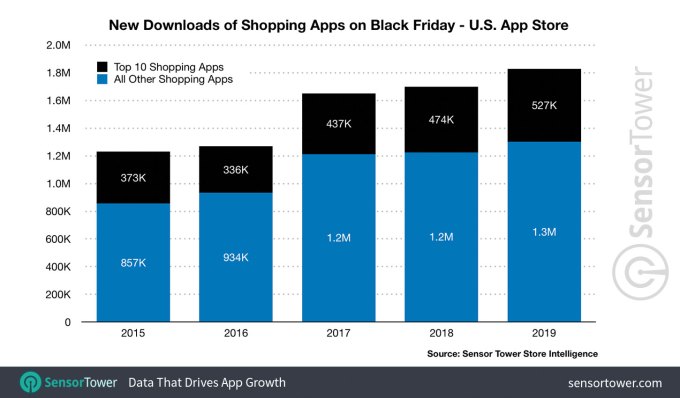
The further top 10 list included: Target, Best Buy, GOAT, Nike, Kohl’s, Wish, Macy’s, and Adidas. Combined, these top 10 most-download apps grew 11% year-over-year, reaching a total 527,000 installs. That’s 28.8% of all downloads for the Shopping category — the largest percentage since the Shopping category’s creation in 2015.

Overall, the number of first-time downloads in the U.S. App Store’s Shopping category on Black Friday increased 8% year-over-year, and totaled 1.8 million downloads.

Though Walmart was No 1 in the U.S., Amazon was No. 1 when apps were ranked globally instead of U.S.-only and it was No. 1 among all U.S. online-only apps.

While Sensor Tower’s analysis is based on Black Friday installs, not Cyber Monday data, Amazon’s worldwide dominance on this day does seem to back up the retailer’s own claims of its record-breaking sales on a global basis on Monday.

Amazon said customers bought “hundreds of millions” of products between Thanksgiving and Cyber Monday. And it said “millions more” customers bought Amazon devices, like Echo Dot and Fire TV Stick, compared with the same period last year. (That may be true, but Amazon devices are also more broadly available to customers worldwide compared with 2018 — so perhaps this isn’t the fairest comparison.)

Walmart, meanwhile, didn’t tout its Cyber Monday event’s numbers, but said “millions” of customers joined for Black Friday sales online and in stores.

One thing that could have boosted Walmart’s app downloads this year was its focus on the in-store customer.

The app now includes an updated Store Map that makes it easier to navigate Walmart’s aisles, and it features “Check out with Me” — a way for shoppers to avoid checkout lines and instead check out with store personnel in the aisles.

03 Dec 2019

AWS launches Sagemaker Studio, a web-based IDE for machine learning

At its re:Invent conference, AWS CEO Andy Jassy today announced the launch of SageMaker Studio, a web-based IDO for building and training machine learning workflows. It includes everything a data scientist would need to get started with, including ways to organize notebooks, data sets, code and models, for example. It essentially wants to be a one-stop-shop for all the machine learning tools and results you need to get started.

At the core of Studio is also the ability to share projects and folders with others who are working on the same project, including the ability to discuss notebooks and results.

Since you need to train those models, too, the service is obviously integrated with AWS’s SageMaker machine learning service, which can automatically scale based on your needs.

In addition to Studio, AWS also today announced a number of other updates to SageMaker that are integrated into Studio. Most of these run under the hood of Studio, but you can also use them as stand-alone tools. These include a debugger, a monitoring tool, and Autopilot, which automatically creates the best models for you based on your data, with full visibility into how it decides to build your models.

Related to this AWS also launched SageMaker Notebooks today, which is also integrated into Studio. These are, in essence, notebooks as a managed service. Data scientists won’t have to provision instances for this as the service will automatically provision them as necessary.

Ideally, Studio will make building models significantly more accessible to a wider range of developers. AWS calls this the middle-layer of the stack, which is meant for machine learning practitioners who don’t want to delve into all the details but still have a lot of hands-on control.