Year: 2019

16 Aug 2019

Lumineye helps first responders identify people through walls

Any first responder knows that situational awareness is key. In domestic violence disputes, hostage rescue, or human trafficking situations, first responders often need help determining where humans are behind closed doors.

That’s why Megan Lacy, Corbin Hennen and Rob Kleffner developed Lumineye, a 3D printed radar device that uses signal analysis software to differentiate moving and breathing humans from other objects, through walls.

Lumineye uses pulse radar technology that works like echolocation (how bats and dolphins communicate). It sends signals and listens for how long it takes for a pulse to bounce back. The software analyzes these pulses to determine the approximate size, range and movement characteristics of a signal.

On the software side, Lumineye’s app that will tell a user how far away a person is when they’re moving and breathing. It’s one dimensional, so it doesn’t tell the user whether the subject is to the right or left. But the device can detect humans out to 50 feet in open air, and that range decreases depending upon the materials placed in between like drywall, brick or concrete.

One scenario the team gave to describe the advantages of using Lumineye was the instance of hostage rescue. In this type of situation, it’s crucial for first responders to know how many people are in a room and how far away they are from one another. That’s where the use of multiple devices and triangulation from something like Lumineye could change a responding team’s tactical rescue approach.

Machines that currently exist to make these kind of detections are heavy and cumbersome. The team behind Lumineye was inspired to manufacture a more portable option that won’t weigh teams down during longer emergency response situations that can sometimes last for up to 12 hours or overnight. The prototype combines the detection hardware with an ordinary smartphone. It’s about 10 x 5 inches and weighs 1.5 pounds.

Lumineye wants to grow out its functionality to become more of a ubiquitous device. The team of four is planning to continue manufacturing the device and selling it directly to customers.
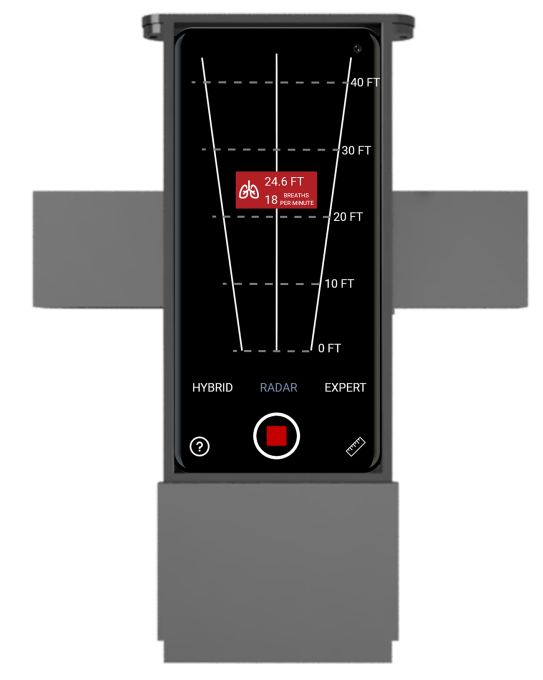
 

Lumineye Device BreathingMode

Lumineye’s device can detect humans through walls using radio frequencies

Lumineye has just started its pilot programs, and recently spent a Saturday at a FEMA event testing out the the device’s ability to detect people covered in rubble piles. The company was born out of the Boise Idaho cohort of Stanford’s Hacking4Defense program, a course meant to connect Silicon Valley innovations with the U.S. Department of Defense and Intelligence Community. The Idaho-based startup is graduating from Y Combinator’s Summer 2019 class.
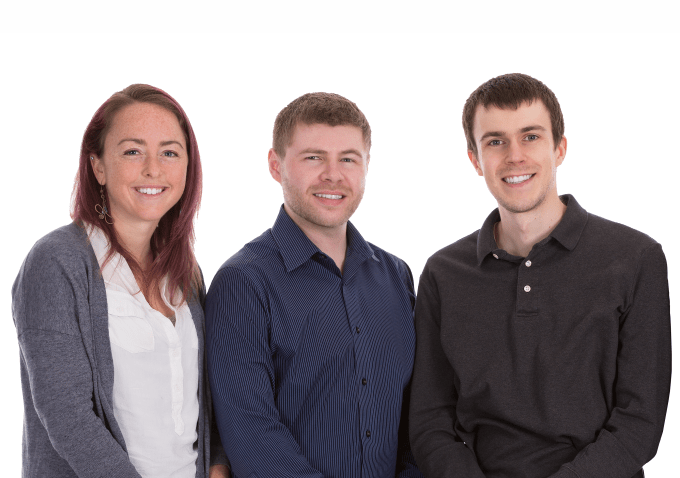
Lumineye TeamPicture 1

Megan Lacy, Corbin Hennen and Rob Kleffner

16 Aug 2019

Slack co-founder Cal Henderson and Spark Capital’s Megan Quinn are coming to Disrupt SF

If there was one company at the top of everyone’s mind this year, it was Slack.

The now-ubiquitous workplace messaging tool began trading on the New York Stock Exchange in June after taking an unusual route to the public markets known as a direct listing. Slack bypassed the typical IPO process in favor of putting its current stock on to the NYSE without doing an additional raise or bringing on underwriter banking partners.

Slack co-founder and chief technology officer Cal Henderson and Slack investor and Spark Capital general partner Megan Quinn will join us on stage at TechCrunch Disrupt SF to give a behind the scenes look at Slack’s banner year, the company’s origin story and what convinced Quinn to participate in the business’s funding round years ago.

Early in his career, Henderson was the technical director of Special Web Projects at Emap, a UK media company. Later, he became the head of engineering for Flickr, the photo-sharing tool co-founded by Slack chief Steward Butterfield. In April 2009, he was reported to be starting a new stealth social gaming company with Butterfield, a project that would ultimately become Slack.

Quinn, for her part, added Slack to the Spark Capital portfolio in 2015, participating in the company’s $160 million Series E at a valuation of $2.8 billion. No small startup at the time, Slack already had 750,000 daily users and backing from Accel, Andreessen Horowitz, Social Capital, GV and Kleiner Perkins.

Quinn is a seasoned investor, known for striking deals with Coinbase, Glossier, Rover and Wealthfront, among others. She first entered the venture capital scene in 2012 as an investment partner at Kleiner Perkins, where she invested in early to mid-stage consumer tech startups. Quinn joined Spark Capital in 2015 to make growth-stage investments in companies across the board.

Before trying her hand at VC, she spent seven years in product management and strategic partnership development at Google and one year as the head of product at payments company Square.

Disrupt SF runs October 2 to October 4 at the Moscone Center in San Francisco. Tickets are available here.

16 Aug 2019

Google discloses its acquisition of mobile learning app Socratic as it relaunches on iOS

Google publicly disclosed its acquisition of homework helper app Socratic in an announcement this week, detailing the added support for the company’s A.I. technology and its relaunch on iOS. The acquisition apparently flew under the radar — Google says it bought the app last year.

According to one founder’s LinkedIn update, that was in March 2018. Google hasn’t responded to requests for comment for more details about the deal, but we’ll update if that changes.

Socratic was founded in 2013 Chris Pedregal and Shreyans Bhansali with the goal of creating a community that made learning accessible to all students.

Initially, the app offered a Quora-like Q&A platform where students could ask questions which were answered by experts. By the time Socratic raised $6 million in Series A funding back in 2015, its community had grown to around 500,000 students. The company later evolved to focus less on connecting users and more on utility.

It included a feature to take a photo of a homework question in order to get instant explanations through the mobile app launched in 2015. This is similar to many other apps in the space, like Photomath, Mathway, DoYourMath, and others.

However, Socratic isn’t just a math helper — it can also tackle subjects like science, literature, social studies, and more.

In February 2018, Socratic announced it would remove the app’s social features. That June, the company said it was closing its Q&A website to user contributions. This decision was met with some backlash of disappointed users.

Socratic explained the app and website were different products, and it was strategically choosing to focus on the former.

“We, as anyone, are bound by the constraints of reality—you just can’t do everything—which means making decisions and tradeoffs where necessary. This one is particularly painful,” wrote Community Lead Becca McArthur at the time.

That strategy, apparently, was to make Socratic a Google A.I.-powered product. According to Google’s blog post penned by Bhansali — now the Engineering Manager at Socratic — the updated iOS app uses A.I. technology to help users.

askaquestion

The new version of the iOS app still allows you to snap a photo to get answers, or you can speak your question.

For example, if a student takes a photo from a classroom handout or asks a question like “what’s the difference between distance and displacement?,” Socratic will return a top match, followed by explainers, a Q&A section, and even related YouTube videos and web links. It’s almost like a custom search engine just for your homework questions.

Google also says it has built and trained algorithms that can analyze the student’s question then identify the underlying concepts in order to point users to these resources. For students who need even more help, the app can break down the concepts into smaller, easy-to-understand lessons.

googleai v2

In addition, the app includes subject guides on over 1,000 higher education and high school topics, developed with help from educators. The study guides can help students prepare for tests or just better learn a particular concept.

explorer 56kHA30

“In building educational resources for teachers and students, we’ve spent a lot of time talking to them about challenges they face and how we can help,” writes Bhansali. “We’ve heard that students often get ‘stuck’ while studying. When they have questions in the classroom, a teacher can quickly clarify—but it’s frustrating for students who spend hours trying to find answers while studying on their own,” he says.

This is where Socratic will help.

That said, the acquisition could help Google in other ways, too. In addition to its primary focus as a homework helper, the acquisition could aid Google Assistant technology across platforms, as the virtual assistant could learn to answer more complex questions that Google’s Knowledge Graph didn’t already include.

The relaunched, A.I.-powered version of Socratic by Google arrived on Thursday on iOS, where it also discloses through the app update text the app is now owned by Google.

The Android version of the app will launch this fall.


16 Aug 2019

Northrop Grumman to build its OmegA rocket at NASA’s VAB as first commercial tenant

NASA is celebrating alongside Northrop Grumman at Kennedy Space Center in Florida, as the latter becomes the first commercial partner to make use of the Vehicle Assembly Building on-site at the base. The VAB, as its more commonly known, is a cavernous building that’s used to build and test rockets ahead of rolling them out to nearby launch pads, which was originally constructed by NASA to support the Apollo program.

Northrop Grumman will be using the VAB to build and prep its OmegA launch vehicle, a new rocket the company is building to transport intermediate and heavy payloads to orbit. It’s a fully expendable rocket, which Northrop is positioning as a lower-risk alternative to reusable models flown by competitors (cough SpaceX cough) and it’s also build as an ‘affordable’ option for those seeking launch services. OmegA is designed to help Northrop Grumman compete for future national security launch contracts, as well as support commercial customer missions.

NASA will also continue to use the VAB for the assembly of its own Space Launch System (SLS) rocket, which will be supporting missions in the Artemis program and transporting the Lockheed Martin-built Orion crew craft to space, and eventually to the Moon.

Kennedy also already plays host to rocket assembly and launch facilities for both SpaceX and Blue Origin, making it a hot spot for public-private space business activity.

16 Aug 2019

Amazon customers say they received emails for other people’s orders

Users have said they are receiving emails from Amazon containing invoices and order updates on other customers, TechCrunch has learned.

Jake Williams, founder of cybersecurity firm Rendition Infosec, raised the alarm after he received an email from Amazon addressed to another customer with their name, postal address, and their order details.

Williams said he ordered something months ago which recently became available for shipping. He checked the email headers to make sure it was a genuine message.

“I think they legitimately intended to email me a notification that my item was shipping early,” he said. “I just think they screwed something up in the system and sent the updates to the wrong people.”

He said the apparent security lapse was worrying because emails about orders sent to the wrong place is a “serious breach of trust” that can reveal private information about a customer’s life, such as sexual orientation, proclivities, or other personal information

Several other Amazon customers also said they received emails seemingly meant for other people.

“I made an order yesterday afternoon and received her email last night,” another customer who tweeted about the mishap told TechCrunch. “Luckily I’m not a malicious person but that’s a huge security issue,” she said.

Another customer tweeted out about receiving an email meant for someone else. He said he spoke to Amazon customer service who said they will investigate additional security issues.

“Hope you didn’t send my sensitive account info to someone else,” he added.

And, one other customer posted a tweet thread about the issue, saying they spoke to a supervisor about the issue who gave a “nonchalant” response, she wrote. She said the supervisor said the issue happens frequently.

A spokesperson for Amazon did not return a request for comment when we asked how many customers were affected and if the company plans on informing customers of the breach. If we hear back, we’ll update.

It’s the second security lapse in a year. In November the company emailed customers saying a “technical error” had exposed an unknown number of their email addresses. When asked about specifics, the notoriously secretive company declined to comment further.

16 Aug 2019

Showcase your startup in Startup Alley at Disrupt SF 2019

What’s the lifeblood of any early-stage startup? Money and media coverage. Opportunities to acquire both abound at Disrupt San Francisco 2019, our flagship tech conference that takes place on October 2-4. It’s all about networking and making the right connections to make your startup dreams come true, and there’s no better networking mecca than Startup Alley.

Buy a Startup Alley Exhibitor Package and plant your early-stage startup in the path of more than 10,000 attendees, including leading technologists, investors, 400 accredited media outlets and other leading influencers. The package includes one full exhibit day and three Founder passes.

You’ll have access to three days of Disrupt programming across the Main Stage, the Extra Crunch Stage, the Showcase Stage and the Q&A Stage. You can watch Startup Battlefield, our epic pitch competition, to see who takes home the $100,000 prize. You’ll also receive invitations to VIP events, like a reception with top-tier investors and global media outlets.

You’ll have CrunchMatch at your side to make networking as easy as possible. This free, business match-making platform helps you find and connect with the people who can move your business forward. It matches people based on their mutual business interests, suggests meetings and sends out invitations (which recipients can easily accept or decline). CrunchMatch even lets you reserve dedicated meeting spaces where you can network in comfort.

And how’s this for opportunity? Every early-stage startup that exhibits in Startup Alley is eligible for a chance to win a Wild Card entry to the Startup Battlefield pitch competition. TechCrunch editors will select two standout startups as Wild Card teams to compete for $100,000 in Startup Battlefield.

It might sound like a longshot (and it is), but RecordGram earned a Wild Card spot and went on to become the Startup Battlefield champ at Disrupt NY 2017. Because dreams do come true.

Disrupt San Francisco 2019 takes place on October 2-4. Buy a demo table, exhibit in Startup Alley and network your way to greatness. Come on and show the world what you’ve got.

Is your company interested in sponsoring at Disrupt SF 2019? Contact our sponsorship sales team by filling out this form.

16 Aug 2019

Why startups ads are taking over the subway

If you’re a New Yorker, one of the easiest ways to keep up-to-date on the latest consumer products — furniture, beauty products, mobile apps, you name it — is to hop on the subway.

Even before you board, you may find yourself walking through a station filled with colorful startup ads. And once you’re actually on the train, you may find yourself surrounded by even more of those of ads.

It felt very different when I first moved to New York in 2013, back when the only companies that seemed to buy subway ads were local colleges, law firms and sketchy-sounding surgeons. Over the next few years, I noticed that the companies I wrote about in TechCrunch were starting to show up on the subway walls.

These ads are managed by Outfront Media, which has an exclusive contract with the MTA and says it’s worked with more than 150 startups and direct-to-consumer brands since 2018.

“Startups and DTC brands, now more than ever before, are looking for ways to raise awareness and gain market share among a heavy competitor set,” said Outfront’s chief product experience officer Jason Kuperman via email. “For these brands, it is all about testing and learning, and leveraging out-of-home (OOH) [advertising] and advertising on the subway allows them to do just that.”

Kuperman added that when they launch their subway campaigns, many of these startups are unknown, so they “find value in a permanent place to advertise that people pass through every day.”

From out-of-home to in transit

John Laramie, CEO of out-of-home advertising agency Project X, agreed that there’s been a big shift over the past few years.

He and I first spoke in 2011 about startups buying billboard ads alongside Silicon Valley’s main highway, Route 101. More recently, he told me, “Fast forward to the last four years, and who cares about the 101? It’s all about the New York City subway.”

16 Aug 2019

SmileDirectClub files to go public amidst concerns from dental associations

SmileDirectClub, the at-home teeth-straightening service, is on its way to becoming a public company. SmileDirectClub is seeking to raise up to $100 million in its IPO, according to its S-1 filed today. The number of shares and price range for the offering have yet to be determined.

Prior to this, SmileDirectClub reached a $3.2 billion valuation following a $380 million funding round last October. Investors from Clayton, Dubilier & Rice led the round, which featured participation from Kleiner Perkins and Spark Capital. This funding came on top of Invisalign maker Align Technology’s $46.7 million investment in SmileDirectClub in 2016, and another $12.8 million investment in 2017 to own a total of 19 percent of the company.

In 2018, SmileDirectClub’s revenues came in at $432.2 million, a significant uptick from just $147 million the year prior.

The company ships invisible aligners directly to customers, and licensed dental professionals (either orthodontists or general dentists) remotely monitor the progress of the patient. Before shipping the aligners, patients either take their dental impressions at home and send them to SmileDirectClub or visit one of the company’s “SmileShops” to be scanned in person. SmileDirectClub says it costs 60 percent less than other types of teeth-straightening treatments, with the length of treatments ranging from four to 14 months. The average treatment lasts six months.

Though, members of the American Association of Orthodontists have taken issue with SmileDirectClub, previously asserting that SmileDirectClub violates the law because its methods of allowing people to skip in-person visits and X-rays is “illegal and creates medical risks.” The organization has also filed complaints against SmileDirectClub in 36 states, alleging violations of statutes and regulations governing the practice of dentistry. Those complaints were filed with the regulatory boards that oversee dentistry practices and with the attorneys general of each state.

SmileDirectClub explicitly calls out those issues in its S-1 as potential risk factors. Here’s a key nugget:

A number of dental and orthodontic professionals believe that clear aligners are appropriate for only a limited percentage of their patients. National and state dental associations have issued statements discouraging use of orthodontics using a teledentistry platform. Increased market acceptance of our remote clear aligner treatment may depend, in part, upon the recommendations of dental and orthodontic professionals and associations, as well as other factors including effectiveness, safety, ease of use, reliability, aesthetics, and price compared to competing products.

Furthermore, our ability to conduct business in each state is dependent, in part, upon that particular state’s treatment of remote healthcare and that state dental board’s regulation of the practice of dentistry, each which are subject to changing political, regulatory, and other influences. There is a risk that state authorities may find that our contractual relationships with our doctors violate laws and regulations prohibiting the corporate practice of dentistry, which generally bar the practice of dentistry by entities. Two state dental boards have established new rules or interpreted existing rules in a manner that purports to limit or restrict our ability to conduct our business as currently conducted.

Additionally, as the S-1 notes, a national dental association recently filed a petition with the U.S. Food and Drug Administration claiming that SmileDirectClub’s manufacturing violates “prescription only” requirements. While no regulations or laws have been passed that would affect SmileDirectClub to date, it’s a possible scenario that would greatly impact the company’s core business.

16 Aug 2019

YC-backed Lokal wants to bring local news, classifieds to 900 million Indians in their regional languages

Each month millions of Indians are coming online for the first time, making India the last great growth market for internet companies worldwide. But winning them presents its own challenges.

These users, most of whom live in small cities and villages in India, can’t speak English. Their interests and needs are different from those of their counterparts in large cities. When they come online, the world wide web that is predominantly focused on the English-speaking masses, suddenly seems tiny, Google executives acknowledged at a media conference last year. According to a KPMG-Google report (PDF) on Indian languages, there will be 536 million non-English speaking users using internet in India by 2021.

Many companies are increasingly adding support for more languages, and Silicon Valley giants such as Google are developing tools to populate the web with content in Indian languages.

But there is still room for others to participate. On Friday, a new startup announced it is also in the race. And it has already received the backing of Y Combinator (YC).

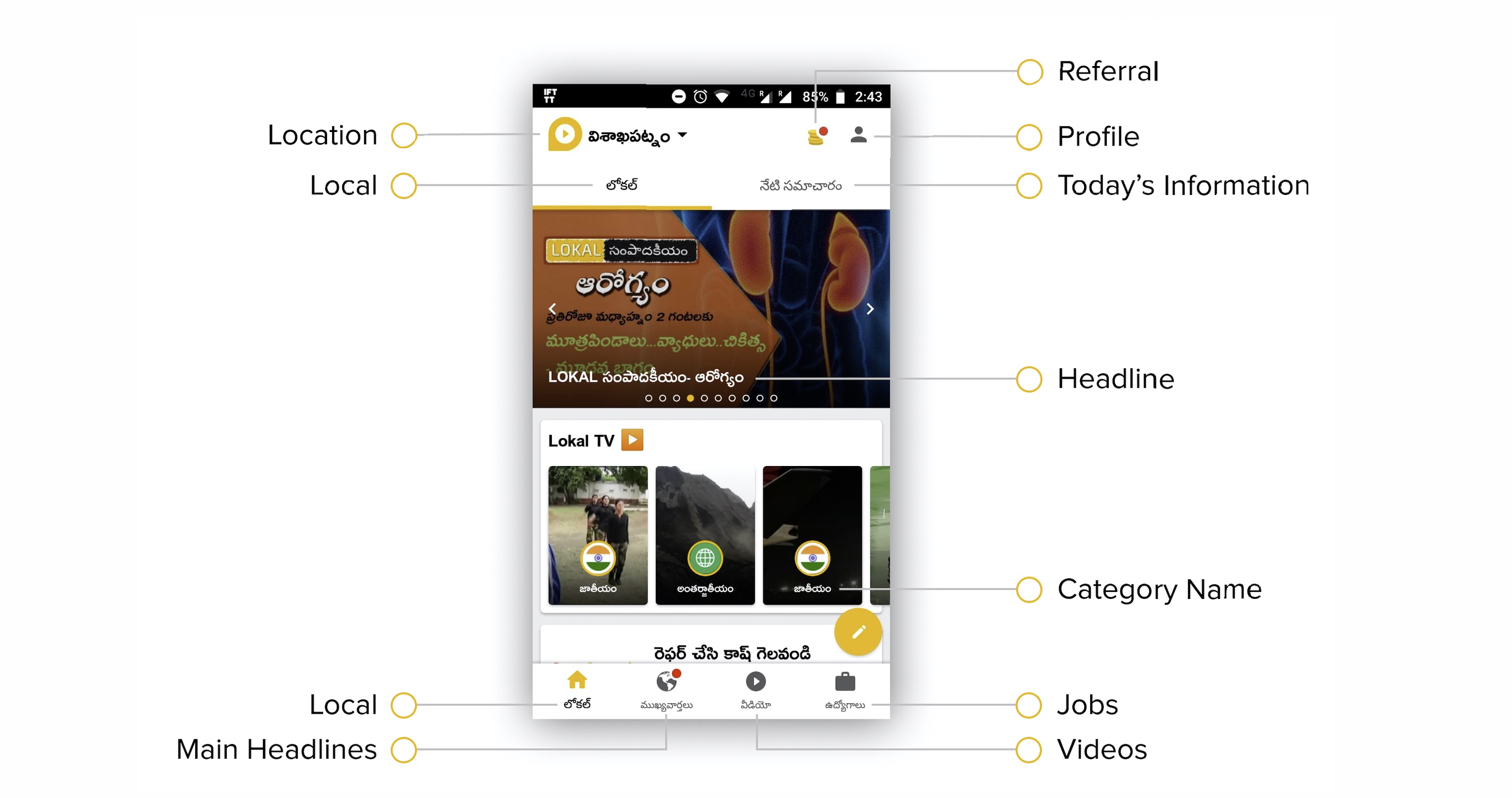
Lokal is a news app that wants to bring local news to hundreds of millions of users in India in their regional languages. The startup, which is currently available in the Telugu language, has already amassed more than two million users, Jani Pasha, co-founder of Lokal, told TechCrunch in an interview.

lokal homescreen

There are tens of thousands of publications in India and several news aggregators that showcase the top stories from the mainstream outlets. But very few today are focusing on local news and delivering it in a language that the masses can understand, Pasha said.

Lokal is building a network of stringers and freelance reporters who produce original reporting around the issues and current affairs of local towns and cities. The app is updated throughout the day with regional news and also includes an “information” stream that shows things like current price of vegetables, upcoming events and contact details for local doctors and police stations.

The platform has grown to cover 18 districts in South India and is slowly ramping up its operations to more corners of the country. The early signs show that people are increasingly finding Lokal useful. “In 11 of the 18 districts we cover, we already have a larger presence and reader base than other media houses,” Pasha said.

Before creating Lokal, Pasha and the other co-founder of the startup, Vipul Chaudhary, attempted to develop a news aggregator app. The app presented news events in a timeline, offering context around each development.

“We made the biggest mistake. We built the product for four to five months without ever consulting with the users. We quickly found that nobody was using it. We went back to the drawing board and started interviewing users to understand what they wanted. How they consumed news, and where they got their news from,” he said.

“One thing we learned was that most of these users in tier 2 and tier 3 India still heavily rely on newspapers. Newspapers still carry a lot of local news and they rely on stringers who produce these news pieces and source them to publications,” he added.

But newspapers have limited pages, and they are slow. So Pasha and the team tried to build a platform that addresses these two things.

Pasha tried to replicate it through distributing local news, sourced from stringers, on a WhatsApp group. “That one WhatsApp group quickly became one of many as more and more people kept joining us,” he recalls. And that led to the creation of Lokal.

Along the journey, the team found that classifieds, matrimonial ads and things like birthday wishes are still driving people to newspapers, so Lokal has brought those things to the platform.

Pasha said Lokal will expand to three more states in the coming months. It will also begin to experiment with monetization, though that is not the primary focus currently. “The plan is to eventually bring this to entire India,” he said.

A growing number of startups today are attempting to build solutions for what they call India 2 and India 3 — the users who don’t live in major cities, don’t speak English and are financially not as strong.

ShareChat, a social media platform that serves users in 15 regional languages — but not English — said recently it has raised $100 million in a round led by Twitter. The app serves more than 60 million users each month, a figure it wants to double in the next year.

16 Aug 2019

Postmates lands permit to test its Serve autonomous delivery robots in SF

Postmates has officially received the green light from the city of San Francisco to begin testing its Serve wheeled delivery robot on city streets, as first reported by the SF Chronicle and confirmed with Postmates by TechCrunch. The on-demand delivery company told us last week that it expected the issuance of the permit to come through shortly after a conditional approval, and that’s exactly what happened on Wednesday thes week.

The permit doesn’t cover the entire city – just a designated area of a number of blocks in and around Potrero Hill and the Inner Mission, but it will allow Postmates to begin testing up to three autonomous delivery robots at once, at speeds of up to 3 mph. Deliveries can only take place between 8 AM and 6:30 PM on weekdays, and a human has to be on hand within 30 feet of the vehicles while they’re operating at all times. Still, it’s a start, and green light for a city regulatory environment that has had a somewhat rocky start with some less collaborative early pilots from other companies.

Autonomous delivery bot company Marble also has a permit application pending with the city’s Public Works department, and will look to test its own four-wheeled, sensor-equipped rolling delivery bots within the city soon should it be granted similar testing approval.

Postmates first revealed Serve last December, taking a more anthropomorphic approach to the vehicle’s overall design. Like many short-distance delivery robots of its ilk, it includes a lockable cargo container and screen-based user interface for eventual autonomous deliveries to customers. The competitive field for autonomous rolling delivery bots is growing continuously, with companies like Starship Technologies, Amazon and many more throwing their hats in the ring.