Year: 2019

14 Aug 2019

Artificial intelligence can contribute to a safer world

We all see the headlines nearly every day. A drone disrupting the airspace in one of the world’s busiest airports, putting aircraft at risk (and inconveniencing hundreds of thousands of passengers) or attacks on critical infrastructure.  Or a shooting in a place of worship, a school, a courthouse.  Whether primitive (gunpowder) or cutting-edge (unmanned aerial vehicles) in the wrong hands, technology can empower bad actors and put our society at risk, creating a sense of helplessness and frustration.

Current approaches to protecting our public venues are not up to the task, and, frankly appear to meet Einstein’s definition of insanity: “doing the same thing over and over and expecting a different result.”  It is time to look past traditional defense technologies and see if newer approaches can tilt the pendulum back in the defender’s favor.  Artificial Intelligence (AI) can play a critical role here, helping to identify, classify and promulgate counteractions on potential threats faster than any security personnel.

Using technology to prevent violence, specifically by searching for concealed weapons has a long history. Alexander Graham Bell invented the first metal detector in 1881 in an unsuccessful attempt to locate the fatal slug as President James Garfield lay dying of an assassin’s bullet. The first commercial metal detectors were developed in the 1960s. Most of us are familiar with their use in airports, courthouses and other public venues to screen for guns, knives and bombs.

However, metal detectors are slow and full of false positives – they cannot distinguish between a Smith & Wesson and an iPhone.  It is not enough to simply identify a piece of metal; it is critical to determine whether it is a threat.  Thus, the physical security industry has developed newer approaches, including full-body scanners – which are now deployed on a limited basis. While effective to a point, the systems in use today all have significant drawbacks. One is speed. Full body scanners, for example, can process only about 250 people per hour, not much faster than a metal detector. While that might be okay for low volume courthouses, it’s a significant problem for larger venues like a sporting arena.

Image via Getty Images

Fortunately, new AI technologies are enabling major advances in physical security capabilities. These new systems not only deploy advanced sensors to screen for guns, knives and bombs, they get smarter with each screen, creating an increasingly large database of known and emerging threats while segmenting off alarms for common, non-threatening objects (keys, change, iPads, etc.)

As part of a new industrial revolution in physical security, engineers have developed a welcomed approach to expediting security screenings for threats through machine learning algorithms, facial recognition, and advanced millimeter wave and other RF sensors to non-intrusively screen people as they walk through scanning devices.  It’s like walking through sensors at the door at Nordstrom, the opposite of the prison-like experience of metal detectors with which we are all too familiar.  These systems produce an analysis of what someone may be carrying in about a hundredth of a second, far faster than full body scanners. What’s more, people do not need to empty their pockets during the process, further adding speed. Even so, these solutions can screen for firearms, explosives, suicide vests or belts at a rate of about 900 people per hour through one lane.

Using AI, advanced screening systems enable people to walk through quickly and provide an automated decision but without creating a bottleneck. This volume greatly improves traffic flow while also improving the accuracy of detection and makes this technology suitable for additional facilities such as stadiums and other public venues such as Lincoln Center in New York City and the Oakland airport.
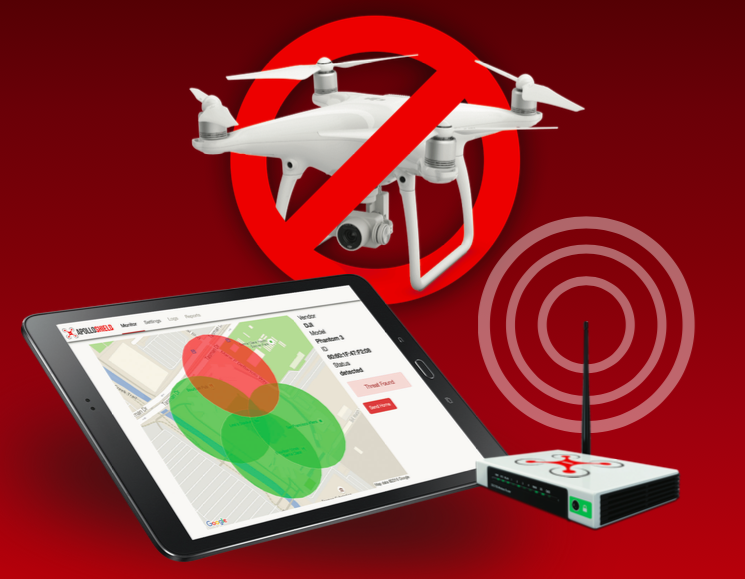
Apollo Shield’s anti-drone system.


So much for the land, what about the air?   Increasingly drones are being used as weapons. Famously, this was seen in a drone attack last year against Venezuelan president Nicolas Maduro. An airport drone incident drew widespread attention when a drone shut down Gatwick Airport in late 2018 inconveniency stranded tens of thousands of people.

People are rightly concerned about how easy it is to get a gun. Drones are also easy to acquire and operate, and quite difficult to monitor and to defend against. AI is now being deployed to prevent drone attacks, whether at airports, stadiums, or critical infrastructure. For example, new AI-powered radar technology is being used to detect, classify, monitor and safely capture drones identified as dangerous.

Additionally, these systems use can rapidly develop a map of the airspace and effectively create a security “dome” around specific venues or areas. These systems have an integration component to coordinate with on-the-ground security teams and first responders.  Some even have a capture drone to incarcerate a suspicious drone. When a threatening drone is detected and classified by the system as dangerous, the capture drone is dispatched and nets the invading drone. The hunter then tows the targeted drone to a safe zone for the threat to be evaluated and if needed, destroyed.

While there is much dialogue about the potential risk of AI affecting our society, there is also a positive side to these technologies.  Coupled with our best physical security approaches, AI can help prevent violent incidents.

14 Aug 2019

Making sense of the WeWork S-1 (or trying to)

Hello and welcome back to Equity, TechCrunch’s venture capital-focused podcast, where we unpack the numbers behind the headlines.

Today is our promised Equity Shot (a short-form, single-topic episode) on the WeWork S-1. You can read Kate’s notes here, or Alex’s here as a place to start.

Given that we didn’t know when the WeWork S-1 filing was going to make itself known, we put together this episode from TechCrunch’s SF HQ, Alex’s home office, and Kate inside a New York Blue Bottle Coffee. We were not about to let the locational issues stop us from having fun!

Where to begin! WeWork is growing like mad, but it’s hard to tell what its gross margins are. This makes its revenue quality hard to parse. (Alex tried to figure that out here, TechCrunch has even more good questions and notes here). What wasn’t hard to figure out was that WeWork — also known as The We Company — is tectonically unprofitable on operating and net bases. And that the company’s operations consume cash, while its investing activities torch the stuff.

WeWork’s eclectic chief executive officer and co-founder Adam Neumann will maintain a majority of voting rights. It’s not uncommon for founder-led companies to adopt this sort of voting structure and considering how central Neumann is to WeWork’s identity, we weren’t the least bit surprised by this.

The company’s IPO will make a lot of groups a lot of money. Mainly Benchmark, a respected venture capital fund, JP Morgan, and, of course, SoftBank, which has invested billions in WeWork and now owns more than 100 million shares.

And that’s all for now. Don’t miss our episode with Dan Primack that came out yesterday. A busy week, but a good one. Chat again soon!

Equity drops every Friday at 6:00 am PT, so subscribe to us on Apple PodcastsOvercast, Pocket Casts, Spotify, Downcast and all the casts.

14 Aug 2019

Inside Voyage’s plan to deliver a driverless future

In two years, Voyage has gone from a tiny self-driving car upstart spun out of Udacity to a company able to operate on 200 miles of roads in retirement communities.

Now, Voyage is on the verge of introducing a new vehicle that is critical to its mission of launching a truly driverless ride-hailing service. (Human safety drivers not included.)

This internal milestone, which Voyage CEO Oliver Cameron hinted at in a recent Medium post, went largely unnoticed. Voyage, after all, is just a 55-person speck of a startup in an industry, where the leading companies have amassed hundreds of engineers backed by war chests of $1 billion or more. Voyage has raised just $23.6 million from investors that include Khosla Ventures, CRV, Initialized Capital and the venture arm of Jaguar Land-Rover.

Still, the die has yet to be cast in this burgeoning industry of autonomous vehicle technology. These are the middle-school years for autonomous vehicles — a time when size can be misinterpreted for maturity and change occurs in unpredictable bursts.

The upshot? It’s still unclear which companies will solve the technical and business puzzles of autonomous vehicles. There will be companies that successfully launch robotaxis and still fail to turn their service into a profitable commercial enterprise. And there will be operationally savvy companies that fail to develop and validate the technology to a point where human drivers can be removed.

Voyage wants to unlock both.

Crowded field

14 Aug 2019

Daily Crunch: Final Oculus co-founder departs Facebook

The Daily Crunch is TechCrunch’s roundup of our biggest and most important stories. If you’d like to get this delivered to your inbox every day at around 9am Pacific, you can subscribe here.

1. Facebook is losing its last Oculus co-founder

Nate Mitchell, the final Oculus co-founder remaining at Facebook, announced in an internal memo that he’s leaving the company and “taking time to travel, be with family, and recharge.” His role within the company has shifted several times since Oculus was acquired, but his current title is head of product management for virtual reality.

This follows the departures of former Oculus CEO Brendan Iribe and co-founder Palmer Luckey.

2. Twitter tests ways for users to follow and snooze specific topics

The company isn’t getting rid of the ability to follow other users, but it announced yesterday that it will start pushing users to start following topics as well, which will feature highly engaged tweets from a variety of accounts.

3. WeWork’s S-1 misses these three key points

WeWork just released its S-1 ahead of going public, but Danny Crichton argues we still don’t know the health of the core of the company’s business model or fully understand the risks it is undertaking. (Extra Crunch membership required.)

4. CBS and Viacom are merging into a combined company called ViacomCBS

The move is, in some ways, a concession to a turbulent media environment driving large-scale M&A, with AT&T buying Time Warner and Disney acquiring most of Fox — both deals are seen as consolidation in preparation for a streaming-centric future.

5. Nvidia breaks records in training and inference for real-time conversational AI

Nvidia’s GPU-powered platform for developing and running conversational AI that understands and responds to natural language requests has achieved some key milestones and broken some records, with big implications for anyone building on their tech.

6. Corporate carpooling startup Scoop raises $60 million

Scoop, which launched back in 2015, is a corporate carpooling service that works with the likes of LinkedIn, Workday, T-Mobile and more than 50 other companies to help their employees get to and from work.

7. Domino’s launches e-bike delivery to compete with UberEats, DoorDash

Domino’s will start using custom electric bikes for pizza delivery through a partnership with Rad Power Bikes.

14 Aug 2019

Ex-NSA chief Mike Rogers and Team8 founder Nadav Zafrir will be at Disrupt SF

What happens when two former spies meet the startup world? We’re about to find out.

We’re pleased to announce former National Security Agency director Adm. Mike Rogers will be at Disrupt SF on October 2-4. The former U.S. intelligence head oversaw the shadowy agency during one of its most tumultuous times in its history in the aftermath of the massive leak of classified documents by whistleblower Edward Snowden. He also oversaw the Pentagon’s cyberwar-fighting division, U.S. Cyber Command, amid Russian interference during the 2016 presidential election.

Since leaving the world of intelligence, Rogers became a senior advisor at Team8, a leading cybersecurity think tank and company creation platform, which helps to build cybersecurity companies from the ground up.

We’re also thrilled to announce Team8 founder Nadav Zafrir will join Rogers onstage at Disrupt, where both will discuss what they can bring to the world of security startups from their extensive intelligence and cybersecurity backgrounds.

Zafrir served as the commander of the elite technology and intelligence division Unit 8200, Israel’s equivalent of the NSA. Since leaving the unit, Zafrir founded Team8 to help cybersecurity companies go from idea to execution.

Team8 recently opened a New York headquarters, with Rogers serving as a key part of the U.S. expansion. To date, the think tank has enlisted several major investors, including Microsoft, Walmart and SoftBank.

Rogers and Zafrir will discuss what they learned from their time working in the intelligence space and what they bring to the startup world, and they’ll look ahead at the cybersecurity landscape and discuss what comes next.

Disrupt SF runs October 2 – October 4 at the Moscone Center in San Francisco. Tickets are available here!

14 Aug 2019

Huawei employees reportedly aided African governments in spying

A new report from The Wall Street Journal could be another damning piece of evidence for a company already under a good deal of international scrutiny. The paper is reporting that technicians working for Huawei helped members of government in Uganda and Zambia spy on political opponents.

The report cites unnamed senior surveillance officers. The paper adds that an investigation didn’t confirm a direct tie between the Chinese government or Huawei executives. It did, however, appear to confirm that employees for the tech giant played a part in intercepting communications.

The list includes encrypted messages, the use of apps like WhatsApp and Skype and tracking opponents using cellular data.

A representative for Zambia’s ruling party confirmed with the paper that Huawei technicians have helped in the fight against news sites with opposing stances in the country, stating, “Whenever we want to track down perpetrators of fake news, we ask Zicta, which is the lead agency. They work with Huawei to ensure that people don’t use our telecommunications space to spread fake news.”

Huawei has, naturally, denied any involvement, stating that it has “never been engaged in ‘hacking’ activities. Huawei rejects completely these unfounded and inaccurate allegations against our business operations. Our internal investigation shows clearly that Huawei and its employees have not been engaged in any of the activities alleged. We have neither the contracts, nor the capabilities, to do so.”

The company has, of course, been under international scrutiny in places like the U.S. and Europe over concerns that its telecommunications technologies could be used for spying on behalf of the Chinese government, allegations Huawei has strongly and often rebuffed.

14 Aug 2019

Why chipmaker Broadcom is spending big bucks for aging enterprise software companies

Last year Broadcom, a chipmaker, raised eyebrows when it acquired CA Technologies, an enterprise software company with a broad portfolio of products, including a sizable mainframe software tools business. It paid close to $19 billion for the privilege.

Then last week, the company opened up its wallet again and forked over $10.7 billion for Symantec’s enterprise security business. That’s almost $30 billion for two aging enterprise software companies. There has to be some sound strategy behind these purchases, right? Maybe.

Here’s the thing about older software companies. They may not out-innovate the competition anymore, but what they have going for them is a backlog of licensing revenue that appears to have value.

14 Aug 2019

‘Private’ and ‘hidden’ mean different things to Facebook

Facebook’s leadership made a pretty heavy-handed indications this year that it believes Facebook Groups are the future of the app, they announced all of this alongside their odd declaration that “The future is private.” Now, Facebook is changing the language describing the visibility of privacy of groups.

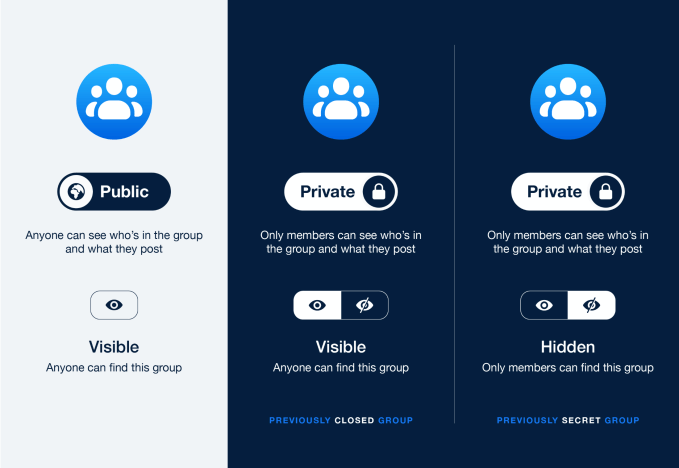
As the Groups feature comes front-and-center in recent redesigns, Facebook has decided that the language they have been using to describe the visibility of “Public,” “Closed,” and “Secret” Groups isn’t as clear as it should be, so the company is switching it up. Groups will now be labeled either “Public” or “Private.”

That means that groups that were previously “Closed” or “Secret” will now share the designation of “Private” meaning that only members of the group can see who’s in the group or what has been posted. The distinction is that there’s now a second metric, whether or not the group is “Visible,” which denoted if the group can be found via search. For groups that were previously “Closed,” the migration to the classification will leave them “Visible” while “Secret” groups will remain “Hidden.”

Screen Shot 2019 08 14 at 8.48.45 AM

In a way, this is kind of just Facebook throwing more privacy-related labels in their app to change perceptions while the feature sets stay the same, but denoting the visibility of a “closed” group in search was probably the biggest point of confusion here that Facebook was aiming to rectify. There’s a clear editorial message with Facebook conveying that there are shades and nuances to what “Private” means on Facebook compared to “Public” which is unwavering and defaulted.

14 Aug 2019

Pandora opens up podcast submissions to all creators

The battle for podcasters among music streaming services continues. A day after Spotify announced the launch of its podcast analytics dashboard, Pandora is today expanding its own podcasting efforts with the arrival of a self-service online hub for creators. The new Pandora for Podcasters will allow creators to submit their shows for inclusion on the streaming service, where they can be discovered through Pandora’s show and episode-level recommendation system.

Pandora’s entry into the podcast market began late last year, when it brought its “Genome” technology to podcast recommendations. Similar to how Pandora’s Music Genome is capable of classifying songs across hundreds of different attributes, the new Podcast Genome Project does the same for audio programs.

The system uses over 1,500 attributes — like MPAA ratings, production style, content type, host profile and more, as well as listener signals, like thumbs, skips, replays and more — combined with machine learning algorithms, natural language processing, and collaborative filtering methods to help determine user preferences.

An additional layer of human curation is also involved in making the final recommendations.

pandora podcastThe end result is a system that is able to suggest not just shows a listener may like, but also individual episodes, based on their likes, dislikes and other insights gained from their listening history.
When podcasts launched on Pandora in December 2018, the service offered hundreds of shows and over 100,000 episodes. There are now thousands of shows and over 500,000 episodes, the company now claims.

Pandora parent SiriusXM has also played a role in expanding the streamer’s podcast offerings, by bringing dozens of SiriusXM talk shows to Pandora as podcasts, and leveraging SiriusXM’s guests to narrate for Pandora’s music-and-audio product called Pandora Stories.

Now, podcast creators both large and small will be able to submit their own shows for inclusion into Pandora’s catalog. To do so, they’ll submit their show’s RSS feed URL to Pandora directly and answer a few questions about the podcast. If approved, the show will be available to allow of Pandora’s 65 million monthly active listeners and their future episodes will be added automatically.

This self-serve hub’s launch follows a similar move by Spotify nearly a year ago, when it opened up podcast submissions to all creators. Today, Spotify’s pitch to podcasters is to submit their shows in exchange for robust listener data. The company says it now has over 450,000 shows on its platform, with around 100,000 signing up for inclusion through its own self-submission process.

Interested podcast creators can now submit their shows to Pandora here after first registering for a Pandora account.

14 Aug 2019

Google’s new ‘Assignments’ software for teachers helps catch plagiarism

Just in time for the new school year, Google’s educational arm, Google for Education, today announced the launch of new tools aimed at helping teachers fight plagiarism. The company this morning is unveiling Assignments, an updated version of the software previously known as CourseKit, which will ship with new features that help instructors check students’ work to ensure it’s properly cited — not stolen from another source.

Students can also take advantage of the new tools, notes Google, as the feature will allow them to run these “originality reports” up to three times before submitting their final work to their teacher.

This gives students the chance to catch and fix any errors, while also saving the teacher time in grading, the company says.

The updated Google Assignments program does more than help catch cheaters, however.

AssignmentsGif

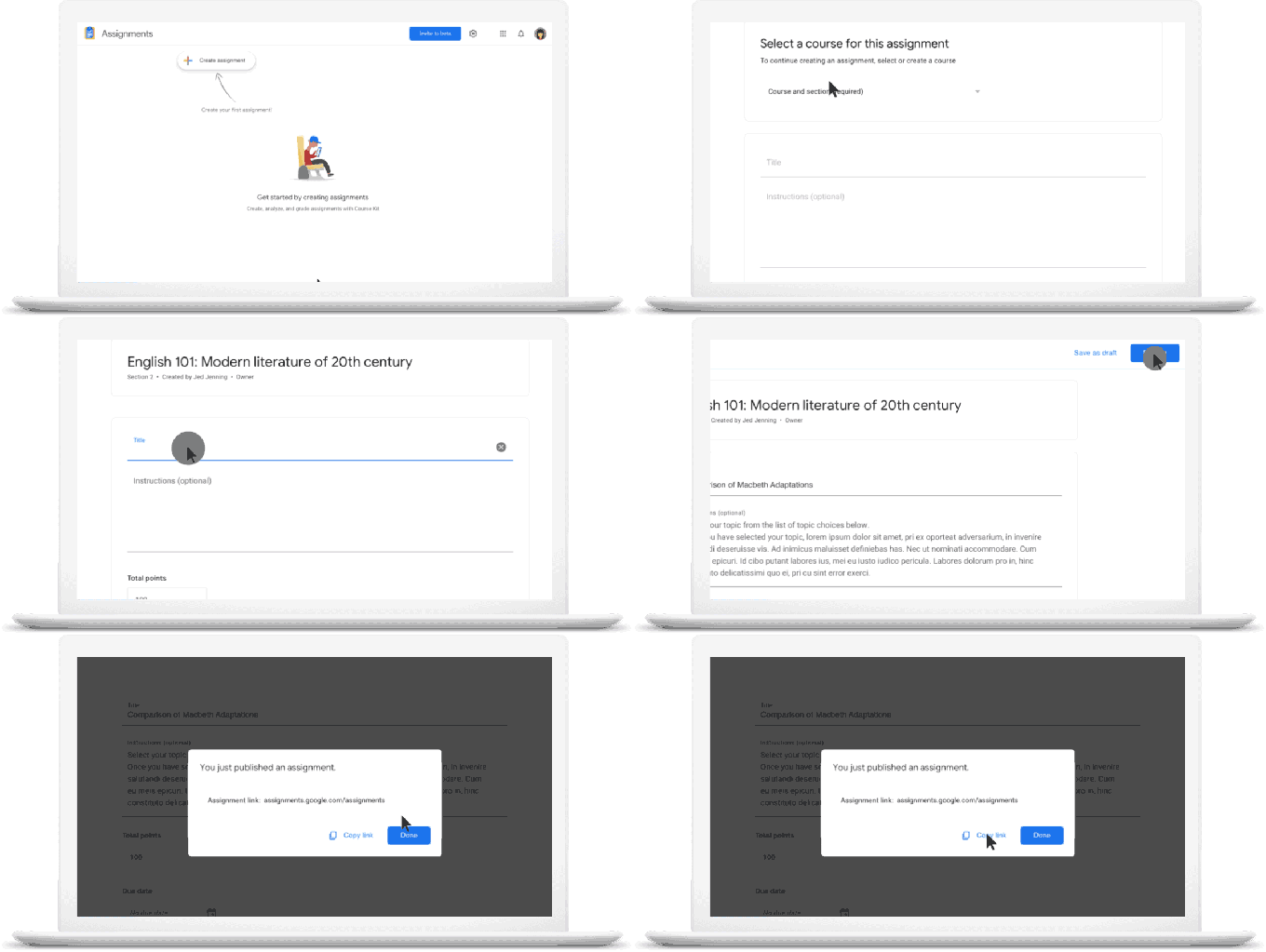
The software combines aspects of Google Docs, Google Drive and Google Search into a new tool that’s focused on the creation and management of schoolwork, including the collection, grading, and feedback process — and now, the ability to check for plagiarism, as well.

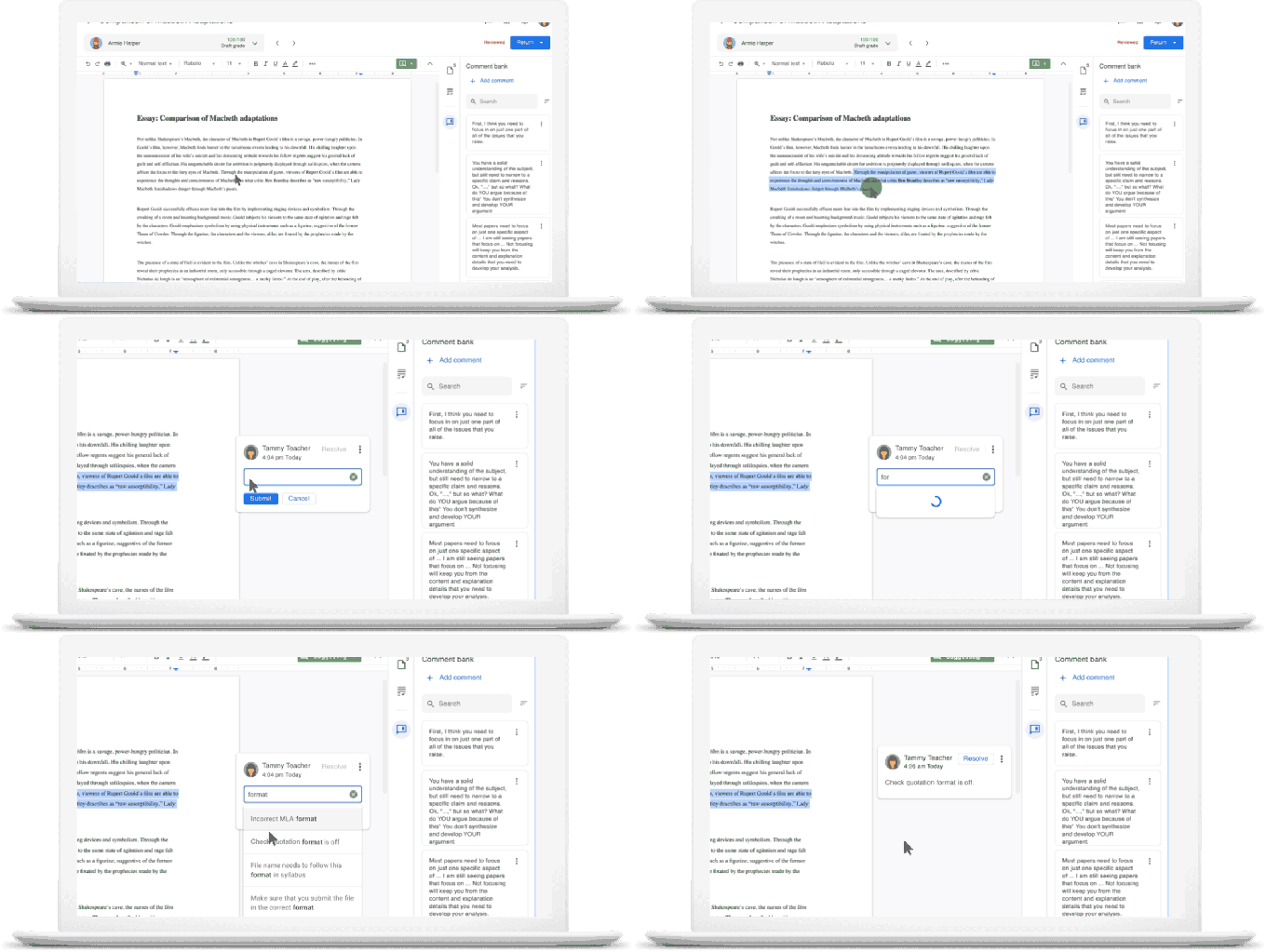
Other features include a comment bank to save teachers from typing the same feedback over and over; the ability to assign files to students without having to use the copier; the ability to grade assignments for a class with a student switcher and rubric included, and more.

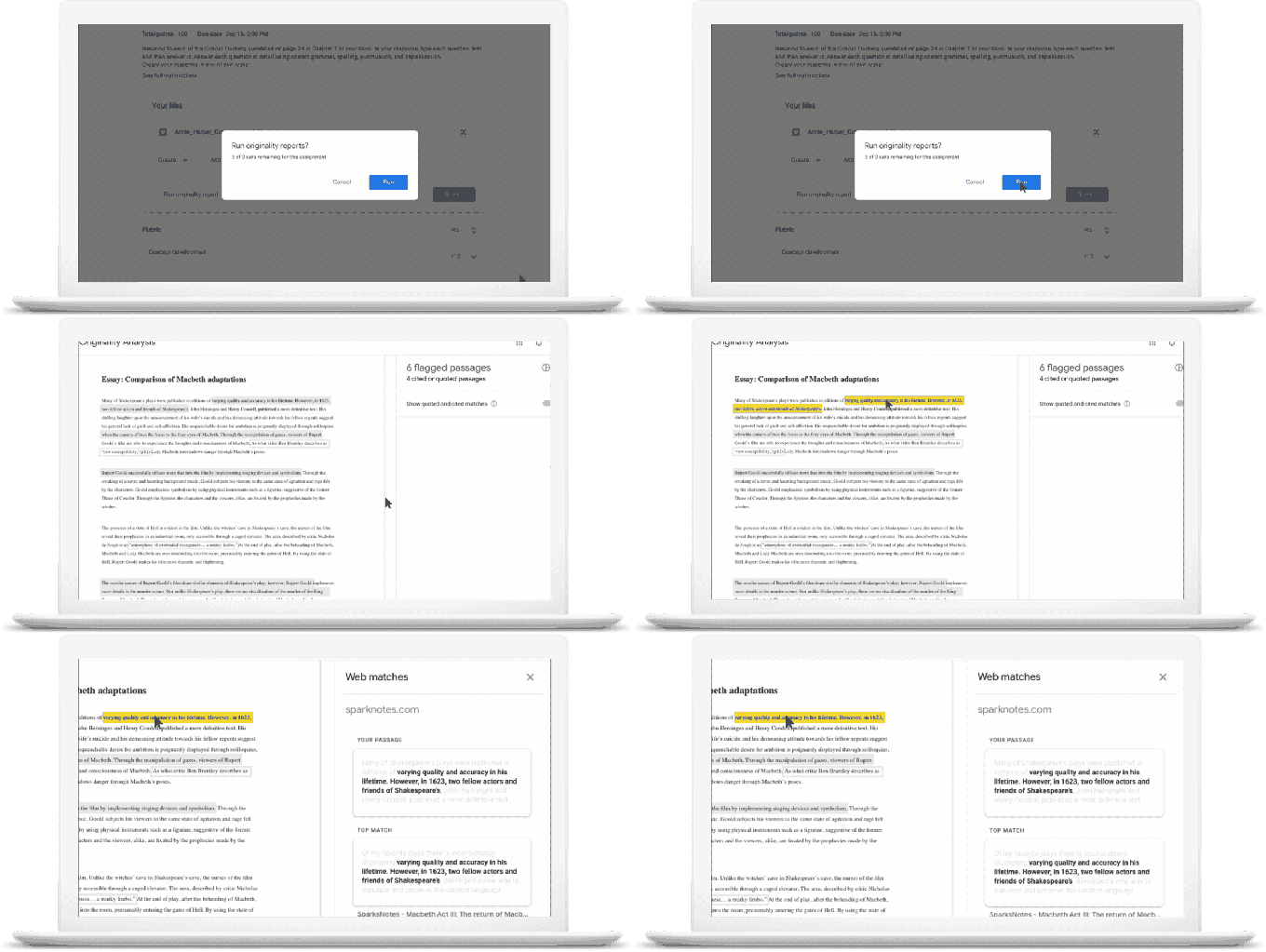
With the plagiarism checker — the feature called “Originality Reports” — teachers can check for missed citations and other issues. When the work is turned in and locked, the feature will check the student’s text against “hundreds of billions of web pages” and “tens of millions of books,” says Google.

Assignments2Gif

Once the feature is enabled on a given assignment, students can only run the check three times. This allows them the chance to fix oversights, but doesn’t let them abuse the feature to rewrite multiple pieces within a longer report to avoid detection.

Teachers will receive an Originality Report attached to the assignments that detail any missed citations and note the source — like a book or a web page.

OriginalityReportsGif

“Today’s students face a tricky challenge: In an age when they can explore every idea imaginable on the internet, how do they balance outside inspiration with authenticity in their own work? Students have to learn to navigate the line between other people’s ideas and their own, and how and when to properly cite sources,” explains Brian Hendricks, a Product Manager for G Suite for Education, in an announcement.

The plagiarism-checking feature is launching into beta testing today, with invites rolling out to schools and teachers over the next few weeks. Assignments is a free part addition to G Suite for Education.

The software can be also used either as a companion to a school’s Learning Management System (LMS) or a school admin can opt to integrate it with the existing LMS, notes Google.