Year: 2019

03 Dec 2019

Cuvva raises £15M Series A to launch flexible monthly car insurance

Cuvva, the app-based insurance provider that began life offering pay-as-you-go driving cover but has since expanded to also sell travel insurance, has raised £15 million in Series A funding.

Backing comes from RTP Global, Breega, and Digital Horizon, joining existing investors LocalGlobe, Techstars Ventures, Tekton and Seedcamp. A number of angels also joined the round, including Dominic Burke, the CEO of Jardine Lloyd Thompson, and Faisal Galaria, the former chief strategy and investments officer of GoCompare.

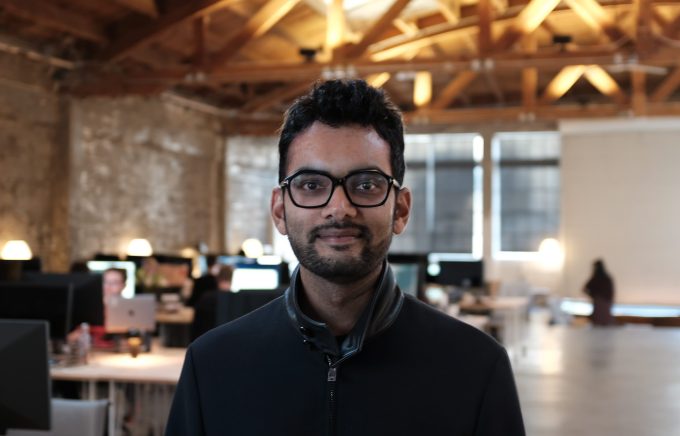
Launched in 2016 when founder Freddy Macnamara (pictured) become frustrated he couldn’t let others drive his car intermittently because of lack of insurance cover, Cuvva was an early pioneer of pay-as-you-go car insurance.

The idea, which was easier explained than done, was to make it possible to insure a car only when it was being driven, and therefore be cheaper for low mileage drivers, and via an app and access to the DVLA database, make it easier to on-board new drivers for pay-as-you-drive cover.

The insurtech still offers hourly car insurance but its product line has since been expanded to daily covery, as well as a product specifically aimed at learner drivers. In addition, Cuvva entered the travel insurance space, no doubt spotting overlap with its presumably younger, millennial demographic.

To that end, Cuvva says it will use the new capital to launch a new pay-monthly motor product in early 2020 that it says could cut average annual bills for car owners “significantly”. It will do this by cutting out various middle people, including brokers and comparison websites, which it says charge insurers about £70 on each policy sold.

“Unlike legacy insurers, Cuvva will not charge a fee to spread payments over the year and it will not penalise loyal customers with dual pricing,” says the startup. Cuvva also says it will offer the same savings, whether you are signing up as a new customer or a returning customer, and won’t charge admin fees to alter personal details registered with your policy.

Cue canned statement from Macnamara: “”I started Cuvva when I couldn’t find flexible insurance to help me share my car. Four years on from launch we are still discovering how big the problem we are solving really is. We’re now selling 3% of all UK motor insurance policies but we’ve got so much further to go. Cuvva is going to be the place where you buy all your insurance, all through our mobile app”.

03 Dec 2019

Penta, the German business banking challenger, partners with SumUp to target offline businesses

Penta, the Berlin-based business banking challenger that also now operates in Italy, has partnered with BBVA-backed card reader company SumUp in a bid to attract more offline businesses.

Up until recently, Penta had been targeting digital businesses, such as startups and e-commerce SMEs, but has since re-positioned itself for wider business banking appeal.

By partnering with a POS provider offering easy card reader-enabled payments, the German challenger bank wants to extend that of offline, such as restaurants, craftsman, healthcare and architects.

Specifically, Penta says businesses can order a SumUp Card Reader via Penta, and in doing so will save money on the initial SumUp setup fee and be able to seamlessly integrate SumUp-powered payments with their Penta account.

They’ll also get access to the existing Penta features, such as being able to open a business banking account entirely digitally, issue multiple payment cards, grant limits and permissions per card for staff, facilitate expense management and integrating with popular accounting tools.

In future, the SumUp integration is planned to go deeper. This will include the ability to use SumUp payments data to forecast future sales and feed into a businesses credit worthiness when they seek a loan.

“One request that we’ve had since day one has been for our customers to easily and quickly accept card payments, so we are very proud to be able to offer this with our newest partner SumUp,” says Penta CEO Marko Wenthin in a statement.

Adds James Henry, Head of Sales and Partnerships at SumUp: “By cooperating with Penta, we will enable even more small and medium-sized companies to digitize their business and make the payment experience as convenient as possible for their customers. Penta, with its growing customer base of companies, is the ideal partner for us to reach the broad mid-market”.

03 Dec 2019

Mass media vs. social media

In the waning years of the last millennium, at my university, one of the cause célèbres of the progressive left was a concept known as “Manufacturing Consent,” the title of a book and film, by and starring Noam Chomsky. Its central thesis was that US mass media “are effective and powerful ideological institutions that carry out a system-supportive propaganda function, by reliance on market forces, internalized assumptions, and self-censorship.”

It’s fair to say that history has been pretty kind to this theory. Consider the support drummed up by mass media for the invasion of Iraq in 2003. To quote the public editor of the New York Times, “To anyone who read the paper between September 2002 and June 2003, the impression that Saddam Hussein possessed, or was acquiring, a frightening arsenal of W.M.D. seemed unmistakable. Except, of course, it appears to have been mistaken.” Consider the September 2002 dossier published by the UK government “to bolster support for war” which turned out to be full of spectacularly incorrect information, and the media’s failure to interrogate those claims.

It’s hard to overstate just how cataclysmic these errors were. If the mass media had pushed back against the false claims of weapons of mass destruction, we might have avoided the Iraq war, which killed hundreds of thousands and cost trillions of dollars. Saddam Hussein was not exactly a tough act to follow, but the US still managed to follow its falsely motivated war with a botched occupation which turned Iraq, and arguably the larger Middle East to this day, into a bloodbath.

An interesting question is: what would have happened if today’s social media had been around in 2003? Today, if a wrong assertion is promoted by the mass media, it doesn’t take long for subject-matter experts to appear on Facebook and Twitter, correcting them, and either going viral themselves or becoming the subjects of countervailing media stories.

This doesn’t necessarily mean catastrophe would have been averted. But at least a possible corrective to the collective hysteria of the mass media would have existed, unlike in 2002-3. (Yes, those were the days of Blogspot and LiveJournal, but they didn’t have anything like the reach or significance of today’s social media.)

Consider a more recent event: the 2016 American presidential election. It has become an article of faith, in certain quarters, that it was won and lost by the diabolical use of Facebook ads, especially in conjunction with the psychographic superscience of Cambridge Analytica. This is ridiculous. First, no one credible thinks CA’s purported ability to mind control Facebook users by showing them “psychographically” targeted ads was anything other than snake-oil nonsense.

Second, as Nate Silver points out, the impact of social-media ads was enormously less than the impact of mass media. Remember the months of hysteria about Hillary Clinton’s emails? Remember how it turned out to be a complete non-story? Doesn’t this remind you of Iraq’s WMDs?

“The media’s coverage of Hillary Clinton’s email scandal was probably literally 50 times more important to the outcome of the 2016 election than Trump ads on Facebook.” Perhaps, my fellow mass media, the fault lies not in our psychographic bullshit artists, but in ourselves

Social media has many downsides. You don’t have to go particularly deeply into my own back catalog to discover that I am a harsh critic of Facebook myself. But let’s not pretend that mass media, just because it’s older, is therefore perfect. It has its own catastrophic failure modes itself. In fact — whisper it — maybe we’re a lot better off, net, with social media and mass media, in that each can act as a counterbalancing corrective on the other’s flaws and failure modes.

The progressive left may have gone from “mass media is the enemy” to “Big Tech social media is the enemy,” but maybe, and I know this sounds crazy because it’s on the Internet, but hear me out here, maybe there’s room for a little nuance; maybe they both have good and bad aspects, and could possibly balance one another out. If you don’t think mass media needs a corrective, let me remind you once again of the Iraq War and But Her Emails, to name but two of many, many examples. Maybe there exists a future in which social and mass media are each a cure for what ails the other.

03 Dec 2019

Billie Eilish, Lizzo and Lil Nas X are the winners of the first Apple Music Awards

Apple now has its own music awards, with winners picked by Apple Music’s editorial team or based on streaming data from the service. The first recipient of its top award, Global Artist of the Year, is Billie Eilish. The Apple Music Awards will be streamed live on Dec. 4 at 6:30PM Pacific Standard Time from the Steve Jobs Theater in Apple’s Cupertino headquarters, with a performance by Eilish.

The Apple Music Awards has five categories. Its editorial team picks the winners for Global Artist of the Year, Songwriter of the Year and Breakthrough Artist of the Year. Album of the Year and Song of the Year are awarded based on streaming data. Eilish also won the Album of the Year and (along with her brother Finneas) the Songwriter of the Year awards, for “WHEN WE ALL FALL ASLEEP, WHERE DO WE GO?”, Apple Music most played album of the year, with more than a billion streams.

Breakthrough Artist of the Year went to Lizzo, for “Cuz I Love You,” while the first Song of the Year is “Old Town Road” by Lil Nas X, the service’s most streamed track this year.

Winners will be given an trophy that contains “Apple’s custom silicon wafer suspended between a polished sheet of glass and a machined and anodized aluminum body… in a symbolic gesture, the same chips which power the devices that put the world’s music at your fingertips sit at the very heart of the Apple Music Awards,” read the company’s press release.

The launch of Apple Music Awards underscores the company’s increasing focus on services, as revenue from hardware slows. This year, it launched new subscription services like Apple TV+ and Apple Arcade, both of which emphasize exclusive content.

Apple Music competitor Spotify also recently announced its own music awards, with winners picked based on streaming and user engagement data. The first Spotify Awards event will be held in March 5 in Mexico City (the service’s biggest single market) and broadcast live on TNT in all Spanish-language countries in the region.

“The Apple Music Awards are designed to recognize the passion, energy and creativity of the world’s favorite artists. The musically diverse group of inaugural winners have sparked deep social conversation, influenced culture and inspired our customers around the world. We couldn’t be more excited to celebrate them,” said Oliver Schusser, vice president of Apple Music and International Content, in its press release.

03 Dec 2019

‘Carpentry Compiler’ turns 3D models to instructions on how to build them

Even to an experienced carpenter, it may not be obvious what the best way is to build a structure they’ve designed. A new digital tool, Carpentry Compiler, provides a way forward, converting the shapes of the structure to a step-by-step guide on how to produce them. It could help your next carpentry project get off the screen and into the shop.

“If you think of both design and fabrication as programs, you can use methods from programming languages to solve problems in carpentry, which is really cool,” said project lead Adriana Schulz from the University of Washington’s computer science department, in a news release.

It sounds a bit detached from the sawdust and sweat of hands-on woodworking, but they don’t say “measure twice, cut once” for nothing. Carpentry is a cerebral process more than a physical one, and smart, efficient solutions tend to replace ones that are merely well made.

What Carpentry Compiler does is codify the rules that govern design and carpentry, for example what materials are available, what tools can do, and so on, and use those to create a solution (in terms of cuts and joins) to a problem (how to turn boards into a treehouse).

Users design in a familiar 3D model interface, as many already do, creating the desired structure out of various shapes that they can modify, divide, pierce, attach, and so on. The program then takes those shapes and determines the best way to create them from your existing stock, with the tools you have — which you can select from a list.

Need to make the roof of your treehouse but only have 2x4s? It’ll provide a recipe with that restriction. Got some plywood sheets? It’ll use those, and the leftovers contribute to the base so there’s less waste. By evaluating lots and lots of variations on how this might be accomplished, the program arrives at what it believes are the best options, and presents multiple solutions.

“If you want to make a bookcase, it will give you multiple plans to make it,” said Schulz. “One might use less material. Another one might be more precise because it uses a more precise tool. And a third one is faster, but it uses more material. All these plans make the same bookcase, but they are not identical in terms of cost. These are examples of tradeoffs that a designer could explore.”

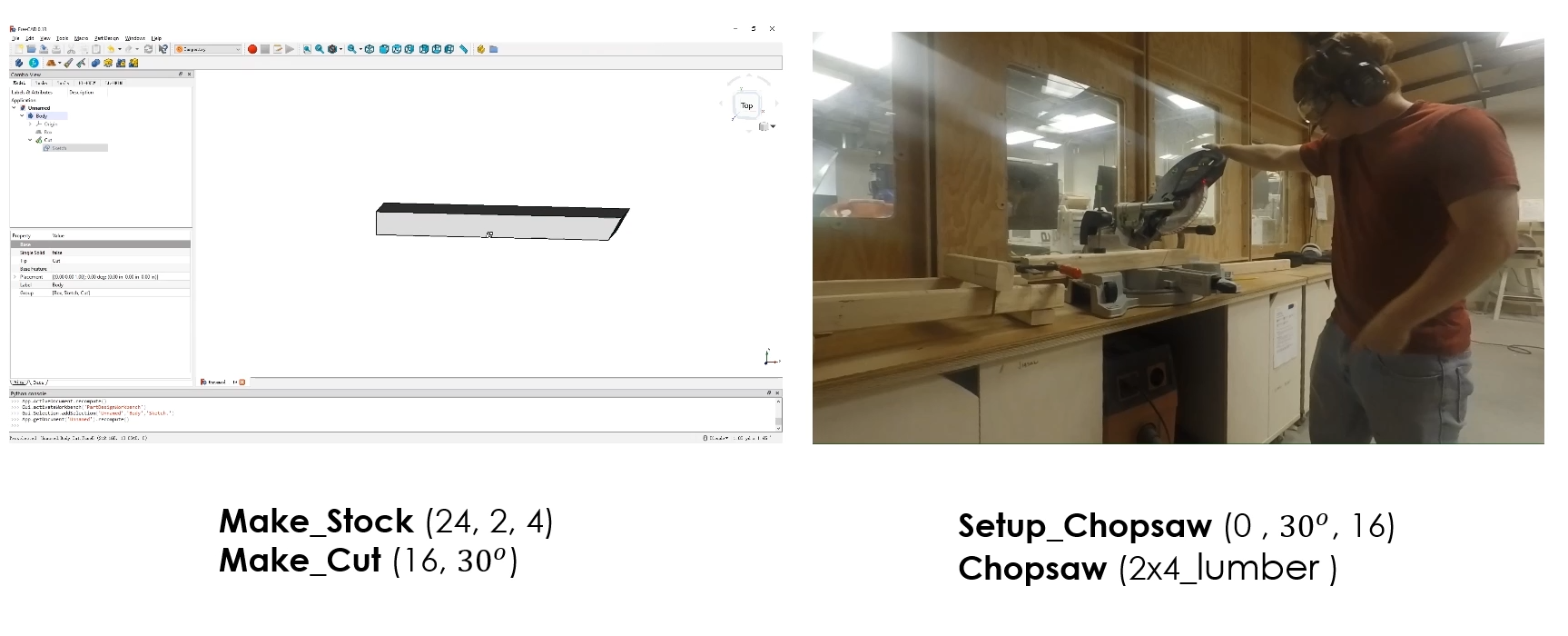
A 24-inch 2×4 gets cut at 16 inches at a 30-degree angle.

That’s really the same kind of thing that goes on inside a woodworker’s brain: I could use that fresh sheet to make this part, and it would be easy, or I could cut those shapes from either corner and it would leave room in the middle, but that’ll be kind of a pain… That sort of thing. It can also optimize for spatial elements, if for example you wanted to pack the parts in a box, or for cost if you wanted to shave a few bucks off the project.

Eventually the user is provided with a set of instructions specific to their set of tools. And the carpenters themselves act as the “processor,” executing operations, like “cut at this angle,” on real-world materials. In Carpenter Compiler, computer programs you!

The team presented their work at SIGGRAPH Asia last month. You can read more about the project (and learn how you can try it yourself) at its webpage.

03 Dec 2019

‘Carpentry Compiler’ turns 3D models to instructions on how to build them

Even to an experienced carpenter, it may not be obvious what the best way is to build a structure they’ve designed. A new digital tool, Carpentry Compiler, provides a way forward, converting the shapes of the structure to a step-by-step guide on how to produce them. It could help your next carpentry project get off the screen and into the shop.

“If you think of both design and fabrication as programs, you can use methods from programming languages to solve problems in carpentry, which is really cool,” said project lead Adriana Schulz from the University of Washington’s computer science department, in a news release.

It sounds a bit detached from the sawdust and sweat of hands-on woodworking, but they don’t say “measure twice, cut once” for nothing. Carpentry is a cerebral process more than a physical one, and smart, efficient solutions tend to replace ones that are merely well made.

What Carpentry Compiler does is codify the rules that govern design and carpentry, for example what materials are available, what tools can do, and so on, and use those to create a solution (in terms of cuts and joins) to a problem (how to turn boards into a treehouse).

Users design in a familiar 3D model interface, as many already do, creating the desired structure out of various shapes that they can modify, divide, pierce, attach, and so on. The program then takes those shapes and determines the best way to create them from your existing stock, with the tools you have — which you can select from a list.

Need to make the roof of your treehouse but only have 2x4s? It’ll provide a recipe with that restriction. Got some plywood sheets? It’ll use those, and the leftovers contribute to the base so there’s less waste. By evaluating lots and lots of variations on how this might be accomplished, the program arrives at what it believes are the best options, and presents multiple solutions.

“If you want to make a bookcase, it will give you multiple plans to make it,” said Schulz. “One might use less material. Another one might be more precise because it uses a more precise tool. And a third one is faster, but it uses more material. All these plans make the same bookcase, but they are not identical in terms of cost. These are examples of tradeoffs that a designer could explore.”

A 24-inch 2×4 gets cut at 16 inches at a 30-degree angle.

That’s really the same kind of thing that goes on inside a woodworker’s brain: I could use that fresh sheet to make this part, and it would be easy, or I could cut those shapes from either corner and it would leave room in the middle, but that’ll be kind of a pain… That sort of thing. It can also optimize for spatial elements, if for example you wanted to pack the parts in a box, or for cost if you wanted to shave a few bucks off the project.

Eventually the user is provided with a set of instructions specific to their set of tools. And the carpenters themselves act as the “processor,” executing operations, like “cut at this angle,” on real-world materials. In Carpenter Compiler, computer programs you!

The team presented their work at SIGGRAPH Asia last month. You can read more about the project (and learn how you can try it yourself) at its webpage.

02 Dec 2019

Why Notion is staying small as its valuation gets bigger

Work tools startup Notion, which recently reached a reported $800 million valuation, isn’t on the verge of a big SoftBank round. In fact, COO Akshay Kothari says the startup has “never felt like if we had more money we could grow faster.”

The company, centered around an app that helps non-developers build collaboration tools, has more than one million users and has scaled its product quickly despite having a team of just 27.

I wrote about the company’s partnership with some of tech’s top accelerators and venture capital firms last month. People are very curious about this small company and how it is run, so here’s more from my recent interview with COO Akshay Kothari in which we discussed the hyped startup’s philosophy of staying small and some of the challenges it may have ahead with this brand of thinking as competitors are raising massive sums.

This interview has been edited for length and clarity.

Notion COO Akshay Kothari

Where does your story begin with Notion? Give me a snapshot of where the team is now.

Akshay Kothari: [Notion co-founders Ivan Zhao and Simon Last] started Notion six years ago and that’s when I invested. I had sold my previous company and I had this newfound money that I didn’t know what to do with. I invested in Notion, so that’s my connection.

We were kind of in research mode for many years trying to uncover what the market needs were. We launched about two years ago; 1.0 was just notes that you could take and a wiki so that you could collaborate with people. And then last year we launched databases and that was the 2.0 version, which kind of seemed like an inflection point, where now you could not only have your notes and your wiki, but also manage your tasks, manage your projects, manage candidates and recruiting, all in a single tool.

Over the last year and a half, the company has grown extremely fast. I joined about a year ago, there were about 10 people at the beginning of this year and now we’re close to 30. It’s still a really small engineering team. We’re 9 engineers, we don’t have any product managers, and we’re 2 designers. So there are about 10 people that are building the product, and 10 people on community and support teams, something that we’ve invested very heavily in. We’re starting to have a sales and marketing team. We have 2 people in marketing and 2 people in sales. That all rounds up to about 27 which is where we are now.

Since you joined do you think the idea has shifted at all?

In terms of the original idea, we were thinking about how people who didn’t know how to code could build things like tools and software that were really useful. I guess the only realization has been that not everyone wakes up wanting to build software, but everyone wakes to solve problems. That was the pivot to focusing on notes, wikis and tasks, because that’s actually something that every team needs.

Are those needs universal for big and small teams?

For the first 100 people you can actually do a lot with Notion. With 30 people, we pretty much run the entire company, except for using Slack for internal communication and Intercom for external communication like talking to customers. Everything else is actually on Notion, like our application tracking system for recruiting inside Notion, our sales CRM is in Notion, our wiki obviously is, our project management as well — no, we don’t use Jira.

For sub-100 businesses, you actually don’t need another tool. When you get to hundreds of people what tends to happens is that some person or some team tends to have a preference for a specific tool. In those situations, Notion plays well with other tools. You can embed things easily. So let’s say Excel or Google Sheets is something that you want to use, you can just embed that inside Notion. So Notion becomes this kind of central nervous system for all of the work that people are doing.

Building on that, one of the things we haven’t done is we don’t do synchronous communication so we’ve stayed away from that because I feel like people like using Slack. On Slack, you can’t actually collaborate on a project… Notion has become a place where you can actually do a lot of your work alongside the synchronous communication.

So, no interest in building a chat or video chat product?

Not in the near term. I think Slack is one of those enterprise tools that people at companies actually like. For a lot of these other tools, we just have to use it, not because we love it but because that that’s what exists.

What are the barriers for satisfying the customers with 100+ employees?

02 Dec 2019

Atomico Partner Tom Wehmeier reviews ‘The State of European Tech’ 2019 report

Atomico, the European venture capital firm founded by Skype’s Niklas Zennström, has released its latest annual The State of European Tech report, published in partnership with Slush and Orrick.

As part of the report, the authors surveyed 5,000 members of the ecosystem — including 1,000 founders — as well as pulling in robust data from other sources, such as Dealroom and the London Stock Exchange .

This year, the report reveals that the European tech ecosystem continues to mature and shows no sign of slowing — particularly highlighting the contrast from five years ago when the The State of European Tech report made its debut. Almost every key indicator is up and to the right, except, rather depressingly, diversity.

The data shows, for example, that competition for talent and access to the best founders has increased ferociously. And from a funding perspective, European founders have more choice than ever, especially with U.S. and Asian VC firms investing more and more in the region. Progress with gender diversity stalled, however, such as 92% of funding going to all-male teams.

I caught up with the report’s author Tom Wehmeier, Partner and Head of Insights at Atomico (also sometimes jokingly referred to as the “Mary Meeker of Europe”), where we discuss in more detail some of the key findings and why, it seems, that the rest of the world has finally woken up to Europe’s tech potential.

But first, a few headlines from the report:

  • European technology companies are on track to raise a record 30$B+ in funding in 2019, up from $25B the year before. (Source: Dealroom)
  • Despite failing to match the level of venture-backed exits of 2018, there was a record number of 40 $100M-plus deals as of September 2019, a size that many European tech sceptics did not believe was possible. (Source: Dealroom)
  • A number of multi-billion-dollar non-venture backed companies like Nexi and Trainline made their debut on the public markets.
  • European tech policymaking remains a mystery to many European founders.
  • When asked to describe the top priority of the European Commission in terms of tech policy, 40% of founders and startup employees say they don’t feel informed enough to comment. (Source: survey)
  • Despite this reported lack of awareness on policy issues, all respondents voted EU competition commissioner Margrethe Vestager as the person who had the most influence on European tech in 2019, good or bad. (Source: survey)
  • European parliamentarians aren’t talking about fintech and digital health, two sectors which investors poured a combined $12.7bn into last year (Source: Politico and Dealroom)
  • Europe’s diversity figures are still grim reading.
  • In 2019, 92% of funding went to all-male teams, a similar level to 2018. (Source: Dealroom)
  • There is still only one woman CTO in the 119 companies (<1%) based on a sample of executives in CxO positions at 251 European VC-backed tech companies that raised a Series A or B round between 1 October 2018 and 30 September 2019 with more than $10M funding, even though 7.5% of software engineers are women. (Source: Stack Overflow, Craft, Dealroom)
  • Looking beyond gender diversity, ethnic minorities in tech experienced discrimination at a much high rate than white peers. (Source: survey)
  • At least 80% of Black/African/Caribbean respondents who reported experiencing discrimination linked it to their ethnicity. (Source: survey)
  • 63% of women VCs reported increased focus on attending events with stronger participation from diverse founders. The corresponding number for men VCs was only 33% of female respondents suggested that their male counterparts are leaving female VCs to fix Europe’s diversity problem. (Source: survey)
  • European founders aren’t just aiming for commercial success — they are trying to solve some of the world’s largest problems.
  • One in five European founders states that their company is already measuring its societal and/or environmental impact. (Source: survey)
  • Only 14% of founders don’t believe it’s relevant for their company. Founders that are women are much more likely to be advanced in their approach to measuring impact. (Source: survey)
  • Employees are placing a greater emphasis on corporate social responsibility, with 57% citing its importance in the State of European Tech survey. (Source: survey)

Extra Crunch: It is 5 years since Atomico published the first The State of European Tech report, which really attempted to capture a data-driven snapshot of the entire ecosystem. What are some of the biggest changes you’ve seen within European tech in the intertwining years or in this year in particular?

Tom Wehmeier: If I think back to when we did the first report, people who believe that Europe could actually be an interesting player in global technology, were largely limited to people who were in the tech industry in Europe itself. If you then fast forward to today, what has clearly happened — and I think 2019 was the year where this really materialized and became part of the narrative — was that belief translating from people on the inside to a bunch of people that were on the outside.

Most obviously has been the strength of interest from from the U.S. and the number of top-tier U.S. funds that are not just increasing their level of investment activity but committing to spending more and more time here on the ground, hiring people, building teams, building a network, and getting to know companies. I think it probably surprises people to know that 19% of all rounds this year will involve at least one U.S. investor in Europe, which is more than double since since the first year we did the report.
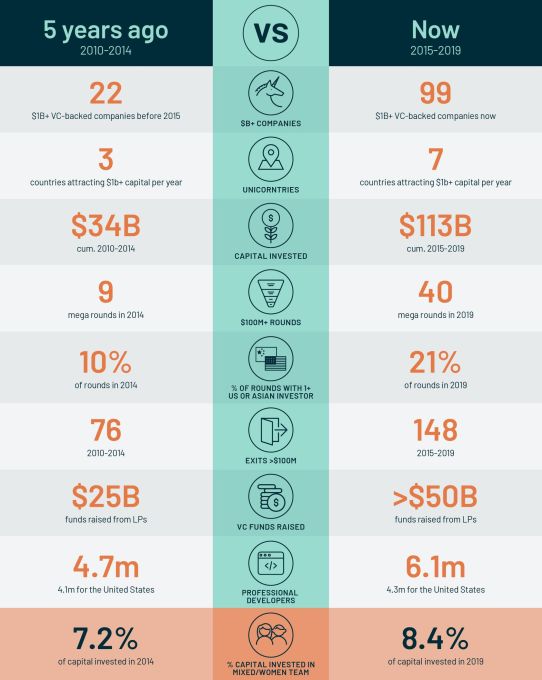
I think the other thing, where I come back to this idea that now we have finally convinced a certain group of people about the role that Europe can play, is mainstream institutional investors. I know it is not going to be lost on you, [but] this is going to be another record year for VC fund raising from Europe. And whilst the headline numbers might not be a surprise, I think what should catch people’s attention is that the composition of the LP base here in Europe is now shifting. And finally, there’s an unlocking of institutional investors, [by which] I mean pension funds, funds of funds, insurance companies, sovereign wealth funds, who are committing to European VC at levels that are significantly increased and elevated from where they had been in the past. So, if you just take pension funds, we’re going to see close to a billion dollars invested which is up nearly three fold.

It’s a validation of what’s happening around European tech to see that now coming through and I think is ultimately something that helps to build a foundation for the next five years of success. As much as this is a report that’s looking back, it’s also about trying to understand where things go from here.

With regards to the pension funds, do you think that is driven by the general bullishness towards European tech, or do you think it’s more the macro economic reality that maybe other places where they could put their money aren’t very attractive at the moment?

I think it’s really a reflection that there’s a strong level of belief that European venture as an asset class is an attractive investment opportunity. And that is reflected by the numbers. One of the charts that we’ve got in the report is from Cambridge Associates who do the benchmarking for the VC indices… And when you look back over a 1, 3, 5, or even a 10 year horizon, the performance from European VC is demonstrating that this is a place where for anyone building a diversified portfolio, they should have some allocation. I think it’s fundamentally the strength of the investment opportunity. That is the single biggest driver for why you’re seeing this happen.

I think the biggest thing that Europe has been able to prove is that it can take a great idea and turn it into a great company and that company can scale to not just a billion dollar outcome but to a multi-billion dollar outcome and go all the way through into an IPO or into a large scale acquisition. What you’ve seen happen in 2019 is in part A reflection of what happened last year where it was obviously this record year with Spotify, Adyen, Farfetch, Elastic and others that really showed you can go full cycle from start all the way to finish. And that the magnitude of those outcomes can be at a scale that makes them globally relevant.

Are the pension funds shifting their allocation of VC away from other geographies or are they just doing more VC as a whole?

02 Dec 2019

Kredivo’s parent firm FinAccel raises $90M to expand its credit lending platform in Southeast Asia

Singapore-headquartered FinAccel has secured $90 million in what is the largest funding round for a fintech startup in Southeast Asia as it looks to further grow its credit lending app Kredivo and build more financial services.

The financing round, dubbed Series C, for the three-and-a-half-year-old startup was jointly led by Asia Growth Fund — a joint venture between Mirae Asset and Naver — and Square Peg.

Singtel Innov8, TMI (Telkomsel Indonesia), Cathay Innovation, Kejora Intervest, Mirae Asset Securities, Reinventure, and DST Partners participated in the “oversubscribed” financing round, the startup said.

FinAccel said it has raised more than $200 million in debt and equity this year itself. It has raised $140 million in equity to date.

FinAccel operates credit lending app Kredivo in Indonesia, where it has amassed more than a million customers and is growing by a whopping 300% each year, Akshay Garg, chief executive of FinAccel, told TechCrunch in an interview.

The app enables customers to secure credit between $100 and $2,200. If a customer pays it back in full in a month, FinAccel does not charge them any fee. Else, the service levies an interest rate of 2.95%, he explained.

Kredivo’s payments option is also integrated with a number of e-commerce firms including Lazada and Shoppe and food delivery startups in Indonesia, so users can quickly access the credit to purchase things and pay the app later.

Credit lending apps are increasingly gaining popularity across the globe, but especially in Southeast Asian markets where the penetration of credit card remains low — hence there are very few people with a traditional credit score. This has created an opportunity for startups to look at other metrics to determine who should get a loan.

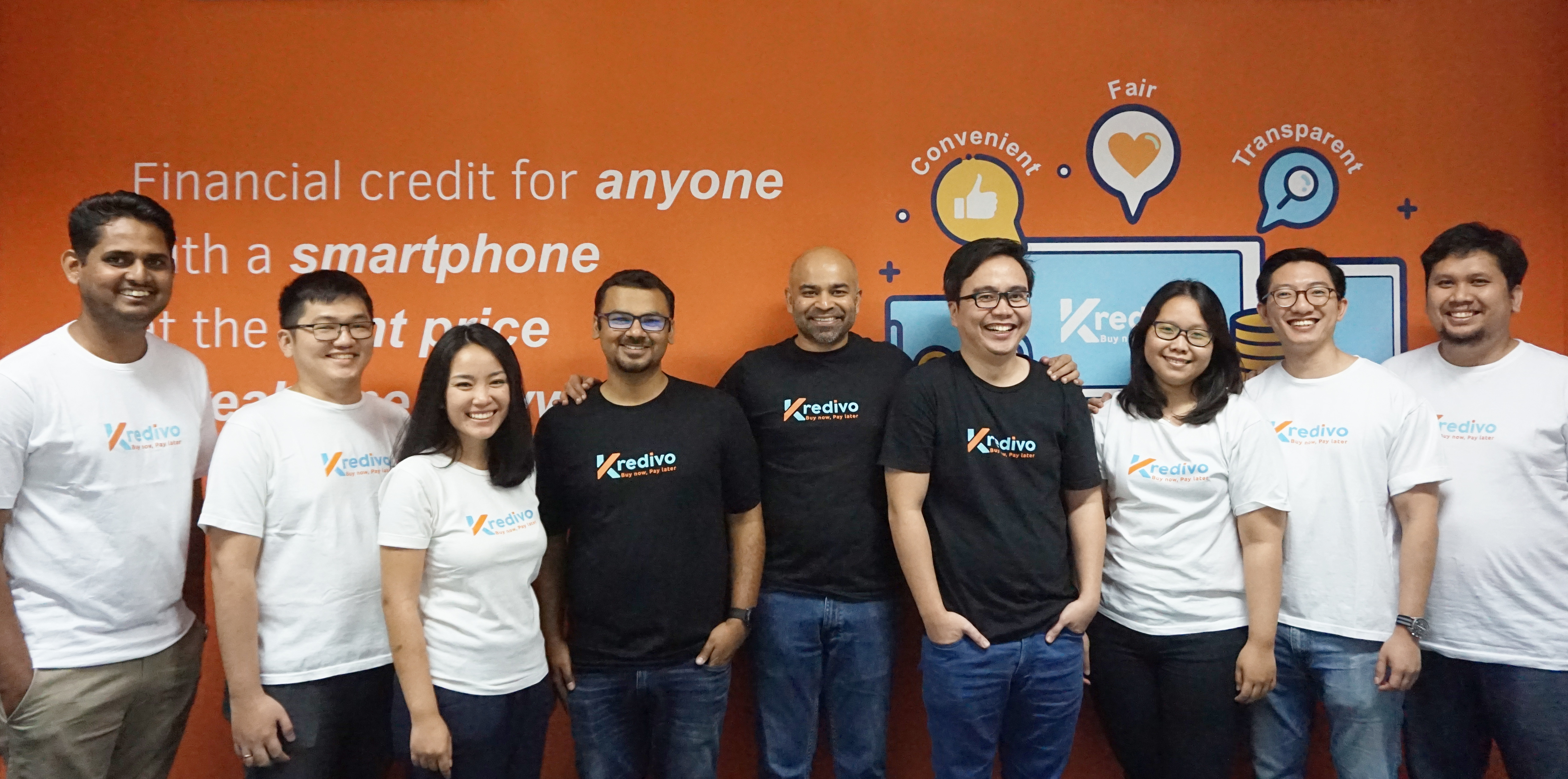
FinAccel’s team poses for a picture

Garg said Kredivo looks at a range of data points including the kind of smartphone model a customer is using, and the apps they have installed on it. “Basically what we’re doing is almost like creating a user profile about the user using a combination of different data signals that come from the existing credit bureaus, the telcos, the e-commerce accounts, the bank accounts, and the users themselves,” he said.

“All of that creates a 360-degree overview of the customer that helps us determine the risk factors and decide whether to issue the credit,” he added. As of today, Kredivo is only approving about one-third of the applications it receives.

Jikwang Chung, Managing Director of Mirae Asset Capital, the strategic investment arm of Mirae Asset, said in a statement that FinAccel is one of the leading companies in Southeast Asia that is able to “combine a strong technology DNA with top-tier risk management and a bold vision of financial inclusion.”

FinAccel, which works with banks to finance the credit to customers, has evaluated more than 3 million applications to date and disbursed nearly 30 million loans. Garg said the startup is now working to develop more financial services such as low-interest education and healthcare loans.

In the next three to four years, it aims to grow to 10 million users and expand to other Southeast Asian markets such as Philippines.

A handful of other startups also operate in this space in Indonesia. C88, which also offers credit to customers, last year raised $28 million in a financing round led by Experian.

02 Dec 2019

Omar Hamoui leaves Sequoia for L.A.-based Mucker Capital as it looks to lead more Series A deals

Mucker Capital, the now eight-year-old, Santa Monica, Ca.-based pre-seed startup accelerator and venture outfit, has brought aboard Omar Hamoui, a partner at Sequoia Capital for the last six-plus years, as its third general partner.

Hamoui joins firm cofounders Erik Rannala and William Su, along with several other investors on the team who are collectively working to fund pre-seed, seed stage and — with Hamoui’s help — Series A stage deals in the L.A. region, as well as elsewhere in the U.S.

Mucker’s largest exit to date appears to be the L.A.-based shopping and rewards platform Honey, which was recently scooped up by PayPal for $4 billion in cash; Mucker was its first investor and the company went through its accelerator program. The firm also has stakes in ServiceTitan, NEXT Trucking, Emailage and AuditBoard, among others of its bets.

To find out more about Hamoui’s previously unreported move, we were in touch earlier today with Rannala to catch up a bit.

TC: When did you start talking with Omar? Did this move involve a recruiter? Is he moving to L.A. for the role? 

ER: We’ve known Omar for several years. He had moved back to Southern California — he’s originally from here — and was covering L.A. and the surrounding areas for Sequoia. We got to know him better while collaborating on companies and he ended up leading rounds in two of our portfolio companies, NEXT Trucking and Papaya.

While we’d been historically more focused on pre-seed and seed, we had also been opportunistically investing in post-seed  and early Series A rounds, and contemplating [a new, Series A stage fund that Mucker expects to raise] for some time. Somewhat serendipitously, Omar actually broached the topic with us independently. Given how well we were already working together, it made a lot of sense for him to join the team.

TC: How many funds have you raised to date? What sizes have they been?

ER: We’re currently investing out of our fourth seed fund [which closed last year]. We’d also raised a separate early-stage vehicle to invest in follow-on rounds for our pre-seed and seed investments and other post-seed and early series A opportunities. In total, we raised a little less than $90 million last year.

TC: What will Omar be doing, specifically? How will the general partners divide up your coverage?

ER: Omar will be focused primarily on post-seed and  early Series A investments, writing $2 million to $3 million checks. The three of us will collaborate across all our seed and early stage investments, though Omar will be point person on post-seed, and Will and I will continue to focus on pre-seed and seed.

TC: You’ve been at this for a bit with Mucker Capital. What, if anything, has changed in the last year or two in terms of the L.A. scene?

ER: The L.A. ecosystem has been scaling and maturing rapidly since we started Mucker. The technical labor force here is roughly the same size as the Bay Area, so we’ve always had a wealth of talent. And the quality and sophistication of entrepreneurs and technical talent just keeps getting better and better as the ecosystem grows and evolves. We continually see more people relocating to L.A., and downstream investors spending more time here.

The vast majority of follow on funding here still comes from Bay Area firms, which isn’t a surprise considering so many firms are headquartered there [so] overall, we believe L.A. is still underfunded relative to the size of the ecosystem and the opportunities here. That’s one of the reasons we’ve been expanding the scope of our post-seed and early-stage investing and bringing on a third partner to focus on it. As there are more exits like Honey, Snap, and Oculus, we see more and more people recirculating back into the ecosystem starting companies, angel investing, and joining startups. [In the meantime], indigenous venture capital here in L.A. has lagged behind the growth in number and quality of opportunities that we see.

TC: You aren’t focused exclusively on L.A., correct?

ER: Over the past couple of years, we’ve continued to expand the geographic scope of our investments – finding companies in places where Silicon Valley VC’s haven’t really been investing, especially at the pre-seed and seed stage. Some of our recent investments are Modus  in Seattle, GoFor in Ottawa, Resilia in New Orleans, Pei in Austin, and Kast in San Diego.

TC: What company did Mucker miss, and what did you learn from the experience?

RN: One investment we passed on very early was Dollar Shave Club, and it’s certainly one we regret. We met Michael Dubin a few months after he launched the site and his original marketing video went viral. We obviously didn’t get it. Generic razor blades from Korea? Funny video? Pass!