
Year: 2019

02 Dec 2019

The Station: Canoo hits the road, Coup shutters and Samsung shifts

Welcome back to The Station, the go-to newsletter for keeping up-to-date on what the heck is going on in the world of transportation. I’m your host, Kirsten Korosec, senior transportation reporter at TechCrunch.

Portions of the newsletter are published as an article on the main site after it has been emailed to subscribers (that’s what you’re reading now). The Station is emailed every Saturday morning. To get everything, you have to sign up. And it’s free. To subscribe, go to our newsletters page and click on The Station.

We love tips and feedback. Please reach out anytime and tell us what you love and don’t love so much. Email me at kirsten.korosec@techcrunch.com to share thoughts, opinions or tips or send a direct message to @kirstenkorosec.

Micromobbin’

the station scooter1a

Shared mopeds might be popular, but that doesn’t mean companies operating these services are guaranteed to succeed. This week, TechCrunch reporter Romain Dillet reported that Coup, a wholly owned subsidiary of Bosch that operates an electric moped scooter-sharing service in Berlin, Paris and Madrid, is shutting down.

The closure might surprise some, considering Coup has brand recognition and, according to the company a loyal customer base that uses its services. That’s not enough to be a profitable enterprise. Coup said that operating the service is “economically unsustainable” in the long term.

Meanwhile, TechCrunch reporter Manish Singh learned from two sources familiar with the deal that Bangalore-based startup Bounce has raised about $150 million as part of an ongoing financing round led by existing investors Eduardo Saverin’s B Capital and Accel Partners India. Bounce, formerly known as Metro Bikes, operates more than 17,000 electric and gasoline scooters in three dozen cities in India.

The new round values the startup “well over $500 million,” the people said, requesting anonymity. This is a significant increase since the year-old startup’s Series C financing round, which closed in June, when it was worth a little more than $200 million.

Bounce, which is known for its cheap rental costs, along with competitors Vugo and Yulu are trying to carve market share away from ride-hailing companies like Uber . The big attraction isn’t necessarily price either. Traffic congestion is prompting people to turn to two wheels as well, giving Bounce and others a boost.

Subscriptions are so hot right now

the station electric vehicles1

Remember Canoo, the Los Angeles startup that revealed a minibus-type electric vehicle a few months back? We have an update. In short, the company’s rapid ramp continues to accelerate despite some legal headwinds.

Canoo is taking an interesting approach to EVs. It aims to offer a “subscription only” electric vehicle in the U.S. and China.

The company began life as Evelozcity in late 2017 after ex-BMW executives Stefan Krause and Ulrich Kranz left Faraday Future amid an internal power struggle. Evelozcity rebranded as Canoo in spring 2019 and unveiled its prototype electric vehicle several months later.

Now, the company is beta testing its EV on public roads. Canoo tells me that its focus is to validate the powertrain, steer-by-wire system, battery, chassis and body structure.

Canoo is building a fleet of more than 30 beta vehicles for various types of testing. The bulk of the beta testing is expected to take place over the next six months in various locations, including near Canoo’s Torrance, California headquarters, Toyota’s Arizona proving grounds and on public roads in Ohio.

Canoo said it’s also conducting hot and cold testing as well as focusing on the advanced driver assistance system in various locations.
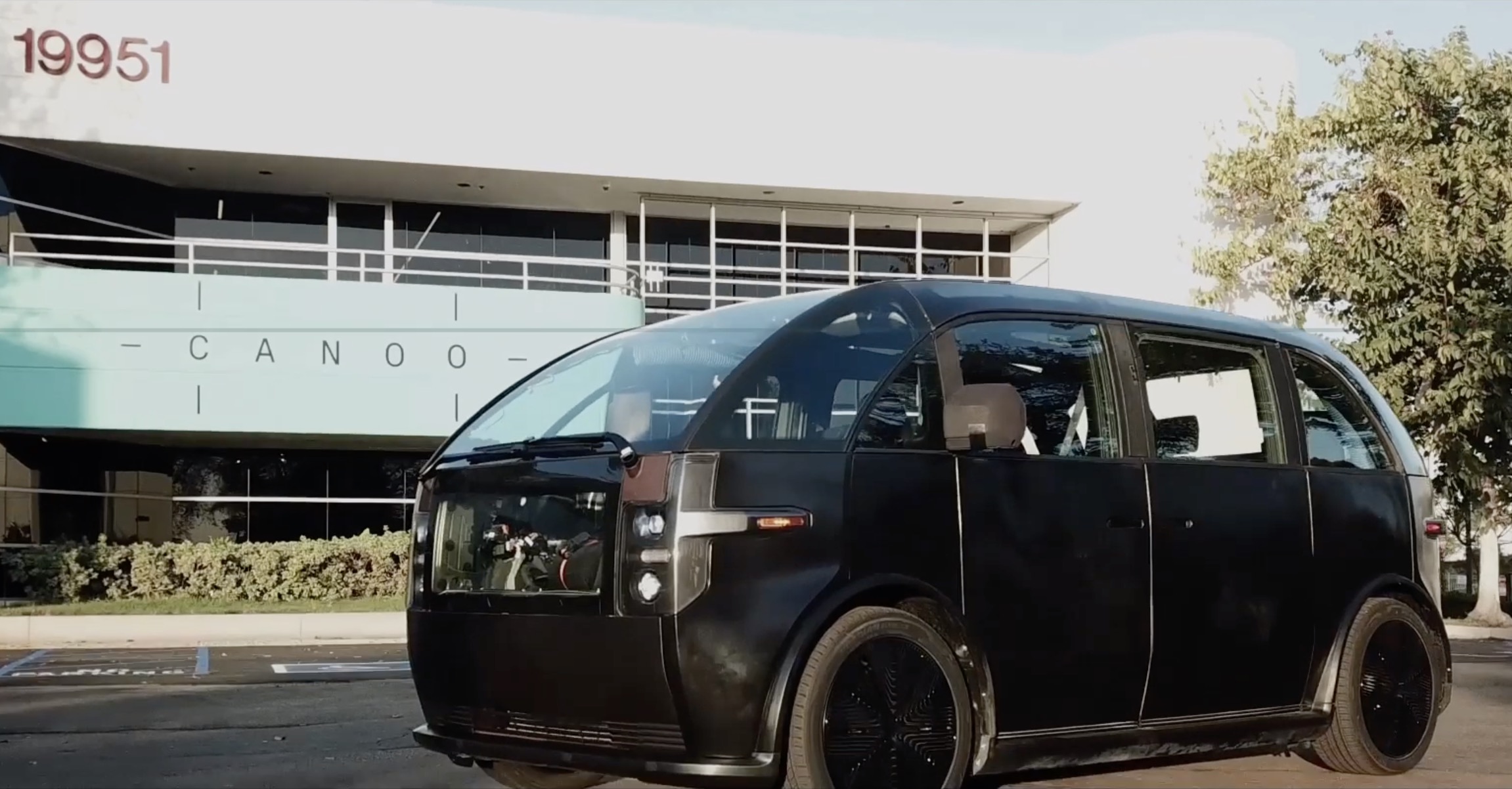
Canoo electric vehicle

A subscription reboot

Automakers including Audi, Porsche and Volkswagen have been testing subscription programs with mixed success. Now, one failed pilot is coming back.

At an event in Los Angeles, GM’s Chief Marketing Officer Deborah Wahl said the subscription service Book by Cadillac will return next year. GM’s luxury brand Cadillac will pilot the next-generation of the subscription service in San Francisco starting in the first quarter of 2020.

“We learned a lot from the first pilot… first, it verified that there is no longer a one-size-fits-all solution to personal transportation,” Wahl said at the event. “Second, we learned that the BOOK model is enormously effective as a conquest mechanism: 70% of Book subscribers were new to Cadillac.”

Moving forward, Cadillac plans to integrate the subscription service into the retail dealer network, Wahl said.

A little bird

blinky cat bird green

We hear a lot. But we’re not selfish. Let’s share.

Samsung appears to be yet another company stepping back from a pursuit of full autonomy and refocusing efforts and investments towards advanced driver assistance technology. At least for now.

Several years ago, Samsung was all in on autonomous vehicle technology.  At CES in 2018, the company introduced its new Samsung DRVLINE platform — an “open, modular, and scalable hardware and software-based platform for the autonomous driving market. But Samsung is changing up its strategy.

The DRVLINE/Smart Machines team based out of its Samsung Strategy and Innovation Center has been shuttered, a source with direct knowledge of the events told me. This move also includes closing offices in Germany.

Let’s get wonky

the station autonomous vehicles1

The U.S. Federal Communications Commission is keen to change how the 5.9 GHz band is used and that matters for connected car technology and the eventual deployment of autonomous vehicles.

For the unfamiliar, the 5.9 GHz band has been reserved for the past two decades to be used by the Dedicated Short Range Communications, a service in the Intelligent Transportation System that was designed to enable vehicle communication. (ITS is a joint operation that overlaps five offices under the Department of Transportation.)

In the FCC’s view, the DSRC service has evolved slowly and has not been widely deployed. The commission issued this month a Notice of Proposed Rulemaking to take, what it calls “a fresh and comprehensive look” at the 5.9 GHz band rules and propose changes to how the spectrum is used.

The upshot: the FCC wants to carve up the band. The commission proposed dedicating the upper 30 megahertz of the 5.9 GHz band to meet current and future needs for transportation and vehicle safety-related communications, while repurposing the lower 45 megahertz of the band for unlicensed operations like Wi-Fi.

Perhaps the most interesting piece of this proposed change is the FCC’s views on DSRC and what sounds like a strong endorsement for Cellular Vehicle to Everything (C-V2X). The FCC wants to revise the rules and give C-V2X the upper 20 megahertz of the band reserved for vehicle communications. The commission plans to seek comment on whether this segment of the spectrum should be reserved for DSRC or C-V2X systems.

C-V2X, which the 5G Automotive Association supports, would use standard cellular protocols to provide direct communications between vehicles as well as infrastructure like traffic signals. But here’s the thing. C-V2X is incompatible with DSRC-based operations.

It’s pretty clear which way the FCC is leaning. In a speech Nov. 20, FCC Chairman Ajit Pai said he believes the government “should encourage the expansion and evolution of this new vehicle-safety technology.” Pai insists that the FCC is not “closing the door” on DSRC, but instead allowing for both.

“So moving forward, let’s resist the notion that we have to choose between automotive safety and Wi-Fi,” Pai said in his speech. “My proposal would do far more for both automotive safety and Wi-Fi than the status quo.”

02 Dec 2019

T-Mobile opens pre-orders on two 5G phones as low-band network goes live

The 5G question has long been carts and horses. The next-generation wireless network has always been an inevitability, of course, but the rollout has always felt a bit piecemeal. T-Mobile, to its credit, is looking to flip the switch all at once (kind of), launching a “nationwide” deployment of 5G to a coverage area it says will reach 200 million of the U.S.’s 327 million residents.

The 600MHz low-band network goes live today, fulfilling the promise of 5G in 2019 with nearly a month to spare. That coincides with the pre-order of two 5G-enabled handsets, from OnePlus and Samsung. The OnePlus 7T Pro 5G McLaren Edition, at least, is a T-Mobile exclusive here in the States.

It’s a premium as far as OnePlus goes, but still arrives at the (relatively) low price of $900. Compare that to the $1,300 Galaxy Note 10 Plus 5G. Both are officially going on sale on Friday, and should be able to connect to the new network at launch.

T-Mobile’s clearly being more deliberate in its roll out here, fighting the urge to plant its flag. Instead, the carrier’s network will be available in wider swaths of land versus the competition’s neighborhood to neighborhood approach. And while the network isn’t expected to be as fast as other solutions, it should reach indoors better — a pretty key differentiator.

As CNET notes, it’s still fairly piecemeal in certain respects — the existing millimeter 5G wave network won’t work with the new devices. Nor will older devices work with the new network. Much of this move appears to be in anticipation of T-Mobile’s merger with Sprint.

The ability to compete with AT&T and Verizon on the 5G front has always been the key selling point of such a merger. Though reducing the field from four players down to three to increase competition has always seemed a dubious claim, at best.

02 Dec 2019

Tim Cook, Satya Nadella, Elon Musk, Sundar Pichai and more sign renewed commitment to Paris Agreement

The U.S. government may be in the process of formally withdrawing from the term of the Paris Agreement, an International accord on targets to fight climate change, but major U.S. employers say they’ll stay the course in a new statement jointly signed by a group of 148 chief executives and U.S. labor organization leaders. The statement, posted at UnitedForTheParisAgreement.com, represents a group that Goethe either directly employs over 2 million people in the U.S., or represents a larger group of 12.5 million through labor organizations.

The group collectively says that they are “still in” on the Agreement, which many of the undesigned also supported vocally back in 2017 when the Trump administration announced its intent to formally remove itself. They also “urge the United States” to reconsider its current course and also agree to remain committed to the agreement. The Agreement will not only help to potentially counter the ongoing impacts of global climate change, the group says in the letter, but also prepare the way for a “just transition” of the U.S. workforce to “new decent, family supporting jobs and economic opportunity,” implying that bowing out of the agreement will actually impede the U.S. workforce’s ability to compete on a global scale.

Apple CEO Tim Cook shared the renewed commitment on Twitter, noting in part that “humanity has never faced a greater or more urgent threat than climate change,” and other prominent tech executives have also co-signed, including Microsoft’s Satya Nadella, Tesla’s Elon Musk, Google’s Sundar Pichai and Adobe’s Shantanu Narayen. Chief executives from other powerful U.S. companies across industries are also represented, including Coca-Cola’s James Quincey, Patagonia’s Rose Marcario, Unilever’s Alan Jope and Walt Disney’s Robert Iger.

02 Dec 2019

AWS announces DeepComposer, a machine-learning keyboard for developers

Today, as AWS re:Invent begins, Amazon announced DeepComposer, a machine-learning driven keyboard aimed at developers.

“AWS DeepComposer is a 32-key, 2-octave keyboard designed for developers to get hands on with Generative AI, with either pretrained models or your own,” AWS’ Julien Simon wrote in a blog post introducing the company’s latest machine learning hardware.

The keyboard is supposed to help developers learn about machine learning in a fun way, and maybe create some music along the way. The area involved in generating creative works in artificial intelligence is called “generative AI.” In other words, it helps you teach machines to generate something creative using “generative adversarial networks.”

“Developers, regardless of their background in ML or music, can get started with Generative Adversarial Networks (GANs). This Generative AI technique pits two different neural networks against each other to produce new and original digital works based on sample inputs. With AWS DeepComposer, you can train and optimize GAN models to create original music,” according to Amazon.

AWS DeepComposer keyboard.

Developers can train their own machine learning models or use ones supplied by Amazon to get started. Either way, you create the music based on the model, tweak it in the DeepComposer console on the AWS cloud, then generate your music. If you wish, you can share your machine-generated composition on SoundCloud when you’re done.

This is the third machine-learning teaching device from Amazon, joining the DeepLens camera introduced in 2017 and the DeepRacer racing cars introduced last year. It’s worth noting that this is just an announcement. The device isn’t quite ready yet, but Amazon is allowing account holders to sign up for a preview when it is.

02 Dec 2019

Amazon debuts automatic speech recognition service, Amazon Transcribe Medical

Amazon is expanding its automatic transcription service for AWS, Amazon Transcribe, to include support for medical speech, the company announced this morning at its AWS Re:Invent conference. The new machine-learning powered service, Amazon Transcribe Medical, will allow physicians to quickly dictate their clinical notes and speech into accurate text in real-time, without any human intervention, Amazon claims.

Unlike some services, the physicians won’t have to say things like “comma” or “full stop,” but can speak normally during the dictation process. The text can then be fed to downstream systems including ER systems or AWS language services, like Amazon Comprehend Medical for entity extraction.

The service is also HIPAA compliant and scales with the users’ needs, meaning you’ll only pay for what you actually use and without upfront fees, notes Amazon.

From a technical perspective, the service works as follows.

You first capture audio through a device’s microphone, then send PCM audio to a streaming API, based on the Websocket protocol. The API responds with a series of JSON blobs wit the transcribed text, plus word-level time stamps and punctuation. This can also be optionally saved to an Amazon Simple Storage Service (S3) bucket.

Amazon Transcribe Medical, which builds on 2017’s debut of Amazon Transcribe, arrives at a time when Amazon is increasing its investments in the medical space — particularly in terms of the intersection of voice technology with medicine.

Last week, for example, Amazon launched a medication management service for Alexa which allows consumers to make voice requests for refills and get medication reminders.

The company has also made it possible for Alexa voice apps to be HIPAA compliant, acquired health startups like PillPack and Health Navigator, launched its own healthcare service for employees, Amazon Health, and has been piloting the use of Alexa in a hospital environment.

Amazon is not alone in working with speech recognition in the healthcare space — this is an area Google is working in as well, with Google Brain, plus Microsoft, established players like Nuance and Philips, and a wide range of startups. 

Amazon Transcribe Medical is initially available in the U.S. East (North Virginia) and U.S. West (Oregon) regions.

02 Dec 2019

Reinventing the relationship between workers and tech

A young father and kitchen worker in Pittsburgh was thrilled to get a job with a big restaurant chain that paid $15 an hour — much more than he had been making in fast food.

Soon after starting, however, he learned that his schedule was set through an algorithm that crunches a range of data — from weather forecasts to past sales — to predict customer traffic, optimize shifts, and, ultimately, maximize profits. As a result, his hours were extremely unpredictable and sometimes his shifts were cancelled minutes before they were set to start. A job he believed would provide security now barely gave him enough hours to make rent and provide for his family. And it was all because of how his employer used technology.

The Pittsburgh worker’s story is not unique; the average American worker hasn’t gotten a meaningful raise in over 40 years, which has been made worse by meager benefits packages, volatile schedules and pay, and barriers to worker voice. While technology didn’t cause these longstanding challenges, the industry has failed to disrupt them — and at times even scaled and amplified them — as new technologies proliferate the workplace. This is one of the reasons there is a growing backlash against the tech industry, from the Uber and Lyft protests that grounded New York traffic to a halt to Google walkouts to the customer uproar that spurred DoorDash to change its tipping practices. And legal action abounds. Just last week, New Jersey fined Uber $649 million, while Washington D.C. sued DoorDash .

But the future doesn’t have to be this way. New and emerging technologies have the power to improve the lives of workers and make jobs more stable, fair, and dignified, while still delivering value and profit. The first step is making sure workers have a seat at the table — and a voice — to shape every aspect of technology, from design and development, investment and adoption, and policymaking and governance. Several new initiatives led by business, government, and workers are embracing this approach and, in the process, offer models for how to create a new, win-win relationship between tech and workers.

Workers and industry are beginning to partner to develop new technologies. The Partnership on Artificial Intelligence (PAI) is a coalition of major tech companies, from Apple to Google, created with the mission of sharing the benefits of artificial intelligence. PAI recently launched an effort focused on workers and labor, engaging directly with workers and their representatives to develop a set of actionable recommendations about how to integrate AI into the workplace in a way that creates greater opportunity and security for workers. MIT, which is prolific in developing innovative technologies often in partnership with industry, is exploring inviting in groups of workers to advise their labs, an idea that emerged from the labor leaders who are involved with the University’s Work of the Future Taskforce. Tech companies should consider adopting and even deepening these practices of partnering directly with workers and worker groups and inviting them in to shape the development of new tech and business practices around tech adoption.

Government is bringing together business and workers to create policy. Government at all levels has been caught off guard by how quickly new technologies have transformed entire industries and struggled to develop the policies and programs needed to ensure that communities and workers benefit from the changes. To address this, California Governor Gavin Newsom recently launched a commission on the future of work. The president of the Service Employees International Union co-chairs the commission, and members include representatives of domestic workers and restaurant workers serving alongside leaders in business, government, and tech.

Having workers at the table for future of work conversations is all too rare, and it is already making an impact: the commission is not defaulting to only the typical solutions — guaranteed basic income and retraining — and is also exploring a range of ideas, from how workers might earn value from their data to the business case for improving job quality.  A number of cities and states are considering launching similar commissions, and New Jersey already has one in place.

When all else fails, workers are becoming the tech developers and investors they need. Many worker organizations are hopeful about the promise of technology, but they take issue with how tech is is too often used to amplify and scale business practices that hurt workers. Palak Shah, Director of National Domestic Worker Alliance’s innovation lab, is one of several, innovative leaders who is not waiting on the tech industry to develop what workers need and is instead building the tech herself. “Silicon Valley is great at optimizing for convenience… but we wanted to optimize for dignity and equity,” she said.

Over the past few years, Shah and a diverse team of organizers, developers, and domestic workers have launched a new fintech product to extend paid time off to house cleaners for the first time ever, a digital tool to help more nannies access contracts rather than work under the table, and even launched an investment fund that puts domestic workers in the investor role, directing capital to where they believe it would most improve their lives. This stands alongside a handful of other impactful efforts launched in the past few years, such as the Worker’s Lab and Employment Tech Fund, that fund a number of technologies designed for and by workers, as well as startups founded by former low-wage workers and worker organizers, such as Driver’s Seat, which supports ride-hail drivers in aggregating and capturing value from their data.

From city hall to the boardroom to protests in the streets, society is asking who tech should serve. The answer is clear: technology can and must work to disrupt the structural inequities in our workplace and economy. This starts by ensuring that workers have a seat at the table to shape how new technologies are developed, applied, and governed.

02 Dec 2019

Accel closes new $550M fund for India

Accel, one of the world’s most influential venture capitalist firms, is becoming more bullish on India.

The Silicon Valley-headquartered firm, which largely focuses on early stage investments, said today it has closed $550 million for its sixth venture fund in India.

This is a significant amount of capital for Accel’s efforts in India, where it began investing 15 years ago and has infused roughly $1 billion through all of its previous funds combined.

Anand Daniel, a partner for Accel in India, told TechCrunch in an interview that the VC fund will continue to focus on identifying and investing in seed and early stage startups.

But the fund realized that it needed more money so that it could actively participate in follow-on rounds (later stage financing rounds) of its portfolio startups. The announcement today follows Accel’s similar recent push in Europe and Israel, where it closed a $575 million fund.

Like in many other markets, Accel’s track record in India is quite impressive. It participated in the seed financing round of e-commerce firm Flipkart, which was then valued at $4 million post-money. Walmart bought majority stake in Flipkart last year for $16 billion.

Accel, which has nine partners and more than 50 members in total in India, also invested in the seed round of SaaS giant Freshworks, which is now valued at over $3 billion, food delivery startup Swiggy, also valued at north of $3 billion, and recently turned unicorn BlackBuck.

The VC firm says 44 startups in its India portfolio today are valued at over $100 million. In total, including Flipkart’s $21 billion market value, Accel’s portfolio firms have created $44 billion in market value.

More to follow…

02 Dec 2019

A bug in Microsoft’s login system put users at risk of account hijacks

Microsoft has fixed a vulnerability in its login system, which security researchers say could have been used to trick unsuspecting victims into giving over complete access to their online accounts.

The bug allowed attackers to quietly steal account tokens, which websites and apps use to grant users access to their accounts without having them to constantly re-enter their passwords. These tokens are created by an app or a website in place of a username and password after a user logs in. That keeps the user persistently logged into the site, but also allows users to access third-party apps and websites without having to directly hand over their passwords.

Researchers at Israeli cybersecurity company CyberArk found that Microsoft left open an accidental loophole which, if exploited, could’ve been used to siphon off these account tokens used to access that victim’s account — potentially without ever alerting the user.

CyberArk’s latest research, shared exclusively with TechCrunch, found dozens of unregistered subdomains connected to a handful of apps built by Microsoft. These in-house apps are highly trusted and as such, associated subdomains can be used to generate access tokens automatically without requiring any explicit consent from the user.

With the subdomains in hand, all an attacker would need is trick an unsuspecting victim into clicking on a specially crafted link in an email or on a website, and the token can be stolen.

In some cases, the researchers said, this could be done in a “zero-click” way, which as the name suggests requires almost no user interaction at all. A malicious website hiding an embedded webpage could silently trigger the same request as a link in a malicious email to steal a user’s account token.

Luckily, the researchers registered as many of the subdomains they could find from the vulnerable Microsoft apps to prevent any malicious misuse, but warned there could be more.

The security flaw was reported to Microsoft in late October and was fixed three weeks later.

“We resolved the issue with the applications mentioned in this report in November and customers remain protected,” said a Microsoft spokesperson.

It’s not the first time Microsoft has acted to fix a bug in its login system. Almost exactly a year ago, the software and services giant fixed a similar vulnerability in which researchers were allowed to alter the records of an improperly configured Microsoft subdomain and steal Office account tokens.

Read more:

02 Dec 2019

Here’s the math behind Telsa’s dumb Cybertruck vs F-150 tow test

A couple weeks back Tesla unveiled the its first pickup truck, called the Cybertruck. During its unveiling the company showed a butt-to-butt pull-off. Besides being a silly test, this particular demo was flawed in multiple ways, giving the Tesla a major advantage. Here’s the math to prove it.

It’s likely Tesla will redo this test if it hasn’t already. After the original test went viral, a VP at Ford suggested Musk send Ford a Cybertruck so the company behind the F-150 can produce a better comparison. Ford quickly released a statement saying the comment was tongue-in-cheek and Ford has nothing to prove. However, Musk had already responded, telling the Ford VP to “bring it on”, later noting that Tesla would conduct another test “next week.”

It looks great on video to connect two trucks and have a pull-off but it produces little real-world conclusions. A better test would involve weighted trailers and conclusions based off range, handling and capacity — you know, things that matter to truck buyers.

02 Dec 2019

Lucid Motors breaks ground on its $700 million Arizona factory

Lucid Motors today is breaking ground on its manufacturing facility. Located in Casa Grande, Arizona, the factory will be used to build the Lucid Motor Lucid Air electric sedan. According to the company, production will begin in late 2020.

This groundbreaking is the latest step taken by Lucid Motor towards getting the Lucid Air on the streets. Earlier this year, the company hired Peter Hochholdinger to head up its manufacturing operations. Hochholdinger came to Lucid Motors after a two-year stint at Tesla, where he oversaw its Fremont, CA factory as well as other sites around the world. Before Tesla, he was a senior director of production at Audi.

Last September, Lucid Motors secured $1 billion from Saudi Arabia’s sovereign wealth fund, which the company said at the time would be used to finance the commercial launch of the Lucid Air. Lucid Motors it will invest over $700 million into the Casa Grande factory by the mid-2020s.

“The Lucid Air is a cutting-edge electric vehicle designed, engineered, and destined for manufacture entirely in America,” said Peter Rawlinson, CEO, and CTO, Lucid Motors. “We are proud to be moving forward on our commitment to manufacturing the Lucid Air in Casa Grande. With supportive investors, an outstanding team of designers and engineers, and a product strategy that extends well beyond the Air, we expect today to be just the start of a longstanding presence in this dynamic city.”

Lucid Motor’s Casa Grande facility is said to result in approximately 4,800 direct and indirect jobs by 2029. It’s also estimated to produce $32 billion revenue impact for the city and county over 20 years.

Arizona Governor Doug Ducey said in a rebased statement that attracting a high-tech automotive company such as Lucid Motors is a testament to Arizon’s talent, business environment, and geographical location.

Lucid Motors says it picked this location after a search that included 13 US states and 60 sites. It says that it chose the area based on business climate, infrastructure, talent, location, and the Arizona-Sonora region’s automotive supply chain.

Lucid Motors was founded ten years ago with a different name and mission. Then called Atieva, the company focused on electric car battery technology until 2016 when it changed its name as it shifted to producing electric vehicles.