Porsche has secured 30,000 deposits for the Taycan more than a month before the German automaker will unveil the all-electric sports cars, numbers that suggest there’s enough to demand to support the company’s plans to produce 40,000 units in its first year.
The latest reservation numbers were cited by Bloomberg and Porsche HR head Andreas Haffner in an interview with German business publication Handelsblatt.
Porsche initially targeted 20,000 Taycan electric vehicles for the first year of production. But interest in the vehicle prompted the automaker to double its planned annual production to 40,000 in its first year. Reservations require a 2,500 euro deposit ($2,785).
If Porsche is able to produce and then deliver 40,000 Taycans in its first year of production, the electric sports car would leap ahead of some of its iconic internal combustion models, including the 718 Boxster and the 911. Porsche sold 35,573 911s and 24,750 718 vehicles globally in 2018.
The Taycan would still trail Porsche’s other popular crossover and SUV models such as the Cayenne and Macan.
The Taycan could also put pressure on the Tesla Model S, the popular luxury electric sedan that has long dominated this niche in the industry. Tesla combines Model S and X delivery numbers. In 2018, the company delivered 99,394 Model S and X vehicles.
The Model S has had a number of updates since production began in 2012, but it hasn’t had a significant facelift since April 2016 when the front fascia was changed to look more like the Model X.
Tesla CEO Elon Musk said earlier this month that the company doesn’t plan to “refresh” its Model X or Model S vehicles. In automotive speak, refreshed typically means small revisions to a vehicle model that extend beyond the typical yearly updates made by manufacturers. A refresh is not a major redesign, although there’s often a noticeable change to the vehicle model.
The company will make minor ongoing changes to the luxury electric sedan and sport utility vehicle, Musk said at that time. Even with those continuous updates, potential customers could opt for the newer Taycan.
Porsche isn’t resting on the novelty of its first electric vehicle to drive sales. The company is rolling out other incentives, notably plans to give owners of the Taycan three years of free charging at hundreds of Electrify America public stations across the United States. Electrify America is the entity set up by Volkswagen as part of its settlement with U.S. regulators over its diesel emissions cheating scandal.day.
The automaker also is making an additional $70 million investment to add DC fast chargers to Porsche dealerships.
Launch vehicles and their enormous rocket engines tend to receive the lion’s share of attention when it comes to space-related propulsion, but launch only takes you to the edge of space — and space is a big place. Tesseract has engineered a new rocket for spacecraft that’s not only smaller and more efficient, but uses fuel that’s safer for us down here on the surface.
The field of rocket propulsion has been advancing constantly for decades, but once in space there’s considerably less variation. Hydrazine is a simple and powerful nitrogen-hydrogen fuel that’s been in use since the ’50s, and engines using it (or similar “hypergolic” propellants) power many a spacecraft and satellite today.
There’s just one problem: Hydrazine is horribly toxic and corrosive. Handling it must be done in a special facility, using extreme caution and hazmat suits, and very close to launch time — you don’t want a poisonous explosive sitting around any longer than it has to. As launches and spacecraft multiply and costs drop, hydrazine handling remains a serious expense and danger.
Alternatives for in-space propulsion are being pursued, like Accion’s electrospray panels, Hall effect thrusters (on SpaceX’s Starlink satellites), and light sails — but ultimately chemical propulsion is the only real option for many missions and craft. Unfortunately, research into alternative fuels that aren’t so toxic hasn’t produced much in the way of results — but Tesseract says the time has come.
“There was some initial research done at China Lake Naval Station in the ’90s,” said co-founder Erik Franks, but it fizzled out when funds were reallocated. “The timing also wasn’t right because the industry was still dominated by very conservative defense contractors who were content with the flight proven toxic propellant technology.”
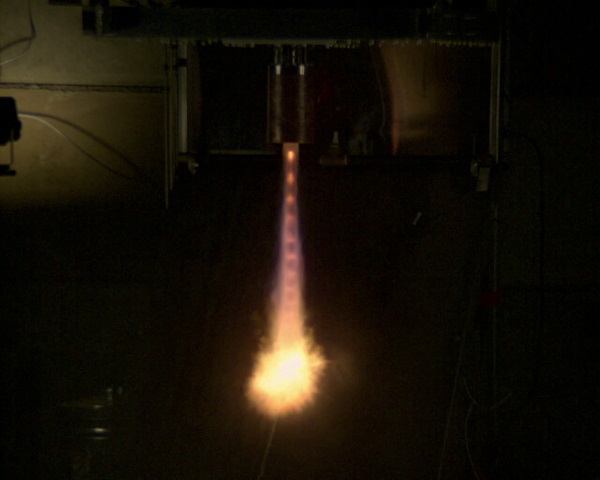
A live fire test of Tesseract’s Rigel engine.
The lapsed patents for these systems, however, pointed the team in the right direction. “The challenge for us has been going through the whole family of chemicals and finding which works for us. We’ve found a really good one — we’re keeping it as kind of a trade secret but it’s cheap, and really high performance.”
You wouldn’t want to rinse your face with it, but you can fuel a spacecraft wearing Gore-Tex coveralls instead of a hermetically sealed hazmat suit. Accidental exposure doesn’t mean permanent tissue damage like it might with hydrazine.
The times have changed as well. The trend in space right now is away from satellites that cost hundreds of millions and stay in geosynchronous orbit for decades, and towards smaller, cheaper birds intended to last only five or ten years.
More spacecraft being made by more people makes safer, greener alternatives more attractive, of course: lower handling costs, less specialized facilities, and so on further democratize the manufacturing and preparation processes. But there’s more to it than that.
If all anyone wanted was to eliminate hydrazine-based propulsion, they could replace the engine with an electric option like a Hall effect thruster, which gets its thrust from charged particles exiting the assembly and imparting an infinitesimal force in the opposite direction — countless times per second, of course. (It adds up.)
But these propulsion methods, while they have a high specific impulse — a measurement of how much force is generated per unit of fuel — they produce very little thrust. It’s like suggesting someone take a solar-powered car with a max speed of 5 MPH instead of a traditional car with a V6. You’ll get there, and economically, but not in a hurry.
Consider that a satellite, once brought to low orbit by a launch vehicle, must then ascend on its own power to the desired altitude, which may be hundreds of kilometers above. If you use a chemical engine, that could be done in hours or days, but with electric, it might take months. A military comsat meant to stay in place for 20 years can spare a few months at the outset, but what about the thousands of short-life satellites a company like Starlink plans to launch? If they could be operational a week after launch rather than months, that’s a non-trivial addition to their lifespan.
“If you can get rid of the toxicity and handling costs of conventional chemical propulsion, but maintain performance, we think green chemical is a clear winner for the new generation of satellites,” Franks said. And that’s what they claim to have created. Not just on paper either, obviously; here’s a video of a fire test from earlier this year.
“It’s also important at end of life, where doing a long, slow spiral deorbit, repeatedly crossing the orbits of other satellites, dramatically increases the risk of collision,” he continued. “For responsibly managing these large, planned constellations the ability to quickly deorbit at end of life will be especially important to avoid creating an unsustainable orbital debris problem.”
Tesseract has only 7 full-time employees, and was a part of Y Combinator’s Summer 2017 class. Since (and before) then they’ve been hard at work engineering the systems they’ll be offering, and building relationships with aerospace.
A render of Tesseract’s two flagship products – Adhara on the left and Polaris on the right.
They’ve raised a $2M seed round, but you don’t have to be a rocket scientist to know that’s not the kind of money that puts things into space. Fortunately the company already has its first customers, one of which is still in stealth but plans to launch a moon mission next year (and you better believe we’re following up on that hot tip). The other is Space Systems/Loral, or SSL, which has signed a $100 million letter of intent.
There are two main products Tesseract plans to offer. Polaris is a “kickstage,” essentially a short-range spacecraft used to deliver satellites to more distant orbits after being taken up to space by a launch vehicle. It’s powered by the company’s larger Rigel engines; this is the platform purportedly headed to the moon, and you can see it propelling a clutch of 6U smallsats on the right in the image above.
But Franks thinks the money is elsewhere. “The systems we think will be a bigger market opportunity are the smallsat propulsion systems,” he said. Hence the second product, Adhara, a propulsion bus for smaller satellites and craft that the company is focusing on keeping straightforward, compact, and of course green. (It’s the smaller rig in the image above; the thrusters are named Lyla.)
“We’ve heard from customers that complete, turnkey systems are what they mostly want, rather than buying components from many vendors and doing all the systems integration themselves like the old-school satellite manufacturers have historically done,” Franks said. So that’s what Adhara is for: “Keep it simple, bolt it on there, let it maneuver where it needs to go.”
Engineering these engines was no cakewalk, naturally, but Tesseract wasn’t reinventing the wheel. The principles are very similar to traditional engines, so development costs weren’t ridiculous.
The company isn’t pretending these are the only solutions that make sense now. If you need to have the absolute lowest mass or volume dedicated to propulsion, or don’t really care if it takes a week or a year to get where you’re going, electric propulsion is still probably a better deal. And for major missions that require high delta-V and don’t mind dealing with the attendant dangers, hydrazine is still the way to go. But the market that’s growing the most is neither one of these, and Tesseract’s engines sit in a middle ground that’s efficient, compact, and far less dangerous to work with.
Shortly after going public, Lyft is losing one of its top executives, according to a new report from CNBC.
Jon McNeill, who joined the ride-hailing business from Tesla about 18 months ago, is reportedly stepping down. We’ve reached out to Lyft to confirm.
Lyft’s stock (NASDAQ: LYFT) is down nearly 3% on the news. Despite a turbulent first month on the public market, Lyft has traded up the past three months, closing Friday up about 1% at $65.52 per share with a market cap of $18.55 billion.
Of his COO pick, Lyft CEO and co-founder Logan Green said in a statement provided to TechCrunch last year that “Jon is a world-class leader who brings deep experience as a highly successful entrepreneur and executive.”
“Last year, the Lyft community experienced more growth than in all previous years combined, growing rides by 2.3x and increasing market share by more than 50%. Jon is the right leader to build upon this momentum with his unique background of starting companies from scratch and managing at scale.”
Facebook, YouTube, and Twitter have failed their task of monitoring and moderating the content that appears on their sites; what’s more, they failed to do so well before they knew it was a problem. But their incidental cultivation of fringe views is an opportunity to recast their role as the services they should be rather than the platforms they have tried so hard to become.
The struggles of these juggernauts should be a spur to innovation elsewhere: While the major platforms reap the bitter harvest of years of ignoring the issue, startups can pick up where they left off. There’s no better time to pass someone up as when they’re standing still.
Asymmetrical warfare: Is there a way forward?
At the heart of the content moderation issue is a simple cost imbalance that rewards aggression by bad actors while punishing the platforms themselves.
To begin with, there is the problem of defining bad actors in the first place. This is a cost that must be borne from the outset by the platform: With the exception of certain situations where they can punt (definitions of hate speech or groups for instance), they are responsible for setting the rules on their own turf.
That’s a reasonable enough expectation. But carrying it out is far from trivial; you can’t just say “here’s the line; don’t cross it or you’re out.” It is becoming increasingly clear that these platforms have put themselves in an uncomfortable lose-lose situation.
If they have simple rules, they spend all their time adjudicating borderline cases, exceptions, and misplaced outrage. If they have more granular ones, there is no upper limit on the complexity and they spend all their time defining it to fractal levels of detail.
Both solutions require constant attention and an enormous, highly-organized and informed moderation corps, working in every language and region. No company has shown any real intention to take this on — Facebook famously contracts the responsibility out to shabby operations that cut corners and produce mediocre results (at huge human and monetary cost); YouTube simply waits for disasters to happen and then quibbles unconvincingly.
The Daily Crunch is TechCrunch’s roundup of our biggest and most important stories. If you’d like to get this delivered to your inbox every day at around 9am Pacific, you can subscribe here.
U.S. trade restrictions are trickling down to the developer community: GitHub is preventing users in Iran, Syria, Crimea and potentially other sanctioned nations from accessing portions of the code-hosting service, as confirmed by tweets from its CEO.
The Microsoft-owned code-sharing service says users in sanctioned countries will not be able to access private repositories and GitHub Marketplace, and also will be blocked from maintaining private paid organization accounts. However, public repositories will remain available to everyone.
The ruling by the Court of Justice of the EU states that sites embedding the Facebook Like button are jointly responsible for the initial data processing — and must either obtain informed consent from site visitors before transferring the data to Facebook, or be able to demonstrate a legal basis for processing this data.
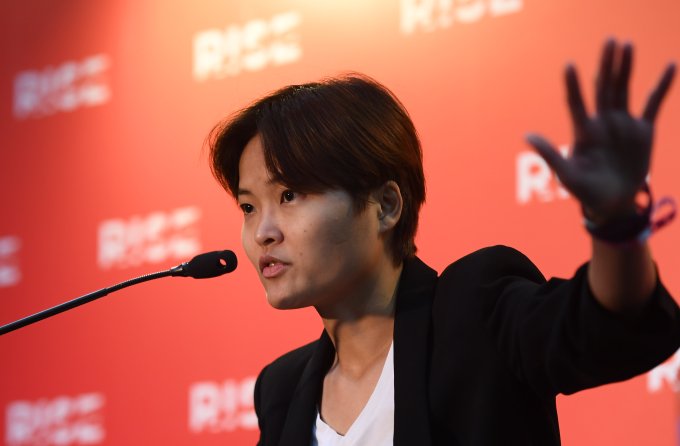
10 July 2018; Tan Hooi Ling, Co-Founder, Grab, speaks at a press confernece during day one of RISE 2018 at the Hong Kong Convention and Exhibition Centre in Hong Kong. Photo by Stephen McCarthy / RISE via Sportsfile
This announcement specifies how Grab will be using some of the $7 billion that it has raised to date, earmarking $2 billion for Indonesian operations over the next five years.
The latest episode of Equity looks at Robinhood’s latest funding round (which came at a $7.6 billion valuation). Meanwhile, over at Original Content, we reviewed the latest season of Netflix’s “Queer Eye.”
YouTube TV has landed another network partner: PBS. The public broadcaster’s member stations will be able to stream live and o-demand to YouTube TV subscribers beginning later this year, PBS and YouTube announced today.
This is the first digital TV provider partnership for PBS, and the broadcaster is intent upon providing local livestreams to “as many Americans as possible” with the move. The partnership will also include PBS KIDS, providing educational and entertainment content for children via the platform. All content will be available through YouTube TV video-on-demand, and recordable via its DVR service without limits on how much content users can store, too.
YouTube has had its own share of criticism for the kind of content kids may be able to access from its platform, and its said to be considering a number of options for addressing misuse of the platform when it comes to children-focused videos. YouTube TV is distinct from its primary streaming video business, however, and is much more like a traditional over-the-top cable or satellite subscription, however, with a number of broadcast networks and premium channels signed on to provide U.S. viewers access for $49.99 per month.
San Francisco and Lagos based fintech startup Flutterwave has partnered with Chinese e-commerce company Alibaba to offer digital payments between Alipay and African merchants.
Flutterwave is a Nigerian founded B2B payments service (primarily) for companies in Africa to pay other companies on the continent and abroad.
A large portion of Alipay’s network is in China, which makes the Flutterwave integration significant to capturing payments activity around the estimated $200 billion in China-Africa trade.
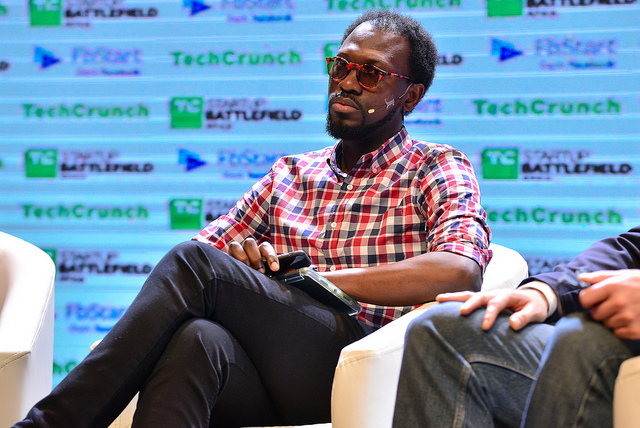
“This means that all our merchants can accept or install Alipay as a payment type to accept payments from its billion users,” Flutterwave CEO Olugbenga Agboola — aka GB — told TechCrunch.
“There’s a lot of trade between Africa and China and this integration makes it easier for African merchants to accept Chinese customer payments.”
A Flutterwave company release added, “We’ve managed to connect African countries…to each other so it was about time we connected Africa to the world. We started with the U.S…but you can’t connect Africa to the world without China.”
An Alipay spokesperson confirmed the Flutterwave collaboration with TechCrunch. Flutterwave will earn revenue from the partnership by charging its standard 2.8 percent on international transactions. The company currently has over 60,000 merchants on its platform, according to Agboola.
“Because of that I was in China to do meetings with Jack Ma and the only ask I had from that trip is ‘I want to be the Africa payment infrastructure that plugs directly into Alipay,'” Agboola said.
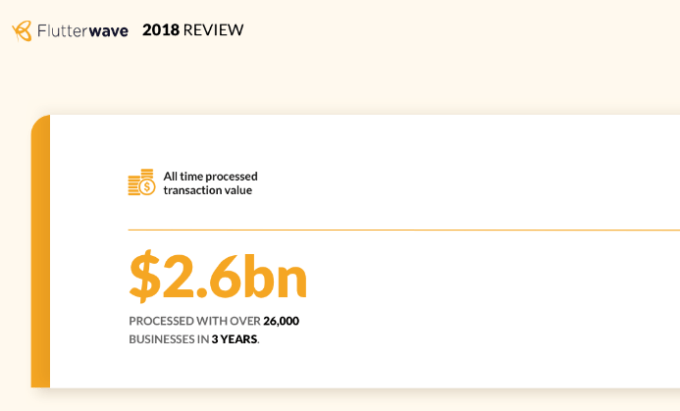
Founded in 2016, Flutterwave allows clients to tap its APIs and work with Flutterwave developers to customize payments applications. Existing customers include Uber, Facebook, Booking.com and e-commerce unicorn Jumia.com. Flutterwave has processed 100 million transactions worth $2.6 billion since inception, according to company data.
In a recent Extra Crunch feature, TechCrunch tracked Flutterwave as one of several Africa focused fintech companies that have established headquarters in San Francisco and operations in Africa to tap the best of both worlds in VC, developers, clients, and digital finance.
Flutterwave’s Alipay collaboration also tracks a trend of increased presence of Chinese companies in African tech.
China’s engagement with African startups has been light compared to the country’s deal-making on infrastructure and commodities. That looks to be shifting.
Alibaba founder Jack Ma has made several trips to the continent and this March announced the $1 million Africa Netrpreneur Prize for African startups and founders. Chinese company Transsion—a top-seller of smartphones in Africa under its Tecno brand—operates an assembly facility in Ethiopia and announced its IPO this year.
And this month Chinese owned Opera announced $55 million in venture spending to support its growing West African digital commercial network, that includes browser, payments and ride-hail services.
Dark has been keeping its startup in the dark for the last couple of years while it has built a unique kind of platform, it calls “deployless” software development. If you build your application in Dark’s language inside of Dark’s editor, the reward is you can deploy it automatically on Dark infrastructure on Google Cloud Platform without worrying about all of the typical underlying deployment tasks.
The company emerged from stealth today and announced $3.5 million in seed funding, which it actually received back in 2017. The founders have spent the last couple of years building this rather complex platform.
Ellen Chisa, CEO and co-founder at the company, admits that the Dark approach requires learning to use her company’s toolset, but she says the trade-off is worth it because everything has been carefully designed to work in tandem.
“I think the biggest downside of Dark is definitely that you’re learning a new language, and using a different editor when you might be used to something else, but we think you get a lot more benefit out of having the three parts working together,” she told TechCrunch.
She added, “In Dark, you’re getting the benefit of your editor knowing how the language works. So you get really great autocomplete, and your infrastructure is set up for you as soon as you’ve written any code because we know exactly what is required.”
It’s certainly an intriguing proposition, but Chisa acknowledges that it will require evangelizing the methodology to programmers, who may be used to using a particular set of tools to write their programs. She said the biggest selling point is that it removes so much of the complexity around deployment by bringing an integrated level of automation to the process.
She says that there are three main benefits to Dark’s approach. In addition to providing automated infrastructure, which is itself a major plus, developers using Dark don’t have to worry about a deployment pipeline. “As soon as you write any piece of backend code in Dark, it is already hosted for you,” she explained. The last piece is that tracing is built right in as you code, “Because you’re using our infrastructure, you have traces available in your editor as soon as you’ve written any code,” she said.
Chisa’s co-founder and company CTO is Paul Biggar, who knows a thing or two about deployment having helped found CircleCI, the CI/CD pioneering company.
As for that $3.5 million seed round, it was led by Cervin Ventures with participation from Boldstart, Data Collective, Harrison Metal, Xfactor (Erica Brescia), Backstage, Nextview, Promus, Correlation, 122 West and Yubari.
Google’s Pixel 4 is coming out later this year, and it’s getting the long reveal treatment thanks to a decision this year from Google to go ahead and spill some of the beans early, rather than saving everything for one big final unveiling closer to availability. A new video posted by Google today about the forthcoming Pixel 4 (which likely won’t actually be available until fall) shows off some features new to this generation: Motion control and face unlock.
The new “Motion Sense” feature in the Pixel 4 will detect waves of your hand and translate them into software control, including skipping songs, snoozing alarms and quieting incoming phone call alerts, with more planned features to come, according to Google. It’s based on Soli, a radar-based fine motion detection technology that Google first revealed at its I/O annual developer conference in 2016. Soli can detect very fine movements, including fingers pinched together to mimic a watch-winding motion, and it got approval from the FCC in January, hinting it would finally be arriving in production devices this year.
Pixel 4 is the first shipping device to include Soli, and Google says it’ll be available in “select Pixel countries” at launch (probably due to similar approvals requirements wherever it rolls out to consumers).
Google also teased “Face unlock,” something it has supported in Android previously – but Google is doing it very differently than it has been handled on Android in the past with the Pixel 4. Once again, Soli is part of its implementation, turning on the face unlock sensors in the device as it detects your hand reaching to pick up the device. Google says this should mean that the phone will be unlocked by the time you’re ready to use it, since it does this all on the fly, and works from pretty much any authentication.
Face unlock will be supported for authorizing payments and logging into Android apps, as well, and all of the facial recognition processing done for face unlock will occur on the device – a privacy-oriented feature that’s similar to how Apple handles its own Face ID. In fact, Google will also be storing all the facial recognition data securely in its own dedicated on-device Titan M security chip, another move similar to Apple’s own approach.
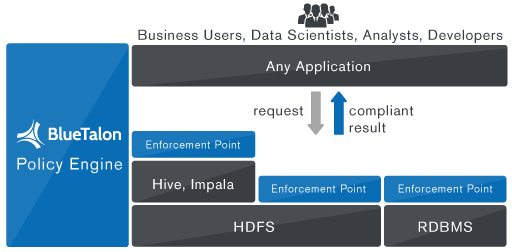
Microsoft today announced that it has acquired BlueTalon, a data privacy and governance service that helps enterprises set policies for how their employees can access their data. The service then enforces those policies across most popular data environments and provides tools for auditing policies and access, too.
Microsoft acquires data privacy and governance service BlueTalon
Neither Microsoft nor BlueTalon disclosed the financial details of the transaction. Ahead of today’s acquisition, BlueTalon had raised about $27.4 million, according to Crunchbase. Investors include Bloomberg Beta, Maverick Ventures, Signia Venture Partners and Standford’s StartX fund.
“The IP and talent acquired through BlueTalon brings a unique expertise at the apex of big data, security and governance,” writes Rohan Kumar, Microsoft’s corporate VP for Azure Data. “This acquisition will enhance our ability to empower enterprises across industries to digitally transform while ensuring right use of data with centralized data governance at scale through Azure.”
Unsurprisingly, the BlueTalon team will become part of the Azure Data Governance group, where the team will work on enhancing Microsoft’s capabilities around data privacy and governance. Microsoft already offers access and governance control tools for Azure, of course. As virtually all businesses become more data-centric, though, the need for centralized access controls that work across systems is only going to increase and new data privacy laws aren’t making this process easier.
“As we began exploring partnership opportunities with various hyperscale cloud providers to better serve our customers, Microsoft deeply impressed us,” BlueTalon CEO Eric Tilenius, who has clearly read his share of ‘our incredible journey‘ blog posts, explains in today’s announcement. “The Azure Data team was uniquely thoughtful and visionary when it came to data governance. We found them to be the perfect fit for us in both mission and culture. So when Microsoft asked us to join forces, we jumped at the opportunity.”



 “There’s a lot of trade between Africa and China and this integration makes it easier for African merchants to accept Chinese customer payments.”
 Founded in 2016, Flutterwave allows clients to tap its APIs and work with Flutterwave developers to customize payments applications. Existing customers include