Year: 2019

29 Jul 2019

GitHub confirms it has blocked developers in Iran, Syria and Crimea

The impact of U.S. trade restrictions is trickling down to the developer community. GitHub, the world’s largest host of source code, is preventing users in Iran, Syria, Crimea and potentially other sanctioned nations from accessing the service, chief executive of the Microsoft-owned firm said.

Over the weekend, GitHub CEO Nat Friedman wrote on Twitter that like any other “company that does business in the US,” GitHub is required to comply with the U.S. export law. The confirmation comes months after work collaboration service Slack, too, enforced similar restrictions on its platform.

As part of the push, Friedman said GitHub has enforced new restrictions to prevent users in sanctioned countries from accessing private repositories and GitHub Marketplace as well as maintaining private paid organizational accounts.

A selection of GitHub services such as access to public repositories will remain available to everyone, the company said in a statement on its website. “This includes limited access to GitHub public repository services (such as access to GitHub Pages and public repositories used for open source projects), for personal communications only, and not for commercial purposes.”

For developers intending to store export-controlled data, GitHub points them to its enterprise server offering, a self-hosted virtual appliance that can be run within users’ own data center or virtual private cloud.

Several developers began to complain about their inability to access some of GitHub’s services last week. News outlet ZDNet reported about a Russian developer living in Crimea whose GitHub account had been restricted, for instance. Hamed Saeedi Fard, a developer who is based in Iran, wrote in a Medium post that his GitHub account was blocked without being given any prior notice or the option to back up his data.

Interestingly, the restrictions are imposed based on a user’s location — by tracking their IP address and payment history — instead of validating their nationality and ethnicity, GitHub said on its website, where it mentions that Cuba and North Korea are also facing the U.S. sanctions. For those who are considering a workaround by using VPNs (virtual private networks), GitHub has ruled out that possibility: People in U.S.-sanctioned countries “are prohibited from using IP proxies, VPNs, or other methods to disguise their location when accessing GitHub.com services.” It remains to be seen how GitHub enforces the rule.

Banned users who believe their accounts have been wrongfully suspended can fill out an appeal form, where they must provide a copy of their government-issued photo ID to prove their current residency along with a selfie, signaling GitHub’s step towards imposing real-name identity check.

29 Jul 2019

SoftBank pumps $2B into Indonesia through new Grab investment, putting it head to head with Gojek

Grab — the on-demand transportation app that is the Uber of Southeast Asia — today announced yet another investment on top of the $7 billion that it has raised to date. SoftBank is putting another $2 billion into the business, earmarked for a specific use: Grab is going to invest $2 billion into its operations in Indonesia — the biggest economy in Southeast Asia — over the next five years.

Specifically, it will be using the money to modernise the country’s transportation infrastructure with the development of an electronic vehicle “ecosystem”, new geo-mapping solutions, and the establishment of a second headquarters for Grab in Jakarta focused on R&D for Indonesia and the wider region, to sit alongside its existing HQ in Singapore.

“With our presence in 224 cities, Indonesia is our largest market and we are committed to long-term sustainable development of the country,” said Anthony Tan, CEO of Grab, in a statement. “We are delighted to facilitate this SoftBank investment, as we believe by investing in digitizing critical services and infrastructure, we hope to accelerate Indonesia’s ambition to become the largest digital economy in the region and improve the livelihoods of millions in the country.” Indonesia accounts for the lion’s share of Grab’s business in terms of total footprint: its in 338 countries overall, meaning this country accounts for two-thirds of the whole list.

The deal will put Grab head to head with another big on-demand transportation startup Gojek: the two were already rivals in the region, but GoJek is based out of Jakarta and has been the dominant player in that specific market up to now.

Indeed, the deal is notable not just for the size of the funding, but for how it casts both Grab and SoftBank as allies of the government, not just accepted as businesses but endorsed as key players in helping improve the Indonesian economy and how the country is able to deliver critical services like healthcare and transportation, as well as give more services to drive the growth of “micro-entrepreneurs” by way of Grab-Kudo, the payments startup in the country that Grab acquired in 2017 for less than $100 million.

Given the track record that companies like Uber have had in locking horns with regulators, this puts Grab immediately into a strong position in terms of introducing and running with new services in the future. Its restaurant delivery business, GrabFood, is already the largest in the region, it claimed today.

Grab said the investment was the result of a meeting between Indonesia’s President Joko Widodo, Masayoshi Son, Chairman & CEO of SoftBank Group, Anthony Tan, CEO of Grab and Ridzki Kramadibrata, President of Grab Indonesia, at the Merdeka Palace in Jakarta.

“Indonesia’s technology sector has huge potential,” said Masayoshi Son, Chairman & CEO of SoftBank Group, in a statement. “I’m very happy to be investing $2 billion into the future of Indonesia through Grab.”

Indonesia’s Coordinating Minister for Maritime Affairs Luhut Binsar Panjaitan also had words supporting the deal: “Supported by the growing economy, Indonesia has a good investment climate where we are working together to boost the ease of investment in Indonesia,” he said. “This investment is evidence that Indonesia has been on the radar of investors, especially in the technology sector. We look forward to working with Grab, the fifth unicorn in Indonesia, and SoftBank to empower SMEs, accelerate tourism, and improving health services.”

We have asked Grab how and if this investment affects the company’s valuation. It last raised money just four weeks ago, $300 million from Invesco as part of a larger, ongoing Series H that it wants to use in part for acquisitions. That round is already at around $4.5 billion, with SoftBank having already put in just under $1.5 billion. This $2 billion is on top of that previous round, the company said today.

The company’s last reported valuation from a couple of months ago was around $14 billion.

This deal is a win on a couple of levels for Grab.

Most obviously, it’s giving the company a huge injection of capital to continue expanding its business aggressively in what is the biggest economy in Southeast Asia, with GDP of around $1 trillion annually.

A well-worn strategy by on-demand transportation companies — typified by others like Uber, Lyft and Didi — is to go big and go fast in order to establish a market presence among drivers and passengers, which can be used as a foothold to expand into other areas like food or package delivery and to then increase prices to improve margins.

Given that Indonesia is Gojek’s home country, and given that Indonesia is one of the biggest markets in the region, this makes it one of the most important territories for Grab to — err — grab.

“Grab is an Indonesia-focused company,” said Ridzki Kramadibrata, president of Grab Indonesia, in a statement today. “Having our second headquarters in Jakarta will allow us to better serve the needs of all Indonesians and those from emerging economies in the region. As a technology decacorn, Grab very well understands the needs and challenges we have here. We are also well positioned to support more high tech industries and infrastructure companies originating from Indonesia.”

On another front, this is an important strategy for the company on the regulatory and government front.

In a climate where it’s not unusual to see companies banned from operating in markets where they have run afoul of officials and the public, Grab is essentially buying its way into working with the state, and actually taking a commercial role in building its infrastructure. This — offering help with building infrastructure and simply passing on some of its experience and learnings — is a route that Didi has also been taking to make its way into new markets.

Grab said that it has invested $1 billion to date in Indonesia before now, and it said that its contribution to the economy in 2018 was $3.5 billion (48.9 trillion Indonesian rupiahs).


29 Jul 2019

Prenetics partners with Watsons, one of Asia’s largest personal care retailers, to sell its new consumer DNA tests

Genetics testing startup Prenetics today announced a major new deal for its brand in Asia. The company is partnering with A.S. Watson Group, the personal care giant whose stores are ubiquitous in many East and Southeast Asian countries. That means Watsons’ Hong Kong stores and website will be the first retailer in Asia to sell Circle DNA, Prenetics’ new consumer DNA testing kit, before it launches in Watsons’ other Asian markets.

Watsons has 15,200 stores in 25 countries across Asia and Europe, including Hong Kong, China, Taiwan, Indonesia, Malaysia, Singapore, Ukraine and Russia, and claims to be the largest health and beauty retailer in the world. Also based in Hong Kong, Prenetics began by providing DNA tests for insurance firms and health care providers, before branching into consumer tests by buying London-based startup DNAFit last year. The acquisition of DNAFIt, which still sells testing services under its own brand, also gave Prenetics a foothold in the U.S., where DNAFit is partnered with Helix, another gene testing company.

Prenetics launched in 2009 and has raised more than $50 million so far from investors including Beyond Ventures and Alibaba Hong Kong Entrepreneurs Fund, who led its $40 million Series B in 2017.

As it expands, Prenetics will become a more direct competitor with companies like 23andMe and AncestryDNA. Circle DNA’s kits differentiate by focusing primarily on health reports instead of ancestry. The most important advantage a DNA test can offer, however, is accuracy, and the ability of consumer DNA tests to answer certain questions reliably has been called into question by geneticists. Prenetics claims its technology, which uses whole exome sequencing instead of genotyping, is able to provide 50 to 100 times more data than competing tests.

In a press statement, A.S. Watson Group chief operating officer Malina Ngai said “We are excited to launch Circle DNA first in Watsons Hong Kong, providing an easy solution for personalized digital healthcare assessment. Combined with our strong customer connectivity, scalable pharmacy network, professional health team and loyalty program, we are committed to help customers to take further actions to improve their known health concerns.”

29 Jul 2019

Applications are open for Startup Battlefield at TechCrunch Disrupt Berlin 2019

Listen up founders — TechCrunch is on the lookout for game-changing, early-stage startups to feature at TechCrunch Disrupt Berlin‘s Startup Battlefield. This is your chance to launch on the famous TechCrunch stage and compete for the a $50,000 equity-free prize and the attention of top global investors and hundreds of media outlets from around the world. Apply here.

We’ve had some incredibly successful companies launch at our European-based event. N26, European fin-tech startup and Startup Battlefield EU 2016 alum, just raised a $170 million Series D round, bringing the company’s valuation up to a whopping $3.5 billion dollars. Startup Battlefield EU 2015 winner JukeDeck was just acquired by TikTok. The list of Startup Battlefield companies doesn’t stop there — Dropbox, GetAround, SirenCare, Fitbit, Mint.com, Vurb and more, and now is your chance to join this impressive group of companies. More than 857 participating companies have raised over $8.9 billion in funding, with 112 successful exits (IPOs or acquisitions). 

How does it work?

Apply. TechCrunch charges zero fees and takes no equity. Fill out your app here. Early-stage startups from any country and any vertical are eligible — hardware, AI/ML, biotech, insurtech, to name a few. All companies must have an MVP to demo to the review committee. TC editors review applications and select 15-20 of the highest potential startups to pitch onstage at Disrupt Berlin (December 11-12).

Train. Selected founders will get intensive training from the Startup Battlefield team to refine pitches and demos, sharpen business models and prepare for this international launch.

Pitch. Trained Startup Battlefield founders will pitch on the live-streamed main stage at Disrupt Berlin for six minutes, including a live demo, followed by a six-minute Q&A with our esteemed judges. Past judges have included Jeff Clavier (Uncork Capital), Eileen Burbidge (Passion Capital), Sonali De Rycker (Accel) and Roelof Botha (Sequoia Capital). After the semi-final round, 4-6 companies will pitch again on day two — same pitch, but with a new panel of judges. The judges will select the winner, who will get the $50,000 check, a feature post on TechCrunch, the Disrupt Cup and the attention of millions.

Disrupt. At the conference, participants get VIP treatment with access to private events, CrunchMatch: TechCrunch’s Investor Startup Matching Program, backstage access, complimentary exhibition space for all days of the conference, free subscriptions to Extra Crunch and a ticket to all future TechCrunch events.

Pitch on the most famous stage in tech. Apply now.

29 Jul 2019

Joy Capital closes $700M for early-stage investments in China

Joy Capital, the venture capital firm that’s backed Luckin, NIO, Mobike and other investor darlings in China, just raised $700 million for a new fund focusing on early-to-growth stage startups.

Launched in 2015 by a team of former investors at Legend Capital, the investment arm of PC maker Lenovo’s parent company, Joy Capital made the news official (in Chinese) on Monday. It didn’t identify the limited partners in this new corpus of funding but said they include “top” public pension funds and insurance companies. Its existing pool of investors counts those from sovereign wealth funds, education-focused endowment funds, family funds and parent funds.

The fresh money boosted Joy’s total tally to over 10 billion yuan ($1.45 billion) under management, with a focus on backing cutting edge technologies and companies involved in the digital upgrade of China’s traditional sectors, or what Joy’s founding partner Liu Erhai (pictured above) dubbed the “new infrastructure” in an op-ed for the China Securities Journal. Targets can include the likes of logistics companies, online car rental platforms or bike-sharing apps.

As a relatively young fund, Joy Capital has so far achieved a few large outcomes. One of its portfolio companies NIO became China’s first electric vehicle startup to go public in the U.S. as a rival to Tesla. It’s also funded Luckin, the Starbucks nemesis from China that floated in the U.S. only 18 months after inception. The fund’s other big wins include Mobike, the bike-sharing pioneer that was sold to Meituan Dianping for $2.7 billion and fast-growing house-sharing unicorn Danke Apartment.

Joy Capital’s new raise arrived at a time when Chinese venture investors are coping with a cash crunch amid a cooling economy exacerbated by the expansion of U.S. tariffs. We reported that private equity and venture capital firms in the country raised 30% less in the first six months of 2019 compared to a year earlier, and the number of investors that managed to attract fundings was down 52% in the same period.

29 Jul 2019

Fortnite World Cup has handed out $30 million in prizes, and cemented its spot in the culture

The Fortnite phenomenon — the wildly popular battle royale game from Epic Games — has manifested itself in concerned articles, cultural shoutouts and now has sealed its place in the cultural firmament by wrapping up its first “World Cup” which saw the company give away $30 million in prizes.

The big winner in today’s solo challenge was sixteen year-old Kyle “Bugha” Giersdorf, who won $3 million for beating out the competition in the solo tournament. And, as sports writer Darren Rovell noted on Twitter, Giersdorf’s prize pool is only $800,000 smaller than the pot for the winner of the U.S. Open, which is set to begin in a few weeks at the same stadium.

Indeed, the esports prize pool is one of the biggest awards for a popular competitive event. Wimbledon winners will take home less than $3 million and Tiger Woods won $2 million for besting the field of competitors at the Masters. \

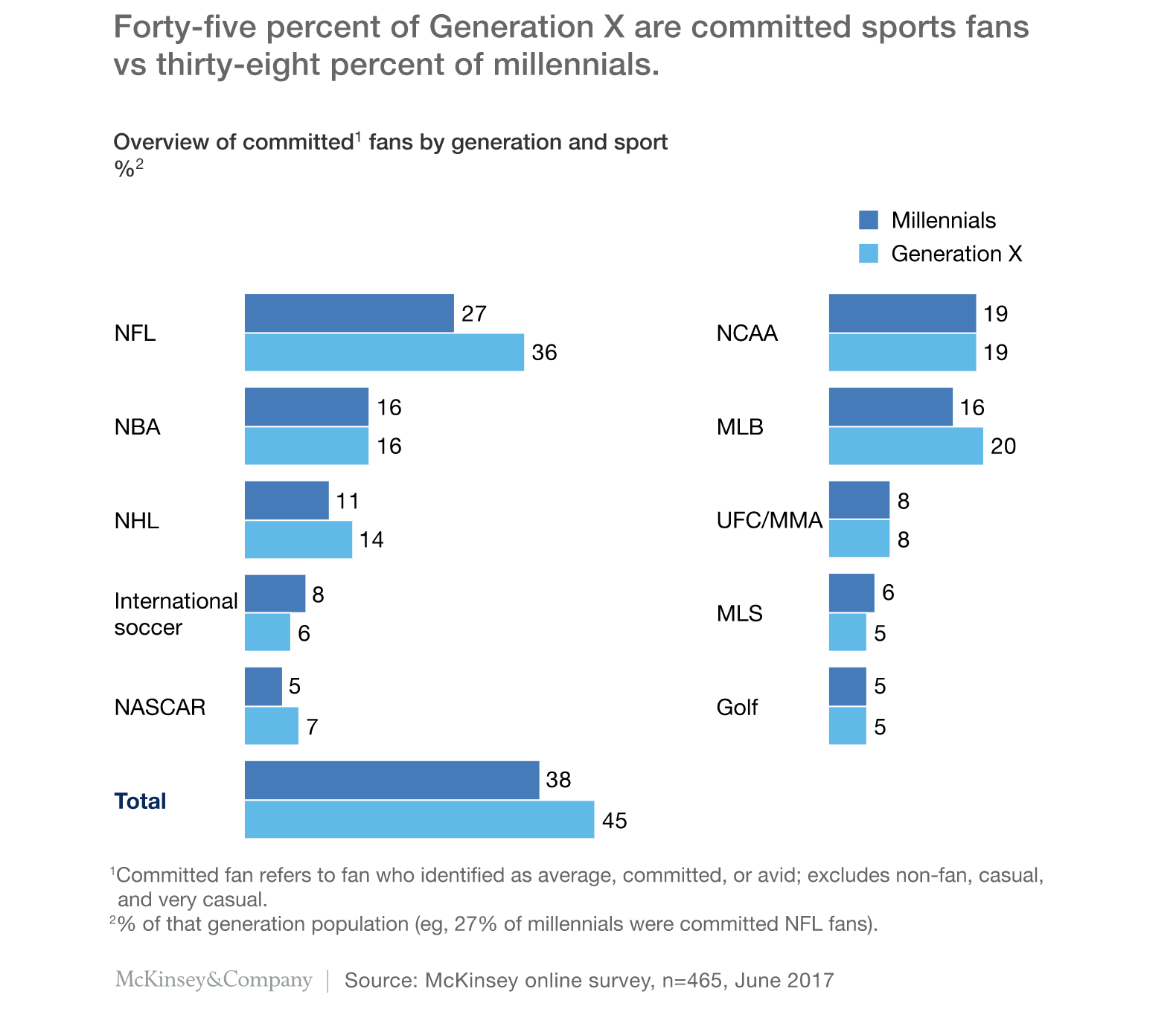
Fortnite’s big moment is also a big deal for competitive esports in the U.S. The biggest prize pool for an esports event in the U.S. was likely meant to plant a flag and show that competitive gaming is something that can capture the attention of a younger audience that has drifted away from watching more traditional pastimes and watching less sports, according to a McKinsey study.

Screen Shot 2019 07 28 at 6.01.13 PM

Courtesy of McKinseys

Giersdorf, who hails from Pennsylvania and plays professionally for the Los Angeles-based esports team, the Sentinels, became the inaugural Fortnite World Cup solo champion by putting in a dominant performance over the entire weekend of competition.

For folks who’ve never played the game (or had it explained to them) Fortnite involves dropping 100 players onto an island where they have to find weapons, build bases and try and eliminate the competition until only one player’s left standing.

It’s a cartoon version of the Hunger Games with no bloodshed, a lot of victory dances, and hours of social networking.

The game has turned its publisher, Epic Games into a multi-billion dollar business. Certainly it’s one that can afford to front a $30 million prize purse for a few days of competition.

The tournament wasn’t just about solo-play. The company had different rounds for the duos competition featuring two-player teams. That competition, which ended on Saturday, also featured a $3 million prize pool and was won by the European duo of Emil “Nyhrox” Bergquist Pedersen and David “Aqua” W.

Epic pulled out all of the stops it could for the multi-day event at Arthur Ashe stadium. In addition to pulling in some of the top names in livestreaming and competitive esports to participate in the event, the company also brought in the DJ Marshmello for a performance.

The tournament pulled in nearly 9 million viewers for the final day of the competition on YouTube alone. Over 40 million people tried out for a slot in the World Cup finals.

And while the prize pot takes a significant chunk out of the $100 million that Epic has committed to spend on competitions this year, the returns in terms of the social capital and cache’ that Epic has given to the esports world can’t be underestimated.

It’s certainly going to change the life of its first World Cup champion. A fact that Giersdorf knows all too well himself.

“Emotionally, right now, I don’t feel too much, except I know that this could pretty much change my life forever,” Giersdorf said in an interview with ESPN. “It’s just absolutely unreal.”

28 Jul 2019

Last-mile training and the future of work in an expanding gig economy

The future of work is so uncertain that perhaps the only possible job security exists for the person who can credibly claim to be an expert on the future of work.

Nevertheless, there are two trends purported experts are reasonably certain about: (1) continued growth in the number of jobs requiring substantive and sustained interaction with technology; and (2) continued rapid expansion of the gig economy.

This first future of work trend is evident today in America’s skills gap with 7 million unfilled jobs — many mid- or high-skill position requiring a range of digital and technology capabilities.

Amazon’s recent announcement that it will spend $700 million over the next six years to upskill 100,000 of its low-wage fulfillment center employees for better digital jobs within Amazon and elsewhere demonstrates an understanding that the private sector must take some responsibility for the requisite upskilling and retraining, as well as the importance of establishing pathways to these jobs that are faster and cheaper than the ones currently on offer from colleges and universities.

These pathways typically involve “last-mile training”, a combination of digital skills, specific industry or enterprise knowledge, and soft skills to make candidates job-ready from day one.

The second trend isn’t new; the gig economy has existed since the advent of the “Help Wanted” sign. But what’s powered the gig revolution is the shift from signs and classified ads to digital platforms and marketplaces that facilitate continued and repeated matching of gig and gig worker. These talent platforms have made it possible for companies and organizations to conceptualize and compartmentalize work as projects rather than full-time jobs, and for workers to earn a living by piecing together gigs.

Critics of the gig economy decry the lack of job security, healthcare and benefits, and rightly so. If it’s hard to make ends meet as a full-time employee making a near-minimum wage, it’s impossible to do so via a gig platform at a comparable low wage. But rather than fighting the onset of the gig economy, critics might achieve more by focusing on upskilling gig workers.

To date, conversations about pathways and upskilling have focused on full-time employment. In the workforce or skills gap vernacular, upskilled Amazon workers might leave the fulfillment center for a tech support job with Amazon or another company, but it’s always a full-time job. But how do these important concepts intersect with the rising gig economy?

GettyImages 924636730

Image via Getty Images / PeterSnow

Just as there are low-skill and high-skill jobs, there are gig platforms that require limited or low skills, and platforms that require a breadth of advanced skills. Gig platforms that can be classified as low-skill include Amazon’s Mechanical TurkTaskRabbitUber and Lyft, and Instawork (hospitality). There are also mid-tier platforms like Upwork that span a wide range of gigs. And then there are platforms like Gigster (app development), and Business Talent Group (consulting and entire management functions) that require the same skillset as the most lucrative, in-demand, full-time positions.

So just as Amazon is focused on last-mile training programs to upskill workers and create new pathways to better jobs, in the gig economy context, our focus should be on strategies and platforms that allow gig workers to move from lower-skill to higher-skill platforms i.e., pathways for Uber drivers to become Business Talent Group executives.

One high-skill gig platform has developed an innovative strategy to do exactly this. CreatorUp is a gig platform for digital video production that has built in a last-mile training on-ramp. CreatorUp offers low-cost or free last-mile training programs on its own and in conjunction with clients like YouTube and Google to upskill gig workers so they can be effective digital video producers on the CreatorUp platform.

CreatorUp’s programs are driven by client demand; because the company saw significant demand from clients for AR/VR video production, it launched a new AR/VR training track. Graduates of CreatorUp’s programs join the platform and are staffed on a wide range of productions that clients require to engage customers, suppliers, employees and/or to build their brands.

Screen Shot 2019 07 28 at 4.39.10 PM

The good news for CreatorUp and other high-skill gig platforms that begin to incorporate last-mile training is that investing in these pathways can start the flywheel that every successful talent marketplace requires. Clients only patronize talent marketplaces once there’s a critical mass of talent on the platform. So how do platforms attract talent? One way is to be first-to-market in a category. A second is to attract billions in venture capital. But a third might be to use last-mile training to create new talent.

CreatorUp believes its last-mile training programs have allowed it to grow a network that serves diverse client needs better than any other video production platform. For not only has last-mile training allowed CreatorUp to understand and certify the skills of talent on the platform, and therefore to meet the needs of more clients, it has also allowed CreatorUp to bid more competitively because newly trained talent is often willing to work for less.

Last-mile training has the potential to be a win-win for the gig economy. It’s a strategy that may allow gig platforms to scale, matching more talent with more clients. Meanwhile, by allowing workers to upskill from lower-tier gig platforms to higher skill platforms, it’s also the first gig economy solution for social mobility.

28 Jul 2019

Reports claims all three new iPhones planned for 2020 will support 5G

Apple analyst Ming-Chi Kuo — sometimes described as “the most accurate Apple analyst in the world” — has written a new note to investors saying that the three iPhones expected to launch in 2020 will feature support for 5G. In previous Kuo reports, it’s said the 2020 iPhones could be available in new sizes: a 5.4 and 6.7-inch high-end iPhones with OLED displays, along with a 6.1-inch model with an OLED display.

Previously, he predicted that only two of the three new iPhones slated for 2020 would support 5G. But with well-spec’d Androids flooding the market, he says it looks like Apple will offer 5G in all models in order to better compete. He’s also confirmed the view that Apple will be able to throw more resources into developing the 5G iPhone now that it has acquired Intel’s smartphone modem chip business.

The report, leaked to MacRumors, contains this quote:

We now believe that all three new 2H20 iPhone models will support 5G for the following reasons. (1) Apple has more resource for developing the 5G iPhone after the acquisition of Intel baseband business. (2) We expect that the prices of 5G Android smartphones will decline to $249-349 USD in 2H20. We believe that 5G Android smartphones, which will be sold at $249-349 USD, will only support Sub-6GHz. But the key is that consumers will think that 5G is the necessary function in 2H20. Therefore, iPhone models which will be sold at higher prices have to support 5G for winning more subsidies from mobile operators and consumers’ purchase intention. (3) Boosting 5G developments could benefit Apple’s AR ecosystem.

The report expects all three 2020 iPhone models to support both mmWave and Sub-6GHz spectrum (two different kinds of 5G) for the US market. Whether Apple will launch a 5G iPhone that only supports Sub-6GHz, allowing for a lower price and thus making it suitable for the Chinese market, remains unclear.

mmWave is the ‘fastest 5G’ that’s most often referred to, but as it is suited to denser, urban areas, it will not be used as much in rural or suburban areas, where mid-bands and low-bands, called sub-6GHz 5G, will be employed. All are banks are faster than 4G, with mmWave the fastest.

Apple will use modem chips from Qualcomm in its 2020 5G iPhones, while it works on its own modem chips, due in 2021.

28 Jul 2019

Original Content podcast: Our love for ‘Queer Eye’ isn’t quite as strong

It’s been barely more than a year since the “Queer Eye” revival premiered on Netflix, but the series is already back for its fourth season.

This time around, the Fab Five finds new makeover subjects in Kansas City (with a detour to Quincy, Illinois, where hairstylist Jonathan Van Ness grew up), offering their custom mix of lifestyle tips and intense emotional conversations. In many ways, the new season serves as a reminder that “Queer Eye” remains one of the most compelling titles in Netflix’s reality TV lineup.

At the same time, some of our excitement is wearing off. That’s not to say that the show is weaker, exactly — but the formula is becoming more familiar, and the contrivance of whirlwind life changes all taking place in a handful of days feels a little harder to swallow.

We also had reservations about Karamo’s big decision in “Disabled But Not Really,” where he asks the episode’s subject Wesley to meet with the man who shot and paralyzed him years earlier. It makes for suspenseful and moving TV, and Wesley seems to find the conversation rewarding, but we argued about whether the sequence felt more contrived and exploitative than helpful.

In addition to reviewing the latest season of “Queer Eye,” we also discussed our first impressions of the new Netflix science fiction series “Years and Years,” which Jordan was particularly excited about because it stars Katee Sackhoff of “Battlestar Galactica.” This, in turn, led to our thoughts on the new trailer for “Star Trek: Picard.”

You can listen in the player below, subscribe using Apple Podcasts or find us in your podcast player of choice. If you like the show, please let us know by leaving a review on Apple. You can also send us feedback directly. (Or suggest shows and movies for us to review!)

And if you’d like to skip ahead, here’s how the episode breaks down:
0:00 Intro
0:28 “Another Life” first impressions
17:32 “Queer Eye” season 4 review

28 Jul 2019

What will happen when the bad times come?

Here in America we are now in the longest economic expansion in history. That doesn’t mean it’s about to end. But it does raise the question: what happens when it does? When the economic cycle finally inverts into recession, perhaps unexpectedly and with no obvious cause, perhaps because of some geopolitical crisis? We know what happens to the overall economy — but what happens to the tech sector?

Last time around, the answer was: “surprisingly little.” Late 2008 saw widespread expectations that tech was about to crater along with all other sectors. This was the era of Sequoia Capital’s infamous “R.I.P. Good Times” deck. They could hardly have been more wrong.

Instead the Great Recession everywhere else was more of a speed bump in Silicon Valley. In fact it was arguably the birth of the modern startup boom. The number of startups tracked by CrunchBase rose rapidly from 1200 in 2007, by at least 25% every year, to 5700 five years later.

Meanwhile, YoY revenue growth at Google did drop into single digits in 2008-09 … but only for a few quarters, never actually stalled, and quickly returned to 20%+. Amazon growth never fell below double digits. Apple’s went negative for one lonesome quarter, but otherwise stayed north of 20%.

Go back a little further, though, and you come to the dot-com crash, in which tech was — of course, and rightly — hit hard. This was not entirely a bad thing. Even at the time it was clear that to some extent the chaff was being sifted from the industry, albeit at widespread painful personal cost. However, that unpleasant correction set the stage for the nonstop growth since.

So: will the next downturn parallel 2008, or 2001? Will tech growth slow but not stop, or has the time come again for a great economic threshing which will separate wheat from chaff? Or will the next downturn take its own, very different shape? Tech is both much larger now, and much more tightly woven into every other sector.

One could argue a recession will accelerate the demise of legacy businesses and systems, and their replacement with newer, more efficient, software- / API- / AI-driven ones, so the tech industry will actually see a net benefit from any downturn. I’m skeptical of this vulture theory, though. A sinking tide ultimately lowers all boats.

Still, the Big Five — Alphabet, Amazon, Apple, Facebook, Microsoft — will probably sail though relatively untouched. They may stop hiring as aggressively (Google has grown by 18,000 employees to 107,000 in just the last year) but they have enough cash on hand, and diverse enough revenue streams, to weather a storm. Even Google is no longer totally reliant on ads, now that it’s making $8 billion/year from GCP.

The one possible exception is Facebook, which remains the most precarious of the Big Five, given the increasing vitriol it attracts, its relative lack of room to grow in wealthy markets, and, probably most important, the fact it remains a one-trick revenue pony. Could the next recession see Facebook drop from Big Five status? Very possibly.

Lesser companies, though — those outside of tech proper, and even the herd of growth-stage unicorns — will almost certainly be forced into major layoffs. Will the newly-laid-off flock back to school, as happened in 2008? Or will they rush to roll the dice with new startups? Given the rising costs of, and increasing skepticism aimed at, traditional higher education, it seems likely that instead we’ll suddenly see an enormous bloom of new startups.

On the one hand, this means more ideas flung at the proverbial wall, and so more innovation. But on the other, these will presumably mostly be low-cost web / app startups, which as I’ve argued before are increasingly played out, from people who are founding them as a reaction to being laid off rather than because they have a vision they can’t ignore, in a downturn during which funding will presumably grow ever harder to acquire.

There’s a school of thought which says more startups is always better, and another which says that bad startups are like an algal bloom, choking the oxygen (money, attention, talent) from the ambient environment and making things worse for the overall ecosystem. It seems likely that the next downturn will serve as a natural experiment testing these hypotheses. Let’s hope the former is more true. And if (but only if) you have your own burning startup idea in you, it might be best to beat the eventual recessionary rush.