Year: 2019

27 Nov 2019

Fabric’s new app helps parents with the hard stuff, including wills, life insurance & shared finances

A new app called Fabric aims to make it simpler for parents to plan for their family’s long-term financial well-being. The goal is to offer parents a one-stop-shop that includes the ability to ability for term life insurance from their phone, create a free will in about five minutes, and collaborate with a spouse or partner to organize key financial accounts or other important documents. In addition, parents are able to coordinate with beneficiaries, children’s guardians, attorneys, financial advisors, and others right from the app.

Fabric was originally founded in 2015 by Adam Erlebacher, previously the COO at online bank Simple, and Steven Surgnier, previously the Director of Data at Simple. The company last year raised a $10 million Series A led by Bessemer Venture Partners, after having sold life insurance coverage to thousands of families.

Since launch, Fabric has expanded beyond life insurance to offer other services, like easy will creation and the addition of tools that help families organize their financial and legal information in one place. The idea, the company explained at the time, was to offer today’s busy parents a better alternative to meetings with agents to discuss complicated life insurance products. Instead, the company offers a simple, 10-minute life insurance application and the option to connect with a licensed team if they need additional help, as well as a similarly simplified will creation workflow.
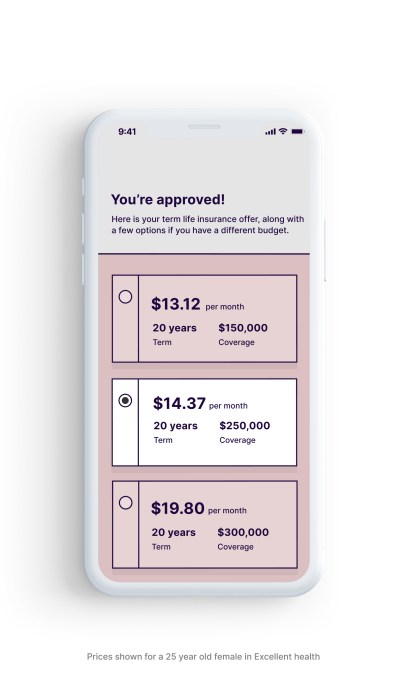
As with the founders’ earlier company, Simple, which offered a better front-end to banking while actual bank accounts were held elsewhere, Fabric’s life insurance policies are issued by “A” rated insurer, Vantis Life, not Fabric itself.

However, until now, Fabric’s suite of services were only available on the web. They’re now offered in an app for added convenience. The app is initially available on iOS with an Android version in the works.

“Money can be especially stressful when you’re trying to build a family and a career,” said Fabric co-founder and CEO Adam Erlebacher. “In one survey by Everyday Health, 52% of respondents said financial issues regularly stress them out, and people between the ages of 38 to 53 were the most stressed out financially. Parents want to have more control over their families’ long-term financial well-being and today’s dusty old products and tools are failing them,” he added.

Using the Fabric app, parents can take advantage of any of its offerings, including the option to apply for life insurance from the phone and get immediate approval. The app also makes it possible to share the policy information with beneficiaries, so it doesn’t get lost.

Another feature lets you create your will for free, and share that information with key people as well, including the witnesses you need to coordinate with in order to finalize the will, for example. And a spouse can choose to mirror your will, which speeds up the process of creating a second one with the same set of choices.
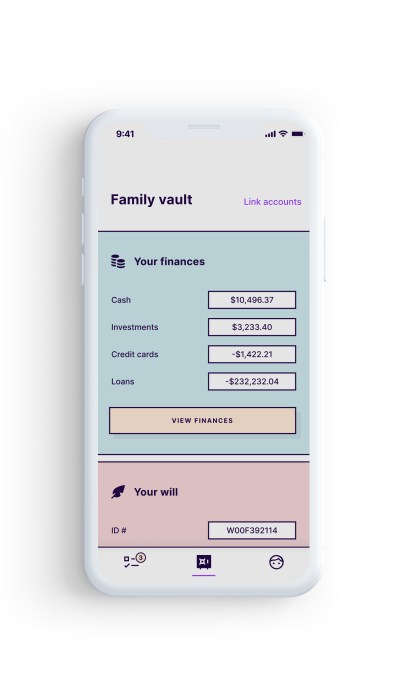
Fabric also helps to address an issue that often only comes up after it’s too late or in other emergency situations — organizing both parents’ finances in a single place. Many working adults today have not just a bank account, but also have investment accounts, 401Ks, IRAs, and credit cards, or a combination of those. But their partner may not know where to find this information or where the accounts are held.

The app, which we put through its paces (but didn’t purchase life insurance through), is very easy to use. It starts off with a short quiz to get a handle on your financial picture. It then delivers you to a personalized homescreen with a checklist of suggestions of what to do next. Naturally, this includes the life insurance application, as this is where Fabric’s revenue lies. And if you’re lacking a will and have other fiances to organize, these are featured, too.

The online forms are easy to fill out, despite the smartphone’s reduced screen space compared with a web browser, and Fabric has taken the time to get the small touches right — like when you enter a phone number, the numeric keypad appears, for example, or the integration of address lookup so you can just tap on the match and have the rest autofill. It also saves your work in progress, so you can finish later in case you get interrupted — as parents often do. And it explains terms, like “executor,” so you know what sort of rights you’re assigning.

Given its focus, Fabric protects user information with bank-grade security, including 256-bit encryption, two-factor authentication, automatic lockouts, biometrics, and other adaptive security features.

Fabric isn’t alone in helping parents and others financially plan wills and more from their iPhone. Other apps exist in this space, including will planning apps from Tomorrow, LegalZoom, Qwill, and others. Plus many insurers offer a mobile experience. Fabric is unique because it puts wills, insurance, and other tools into a single destination, without complicating the user interface.

Fabric’s app is a free download on the App Store. 
27 Nov 2019

Only a few 2020 US presidential candidates are using a basic email security feature

Just one-third of the 2020 U.S. presidential candidates are using an email security feature that could prevent a similar attack that hobbled the Democrats’ during the 2016 election.

Out of the 21 presidential candidates in the race according to Reuters, seven Democrats and one Republican candidate are using and enforcing DMARC, an email security protocol that verifies the authenticity of a sender’s email and rejects spoofed emails, which hackers often use to try to trick victims into opening malicious links from seemingly known individuals.

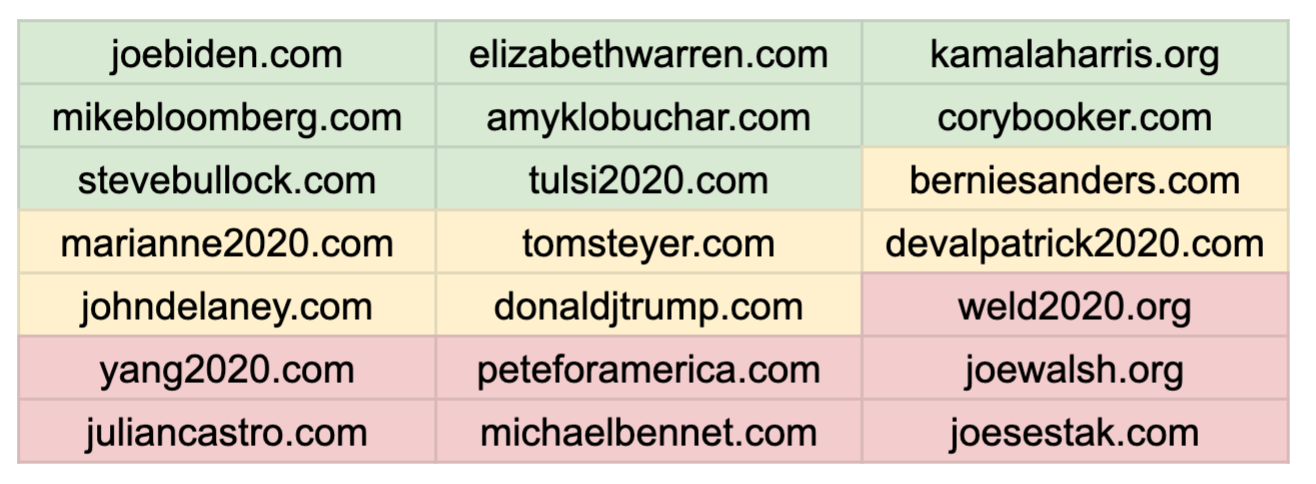
It’s a marked increase from April, where only Elizabeth Warren’s campaign had employed the technology. Now, the Democratic campaigns of Joe Biden, Kamala Harris, Michael Bloomberg, Amy Klobuchar, Cory Booker, Tulsi Gabbard, and Republican candidate Steve Bullock have all improved their email security.

The remaining candidates, including presidential incumbent Donald Trump, are not rejecting spoofed emails. Another seven candidates are not using DMARC at all.

That, experts say, puts their campaigns at risk from foreign influence campaigns and cyberattacks.

“When a campaign doesn’t have the basics in place, they are leaving their front door unlocked,” said Armen Najarian, chief identity officer at Agari, an email security company. “Campaigns have to have both email authentication set at an enforcement policy of reject and advanced email security in place to be protected against socially-engineered covert attacks,” he said.

Green indicates a reject/quarantine policy, while yellow indicates a non-enforced policy. (Image: TechCrunch)

DMARC, which is free and fairly easy to implement, can prevent attackers from impersonating a candidate’s campaign but also prevent the same kind of targeted phishing attacks against the candidate’s network that resulted in the breach and theft of thousands of emails from the Democrats.

In the run-up to the 2016 presidential election, Russian hackers sent an email to Hillary Clinton campaign manager John Podesta, posing as a Google security warning. The phishing email, which was published by WikiLeaks along the rest of the email cache, tricked Podesta into clicking a link that took over his account, allowing hackers to steal tens of thousands of private emails.

A properly enforced DMARC policy would have rejected the phishing email from Podesta’s inbox altogether, though DMARC does not protect against every kind of highly sophisticated cyberattack. The breach was bruising for the Democrats, one that led to high-profile resignations and harmed public perceptions of the Clinton presidential campaign — one she ultimately lost.

“It’s perplexing that the campaigns are not aggressively jumping on this issue,” said Najarian.

27 Nov 2019

Rossum raises $4.5M to make OCR-like data entry many times more accurate

Every day, people slog over inputting date from invoices and other forms. So instead of using traditional Optical Character Recognition (OCR) extraction software, you could apply a new form of machine learning to documents to speed up the process. That’s the thinking behind Rossum’s technology, which uses ‘Cognitive Data Capture’ to teach computers to understand documents in the way humans do. It says its AI tool has been proven to extract data six times faster than at a human rate while saving companies up to 80% of the costs.

The company has now secured $4.5 million after one $1million pre-seed with Miton and StartupYard, followed by a second $3.5 million seed round, led by LocalGlobe out of London. Seedcamp also participated.

A number of Angels also took part: Elad Gil (Twitter’s former VP of strategy and investor in Airbnb, Square, and Pinterest); Michael Stoppelman (investor in Wish, Lyft and the former SVP of Engineering at Yelp); Vijay Pandurangan (investor and advisor for Wish and Get Room and former Director of Engineering at Twitter); and Ryan Petersen (founder and CEO Flexport and Import Genius).

Rossum’s software was built by its three founders, former AI PhD students Tomas Gogar, Petr Baudis and Tomas Tunys. Baudis’ work is credited in Google’s scientific paper on its historic AlphaGo AI victory in 2016.

Rather than replacing employees, Rossum’s aim is to speed up human operators, giving businesses more flexibility and reliability for their customers, and helping employees focus their attention on more complex tasks or tasks that require creativity. Rossum says its accuracy rates average at around 95% and for any data fields Rossum’s software can’t identify, it asks for feedback from a human worker. Each time it receives feedback, the software learns, improves and this accuracy increases.

Rossum’s product is already used by companies in every continent, including multiple Fortune 500 enterprises, such as Siemens.

Rossum’s current system is helping its clients chiefly process invoices and similar documents, like delivery notes. However, the technology can be used to process documents across many segments including accounting, logistics, insurance, real estate management, among others. It plans to use its investments to further develop this technology for multiple sectors, open a US office and continue its global expansion.

Rossum’s co-founder Tomas Gogar said: “Technology should make data entry easier and cheaper but businesses have become too reliant on using old systems that no longer meet their needs. Rossum solves these problems without complicated, clunky integrations; without teams of developers; and without high costs. ”

Reshma Sohoni from SeedCamp said: “Rossum’s technology is a game-changer for business. We’re excited to work with such a passionate and highly skilled team to bring the cost and time savings of its AI data-extraction tool to even more businesses.”

27 Nov 2019

TechStars’s new CEO on the state of the famed accelerator and what’s next for 2020

Like another famous accelerator program founded around the same time, Techstars has grown considerably since its 2006 launch in Boulder, Colorado.

In fact, the brand seems to be in so many places that it’s hard to keep track of its reach, along with its impact. Where is Techstars, exactly? Who funds it? And how many startups have passed through its program?

We caught up yesterday with co-founder and CEO David Brown, who shared CEO duties with co-founder David Cohen until recently, and he got us up to speed while getting his family out of town for the upcoming Thanksgiving holiday.

First, some stats: TechStars is now in 49 cities around the world, including across the U.S., as well as in Europe, Australia, Singapore and South Korea, among other countries. Each accepts 10 companies each year that pass through a three-month-long program that ends in a so-called demo day. This is typically at a physical hub, though, like YC, Techstars began to experiment with virtual batches a couple of years ago. Two weeks ago, for example, it launched a program in partnership with the U.S. Air Force, the Netherlands Ministry of Defence, the Norwegian Ministry of Defence and the Norwegian Space Agency called the Techstars Allied Space Accelerator.  Beyond its focus on startups that operate, the programming is almost entirely remote.

Altogether, 2,000 companies have now gone through the Techstars program. Dome of its better-known alums include email service provider Sendgrid, which went public before being acquired last year by Twilio; and the pharmacy company Pillpack, which sold last year to Amazon. Other high-fliers that have yet to exit include drone delivery company Zipline, cloud infrastructure startup DigitalOcean, and password manager LastPass.

27 Nov 2019

Alexa is about to be very disappointed

A general lack of judgement has always been one of the strongest appeals of smart assistants. Whatever bad pop song or terrible online video you play for the 10,000th time — they don’t care. They’re simply there to help, judgement free.

Amazon, however, has been working on some features behind the scenes to help make Alexa more lifelike. Those involve bringing more emotional resonance to the smart assistant — namely the ability to make it voice sound varying levels of excited and disappointed.

“Alexa emotions” feature three levels of intensity. For the full effect, here’s “I just listened to the Smiths and then Googled what Morrissey has been up to lately” mode:

We all get down around the holidays, Alexa. Are you sure there’s nothing you want to talk about here? Amazon says users are feeling the newly empathetic assistant. “ Early customer feedback indicates that overall satisfaction with the voice experience increased by 30% when Alexa responded with emotions,” it writes in a post.

The feature is available to developers starting today, primarily focused on gaming skills. That means they’ll probably start rolling out to applications in the near future. No word on whether it’s possible to set those flash news briefings to perpetual disappointment.

The company is also rolling out a content-tailored delivery, design to give Alexa a style more akin to a news anchor or radio host.

27 Nov 2019

Here’s what happens when you decide to sell your startup

Are you considering selling your company as a potential exit? Now? A year from now? Five years from now? 

In more than 20 years of startup, with over a dozen acquisitions under my belt as an entrepreneur, advisor and investor, I can assure you that an acquisition is always a massive and complex transaction that you’re never 100% prepared for. In fact, the one regret I hear over and over again from my peers is that they got less than what they should have when they signed the deal.

Whether you’re a founder or just have some equity, there’s a bunch of stuff you need to know before you decide to sell your startup, stuff that you won’t actually learn until you’ve been through it.

I sat down with a friend last week who is in the position to seriously consider selling her company. It’s her first startup, so we went over a high-level outline of the process. Then I added a bunch of notes from my own experience for this post. 

How to know when it’s time to sell

There are basically four reasons to sell your company.

  1. Things are going poorly. This obviously isn’t good, and unless you’re in a position where you have to sell, I would recommend against it. Instead, I’d do everything in my power to stabilize and reconsider later.
  2. Things are going extremely well. On the other side, this is the best position to be in, but it’s also the time when the founders are least interested in selling. The deal has to be outstanding.
  3. An external factor. Something has happened outside of the company that has made selling an attractive option. For example, I wound up running two companies at the same time, and decided to get out of the small one to focus on the big one.
  4. You’ve taken it as far as you can. This is most often the primary reason why founders choose to sell their company. They see a lot of opportunity down the road, and decide that a specific acquirer can take much better advantage of that opportunity.

Usually, the decision to sell is based on a combination of these reasons.

How to make the decision to sell

There are basically three ways to get acquired.

  1. A larger company. This is someone in your space or close to it. To them, your company represents either an advance in innovation or just a bunch of new customers. This is the most popular option.
  2. Private equity. These firms usually buy out all of the existing owners and investors and may put company leadership on a profit plan to keep them around and motivated. These transactions usually happen at high levels of valuation, like approaching the billions.
  3. A new investment round. At lower levels of valuation, the same kind of transaction can take place where a new investor or group of investors buys out all of the current owners and investors.

There are two things you need to do before you decide to sell. First, consider your negotiating position from strongest to weakest. 

Ideally, you should already have at least one offer on the table, or have rejected one or more offers in the recent past. This is the strongest position, as one offer usually attracts more offers.

If you don’t have a solid offer, you should at least be investigating one or more implied offers. These hints and clues will come from partners, customers, competition, even investors and advisors with connections to other investors and PE firms. 

If you have none of these, selling the company is going to be a lot more difficult, but not impossible. In this case, acquisition is a lot like fundraising. If you don’t have any offers or leads, you need to build connections and relationships. You’re basically putting together a pitch deck and going door to door. If you’re not patient, you’ll end up giving up a lot of value on your equity.

You might also consider bringing in a fixer, an experienced person who will come in as CEO for a large chunk of equity and get your company into a better position to sell, both operationally and in terms of connections. I rarely see this work, but I have indeed seen it work. Here, you’re trading shares for the hopes of increased value of those shares. 

Finally, you might find private money that just wants to take over your company. These transactions happen at much lower valuations. Kind of a fire sale.  

The second thing you need to do before you make the decision to sell is talk to your board, your current investors, your executive team, and your advisors. Everyone has to be in line, on board, and the proper expectations need to be set and agreed upon. 

Preparing the company to be sold

There are basically three ways to calculate the sale price of your company.

  1. A service-based company is usually valued at 1x to 2x annual revenue. In cases where the company is a hybrid of product or intellectual property that may be spun off, this can creep to 3x or maybe a little more.
  2. A product company is usually valued at 2x to 10x annual revenue, depending on the market for the product, the protected unique differentiators, the higher the tech, and a number of other things, usually related to opportunity.
  3. In cases of extreme opportunity and innovation, a product company can be sold for 20x to 50x.

There are two things you’ll have to do to sell your company: Show you’re worth the sale price and prove the legitimacy of your operation.

To show your worth, if your company is taking in $10 million in revenue and your valuation comes out at 10x, or $100 million, you need to be able to show the acquirer the path to $100 million within a three- to five-year time frame. The more objectively you can show that return, the more likely you’ll get your asking price.

There are a number of ways you can do this, but spreadsheets and hockey-stick charts probably aren’t enough to open the checkbook. For example, in one case we had to actually conduct a one-month experimental project and hit certain milestones dictated by the acquirer. In another, we went through a three month period where we pushed the accelerator to the ground to show 100% month over month growth for three straight months. 

To prove your legitimacy, you’re going to have to go through due diligence. This will happen after an offer sheet has been put together and hopefully there’s a penalty clause if the buyer pulls out. 

During due diligence, you’ll have to show that the structural integrity of your company is clean. This means you’ll need to: 

  • Show a clean cap table, with all the equity in the company past, present, and future accounted for.
  • Open your books so they can audit your financials.
  • Sit your lawyers with their lawyers to sniff out liability and risk, and also make sure your intellectual property is properly protected.
  • Interview and background check your management team to uncover skeletons in anyone’s closet. And also make sure everyone important will stay on.

There will be no time between the initial interest from the acquirer and microscope time, so you’ll need to have all your ducks in a row before you put your company on the market.

Timeline

Your guess is as good as mine, so make your best guess, then double it.

The fastest I’ve ever been through an acquisition deal was four months, the longest was seven months. Again, it’s like raising a funding round, so the shape your company and the strength of your negotiating position will determine a lot of the timeline, but there will always be external factors to deal with. 

For example, one time we had the buyer just drop off the face of the earth for 45 days. At about day 30 we resigned ourselves to the fact that it wasn’t going to happen. Then it did.

Think 1–2 months to prepare and line up suitors, 2–3 months to get a solid offer in place, 1–2 months of due diligence. It is not quick, but it should not drag. Regardless of my anecdote above, both sides have an incentive to move quickly, it just takes time. 

Preparing yourself for life after startup

The last thing my friend and I talked about was what she was going to do once her startup was folded into a new company. Even from her early vantage point, in almost all outcomes, she was looking at a comfy VP position at a nice salary. She could do that. The question, of course, was for how long.

The last time my company was acquired was the first time I planned to stick around to hit the next milestone. I didn’t make it. Two years in, I hit a wall that I never recovered from, even after a few more months of soul-searching. It was a mix of internal changes, external factors, and me just being done. I felt like I was dragging a bag of bricks to work every morning. 

I’d try to stick around again. I’ve never been one to hop from startup to startup, and I’ve been immersed enough in the corporate world to know I can navigate it. But there’s a reason they usually lock the executive team in for two years. That’s about all either side can take of the other. 

The thing is, because it was the first time I planned to stay put after the acquisition, I never developed a contingency plan going into the acquisition, and I paid for it afterwards. When I did leave, it took three months just to find my feet. 

I’ve seen other folks take way longer to decompress, and I’ve seen some of them do some crazy stuff along the way, like start that folly of a company they always wanted to start and now that they had the means to start it and no one to tell them no… disaster. 

So whether your plan is to stick around or run away screaming, make sure you build in time to think about what’s next. You can do whatever you want after that time, maybe start a new project, maybe take a new position. What you do might not even be startup-related at all.

But chances are it will be. Entrepreneurs are like addicts; we don’t know when to quit.

27 Nov 2019

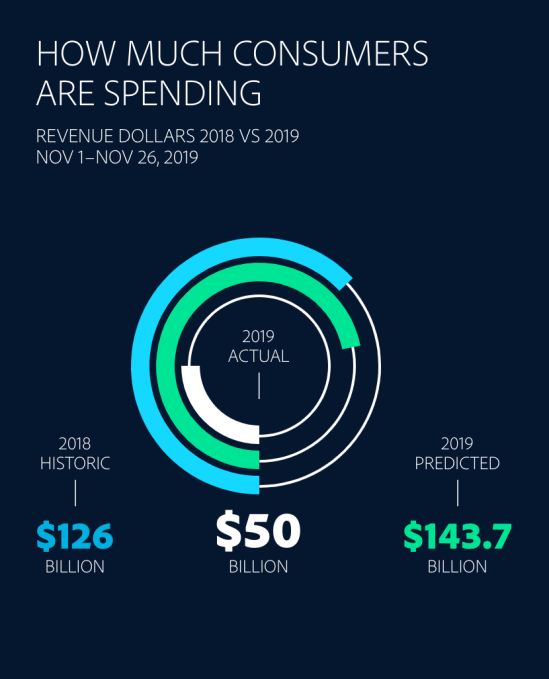
U.S. online shoppers already spent $50B in November, holiday season on track for $143.7B

Facing a shorter holiday shopping season this year, U.S. retailers started rolling out their Black Friday deals earlier than usual. That move has paid off, according to new e-commerce data shared by Adobe Analytics this morning, which found that U.S. consumers have already spent $50.1 billion online between November 1 and November 26, 2019 — which represents a comparable increase of 15.8 percent year-over-year.

This year, Thanksgiving arrived on November 28, a full week later than it did in 2018 when it came on November 22. That left retailers with 6 fewer days to drive post-Thanksgiving Day sales — a situation it hadn’t been in since 2013, when the shorter time frame led to serious delivery struggles. To salvage the lost shopping days (and to not again find themselves in a similar situation as 2013), retailers simply rolled out their deals a week early.

For example, Amazon kicked off a Black Friday deals week on November 22. Walmart introduced early savings through “Buy Now” deals on Walmart.com, in addition to a pre-Black Friday event that started on Nov. 22. Target integrated Shipt’s same-day shopping service into its app and ran a preview sale, weekend deals, and today, Nov. 27, an early access sale. Other retailers followed suit, as well.

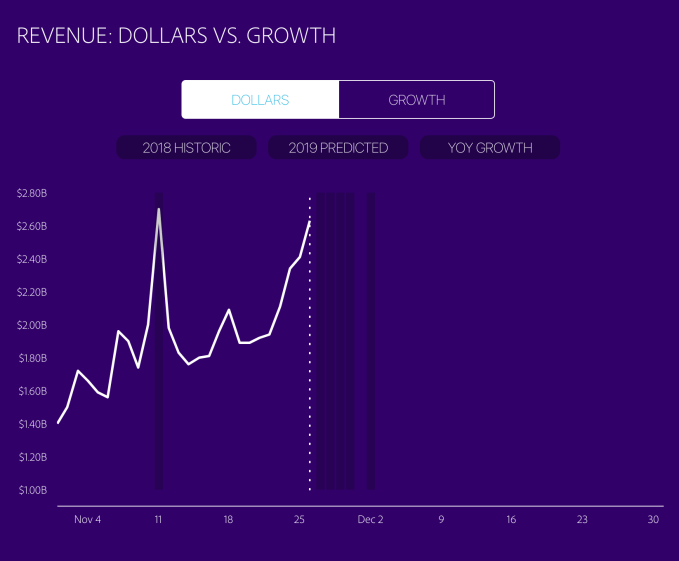
But consumers weren’t even waiting for these Black Friday preview deals to start shopping. According to Adobe Analytics, which tracks online transactions for 80 of the top 100 U.S. retailers, all 26 days in November so far have surpassed $1 billion in online sales. Seven days even passed $2 billion in sales, which made 2019 the first year to see multiple $2 billion days this early in the shopping season.

And as of this morning, $240 million has already been spent online, representing 19.3% growth year-over-year, and putting the day on track to hit $2.9 billion.


Based on this data, Adobe believes its earlier forecast of $143.7 billion spent during the full holiday shopping season (Nov.-Dec.) remains accurate. That estimate represents a 14.1% rise from a year ago, according to Adobe. In addition, the three biggest shopping days — Thanksgiving, Black Friday, and Cyber Monday — will also see increases, it says.

Thanksgiving Day sales are forecast to jump 19.7% year-over-year to $4.4 billion; Black Friday is expected to grow by 20.5% to reach $7.5 billion; and Cyber Monday sales are expected to top the charts at $9.4 billion, an increase of 19.1% year-over-year — a new record.

The firm also sees a surge in mobile shopping this year, with 34.3% of all e-commerce sales being made via a smartphone, up 24.2% year-over-year. App Annie’s mobile shopping forecast had also predicted a record numbers of mobile shoppers, with a 25% year-over-year increase in time spent mobile shopping during the weeks of Black Friday and Cyber Monday. The firm said shoppers will spend 2.2 billion hours globally across shopping apps this holiday season.

Other notable trends include a rise in “buy online, pickup in-store” shopping — 61% will take advantage of this, leading to 27% more in sales over last year. Plus email promotions this season have led to 16.5% of all online revenue, up 10% year-over-year. Paid search accounted for 23.7% of sales, while social media led to just 2.8%.

In terms of products, shoppers are buying Apple AirPods, Apple Laptops, Samsung and LG TV’s, Frozen 2 toys, L.O.L Surprise Dolls, NERF toys, Pikmi Pops, Fortnite toys, and games like Pokemon Sword/Shield, Jedi Fallen Order, and Madden 20.

“With the shorter shopping season and retailers starting their promotions earlier, Adobe is seeing holiday discounts already well underway even before Thanksgiving Day,” said Jason Woosley, Vice President of Commerce Product & Platform at Adobe. “For televisions alone, shoppers are already seeing discounts twice as deep as expected with average savings yesterday of 17.5%. Those consumers who grab their smartphone to do some quick online shopping after dinner are likely to find offers that are even better than this time last year,” he added.


27 Nov 2019

U.S. online shoppers already spent $50B in November, holiday season on track for $143.7B

Facing a shorter holiday shopping season this year, U.S. retailers started rolling out their Black Friday deals earlier than usual. That move has paid off, according to new e-commerce data shared by Adobe Analytics this morning, which found that U.S. consumers have already spent $50.1 billion online between November 1 and November 26, 2019 — which represents a comparable increase of 15.8 percent year-over-year.

This year, Thanksgiving arrived on November 28, a full week later than it did in 2018 when it came on November 22. That left retailers with 6 fewer days to drive post-Thanksgiving Day sales — a situation it hadn’t been in since 2013, when the shorter time frame led to serious delivery struggles. To salvage the lost shopping days (and to not again find themselves in a similar situation as 2013), retailers simply rolled out their deals a week early.

For example, Amazon kicked off a Black Friday deals week on November 22. Walmart introduced early savings through “Buy Now” deals on Walmart.com, in addition to a pre-Black Friday event that started on Nov. 22. Target integrated Shipt’s same-day shopping service into its app and ran a preview sale, weekend deals, and today, Nov. 27, an early access sale. Other retailers followed suit, as well.

But consumers weren’t even waiting for these Black Friday preview deals to start shopping. According to Adobe Analytics, which tracks online transactions for 80 of the top 100 U.S. retailers, all 26 days in November so far have surpassed $1 billion in online sales. Seven days even passed $2 billion in sales, which made 2019 the first year to see multiple $2 billion days this early in the shopping season.

And as of this morning, $240 million has already been spent online, representing 19.3% growth year-over-year, and putting the day on track to hit $2.9 billion.


Based on this data, Adobe believes its earlier forecast of $143.7 billion spent during the full holiday shopping season (Nov.-Dec.) remains accurate. That estimate represents a 14.1% rise from a year ago, according to Adobe. In addition, the three biggest shopping days — Thanksgiving, Black Friday, and Cyber Monday — will also see increases, it says.

Thanksgiving Day sales are forecast to jump 19.7% year-over-year to $4.4 billion; Black Friday is expected to grow by 20.5% to reach $7.5 billion; and Cyber Monday sales are expected to top the charts at $9.4 billion, an increase of 19.1% year-over-year — a new record.

The firm also sees a surge in mobile shopping this year, with 34.3% of all e-commerce sales being made via a smartphone, up 24.2% year-over-year. App Annie’s mobile shopping forecast had also predicted a record numbers of mobile shoppers, with a 25% year-over-year increase in time spent mobile shopping during the weeks of Black Friday and Cyber Monday. The firm said shoppers will spend 2.2 billion hours globally across shopping apps this holiday season.

Other notable trends include a rise in “buy online, pickup in-store” shopping — 61% will take advantage of this, leading to 27% more in sales over last year. Plus email promotions this season have led to 16.5% of all online revenue, up 10% year-over-year. Paid search accounted for 23.7% of sales, while social media led to just 2.8%.

In terms of products, shoppers are buying Apple AirPods, Apple Laptops, Samsung and LG TV’s, Frozen 2 toys, L.O.L Surprise Dolls, NERF toys, Pikmi Pops, Fortnite toys, and games like Pokemon Sword/Shield, Jedi Fallen Order, and Madden 20.

“With the shorter shopping season and retailers starting their promotions earlier, Adobe is seeing holiday discounts already well underway even before Thanksgiving Day,” said Jason Woosley, Vice President of Commerce Product & Platform at Adobe. “For televisions alone, shoppers are already seeing discounts twice as deep as expected with average savings yesterday of 17.5%. Those consumers who grab their smartphone to do some quick online shopping after dinner are likely to find offers that are even better than this time last year,” he added.


27 Nov 2019

Xiaomi’s Q3 earnings report shows slowing growth

Xiaomi, the world’s fourth largest smartphone vendor, on Wednesday reported a 3.3% revenue growth (QoQ) in the quarter that ended in September. While the results fell largely in line with analysts’ expectations, a drastic drop in the company’s growth underscores some of the struggles that handset makers are facing as they shift to services to make up for dwindling smartphone purchases globally.

The Chinese electronics firm posted Q3 revenue of 53.7 billion yuan, or $7.65 billion, an increase compared to 51.95 billion yuan ($7.39 billion) revenue it reported in Q2 and up 5.5% from the same period last year.

This is largely in line with analysts’ estimated revenue of 53.74 billion yuan, per Refinitiv figures, but growth is slowing. As a point of comparison, in Q2, Xiaomi reported QoQ growth of 18.7% and YoY of 14.8%.

Xiaomi said its adjusted profit in the aforementioned quarter was 3.5 billion yuan ($500 million), up from about 2.5 billion yuan a year ago. Gross profit during the period was 8.2 billion yuan ($1.17 billion), up 25.2% year-over-year.

The company said its smartphone business revenue during Q3 stood at 32.3 billion yuan ($4.6 billion), down 7.8% year-over-year. The company, which shipped 32.1 million smartphone units during the period, blamed “downturn” in China’s smartphone market for the decline.

Marketing research firm Canalys reported this month that China’s smartphone market shrank by 3% during Q3. Despite the slowdown, Xiaomi said its gross profit margin of smartphones segment had reached 9% — up from 8.1% and 3.3% in the previous quarters.

Other than Huawei, which leads the handsets market in China, every other smartphone vendor has suffered a drop in their shipment volumes in the country, according to research firm Counterpoint.

But for Xiaomi, this should technically not be a problem. Long before the company listed publicly last year, it has been boasting about its business model: how it makes little money from hardware and more and more from delivering ads and selling internet services.

That internet services business is not growing fast enough, however, to be an engine for the overall company. It grew by 12.3% year-on-year to 5.3 billion yuan ($750 million) and 15% since last quarter. Either way, it accounts for only a fraction of smartphone business’ contribution to the bottomline.

Xiaomi said two years ago that it will only ever make 5% profit from its hardware, something its executives told TechCrunch has been engraved in the company’s “constitution.” But the slow shift to making money off of internet services, while making less money from selling hardware, is one of the chief reasons why the company had an underwhelming IPO.

Meanwhile, the user base of Xiaomi’s Android -based MIUI software is growing. It had 292 million monthly active users as of September this year, up from 278.7 in June.

In more promising signs, Xiaomi said its smart TV and Mi Box platforms had more than 3.2 million paid subscribers and revenue from its fintech business, a territory it entered only in recent quarters, had already reached 1 billion yuan ($140 million).

But it’s hardware that continues to make up the biggest proportion of its revenues. The company, which is increasingly moving its gadgets and services beyond Chinese shores, said revenue from its international business grew 17.2 year-over-year to 26.1 billion yuan ($3.7 billion) in the third quarter — accounting for 48.7% of total revenue.

In a statement, Xiaomi founder and chairman Lei Jun said the company is hopeful that it will be able to further grow its revenues when 5G devices start to get traction. The company has plans to launch at least 10 5G-enabled smartphone models next year, he said. No word from him on what the company intends to do about its services ecosystem.

27 Nov 2019

Louis Bacon’s sunset ride may foretell ‘mechanized future’ of data-driven investing

The legendary Moore Capital is closing. Its founder, Louis Bacon, is reported to be riding off into the sunset.

His name was often mentioned in the same breath as George Soros, Stan Druckenmiller and Paul Tudor Jones. Like them, over his three-decade career he helped build hedge funds’ reputation for placing big bets on big world events — profiting from predictions of war and economic meltdown. He has been described as one of the best foreign exchange traders ever. Bacon earned outsized returns from bets that stocks would plummet and oil would spike if Iraq invaded Kuwait and pulled the U.S. into war in the 1990s, which they did. He was managing $14 billion at his height, but his returns haven’t had the shine they used to.

It’s the latest in series of money manager giants taking their leave, including Leon Cooperman and Jeffrey Vinik. One imagines them joining Tom Cruise in the 2003 movie “The Last Samurai,” galloping at full tilt, swords drawn, representing the last vestige of their chivalrous time crashing against the mechanized future. 

In the movie, the mechanized future was represented by Gatling guns mowing down the warriors of old. On Wall Street, it’s quants, their data operations and passive management versus active. Think Jim Simons of Renaissance Technologies taking all emotion out of investing, dismissing “stories” about a stock as distraction, and becoming known as one of the greatest investor of all time.

The truth of what’s going on is something different.