Year: 2019

10 Jul 2019

Chinese electric carmaker Xpeng says Nio stock swings a ‘good lesson’ for rivals

Seeing your competitor undergo dramatic changes in fortune can be unnerving as there’s the fear that the same will happen to you. For electric vehicle maker Xpeng, Nio’s period of stock swings is a wakeup call for China’s EV startup boom.

Xpeng and Nio are Tesla -like Chinese startups competing with more established automakers such as Warren Buffett-backed BYD . Like Tesla, Xpeng and Nio design, manufacture and sell EVs through company-owned online and offline channels.

Both have raised large sums of cash from noted investors. Xpeng itself is backed by Alibaba, Foxconn and Xiaomi founder Lei Jun . As late, it’s seeking to raise at least $500 million in funding.

Nio’s investors include Tencent, Hillhouse Capital and Shunwei Capital, a venture fund co-founded by Lei Jun. Its shares were trading at around $2.50 apiece in June, a big fall from the $11.60 high it achieved shortly after debuting on NYSE in September. 

The reasons for the slump are varied. Sales slowed down in the first quarter against a backdrop of subsidy reduction and macroeconomic headwinds in China. Losses amounted to $390.9 million in the period. To cope with sluggish performance, Nio said it would delay the rollout of its next-gen products to focus on existing models. It also planned to slash costs by cutting R&D spending and its workforce.

Nio’s stock rout “is a good lesson for the rest of us… to try to be more efficient and more sustainable,” said Xpeng president Brian Gu at the Rise conference in Hong Kong on Wednesday. The five-year-old company aims to do so by building mass-market products rather than a luxury brand, which allows it to have “less capital deployment.”

“Our capital efficiency is also high. We probably use a quarter of the capital to reach the same delivery numbers as Nio, for example,” Gu claimed.

Xpeng began deliveries in December and had shipped 10,000 models by mid-June. Nio sold 11,300 units between June and December last year, according to China Association of Automobile Manufacturers (report in Chinese).

In the long run, Xpeng remains optimistic about the Chinese EV industry. The country shipped 1.26 million units of alternative fuel cars last year, representing a 61.7% increase year-over-year, per data from CAAM. Of all the alternative energy passenger cars sold, 75% were all-electric.

Overall, only 4.5% of China’s vehicles sold last year used alternative fuels. The sector is tipped to pick up speed over time. The CAAM forecasts that China will sell more than two million alternative fuel vehicles in 2020.

“Definitely, market sentiment is swayed by stock prices, but I don’t think that really sways people’s long-term enthusiasm for EVs. This is almost a certainty that the [EV] revolution is coming,” Gu added.

With plans for an initial public offering, Xpeng may not be far off from testing investor sentiments. While it doesn’t yet have a timeline for selling shares to the public, Xpeng’s chief executive officer told CNBC in March that the startup will focus on “business before considering the IPO.”

10 Jul 2019

Amazon expands Transparency anti-counterfeit codes to Europe, India and Canada

Amazon is no stranger to the nefarious forces of e-commerce: fake reviews, counterfeit goods and scams have all reared their heads on its marketplace in one place or another, with some even accusing it of turning a blind eye to them since, technically, Amazon profits from any transactions, not just the legit ones. The company has been working to fight that image, though, and today it announced its latest development in that mission: it announced that Transparency — a program to serialize products sold on its platform with a T-shaped QR-style code to identify when an item is counterfeit — is expanding to Europe, India and Canada. (More detail on how it actually works below.)

“Counterfeiting is an industry-wide concern – both online and offline. We find the most effective solutions to prevent counterfeit are based on partnerships that combine Amazon’s technology innovation with the sophisticated knowledge and capabilities of brands,” said Dharmesh Mehta, vice president, Amazon Customer Trust and Partner Support, in a statement. “We created Transparency to provide brands with a simple, scalable solution that empowers brands and Amazon to authenticate products within the supply chain, stopping counterfeit before it reaches a customer.”

The growth of Transparency has been quite slow so far: it has taken more than two years for Amazon to offer the service outside of the US market, where it launched first with Amazon’s own products in March 2017 and then expanded to third-party items. Even today, while Transparency is launching to sellers in more markets, the app for consumers to scan the items themselves is still only available in the US, according to Amazon’s FAQ.

In that time, take-up has been okay but not massive. Amazon says that some 4,000 brands have enrolled in the program, covering 300 million unique codes, leading to Amazon halting more than 250,000 counterfeit sales (these would have been fake versions of legit items and brands enrolled in the Transparency program).

There is some evidence that all this works. Amazon says that 2019, for products fully on-boarded into the Transparency service, there have been zero reports of counterfeit from brands or customers who purchased these products on Amazon.

But how wide ranging that is, though, compared to the bigger problem, is not quite clear. While it’s not an apples-to-apples comparison — Amazon doesn’t disclose collectively how many brands are sold on its platform, although Amazon itself accounts for 450 brands itself — there are some 2.5 million sellers on its platform globally, and my guess is that 4,000 is just a small fraction of Amazon’s branded universe.

Recent developments have put an increased focus on what role Amazon has been playing to keep in check rampant activity around counterfeiting and other illegal activity.

The NYT published a damning expose in June that highlighted how one medical publisher found rampant counterfeiting of one of its books, a guide for doctors prescribing medications to help them determine dosages of drugs, an alarming situation considering the subject matter. Regulators like the FCC have also taken action to ask Amazon (among others like eBay) to make a better effort to remove the sale of products in specific categories, such as fake pay-TV boxes.

Coupled with other kinds of dodgy activity on the platform like fake reviews, Amazon has been making more moves of late to get a grip and create more channels for brands and sellers to help themselves, from product launches and expansions, to taking legal measures to go after bad actors.

Transparency is part of former category, and it sits alongside one of the company’s other recent, big initiatives called Project Zero, an AI-based continuous monitoring of products and activities launched four months ago to proactively identify counterfeit sellers and items on the platform.

Screenshot 2019 07 10 at 11.47.45Transparency works by way of a unique code — which looks a bit like a “T” — printed on each manufactured unit. When a customer orders the product, Amazon scans the code to verify that the product it’s shipping is legit. Customers can also scan the code after receiving the item to verify authenticity. Other details that are encoded in the T are manufacturing date, manufacturing place, and other product information like ingredients.

This system also throws some light on some of the strange workings of e-commerce, supply chains, and how marketplaces operate.

On Amazon, an item you buy that might be branded — say, a North Face jacket — may not actually be sold by North Face itself, but a reseller. And those resellers may just as likely never even touch the item: they are working off stock that is distributed from another place altogether, or perhaps manufactured and sent in bulk to Amazon or another fulfilment provider that sends the item when the order is made. All of these tradeoffs within the supply chain create an environment where counterfeit goods might creep in.

Amazon’s system, by working directly with brands and not sellers, is trying to provide an over-arching level of monitoring and control into the mix, and it notes in its announcement that its Transparency codes are trackable “regardless of where customers purchased their units.”

Ironically for a service called “Transparency”, Amazon doesn’t seem to list the price for sellers to use this service, but four months ago, when Amazon launched Project Zero, we reported that the serialization service are charged between $0.01 and $0.05 per unit, based on volume. It’s a price that especially smaller brands, which are even less immune to copycats than well-capitalized big brands, are willing to pay:

“Amazon’s proactive approach and investment in tools like Transparency have allowed us to grow consumer confidence in our products and prevent inauthentic product from ending up in the hands of our customers,” said Matt Petersen, Chief Executive Officer at Neato Robotics, a maker of smart robotic vacuum cleaners, in a statement.

“Blocking counterfeits from the source has always been a tough task for us – it’s something all brand owners face through nearly all channels around the world,” said Bill Mei, Chief Executive Officer at Cowin, a manufacturer of noise cancelling audio devices, in his own statement. “After we joined Transparency, our counterfeit problem just disappeared for products protected by the program.”


10 Jul 2019

Dataform scores $2M to build an ‘operating system’ for data warehouses

Dataform, a U.K. company started by ex-Googlers that wants to make it easier for businesses to manage their data warehouses, has picked up $2 million in funding. Leading the round is LocalGlobe, with participation from a number of unnamed angel investors. The startup is also an alumni of Silicon Valley accelerator Y Combinator and graduated in late 2018.

Founded by former Google employees Lewis Hemens and Guillaume-Henri Huon, Dataform has set out to help data-rich companies draw insights from the data stored in their data warehouses. Mining data for insights and business intelligence typically requires a team of data engineers and analysts. Dataform wants to simply this task and in turn make it faster and cheaper for organisations to take full advantage of their data assets.

“Businesses are generating more and more data that they are now centralising into cloud data warehouses like Google BigQuery, AWS Redshift or Snowflake. [However,] to exploit this data, such as conducting analytics or using BI tools, they need to convert the vast amount of raw data into a list of clean, reliable and up-to-date datasets,” explains Dataform co-founder Guillaume-Henri Huon. .

“Data teams don’t have the right tools to manage data in the warehouse efficiently. As a result, they have to spend most of their time building custom infrastructure and making sure their data pipelines work”.

Huon says Dataform solves this by offering a complete toolkit to manage data in data warehouses. Data teams can build new datasets and set them to update automatically every day, or more frequently. The entire process is managed via a single interface and setting up a new dataset is said to take as little as 5 minutes. “On top of this, we have an open source framework that helps managing data using engineering best practices, including reusable functions, testing and dependency management.

Meanwhile, Dataform says the seed funding will help the company continue to grow both its sales and engineering teams. It will also be used to further develop its product. The startup generates revenue based on a classic SaaS model: typically charging per number of users.

10 Jul 2019

India’s Byju’s raises $150 million to expand globally

Byju’s, India’s most valuable edtech startup, has received new $150 million as it races to expand the reach of its learning app in the country and some international markets.

The unnamed ongoing financing round was led by Qatar Investment Authority (QIA), the sovereign wealth fund of the State of Qatar, and included participation from Owl Ventures, a leading investor in education tech startups. This is Owl Venture’s first investment in an Indian startup.

The 11-year-old startup, which has raised about $925 million to date and was valued at nearly $4 billion in December last year, said it would use the fresh capital to aggressively explore and expand in international markets. The startup has previously said it plans to enter the U.S. and UK, Australia, and New Zealand.

It acquired Osmo, a U.S.-based learning startup that is popular among kids aged between five and 12 for $120 million early this year. Osmo recently unveiled new products to serve the pre-schoolers market.

Byju’s helps all school-going children understand complex subjects through its app where tutors use real life objects such as pizza and cake. It has amassed more than 35 million registered users, about 2.4 million of which are paid customers. Byju’s generated around $205 million in revenue in the fiscal year that ended in March. It plans to increase that figure to over $430 million this year.

“Investment from prominent sovereign and pension funds validates our strong business fundamentals. Indian ed-tech firms attracting interest from eminent investors demonstrates that India is pioneering the digital learning space globally,” Byju Raveendran, founder and CEO of Byju’s said in a statement.

In India, Byju’s competes with a handful of players, including Bangalore-based Unacademy, which is aimed at students who are preparing for graduation-level courses. It raised $50 million last month. India has the largest population in the world in the age bracket of 5 to 24 years. The education space in the nation is estimated to grow to $35 billion in the next six years.

10 Jul 2019

Opera founded startup OPay raises $50M for mobile finance in Nigeria

OPay, an Africa focused mobile payments startup founded by Norwegian browser company Opera, has raised $50 million in funding.

Lead investors include Sequoia China, IDG Capital, and Source Code Capital. Opera also joined the round in the payments venture it created.

OPay will use the capital (which wasn’t given a stage designation) primarily to grow its digital finance business in Nigeria—Africa’s most populous nation and largest economy.

OPay will also support Opera’s growing commercial network in Nigeria, which includes a motorcycle ride-hail app ORide and OFood delivery service.

Opera founded Opay in 2018 on the popularity of its internet search engine. Opera’s web-browser has ranked number two in usage in Africa, after Chrome, the last four years.

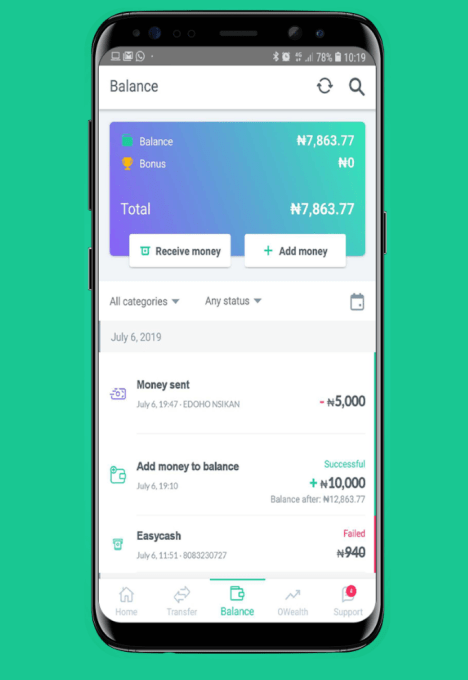
Opera Opay NigeriaOn the payments side, OPay in Nigeria has scaled to 40,000 active agents and $5 million in transaction volume in 10 months.

The $50 million investment in OPay is more than just another big round in Africa. It has significance for the continent’s tech-ecosystem on multiple levels.

To start, OPay’s raise tracks greater influence in African tech from China—whose engagement with African startups has been light compared to China’s deal-making on infrastructure and commodities. OPay founder Opera was acquired in 2016 for $600 million by a consortium of Chinese investors, led by current Opera CEO Yahui Zhou.

The majority of the investment for OPay’s raise comes from Chinese funds and sources, including Source Code Capital, Sequoia China, and GSR Ventures. There’s not a lot of statistical data on the value of Chinese VC investment in Africa, but a large portion of $50 million to a fintech venture stands out.

OPay’s VC haul also has significance vis-a-vis digital-finance in Nigeria. In tandem with other trends, it could support the shift of Nigeria surpassing Kenya as Africa’s digital payments leader. For years Kenya has outpaced Nigeria in P2P digital payments volumes and digital financial inclusion, largely due to the rapid adoption of mobile-money products, such as Safaricom’s M-Pesa.

Some of this is due in part to Nigeria’s Central Bank limiting the ability of non-banks (including telcos) to offer mobile payment services. The CBN eased many of those restrictions earlier this year. This opens the door for mobile-operators like MTN, with the largest phone network in Nigeria, to offer mobile-money products. In addition to fintech regulatory improvements, there’s been a gradual increase in VC flowing to Nigerian payment ventures.

The country’s leading digital payment company, Paga, raised $10 million in 2018 to further expand its customer base that now tallies 13 million. OPay’s $50 million backed commitment to grow mobile money in Nigeria should provide another big boost to digital-finance adoption across the country’s 190 million people.

And not to be overlooked is how OPay’s capital raise moves Opera toward becoming a multi-service commercial internet platform in Africa. Part of the $50 million investment includes diversifying country and product offerings. “Geographic expansion of OPay and other services is a key part of our plans,” Opera CEO Yahui Zhou told TechCrunch via email.

This could place OPay and its Opera supported suite of products on a competitive footing with other ride-hail, food-delivery, and payments startups across the continent. It could also mean competition between Opera and Africa’s largest multi-service internet company, e-commerce unicorn Jumia.   


10 Jul 2019

Remitly raises $220M to expand from money transfers to financial services, now at $900M+ valuation

When it comes to financial services in emerging markets, remittances — people sending money to each other across international borders, often not to established bank accounts — continues to be one of the biggest, with the World Bank estimating that $529 billion was sent in and out of lower-income countries in 2018, up 9% over 2017. And today, Remitly, one of the bigger startups providing these services, is announcing that it has raised $220 million in funding to ride that wave.

CEO and founder Matt Oppenheimer said in an interview that the startup will use the money both to help it continue to keep growing that money transfer business, and to catch new opportunities as they appear, in the form of new financial services for the immigrants and migrants that make up the majority of its customer base.

The money is coming in the form of equity and debt, specifically a $135 million Series E led by Generation Investment Management, and $85 million in debt from Barclays, Bridge Bank, Goldman Sachs, and Silicon Valley Bank. Owl Rock Capital, Princeville Global, Prudential Financial, Schroder & Co Bank AG, and Top Tier Capital Partners; and previous investors DN Capital, Naspers’ PayU, and Stripes Group all also participated in the equity round.

Oppenheimer said the equity will both be used to expand its remittance business but mainly to invest in that new wave of services it’s eyeing up. The debt, meanwhile, is to fuel the growth of its “express” fast-send option. “Today we can post funds, but we can also pre-fund for express transfers, and we wanted to have the capacity and the line of credit to be able to fund the pre-funding part, which is growing rapidly,” he said of the debt portion of the financing.

With the equity portion, Remitly’s valuation is now at around $900 million, sources close to the company say. As a point of comparison, that puts Remitly on par with World Remit, another big player in remittances for emerging markets that raised $175 million in June also at around a $900 million valuation. (Transferwise, which focuses on ‘banked’ accounts and mostly mature markets, earlier this year closed funding that valued it at $3.5 billion.)

It’s the biggest round of funding yet for the startup, and for some context, it was valued at just $230 million when it last disclosed the number. (Remitly did not disclose valuation in its most recent funding before this one, a $115 million round led by Naspers that finally closed in the beginning of 2018.)

Today, Remitly’s services cover 16 “send” (originating) and 44 “receive” countries, covering a total of some 700 “corridors” where the company specialises in providing an easy way — either online or by phone — for individuals to send money, with the service localised on the receiving end to come in formats that are most popular in each specific market.

The company said that average annual revenue growth has been at around 100% each year for the past three. Oppenheimer — who coincidentally used to be an executive for one of its new backers, Barclays — wouldn’t break out which markets were growing faster than the others, but that figure includes both Remitly’s more mature corridors as well as those that it’s added in recent years.

The plan for diversification is not surprising. The remittance market is extremely fragmented and — with the rise of smartphones that have untethered users from physical retail locations — getting even more so, with incumbents like Western Union accounting for less than 20 percent of the market today, bigger startups like TransferWise also looking like it’s also increasingly eyeing emerging markets as well, and completely new concepts like using the blockchain to transfer money also potentially disrupting the disruptors.

That means pricing on money transfers for a section of that market that is already price-sensitive — immigrants and migrants — is very competitive, which in turn means a hit on remittance companies’ margins. Remitly itself has varying rates for different markets based on demand: sending money for example to Kenya from the UK currently costs nothing if you’re using MPESA accounts (other corridors obviously have higher costs than this).

Oppenheimer wouldn’t specify what kinds of other financial services it’s considering until they are closer to getting launched.

“We’re still working on that, but you can imagine the immigrant or migrant journey and the challenges that they face as they move to a new country,” he said. “It can have a painful impact not having a credit history: how do you get a loan, or set up a bank account? That is the strategic angle… The idea is to transform the lives of immigrants and their families.”

That mindset has been what helped Remitly raise this recent round. Generation — the investment firm co-founded by Al Gore — has made it a mission to put its money into sustainability. In its case, this means not only planet health but people health, in the form of services that improving the lives. Financial services for emerging markets is an important area for it in that regard.

Lucia Rigo, a director in growth equity at Generation who is joining Remitly’s board with this round, said that Generation had been looking at the remittance market for a while and had honed in on Remitly as a key company within it that ticked all the right boxes in terms of its mission, its journey so far, its numbers, and most importantly its prospects.

“Foreign-born or foreign-resident populations in developed markets is a segment that is just not catered for well,” she said in an interview. “There are a lot of digital means for sending money today, which is definitely driving down the cost of doing so, but we also think that digital penetration is just at its early stages, and new markets will drive differentiation and that will expand the customer base, and Remitly’s services.”

10 Jul 2019

The Commerce Department will accept applications from companies that want to supply Huawei, but it remains blacklisted

About two months after Huawei was placed on the Commerce Department’s Entity List, the Chinese telecom equipment and smartphone giant will be able to do business with American suppliers again–but only if they get a license from the U.S. government. Commerce Secretary Wilbur Ross made the announcement during a department conference, adding that companies must first demonstrate that the technology they sell to Huawei will not put national security at risk.

Huawei will remain on the entity list, however, and license applications will be reviewed under a “presumption of denial,” making it likely that most will not be approved.

Last month while both presidents were in Japan for the G20 Summit, Donald Trump told Chinese leader Xi Jinping that he would allow U.S. companies to sell equipment to Huawei again, but the promise created confusion about how it would be carried out, with the Commerce Department instructing staff to continue acting as if the blacklist is still in place. Huawei, the world’s largest telecom equipment maker and second-largest smartphone vendor, is a major bargaining chip in the ongoing trade war between the U.S. and China.

The blacklist has had a major impact on Huawei, with important suppliers like Qualcomm, Intel and Google severing ties after it was placed on the entity list. Huawei, which has repeatedly denied being a threat to U.S. national security, said that being blacklisted would cost the company about $30 billion in revenue, though founder and CEO Ren Zhengfei later downplayed the impact in an interview with CNBC. It also means U.S. companies have lost an important customer. Out of the $70 billion Huawei spent buying components last year, $11 billion went to American companies like Qualcomm, Intel and Micron.

10 Jul 2019

Inrix expands its digital rule book beyond self-driving cars to help cities with scooters, bikes and delivery bots

Cities use paint and signs to communicate the rules of the road in a world where urban spaces must choreograph an infinite dance between pedestrians and personally owned cars, scooters and bicycles, ride-hailing services, delivery trucks, buses, rail, and someday autonomous vehicles.

It’s a crude method for increasingly modern cities that are trying to juggle all the ways people and packages get around. It also has limitations. Paint fades. Signs become obstructed. And companies deploying dockless scooters or autonomous vehicles have no easy way to access the rules of the road.

And that’s where Inrix, a global transportation analytics company, sees an opportunity. The company is taking a digital data platform that it developed for autonomous vehicles and expanded it to all forms of transportation.

The platform called Road Rules was designed to help cities create a digital record of their traffic rules and restrictions. Inrix said Wednesday that 11 cities, including Austin, Texas, Boston and Cambridge, Massachusetts, Calgary in Canada, Detroit, Miami-Dade County, and the Regional Transportation Commission of Southern Nevada, which includes Las Vegas have signed on to implement Road Rules and are digitizing their infrastructure and restrictions this year. Four companies  — Jaguar Land Rover, May Mobility, nuTonomy (an Aptiv company) and operators running Renovo’s Aware platform — have also agreed to use the data authored by the cities.

All of the cities that have signed on are thinking about or already have autonomous vehicle companies testing or running pilot programs on public roads. Tthe expanded version of the platform is designed to help these cities manage and communicate rules to companies deploying other forms of mobility whether it’s a delivery bot or dockless scooter.

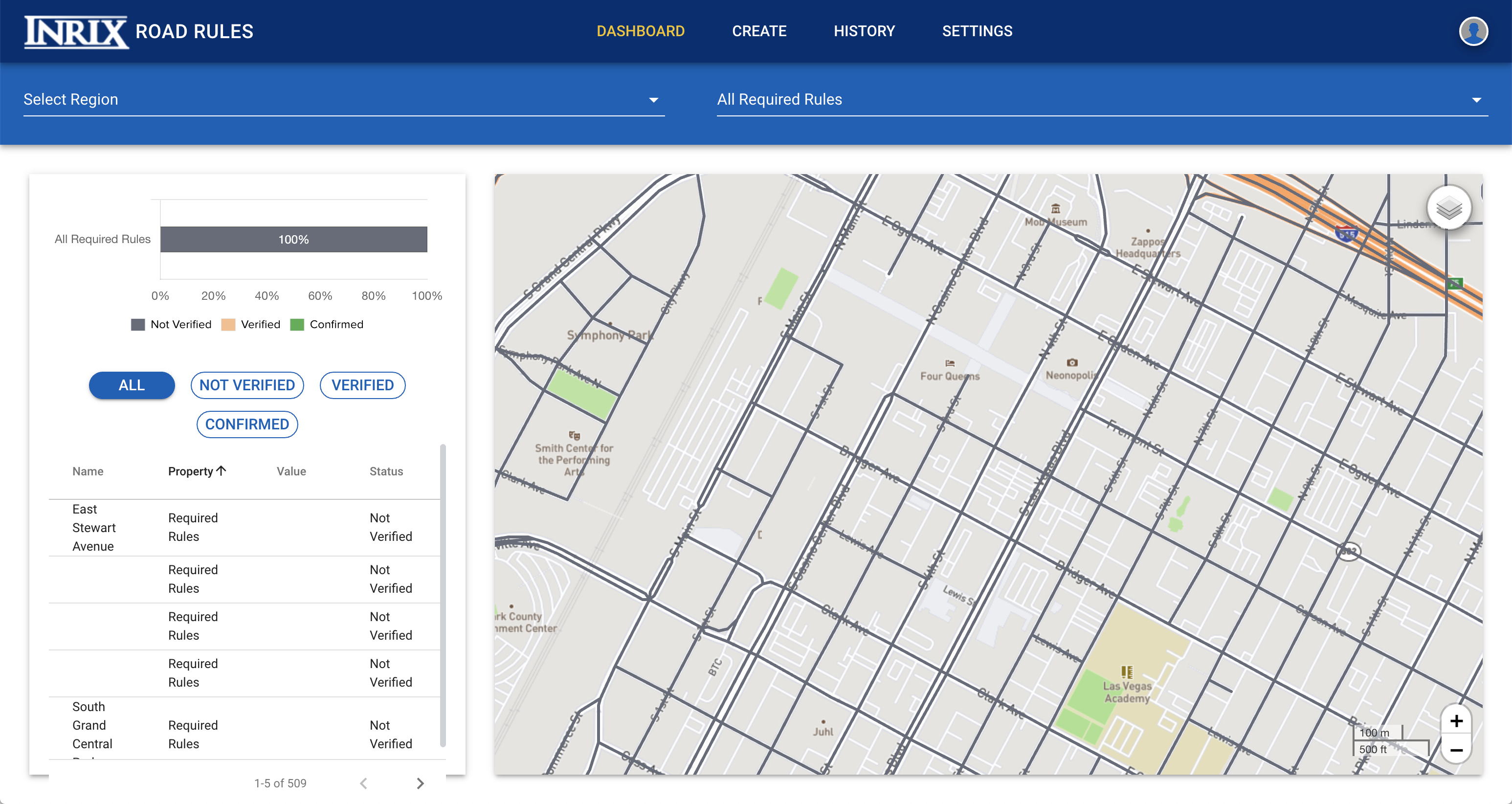
The tool is set up to make it easy for a city employee to enter roadway information such as traffic signals and pedestrian crossing signs as well as rules for curbs and sidewalks, including where loading zones, EV charging stations, dockless bike and scooter operational domains and shared vehicle drop zones are located.

Road Rules Dashboard Page

The platform initially launched as a pilot program in July 2018. This revamped and expanded version, which became public Wednesday ahead of the TC Sessions: Mobility event in San Jose, has a new user experience and clearer work-flows is supposed to make it easier for road authorities to digitize and manage transportation rules. And of course, there’s the expanded focus of the platform, which should make it far more useful for cities grappling with today’s mobility problems, not just the ones a decade from now. But the killer feature is the ability for cities to share that data across departments, with other agencies and even companies.

“Cities were looking for a platform that is actually open,” Avery Ash, head Inrix’s autonomous mobility division, told TechCrunch recently. “This keeps the control in the hands of the city to be able to manage, update and distribute the data that they are validating — and then it can be can be easily shareable.”

This shareable open component part is based on the National Association of City Transportation Official’s SharedStreets project, which has created a global referencing system. This means that city, agency or company who is getting information out of Road Rules can easily snap it to whatever map they’re using.

Inrix has grand ambitions for Road Rules. Ash told TechCrunch that the company is aiming to get 100 cities on the platform by the end of 2019. And here’s why cities might bite. There are companies that can provide cities with data. Inrix’s platform lets cities build this database on their own, control it and share it.

Building a database of road rules is still a massive undertaking by any city. Some of that process can be automated, although the information coming in would likely require validation from a city employee.

Ash also said that cities will likely target small sections of a city at first and slowly expand from there. For instance, a specific block where dockless scooters might be allowed to operate under a temporary permit, or a loop where autonomous vehicles might be tested and eventually deployed.

09 Jul 2019

Doctours offers packaged medical tourism for U.S. customers

Doctours, a Los Angeles-based online platform for booking trips and treatments for medical and dental care around the world, is expanding its services to 35 countries.

Founded by serial travel entrepreneur Katelyn O’Shaughnessy, whose last company TripScope was acquired by Travefy, Doctours aims to connect patients with doctors to receive access to quality, affordable healthcare around the world.

The cost of care in the U.S. continues to climb, leading patients with few options but to travel to the best facilities offering the lowest cost care. Some companies that provide insurance benefits to their employees, like Walmart, are opting to pay for better care upfront by transporting their workers to facilities to receive appropriate care, rather than pay later for shoddy treatment.

Doctours sort of expands that thesis in an international context.

“When it comes to medical and dental treatment, there is no longer any reason to limit ourselves based on where we live,” said O’Shaughnessy, in a statement. “There is an increasingly advantageous global marketplace available with highly trained practitioners offering quality healthcare solutions at affordable prices and, although medical and dental tourism is a safe and cost-efficient solution, the current market is extremely fragmented and challenging to navigate. Doctours eliminates this fragmentation and allows anyone to easily and affordably access international medical and dental treatments and procedures.”

Katelyn Headshot 2

Katelyn O’Shaughnessy, founder, Doctours

The company, which is backed by investors including investors in Doctours include the former CEO of Expedia, Erik Blachford, Texas billionaire and CEO of multi-strategy holding company, Cathexis, William Harrison, and Charles Cogliando of Mosaic Advisors, offers more than 330 different medical and dental procedures and has a global service area that includes Mexico, Colombia, the Caribbean, Thailand, Dubai, Brazil, Germany and Costa Rica. 

Currently working out of Quake Capital’s Austin incubator, the company helps patients search for and compare the cost of procedures, connect with doctors and book everything from in vitro fertilization to stem cell therapy, cosmetic and reparative plastic . surgery, weight loss surgery, dental work and Lasik. 

Once the procedure is booked, Doctours puts together itineraries that provide different options for flights and hotels based on the needs of the patient,  the company said.

The company also offers specialized medical tourism insurance to all of its customers, according to O’Shaughnessy. And the company vets its doctors by ensuring that they are Joint Commission International accredited physicians. Roughly 70% of the company’s doctors were trained at universities and medical schools in Europe or the U.S., O’Shaughnessy wrote in an email.

Doctours is certainly entering a lucrative market. Medical and dental tourism is a $439 billion global market growing at a rate of 25% per year, according to data provided by Doctours. In 2018 alone, 14 million patients traveled abroad to seek healthcare, according to the company.

09 Jul 2019

Digital health is growing fast — but at what cost?

Silicon Valley is obsessed with growth. And for digital health startups, that obsession is not only misguided, but dangerous.

The prevailing idea in the tech industry is that to succeed, you have to be ready to sell your idea, no matter how far along your idea really is. You’re encouraged to believe in your product even when there is no product to believe in.

And if you’re disrupting the mattress industry or the eyewear sector, maybe that’s okay.

But digital health startups must be held to a different and higher standard. We touch people’s lives, often when they are at their most vulnerable.

The healthcare startups in the news recently — Theranos, uBiome, Nurx, eClinicalWorks, Practice Fusion — seem to have lost sight of that crucial standard. We’ll never know every detail of what happened in these organizations, but one thing seems clear: In the pursuit of growth, they have put the patient second, and suffered as a result.

Where we went wrong

In the early days of digital health, I think we were much more focused on the patient than we are now. When I think of the early digital health companies — not just Propeller, but Omada Health, WellDoc, Ginger.io and Mango Health — all of their founders had an innate understanding of the importance of health outcomes. They craved proof that their product worked. They might have “faked it” a little bit when it came to their plans to scale — we all thought things would happen faster than they have — but when it came to research, they had answers, or a concrete plan to get answers.

My first conversation with Propeller’s co-founder and CEO, David Van Sickle, was illustrative of this. I met David at the geekiest of health conferences, Health Datapalooza. We talked about how sensors on medicines could improve people’s health. We talked about study designs and methods to generate data quickly in the real world, long before “real-world evidence” was all the buzz. We talked about a 500-person randomized controlled trial they were about to begin, immediately following FDA clearance of the system.

We talked — almost exclusively — about how Propeller could improve people’s lives, and how to prove that it worked.

So when did the digital health sector get away from that focus? And how do we get back to it?

I have a few theories on what went wrong.

First, it’s incredibly difficult to prioritize the patient as a digital health company when your investors are pushing for growth above all else. At Propeller, we were very lucky to have investors who understood our focus on making a product that worked, especially when growth was slow. Early digital health companies were funded like tech companies, with small amounts of money at a time and a need to show significant progress in 18-24 months to get the next round of funding. In contrast, life science companies are funded more heavily from the start, knowing there is a long road ahead of product development and clinical validation.

When I look at a company like uBiome, which may have rushed its tests through physician approval to meet aggressive growth targets, I see the effects of a culture and funding environment that pushes companies to deliver on growth first and foremost, no matter the tactics it takes to do so.

Product, then proof, then commercialization.

Second, we had a flood of founders and investors enter digital health from outside of healthcare.

I think digital health absolutely needs people, ideas and energy from outside the industry in order to change healthcare. But we also need everyone to learn the basics of how innovation occurs in a clinical setting: Product, then proof, then commercialization. Many of these new entrants were not just naive; they flaunted laws and “traditional healthcare” methods (and people) because they were deemed outdated and unnecessary.

They were aiming for disruption, not integration, and in doing so were ignoring the vast set of protections and people that have been put in place to ensure public safety.

The result is a glut of companies that have tried to scale growth before proving their product worked, which comes with tremendous risk. It can give patients and their physicians incorrect information leading to incorrect treatment. It can waste money on unneeded products. And it can impact the credibility of the entire digital health ecosystem.

Rebuilding a culture of outcomes

To fix this, we have to change the way we think about success in digital health, and that responsibility falls on many different parties.

The media has to be more critical of how it covers burgeoning digital health startups, prioritizing coverage of peer-reviewed research and proven outcomes over funding rounds and hiring numbers. The speaking circuit has to laud founders who can talk about how their products have changed people’s lives for the better, rather than giving the main speaking slot to the biggest exit of the year. And the investor community has to be patient with its investments, understanding that true growth in healthcare takes time.

And most of all, digital health startup founders have to be patient with themselves. I’ve been in the trenches of digital health; I know how hard it can be. But when things are tough and it’s easy to lose focus, you have to think to yourself, “Do I want to be in the headlines for astonishing growth now, and accusations of cutting corners in two years? Or am I okay with sacrificing temporary stardom for a product that actually helps people?”

This is not an easy choice to make. But if digital health is going to survive and scale, it’s one we have to make on a daily basis. Move slowly, and prove things: It’s the only way to create the kind of long-term change we’re seeking.