Year: 2019

26 Nov 2019

Instagram founders join $30M raise for Loom work video messenger

Why are we all trapped in enterprise chat apps if we talk 6X faster than we type, and our brain processes visual info 60,000X faster than text? Thanks to Instagram, we’re not as camera-shy anymore. And everyone’s trying to remain in flow instead of being distracted by multi-tasking.

That’s why now is the time for Loom. It’s an enterprise collaboration video messaging service that lets you send quick clips of yourself so you can get your point across and get back to work. Talk through a problem, explain your solution, or narrate a screenshare. Some engineering hocus pocus sees videos start uploading before you finish recording so you can share instantly viewable links as soon as you’re done.

“What we felt was that more visual communication could be translated into the workplace and deliver disproportionate value” co-founder and CEO Joe Thomas tells me. He actually conducted our whole interview over Loom, responding to emailed questions with video clips.

Launched in 2016, Loom is finally hitting its growth spurt. It’s up from 1.1 million users and 18,000 companies in February to 1.8 million people at 50,000 businesses sharing 15 million minutes of Loom videos per month. Remote workers are especially keen on Loom since it gives them face-to-face time with colleagues without the annoyance of scheduling synchronous video calls. “80% of our professional power users had primarily said that they were communicating with people that they didn’t share office space with” Thomas notes.

A smart product, swift traction, and a shot at riding the consumerization of enterprise trend has secured Loom a $30 million Series B. The round that’s being announced later today was led by prestigious SAAS investor Sequoia and joined by Kleiner Perkins, Figma CEO Dylan Field, Front CEO Mathilde Collin, and Instagram co-founders Kevin Systrom and Mike Krieger.

“At Instagram, one of the biggest things we did was focus on extreme performance and extreme ease of use and that meant optimizing every screen, doing really creative things about when we started uploading, optimizing everything from video codec to networking” Krieger says. “Since then I feel like some products have managed to try to capture some of that but few as much as Loom did. When I first used Loom I turned to Kevin who was my Instagram co-founder and said, ‘oh my god, how did they do that? This feels impossibly fast.'”

Systrom concurs about the similarities, saying “I’m most excited because I see how they’re tackling the problem of visual communication in the same way that we tried to tackle that at Instagram.” Loom is looking to double-down there, potentially adding the ability to Like and follow videos from your favorite productivity gurus or sharpest co-workers.

Loom is also prepping some of its most requested features. The startup is launching an iOS app next month with Android coming the first half of 2020, improving its video editor with blurring for hiding your bad hair day and stitching to connect multiple takes. New branding options will help external sales pitches and presentations look right. What I’m most excited for is transcription, which is also slated for the first half of next year through a partnership with another provider, so you can skim or search a Loom. Sometimes even watching at 2X speed is too slow.

But the point of raising a massive $30 million Series B just a year after Loom’s $11 million Kleiner-led Series A is to nail the enterprise product and sales process. To date, Loom has focused on a bottom-up distribution strategy similar to Dropbox. It tries to get so many individual employees to use Loom that it becomes a team’s default collaboration software. Now it needs to grow up so it can offer the security and permissions features IT managers demand. Loom for teams is rolling out in beta access this year before officially launching in early 2020.
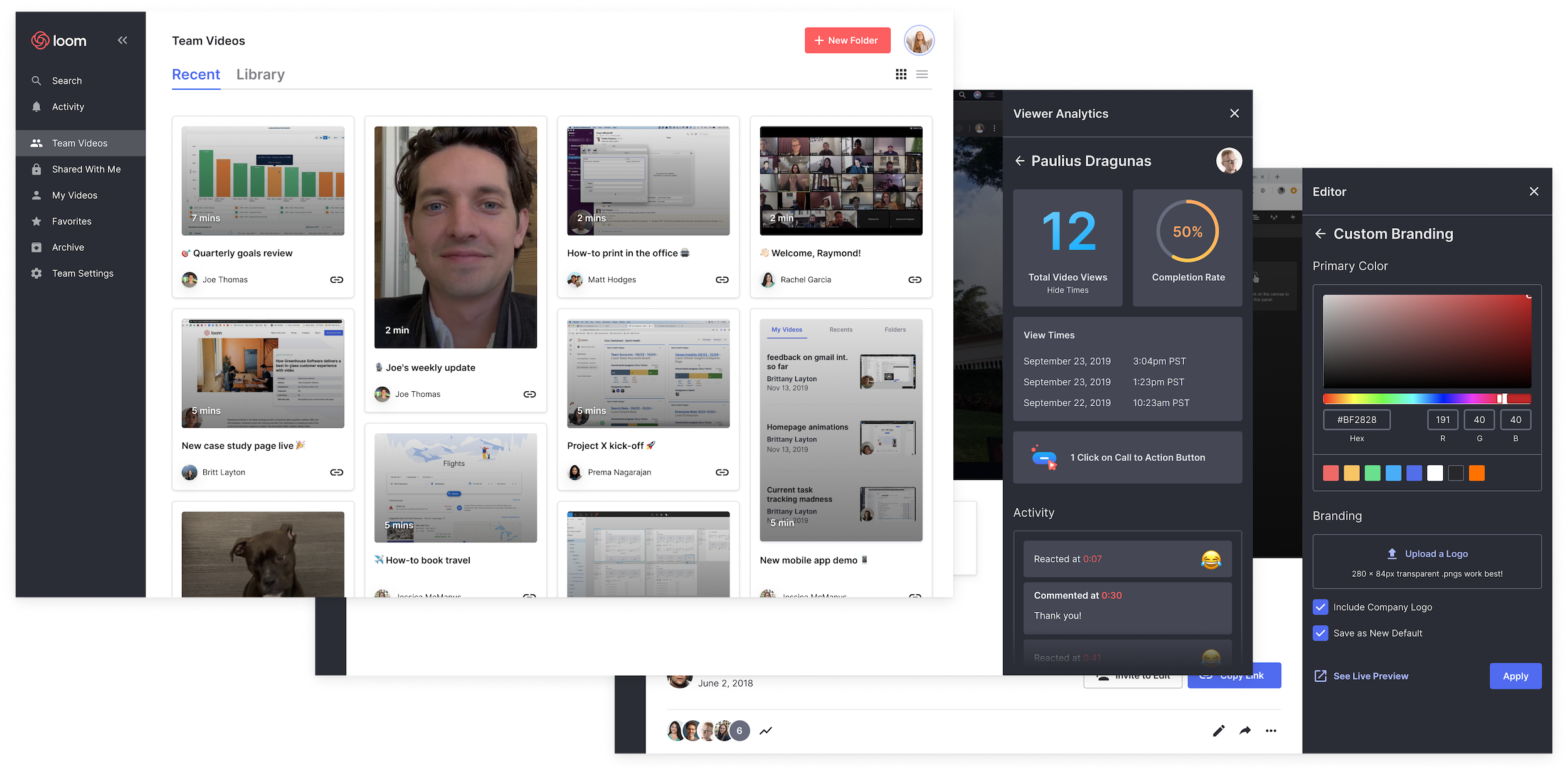
Loom’s bid to become essential to the enterprise, though, is its team video library. This will let employees organize their Looms into folders of a knowledge base so they can explain something once on camera, and everyone else can watch whenever they need to learn that skill. No more redundant one-off messages begging for a team’s best employees to stop and re-teach something. The Loom dashboard offers analytics on who’s actually watching your videos. And integration directly into popular enterprise software suites will let recipients watch without stopping what they’re doing.

To build out these features Loom has already grown to a headcount of 45. It’s also hired away former head of growth at Dropbox Nicole Obst, head of design for Slack Joshua Goldenberg, and VP of commercial product strategy for Intercom Matt Hodges.

Still, the elephants in the room remain Slack and Microsoft Teams. Right now, they’re mainly focused on text messaging with some additional screensharing and video chat integrations. They’re not building Loom-style asynchronous video messaging…yet. “We want to be clear about the fact that we don’t think we’re in competition with Slack or Microsoft Teams at all. We are a complementary tool to chat” Thomas insists. But given the similar productivity and communication ethos, those incumbents could certainly opt to compete.

Loom co-founder and CEO Joe Thomas

Hodges, Loom’s head of marketing, tells me “I agree Slack and Microsoft could choose to get into this territory, but what’s the opportunity cost for them in doing so? It’s the classic build vs. buy vs. integrate argument.” Slack bought screensharing tool Screenhero, but partners with Zoom and Google for video chat. Loom will focus on being easily integratable so it can plug into would-be competitors. And Hodges notes that “Delivering asynchronous video recording and sharing at scale is non-trivial. Loom holds a patent on its streaming, transcoding, and storage technology, which has proven to provide a competitive advantage to this day.”

The tea leaves point to video invading more and more of our communication, so I expect rival startups and features to Loom will crop up. As long as it has the head start, it needs to move as fast as it can. “It’s really hard to maintain focus to deliver on the core product experience that we set out to deliver versus spreading ourselves too thin. And this is absolutely critical” Thomas tells me.

One thing that could set Loom apart? A commitment to financial fundamentals. “When you grow really fast, you can sometimes lose sight of what is the core reason for a business entity to exist, which is to become profitable. . . Even in a really bold market where cash can be cheap, we’re trying to keep profitability at the top of our minds.”


26 Nov 2019

American Express launches new in-app restaurant reservation booking following its Resy acquisition

Earlier this year, American Express announced it was acquiring Resy, the New York-based restaurant reservation platform whose software was used by 4,000+ restaurants across 10 countries. This week, the company has taken the next step to now integrated Resy’s system within the Amex Mobile App. In a new restaurant booking feature, Resy’s inventory will be combined with the American Express Global Dining Collection and other partners, including BookTable and SevenRooms, to offer cardholders reservations from over 10,000 restaurants worldwide.

Currently, this restaurant-booking feature will be available only to a portion of Amex’s Platinum Card Member base. But American Express says the plan is to roll out the feature more broadly in the months ahead.

The company says its decision to go this route was driven by customer activity. Dining is a top spending category among cardholders and the number one request through the Platinum Concierge service — a premium perk that’s like having an assistant work for you to research travel, find gifts, or make dinner reservations, for example.

Resy fits in with Amex’s larger goal of providing services to cardholders that can help connect them to unique experiences, as its platform can be used to acquire reservations even at newer, hipper and hard to get into restaurants.

Before its acquisition, Resy’s software for restaurants had managed to steal market share away from OpenTable, thanks to its advances in table management solutions for restaurant owners, which includes features like an adaptive optimization engine, business intelligence capabilities, and the ability to combine different scheduling strategies, like slots and a more dynamic flex system. This system and the consumer-facing booking options continue to be available through Resy directly, even if users aren’t Amex members.

Resy was the latest in a string of Amex acquisitions aimed at expanding its Global Dining Program. Amex also bought Japan-based restaurant booking service Pocket Concierge in January, and U.K. fintech startup Cake Technologies, designed to help people more easily pay their restaurant bill.

More broadly, these acquisitions aim to help Amex become more central to its customers’ lives, the company had said at the time of the Resy deal. And that’s just as important as the points program.

In addition, by building more digital services into its app, Amex aims to better serve an increasingly mobile and tech-savvy audience. The company says that 84% of its card members now use the app or website to interact with the company, and it’s seen a 35% year-over-year increase in daily active American Express mobile app users globally.

The new in-app reservation booking tool will become available to the larger Platinum and Centurion Card Member base by 2020, following this week’s more limited launch.

26 Nov 2019

Tray.io brings in $50M more at a $600M+ valuation for its workflow automation tools

Organizations are always looking for new ways to work more efficiently, but too often the problem is that, in a digital-first environment, they have to get in line to ask their in-house IT experts (or even more expensively, external consultants) to build those solutions for them. To underscore the demand for a better approach, today a startup that has constructed a way around that, specifically in the world of app integrations, is announcing a sizeable round of funding.

Tray.io, which has built a “general” workflow automation platform that uses a graphical interface to let anyone integrate APIs between two or more apps to create new ways of working with data across them, has raised $50 million in funding, at a valuation that a source close to the company tells me is over $600 million post-money.

The funding, a Series C, is being led by Meritech Capital, with previous investors Spark Capital, GGV Capital, and True Ventures also participating. It brings the total raised by Tray.io to just under $110 million and is notable for coming just five months after its previous round, a Series B of $37 million.

“Since we started the company we’ve been very fortunate with what’s happened in the tech world,” CEO and co-founder Rich Waldron said in an interview last week while visiting London when asked about the funding.

He said that in addition to acquisition approaches (from a number of household names) there were offers of more money coming in almost immediately after the last round closed, and the startup decided that making hay while the sun shines — that is, taking the money when it’s offered, since you don’t know what will happen tomorrow — was the right approach.

“It took us five years to build the company, and we seeded it slowly, but in the last 18 months things have exploded.” As for the sparks for that explosion, he credits the trajectories of companies like Twilio and Stripe, two other tech companies that have built large businesses on, and raised public awareness of, APIs creating new worlds of functionality; and signing on IBM as a partner: the company created a number of new integrations on the platform, some of which became standards that now other companies are using daily.

It’s been a big journey for the startup. Tray.io started out years ago with just a handful of integrations, mostly “email-centric” features, as Waldron describes them, allowing people, for example, to import data from Mailchimp into Slack to track email marketing campaigns. Now, the company provides integrations for some 400 apps, with customers ranging from small startups through to the likes of IBM, and it’s continuing to grow.

The company — which has no “free” tier, with integration packages starting at $595 per month — says that ARR is up by more than 500% this year (it does not disclose actual revenue numbers) — and its customer base is up by 37% with VMWare, Pearson, Bain & Company, Zendesk, and Udemy, SAP, Arrow Electronics, Lexmark, and New Relic among those using its services.

Typical integrations might involve apps like SAP S/4HANA, Qualtrics, Ellucian, Magento, Microsoft PowerBI and Azure, Okta, OneLogin, DropBox, Drift, Segment, Zendesk, Salesloft, Copper, Qualtrics, Intercom, and Marketo
 and alongside that Tray.io provides automation features, error handling, version management and more.

The company is now also providing a white-label version of its platform, Tray Embedded, which third parties can offer to their customers to manage integrations in their own environments.

Altogether the company today processes about 10 billion tasks each month.

Tray.io’s rise comes on the heels of a wider trend. When it comes to some of the prime ways that enterprises are leveraging the advances of technology to improve how they work, integration and automation are the name of the game: bringing data out of silos, and doing so in an instant way, speeds up operations, reduces human error and can also help with costs.

It’s not the only company working in this area, or to take the approach that technology should be accessible and used by more than just engineers another tech employees.

Others working in the automation and integration space include Snaplogic (which raised $72 million in October), Dell’s Boomi, and Workato (which itself raised $70 million earlier this month and now has a valuation of $500 million, according to PitchBook data).

Rich Waldron, Tray.io’s CEO and co-founder, said that the company likes to think of itself as something in between Mulesoft (now a part of Salesforce) and Zapier, which somewhat also puts those two companies also into the wider category of competitors.

Other non-consumer startups that are also tackling the idea of providing tech tools to non-technical employees include Airtable, Parabola, DashDash, the AI-based data parser for unstructured contracts and other legal documents Eigen, and many more.

But around all of these, Tray.io’s investors believe they have backed one of the winning horses.

“General automation is showing nonstop momentum in a software-heavy marketplace that’s hungry for integration support and efficiency lift,” explained Alex Kurland of Meritech Capital, in a statement. “The increasingly urgent need to provide a personalized and cohesive customer experience across the entire buying journey demands ongoing digital transformation. To have any hope of scaling with the exponential increase in new software and new customer data in play, companies need to take full ownership of every piece of that data with general automation. Not just in IT, but for line-of-business roles in marketing, sales, support, HR, finance, and many others across the entire organization. There’s no limit to the upside for general automation in today’s marketplace, and Tray.io is the undisputed leader in the category.”

The origin story of the startup is a notable one for those wondering how and if ecosystems can evolve.

I first met Tray.io when it was still a small startup working at a few desks donated to it by UsTwo in Shoreditch, London. The company had just raised a seed round and was on its way to relocating to San Francisco to take its growth up a gear.

That in itself was a significant stage of progress for the company: Waldron said that when he and co-founders Alistair Russell and Dominic Lewis had trouble raising its earliest funding prior to that, they financed the startup for several months by selling Wellington boots (Hunters mostly, purchased wholesale) on sites like eBay to people “during the festival season.”

Tray.io was — in the literal and figurative sense — a bootstrapped startup.

Eventually the company went through a couple of accelerators, Angelpad and Techstars, and started to catch the eye of angel investors — Passion Capital, Ballpark Ventures, Firestartr, Andy McLoughlin, Tom Hulme, Ustwo founders Mills and Sinx, FIG and Richard Fearn — who collectively put $600,000 into the startup. The seed round that I wrote about, interestingly, had come with a rider: move to San Francisco if you want the money.

“The terms that we were getting in the UK for the seed round were not good,” Waldron said. “It would have hindered our growth. But it’s not the same now. There is an amazing set of companies in the UK, building deep tech and more. This feels like the new model: you can really think big and make it.”

The startup has kept its R&D here in the UK and will continue to build out its office too, even as its HQ remains in SF.

26 Nov 2019

Anti-bot startup Kasada raises $7M in Series A from CIA’s venture fund In-Q-Tel

Kasada, an anti-bot startup we profiled earlier this year, has raised $7 million in its Series A led by In-Q-Tel, the non-profit venture arm of the intelligence community.

The Sydney and Chicago-based company helps to fight online bots using its proprietary anti-bot platform Polyform.

Bots don’t just pummel websites with junk traffic to try to knock them offline, they’re used to automate fraudulent purchases and scraping content from sites like airlines and entertainers to try to undercut prices. Bots cost businesses in unnecessary web server and bandwidth costs each year.

The company’s anti-bot platform puts an unsolvable cryptographic challenge on the outer edges of a customer’s website. The platform uses fingerprinting technology to determine if a visitor is a human. If the platform detects a bot, it tricks the bot into trying to solve the impossible math puzzle, churning up server and memory resources on the server from which the bot operates and costing the bot operator in excessive cloud resources.

Kasada’s chief executive and co-founder Sam Crowther said the venture firm’s backing was a “strong validation” of its technology and its team.

The company, which launched in 2015, said it has doubled its engineering and customer-facing teams in the past year, and appointed Pascal Podvin, a former field operations executive, to help ramp up its revenue operations.

In-Q-Tel’s Peter Tague said he was “impressed” by Kasada’s technology. It also marks In-Q-Tel’s first investment in Australia after the venture firm opened an office in Sydney late last year. To date, In-Q-Tel has invested in enterprise data cloud platform Cloudera, cybersecurity giant FireEye, open-source database maker MongoDB, and surveillance software firm Palantir.

The $7 million round will help Kasada grow and expand its customer base, as the company faces increasing competition from its rivals. The fundraise comes hot on the heels of networking and content delivery giant Cloudflare launching its own anti-bot “fight mode” feature — a free opt-in offering to its customers — which the company said will help “frustrate” bots from targeting and attacking its customers.

Crowther said Cloudflare’s own efforts was a “testament” to the importance of ant-bot services, but said that Kasada covers ground where others haven’t.

26 Nov 2019

Announcing the complete Disrupt Berlin agenda!

Disrupt Berlin is right around the corner. And there is plenty to look forward to.

Join us December 11 and December 12 to hear from industry leaders, investors and bright stars in the startup world. We’ll sit down with CEOs from big-name companies such as UIPath, Samsung, and Naspers, as well as leading investors from Atomico, SoftBank and Index.

On the Extra Crunch stage, panelists will discuss important trends in the startup world, and deliver actionable insights to founders looking to scale their business, from product management to raising money to building a brand.

And, of course, we can never forget the legendary Startup Battlefield competition, where companies pitch their startups onstage for the first time in front of a panel of expert judges. Only one walks away victorious, with USD$50,000, the Disrupt Cup and eternal glory.

We can’t wait to see you there! Tickets are available right here!

Wednesday, December 11

Morning


Creating a Global Payment Network with Hiroki Takeuchi (GoCardless)

GoCardless has a shot at becoming a global leader when it comes to payments via direct debit. And now, all eyes are on the company’s next challenge — becoming the best way to collect recurring payments, globally. The startup’s CEO will join us to talk about how GoCardless plans to replace cash, cheques and even card payments at a global scale. Main Stage @ 10:05AM

How to Build Sustainability as a Business with Benjamina Bollag (Higher Steaks) and Pierre Paslier (Notpla) 

As climate change and the impacts of a warming world become more important for the consumers who are exposed to it, hear from a developer of lab grown meat and a biodegradable packaging technology developer on how to build sustainability as a business. Extra Crunch Stage @ 10:05AM

How Station F is Boosting the French Tech Ecosystem with Roxanne Varza (Station F)

Three years after unveiling Station F at Disrupt, its Director Roxanne Varza is back to give us an update on the world’s biggest startup campus. Station F has become a cornerstone of the French tech ecosystem and a signal for the international tech community. There are now 1,000 startups working from Station F in Paris. Station F’s director will join us to talk about what’s next for Station F and the French tech ecosystem. Main Stage @ 10:25AM

What Does It Take to Raise a Series A with Jessica Holzbach (Penta), Lousie Dahlborn Samet (Blossom Capital) and Hannah Seal (Index Ventures)

Venture capital funds have boomed this decade, but raising money is still hard for young companies. What are investors today looking for in teams, metrics and products? Extra Crunch Stage @ 10:45AM

Fireside Chat with Atomico with Sophia Bendz, Siraj Khaliq, Hiro Tamura and Niall Wass (Atomico)

From a single London base a few years ago, Atomico has now spread to the US and Asia. Hear from key partners about this global VC’s strategy going forward. Main Stage @10:45AM

Startup Battlefield Competition – Session 1 

TechCrunch’s iconic startup competition is back, as entrepreneurs from around the world pitch expert judges and vie for the Battlefield Cup and $50,000. Main Stage @ 11:15AM

The Top Three Immigration Mistakes Startups Make with Sophie Alcorn (Alcorn Immigration Law)

Learn how to troubleshoot the many snags that can affect startups trying to bring international talent into their organizations, with top Silicon Valley immigration expert Sophie Alcorn. Extra Crunch Stage  @ 11:25AM

How to Iterate Your Product with Andrew Bowell (Unity) and Georgina Smallwood (N26

Building something that’s used by millions is an exhilarating feat, but the real challenge is understanding how to iterate your product so that it can scale to a bigger audience with a bigger impact. We’ve assembled the product chiefs from some of the most influential tech companies in the world to dive into the details of what every product manager and product chief needs to know. Extra Crunch Stage  @ 11:45AM

Afternoon


Startup Battlefield Competition – Session 2 

TechCrunch’s iconic startup competition is back, as entrepreneurs from around the world pitch expert judges and vie for the Battlefield Cup and $50,000. Main Stage @ 1:15PM

Lessons Learned from Serial Founders with Zoe Adamovicz (Neufund), Thibaud Elziere (eFounders) and Christian Reber (Pitch

What would you do differently if you were crazy enough to start another company? Hear what these leaders learned from the first time(s) around — and why they’re back at it again. Extra Crunch Stage @ 1:20PM

How to Build for the Virtual Economy with Paul Murphy (Northzone

Gaming platforms ranging from Second Life and Eve Online to Fortnite and Roblox offer virtual worlds where our avatars can create and trade virtual goods like digital clothing, weapons, vehicles, and buildings with other players for real-world value. With rapidly growing mainstream participation in these virtual economies and announcements of new worlds in development like Facebook’s Horizon, where are there biggest opportunities for entrepreneurs? Extra Crunch Stage @ 2:00PM

Investing and Operating in Growth Markets with Michal Borkowski (Brainly) and Bob van Dijk (Prosus and Naspers)

Naspers’ tech holdings Prosus became Europe’s largest consumer internet company when it listed earlier this year on Euronext in Amsterdam. Its interests include food delivery, payments and fintech, classifieds, travel, retail, media, social platforms — not to mention a huge stake in Tencent. It also has a dedicated and very active ventures team. Come hear from one of its portfolio companies, the ed-tech startup Brainly, whose CEO will be on stage with Prosus CEO Bob van Dijk talking about how to scale a startup, the challenges of knowing when to hold and when to fold, and more. Main Stage @ 2:15PM

How to Scale Your Startup Globally with Sophie Alcorn (Alcorn Immigration Law), Karoli Hindriks (Jobbatical), Holger Seim (Blinkist)

Global expansion is critical to building the next unicorn, but what’s the right approach to maximize growth with limited resources? Join Holger Seim, founder and CEO of audio startup Blinkist, Karoli Hindriks, founder and CEO of Jobbatical, and prominent Silicon Valley immigration attorney Sophie Alcorn as we discuss the opportunities – and pitfalls – of expanding outside your local market. Extra Crunch Stage @ 2:25PM

Fireside Chat with Sebastian Siemiatkowski (Klarna)

Klarna was once a small Stockholm-based outfit looking to offer payment services for online shops. Today, it’s tackling physical stores and looking to storm the U.S. It has plenty of support, including that of early investor Sequoia Capital. In fact, it has amassed more funding and a higher valuation than almost any other privately held company in the world. Can it live up to expectations?  We’ll talk with co-founder and CEO Sebastian Siemiatkowski about the company’s ride so far, and where it goes next in this must-see sit-down. Main Stage @ 2:40PM

AI Chips with Everything? — Nigel Toon (Graphcore)

In this fireside chat with Nigel Toon, founder of Graphcore, we’ll discuss the race between chip giants and startups to build AI chips, how next-gen chipsets are pushing the boundaries of software innovation, and what happens once AI chips are everywhere. Main Stage @ 3:00PM

How To Win Customers and Influence Markets with Colette Ballou (Ballou PR), Joanna Kirk, (Joanna Kirk PR) and Katy Turner (Multiple

Every startup is a story and the best stories can change the world. Some of Europe’s finest alchemists of allusion will share their tips on how to be a signal in a world of noise. Extra Crunch Stage @ 3:05PM

Are We There Yet? Inside the Tech that Will Help AVs be Better Chauffeurs with Clare Jones (What3Words) and Eran Shir (Nexar)

Clare Jones, chief commercial officer of what3words, and Eran Shir, CEO of Nexar will talk about the role of mapping and geolocation in autonomous vehicles and how this tech is already rolling out in human driven cars. Main Stage @ 3:20PM

Will We Pay For Social Media? with Hovhannes Avoyan (PicsArt)

PicsArt has reached 120 million users for its photo editor by asking people to pay for its creative tools. We’ll talk to CEO Hovhannes Avoyan about why free isn’t always the answer and how top social networks will embrace subscription pricing. Main Stage @ 3:45PM

How to Brexit as a Startup with Volker Hirsh (Amadeus Capital Partners), Bindi Karia (bindi ventures) and Glenn Shoosmith (JRNI)

The turbulence of Brexit has left both UK and European startups alike wondering about the best path forward. Hear from from both the investor and entrepreneur perspective on how best to deal with this thorny subject. Extra Crunch Stage @ 4:05PM

Opening Up VC with Matt Penneycard and Francesca Warner (Ada Ventures)

VC has been historically bad at backing under-represented founders. ‘Old boys networks’ and unconscious biases abound. VC needs a systemic change. Check Warner and Matt Penneycard of Ada Ventures have previously pioneered industry initiatives to address this and will discuss what new techniques VCs can use to support overlooked founders. Main Stage @ 4:05PM

Startup Battlefield Competition – Session 3 

TechCrunch’s iconic startup competition is back, as entrepreneurs from around the world pitch expert judges and vie for the Battlefield Cup and $50,000. Main Stage @ 4:25PM

Pitch Deck Teardown with Russ Heddleston (DocSend), Karen Stafford (Intel Capital), and Sitar Teli (Connect Ventures)

Talk through the nuts and bolts of what makes a great deck (or not) with investors Sitar Teli and Karen Stafford, plus insights from DocSend’s Russ Heddleston, as they go through submitted pitches live on stage. Extra Crunch Stage @ 4:45PM

Thursday, December 12

Morning


Delivery-as-a-service with Oscar Pierre (Glovo) and Charity Stafford (Uber Eats)

On this panel we’ll sit down with Oscar Pierre, CEO of Glovo, and Charity Safford of UberEats to talk ops and logistics of scaling on-demand delivery, plus delve into what the model means for suppliers and partners, and consider regulatory headwinds. Main Stage @ 9:30AM

How to Build a Billion Dollar SaaS Company with Christoph Janz (Point Nine Capital), Matthew Prince (Cloudflare) and Laura Urquizu (Red Points

Scaling a SaaS company is anything but easy. In this session, we’ll talk about everything from how (and when) to charge for your product, when to make crucial hires, how to sell into the enterprise and when it’s time to consider an exit.Extra Crunch Stage @ 9:50AM

Scaling Ethereum and Beyond with Justin Drake (Ethereum Foundation)

The Ethereum vision has always been to create a world computer. But its scalability remains an issue. Ethereum Researcher Justin Drake will discuss the road ahead. Main Stage @ 9:55AM

Unnatural Language Processing with Emily Foges (Luminance) and Sofie Quidenus-Wahlforss (omni:us)

Legal contracts and insurance policies can be difficult even for experts to decipher – hear how the founders of Luminance and omni:us are using AI to take on jargon and save everyone some time. Main Stage @ 10:15AM

How to Raise Your First Euros with Nic Brisbourne (Forward Partners), Russ Heddleston (DocSend), and Malin Holmberg (Target Global)

The process of securing your very first check isn’t an easy one. To make it a little bit easier, we’ve invited DocSend founder Russ Heddleston, Forward Partners managing partner Nic Brisbourne, and Target Global partner Malin Holmberg to the stage to offer their best tips and tricks to aspiring or current founders. Extra Crunch Stage @ 10:30AM

Investing in 2020 with Carolina Brochado (SoftBank Vision Fund

Nothing changes quite as rapidly as investment trends. Brochado and Hulme will offer perspectives from their experience both on the ground in Europe and from 50,000 feet to talk about what 2020 has in store for startups. Main Stage @ 10:40AM

Succeeding in the Streaming Era with Efe Cakarel (MUBI)

MUBI has been in the streaming business since before Netflix, and has successfully built a service that caters to specific needs in a useful, novel way. The company’s CEO will join us to talk about the maturation of the streaming market, and what it takes to build a lasting business in an increasingly crowded space. Main Stage @ 11:05AM

The New New Shop with Maria Raga (Depop)

As shopping has moved from the web to apps, Depop has caught the Gen Z wave. We’ll hear from the CEO who is nurturing this “eBay for the 21st Century.” Main Stage @ 11:25AM

Oh the Places You’ll Go! Disrupting Travel with Johannes Reck (GetYourGuide)

Travel is perhaps the last bastion of the on-demand economy to be colonised. GetYourGuide founder Reck will unpack how, after raising a total of $654.5 million, he plans to expand across the globe. Main Stage @ 11:45AM

Afternoon


How to Fit Blockchain into Your Startup Strategy with Justin Drake (Ethereum Foundation), Ash Egan (Accomplice VC) and Ashley Tyson (Web3 Foundation)

Chances are, you keep hearing about this ‘blockchain’ thing all the time — and maybe you’re ignoring it but deep down, you know you should probably think about how it could help your startup. To help you with that and maybe demystify blockchain a bit, too, we’ll be joined by three panelists who all have deep roots in the blockchain community: Ethereum Foundation Researcher Justin Drake, Accomplice VC’s Ash Egan and Web3 Foundation Co-founder and Director of Partnerships and Strategic Initiatives Ashley Tyson. Extra Crunch Stage @ 12:55PM

Investing in Africa’s Tech Talent with Jeremy Johnson (Andela) and Lila Preston (Generation Investment Management

Generation Investment Management, the firm co-founded by former U.S Vice President Al Gore, was built on the premise of backing sustainable startups. The fund’s lead Lila Preston brings their portfolio company Andela to discuss how they have harnessed the booming talent in Africa to solve global outsourcing issues and what’s next in building sustainable companies. Main Stage @ 1:00PM

Mobilizing Emerging Markets with Sujay Tyle (Frontier Car Group)

As the mobility industry evolves rapidly, a huge opportunity lies in emerging markets. Sujay Tyle, serial entrepreneur and founder and CEO of Frontier Car Group, is looking to capitalize on that opportunity with its investments in used-car marketplaces. Main Stage @ 1:25PM

Startup Battlefield Alumni Updates

Battlefield startups from the past return to the stage to tell us what they’ve been up to since they competed for the Disrupt Cup. Main Stage @ 1:45PM

Startup Battlefield Final Competition

TechCrunch’s iconic startup competition is back, as entrepreneurs from around the world pitch expert judges and vie for the Battlefield Cup and $50,000. Main Stage @ 2:00PM

Growth Marketing with Asher King Abramson (Demand Curve

Learn about the right ways and wrong ways to create great assets for paid channels, landing pages and more in this teardown workshop with Asher King Abramson, a top growth marketer who works with hundreds of successful startups. Submit your landing page and ads beforehand for a chance to receive feedback live on stage. Extra Crunch Stage @ 2:05PM

How to Radically Change Finance Through Fintech Startups with Yoni Assia (eToro) and Charlie Delingpole (ComplyAdvantage)

Few areas of investment have been as white hot as fintech these past few years, but how can startups radically transform the finance industry both for financial institutions but also for consumers? Join Charlie Delingpole, founder and CEO of ComplyAdvantage and Yoni Assia, founder and CEO of eToro, as we discuss how startups can compete in this fast-moving industry. Extra Crunch Stage @ 2:45PM

Democratizing Robots with Daniel Dines (UiPath)

Robotics is a hotbed of investment and activity, but how does the average person access the benefits of automation? UiPath CEO and founder Daniel Dines will explain how we can expand access to the benefits of robotics, for companies and individual workers alike. Main Stage @ 3:15PM

Hackathon Finals 

Everybody loves a Hackathon! Hear from developers about what they built in 24 hours. Extra Crunch Stage @ 3:25PM

TravelTech Opportunities with Andrew Reed (Sequoia Capital) and Julian Stiefel (Tourlane)

Berlin-based Tourlane has raised $81 million for multi-day travel booking. Co-founder Julian Stiefel and his investor Sequoia’s Andrew Reed will discuss what products still need to be built in travel, and how startups can do something unique enough to avoid getting steamrolled by tech giants. Main Stage @ 3:35PM

Igniting Innovation with Young Sohn (Samsung)

As the President and Chief Strategy Officer for Samsung Electronics, Young Sohn oversees critical aspects involving global innovation, investment and business creation. Hear how Sohn views the opportunities for Samsung and startups in the European market. Main Stage @ 4:00PM

From Startup Battlefield to IPO with Matthew Prince (Cloudflare)

In 2010, Cloudflare participated in one of the very first Disrupt Battlefields and a few months ago, the company made its debut on the New York Stock Exchange. In this conversation with co-founder and CEO Matthew Prince, we’ll talk about Cloudflare’s path to an IPO, the unique challenges it faced, and what’s next for the company. Main Stage @ 4:20PM

Startup Battlefield Closing Awards Ceremony

Watch the crowning of the latest winner of Startup Battlefield. Main Stage @ 4:40PM

Tickets to Disrupt Berlin, which runs December 11 and 12, are available right here. Snatch one up for yourself before it’s too late!

26 Nov 2019

Amazon launches medication management features for Alexa

As Amazon moves further into the healthcare market, the company today is rolling out a medication management feature for Alexa owners. The feature will allow customers to set up their own medication reminders and request voice refills using their prescription information. At launch, these capabilities are only available to customers of Giant Eagle Pharmacy, a regional retailer in the Midwest and East Coast.

That being said, there are obvious ties to Amazon’s larger plans with regard to prescription management and healthcare. Amazon has now acquired two health startups, first with online pharmacy PillPack in 2018 for slightly less than $1 billion. This was followed by last month’s acquisition of Health Navigator, which will become a part of Amazon’s pilot healthcare service program for its employees, the recently launched Amazon Care.

The new Alexa features seem to be custom designed for integrations with both Amazon Care and PillPack prescription ordering, even though neither of the two services are referenced today as part of Amazon’s current or future plans with the Alexa features.

Asked about this, an Amazon spokesperson said only that the company would not “comment or speculate on the future.”

Instead, Amazon says it has teamed up with medication management solution and adherence tool provider Ominicell to enable the new features, which were inspired by how people were already using Alexa’s reminders system and other feedback.

For example, some customers said they would like to set time frames for reminders like “twice a day.”

To use the new Alexa medication management, customers will first need to enable the Giant Eagle Pharmacy skill and link their accounts. They’ll also need to create an Alexa voice profile, which helps Alexa to verify the person who is speaking, and they’ll need to create a personal passcode for an extra layer of security. Amazon notes that it had already rolled out a way for developers to build HIPAA-compliant skills using its platform, which not only includes the added authentication steps, but also redacts users’ interactions with the skill from the Alexa app for further privacy.

In addition, Amazon had also recently added a way for customers to view and delete recordings at any time, including from the Privacy Settings page, in the Alexa app, or by voice.

Once their account is set up, the customer can then say “Alexa, manage my medication” to get started setting up their reminders. Alexa will help the customer to review their current prescriptions and set up reminders based on when they prefer to take each medication.

When the reminders go off, customers can ask “Alexa, what medication am I supposed to take right now?”

When it’s time, customers can also use Alexa to request refills from the pharmacy by saying “Alexa, refill my prescription.”

The features, though limited to one regional pharmacy for the time being, offer a view into how Amazon envisions voice-ordering for prescriptions will work for its customer base, and how such a system could be integrated with its own health care program at some later date, perhaps.

“Voice has proven to be beneficial for a variety of use cases because it removes barriers, and simplifies daily tasks. We believe this new Alexa feature will help simplify the way people manage their medication by removing the need to continuously think about what medications they’ve taken that day or what they need to take,” noted Rachel Jiang, Head of Alexa Health & Wellness, in an announcement about the new features.

“We want to make it easy for people to get the information they need and to manage their healthcare needs at home while maintaining the privacy and security of their information, and hope this feature is a step toward that vision,” she added.


26 Nov 2019

Coralogix announces $10M Series A to bring more intelligence to logging

Coralogix, a startup that wants to bring automation and intelligence to logging, announced a $10 million Series A investment today.

The round was led by Aleph with participation from StageOne Ventures, Janvest Capital Partners and 2B Angels. Today’s investment brings the total raised to $16.2 million, according to the company.

CEO and co-founder Ariel Assaraf says his company focuses on two main areas: logging and analysis. The startup has been doing traditional applications performance monitoring up until now, but today, it also announced it was getting into security logging, where it tracks logs for anomalies and shares this information with security information and event management (SEIM) tools.

“We do standard log analytics in terms of ingesting, parsing, visualizing, alerting and searching for log data at scale using scaled, secure infrastructure,” Assaraf said. In addition, the company has developed a set of algorithms to analyze the data, and begin to understand patterns of expected behavior, and how to make use of that data to recognize and solve problems in an automated fashion.

“So the idea is to generally monitor a system automatically for customers plus giving them the tools to quickly drill down into data, understand how it behaves and get context to the issues that they see,” he said.

For instance, the tool could recognize that a certain sequence of events like a user logging in, authenticating that user and redirecting him or her to the application or website. All of those events happen every time, so if there is something different, the system will recognize that and share the information with DevOps team that something is amiss.

The company, which has offices in Tel Aviv, San Francisco and Kiev, was founded in 2015. It already has 1500 customers including Postman, Fiverr, KFC and Caesars Palace. They’ve been able to build the company with just 30 people to this point, but want to expand the sales and marketing team to help build it out the customer base further. The new money should help in that regard.

26 Nov 2019

Vivun snags $3M seed round to bring order to pre-sales

Vivun, a startup that wants to help companies keep better track of pre-sales data announced a $3 million seed round today led by Unusual Ventures, the venture firm run by Harness CEO Jyoti Bansal.

Vivun founder and CEO Matt Darrow says that pre-sales team works more closely with the customer than anyone else, delivering demos and proof of concepts, and generally helping sales get over the finish line. While sales has CRM to store knowledge about the customer, pre-sales has been lacking a tool to track info about their interactions with customers, and that’s what his company built.

“The main problem that we solve is we give technology to those pre-sales leaders to run and operate their teams, but then take those insights from the group that knows more about the technology and the customer than anybody else, and we deliver that across the organization to the product team, sales team and executive staff,” Darrow explained.

Darrow is a Zuora alumni, and his story is similar to that company’s founder Tien Tzuo, who built the first billing system for Salesforce, then founded Zuroa to build a subscription billing system for everyone else. Similarly, Darrow built a pre-sales tool for Zuroa after finding there wasn’t anything else out there that was devoted specifically to tracking that kind of information.

“At Zuora, I had to build everything from scratch. After the IPO, I realized that this is something that every tech company can take advantage of because every technology company will really need this role to be of high value and impact,” he said.

The company not only tracks information via a mobile app and browser tool, it also has a reporting dashboard to help companies understand and share the information the pre-sales team is hearing from the customer. For example, they might know that x number of customers have been asking for a certain feature, and this information can be organized and passed onto other parts of the company.

Screenshot: Vivun

Bansal, who was previously CEO and co-founder at AppDynamics, a company he sold to Cisco for $3.7 billion just before its IPO in 2017, saw a company filling a big hole in the enterprise software ecosystem. He is not just an investor, he’s also a customer.

“To be successful, a technology company needs to understand three things: where it will be in five years, what its customers need right now, and what the market wants that it’s not currently providing. Pre-sales has answers to all three questions and is a strategically important department that needs management, analytics, and tools for accelerating deals. Yet, no one was making software for this critical department until Vivun,” he said in a statement.

The company was founded in 2018 and has been bootstrapped until now. It spent the first year building out the product. Today, the company has 20 customers including SignalFx (acquired by Splunk in August for $1.05 billion) and Harness.

26 Nov 2019

India’s Ola to begin operations in London in ‘coming weeks’

Indian ride-hailing giant Ola said today it will begin operations in London “in the coming weeks,” a day after the local authority revoked Uber’s license to operate in the city.

The Indian firm, which entered portions of the UK two years ago, said it has started to sign up drivers in London ahead of the launch in the city. It aims to on-board 50,000 drivers in London.

More to follow…

26 Nov 2019

NASA’s second free-flying assistant robot gets to work

The International Space Station is crewed by more than astronauts these days – NASA activated a free-floating autonomous robot called ‘Bumble’ earlier this year, and now Bumble has a new companion called Honey. Both are Astrobee robots, cube-like “robotic teammates” for ISS astronauts, which ar designed to help with experiments, day-to-day activities and more.

These two robots are alike in all regards, though Honey features yellow accents while Bumble has blue fo the sake of visual identification. Honey will still need to undergo testing before it’s fully ready to start its work in earnest, but it’s going to benefit from its similarity to Bumble – the earlier robot has already mapped the interior of the Space Station’s Kibo module, which means that Honey won’t be starting from scratch since it’s received that mapping data via a software update.

This robotic duo will soon become a trio, since a third Astrobee called ‘Queen’ was delivered to the ISS in July and will go online after Honey is up and running. This is hardly the only example of space-based autonomous robotics in use, but it is an interesting example because these robots are designed to work alongside human astronauts and share their space while operating on their own, untethered in a zero gravity environment.

Eventually, NASA hopes that robots like these will be able to not only make astronauts more efficient in their work by providing additional assistance and managing a portion of their current workload, but also be entrusted with the maintenance of spacecraft and stations when there’s no one on board at all. Astrobee, and its eventual successors, could be the key to establishing more permanent human presences in orbit around the Moon and beyond.