
Year: 2019

26 Nov 2019

Pricefx scores additional €23M for its cloud-based pricing software

Pricefx, the Munich-founded startup that offers cloud-based pricing software, has raised €23 million in additional funding as part of its earlier Series B round.

The new investment is led by Digital+ Partners, the European B2B technology growth investor, and management consulting firm Bain & Company. Talis Capital, Pricefx’s Series A investor, also followed on, while its brings the Series B as a whole to €48 million.

“This new funding will allow us to further expand our platform capabilities, add new functionality and introduce several new, game-changing products to the market in 2020,” said Marcin Cichon, CEO and co-founder of Pricefx, in a statement.

“We anticipate continued global expansion through both organic and partner-enabled growth, as well as strategic projects. Our investors are excited about our path forward, and this subsequent investment helps to secure their positions ahead of our further expansion.”

I understand those “strategic projects” include planned M&A activity, as Pricefx looks to expand its offering within the broader pricing intelligence space.

The company also says its valuation has tripled in the last 12 months but isn’t specifying the actual figure.

It is also worth noting that Pricefx has resolved recent legal wrangling over some of its IP, which feels potentially related to both the new Series B tranche and an increased valuation.

According to a press release put out by Pricefx in September, the litigation between Pricefx and Vendavo began when Vendavo filed a complaint in California federal court in December 2017. The case then expanded to include several counterclaims by Pricefx against Vendavo for trade secret misappropriation, as well as an ancillary suit in Illinois federal court, and challenges by Pricefx to Vendavo’s patents in the U.S. Patent Office.

Founded in 2011, Munich-based Pricefx provides a modular SaaS solution for price optimisation management (PO&M) and configure-price-quote (CPQ) for enterprises of any size.

Pricing optimisation software typically helps companies accurately define the price of goods across a vast and constantly changing spectrum of data and variables. This can include things like customer survey data and segments, competitor data, operating costs, inventories, and historic prices and sales.

CPQ software aggregates these variables, thus enabling companies to configure products or services in the most optimal way (i.e. bundling, up-sells, etc.), and price them according to costs, competition and local economic factors.

“We are experiencing great momentum, particularly in the United States. This funding allows us to more than double our investment in sales and marketing in 2020,” adds Tom Fencl, CFO of Pricefx, in a statement. “As we grow, we are also beginning to look at potential acquisitions to expand our functional footprint in the area of optimization and artificial intelligence as well as offer higher value to our customers through specialized industry knowhow and expertise.”
26 Nov 2019

Sim Shagaya’s uLesson African edtech startup raises $3.1M

Nigerian founder Sim Shagaya is back with a new startup —  uLesson — that has raised a $3.1 million seed round led by TLcom Capital.

The venture is integrating mobile platforms, SD cards, culture-specific curriculum and a network of tutors to bridge educational gaps for secondary school students in Nigeria and broader Africa.

Founded in 2019 by Shagaya — who also founded Nigerian e-commerce startup Konga and ad venture E-Motion — uLesson is headquartered in Lagos with a production studio in Jos.

The startup has been in development phase and plans to go to market in February 2020 in Nigeria, Ghana, Sierra Leone, and Gambia — Shagaya told TechCrunch on a call.

“We’re targeting Anglophone West Africa…for a market of effectively 300 million people,” he said.

On product demand, Shagaya notes the priority placed on education across West African households vs. structural deficiencies — such as student teacher ratios as high as 1:70 in countries such as Nigeria.

“We have this massive gap…We’re adding more babies in this country nominally than all of Western Europe…Even if the [Nigerian] government was super efficient, it couldn’t catch up with the educational needs of the young people that are coming up,” Shagaya said.

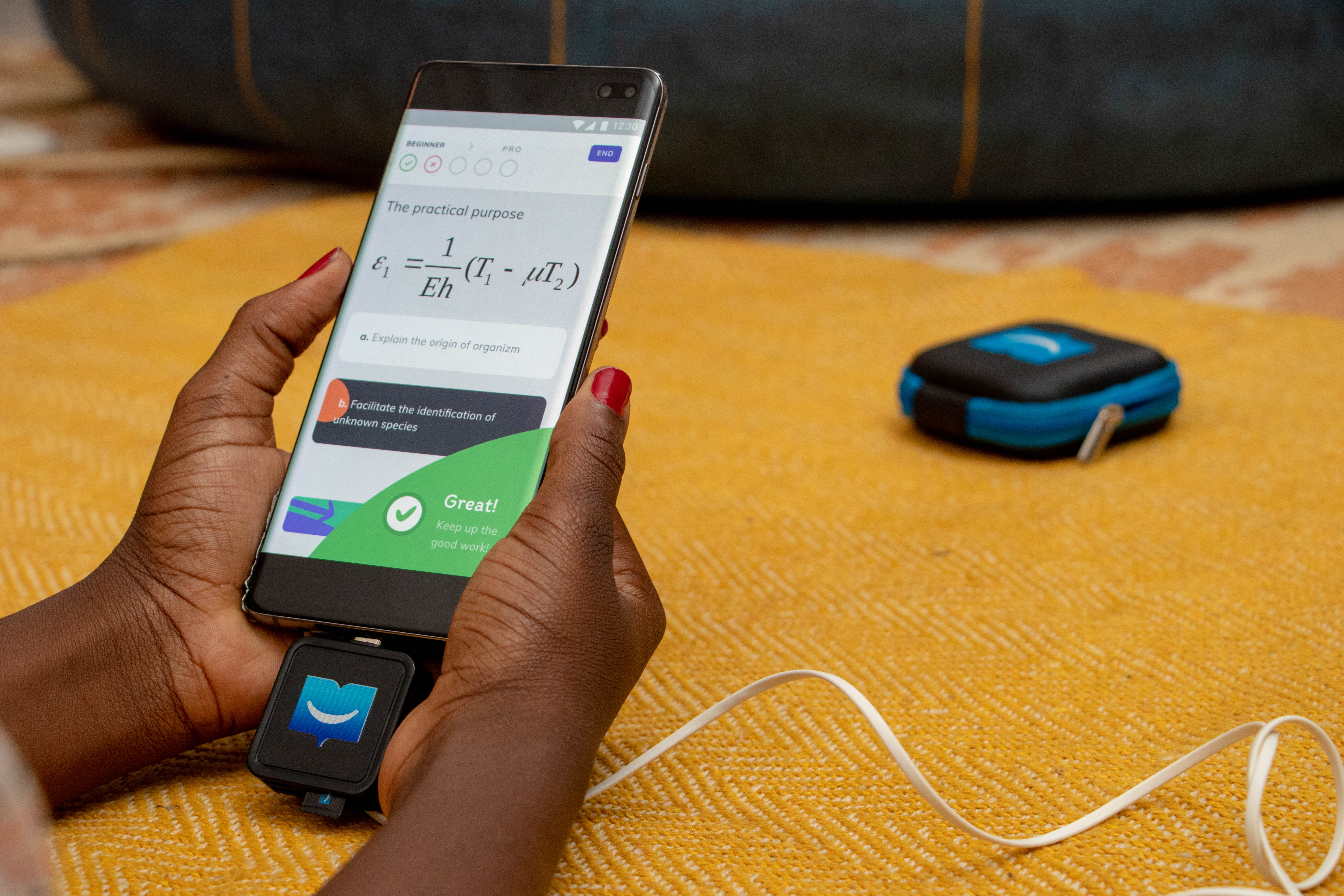
To address this, uLesson will offer an app-based home education kit for students with an up-front yearly subscription price of around $70 and the option to pay as you go. The startup’s product pack will contain a dongle, SD card, and a set of headphones to connect to Android devices.


Curriculum on the uLesson program will include practice tests and tailored content around math, physics, chemistry, and biology. The venture has already created 3000 animated videos for core subjects, according to Shagaya.

To leverage high android mobile penetration in Africa — and minimize data-streaming costs — uLesson content and performance assessment will come via a combination of streaming and SD cards.

Parents and students can connect online temporarily to update the app and sync curriculum and results, while operating off-line for the bulk of lessons.

Shagaya likened the use of SD cards to the old Netflix model of sending and returning DVD’s by mail, prior to faster and more affordable internet service in the U.S.

The uLesson program will also package a human component. The startup plans to deploy a network of counselors in major distribution areas to instruct on how to use app and follow lesson plans.

uLesson is to be a supplement to secondary school education and a more affordable and effective alternative to private tutors, explained Shagaya.

After taking uLesson to market in Africa’s most populous nation — Nigeria — and other countries in the region, Shagaya and team plan to adapt the product for a future East Africa launch.

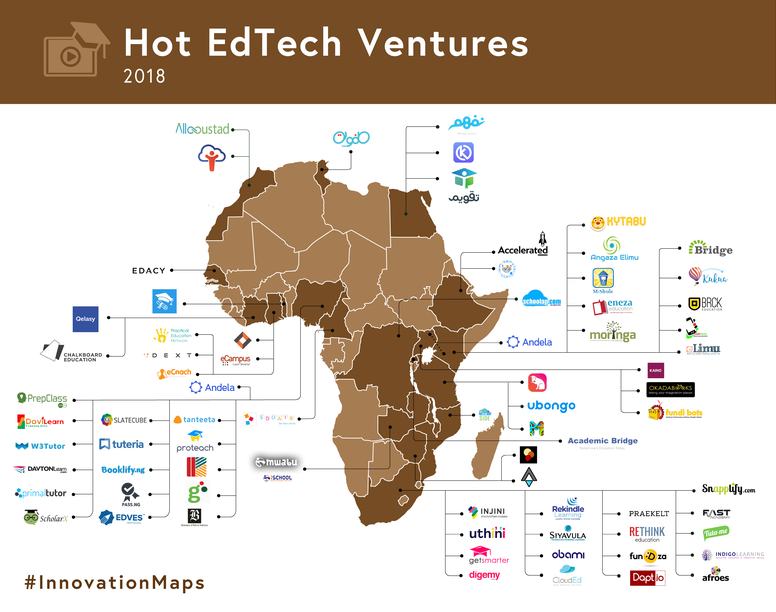
In both Nigeria and Kenya uLesson will face competition from existing ventures. Edtech in Africa doesn’t have as many companies (or as much VC funding) as leading startup sectors fintech and e-commerce, but there are a number of players.

Source: Briter Bridges

Nigeria has online edu startups, such as Tuteria. Feature phone based student learning company Eneza Education has scaled in Kenya and expanded to Ghana.

uLesson could count having Shagaya as CEO as one of its advantages in the edtech space. The venture marks the founder’s return to the startup scene after a hiatus. Shagaya earned a Harvard MBA and worked for Google before repatriating to Nigeria to found several digital companies.

His best known venture, Konga, went head to head with online retailer Jumia in pioneering e-commerce for Nigeria and Africa. Konga was sold in a distressed acquisition in 2018.

Shagaya successfully exited his digital advertising venture E-Motion this year, after it was purchased by Loatsad Promedia.

The Nigerian tech entrepreneur confirmed he’s redirected some of that windfall into uLesson’s $3.1 million seed-round.  As part of TLcom’s lead on the investment, partners Omobola Johnson and Ido Sum will join uLesson’s board, Sum confirmed to TechCrunch.

For his part, Sim Shagaya underscores the for-profit status of his new startup, while noting it carries greater meaning for him than past commercial endeavors.

“If you drill down to it all, all our problems in Africa are tied this problem of education…If we do this right, our impact will be huge. For me this is probably the most important work I’ll do,” he said.

26 Nov 2019

New smartphone figures highlight continued struggles to grow market

In some corners, the smartphone market is showing its first signs of life in some time.

Recent figures from Canalys indicate a small but notable uptick in the European market as shipments grew 3%, year-over-year in Q3.

The analyst firm put global growth at 1% globally in another recent report. Generally, such numbers wouldn’t warrant much celebration, but the way the market has been going, most manufacturers will take what they can get.

New numbers out this morning from Gartner paint a less rosy picture, with sales numbers declining 0.4%. It’s not a huge discrepancy between shipping and sales figures, but it’s the difference between being in the red and being in the black for the quarter.

26 Nov 2019

Leavy.co, the app for millennials who want to rent out their room while travelling, discloses $14M funding

Leavy.co, the Paris-born startup that offers a travel app for millennials to help them travel more without getting into further debt, has quietly raised $14 million in funding.

The investment — which is pegged as a seed round and actually closed in January! — is led by Dutch investor Prime Ventures, with participation from angel investor Dominique Vidal (who is also a partner at Index Ventures). Pieter Welten, a partner at Prime Ventures, has taken a seat on Leavy’s board.

Founded in 2017 by CEO Aziza Chaouachi, who at the time was studying law and traveling a lot, and later joined by co-founders Yassine Ben Romdhane (COO) and Mario Moinet (Chief Strategy Officer), the Leavy.co app is described as a “travel community and marketplace” that wants to help millennials travel (more) for less.

At the heart of its offering is a way for travellers (dubbed “Happy Leavers”) to rent out their room or apartment when they are away to help fund their trip. Other members (dubbed “Hosts on Demand”) then get paid to act as a local host and manage the Leavy booking. The idea, explained Chaouachi on a call yesterday evening, is to scale the community model that she first developed informally amongst friends and via her use of Airbnb when she was a student.

The killer feature — and undoubtedly where things get more interesting — is that Leavy gives members cash up front when they make their space available prior to traveling, regardless of whether or not a booking takes place. The exact price offered is dynamic and factors in various data, including how much notice is given.

Chaouachi declined to talk about the range of margin Leavy expects to generate, but, unlike most marketplaces, the startup is taking on most of the risk. If it fails to rent out a space while a member is away, it loses money. On the other hand, if its algorithm works well, it should be quite lucrative.

However, Chaouachi stressed that its algorithm and everything the startup does is being optimised for member satisfaction. If the pricing doesn’t work for all sides of the marketplace — renters, guests and hosts — Leavy’s network will stop growing and that’s the bottom line for a community-driven business that is incredibly reliant on network effects.

“We are the first pure-scale marketplace that takes a risk for its users,” she told me in an email prior to our call. “As network orchestrators, we generate profit with dynamic pricing. Our tech is obsessed with finding the optimal point of satisfaction for every user”.

Additionally, the Leavy.co app rewards members with travel credit — called Leavy Coins – when they invite friends to join and share travel tips and recommendations, or when posting photos to the app. They can then spend Leavy Coins on various travel-related products.

More broadly, the problem that Chaouachi is passionate about solving is that millennials are typically saddled with debt, often through buying an education or high accommodation costs, and that the desire and need to travel can often push them into further debt.

“As millennials, we go broke the second we decide to get an education or a credit card,” she says. “Buying a house like our parents is not an option, so we crave that weekend trip to Lisbon to lift our spirits before we go back to work on Monday. Once our outrageous rents have been paid out, it is the only air we can afford and — most of all — post about. The travel industry is the second-fastest-growing sector… and it is so at our expense, since we are its largest spenders”.

To that end, Leavy.co says its community network has grown to more than 65,000 millennials, of whom 60% are women. The young company already has 100 employees across 6 markets, with offices in Paris, Amsterdam, London, Madrid, Rome, and Lisbon. The plan is to open up in the U.S. by the end of this year.

“We are a brand new actor within the travel space, the next generation of OTA (online travel agency),” adds Chaouachi. “But unlike other OTAs such as traditional search engines like Booking.com, or short-term rental platforms like Airbnb, we don’t offer yet another item the Instagram-generation will never be able to buy: we actually boost their buying power instead”.

26 Nov 2019

India’s electric bike rental startup Yulu inks strategic partnership with Bajaj Auto, raises $8M

Yulu, a Bangalore-based electric bike sharing platform, which maintains a partnership with Uber said today it has won the backing of one of the country’s largest automaker firms.

The two-year-old startup said it has entered into a strategic partnership with Bajaj Auto, which has also funded Yulu’s $8 million Series A financing round. As part of the partnership, Bajaj will co-design and manufacture future generation of Yulu two-wheelers, Amit Gupta, cofounder and chief executive of Yulu, told TechCrunch in an interview.

Yulu, which operates in Bengaluru and recently entered portions of New Delhi and Mumbai, has raised about $18.5 million to date, he said.

The startup maintains over 3,000 electric bikes on its platform. A customer can rent the bike through Yulu’s app for 14 cents, pay another 14 cents for each hour of usage and then park it at the nearest zone.

More to follow…

26 Nov 2019

Alibaba’s shares climb almost 8% in their first morning of trading on the Hong Kong stock exchange

Alibaba share price increased as much as 7.7% during its first morning of trading on the Hong Kong Stock Exchange. Soon after the market opened, the shares climbed from their listing price of HKD $176 (a 2.9% discount from their closing price on the New York Stock Exchange on Tuesday) to HKD $189.50.

Each of Alibaba’s American depositary receipts on the NYSE is equivalent to about eight Hong Kong shares. Alibaba issued 500 million new ordinary shares for the secondary offering, plus an overallotment option for 75 million shares that will allow it to raise even more money if exercised. Its Hong Kong shares are trading under the ticker number 9988, a play on the words for “long-term prosperity” in Chinese.

Alibaba’s debut on the New York Stock Exchange in 2014 raised a total of $25 billion, making it the largest public offering in history. The company had initially considered holding its IPO in Hong Kong, but at the time, its stock exchange did not allow dual-class shares, a structure often used by tech startups because it allows holders of one class of shares to have more voting rights than common shareholders, ensuring companies continue to have control even after they go public.

Last year, the Hong Kong Stock Exchange changed its rules to accommodate dual-class share, enabling tech companies, including Meituan and Xiaomi, to debut there.

Listing on Hong Kong will also make it easier for more Chinese investors to buy and sell Alibaba shares, once it is included in the Stock Connect, a collaboration between the Hong Kong, Shanghai and Shenzhen stock exchanges.

This is not the first time Alibaba has had a presence on the Hong Kong stock market. In 2007, its B2B e-commerce platform, Alibaba.com, went public there, before the company took the unit private again in 2012.

Alibaba’s Hong Kong debut comes after months of tumultuous pro-democracy demonstrations (the stock exchange has stayed stable despite the protests), and the day after more than half the 452 seats up for vote in local district council elections flipped from pro-Beijing to pro-democracy candidates. Demonstrators have called for more transparency from the government and police, and the election results send a clear signal about public sentiment to chief executive Carrie Lam.

26 Nov 2019

Inside the Instagram AI that fills Explore with fresh, juicy content

Instagram has posted an article describing the behind-the-scenes machinery that fills the Explore tab in Instagram with new, interesting stuff every time you open it. It’s a bit technical, so here are five takeaways.

Even Instagram and Facebook have limited resources

Unlike the feed, which some still would prefer was simply chronological, the Explore tab needs to be algorithmically driven. But understanding what’s happening on an image-based social network and recommending new content to people is a problem that’s exactly as hard as you make it.

If these companies had infinite processing power and time, they’d probably come at the question of Explore a bit differently. But as it is they need to serve hundreds of millions of people on short notice and with merely enormous computing resources. I think they put this at the top of the post so people don’t wonder why they’re cutting corners.

It’s also easier to experiment and iterate when you can change stuff and see results quickly, they point out.

It’s all about the account, not the post

So much is posted to Instagram that it would be pretty much impossible to keep track of every photo individually, for recommendation purposes anyway. It’s simpler and more efficient to track accounts, since accounts tend to have themes or topics, from a broader one like “travel” to something highly specific, like especially round seals.

While liking one post from an account doesn’t necessarily mean you’ll like everything else from that account, it is a good indicator that you’re at least interested in the theme of that account. Even if it was this particular post of this particular cat that you wanted to heart because it reminds you of old Mittens, if you’re liking pictures from an account that mostly posts cats, that’s valuable information.

Complex habits inform the algorithm

Notably it isn’t just image features that Instagram uses to figure out what accounts are topically linked, though of course that kind of thing can be detected too. They also use your behavior.

For instance, when you like several posts in a row, they’re more likely to be linked in some way even if Instagram’s algorithms can’t quite see it:

If an individual interacts with a sequence of accounts in the same session, it’s more likely to be topically coherent compared with a random sequence of accounts from the diverse range of Instagram accounts. This helps us identify topically similar accounts.

People just tend to look into stuff that way, going from one travel-focused account to the next, or focusing on animals because they need a pick-me up. All that information gets sucked up by the algorithm and inspected for relevance. Of course deliberate actions like “see fewer posts like this” and blocking accounts has a lot of weight as well.

From “seed accounts” to a top 25

The process of getting from a couple billion posts to just two dozen can be pretty difficult, but you can cut the problem down to manageable size by limiting the Explore tab to accounts linked in some way to accounts the user has already liked or saved posts from. These are called “seed accounts” because everything else in the process really grows out of them.

Because of how the machine learning system represents accounts and their topics inside itself, it’s super easy for it to find a couple hundred similar accounts.

Imagine if you know someone likes a particular reddish-orange marble and you need to find some more like it. If you just dip your hand into a sack of marbles you’re unlikely to find one quickly. Even if you pour them out on the floor you’ll still have to hunt around for a bit. But if you’ve already organized them by color, all you have to do is reach into the general vicinity of the marble they like and you’re almost guaranteed to pick a winner.

The machine learning model does that by giving all these accounts a sort of location in a virtual space, and the closer two are in that space, the closer they are topically.

So the really hard part of paring down a set of billions to a set of hundreds is basically already accomplished by the way the accounts are classified.

From there Instagram does three passes with neural networks of increasing complexity.

First, slightly confusingly, is a simpler, combined version of the next two processes, which takes it from 500 to 150 accounts. This is a little weird, but think about it this way: This neural network has seen steps 2 and 3 happen many times and has a pretty good idea of what they do. Sort of like if you’d seen cookies get made enough times that you could guess at a recipe. You’d probably get close, but you also wouldn’t want to publish it to like a hundred million people. So this step just gets the obvious stuff right.

Second is a computationally cheap neural network that uses way more signals than the simple topical similarity mentioned above. Here’s where your individual likes come into play, as well as the deeper data about accounts. You like travel, sure, but in particular you like couples traveling — both things the marble-sorting algorithm above can help with. Other parameters, like a post’s general popularity, or actually its being different from the other posts in the mix, figure in as well. That skims another 100 off the top, leaving 50.

Third is a computationally expensive version of the above, which does another pass on those 50 and cuts them in half, basically by looking closer and taking the time to include, perhaps, a thousand data points each rather than a hundred.

I guess that was kind of long for a “takeaway.” Don’t worry, the next one is quick.

And of course, no ?

“We want to make sure the content we recommend is both safe and appropriate for a global community of many ages on Explore,” they write. “Using a variety of signals, we filter out content we can identify as not being eligible to be recommended.”

So now you know why you don’t get any of that in Explore.

26 Nov 2019

Taiwan’s Appier raises $80M for AI-based marketing technology

Artificial intelligence continues to be the theme of the moment in enterprise software, and today a company out of Asia that has built a suite of AI-powered marketing and ad tools is announcing a round of funding. Appier, a Taipei-based startup that provides an artificial intelligence engine to brands and retailers to help improve customer engagement, predict purchasing and improve conversions on their sites, has picked up $80 million.

This Series D includes TGVest Capital, HOPU-Arm Innovation Fund (SoftBank owns Arm), Temasek’s Pavilion Capital, Insignia Venture Partners, JAFCO Investment and UMC Capital. The company has raised $162 million to date, with previous investors including Alibaba, Sequoia, SoftBank, and Line. (The company is not disclosing its valuation but says it’s been growing since its Series C and it’s an upround. Appier now has around 1,000 customers.

Marketing technology — the bigger area of software that marketing and advertising people use to help launch, optimize and measure marketing campaigns — sometimes sits under the shadow of adtech, but in reality it’s estimated to be a $121 billion business, and growing as marketers for brands, retailers and others turn to data science to improve how they execute their work and to supplement what has traditionally been a business that operates on human precedents, psychology and hunches.

While the US and UK account for around half of all that spend, that leaves an interesting opening in markets like Asia Pacific: the customer base is still nascent but growing, and the number of startups that are focusing on the region are fewer, meaning less competition for business.

Those open waters became some of the impetus for founding Appier in Asia. Appier’s CEO, Chih-Han Yu, studied computer science and AI in graduate school at Sanford and then Harvard for his PhD, looking at how to use human gait data and machine learning to design better orthotics systems.

(If it seems like a big leap — no pun intended — to move from orthotics to sales conversions, it’s not an unusual path when you consider that for AI scientists, both are essentially mathematical problems, jumps that other AI startup founders have also made.) Ultimately, Yu decided to move back home to found his company with Winnie Lee (COO) and Joe Su (CTO).

In Asia things have been growing so fast that it seemed like an easy entry point to us,” Yu said. The company is already pan-Asian, headquartered in Taiwan, with offices in Japan and Singapore, and with a list of investors that span all those geographies and more.

Yu noted (in answer to my question about it) that while some of the investors in this round have ties to Hong Kong, there have been no tensions in respect of the current political situation unfolding between the Mainland and its special administrative region.

Appier’s initial and core product is a cross-platform advertising engine, CrossX, which covers retargeting and app installations, but also provides deep learning to help publishers and brands discover new audiences for their products.

This is still the company’s most popular product, but around it, Appier has built a series of other services around the basic concept of better customer information, specifically sourcing and utilising customer data in more intelligent (and, Yu says, anonimised) ways.  This has included making acquisitions — of QGraph and Emotion Intelligence (Emin) to bring in more analytics and functionality into the platform.

Yu said that the funding will be used to expand further in the region, where it is currently live in 12 countries and works with a number of large local brands, and the Asian arm of global brands (those customers include the supermarket chain Carrefour, Audi and Estee Lauder), to improve their marketing work.

“Appier is riding a strong long-term trend for enterprises leveraging data to make smarter decisions,” said DC Cheng, Chairman of TGVest Capital, in a statement. “Thanks to its unique use of AI technology in the digital marketing space, Appier has been a category leader since its inception and has the opportunity to expand into new corporate functions where data-based decisions are made. We share Appier’s ambition and we are excited to be a partner to the company. We are confident that Appier will continue to grow as a sustainable technology company at the forefront of technology innovation.”

25 Nov 2019

AWS Translate comes to 22 new languages and 6 new regions

AWS seems to be using this week to get some news out ahead of its annual re:Invent developer conference in Las Vegas next week. In addition to new IoT services and updates to its Rekognition AI service, the company also today announced that it is bringing 22 new languages to its AWS Translate service and that it is expanding support for the service to six new regions.

The new languages, which are now generally available, are Afrikaans, Albanian, Amharic, Azerbaijani, Bengali, Bosnian, Bulgarian, Croatian, Dari, Estonian, Canadian French, Georgian, Hausa, Latvian, Pashto, Serbian, Slovak, Slovenian, Somali, Swahili, Tagalog and Tamil. With these 22 new languages, the service now supports a total of 54 languages and 2,804 language pairs.

With this, the service is now available in 17 regions, which now include US West (N. California), Europe (London), Europe (Paris), Europe (Stockholm), Asia Pacific (Hong Kong) and Asia Pacific (Sydney). With this, more users will be able to translate text right where it’s stored, without having to move it to other regions first (which would, of course, also incur additional cost).

The free tier of AWS Translate includes 2 million characters for the twelve months.

25 Nov 2019

The ACLU wants details about videos of Boston Dynamics robot in police exercises

Back in April at our robotics event at UC Berkeley, Boston Dynamics head Marc Raibert showed off video of the company’s Spot robot in a number of different real world scenarios. Some, like construction and first responders, were familiar to anyone who has been following the company — and automation in general. 

Another scenario, which found the robot opening doors during a training exercise for the Massachusetts State Police, was something different entirely. It was a brief video that demonstrated how the robot could potentially be used to help get human officers out of harm’s way during a terrorist or hostage situation.

All these months later, the video has raised some questions among some civil liberties groups — including, mostly notably, the Massachusetts wing of the ACLU. A public records request filed by the organization is in response to a Facebook post by the department describing the July event that, “seeks to learn more about how your agency uses or has contemplated using robotics.”

ACLU Massachusetts’ Technology for Liberty Program Director Kade Crockford expanded on the request in a statement provided to TechCrunch:

There is a lot we do not know about how and where these robotics systems are currently deployed in Massachusetts. All too often, the deployment of these technologies happens faster than our social, political, or legal systems react. We urgently need more transparency from government agencies, who should be upfront with the public about their plans to test and deploy new technologies. We also need statewide regulations to protect civil liberties, civil rights, and racial justice in the age of artificial intelligence. Massachusetts must do more to ensure safeguards keep pace with technological innovation, and the ACLU is happy to partner with officials at the local and state levels to find and implement solutions to ensure our law keeps pace with technology.

As with any new technology, it’s right to ask many of these questions. Of course, this particular video has the added bonus of combining people’s distrust of big, scary robots with their (arguably deserved) distrust of law enforcement. It’s pretty easy to watch a video like that and go immediately down a dystopian rabbit hole.

Boston Dynamics told TechCrunch that it’s not at liberty to discuss the specifics of how the Massachusetts State Police deployed the robot, but the company’s Vice President Of Business Development Michael Perry explained that it’s put in place guidelines for how the loaner units can be used.

“Right now we’re at a scale where we can pick and choose the partners we engage with and make sure that they have a similar deployment and a vision for how robots are used,” Perry said. “For example, not using robots in a way that would physically harm or intimidate people. But also have a realistic expectation for what a robot can and cannot do.”

Perry explained that Boston Dynamics’ vision has the robots taking on a first responder role, rather than one of law enforcement. The latter seems to be the source of much of the concern here. It’s not so much the idea of the robots being implemented in a scenario with bomb deployment or hazardous material, so much as the potential to take a role in policing.

Notably, the ACLU’s request involves, “Documents, including emails, discussing, referencing, or pertaining to the weaponization of any robotics.”

Perry explains that the organization’s concerns are valid, but believes that Spot doesn’t represent a significant departure from existing technologies employed by first responders.

“It’s certainly the case that when a new technology is employed, multiple stakeholders need to come to the table,” he says. “I think the issues that the ACLU has raised specifically are applicable not just to our robots but to any new technology that is deployed. I’m not sure that what we bring to the table is significantly differentiated from anything that is already out there.”