Year: 2019

25 Nov 2019

The ACLU wants details about videos of Boston Dynamics robot in police exercises

Back in April at our robotics event at UC Berkeley, Boston Dynamics head Marc Raibert showed off video of the company’s Spot robot in a number of different real world scenarios. Some, like construction and first responders, were familiar to anyone who has been following the company — and automation in general. 

Another scenario, which found the robot opening doors during a training exercise for the Massachusetts State Police, was something different entirely. It was a brief video that demonstrated how the robot could potentially be used to help get human officers out of harm’s way during a terrorist or hostage situation.

All these months later, the video has raised some questions among some civil liberties groups — including, mostly notably, the Massachusetts wing of the ACLU. A public records request filed by the organization is in response to a Facebook post by the department describing the July event that, “seeks to learn more about how your agency uses or has contemplated using robotics.”

ACLU Massachusetts’ Technology for Liberty Program Director Kade Crockford expanded on the request in a statement provided to TechCrunch:

There is a lot we do not know about how and where these robotics systems are currently deployed in Massachusetts. All too often, the deployment of these technologies happens faster than our social, political, or legal systems react. We urgently need more transparency from government agencies, who should be upfront with the public about their plans to test and deploy new technologies. We also need statewide regulations to protect civil liberties, civil rights, and racial justice in the age of artificial intelligence. Massachusetts must do more to ensure safeguards keep pace with technological innovation, and the ACLU is happy to partner with officials at the local and state levels to find and implement solutions to ensure our law keeps pace with technology.

As with any new technology, it’s right to ask many of these questions. Of course, this particular video has the added bonus of combining people’s distrust of big, scary robots with their (arguably deserved) distrust of law enforcement. It’s pretty easy to watch a video like that and go immediately down a dystopian rabbit hole.

Boston Dynamics told TechCrunch that it’s not at liberty to discuss the specifics of how the Massachusetts State Police deployed the robot, but the company’s Vice President Of Business Development Michael Perry explained that it’s put in place guidelines for how the loaner units can be used.

“Right now we’re at a scale where we can pick and choose the partners we engage with and make sure that they have a similar deployment and a vision for how robots are used,” Perry said. “For example, not using robots in a way that would physically harm or intimidate people. But also have a realistic expectation for what a robot can and cannot do.”

Perry explained that Boston Dynamics’ vision has the robots taking on a first responder role, rather than one of law enforcement. The latter seems to be the source of much of the concern here. It’s not so much the idea of the robots being implemented in a scenario with bomb deployment or hazardous material, so much as the potential to take a role in policing.

Notably, the ACLU’s request involves, “Documents, including emails, discussing, referencing, or pertaining to the weaponization of any robotics.”

Perry explains that the organization’s concerns are valid, but believes that Spot doesn’t represent a significant departure from existing technologies employed by first responders.

“It’s certainly the case that when a new technology is employed, multiple stakeholders need to come to the table,” he says. “I think the issues that the ACLU has raised specifically are applicable not just to our robots but to any new technology that is deployed. I’m not sure that what we bring to the table is significantly differentiated from anything that is already out there.”
25 Nov 2019

NASA’s space pallet concept could land rovers on the moon cheaply and simply

Establishing an enduring presence on the Moon will mean making a lot of landings — and NASA researchers want to make those landings as reliable and cheap as possible. This robotic “pallet lander” concept would be a dead simple (as lunar landers go) way to put up to 300 kilograms of rover and payload onto the Moon’s surface.

Detailed in a technical paper published today, the lander is a sort of space pallet: a strong, basic framework that could be a unit in many a future mission. It’s still a concept and doesn’t really have a name, so space pallet will do for now.

It’s an evolution of a design that emerged in studies surrounding the VIPER mission that was intended to “minimized cost and schedule” and just get the rover to the surface safely. In a rare admission of (at least theoretically) putting cost over performance, the paper’s introduction reads:

The design of the lander was based on a minimum set of level 1 requirements where traditional risk, mass, and performance trade parameters were weighed lower than cost. In other words, the team did not sacrifice ‘good enough’ for ‘better’ or ‘best.’

It should be noted, of course, that “good enough” hardly implies a slapdash job in the context of lunar landers. It just means that getting 5 percent more tensile strength from a material that costs 50 times more wasn’t considered a worthwhile trade-off. Same reason we don’t use ebony or elm for regular pallets. Instead they’re using the space travel equivalent of solid pine boards that have been tested into the ground. (The team does admit to extrapolating a little but emphasizes that this is first and foremost a realistic approach.)

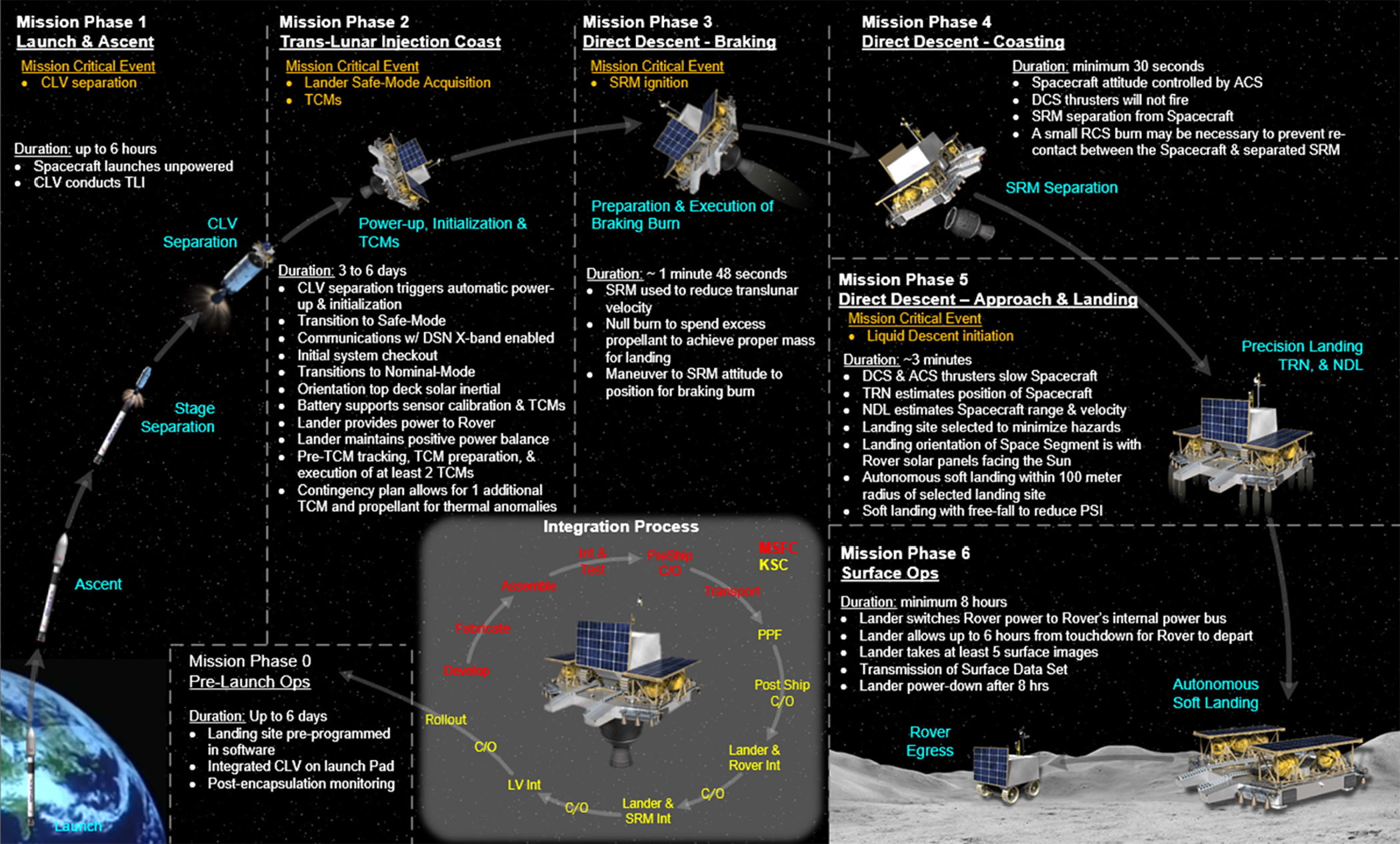
The space pallet would go up aboard a commercial launch vehicle, such as a Dragon atop a Falcon 9 rocket. The vehicle would get the pallet and its rover payload into a trans-lunar injection trajectory, and a few days later the space pallet would perform the necessary landing maneuvers: attitude control, landing site selection, braking, and a soft touchdown with the rover’s solar panels facing the sun.

Once on the surface, the rover would go on its merry way at some point in the next couple hours. The lander would take a few surface images and characterize its surroundings for the team on Earth, then shut down permanently after 8 hours or so.

Yes, unfortunately the space pallet is not intended to survive the lunar night, the researchers point out. Though any presence on the moon’s surface is a powerful resource, it’s expensive to provide the kind of power and heating infrastructure that would let the lander live through the freezing, airless cold of the Moon’s weeks-long night.

Still, it’s possible that the craft could be equipped with some low-key, self-sustaining science experiments or hardware that could be of use to others later — a passive beacon for navigation, perhaps, or an intermittent seismic sensor that detect nearby meteorite impacts.

I’ve asked for a bit more information on the possibilities of science instruments onboard, and what the alternatives might be should the space pallet not be pursued further than concept stage. But even if that were to be the case, the team writes in the paper, “it is important to note that these and other derived technologies are extensible to other lander designs and missions.”

25 Nov 2019

Argentine fintech Ualá raises $150M led by Tencent and SoftBank

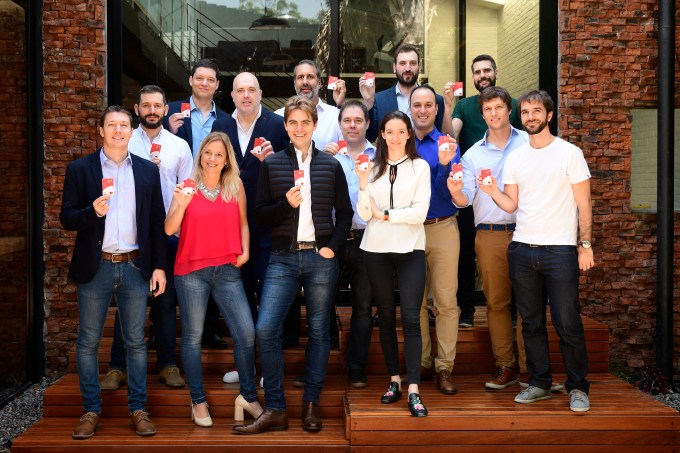
Ualá, an Argentine personal finance management app, has raised a $150 million Series C led by Tencent and SoftBank’s Latin America-focused Innovation Fund.

Ualá is a mobile banking app and lending platform with services similar to Revolut, Monzo and Nubank. However Ualá has no intention of actually becoming a bank itself. 

Founder and CEO Pierpaolo Barbieri, a Buenos Aires native and Harvard University graduate, says his ambition was to create a platform that would bring all financial services into one app linked to one card. As it exists now, Ualá is linked to a prepaid, global Mastercard and allows users to transfer money, invest in mutual funds, request loans, pay bills and top-up prepaid services. 

Although SoftBank has rapidly deployed its Latin America-focused Innovation Fund (most recently with a $140 million investment in VTEX, a Brazilian e-commerce platform used by Walmart), Ualá’s Series C marks SoftBank’s entry into Argentina. While Argentina is well known developer talent and high entrepreneurial spirit, the country has remained under-capitalized.  

Argentina is in the midst of a presidential leadership shift and as well as a $330 billion debt uncertainty. However personal mobile banking services like Ualá that promote a financial system that is more open, inclusive and competitive, are resonating with both the market and investors.

Barbieri doesn’t have his sights set on expanding Uala into any other Spanish-language countries at this time. Ualá has 1.3 million issued cards in a market of 45 million people – so there’s still a lot more work to be done in Argentina alone.

Buenos Aires-based Ualá closes a $150 million Series C

What exactly does Tencent gain by partnering with these country-specific fintechs? The Shenzhen-based internet giant and WeChat parent company wrote the playbook on mobile payments and has strategically invested in other Latin America fintechs like Nubank. Tencent clearly wants a granular understanding of the Latin America consumer spending behavior and market – and has the capital in the form of large and consistent checks to back it up.

While it’s unclear if there are any WeChat/Ualá collaborations on the product roadmap, Barbeiri explains that working with Tencent will help them learn how to create a product that drives daily engagement.

When it comes to capital deployment, Barbieri tells me that the money will be used to triple the company in size, hiring about 400 people between operations and technical roles. The new capital will be used to scale the teams that touch partnerships and business development, too. Ualá has existing partnerships with tech companies like Netflix, Rappi and Spotify, and intends to strengthen and expand similar deals over time. 

The fintech launched in October 2017, and last raised $34 million in 2018 led by Goldman Sach’s venture unit, along with Ribbit Capital and Monashees. Tencent also invested an undisclosed amount earlier this year in March. The most recent round brings Ualá’s total funding to $194 million. Barbieri declined to comment or benchmark Ualá’s valuation. 

25 Nov 2019

The herd sours on unprofitable unicorns again

There has been a mountain of press lately about how investors are souring on unprofitable unicorns.

We’ve seen this movie before; for a while, it’s all about growth, and profits be damned, then the winds change, and everyone focuses on “capital efficiency,” or similar jargon meaning, “how can I get big returns without having to put much money at risk?”

The winds blow back and forth. Until very recently, everyone was in love with consumer unicorns again. Now investors are licking their wounds, except for those who eschewed the name brands and went for boring old B2B and infrastructure companies. They are doing just fine, thank you.

Why are investors overpaying for household-name unicorns? Is it that they really believe they are good assets, or are other factors at play? The fact is that venture funds and private equity funds are competing for investment funds themselves. I am personally an investor in several venture funds, and I have heard the pitch, “we were investors in Facebook, Instagram, Uber, Twitter (or whatever), and we can get you access to these deals.” Sounds good, but what they don’t tell you is how much they paid (or overpaid) to be part of these deals. It’s such nonsense and the perennially poor returns delivered by the ego-driven venture capital industry are its just rewards.  

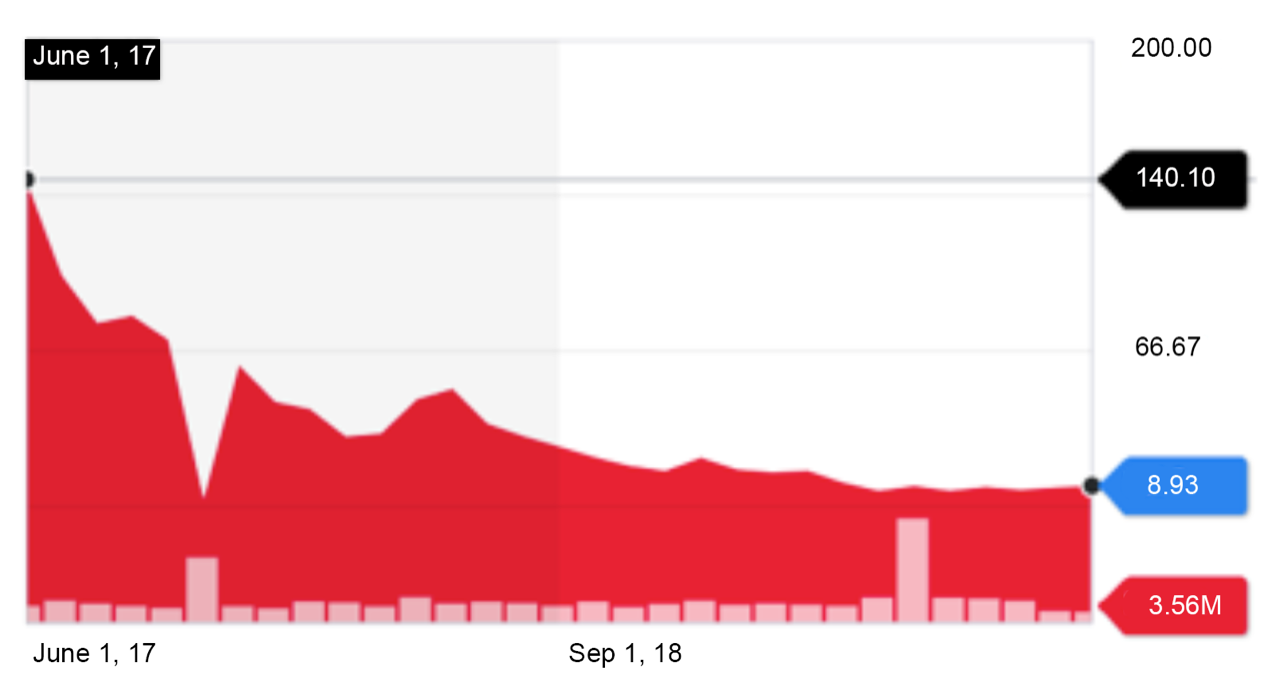
Downward stock valuations of unicorns post-IPO

Downward stock valuations of unicorns post-IPO. (Yahoo Finance)

Investors who bid up the valuations of high-profile unicorns are of course hoping that an IPO will eventually bail them out. The problem is that public fund managers, like Fidelity or Blackstone, who control most of post-IPO stocks, look at the value of a company quite differently. They see a company’s “value” as the sum total of all the company’s future profits. They can’t offer their clients “exclusive” access to hot deals. We’re talking public stocks that anyone can buy.

If nobody can see a clear road to profitability, then this hard-nosed approach to valuation will lead to stocks tanking after an IPO. That’s recently been the case with We, Uber, and numerous others.  

From 2010 to the first quarter of 2015, investors collectively poured $9.4 billion into the on-demand economy, according to data from CB Insights. Uber accounted for 58% of the $4.12 billion raised in 2014. What’s also striking is how quickly the industry piled onto the latest thing between 2013 and 2014. Since its IPO in May of 2019, Uber’s stock has fallen nearly 40% from its peak, Lyft is down even more, and Softbank’s most recent investment in We appears to have wiped out nearly 80% of its previous private valuation. Masayoshi Son has been publicly apologizing for his investment in We: “My investment judgment was poor in many ways,” said Son.

25 Nov 2019

AI expert Stuart Russell to join TC’s Robotics+AI 2020 at UC Berkeley

Computer scientists agree that artificial intelligence will have a stunning impact on the future of humanity. And more often than not, futurists depict a dystopian outcome – a world where we are at best subservient to machines and at worst exterminated by them. Computer scientist Stuart Russell, one of the world’s top experts on AI and author of the recently published “Human Compatible: Artificial Intelligence and the Problem of Control,” will join us at TC Sessions: Robotics & AI (March 3 at UC Berkeley’s Zellerbach Hall) ), to discuss how researchers and founders today will determine AI’s ultimate impact.

At a time when the debate about AI seems to be polarized between the alarmists predicting the imminent “singularity” and those pooh-poohing the advent of human-level AI, Dr. Russell, a professor of computer science at UC Berkeley, cuts through the debate to argue that we still have time to ensure that the doomsayers are proven wrong. As Dr. Russell argues in “Human Compatible,” the key is to ensure that AI designs “will necessarily defer to humans: they will ask permission, they will accept correction, and they will allow themselves to be switched off.”

Dr. Russell believes that super human-level AI is likely a generation or two away, though he allows that unexpected breakthroughs – like Leo Szilard’s totally unexpected breakthrough on nuclear chain reactions in 1933 – could hasten the day. Regardless of the timeline, Dr. Russell argues that the current approach to AI is dangerous to the future of humanity. For his part, Dr. Russell is literally re-writing his textbook on AI to advance what he has described as a Jeeves-like humility in  future AI systems and spurring related research through organizations like The Center for Human Compatible AI (CHAI).

Join our 4th annual TC Sessions: Robotics & AI on March 3 at UC Berkeley’s Zellerbach Hall for a remarkable day with the world’s top roboticists, investors, founders, and AI engineers. The day features a full day or programming lead by TechCrunch’s editors on the main stage, a pitch-off competition featuring early-stage startups, numerous breakout and speaker Q&A sessions, and much more.

Get your early bird pass here. Interested in sponsoring? Please get in touch.

25 Nov 2019

Google employee activist says she’s been fired

Google has terminated Rebecca Rivers, an employee activist the company put on indefinite administrative leave this month, Rivers tweeted this afternoon.

Earlier this month, Google put Rivers and Laurence Berland on leave for allegedly violating company policies. At the time, Google said one had searched for and shared confidential documents that were not pertinent to their job, and one had looked at the individual calendars of some staffers.

Protestors on Friday, however, said Google was punishing Berland and Rivers for speaking out against the company. The rally, where both Berland and Rivers spoke, was in protest of their administrative leaves.

Ahead of the rally, organizers said the “attack” on Rivers and Berland “is an attack on all people who care about transparency and accountability for tech.” Organizers pointed to how Rivers helped create the petition to demand Google end its contract with U.S. Customs and Border Protection, and how Berland has participated in a number of worker-organized campaigns, including the one resisting YouTube’s role in facilitating hate speech.

Since the massive employee-led walkout last November, organizers say Google has tried to undermine further attempts to organize. In July, walkout co-organizer Meredith Whittaker left the company following reports of retaliation in April. Organizers of the rally say both Rivers and Berland were put on leave for “simply looking at openly shared internal information.”

This comes shortly after The New York Times reported Google hired an anti-union firm, ISI Consultants. Google employees, who the Times kept anonymous, discovered Google’s relationship with ISI via internal calendar entries.

I’ve reached out to Google and will update this story if I hear back.

25 Nov 2019

Ford VP challenges Tesla to a fair F-150 vs Cybertruck tow battle

Elon Musk took a big swipe at Ford during the unveiling of the Cybertruck. Mid-presentation, he played a video of a Cybertruck pulling an F-150 in what was pitched as a head-to-head contest. Many have questioned if it was a fair fight (I don’t think it was)… including Sundeep Madra, VP of Ford X, the automaker’s venture incubator.

Madra tweeted to Elon Musk today, calling for Tesla’s CEO to send Ford a Cybertruck to do an “apples to apples” test.

The test showed by Tesla is questionable on several levels. First, the Cybertruck is dramatically heavier, particularly in the rear-end. The Ford used in the test appears to be in 2-wheel drive mode running on older tires. Without weight on the rear wheels, and the front axle spinning freely, the Ford is at the mercy of the heavier all-wheel drive Cybertruck.

The Ford appears to be a mid-level XLT trim and it’s impossible to identify the engine used. However, the truck lacks the badging used with Ford’s top-of-the-line 3.5L Ecoboost, which seems to indicate the truck sports a lower-end V8 or Ford’s smaller 2.7L Ecoboost. Either way, it’s not a fair fight under the hood.

Other factors are at play, too. The Cybertruck pulls first, increasing the Tesla’s traction and decreasing the Ford’s. (Also, Tesla, when towing a vehicle from a standstill, it’s critical to ensure the slack is removed from the line. It’s dangerous to do otherwise. That line can snap.)

In the end, though these butt-to-butt pull challenges are fun to watch but don’t prove much relevant to the real world. A better tow test would involve weighted trailers and conclusions based off of range and weight.

Ford is among a handful of automakers developing an electric pickup that will compete against the Tesla Cybertruck. The F-150 is the automaker’s best selling vehicle and critical to its balance sheet.

The Cybertruck upends decades of truck styling and functionality by taking the unibody form and function to an extreme. The polarizing design has lead to countless memes and digs at Tesla, but also over 200,000 in pre-orders in just a few days.

25 Nov 2019

Baby Yoda memes return as Giphy stops pulling content over copyright concerns

Almost as soon as “Baby Yoda” (or “Yoda Baby”?) debuted on the wildly popular new Disney Plus series “The Mandalorian,” a thousand internet memes bloomed in its wake.

Yet, nearly as quickly as the image took hold everywhere online, it was mysteriously pulled — as if a thousand bounty hunters all got the same tracking fob.

Initially, outlets like Vulture, which had a slew of adorable baby Yoda images, blamed an overabundance of caution from Walt Disney Co. for the disappearance of everyone’s favorite new adorable Star Wars alien. But Disney, it turns out, (surprisingly) wasn’t to blame for the disappearance of Yoda Baby.

Rather it was Giphy, the maven of meme generation that was behind the dastardly deed, as initially reported by the BBC.

“Last week, there was some confusion around certain content uploaded to Giphy and we temporarily removed these GIFs while we reviewed the situation,” the company said in a statement. “We apologize to both Disney and Vulture for any inconvenience, and we are happy to report that the GIFs are once again live on Giphy.”

It’s the latest example of the overwhelming sensitivity and general joylessness that surrounds intellectual property and copyright in the age of corporate branding über alles.

TechCrunch has been weighing in on copyright claims and fair use for at least a decade. And for the past decade or more, killjoys have been ruining the remix culture that was part of the internet’s strength in the first place. Corporations should lighten up — as some Twitter users have noted; they may be super-pumped with the results.

25 Nov 2019

Elon Musk says sledgehammering Cybertruck led to the onstage window failure

After pounding the side of his new Cybertruck with a sledgehammer with not a mark left behind, Elon Musk turned his focus to the “Tesla Armor Glass”.

As we all saw, the glass did not fare so well. A toss of a steel ball into the window caused it to splinter, catching everyone on stage off guard. “Oh my [bleeping] God,” said Musk.

A repeat attempt on the rear window had the same results, leaving the truck with cracks awkwardly sprawled across its glass for the remainder of the presentation.

In hindsight, Elon says they probably should’ve done the window demo before they smacked the truck with a big ol’ hammer.

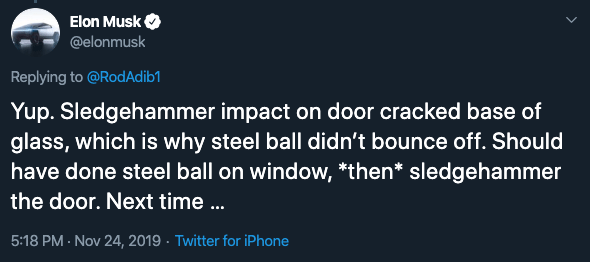
Elon tweets:

Would the window have cracked regardless of order? At least on stage, they only pounded on the front door panel; were these hits enough to crack the base of the glass on the rear door, too? It’s probably impossible for anyone outside of Tesla to say with certainty, but that seems pretty wild.

The night after the announcement, Elon tweeted out a video of their tests “right before launch”, in which the window seemingly had no problems:

Some commenters postulated (assuming that the truck in the video was the same one on stage) that these earlier tests could’ve primed the window for failure — that the test hits weakened the glass, even if they didn’t visibly damage them.

Whatever the cause, the glass cracked — twice. The (literal) damage is done. But while the broken windows have become something of a meme, it’s not as if the failed demo wiped out interest; Musk says that, as of Sunday night, over 200,000 people had put down refundable $100 deposits (so over $20M in deposits in all) on the truck. And with the Cybertruck not expected to go into production until late 2021, I’d be surprised if Tesla doesn’t make some tweaks and find some over-the-top way to demonstrate V2 of the truck’s glass before then.

25 Nov 2019

What the partnership at Trinity Ventures sees for the road ahead in 2020

Over the years, Trinity Ventures has racked up many exits for its limited partners.

Through deals in consumer brands like Starbucks and Zulily and enterprise companies like TubeMogul and New Relic, the Menlo Park-based fund has found repeated success, but as it retrenches with a pared-down investment team and a much smaller new fund, Trinity’s investors have some thoughts about what lies ahead for the venture capital community.

As the firm’s partners consider what’s in store for 2020, they emphasize that entrepreneurs will have to focus on public policy; blockchain will experience a renaissance; a recession is coming and the accessibility of data and an aging global population will continue to reshape healthcare markets.

The firm is currently in the process of closing what would be its smallest fund in years, a $250 million investment vehicle, first disclosed in a filing with the Securities and Exchange Commission in July. That fund, as first reported by Crunchbase News, is the firm’s most modest vehicle in nearly 20 years; the last time Trinity raised less than $300 million was in 1998.

Even as it invests from a smaller vehicle, the team is still putting capital to work in deals like the human resources-focused technology startup, Cultivate; the interbank payment company, BatonSquire, a payment and booking management platform for barbershops and salons, and Valtix, an enterprise security company.

For Patricia Nakache, an investor in companies like Turo, Care.com, and ThredUp, understanding regulation and public policy will have to become part of the job for budding entrepreneurs and big companies alike.