Year: 2019

14 Nov 2019

Recycling robots raise millions from top venture firms to rescue an industry in turmoil

The problem of how to find the potential treasure trove hidden in millions of pounds of trash is getting a high-tech answer as investors funnel $16 million into the recycling robots built by Denver-based AMP Robotics.

For recyclers, the commercialization of robots tackling industry problems couldn’t come at a better time. Their once-stable business has been turned on its head by trade wars and low unemployment.

Recycling businesses used to be able to rely on China to buy up any waste stream (no matter the quality of the material). However, about two years ago, China decided it would no longer serve as the world’s garbage dump and put strict standards in place for the kinds of raw materials it would be willing to receive from other countries. The result has been higher costs at recycling facilities, which actually are now required to sort their garbage more effectively.

At the same time, low unemployment rates are putting the squeeze on labor availability at facilities where humans are basically required to hand-sort garbage into recyclable materials and trash.

Given the economic reality, recyclers are turning to AMP’s technology — a combination of computer vision, machine learning and robotic automation to improve efficiencies at their facilities.

trash cans

Photo courtesy of Flickr/Abulla Al Muhairi

That’s what attracted Sequoia Capital to lead the company’s latest investment round — a $16 million Series A investment the company will use to expand its manufacturing capacity and boost growth as it looks to expand into international markets.

“We are excited to partner with AMP because their technology is changing the economics of the recycling
industry,” said Shaun Maguire, partner at Sequoia, in a statement. “Over the last few years, the industry has had their margins squeezed by labor shortages and low commodity prices. The end result is an industry proactively searching for cost-saving alternatives and added opportunities to increase revenue by capturing more high-value recyclables, and AMP is emerging as the leading solution.”

The funding will be used to “broaden the scope of what we’re going after,” says chief executive Matanya Horowitz. Beyond reducing sorting costs and improving the quality of the materials that recycling facilities can ship to buyers, the company’s computer vision technologies can actually help identify branded packaging and be used by companies to improve their own product life cycle management.

“We can identify… whether it’s a Coke or Pepsi can or a Starbucks cup,” says Horowitz. “So that people can help design their product for circularity… we’re building out our reporting capabilities and that, to them, is something that is of high interest.”

That combination of robotics, computer vision and machine learning has potential applications beyond the recycling industry as well, according to Horowitz. Automotive scrap and construction waste are other areas where the company has seen interest for its combination of software and hardware.

Meanwhile, the core business of recycling is picking up. In October, the company completed the installation of 14 robots at Single Stream Recyclers in Florida. It’s the largest single deployment of robots in the recycling industry and the robots, which can sort and pick twice as fast as people with higher degrees of accuracy, are installed at sorting lines for plastics, cartons, fiber and metals, the company said.

AMP’s business has two separate revenue streams — a robotics as a service offering and a direct sales option — and the company has made other installations at sites in California, Colorado, Indiana, Minnesota, New York, Pennsylvania, Texas, Virginia and Wisconsin.

The traction the company is seeing in its core business was validating for early investors like BV, Closed Loop Partners, Congruent Ventures and Sidewalk Infrastructure Partners, the Alphabet subsidiary’s new spin-out that invests in technologies to support new infrastructure projects.

For Mike DeLucia, the Sidewalk Infrastructure Partners principal who led the company’s investment into AMP Robotics, the deal is indicative of where his firm will look to commit capital going forward.

“It’s a technology that enables physical assets to operate more efficiently,” he says. “Our goal is to find the technologies that enable really exciting infrastructure projects, back them and work with them to deliver projects in the physical world.”

Investors like DeLucia and Abe Yokell, from the investment firm Congruent Ventures, think that recycling is just the beginning. Applications abound for AMP Robotic’s machine learning and computer vision technologies in areas far beyond the recycling center.

“When you think about how technology is able to impact the built environment, one area is machine vision,” says Yokell. “[Machine learning] neural nets can apply to real-world environments, and that stuff has gotten cheaper and easier to deploy.”

14 Nov 2019

This ride-hailing PR pitch shows platforms and digital campaign ‘dark arts’ want democracy to be pay to play

A UK PR firm pitching to run an account for Ola has proposed running a campaign to politicize ride-hailing as a tactic to shift regulations in its favor.

The approach suggests that, despite the appearance of ride-hailing platforms taking a more conciliatory position with regulators that are now wise to earlier startup tactics in this space, there remains a calculus involving realpolitik, propaganda and high-level lobbying between companies that want to enter or expand in markets, and those who hold the golden tickets to do so.

In 2017 Estonia-based ride-hailing startup Taxify tried to launch in London ahead of regulatory approval, for example, but city authorities clamped down straight away. It was only able to return to the UK capital 21 months later (now known as Bolt).

In Western markets ride-hailing companies are facing old and new regulatory roadblocks that are driving up costs and creating barriers to growth. In some instances unfavorable rule changes have even led companies to pull out of cities or regions all together. Even as there are ongoing questions around the employment classification of the drivers these platforms depend on to deliver a service.

The PR pitch, made by a Tufton Street-based PR firm called Public First, suggests Ola tackle legislative friction in UK regions with a policy influence campaign targeted at local voters.

The SoftBank-backed Indian ride-hailing startup launched in the U.K. in August, 2018 and currently offers services in a handful of regional locations including South Wales, Merseyside and the West Midlands. Most recently it gained a licence to operate in London, and last month launched services in Coventry and Warwick — saying then that passengers in the UK had clocked up more than one million trips since its launch.

Manchester is also on its target list — and features as a focus in the strategy proposal — though an Ola spokesman told us it has no launch date for the city yet. The company met with Manchester’s mayor, Andy Burnham, during a trade mission to India last month.

The Public First proposal suggests a range of strategies for Ola to get local authorities and local politicians on-side, and thus avoid problems in potential and future operations, including the use of engagement campaigns and digital targeting to mobilize select coalitions around politicized, self-serving talking points — such as claims that public transport is less safe and convenient; or that air quality improves if fewer people drive into the city — in order to generate pressure on regulators to change licensing rules.

Another suggestion is to position the company less as a business, and more as an organization representing tens of thousands of time-poor people.

Public First advocates generally for the use of data- and technology-driven campaign methods, such as microtargeted digital advertising, as more effective than direct lobbying of local government officials — suggesting using digital tools to generate a perception that an issue is politicized will encourage elected representatives to do the heavy lifting of pressuring regulators because they’ll be concerned about losing votes.

The firm describes digital campaign elements as “crucial” to this strategy.

“Through a small, targeted online digital advertising campaign in both cities, local councillors’ email inboxes would begin to fill with requests from a number of different people (students, businesses, and other members of [a commuter advocacy group it proposes setting up to act as a lobby vehicle]) for the local authority to change its approach on local taxi licensing — in effect, to make it easier for Ola to launch,” it offers as a proposed strategy for building momentum behind Ola in Manchester and Liverpool.

Public First confirmed it made the pitch to Ola but told us: “This was merely a routine, speculative proposal of the sort we generate all the time as we meet people.”

“Ola Cabs has no relationship whatsoever with Public First,” it added.

A spokesperson for Ola also confirmed that it does not have a business relationship with Public First. “Ola has never had a relationship with Public First, does not currently have one and nor will it in the future,” the spokesman told us.

“Ola’s approach in the UK has been defined by working closely and collaborating with local authorities and we are committed to being fully licensed in every area we operate,” he added, suggesting the strategy it’s applying is the opposite of what’s being proposed.

We understand that prior to Public First pitching their ideas to a person working in Ola’s comms division, Ola’s director of legal, compliance and regulation, Andrew Winterton, met with the firm over coffee — in an introductory capacity. But that no such tactics were discussed.

It appears that, following first contact, Public First took the initiative to draw up the strategy suggesting politicizing ride-hailing in key target regions which it emailed to Winterton but only presented to a more junior Ola employee in a follow-up meeting the legal director did not attend.

Ola has built a major ride-hailing business in its home market of India — by way of $3.8BN in funding and aggressive competition. Since 2018 it has been taking international steps to fuel additional growth. In the U.K. its approach to date has been fairly low key, going to cities and regional centers outside of high-profile London first, as well as aiming to serve areas with big Indian populations to help recruit riders and drivers.

It’s a strategy that’s likely been informed by being able to view the track record of existing ride-hailing players — and avoid Uber-style regulatory blunders.

The tech giant was dealt a major shock by London’s transport regulator in 2017, when TfL denied it a licence renewal — citing concerns over Uber’s approach to passenger safety and corporate governance, including querying its explanation for using proprietary software that could be used to evade regulatory oversight.

The Uber story looks to be the high water mark for blitzscaling startup tactics that relied on ignoring or brute forcing regulators in the ride-hailing category. Laws and local authorities have largely caught up. The name of the game now is finding ways to get regulators on side.

Propaganda as a service

The fact that strategic proposals such as Public First’s to Ola are considered routine enough to put into a speculative pitch is interesting, given how the lack of transparency around the use of online tools for spreading propaganda is an issue that’s now troubling elected representatives in parliaments all over the world. Tools such as those offered by Facebook’s ad platform.

In Facebook’s case the company provides only limited visibility into who is running political and issue-based ads on its platform. The targeting criteria being used to reach individuals is also not comprehensively disclosed.

Some of the company’s own employees recently went public with concerns that its advanced targeting and behavioral-tracking tools make it “hard for people in the electorate to participate in the public scrutiny that we’re saying comes along with political speech”, as they put it.

At the same time, platforms providing a conduit for corporate interests to cheaply and easily manufacture ‘politicized’ speech looks to be another under-scrutinized risk for democratic societies.

Among the services Public First lists on its website are “policy development”, “qualitative and quantitative opinion research”, “issues-based campaigns”, “coalition-building” and “war gaming”. (Here, for example, is a piece of work the firm carried out for Google — where its analysis-for-hire results in a puffy claim that the tech giant’s digital services are worth at least $70BN in annual “economic value” for the UK.)

Public First’s choice of office location, in Tufton Street, London, is also notable as the area is home to an interlinked hub of right-leaning think tanks, such as the free market Center for Policy Studies and pro-Brexit Initiative for Free Trade. These are lobby vehicles dressed up as policy wonks which put out narratives intended to influence public opinion and legislation in a particular direction without it being clear who their financial backers are.

Some of the publicity strategies involved in this kind of work appear to share similarities with tactics used by Big Tobacco to lobby against anti-smoking legislation, or fossil fuel interests’ funding of disinformation and astroturfing operations to create a perception of doubt around consensus climate science.

“A lot of what used to get sold in this space essentially was access [to policymakers],” says one former public relations professional, speaking on background. “What you’re seeing an increasingly amount of now is the ‘technification’ of that process. Everyone’s using those kinds of tools — clearly in terms of trying to understand public sentiment better and that kind of thing… But essentially what they’re saying is we can set up a set of politicized issues so that they can benefit you. And that’s an interesting change. It’s not just straight defence and attack; promote your brand vs another. It’s ‘okay, we’re going to change the politics around an issue… in order to benefit your outcome’. And that’s fairly sophisticated and interesting.”

Mat Hope, editor of investigative journalism outlet DeSmog — which reports on climate-related misinformation campaigns — has done a lot of work focused on Tufton Street specifically, looking at the impact the network’s ‘policy-costumed’ corporate talking points have had on UK democracy.

“There is a set of organisations based out of offices in and around 55 Tufton Street in Westminster, just around the corner from the Houses of Parliament, which in recent years have had an outsized impact on British democracy. Many of the groups were at the forefront of the Leave campaign, and are now pushing for a hard or no-deal Brexit,” he told us, noting that Public First not only has offices nearby but that its founders and employees “have strong ties to other organisations based there”.

“The groups regularly lobby politicians in the interests of specific companies or big industry through the guise of grassroots or for-the-people campaigns,” he added. “One way they do this is through targeting adverts or social media posts, using groups with benign sounding names. This makes it hard to trace the campaign back to any particular company, and gives the issue an impression of grassroots support that is, on the whole, artificial.”

Platform power without responsibility

Ad platforms such as Facebook which profit by profiling people offer cheap yet powerful tools for corporate interests to identify and target highly specific sub-sets of voters. This is possible thanks to the vast amounts of personal data they collect — an activity that’s finally coming under significant regulatory scrutiny — and custom ad tools such as lookalike audiences, all of which enables behavioral microtargeting at the individual user/voter level.

Lookalike audiences is a powerful ad product that allows Facebook advertisers to upload customer data yet also leverage the company’s pervasive people-profiling to access new audiences that they do not hold data on but who have similar characteristics to their target. These so-called lookalike audiences can be tightly geotargeted, as well as zeroed in on granular interests and demographics. It’s not hard to see how such tools can be applied to selectively hit up only the voters most likely to align with a business’ interests.

The upshot is that an online advertiser is able to pay little to tap into the population-scale reach and vast data wealth of platform giants — turning firehose power against individual voters who they deem — via focus group work or other voter data analysis — to be aligned with a corporate agenda. The platform becomes a propaganda machine for manufacturing the appearance of broad public engagement and grassroots advocacy for a self-interested policy change.

The target voter, meanwhile, is most likely none the wiser about why they’re seeing politicized messaging. It’s that lack of transparency that makes the activity inherently anti-democratic.

The UK’s Digital, Culture, Media and Sport committee raised Facebook’s lookalike audiences as a risk to democracy during a recent enquiry into online disinformation and digital campaigning. It went on to recommend an outright ban on political microtargeting to lookalike audiences online. Though the UK government has so far failed to act on that or its fuller suite of recommendations. (Nor has Facebook responded to increasingly loud calls from politicians and civic society to ban political and issue ads altogether.)

Even a code of conduct published by the International Public Relations Association (IPRA) emphasizes transparency — with member organizations committing to “be open and transparent in declaring their name, organisation and the interest they represent”. (Albeit, the IPRA’s member list is not itself public.)

While online targeting of social media users remains a major problem for democracies, on account of the lack of transparency and individual consent to targeting (or, indeed, to data-based profiling), in recent years we’ve also seen more direct efforts by companies to use their own technology tools to generate voter pressure.

Examples such as ride-hailing giant Uber which, under its founding CEO, Travis Kalanick, became well known for a ‘push button’ approach to mobilizing its user base by sending calls to action to lobby against unfavorable regulatory changes.

Airbnb has also sought to use its platform-reach to beat against local authority rule changes that threaten its ‘home sharing’ business model.

However it’s the opaque tech-fuelled targeting enabled by ad platforms like Facebook that’s far more problematic for democracies as it allows vested interests to generate self-interested pressure remotely — including from abroad — while remaining entirely shielded from view.

Fixing this will require regulatory muscle to enforce existing laws around personal data collection (at least where such laws exist) — and doing so in a way that prevents microtargeting from being the cheap advertising default. Democracies should not allow their citizens to be mirrored in the data because it sets them up to be hollowed out; their individuals aggregated, classified and repackaged as all-you-can-eat attention units for whoever is paying.

And likely also legislation to set firm boundaries around the use of political and campaigning/issue ads online. Turning platform power against the individual is inherently asymmetrical. It’s never going to be a fair fight. So fair ground rules for digital political campaigning — and a proper oversight regime to enforce them — are absolutely essential.

Another democratic tonic is transparency. Which means raising awareness about tech-fuelled tactics that are designed to generate and exploit data-based asymmetries in order to hack and manipulate public opinion. Such skewed stuff only really works when the target is oblivious to what’s afoot. In that respect, every little disclosure of these ‘dark arts’ and the platforms that enable them provides a much-needed counter boost for critical thinking and democracy.


14 Nov 2019

Lyft is ceasing scooter operations in six cities and laying off 20 employees

In an industry where unit economics and rider utilization are key to running a profitable business, perhaps it’s better to cut your losses early on. Lyft notified employees today that it’s pulling its scooters from six markets, Nashville, San Antonio, Atlanta, the Phoenix area, Dallas and Columbus.

“We’re choosing to focus on the markets where we can have the biggest impact,” a Lyft spokesperson told TechCrunch. “We’re continuing to invest in growing our bike and scooter business, but will shift resources away from smaller markets and toward bigger opportunities.”

That means Lyft is laying off about 20 employees from its bikes and scooter team, which consists of about 400 people. Additionally, a number of contractors responsible for scooter charging and repositioning are also losing their jobs. This is the second round of layoffs in the bikes and scooters division this year. In March, Lyft laid off around 50 people, mostly those who came on board from Motivate following Lyft’s acquisition of the company last year.

Lyft landed on this decision because it found that cities with the greatest population density are best for micromobility, and those six markets are not included in that group. But Lyft is not the only company to pull out from markets this year. Competitor Uber has also pulled JUMP bikes and scooters from a handful of markets, including San Diego, Providence and Atlanta. In some cases, what led to ceasing operations were regulatory hurdles. For Lyft, however, the company said it came down to a lack of ridership.

Back in June, Lyft deployed its new scooters, built by Segway, that are designed for sharing. Since then, Lyft says its operating costs have decreased and ridership has increased about 20% in markets like Denver and Miami. These Segway-built scooters make up more than 65% of Lyft’s scooter fleet and plans to upgrade the entire fleet by the end of January.

Lyft currently operates its scooters in Alexandria, Arlington, Austin, Denver, Los Angeles, Miami, Minneapolis, Montogmery County, Oakland, San Diego, San Jose, Santa Monica and Washington, D.C.

14 Nov 2019

Spotify confirms it’s testing real-time lyrics synced to music

With the launch of iOS 13, Apple added perfectly timed live lyrics to its Apple Music app. Now Spotify may do the same. Several users in international markets are now seeing a similar synced lyrics feature in their Spotify mobile app, where lyrics scroll by in time with the music. The feature is powered by Musixmatch, according to the screenshots. Spotify confirmed to TechCrunch the feature is a test in a limited number of markets.

While Spotify didn’t confirm which regions have access, we’re seeing that users in Canada, Indonesia, and Mexico appear to be among the test markets.

The feature sits beneath the playback controls where today, other enhancements like Behind the Lyrics or Storyline, currently appear. And users say they can also view the lyrics in a full-screen experience.

We were not able to duplicate the same experience here in the U.S., which indicates it’s still limited by geography.


Spotify had lyrics support on the desktop several years ago, but that feature was later removed. Since then, users have repeatedly asked when it would return. On Spotify’s user feedback community, for example, a request asking the company to “bring back lyrics” was upvoted over 14,300 times. Spotify wouldn’t respond to user requests except to point users to its Genius integration, Behind the Lyrics.

Genius, however, doesn’t provide full lyrics. Instead, it’s a way to annotate tracks with a combination of lyrics and stories. While the feature can be both informative and entertaining, it’s not necessarily the experience people want when they’re trying to learn the words to a song.

Currently, neither Spotify’s desktop or mobile app has lyrics support, with the exception of Japan. It also regularly runs tests like this, so this is not a confirmation of a near-term launch.

Spotify’s decision to not make lyrics integration a priority has given Apple Music a competitive advantage in terms of its feature set. While it may not be a key selling point, per se — Spotify now has 113 million paying customers to Apple Music’s 60 million — it could help to retain users who don’t want to lose access by switching. Amazon has also capitalized on Spotify’s lack of lyrics with integrations of music and lyrics on Alexa devices.

Reached for comment, a Spotify spokesperson confirmed a synced lyrics experience is something it’s testing.

“We can confirm we are testing this feature in a small number of markets,” the spokesperson said. “At Spotify, we are always testing new products and experiences but have no further news to share at this time.”

14 Nov 2019

Quibi series from Steven Soderbergh starring Tye Sheriden focuses on smartphone survival skills

People dramatically proclaim all the time that they don’t think they could survive without their smartphones, but a new series form the forthcoming streaming service Quibi from Jeffrey Katzenberg and Meg Whitman approaches smartphone survival in a much more literal way. The scripted series, which will premiere on Quibi at launch in April 2020, stars Ready Player One‘s Tye Sheridan, and counts Steven Soderbergh as an executive producer.

The series, called ‘Wireless,’ was created by Jack Seidman and Zach Wechter, who are the creators of the short film Pocket, which is shot entirely as though it was taking place on a person’s phone, almost like a screencast of that device. Wireless will similar cinematic, which is a good fit for Quibi’s short-form, made for mobile approach to original streaming content. Wechter and Seidman have a head-start in this regard, in fact, since their film collective Pickpocket is specifically aimed at making this kind of feature.

‘Wireless’ will tell the story of Sheridan’s lead character, who is described as “a self-obsessed college student whose only hope for survival is the tool he has spent his whole life learning to use: his smartphone.” Said character will apparently be trapped inside of his freshly crashed car during the action, and using the smartphone (which is low on battery) to try to survive his predicament.

Quibi has already made a whole host of slate announcements, with new ones coming all the time, but it’s going to have a lot to prove once it actually debuts, into what will be by April a very crowded streaming content market. Apple TV+ and Disney+, two new entrants from heavyweights who aren’t building a name from scratch with consumers, just debuted, and there are more coming early next year from NBC, HBO/AT&T and more.

14 Nov 2019

Decide which type of investor to target for raising capital

I recently wrote Should you raise venture capital from a traditional equity VC or a Revenue-Based Investing VC? Since then, I’ve talked with a number of other firms and greatly expanded my database: Who are the major Revenue-Based (RBI) Investing VCs?

That said, venture capital is just one of many options to finance your business, typically the most expensive. The broader question is, what type of capital should you raise, and from whom?  

I find many CEOs/CFOs default to approaching investors who have the most social media followers; who have spent the most money sponsoring events; or whom they met at an event. But, fame and the chance that you met someone at a conference do not logically predict that investor is the optimal investor for you. In addition, the best-known investors are also the ones who are most difficult to raise capital from, precisely because they get the most inbound.

The first step is to decide the right capital structure for your financing. Most CFOs build an Excel model and do a rough comparison of the different options. Some firms provide tools to do this online, e.g., Capital’s Cost of Equity estimator; Lighter Capital’s Cost of Capital Calculator; 645 Ventures’ cap table simulator. A similar, open-source, highly visual tool focused on VC is Venture Dealr.

For each of the major categories of investors, you can find online databases of the major providers. Major options include:

  • Traditional equity venture capital and private equity. For early-stage startups in particular, I suggest Foundersuite*, Samir Kaji’s Master List of US Micro-VC’s and Shai Goldman’s database of VC funds at/below $200M in size. You can find other databases of investors at AngelList, CB Insights, Crunchbase, Dow Jones VentureSource, Pitchbook, Preqin, and Refinitiv Eikon
  • Revenue-based investing VC. See Who are the major Revenue-Based Investing VCs?
  • Venture debt. See FindVentureDebt and this comparison guide of debt options for SAAS companies. Watch out for double dipping, or interest on interest.
  • Merchant cash advances/factoring. See Debanked’s list.
  • Small Business Association Loans. Ravi Bhagavan, Managing Director, BRG Capital Advisors, said, “a low-cost and often convenient form of capital for small businesses is SBA loans, which are guaranteed by the Small Business Administration. SBA loans are $5k – $5M in size and are typically at a lower cost of capital compared to alternate forms of debt, since up to 85% of the loan is guaranteed by the SBA. Additionally, SBA loans have longer payment periods (5-25 years) than traditional forms of financing and come with less onerous ongoing disclosure requirements. However, SBA loans typically require a personal guarantee (PG) from the founder(s), who are scrutinized for income and credit history at the time of application. PGs can be quite daunting to founders because it puts their personal assets, including homes and investment accounts, on the line. SBA loans are available through SBA-approved banks and SBIC funds. SBICs make equity and debt investments of size $100k – $10M in qualifying small businesses. A good resource for looking up SBICs is here.” 
  • Crowdfunding, e.g., Republic*, Indiegogo*.  This option provides you capital and also market validation for desire for your product.  

Once you decide on the right category of investor, here are some tools I suggest using to find the optimal capital provider:

  • Most important, reference checking. I have a whitelist of investors I recommend to my portfolio — and a blacklist which I guide them to avoid.
  • Comparison websites: BitX, Fundera, GUD Capital, Lencred.com, Lendio, and NerdWallet Small Business Loans are all resources which can help you evaluate different options for small business financing, typically within a defined category of financing. Braavo specializes in financing app companies.
  • Financing supermarkets: Most investment firms start out with one asset class, and then over time they often add others. There are countless examples, e.g., most of the large B2B banks, Kapitus, Kalamata Capital, United Capital Source, etc. These firms can give you an apples-to-apples comparison of what different capital forms, albeit all from one provider, will cost you.
14 Nov 2019

Decide which type of investor to target for raising capital

I recently wrote Should you raise venture capital from a traditional equity VC or a Revenue-Based Investing VC? Since then, I’ve talked with a number of other firms and greatly expanded my database: Who are the major Revenue-Based (RBI) Investing VCs?

That said, venture capital is just one of many options to finance your business, typically the most expensive. The broader question is, what type of capital should you raise, and from whom?  

I find many CEOs/CFOs default to approaching investors who have the most social media followers; who have spent the most money sponsoring events; or whom they met at an event. But, fame and the chance that you met someone at a conference do not logically predict that investor is the optimal investor for you. In addition, the best-known investors are also the ones who are most difficult to raise capital from, precisely because they get the most inbound.

The first step is to decide the right capital structure for your financing. Most CFOs build an Excel model and do a rough comparison of the different options. Some firms provide tools to do this online, e.g., Capital’s Cost of Equity estimator; Lighter Capital’s Cost of Capital Calculator; 645 Ventures’ cap table simulator. A similar, open-source, highly visual tool focused on VC is Venture Dealr.

For each of the major categories of investors, you can find online databases of the major providers. Major options include:

  • Traditional equity venture capital and private equity. For early-stage startups in particular, I suggest Foundersuite*, Samir Kaji’s Master List of US Micro-VC’s and Shai Goldman’s database of VC funds at/below $200M in size. You can find other databases of investors at AngelList, CB Insights, Crunchbase, Dow Jones VentureSource, Pitchbook, Preqin, and Refinitiv Eikon
  • Revenue-based investing VC. See Who are the major Revenue-Based Investing VCs?
  • Venture debt. See FindVentureDebt and this comparison guide of debt options for SAAS companies. Watch out for double dipping, or interest on interest.
  • Merchant cash advances/factoring. See Debanked’s list.
  • Small Business Association Loans. Ravi Bhagavan, Managing Director, BRG Capital Advisors, said, “a low-cost and often convenient form of capital for small businesses is SBA loans, which are guaranteed by the Small Business Administration. SBA loans are $5k – $5M in size and are typically at a lower cost of capital compared to alternate forms of debt, since up to 85% of the loan is guaranteed by the SBA. Additionally, SBA loans have longer payment periods (5-25 years) than traditional forms of financing and come with less onerous ongoing disclosure requirements. However, SBA loans typically require a personal guarantee (PG) from the founder(s), who are scrutinized for income and credit history at the time of application. PGs can be quite daunting to founders because it puts their personal assets, including homes and investment accounts, on the line. SBA loans are available through SBA-approved banks and SBIC funds. SBICs make equity and debt investments of size $100k – $10M in qualifying small businesses. A good resource for looking up SBICs is here.” 
  • Crowdfunding, e.g., Republic*, Indiegogo*.  This option provides you capital and also market validation for desire for your product.  

Once you decide on the right category of investor, here are some tools I suggest using to find the optimal capital provider:

  • Most important, reference checking. I have a whitelist of investors I recommend to my portfolio — and a blacklist which I guide them to avoid.
  • Comparison websites: BitX, Fundera, GUD Capital, Lencred.com, Lendio, and NerdWallet Small Business Loans are all resources which can help you evaluate different options for small business financing, typically within a defined category of financing. Braavo specializes in financing app companies.
  • Financing supermarkets: Most investment firms start out with one asset class, and then over time they often add others. There are countless examples, e.g., most of the large B2B banks, Kapitus, Kalamata Capital, United Capital Source, etc. These firms can give you an apples-to-apples comparison of what different capital forms, albeit all from one provider, will cost you.
14 Nov 2019

Consumer Reports puts Tesla Model 3, Model S back on its recommended list after reliability improves

Tesla gained ground and moved up four spots in in the latest Annual Auto Reliability Survey from Consumer Reports, thanks largely to improvements with the Model 3.

Reliability has improved in the Model 3 and Model S enough that Consumer Reports can now recommend the two models.

Consumer Reports announced Thursday the results of its Annual Auto Reliability Survey, which is based on data collected from the organization’s members about their experiences with more than 400,000 vehicles. The survey covers more than 300 models.

CR does not recommend the Model X. The Model X continues to rank among the least reliable models in the survey.

The reversal is good news for Tesla. In February, Consumer Reports said it could no longer recommend the Model 3 because issues with the paint, trim and body hardware raised reliability questions.

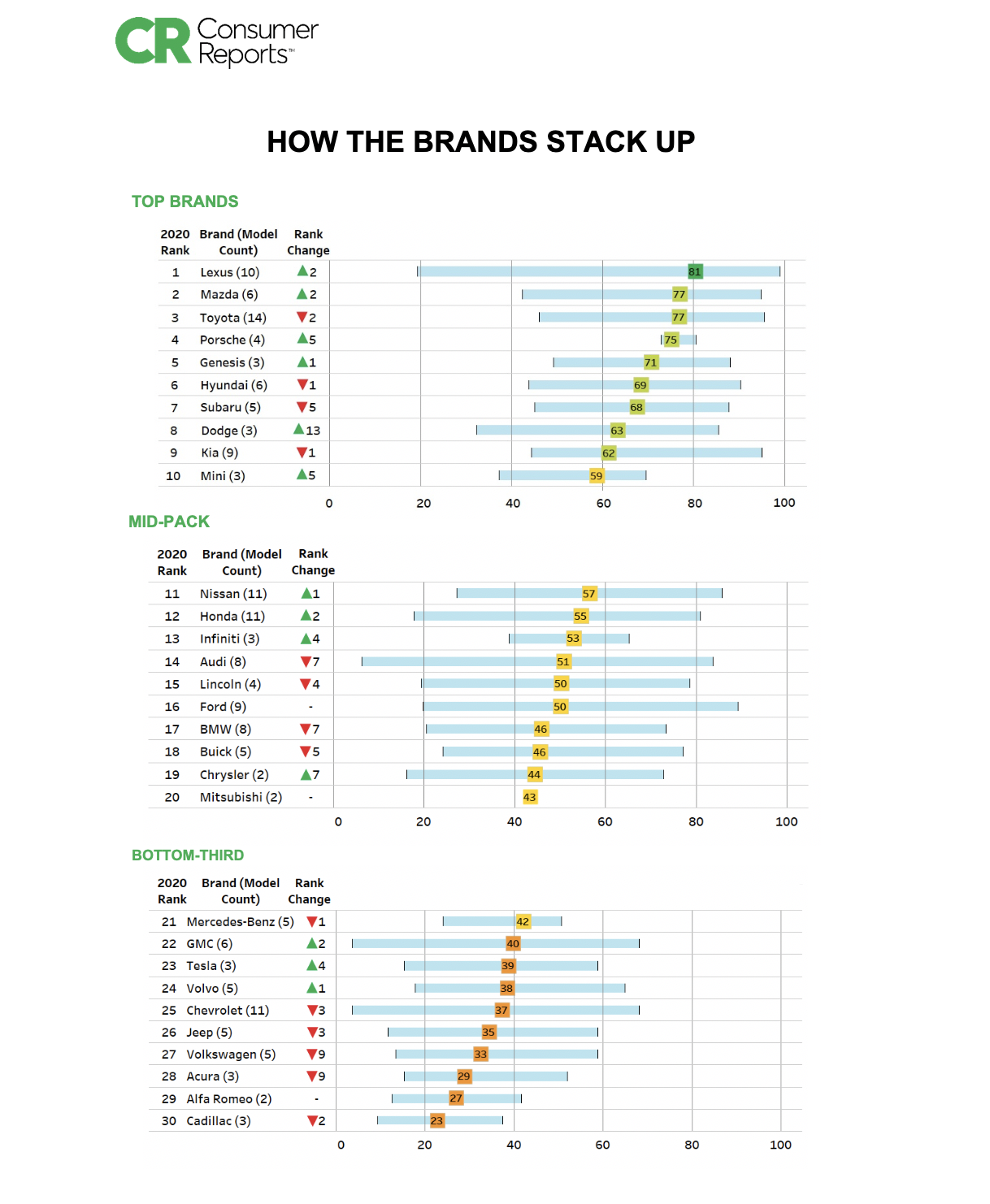
Lexus took the top spot, followed by Mazda, Toyota, Porsche and Genesis. Tesla is still ranked in the bottom third of the survey. It now is ranked 23 out of 30 brands reviewed in the annual survey.

“The Tesla Model 3 struggled last year as the company made frequent design changes and ramped up production to meet demand,” Jake Fisher, senior director of auto testing at CR said in a statement. “But as the production stabilized, we have seen improvements to the reliability of the Model 3 and S that now allow us to recommend both models.”

While Tesla has improved, Fisher said he expects Tesla’s reliability rankings will fluctuate, given its track record to date.

Cadillac came in last place. Audi, Acura and Volkswagen are among the brands that saw sharp drops, following the introduction of troublesome redesigned vehicles. Volkswagen, which is ranked 27th, dropped nine spots from last year due reliability issues with the Atlas and Tiguan. The Consumer Reports survey noted that the two SUVs had problems with power equipment, in-car electronics and emissions/fuel system.


Consumer Reports-reliability 2019

Dodge posted one of the best improved reliability scores in the annual survey, gaining 13 places to round out the top 10 after years as a lower ranked brand.

Audi also fell seven spots in its ranking. CR said the number of new or redesigned 2019 models that shared similar powertrains and the new infotainment system caused the fall in ranking. The A6 and Q8 had well below average reliability, CR said.

14 Nov 2019

Consumer Reports puts Tesla Model 3, Model S back on its recommended list after reliability improves

Tesla gained ground and moved up four spots in in the latest Annual Auto Reliability Survey from Consumer Reports, thanks largely to improvements with the Model 3.

Reliability has improved in the Model 3 and Model S enough that Consumer Reports can now recommend the two models.

Consumer Reports announced Thursday the results of its Annual Auto Reliability Survey, which is based on data collected from the organization’s members about their experiences with more than 400,000 vehicles. The survey covers more than 300 models.

CR does not recommend the Model X. The Model X continues to rank among the least reliable models in the survey.

The reversal is good news for Tesla. In February, Consumer Reports said it could no longer recommend the Model 3 because issues with the paint, trim and body hardware raised reliability questions.

Lexus took the top spot, followed by Mazda, Toyota, Porsche and Genesis. Tesla is still ranked in the bottom third of the survey. It now is ranked 23 out of 30 brands reviewed in the annual survey.

“The Tesla Model 3 struggled last year as the company made frequent design changes and ramped up production to meet demand,” Jake Fisher, senior director of auto testing at CR said in a statement. “But as the production stabilized, we have seen improvements to the reliability of the Model 3 and S that now allow us to recommend both models.”

While Tesla has improved, Fisher said he expects Tesla’s reliability rankings will fluctuate, given its track record to date.

Cadillac came in last place. Audi, Acura and Volkswagen are among the brands that saw sharp drops, following the introduction of troublesome redesigned vehicles. Volkswagen, which is ranked 27th, dropped nine spots from last year due reliability issues with the Atlas and Tiguan. The Consumer Reports survey noted that the two SUVs had problems with power equipment, in-car electronics and emissions/fuel system.


Consumer Reports-reliability 2019

Dodge posted one of the best improved reliability scores in the annual survey, gaining 13 places to round out the top 10 after years as a lower ranked brand.

Audi also fell seven spots in its ranking. CR said the number of new or redesigned 2019 models that shared similar powertrains and the new infotainment system caused the fall in ranking. The A6 and Q8 had well below average reliability, CR said.

14 Nov 2019

Facebook quietly built “Popular Photos”, an in-app Instagram

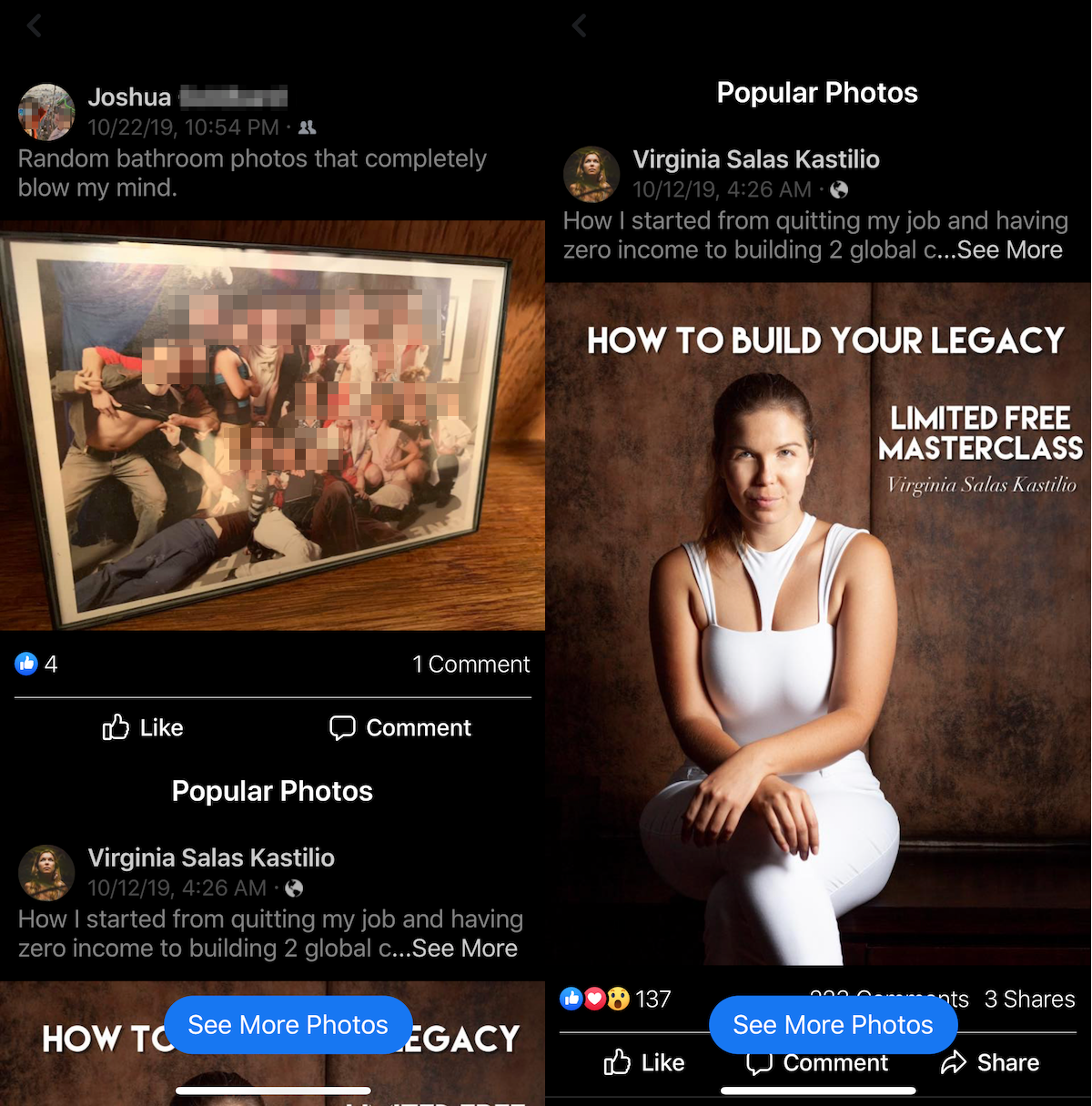
Facebook is copying Instagram while simultaneously invading its acquisition with branding and links back to the mothership. TechCrunch has spotted Facebook testing a feature called Popular Photos, which affixes an endless scroll of algorithmically selected pics from friends beneath the full-screen view of a photo opened from the News Feed. The result is an experience that feels like the Instagram feed, but inside of Facebook.

Popular Photos could offer users a more relaxing, lean-back browsing experience that omits links you have to click through, status updates you have to read, and other content types that bog down the News Feed. Instead, users can just passively watch the pretty pictures go by.

Facebook’s text and link-heavy feed looks increasingly stodgy and exhausting compared to visual communication-based social networks like Instagram, Snapchat, and TikTok. Users have to do the work of digging into the meaning of News Feed each post rather than being instantly entertained. That experience doesn’t fit as well into short browsing sessions throughout the day, or when users are already drained from work, school, or family. Facebook used to have a dedicated Photos bookmark on desktop that would let you just browse that content type, but at some point it disappeared.

A Facebook spokesperson confirms that Facebook was running a small test of Popular Photos in October when we spotted it. That trial has concluded but the team is now iterating on the product and plans to do updated tests in the future. The company refused to disclose more details or its motives for Popular Photos.

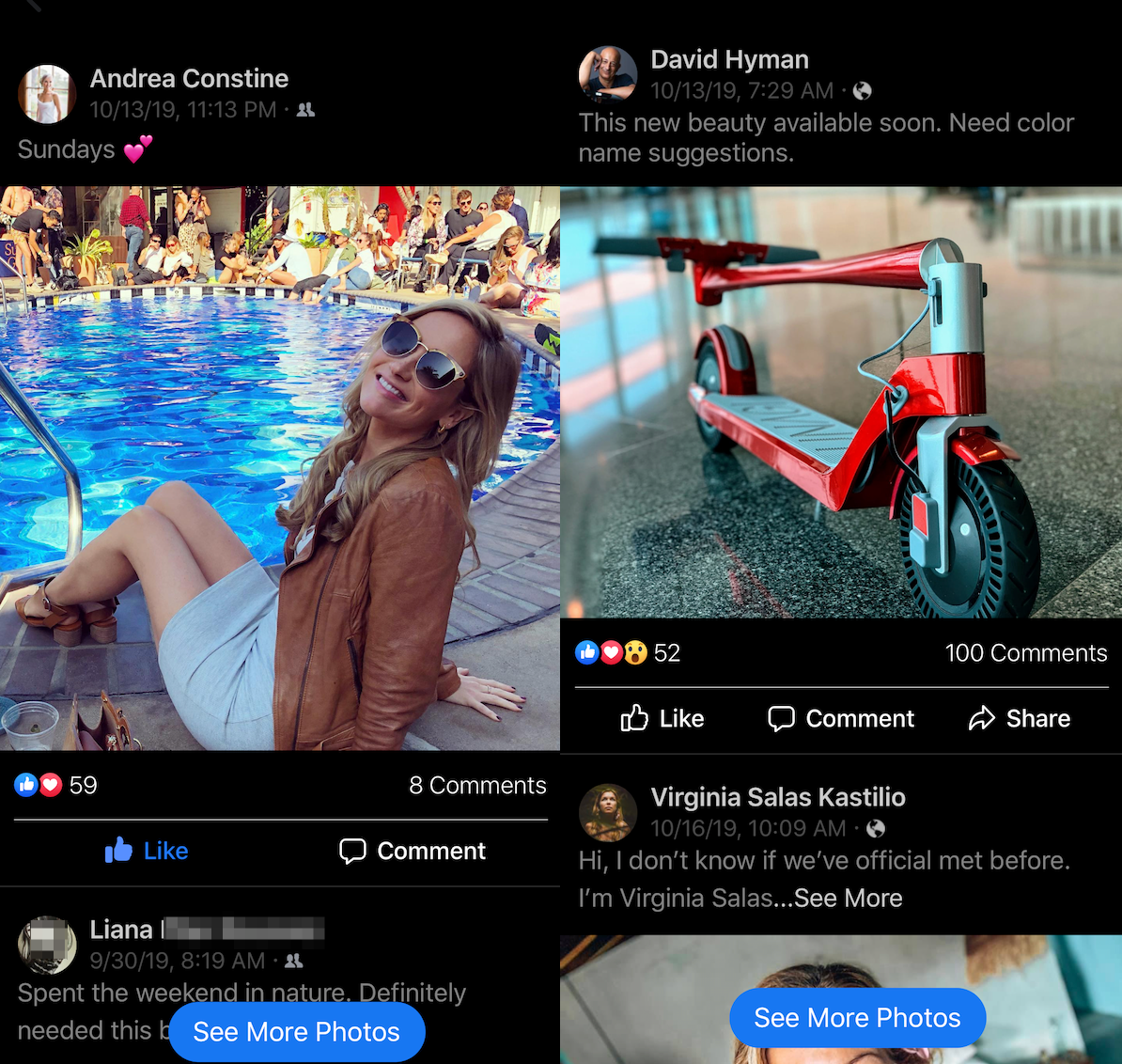
Here’s how Popular Photos works. When users discover a photo in the News Feed or a profile, they can tap on it to see it full-screen on a black theater-view background. Typically, if users swipe or scroll on that photo, they’re just booted back out to where they came from. But with the Popular Photos feature, Facebook splays out more images for users to scroll through after the original.

By scrolling down past the Popular Photos title, they’ll see additional pics and a “See More Photos” label beckoning them to keep whipping through more public and friends-only images shared by friends and who they follow. Like on Instagram but unlike the News Feed, Facebook truncates the captions of Popular Photos after only around 65 characters so the stream doesn’t look overwhelmingly wordy. The black backgrounds give a more cinematic feel to the Popular Photos, putting emphasis on the imagery.

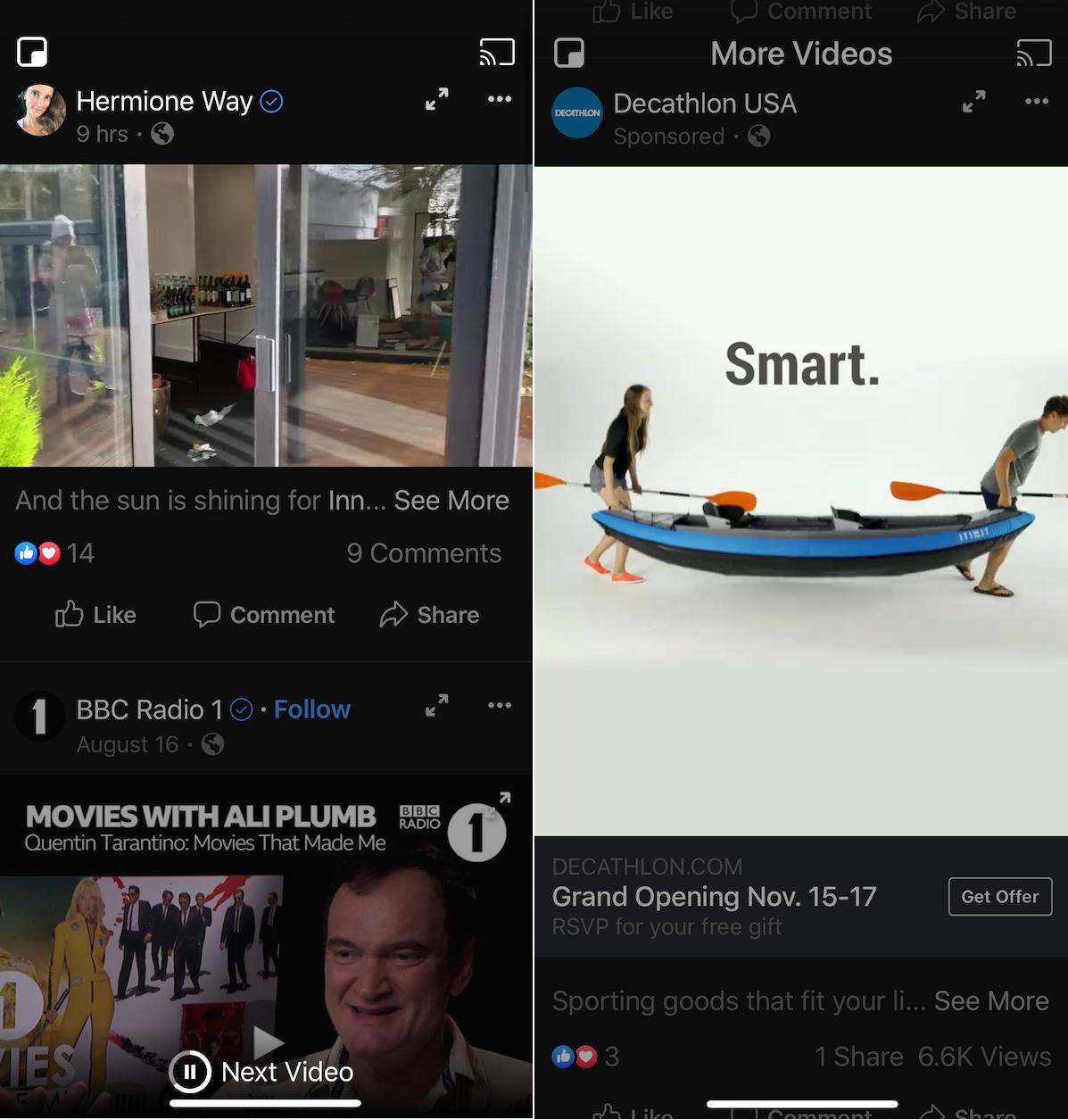
Facebook started showing Related Videos in 2014 when users scrolled past a video they’d opened full-screen. Now this “More Videos” feature will auto-play the next video and automatically bump users down the feed to view it. The feature even shows video ads. That could foreshadow Facebook inserting advertisers’ photos into the Popular Photos tab to monetize the extra browsing.

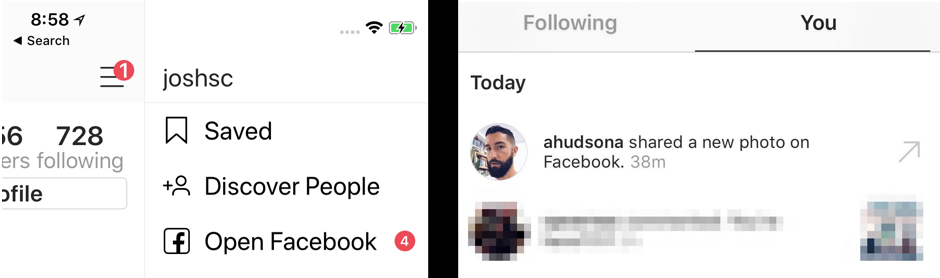
Facebook hasn’t been shy about trying to leverage Instagram to benefit itself. The company has placed an Open Facebook button in the Instagram navigation sidebar.

Previously, Instagram tried showing Facebook alerts in its own Notifications tab, and an annoying red counter for Facebook notifications on the three-line hamburger button that opens the Instagram sidebar in an attempt to drive referral traffic back to the Facebook app. Facebook has also tried notifying users in its app asking them to Like the Facebook Pages of people they follow on Instagram. And now, a “from Facebook” and new FACEBOOK logo can be found appended to the Instagram loading screen.

For Facebook to keep growing after 15 years in the market, it needs to fully embrace visual communication. It’s already copied Snapchat Stories and implemented the ephemeral photo and video format across its apps. Clearly it’s not above copying its own subsidiary Instagram to offer an alternative take on feed scrolling. I wonder how Instagram’s team feels about its parent company building a direct competitor?