Kea is a new startup giving restaurants an opportunity to upgrade one of the more old-fashioned ways that they take orders — over the phone.
Today, Kea is announcing that it has raised a $10 million Series A led by Marbruck, with participation from Streamlined Ventures, Xfund, Heartland Ventures, DEEPCORE, Barrel Ventures and AVG Funds, as well as angel investors Raj Kapoor (chief strategy officer at Lyft), Craig Flom (who was on the founding team at Panera Bread), Wingstop franchisee Tony Lam and Five Guys franchisee Jonathan Kelly.
Founder and CEO Adam Ahmad said that with restaurants perpetually understaffed, they usually don’t have someone who can devote their attention to answering the phone. (Many of you, after all, are probably pretty familiar with the experience of calling a restaurant and being immediately placed on hold.)
At the same time, he suggested it remains an important ordering channel — especially during the pandemic, as takeout and delivery has become the biggest source of revenue for many restaurants. The New Yorker’s Helen Rosner put it succinctly when she suggested that anyone who wants to support restaurants should “pick up the damn phone.”
Similarly, Ahmad said that for restaurants, paying substantial third-party ordering fees on all of their orders is “not a sustainable long-term strategy.” So Kea is offering technology that should help restaurants handle more orders over the phone, creating what Ahmad called a “virtual cashier” who can do the initial intake with customers, process most routine orders and bring in a human employee when needed.
The idea of an automated voice assistant may bring back unpleasant memories of trying to call your bank or another Byzantine customer service department. But Ahmad said that while most existing phone systems are “not smart,” Kea’s AI is very different, because it’s just focused on restaurant ordering.
“We’re doing a very closed domain,” he said. “In the pizza world, there are only a couple thousand permutations. We’re not innovating for the whole dictionary — it’s a constrained model, it’s a menu.”
In fact, the Kea team gave me a number to dial where I could try the system out for myself. It was a pretty straightforward and easy process, where I provided my address and then the details of my pizza order. And again, you can transfer to a human employee at any time. (In fact, I was accidentally transferred during my demo, leading me to quickly hang up in embarrassment.)
Kea is already live in more than 250 restaurants including Papa John’s, Donatos and Primanti Brothers, and it says it’s saving them an average of 10 hours of labor per week, with a 23% increase in average order size. With the new funding, Ahmad’s goal is to bring Kea to 1,000 restaurants across 37 states in 2021.
Luminar, the buzzy sensor startup that is on the verge of becoming a publicly traded company, locked in a supplier deal to furnish Intel subsidiary Mobileye with lidar for its fleet of autonomous vehicles.
The deal, announced Friday, will see a rising star paired with a company that has long dominated the automotive industry. While the supplier agreement is nowhere near the scale of Mobileye’s core computer vision business, it is an important collaboration that extends beyond a few pilot programs. Luminar has had a development agreement with Mobileye for nearly two years now. This new agreement signals the next critical step for both companies.
Mobileye’s camera-based sensors are used by most automakers to support advanced driver assistance systems. Today, more than 54 million vehicles have Mobileye technology. But the company, which was acquired by Intel for $15.3 billion in 2017, has branched out in recent years, moving beyond its advanced driver assistance technology and towards the development of a self-driving vehicle system. Two years ago, Mobileye announced plans to launch a kit that includes visual perception, sensor fusion, its REM mapping system and software algorithms.
Mobileye has since ratcheted up its self-driving ambitions and taken what some in the industry see as an unlikely turn to become a robotaxi operator, not just a supplier.
Luminar and Mobileye’s agreement while small at the moment is still a production contract. Luminar’s lidar will be part of Mobileye’s first-generation fleet of driverless vehicles, which are being piloted in Dubai, Tel Aviv, Paris, China and Daegu City, South Korea. Mobileye’s ultimate aim is to expand its robotaxi operations and sell its self-driving stack (or AV series solution) to other companies. Mobileye CEO Ammon Shashua has said the company is targeting commercial robotaxi services to be launched in 2022.
“So you basically have a production deal here to be able to equip their vehicles towards the 2022 launch of their service and power that in parallel to their camera solution to create that safety and redundancy,” Luminar founder and CEO Austin Russell said in a recent interview.
While the first use of this ‘AV series solution’ is for Mobileye’s own internal fleet, Russell is interested in the opportunities that will follow.
“They’ve taken a very different strategy and are very different company than any other kind private AV development company,” Russell said. “These guys have, tens of millions of products deployed on series production vehicles; they know what it takes to put something into series production. So to able to ride that wave and get on the ground floor to be in production vehicles as well was of particular interest for us.”
Luminar has landed other production-level deals. Volvo announced in May that it will start producing vehicles in 2022 that are equipped with lidar and a perception stack Luminar that the automaker will use to deploy an automated driving system for highways. For now, the lidar will be part of a hardware package that consumers can add as an option to a Volvo’s second-generation Scalable Product Architecture vehicles, starting with the XC90. Volvo will combine Luminar’s lidar with cameras, radar, software and back-up systems for functions such as steering, braking and battery power to enable its highway pilot feature.
Daimler’s trucks division said in October it had invested in Luminar as part of a broader partnership to produce autonomous trucks capable of navigating highways without a human driver behind the wheel.
Andreessen Horowitz (a16z) has closed a pair of funds totaling $4.5 billion, the firm confirmed in a blog post this morning. The firm has raised $1.3 billion for an early-stage fund focused on consumer, enterprise, and fintech; and closed a $3.2 billion growth-stage fund for later-stage investments. The firm did not immediately respond to request for comment.
The funds may seem somewhat typical, given the size of new funds that venture firms have been raising in recent years, Still, these are extraordinary amounts given that a16z, with offices in Menlo Park and San Francisco, was founded just 11 years ago.
As extraordinary, they bring the firm’s total assets under management to $16.5 billion.
It was just 20 months ago that a16z closed its most recent pair of funds — a $2 billion late-stage fund, and a $740 million flagship early-stage fund.
It also announced a separate, $515 million crypto-focused fund back in April of this year, its second such vehicle. And, in February, it rolled out its third biotech and healthcare investing fund, which closed with $750 million in capital commitments.
That’s a lot of capital to capture in one year. Then again, its limited partners have had reason to feel cautiously optimistic about its portfolio. In January, for example, the fintech company Plaid, whose Series C round a16z joined in late 2018, was acquired by Visa for a hefty $5.3 billion after raising roughly $310 million altogether.
The Justice Department recently sued to block the deal on antitrust grounds, but even if it’s unwound, industry observers like Plaid’s prospects.
The firm is also an investor in the soon-to-be-publicly traded accommodations marketplace Airbnb, though notably, according to Airbnb’s S-1, a16z does not own enough of the company to be listed on the filing, despite that it led the company’s Series B round in 2011 and despite that general partner Jeff Jordan sits on the company’s board and would need to list any ownership position as a result.
Another of a16z’s portfolio companies, the pay-as-you-go lending company Affirm, has also filed to go public. Andreessen Horowitz first participated in the company’s Series B round back in 2015. It is also not listed on Affirm’s S-1 filing, meaning it owns less than 5% of the company.
And the firm is an investor in the game company Roblox, whose $150 million Series G round it led earlier this year. Roblox made its S-1 public just earlier this week; a16z is not listed on it.
On the early-stage side, the firm is often characterized by its flashy deals, including its $100 million valuation of voice-chat app Clubhouse and $75 million valuation of Y Combinator graduate Trove.
A16z also recently launched a TxO accelerator, which uses a donor-advised fund to invest in underrepresented founders. Led by a16z partner Nait Jones, TxO has invested $100,000 each in an initial cohort of seven companies in exchange for 7% of ownership stake.
The donor-advised fund launched with $2.2 million in initial commitments, with Ben and Felicia Horowitz announcing that they would match up to $5 million. Any returns from companies in the fund will be repurposed into the investment vehicle. The firm has declined to share the fund’s total size to date.
Currently, a16z employs 185 people, most recently hiring Anthony Albanese, the chief regulatory officer at the New York Stock Exchange, as an operating partner for its cryptocurrency team.
Its biggest win to date may well be Github, which sold to Microsoft in a $7.5 billion all-stock deal in 2018 and from which a16z reportedly pocketed more than $1 billion. When it invested in the company, it wrote the biggest check it had issued at the time: $100 million. The deal was enough for a16z to win the deal against some tough competition, including Benchmark, which was also trying to woo Github at the time, as general partner, Peter Fenton, said recently.
Japan-based financial services group ORIX Corporation today announced that it has made a $60 million strategic investment into the Israeli crowdsourcing platform OurCrowd. In return, the crowdfunding platform will provide the firm with access to its startup network. OurCrowd also says that the two groups will collaborate to create financial products and investment opportunities for the Japanese and global market, including access to its venture funds and specific companies in the OurCrowd portfolio.
“ORIX is a global leader in diversified business and financial services who will strengthen OurCrowd in many ways,” OurCrowd CEO Jon Medved said in today’s announcement. “We are enthusiastic about the potential to further transform the venture capital asset class together and provide a strong bridge for our innovative companies to the important Asian markets.”
While ORIX already operates in 37 countries, including the U.S., this is the company’s first investment in Israel. It comes at a time where Japanese investments in Israel are already surging. And earlier this year, Israel’s flag carrier El Al was about to launch direct flights to Tokyo, for example, and while the pandemic canceled those plans, it’s a clear sign of the expanding business relations between the two countries.
“We are excited about investing in OurCrowd, Israel’s most active venture investor and one of the world’s most innovative venture capital platforms,” ORIX UK CEO Kiyoshi Habiro said. “We intend to be active partners with OurCrowd and help them accelerate their already impressive growth, while bringing the best of Israeli tech to Japan’s large industrial and financial sectors.”
So far, OurCrowd has made investments in 220 companies across its 22 funds. Some of its most successful exits include Beyond Meat and Lemonade, JUMP Bike, Briefcam and Argus. ORIX, too, has quite a diverse portfolio, with investments that range from real estate to banking and energy services.
Uber today released its latest diversity report, showing a decline in the overall representation of Black employees in the U.S. despite an increased focus on racial justice this year in the wake of the police killing of George Floyd. In 2019, Uber was 9.3% Black while this year, only 7.5% of its employees are Black.
Uber attributes the decline in Black employees to its layoffs earlier this year, where about 40% of its employees in community operations were laid off, Uber Chief Diversity Officer Bo Young Lee told TechCrunch.
“As a company that has so publicly stated its stance on anti-racism, that’s not acceptable,” she said.
That unintentional decline in the Black population at Uber “led to a lot of soul searching,” she said. “Dara was certainly upset by it. Every leader was. It reinforced how easy it is to lose some ground after all the work you’ve done.”
Lee said her diversity, equity and inclusion team was consulted prior to the layoffs in an attempt to ensure there was no disparate impact on any one group.
“The unfortunate thing that wasn’t understood at the time was our customer service org in particular was hit pretty hard,” she said. “The overall rate of layoffs was 25-26% in most parts.”
But in the customer service organization, about 40% of employees were affected. And that part of the company had a higher representation of Black and Latinx folks than in other areas.
While Uber saw a decline in its overall Black population, it saw an overall net increase in women of color. And in order to get even more granular, Uber plans to start disaggregating the Asian community and Latinx community.
Uber first set diversity goals just last year. Those goals entailed increasing the percentage of women at levels L5 (manager level) and higher to 35% and increasing the percentage of underrepresented employees at levels L4 (senior associate) and higher to 14% by 2022.
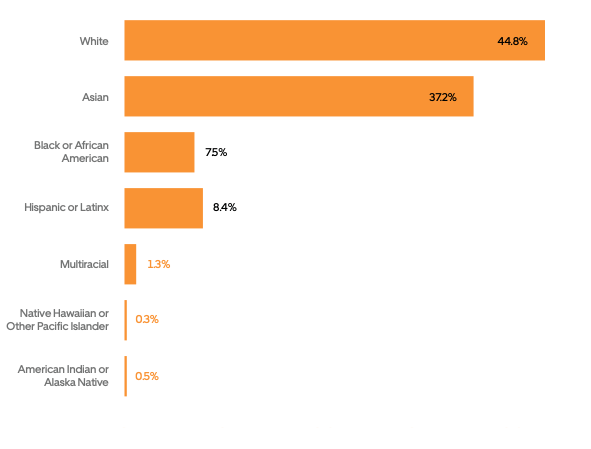
Source: Uber. Uber’s overall U.S. racial breakdown
Currently, Uber is 59.7% male, 44.8% white, 37.2% Asian, 7.5% Black, 8.4% Latinx, 1.3% multiracial, 0.3% Native Hawaiian or other Pacific Islander and 0.5% Native American.
Uber does not break out the demographics of its gig workforce, but many studies have shown people of color make up a large portion of the gig economy.
While Lee is not directly responsible for the driver and delivery population, she said they also represent a wide variety of socioeconomic backgrounds. With that in mind, her team does advise other parts of Uber in policy setting as it relates to gig workers.
Uber has had a contentious relationship with its drivers and delivery workers for the last couple of years, especially in California. That all came to a head when California voters passed Proposition 22, a ballot measure that will keep gig workers classified as independent contractors. Uber, Lyft, Instacart and DoorDash collectively proposed and backed the measure with $206 million in funding.
On the other side of the proposition were labor groups representing gig workers. But it wasn’t just gig workers who opposed the measure. Inside Uber, engineer Kurt Nelson spoke out against the measure. In fact, he credited the measure as being the final straw that led him to seek out other job opportunities.
For Lee, deciding to support Prop 22 came down to paying attention to “who gets included and who gets excluded from policies.” When looking at AB 5, the California bill that changed the way companies could classify their workers, she “couldn’t help but notice the majority of independent contractor roles that were predominantly white were being excluded from AB 5.”
For example, California exempted fine artists, freelance writers, still photographers, copy editors, producers and other types of professions from AB 5.
“Maybe if AB 5 was applied differently, I would’ve landed somewhere else,” Lee said, being sure to clarify she was speaking for herself and not for Uber. “For me, I recognize that Prop 22 was the right thing at the end of the day.”
Meanwhile, Uber CEO Dara Khosrowshahi has said the company plans to advocate for similar laws in other parts of the country and world. It’s not clear what that will specifically entail, but an Uber spokesperson said the company plans to discuss this type of framework with stakeholders in other states and countries.
Leading on-demand digital freight platform Loadsmart has raised a $90 million Series C funding round, led by funds under management by BlackRock, and co-led by Chromo Invest. The funding will be used to continue to build out its platform to offer even more end-to-end logistics services to its freight customers, and the company says that it will be doing that in part through new collaboration with strategic investor TFI International, a leader in the logistics space, which also participated in this round.
In addition to TFI, the round also saw renewed investment from Maersk, a global oceanic shipping leader and one of Loadsmart’s strategic backers since its Series A round. The company says it has increased its revenues by 250% across 2020, while at the same time managing to keep its operating expenses flat. In a press release announcing the news, the company seemed to take indirect shots at competitors including Uber Freight and Convoy by noting that it has achieved its growth through “organic” means, rather than “by subsidizing its customers’ freight spend” through aggressive pricing.
Loadsmart offers booking for freight transportation across land, rail and through ports, all from a single online portal. It recently added the ability to ship partial truckloads, and it’s consistency brought in new strategic investors deeply involved in all aspects of the industry, including port management and overland shipping, which is likely contributing to its growth through ever-deeper industry insight.
You wait ages for foot scanning startups to help with the tricky fit issue that troubles online shoe shopping and then two come along at once: Launching today in time for Black Friday sprees is Xesto — which like Neatsy, which we wrote about earlier today, also makes use of the iPhone’s TrueDepth camera to generate individual 3D foot models for shoe size recommendations.
The Canadian startup hasn’t always been focused on feet. It has a long-standing research collaboration with the University of Toronto, alma mater of its CEO and co-founder Sophie Howe (its other co-founder and chief scientist, Afiny Akdemir, is also pursuing a Math PhD there) — and was actually founded back in 2015 to explore business ideas in human computer interaction.
But Howe tells us it moved into mobile sizing shortly after the 2017 launch of the iPhone X — which added a 3D depth camera to Apple’s smartphone. Since then Apple has added the sensor to additional iPhone models, pushing it within reach of a larger swathe of iOS users. So you can see why startups are spying a virtual fit opportunity here.
“This summer I had an aha! moment when my boyfriend saw a pair of fancy shoes on a deep discount online and thought they would be a great gift. He couldn’t remember my foot length at the time, and knew I didn’t own that brand so he couldn’t have gone through my closet to find my size,” says Howe. “I realized in that moment shoes as gifts are uncommon because they’re so hard to get correct because of size, and no one likes returning and exchanging gifts. When I’ve bought shoes for him in the past, I’ve had to ruin the surprise by calling him – and I’m not the only one. I realized in talking with friends this was a feature they all wanted without even knowing it… Shoes have such a cult status in wardrobes and it is time to unlock their gifting potential!”
Howe slid into this TechCrunch writer’s DMs with the eye-catching claim that Xesto’s foot-scanning technology is more accurate than Neatsy’s — sending a Xesto scan of her foot compared to Neatsy’s measure of it to back up the boast. (Aka: “We are under 1.5 mm accuracy. We compared against Neatsy right now and they are about 1.5 cm off of the true size of the app,” as she put it.)
Another big difference is Xesto isn’t selling any shoes itself. Nor is it interested in just sneakers; its shoe-type agnostic. If you can put it on your feet it wants to help you find the right fit, is the idea.
Right now the app is focused on the foot scanning process and the resulting 3D foot models — showing shoppers their feet in a 3D point cloud view, another photorealistic view as well as providing granular foot measurements.
There’s also a neat feature that lets you share your foot scans so, for example, a person who doesn’t have their own depth sensing iPhone could ask to borrow a friend’s to capture and takeaway scans of their own feet.
Helping people who want to be bought (correctly fitting) shoes as gifts is the main reason they’ve added foot scan sharing, per Howe — who notes shoppers can create and store multiple foot profiles on an account “for ease of group shopping”.
“Xesto is solving two problems: Buying shoes [online] for yourself, and buying shoes for someone else,” she tells TechCrunch. “Problem 1: When you buy shoes online, you might be unfamiliar with your size in the brand or model. If you’ve never bought from a brand before, it is very risky to make a purchase because there is very limited context in selecting your size. With many brands you translate your size yourself.
“Problem 2: People don’t only buy shoes for themselves. We enable gift and family purchasing (within a household or remote!) by sharing profiles.”
Xesto is doing its size predictions based on comparing a user’s (<1.5mm accurate) foot measurements to brands’ official sizing guidelines — with more than 150 shoe brands currently supported.
Howe says it plans to incorporate customer feedback into these predictions — including by analyzing online reviews where people tend to specify if a particular shoe sizes larger or smaller than expected. So it’s hoping to be able to keep honing the model’s accuracy.
“What we do is remove the uncertainty of finding your size by taking your 3D foot dimensions and correlate that to the brands sizes (or shoe model, if we have them),” she says. “We use the brands size guides and customer feedback to make the size recommendations. We have over 150 brands currently supported and are continuously adding more brands and models. We also recommend if you have extra wide feet you read reviews to see if you need to size up (until we have all that data robustly gathered).”
Asked about the competitive landscape, given all this foot scanning action, Howe admits there’s a number of approaches trying to help with virtual shoe fit — such as comparative brand sizing recommendations or even foot scanning with pieces of paper. But she argues Xesto has an edge because of the high level of detail of its 3D scans — and on account of its social sharing feature. Aka this is an app to make foot scans you can send your bestie for shopping keepsies.
“What we do that is unique is only use 3D depth data and computer vision to create a 3D scan of the foot with under 1.5mm accuracy (unmatched as far as we’ve seen) in only a few minutes,” she argues. “We don’t ask you any information about your feet, or to use a reference object. We make size recommendations based on your feet alone, then let you share them seamlessly with loved ones. Size sharing is a unique feature we haven’t seen in the sizing space that we’re incredibly excited about (not only because we will get more shoes as gifts :D).”
Xesto’s iOS app is free for shoppers to download. It’s also entirely free to create and share your foot scan in glorious 3D point cloud — and will remain so according to Howe. The team’s monetization plan is focused on building out partnerships with retailers, which is on the slate for 2021.
“Right now we’re not taking any revenue but next year we will be announcing partnerships where we work directly within brands ecosystems,” she says, adding: “[We wanted to offer] the app to customers in time for Black Friday and the holiday shopping season. In 2021, we are launching some exciting initiatives in partnership with brands. But the app will always be free for shoppers!”
Since being founded around five years ago, Howe says Xesto has raised a pre-seed round from angel investors and secured national advanced research grants, as well as taking in some revenue over its lifetime. The team has one patent granted and one pending for their technologies, she adds.
Global internet companies Facebook, Google and Twitter and others have banded together and threatened to leave Pakistan after the South Asian nation granted blanket powers to local regulators to censor digital content.
Earlier this week, Pakistan Prime Minister Imran Khan granted the Pakistan Telecommunication Authority the power to remove and block digital content that pose “harms, intimidates or excites disaffection” toward the government or in other ways hurt the “integrity, security, and defence of Pakistan.”
Through a group called the Asia Internet Coalition Asia (AIC), the tech firms said that they were “alarmed” by the scope of Pakistan’s new law targeting internet firms.” In addition to Facebook, Google, and Twitter, AIC represents Apple, Amazon, LinkedIn, SAP, Expedia Group, Yahoo, Airbnb, Grab, Rakuten, Booking.com, Line, and Cloudflare.
If the message sounds familiar, it’s because this is not the first time these tech giants have publicly expressed their concerns over the new law, which was proposed by Khan’s ministry in February this year.
After the Pakistani government made the proposal earlier this year, the group had threatened to leave, a move that made the nation retreat and promise an extensive and broad-based consultation process with civil society and tech companies.
That consultation never happened, AIC said in a statement on Thursday, reiterating that its members will be unable to operate in the country with this law in place.
“The draconian data localization requirements will damage the ability of people to access a free and open internet and shut Pakistan’s digital economy off from the rest of the world. It’s chilling to see the PTA’s powers expanded, allowing them to force social media companies to violate established human rights norms on privacy and freedom of expression,” the group said in a statement.
“The Rules would make it extremely difficult for AIC Members to make their services available to Pakistani users and businesses. If Pakistan wants to be an attractive destination for technology investment and realise its goal of digital transformation, we urge the Government to work with industry on practical, clear rules that protect the benefits of the internet and keep people safe from harm.”
Under the new law, tech companies that fail to remove or block the unlawful content from their platforms within 24 hours of notice from Pakistan authorities also face a fine of up to $3.14 million. And like its neighboring nation, India, — which has also proposed a similar regulation with little to no backlash — Pakistan now also requires these companies to have local offices in the country.
The new rules comes as Pakistan has cracked down on what it deems to be inappropriate content on the internet in recent months. Earlier this year, it banned popular mobile game PUBG Mobile and last month it temporarily blocked TikTok.
Countries like Pakistan and India contribute little to the bottomline for tech companies. But India, which has proposed several protectionist laws in recent years, has largely escaped any major protest from global tech companies because of its size. Pakistan has about 75 million internet users.
By contrast, India is the biggest market for Google and Facebook by users. “Silicon Valley companies love to come to India because it’s an MAU (monthly active users) farm,” Kunal Shah, a veteran entrepreneur, said in a conference in 2018.
With Roblox joining the end-of-year unicorn stampede towards the public markets, we’re set for a contentedly busy second half of November and early December. I hope you didn’t have vacation planned in the next few weeks.
This morning we need to get deeper into the Roblox S-1 so that we can better understand the nature of its revenue generation. Why? Because we want to start working on what the gaming company is worth; some comparisons are being made to Unity, another unicorn that went public earlier this year with a gaming focus.
Should we apply Unity’s revenue multiple to Roblox? Or does the company deserve a slimmer multiple based on the substance of its revenue?
We’ll also have to remind ourselves how much capital Roblox last raised while private, and at what price. Given our historical knowledge of its financial results, we might be able to nail some valuations to revenue figures, helping us understand, roughly, how the venture capital community was valuing Roblox while it was private.
If you want an overview of just the numbers, Natasha and I wrote a digest here.
Now, let’s get to work.
What’s Roblox worth as a public company?
To get a foundation, let’s recall how Roblox was valued during its last private round. According to Crunchbase data, Roblox’s $150 million Series G was raised at a $3.9 billion pre-money valuation. So, Roblox was worth $4.05 billion after the February 2020 funding event.
Naturally there is a lag in between when a deal is struck and when it announced. So, let’s rewind the clock to Q4 2019 and ask ourselves what Roblox looked like at the time. From its S-1, here are the Q4 2019 numbers:
Revenue of $138.3 million, +44.2% compared to the year-ago quarter
A net loss of $39.6 million, +197.1% compared to the year-ago quarter
Annualizing that revenue figure, Roblox was on a $553.3 million run rate at around the time it raised that Series G. In revenue multiple terms, Roblox was valued at 7.3x its top line on an annualized basis.
If you are a SaaS fan you are probably pretty shocked right now. Why the hell was Roblox, a software company, worth so little? Well let’s remind ourselves how it makes money:
We generate substantially all of our revenue through the sales of Robux to users. Users can spend Robux to purchase access to experiences, enhancements in experiences, and items in the Avatar Marketplace. Robux are available as one-time purchases or monthly subscriptions. We recognize revenue ratably over the estimated average lifetime of a paying user. […]
Other revenue streams include a minimal amount of revenue from advertising, licenses, and royalties.
“Space, the final frontier…” You can probably recite the “Star Trek” opening monologue in your sleep. But we’re talking science fact, not fiction, and TC Sessions: Space 2020 provides real opportunity to connect with the people, information and funding you need to boldly build the future of space technology.
Go boldly, yes. But why pay full price? Early bird pricing ends — in Gene Roddenberry’s parlance — on Stardate 98489.04. (a.k.a. today, November 20 at 11:59 p.m. PST). Boldly buy your pass before the deadline and save $100.
Tune in to hear from leading space industry founders, investors and technologists from across the public, private and defense industries. When it comes to experts, TechCrunch delivers. People like Rocket Lab CEO Peter Beck, U.S. Space Force Chief of Space Operations General Jay Raymond, Lockheed Martin VP and head of civil space programs Lisa Callahan.
On the investment front we have VCs like Chris Boshuizen (Data Collective DCVC), Mike Collett (Promus Ventures) and Tess Hatch (Bessemer Venture Partners). And don’t miss out on the Fast Money breakout sessions to learn about space accelerator programs and how to access grant money.
Topics span a galaxy’s worth of technology, including 3D-printed rockets, earth observation data, orbital operations, ground station networks, launch services, broadband communications, defense operations and manufacturing in space.
Here’s a classic “but wait, there’s more” moment, because we’re not done adding opportunity. And this one’s a doozy!
Starburst x TechCrunch: Pitch Me to the Moon — Starburst Aerospace and TechCrunch are teaming up to launch a pitch competition called Pitch Me to the Moon. Think the Startup Battlefield, but for space. Ten promising early-stage space startups, selected by Starburst, will have an opportunity to present their innovations live to a panel of high-profile judges from across the industry.
Find this and all the panel discussions, interviews, fireside chats and interactive Q&As listed in the event agenda. Don’t worry about time conflicts — all sessions are available live and on-demand. Feel free to network with attendees, take care of client business or catch sessions live knowing that you can watch anything you missed later as your schedule permits.
Up your exposure game with a Space Startup Exhibitor Package ($360). It includes digital exhibition space, lead-generation capabilities and three conference passes. Bonus exposure: all exhibiting space startups get pitch live to attendees during the event.
Go boldly for $100 less. Buy your pass to TC Sessions: Space 2020 before the early bird deal ends tonight, November 20 at 11:59 p.m. PST.
Is your company interested in sponsoring TC Sessions: Space 2020? Click here to talk with us about available opportunities.