
Year: 2020

29 Oct 2020

Developer productivity tools startup Raycast raises $2.7M from Accel

Workplace SaaS tools for teams have seen rocket ship growth in the past several years, and that adoption has given rise to a host of software tools geared towards improving individual productivity. Many of the startups behind these tools see building a cult following among individual users as the best way to set themselves up for later enterprise-wide success.

Raycast is a developer-focused productivity tool that aims to be the quickest way to get common tasks done. Today, it’s launching into public beta and sharing with TechCrunch that the team has raised new funding from Accel months after graduating from Y Combinator.

The company has closed a $2.7 million seed round led by Accel with participation from YC, Jeff Morris Jr.’s Chapter One fund as well as angel investors Charlie Cheever, Calvin French-Owen and Manik Gupta .

The desktop software takes a note from peers like Superhuman and Command E, allowing users to quickly pull up and modify data with keyboard shortcuts. Users can easily create and re-modify issues in Jira, merge pull requests in Github and find documents. The software is very much a developer-focused version of the Apple’s Spotlight search that aims to help software engineers navigate all of the parts of their job that aren’t development work with a single tool.
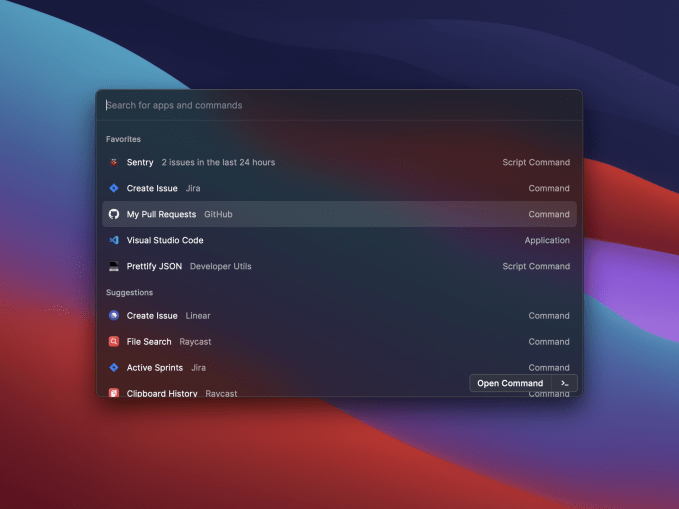
Image via Raycast.

Like plenty of workplace tools startups, one of the keys for Raycast is building out a network of extensions that can encompass a user’s workflow. For now, the software supports integrations from Asana, Jira, Zoom, Linear, G Suite, Calendar, Github and Reminders alongside core functionality that can help manage system settings and a calculator that can handle complex math problems. As the startup launches out of public beta, they’re looking to double down on extensions and are rolling out a developer program for early access to their API.

The Mac-only software is free while in public beta, but the company does plan on charging a monthly subscription for the service eventually, though they aren’t quite ready to talk about pricing yet.

Raycast’s team is interested in appealing to individual users for now, but might eventually expand to becoming a teams-level enterprise product that could help onboard new employees faster by quickly orienting them with their office’s software suite, but that’s all a bit down the road, the team says.

“We’re staying focused on single-player mode for a while,” CEO Thomas Paul Mann tells TechCrunch.
29 Oct 2020

India’s WareIQ raises $1.65M for its Amazon-like delivery platform for sellers

Despite e-commerce firms Amazon and Walmart and others pouring billions of dollars in India, offline retail still commands more than 95% of all sales in the world’s second largest internet market.

The giants have acknowledged the strong hold neighborhood stores (mom and pop shops) have in the country, and in recent quarters scrambled for ways to work with them. Mukesh Ambani, India’s richest man, has made the dynamics more interesting in the past year as he works to help these neighborhood stores sell online.

But the market opportunity is still too large, and there are many aspects of the old retail business that could use some tech. That’s the bet WareIQ, a Bangalore-headquartered, Y Combinator-backed startup is making. And it has just raised a $1.65 million Seed financing round from YC, FundersClub, Pioneer Fund, Soma Capital, Emles Venture Advisors, and founders of Flexport.

The one-year-old startup operates a platform to leverage the warehouses across the country. It has built a management system for these warehouses, most of which largely engage in offline business-to-business commerce and have had little to no prior e-commerce exposure.

“We connect these warehouses across India to our platform and utilize their infrastructure for e-commerce order processing,” said Harsh Vaidya, co-founder and chief executive of WareIQ, in an interview with TechCrunch. The company offers this as a service to retail businesses.

Who are these businesses? Third-party sellers, some of whom sell to Amazon and Flipkart and use WareIQ to speed up their delivery, e-commerce firms such as fashion e-tailer Nykaa, social commerce platforms such as Meesho as well as neighborhood stores, and social media influencers.

Any online store, for instance, can send its products to WareIQ, which has integrations with several popular e-commerce platforms and marketplaces. It works with courier partners to move items from one warehouse to another to offer the fastest delivery, explained Vaidya.

The infrastructure stitched together by WareIQ also enables an online seller to set up their own store and engage with customers directly, thereby saving fees they would have paid to Amazon and other established e-commerce players.

“The sellers were not able do this on their own before because it required them to talk directly to warehousing companies that maintain their own rigid contracts, and high-security deposits, and they still needed to work with multiple technology providers to complete the tech-stack,” he said. WareIQ also offers these sellers last-mile delivery, cash collection, and fraud detection among several other services.

“In a way, we are building an open source Amazon fulfilment service, where any seller can send their goods to any of our warehouses and we fulfil their Amazon orders, Myntra orders, Flipkart orders, or their own website orders. We also comply with the standard of these individual marketplaces, so our sellers get an assured tag on Amazon,” he said.

WareIQ is free for anyone to sign up with any charge and it takes a cut by the volume of orders it processes. The startup today works with over 40 fulfilment centres and it plans to deploy the fresh capital to expand its network to tier 2 and tier 2 cities, he said. It’s also hiring for a number of tech roles.

29 Oct 2020

Donut launches Watercooler, an easy way to socialize online with coworkers

If you miss hanging out with your coworkers but don’t want to spend a single second more on Zoom, the latest product from Donut might be the answer.

The startup is launching its new Watercooler product today while also announcing that it has raised $12 million in total funding, led by Accel and with participation from Bloomberg Beta, FirstMark, Slack Fund and various angel investors.

Co-founder and CEO Dan Manian told me that this is actually money that the startup raised before the pandemic, across multiple rounds. It just didn’t announce the fundraising until now.

The startup’s vision, Manual said, is “to create human connection between people at work.” Its first product, Introductions, connects teammates who didn’t already know each via Slack, often with the goal of setting up quick coffee meetings (originally in-person and now virtual).

Donut says it has facilitated 4 million connections across 12,000 companies (including The New York Times, Toyota and InVision), with 1 million of those connections made since the beginning of the pandemic.

However, Manian said customers have been asking Donut to facilitate more frequent interactions, especially since most people aren’t going to have these coffee meetings every day. At the same time, people face are the duelling issues of isolation and Zoom fatigue, where “the antidote to one thing makes the other pain worse.” And he suggested that one of the hardest things to recreate while so many of us are working remotely are “all the little microinteractions that you have while you’re working.”

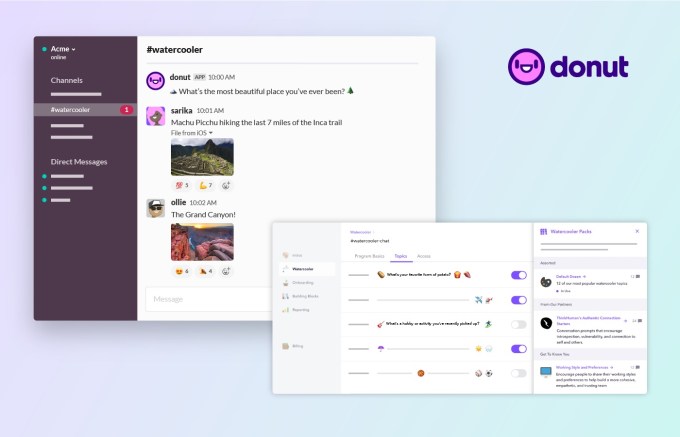
That’s where Watercooler comes in — as the name suggests, it’s designed to replicate the feeling of hanging out at the office watercooler, having brief, low-key conversations. Like Introductions, it integrates with Slack, creating a new channel where Watercooler will post fun, conversation-starting questions like “‘What’s your favorite form of potato?” or “What’s one thing you’ve learned in your career that you wish you knew sooner?”

Talking about these topics shouldn’t take much time, but Manian argued that brief conversations are important: “Those things add up to friendship over time, they’re what actually transform you from coworker to friend.” And those friendships are important for employers too, because they help with team cohesion and retention.

I fully endorse the idea of a Slack watercooler — in fact, the TechCrunch editorial team has a very active “watercooler” channel and I’m always happy to waste time there. My big question was: Why do companies need to purchase a product for this?

Donut Watercooler

Donut Watercooler

Manian said that there were “a bunch of our early adopters” who had tried doing this manually, but it was always in the “past tense”: “It got too hard to come up with the questions, or it took real work coming up with them, whoever was doing it already had a it full time job.”

With Watercooler, on the other hand, the company can choose from pre-selected topics and questions, set the frequency with which those questions are posted and then everything happens automatically.

Manian also noted that different organizations will focus on different types of questions. There are no divisive political questions included, but while some teams will stick to easy questions about things like potatoes and breakfast foods, others will get into more substantive topics like the ways that people prefer to receive feedback.

And yes, Manian thinks companies will still need these tools after the pandemic is over.

“Work has fundamentally changed,” he said. “I don’t think we’ll put remote work back in the bottle. I think it’s here to stay.”

At the same time, he described the past few months as “training wheels” for a hybrid model, where some team members go back to the office while others continue working remotely. In his view, teams will face an even bigger challenge then: To keep their remote members feeling like they’re connected and in-the-loop.


29 Oct 2020

One-click housing startup Atmos raises another $4M from Khosla, real estate strategics, and TikTok star Josh Richards

Atmos wants to make designing a house as simple as a single click. Well, that vision is now getting a double click from VCs.

The company, which we profiled back in July, announced today that it raised another $4 million, this time from Evan Moore at Khosla Ventures, real estate strategic investors like David Gerster at JLL Spark and Lennar board member Scott Stowell as well as individuals like Adam Nash of Dropbox and TikTok star Josh Richards, who I guess has turned that whole concept of hype houses into a real estate investment thesis. Or something.

That’s on top of the company’s earlier $2 million seed round, bringing the total fundraised to $6 million if this desk calculator is functioning.

Atmos has made even more progress since they graduated from YC earlier this year. According to CEO Nick Donahue, users have started designing the “first dozen homes” on the platform, and the first home designed through Atmos has now broken ground on construction.

The company has also done an acquihire to expand its team, and it is growing its technology to allow users to more easily visualize their housing designs within the context of specific property lots.

If you’re curious about the company’s founding story and more of what they are doing, definitely read more from our story just a few weeks ago.

29 Oct 2020

The Wanderlust Group raises $14.2M to double-down on getting folks outdoors

The Wanderlust Group, a Rhode Island-based startup focused on building software for the boating world, announced that it has closed a $14.2 million Series B round of capital this week. The new funds were provided by Allen & Company, Drubner Equities and Avenir Corporation, a collection of family office capital and management groups.

Wanderlust had raised $13.1 million prior to this round of funding, making its new Series B larger than all the capital the startup had raised previously.

According to Wanderlust’s CEO, Mike Melillo, a large percentage of the company’s early team were formerly senior denizens at HubSpot, allowing the startup to raise money in smaller, $2 and $3 million rounds before its Series B. The CEO added that his company had been looking to raise just $7 million, and had been on a path to profitability.

Demand embiggened the round, putting more capital into the Newport startup’s coffers.

The Wanderlust Group has two main halves today: Dockwa, a software suite for marinas that allows them to manage their businesses, from customer acquisition through to operations. And Wanderlust bought Marinas.com back in 2017, a classifieds service for marinas that it claims is the “world’s #1 searchable marina directory.”

Dockwa’s marina software costs from a little over $1,000 yearly up to $30,000 for larger, more complex operations.

The startup has expansion plans, for which its boosted capital base may come in handy. The company wants to expand from the marina and boating worlds into the RV market, a space into which Dockwa customers are helping pull the company.

Melillo said the company noticed some of its customers essentially hacking the boating software to include RV rentals, something that some marinas feature. As far as customer signals regarding product direction go, that was a clear one. (Its About page hints that the future RV product could be called “Campouts.”)

The Wanderlust Group is a vertical SaaS play, attacking a market that runs too frequently on old-school technologies, or a simple lack of tech. Software may make it easier for marinas to book more boats, and easier for boaters to lock in berths, allowing their owners to set out on more trips.

If so, that would match Wanderlust’s goal, which Melillo described as getting folks outdoors more. That’s something that the pandemic is assisting, notably, with the CEO telling TechCrunch that COVID-19 has helped get younger folks like millennials outside, and into boats. He also pointed to the average age of folks purchasing boats dropping recently, a reversal of prior trends.

Regardless, with plans to evolve from the sea to the land, and an eye on international markets — Melillo told TechCrunch that Australia and New Zealand are prime RV countries — The Wanderlust Group appears well set to get more folks out of their office chairs and out the door.

Closing, the fully remote-enabled startup has an interesting cultural setup in which it doesn’t have formal Monday work days. Meetings are banned on Mondays, and employees can work or not, as they wish. Why? Because a lot of the staff live in coastal towns — where there are marinas, we reckon — where Mondays are the day when tourists aren’t around, making it a good day to get around and enjoy the world. So Wanderlust has the day off, or at least sufficiently off so that its staff can catch up on real work, sans interruption.

According to Melillo, the setup has led to better Tuesday meetings, and, I would guess, pretty good personnel retention.

29 Oct 2020

Goodcover, the YC-backed insurance startup, raises $7.5 million in Series A

YC-backed Goodcover, the insurtech startup that looks to pass unused premiums back to the policyholder, is today announcing the close of a $7.5 million Series A funding round. The funding was led by Goodwater Capital, with participation from Fuel Capital, Broadhaven Ventures, Global Founders Capital, Liquid 2 and TransRe.

Goodcover launched out of Y Combinator in February of this year with a mission to charge as close to what is needed as possible in premiums, using its own machine learning algorithm for underwriting. It backs up that pact with its users by paying back unused premiums to its users. In fact, this year marked the first time Goodcover was able to offer users a dividend, which amounted to 1.89 percent of premiums paid that year.

“This isn’t about charging everyone and then giving 50% back,” Lotz told TechCrunch at launch. “It’s a guarantee that we’re not overcharging you in the first place.”

The company operates as a managing general agent, which means they write the policy, set the pricing and build their own risk assessment model, but partner with insurance carriers to hold the back-end capital and write on their book. This differs from Lemonade, which is its own insurance carrier, but is similar to Hippo and many other new insurtech startups.

At launch, Goodcover was operational in California, which CEO and cofounder Chris Lotz says is one of the more difficult states to get licensed in. With the fresh funding, Goodcover plans to move to more states in 2021 and expand coverage across the country.

Here is what Goodwater Capital’s Eric Kim had to say in a prepared statement:

We fully trust in Goodcover’s mission. We think a cooperative model is the future of insurance, and companies of yesterday who maintain their incentives that are in conflict with the customers will struggle. Goodcover is the modern alternative that will help move the industry forward to better serve customers. We’re excited to see Goodcover grow and fulfill this role to more people.

Goodcover also has plans to hire on the back on the funding. The team is currently only five people, and Lotz admits that it’s not a diverse team.

“As we go forward, that’s one of my number one priorities,” said Lotz. “I think it’s important that our company reflect as much as possible the people we’re serving. We’ve written a little bit about the systemic inequities that exist in the insurance world and it’s one of those spaces that has traditionally been difficult to change, and I think we have a strong opportunity to be able to do that.”

Goodcover wouldn’t share specific membership numbers, but said the company is growing 30 percent month-over-month and is on track to hit its goal of 10,000 members by early next year.

29 Oct 2020

Meet the 11 startups graduating from the Entrepreneurs Roundtable Accelerator

Disruption favors the small startup, and the pandemic has most certainly been disruptive. So it’s no surprise that accelerators and incubators are pumping out new startups who are ready to tackle the problems of 2020.

One such accelerator is the Entrepreneurs Roundtable Accelerator, which is graduating 11 new startups out of the program today with its Summer 2020 Demo Day. Since inception, ERA has launched 215+ startups, which have raised more than $500 million in capital collectively.

So without any further ado, let’s meet the companies:

Aires Medical is a hardware company that has developed a handheld ventilator for COPD patients, who normally need cumbersome medical equipment to get around outside of the house. The company is currently seeking FDA 510(k) clearance and once cleared, will sell to medical equipment distributors.

Alaffia automates the process of auditing health insurance claims. The company’s machine learning dashboard is able to detect improper payments more quickly, conduct clinical claim reviews and generate reports, speeding up and cleaning up a process that’s been mostly manual and inefficient. The company will generate revenue by recovering health insurance companies’ overpayments.

Caire is a direct-to-consumer brand focused on skincare products for women over 40. The company has proprietary formulations for its products that are targeted specifically at what happens to the skin during menopause (and the natural hormone decline that comes with it). Caire uses a subscription model (the starter Defiance Science Duo is $80/month).

ChalkTalk is tackling the rapidly changing edtech ecosystem with a personalized curricula and lesson planning. The platform turns this information into personalized instructional materials, group. activities and practice exercises encompassing K-12 Math and English Language Arts. The mission is to give teachers the time to have meaningful connections with their students instead of spending that time building out lesson plans, creating assignments, etc.

Cquence is a SaaS platform looking to take a slice of the video creation pie. Cquence uses machine learning to review and organize footage at the onset of video editing, indexing and tagging across millions of metadata points to give editors a clean library of content from the start, letting them find a particular person, object or quote. Cquence charges based on the number of seats using the platform and minutes of footage ingested.

Flourish Savings works with banks, credit unions, lenders and other financial institutions to gamify good financial habits for end users. Flourish allows these partners to license its technology and takes a fee based on active users.

Masonry automates the process of managing multi-family property. The software optimizes the wide variety of tasks involved in maintaining these properties and offers a full data analytics and insights dashboard for property managers. Masonry charges based on a per unit/per month basis.

Mosaic is looking to optimize the most valuable resource that any individual or organization has: time. The company uses AI to update people’s work plans based on who is working on what and when, and gives feedback on the productivity and profitability of an org’s time management. Mosaic charges annually on a per-seat basis.

OLIMP is a platform that lets truck drivers find and book short-term warehousing whenever a truck is rejected at delivery, saving time and money for fleets. OLIMP also handles payments online, making the process as simple as possible after a long journey.

StartSure is tackling the ever-growing InsureTech space by offering insurance policies to startups in particular. The differentiator is a super simple five-question survey that leads into a policy that covers the most basic liability and property needs of the company. The company then offers an AI-based assistant to further address individual and unique needs of the company. StartSure policies start at $25/month.

Virtuleap is a diagnostics tool that uses VR to help pharmaceutical companies evaluate the outcome of drugs designed to treat cognitive illnesses. The startup has a library of VR games, designed in conjunction with neuroscientists, to evaluate a range of cognitive abilities, helping drugmakers understand the measurable effects of their drugs.

29 Oct 2020

SiFive’s new PC is bringing open-source computing closer to reality

One of the most interesting projects to watch these days in tech is RISC-V. The non-profit organization and wider community is building an open-source and standardized instruction set architecture (ISA) that allows chip creators to design their own chips unencumbered by licensing and patents typical of other ecosystems, such as those of Arm.

Building an ISA and the associated tooling is hard work — and expensive, which is one reason why the industry has been practically impervious to the open-source movement that is now a mainstay in software circles. The RISC-V community has spent years developing, cohering, and getting traction for its vision of the future of computing. Along the way, it’s acquired major support, with members as diverse as Google, Oculus, Huawei, IBM, Nvidia (which is in the process of buying Arm), Qualcomm and more joining the organization.

Now, the ecosystem is starting to mature and getting ready for wider adoption outside of hardware laboratories and test data rooms.

SiFive is one of the most high-profile companies spearheading the commercialization of RISC-V technology. It was founded by a number of the inventors and leading researchers of the technology (which was centered around Berkeley), and has also managed to attract big names like Chris Lattner, who led the development of the Swift programming language that today is the main choice for developers in the Apple ecosystem. The company has raised $190 million to date, including most recently a $61 million Series E round. Among its most notable investors is Sutter Hill, which made a massive return earlier this year on Snowflake Computing.

Today at the Linley Conference, a major stop on the … circuit for processor announcements, SiFive launched its PC-focused RISC-V board, dubbed “Unmatched.” The goal of the product is to make it easier for developers to buy PCs or host server farms and enable them to test their code on RISC-V’s architecture. That should make the onramp into the RISC-V universe more inviting for a broader range of engineers.

It’s all part of a revamped go-to-market strategy that SiFive’s new CEO Patrick Little is plowing ahead on. Little joined the company last month from Qualcomm, where he led the company’s expansion into automotive tech, and he has a multi-decade background in the industry. His mandate is to take the technological work that SiFive has developed and get it into the hands of the widest number of users.

“We’re just trying to drive adoption and open up the platform, so that software can be developed at scale,” Little said. He noted that developers have consistently asked for a more mainstream PC board in a standard form factor. “They wanted to plug and play on a PC platform that was familiar to them,” he said.

The HiFive Unmatched PC board hosts the SiFive FU740 SoC, and has a five-core processor that is based on SiFive’s 7-series core, which the company says is the fastest commercially-available core available through RISC-V today. The board is based on the mini-ITX form factor.

In addition to the PC board, the company announced last week at the Linley conference the launch of its SiFive Intelligence VIU7 Series, which is a vector processor designed for AI and graphics workflows and is centered around the RISC-V Vector Extension (RVV) standard ISA.

These announcements are laying the groundwork for more new products targeting the major buckets of computing needs in the industry.

One major new propulsive force for the company is indeed Nvidia’s announcement that it intends to acquire Arm. That news reverberated quickly around the industry as chip builders grapple with a future where the tie-up controls a wide swatch of the AI, graphics and mobile processing markets. More and more companies are looking for alternatives, and RISC-V is one of the few available on the market today.

An open-source ISA means “a company can design around that platform for years or even decades to come without the fear that it would go away,” Little said. “It’s moved from an operational objective to a strategic imperative.”

Little is ambitious for SiFive, saying that “leading is choosing for us, because the opportunity is fantastic right now, and so really it’s just trying to map these assets into the right opportunities.” With the market currents going its way and open-source hardware looking less like a pipe dream, SiFive is well-positioned to take advantage of what might well be one the bigger shifts in processing we have seen in years.

29 Oct 2020

Spotify CEO says company will ‘further expand price increases’

Spotify is planning further price increases, according to comments made by co-founder and CEO Daniel Ek during the company’s third quarter earnings on Thursday. The streaming service had added 6 million subscribers in Q3 to achieve a total 144 million paying customers across 320 million active users, but fell short on both sales and earnings, driving the stock lower.

By raising prices for its service, Spotify could pull in higher revenues in markets where the company believes users will continue to see the value in paying for their streaming subscription.

The company didn’t specifically detail its plans for price increases in terms of dollars and cents or geographies. However, Ek explained how the company was thinking about possible price hikes in broader terms.

He said although Spotify’s primary focus continues to be user growth, there are markets where the service is more mature and has increased the value it provides subscribers, including with its “enhanced content.” In these mature markets, Spotify says it’s seen engagement and value per hour grow over the years.

“I believe an increase in value per hour is the most reliable signal we have in determining when we are able to use price as a lever to grow our business,” noted Ek.

He also said that early tests of price increases have performed well.

“While it’s still early, initial results indicate that in markets where we’ve tested increased prices, our users believe that Spotify remains an exceptional value and they have shown a willingness to pay more for our service,” said Ek, in his remarks. “So as a result, you will see us further expand price increases, especially in places where we’re well-positioned against the competition and our value per hour is high,” he added.

Spotify has been openly hinting about price increases all year.

In the first quarter, Ek had slightly opened the door to the idea, saying it was “encouraging” to see the company had the opportunity to raise prices when the economy improved. In Q2, Ek again suggested higher prices were coming, and added that Spotify’s exclusive podcast content enables “pricing power,” along with its overall improving service and the existence of higher ARPU (average revenue per user.)

Today, Ek’s statement suggests higher prices aren’t just being weighed or discussed — they’re coming.

To date, Spotify has tested price hikes at its upper tiers of its service in several markets.

Last year, for example, Spotify tested price increases for its Family Plan in some Scandinavian markets, upping the cost by around 13%. The goal of those tests was to figure out if it would make sense for the streamer to roll out higher pricing on a worldwide basis.

Just this month, reports indicated Spotify had increased the price of its Family Plan in Australia from AUS $17.99 to AUS $18.99 — or, approximately US $13.69. This change was effective October 1 for new subscribers.

Today, Spotify notes it also raised the price of the Family Plan in a half dozen other markets this month, including Belgium, Switzerland, Bolivia, Peru, Ecuador, and Colombia, alongside its Duo Plan (2-person plan) in Colombia.

There was one caveat to Spotify’s plans for higher pricing, however: the pandemic. Ek said the company would “continue to tread carefully in these COVID times to ensure we don’t get ahead of the market.”

In other words, it doesn’t make sense to raise prices in a recession, where people have lost jobs and are cutting unnecessary expenses — like their streaming subscriptions.

29 Oct 2020

Spotify hits 320 million monthly active users

In its latest quarterly financial report, Spotify announced that it had crossed 320 million active monthly users. That marks a 29% growth for the quarter, coming on the heels of what seems to be a rather successful launch into the Russian market. Of that number, it now counts 144 million paid users — a 27% jump.

Spotify continues to be the largest music streaming service globally by a rather wide margin. Apple comes in at number two, with around 60 million paid subscribers, as of last year. Amazon Music, meanwhile, is not too far behind at 55 million — though the company doesn’t break out paid subscriber figures (Apple’s is premium only, following a three-month free trial).

In spite of solid growth, Spotify reported a quarterly loss of around $118 million — a big shift since making a quarterly profit in Q3. Among the key drivers the company cited are its on-going decision to offer discounted plans in order to attract new users to the service.

“We can grow that by either adding more users or raising the price of existing users,” the company said on this morning’s call. “We still think there are billions more to go after in this ecosystem, and we’re going to invest in better tools. That will increase the engagement, and if that increases the engagement, it increases our ability to monetize them as well.”

The company has, of course, been spending money like crazy in a bid to become a leader in podcasting content. The past two years have found it spending hundreds of millions of dollars to purchase technology and content companies, including Gimlet, Anchor, Parcast and sports media giant, the Ringer. It noted in this morning’s call that recent purchase the Joe Rogan Experience has quickly become its most popular podcast in all of its English speaking markets.

Spotify says the show has “outperform[ed] our audience expectations. We look forward to the start of our exclusivity period for this podcast by the end of this year.” Rogan’s show created a storm of controversy almost immediately. Just this week, an appearance by de-platformed conspiracy theorist Alex Jones reignited a number of these issues. The company did not respond to our request for comment yesterday.

Nor did it respond to a recent call to increase pay and transparency for musicians — an increasingly important issue as the COVID-19 pandemic has made it all but impossible to make a living on live shows.