Year: 2020

28 Oct 2020

Coinbase to launch debit card in the US with rewards program

Cryptocurrency exchange Coinbase is launching a debit card in the U.S. this winter. Customers can join the waitlist and get the Coinbase Card whenever it is available. Coinbase already launched the Coinbase Card in the U.K. and Europe.

The Coinbase Card is a Visa debit card that works with any Visa-compatible payment terminal, online checkout interface and ATM. It works with a mobile app that lets you control how you want to spend your cryptocurrencies. In the U.S., customers get a virtual card immediately after signing up, and a plastic card within two weeks.

You don’t need to liquidate your cryptocurrencies in order to spend them in a store. Coinbase can do that for you when the transaction occurs. That’s why you can select between all your crypto balances for your upcoming transactions in the app.

The Coinbase Card should support many cryptocurrencies currently available on Coinbase, including USDC. While Coinbase has released a separate app for European customers, you’ll be able to manage the card from the main Coinbase app in the U.S. The card withdraws money from your Coinbase account directly. You don’t need to transfer your tokens to another wallet.

In the U.S., Coinbase Card users will also earn rewards. The company says that you could earn up to 4% back in Stellar Lumens or 1% back in Bitcoin. You can select one reward at a time and rewards will be refreshed regularly.

Unlike in Europe, you won’t have to pay any issuance fee in the U.S. But there will be some fees. The company charges 2.49% in crypto liquidation fees. There’s one exception to the crypto liquidation fees. If you’re using your USDC balance, there’s no fee to spend your USDC using the card.

There are some foreign transaction fees and ATM limits on top of that as well. But some customers might be focusing on convenience. And it’s true that a debit card is much more useful than a bitcoin wallet when you want to shop in-store.

28 Oct 2020

Justice at Spotify demands better compensation and increased transparency for musicians

Musicians have taken issue with Spotify’s artist compensation for about as long as there’s been a Spotify. Making a living as a musician is difficult enough for the vast majority of those who are brave — or perhaps foolish — enough to attempt such things, but being thrown in a seemingly endless global pandemic has made it near impossible for many.

This week the Music Workers Union (UMAW) launched a campaign aimed at highlighting some of the issues around the streaming giant’s model. There are demands, as well. At the top of the list is a seemingly small one: one cent per stream on the service. Justice at Spotify has its own site, along with a petition, asking artists to sign on.

“With the entire live music ecosystem in jeopardy due to the coronavirus pandemic, music workers are more reliant on streaming income than ever,” the org writes. “We are calling on Spotify to deliver increased royalty payments, transparency in their practices, and to stop fighting artists.

Organization rep Damon Krukowski told TechCrunch that the reaction so far has been overwhelmingly positive among artists. And, as anticipated, less so among some in the industry.

Response to our Justice at Spotify campaign from musicians has been quick and positive — we are about to hit 10,000 signatures by artists in only the first 48 hours,” Krukowski writes. “At the same time, response from certain corners of the industry has been as cold as we expected: ‘you’re just musicians and don’t understand business,’ is the basic gist of it. To which I would say: the problem we are calling attention to is precisely that musicians have been left out of the conversation! We always come last in payment, and in consultation — even though our work is what the streaming business is built on.”

The growing list of signees includes a number of prominent names — including, unsurprisingly, many in indie music who have been disproportionally hurt by changing models and the current lockdown. Names include Thurston Moore, Saul Williams, Ezra Furman, New Bomb Turk, Frankie Cosmos, Guy Picciotto, Speedy Ortiz and Mary Lattimore.

Spotify CEO Daniel Ek caused a storm of controversy in July with seemingly callous comments about artist compensation as live shows have all but completely dried up during the pandemic. “Some artists that used to do well in the past may not do well in this future landscape,” he told Music Ally, “where you can’t record music once every three to four years and think that’s going to be enough.”

Meanwhile, the service has poured millions into content and startup acquisitions to gain a foothold in the podcast industry. That includes a $100 million acquisition of the Joe Rogan Experience, which continues to cause controversy among the public and, reportedly, Spotify’s own staff.

We’ve reached out to Spotify for comment and will update accordingly when we hear back. Krukowski says the next steps for the organization will largely depend on the response from Spotify and the will of its members. “We have ideas for next steps in this campaign but that will depend on how it is received by both our fellow musicians, and Spotify,” he says.

28 Oct 2020

Apple’s Jeff Bigham, disability rights lawyer Haben Girma, author Sara Hendren and more to join Sight Tech Global

The other day we announced the first ten sessions for Sight Tech Global, a virtual event Dec. 2-3 that is convening the world’s top technologists to discuss how AI-based technologies are revolutionizing the future of accessibility. Today, we’re pleased to announce three additional sessions. Registration is free and and open now.

Designing for Everyone: Accessibility Innovation at Apple
Apple has long embraced accessibility as a bedrock design principle. Not only has Apple created some of the most popular consumer products in history, these same products are also some of the most powerful assistive devices ever. Apple’s Sarah Herrlinger and Jeffrey Bigham will discuss the latest accessibility technology from Apple and how the company fosters a culture of innovation, empowerment, and inclusion.

Sarah Herrlinger, senior director of Global Accessibility Policy & Initiatives, Apple
Jeffrey Bigham, research lead, AI/ML accessibility Research, Apple
Moderator: Matthew Panzarino, Editor-in-chief, TechCrunch

Inventing the Accessible Future, by Collaboration or by Court
When technologists design exciting new innovations, those designs rarely include blind people. Advocates urge us to employ a variety of strategies, from education to litigation, to ensure accessibility is baked into all future tech. Harvard Law’s first Deafblind graduate Haben Girma, disability rights attorney Lainey Feingold, and International Digital Publishing Forum president George Kerscher will discuss strategies for creating a future fully accessible to blind people, including those who are Black, Indigenous, People of Color.

Haben Girma, disability rights lawyer, speaker, and author of Haben: The Deafblind Woman Who Conquered Harvard Law
Lainey Feingold, disability rights lawyer and author of Structured Negotiations: A Winning Alternative to Lawsuits
George Kerscher, Chief Innovations Officer for the DAISY Consortium, Senior Advisor for Benetech’s Global Education and Literacy Group, and President of the International Digital Publishing Forum (IDPF)
Moderator: Megan Rose Dickey, senior reporter, TechCrunch

What can a body do? How we meet the built world
Technologists like to imagine how their work affects people, but that’s no substitute for truly knowing the real impact on lives, or better yet understanding what people, especially people with disabilities, really want from their surroundings and community. In her recent book, What Can a Body Do? professor and designer Sara Hendren’s “aim…isn’t to throw cold water on innovation; it’s to re-center the people, behind the tools, who must work with their surroundings, their adaptations at least as miraculous as the technology that helps them.” (Katy Waldman, in her New Yorker review)

Sara Hendren, Associate professor, Olin College
Moderator: Will Butler, Vice president, Be My Eyes

Keep an out for more sessions and breakouts in early November. In the meantime, registration is open. Get your pass today!

Sight Tech Global is eager to hear from potential sponsors. We’re grateful to current sponsors Amazon, Ford, Google, Humanware, Microsoft, Mojo Vision, Salesforce, Waymo, and Wells Fargo. All sponsorship revenues go to the nonprofit Vista Center for the Blind and Visually Impaired, which has been serving the Silicon Valley area for 75 years.

28 Oct 2020

Audible further expands into podcasts

Audible, the Amazon-owned audiobook company, is further expanding into podcasts with the addition of approximately 100,000 of podcasts, totaling 5 million episodes to its service. The shows will be offered for free streaming to Audible members and non-subscribers alike, Audible says.

Included in the new lineup are top podcasts like Pod Save America, You’re Wrong About, This American Life, Conan O’Brien Needs a Friend, and FiveThirtyEight Politics, to name a few.

The company told TechCrunch the additions did not come by way of any recent partnerships or new deals with podcast providers, but are instead a part of Audible’s ongoing efforts to become known as a provide of “premium audio storytelling and entertainment.”

It seems that Audible will use the free programming to entice users to subscribe to its paid service, where they’ll gain access to Audible’s collection of exclusive programs, Audible Originals.

Image Credits: Audible

Audible has actually had its eye on podcasts for some time. Back in 2016, it announced a new service then called “Audible Channels.” that featured bite-sized original audio content from publishers that had included the NYT, WSJ, The Washington Post, and others.

Today, the company has grown its collection of original spoken word content to include documentaries, theater, and sleep programs, and more. It also features a number of exclusive podcasts for members only.

This summer, Audible introduced a new, cheaper subscription plan, Audible Plus, to connect users to its growing collection of originals. The $7.95 per month membership now offers over 11,000 pieces of content from names like Common, Jamie Lee Curtis, Tom Morello, Blake Griffin, André Aciman, Tayari Jones, Jesse Eisenberg, St. Vincent, Kevin Bacon, Kate Mara, Maria Bamford, Alanis Morissette, Harvey Fierstein, and more.

The Plus plan, however, doesn’t include credits to download audiobooks, as on the $14.95 per month Audible Premium Plus plan. (Audible consolidated its Gold and Platinum plans and rebranded it). It’s just focused on other audio content.

With the addition of free, third-party podcasts, Audible has the chance to capture users’ attention in its app, then try to upsell them to paid memberships, including the new Plus plan.

Audible announced its plans for the expanded podcast selection on Tuesday, but the new section itself didn’t launch until today.

On the refreshed website, Audible arranges the podcasts in horizontal rows as “Top Free” podcasts and “Popular,” the latter which allows it to feature its originals. It also offers thematic grouping, like true crime, comedy, business and management, news, fiction, science and technology, self development and many others.

Image Credits: Audible, screenshot via TechCrunch

Those exclusive to Audible are also labeled with a yellow banner on the image thumbnail, in another push to upgrade.

The new additions can also be found in the Audible mobile app, under the “Podcasts” section, where you can follow shows, rate them, and stream episodes, much like any other podcast client app.

Podcasts are a significant source of investment for streaming services these days, with Spotify having snapped up studios and podcast startups to increase its output of audio programming and original content. Pandora parent SiriusXM, meanwhile, just completed its acquisition of Stitcher, which included its podcast service, ad network and content network Earwolf. Even Apple has begun to more seriously dabble in the format.

Audible says more shows and podcasts will be added in the weeks and months ahead.

28 Oct 2020

Lotame unveils its new cookie-less tech for ad targeting

Data management company Lotame is announcing a new way for publishers and marketers to track identity that it calls Panorama ID .

For years, online advertisers have relied on cookies to track and target audiences, but they need new approaches as the major browsers phase out support for third-party cookies. (This shift isn’t limited to cookies. For example, Apple is forcing developers to allow users to opt out of ad tracking next year.)

To adapt to an internet without cookies, a Lotame spokesperson told me that the Panorama ID is built on top of the company’s Cartographer technology, which helps publishers unify their first-party data.

This approach combines different elements of user identity — such as device identifiers, customer IDs and hashed email addresses — with associated behaviors. The company says that on average, a single pseudonymous ID will include 119 web and 89 mobile attributes.

Lotame says that the Panorama ID will be able to unite user behavior across devices, enabling advertisers to target audiences through header bidding. They’ll also be able to effectively employ strategies like capping the frequency with which a person sees their ad.

“Consumers are changing all the time, even more so in the last 8 months,” said Lotame CEO Andy Monfried in a statement. “Marketer and publisher relationships have to evolve with each other and with customers to reflect these profound shifts. Panorama ID provides that new common language or bridge to make relevant advertising possible and impactful for marketers, publishers, and consumers.”

At the same time, the company says the Panorama ID is privacy friendly and compliant with a variety of regulations including GDPR and CCPA. Users will be able to to opt out of from Panorama ID tracking across their devices.

28 Oct 2020

Pulumi raises $37.5M Series B for its cloud engineering platform

Seattle-based Pulumi, one of the newer startups in the ”infrastructure-as-code” space, today announced that it has raised a $37.5 million Series B funding round led by NEA. Previous investors Madrona Venture Group and Tola Capital also participated in this round, which brings the total investment in the company to $57.5 million.

The new investment follows the launch of Pulumi 2.0, which got the company closer to its vision of becoming what the team calls a ‘cloud engineering platform’ and impressive growth over the last, with a 10x growth in adoption in the last twelve months.

“We started with infrastructure as code, because we felt like that was a foundational piece that gave us the programming model, along with the cloud resource model,” Pulumi co-founder and CEO Joe Duffy told me. “That was an important place to start. With [Pulumi] 2.0,  we launched support for testing, for policy as code — so that you could actually apply governance and compliance as part of your infrastructure management — and really helping more of the team work together.”

Indeed, after starting with a focus on infrastructure teams, Pulumi is now looking to expand across teams.

“The infrastructure team is becoming the nucleus that pulls the whole team together. We’re actually calling this cloud engineering,” Duffy explained. “What we’re calling cloud engineering is developers using the cloud in a first-class way, infrastructure teams helping them do that and increasingly pulling in security engineers to make sure that governance is part of the story as well. The 2.0 release was our first time exploring those adjacencies and trying to paint a path to realizing the full Pulumi vision.”

Infrastructure as code isn’t necessarily new, of course. The promise of Pulumi is that it isn’t hobbled by any legacy products but that the team designed it as a cloud-native product from the ground up. That’s something NEA’s Aaron Jacobson, who will join the company’s board, also stressed.

“If you think about how fast the cloud has evolved just in 10 years, Pulumi is built in a place of multi-cloud, of Kubernetes, of serverless, Jacobson said. “And much of the original infrastructure-as-code constructs didn’t even have those in mind. Since Pulumi is newer to market and has come after all those constructs, it just has better integration, it’s just is a more delightful experience to developers.”

NEA’s Scott Sandell is actually taking this a bit further. “Venture capitalists are in the business of pattern recognition,” he said. “And the pattern that I recognized actually goes all the way back to when I was a product manager in the windows group. And I saw that developers don’t want to have to deal with complexity — they want to have the complexity managed for them.” That, he argues, is what Pulumi does for developers — and it surely helped the both Duffy and his co-founder and Pulumi executive chairman Eric Rudder left successful careers at Microsoft to build this company.

In addition to the new funding, Pulumi also today announced that it brought in a number of new executives, including industry veterans Jay Wampold as CMO, Lindsay Marolich as senior director of demand generation, Kevin Kotecki as VP of sales and Lee-Ming Zen as VP of engineering.

28 Oct 2020

Samsung beats Xiaomi to reclaim No. 1 spot in Indian smartphone market

Xiaomi, which has led the Indian smartphone market for three consecutive years, has ceded ground to its long-rival Samsung in the world’s second largest market, according to a new report.

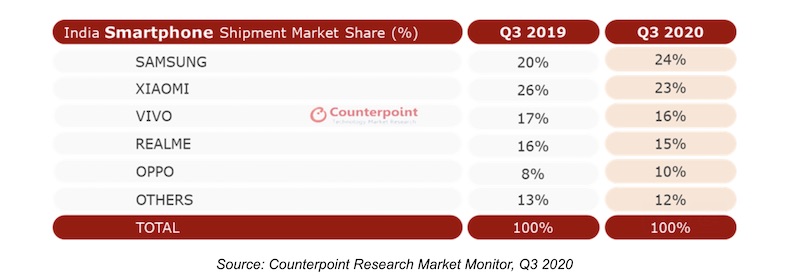
According to estimates from marketing research firm Counterpoint, Samsung commanded 24% of the Indian smartphone market in the quarter that ended in September this year, ahead of Xiaomi’s 23% share. (For context: during Q3 2019, Samsung assumed 20% of the smartphone market in India while Xiaomi captured 26%.)

Counterpoint’s finding is in contrast to what research firm Canalys reported last week. According to Canalys, Xiaomi held the top spot in India with 26.1% of the market share in Q3 2020, ahead of Samsung’s 20.4%.

But both the firms agree that India’s smartphone market saw a sharp rebound during the quarter. According to Counterpoint, more than 53 million smartphone units shipped in Q3 2020 at a 9% year-over-year growth. (Canalys pegged the figure to be about 50 million.)

The volume of units Samsung shipped in Q3 2020 was up 32% year-over-year, Counterpoint said. The company has benefited from its recent aggressive push in online sales and launch of several affordable smartphone handsets in recent months, Counterpoint analysts said.

Xiaomi, which entered India in 2014 and for several years sold exclusively through e-commerce platforms, is still the top online brand in India, Counterpoint said. But the company, which identifies India as its biggest market outside of China, is struggling to grapple with a growing anti-China sentiment in India among consumers as tension between the two neighboring nations have escalated in recent quarters.

This tension may lead to some more changes in the market in the coming months. Micromax, an Indian smartphone vendor which once ruled the market, said earlier this month that it was gearing up to launch a new smartphone sub-brand called “In.” Rahul Sharma, the head of Micromax, said the company will invest $67.9 million in the new smartphone brand.

In a video he posted on Twitter earlier this month, Sharma said Chinese smartphone makers killed the local handset makers but that time had come to fight back. “Our endeavour is to bring India on the global smartphone map again with ‘in’ mobiles,” he said in a statement.

It’s worth pointing out that long before Chinese smartphone makers, who command more than 70% of the local smartphone market in India, arrived to the country, they engaged closely with Chinese phone makers. Chinese firms manufactured the phones and sold it to Indian firms under a white-label agreement.

Indian firms then sold those phones to consumers in the country. Eventually, Chinese smartphone makers cut the middlemen and started to sell better smartphone models at much better prices to Indian directly, said Jayanth Kolla, a smartphone industry veteran and chief analyst at consultancy firm Convergence.

India also recently approved applications from 16 smartphone and other electronics companies for a $6.65 billion incentives program under New Delhi’s federal plan to boost domestic smartphone production over the next five years. Foxconn (and two other Apple contract partners), Samsung, Micromax and Lava (also an Indian brand) are among the companies that will be permitted to avail the incentives.

Missing from the list are Chinese smartphone makers such as Xiaomi, Oppo, Vivo, OnePlus and Realme.

28 Oct 2020

Tech stocks sell off sharply as market looks at COVID-19 numbers, whispers ‘oh f***’

The American stock market is struggling today, with tech stocks in particular taking extra stick.

After European stocks tanked on the back of COVID-19 concerns, American stocks are following suit. Tech stocks in particular.

As of the time of writing, the Dow Jones Industrial Average, a venerable if dated stock market barometer, is off 2.81%. The broader and more useful S&P 500 is off 2.90%. And the tech-heavy Nasdaq Composite is off 3.14%.

But perhaps most importantly for startups and startup founders, the SaaS-heavy Bessemer cloud index is off an even sharper 3.80%.

What’s going on? Stimulus is out of the cards for a while. COVID-19 cases and hospitalizations are rising. Deaths are picking up too. Political gridlock is the law of the land. And weak earnings from Intel and Netflix, and lackluster guidance from Microsoft could be weighing on tech-bulls. (Oh, and SAP flopped as well!)

In short, it’s a huge mess out there. More as it happens, but it’s not great day for tech stocks and the sort of bullish public-market valuations that late-stage startups are using as private-market valuation comps.

28 Oct 2020

The DOJ is investigating Visa’s $5.3 billion bid for Plaid on antitrust grounds

It’s not just big tech that’s getting the antitrust treatment from the Department of Justice.

Late Monday afternoon, the Department of Justice tipped its hand that it was investigating Visa’s proposed $5.3 billion acquisition of the venture-backed Plaid, which allows applications to connect with a users’ bank account.

It’s a tool that powers a good chunk of new fintech offerings, and the Justice Department has apparently spent the past year looking into how the deal would affect the broader market for new financial services coming from startups.

The revelation that the DOJ was taking a closer look at the Plaid acquisition came from a petition filed in the U.S. Court for the District of Massachusetts to compel Bain, the consulting firm that worked on Visa’s bid for Plaid, to comply with the agency’s civil investigative demand (CID).

The DOJ is alleging that Bain has withheld documents demanded by asserting that it had some privilege over the documents — effectively stalling the DOJ’s investigation.

“American consumers rely on the Antitrust Division to investigate mergers promptly and thoroughly,” said Assistant Attorney for the Antitrust Division Makan Delrahim, in a statement. “Collecting relevant third-party documents and data is essential to the division’s ability to analyze these transactions. Too often, third parties seek to flout these requirements, hoping the division will lose interest and focus its enforcement efforts elsewhere.”

DOJ first asked Bain in June for documents related to Visa’s pricing strategy and competition against other debit card networks. The feds intended to use that information to analyze the effects of Visa’s attempted acquisition on the broader financial services market. Bain refused to produce the documents by claiming that the information was privileged.

Visa’s bid for Plaid isn’t the only big fintech acquisition that is in the DOJ’s sights, according to a report in The Wall Street Journal. Federal regulators are also looking at MasterCard’s $1 billion bid for the fintech startup Finicity, and Intuit’s $7 billion pitch to acquire the credit advisory and lending marketplace, Credit Karma.

“The division’s petition against Bain is aimed at securing relevant documents and making clear that the division will hold third parties to the deadlines and specifications in the CIDs we issue,” Delrahim said. “Third parties, like Bain, must comply fully and expeditiously with our civil investigative demands and provide the documents and data we need to discharge our duties and serve the American people.”

28 Oct 2020

Stripe Climate is a new tool to let Stripe customers purchase credits towards carbon removal efforts

Last year, payments giant Stripe announced that it would donate $1 million of its own funds annually into companies that are building technology to remove carbon from our environment, with the recipients of that investment announced in May of this year. Now, it’s expanding that commitment with a new product aimed at getting its customers to invest, too.

Today, the company is launching Stripe Climate, a new tool that companies using Stripe can integrate to set up automatic contributions that are made as a percentage of each transaction — the company can set the percentage itself — with the proceeds feeding into an add-on pot on top of Stripe’s own investments in carbon reduction companies.

Currently there are four companies on that investment list: CarbonCure (which collects carbon dioxide and recycles it for other purposes, among other things); Climeworks, which is building carbon removal plants; Project Vesta, which has worked on projects like “green sand” to remove carbon on beaches; and Charm Industrial (converting waste biomass to bio-oil). It’s likely there will be more added to the list over time. And for now, companies don’t get a chance to choose how their contributions get invested: they basically mirror and follow the path of those being made by Stripe itself.

Stripe Climate is free to use, and Stripe said that the 25 companies testing out the service in a closed beta — the list includes Flexport, Substack, Flipcause, and OpenSnow — have already contributed hundreds of thousands of dollars to the effort.

“We built Substack because, while it’s easy to be depressed about the current state of the media business, we think there’s tremendous opportunity for those daring enough to be optimistic. We feel the same way about climate change,” said Chris Best, Co-Founder and CEO of Substack, in a statement. “We’re done with defaulting to depression. We want to help show the way to a better future—and better yet, we want to give all Substack writers the opportunity to join us. Stripe’s climate initiative is a gift because it removes all barriers to positive action. This program makes it easy, and valuable, to do the right thing. We’re proud to be part of it.”

Stripe Climate is playing on some important themes at the company.

Stripe — now valued at $36 billion — has made a name for itself primarily through a simple payments service that site and app developers can integrate by way of APIs, using a few lines of code. That has helped the company grow fast and pick up a huge number of users, from sole-trader outfits to much bigger businesses.

The company is using the same low-friction principle here with Stripe Climate: the idea is that while companies and individuals might in theory be committed to making investments in environmental causes, many don’t know where to begin, or how to do it in an efficient way. This gives them that way, having it integrated as part of its existing payments flow.

“A lot of the social issues dealing with right now are collective action problems,” said Nan Ransohoff, Stripe’s head of climate, in an interview. “Climate change is a collective action problem. Coordinating can be complicated and expensive. So can we make it easy to bring Stripe businesses together to make the whole bigger than the sum of its parts? If we can do it even a little bit we as a planet we will be in a better place.”

The second theme of this is how it fits into what Stripe is building on a more strategic level. Basic payments may be the company’s bread and butter, but on top of that it’s been adding a host of other services for businesses, from tools to help them incorporate their operations in the US, through to fraud prevention and analytics, and money advances and credit based on their existing activity on the platform.

The idea is not just to make more money from their customers through value-added services, but to increase stickiness with customers, who might be less reluctant to switch out a simple API if that data is also integrated into a number of other parts of their business and how they operate.

Stripe Climate isn’t going to make Stripe or its customers any money — in fact, it’s a way for its customers to give money away — but it’s a very strong goodwill gesture that could go some way to building more loyalty and regard with its customers.

Ransohoff said that the plan will also be to expand Stripe Climate into a tool that these companies can also in turn offer to their own customers at checkout — not unlike the many offers you might already see these days to contribute money towards good causes when you are hitting “buy now” on any number of sites.