Year: 2020

27 Oct 2020

Spying a pivot to ghost kitchens, Softbank’s second Vision Fund pours $120 million into Ordermark

“We’re building a decentralized ghost kitchen,” is a sentence that could launch a thousand investor calls, and Alex Canter, the chief executive officer behind Ordermark, knows it.

The 29 year-old CEO has, indeed, built a decentralized ghost kitchen — and managed to convince Softbank’s latest Vision Fund to invest in a $120 million round for that the company announced today.

“We have uncovered an opportunity to help drive more orders into restaurants through this offering we have called Nextbite,” Canter said. “Nextbite is a portfolio of delivery-only restaurant brands that exist only on UberEats, DoorDash, and Postmates.”

After hearing about Nextbite, Softbank actually didn’t take much convincing.

Investors from the latest Vision Fund first reached out to Canter shortly after the company announced its last round of funding in 2019. Canter had just begun experimenting with Nextbite at the time, but now the business is driving a huge chunk of the company’s revenues and could account for a large percentage of the company’s total business in the coming year.

“We believe Ordermark’s leading technology platform and innovative virtual restaurant concepts are transforming the restaurant industry,” said Jeff Housenbold, Managing Partner at SoftBank Investment Advisers, in a statement. “Alex and the Ordermark team have a deep understanding of the challenges that independent restaurants face. We are excited to support their mission to help independent restaurants optimize online ordering and generate incremental revenue from under-utilized kitchens.”

It’s an interesting pivot for a company that began as a centralized hub for restaurants to manage all of the online delivery orders coming in through various delivery services like GrubHub, Postmates and Uber Eats .

Canter is no stranger to the restaurant business. His family owns one of Los Angeles’ most famous delicatessens, the eponymous Canters, and Ordermark apocryphally started as a way to manage the restaurant’s own back-of-the-house chaos caused by a profusion of delivery service orders.

Now, instead of becoming the proprietor of one restaurant brand, Canter is running 15 of them. Unlike Cloud Kitchens, Kitchen United or Reef, Ordermark isn’t building or operating new kitchens. Instead, the company relies on the unused kitchen capacity of restaurants that the company has vetted to act as its quasi-franchisees.

Ordermark logos for some of the company’s delivery-only restaurant concepts. Image Credit: Ordermark

While most of the restaurant concepts have been developed internally, Ordermark isn’t above the occasional celebrity sponsorship. Its Nextbite service has partnered with Wiz Khalifa on a delivery-only restaurant called HotBox by Wiz, featuring “stoner-friendly munchies”.

The first brand Canter launched was The Grilled Cheese Society, which took advantage of unused kitchens at places like a Los Angeles nightclub and mom-and-pop restaurants across the East Coast to build out a footprint that now covers 100 locations nationwide.

It’s perhaps the growth of the HotBox brand that shows what kind of growth Nextbite could promote. Since the brand’s launch in early October, it has grown to a footprint that will reach 50 cities by the end of the month, according to Canter.

In some ways, Nextbite couldn’t exist without Ordermark’s delivery aggregation technology. “The way that Ordermark’s technology is designed, not only can we aggregate online orders into the device, but we can aggregate multiple brands into the device.”

For restaurants that sign up to be fulfillment partners for the Nextbite brands, there are few additional upfront costs and a fair bit of upside, according to Canter. Restaurants are making 30% margin on every order they take for one of Ordermark’s brands, Canter said.

To become a part of Nextbite’s network of restaurants the business has to be vetted by Ordermark. The company takes cues on what kinds of restaurants are performing well in different regions and develops a menu that is suited to match those trends. For instance, Nextbite recently launched a hot chicken sandwich brand after seeing the item rise in popularity on different digital delivery services.

Restaurants are chosen that can match the menu style of the delivery-only brand that Ordermark’s Nextbite business creates.

Behind those menus is Guy Simsiman, a Denver-based chef who is in charge of developing new menus for the company.

“We’re building things that we know can scale and we do a lot of upfront vetting to find the right types of fulfillment partners,” said Canter. “When a restaurant signs up to become a fulfillment partner, we’re vetting them and training them on what they need to do to … We’re guiding them to become fulfillment partners for these concepts. There’s a whole bunch of training that happens. Then there’s secret shopping and review monitoring to monitor quality.”

While Nextbite may be the future of Ordermark’s business, its overall health looks solid. The company is about to cross $1 billion worth of orders processed through its system.

“We are laser focused right now on helping our restaurants survive COVID and the best way we can do that is by doubling down on the incremental revenues of the Nextbite business,” said Canter when asked where the company’s emphasis would be going forward.

Nextbite is something we’ve been developing for a while now. We took it to market at the end of last year prior to COVID. When COVID kicked in every restaurant in America needed to be more creative. People were looking for alternative ways to supplement the loss in foot traffic,” he said. Nextbite provided an answer.

27 Oct 2020

NASA and SpaceX set November 14 target date for first operational Crew Dragon launch

The first mission to officially carry astronauts to the International Space Station for a standard crew rotation is now tentatively set for November 14. NASA provided an updated date for the mission this week, after it shifted from an original planned timeframe of sometime in October. This is the first time that Crew Dragon, SpaceX’s human-rated capsule, will be flown in for an operational ‘shift-change’ mission at the ISS, after its historic Demo-2 mission earlier this year officially concluded its testing phase and certified it for NASA use.

This launch will carry three NASA astronauts, including Shannon Walker, Victor Glover and Mike Hopkins, as well as JAXA astronaut Soichi Noguchi of Japan to the ISS, where they’ll join the crew and carry out regular station operations, including upkeep and upgrades, as well as conducting experiments in partnership with researchers on Earth.

They’ll join the existing ISS crew, including Russian cosmonauts Sergey Ryzhikov and Sergey Kud-Sverchkov and NASA astronaut Kate Rubins. Once they arrive, the full crew size will be seven astronauts, which is up from the usual six, but this will help ensure that more time is spent on research and experimentation vs. the regular duties that the crew takes on just to ensure continued smooth operation of the station.

Crew-1 is set to launch aboard a Falcon 9 rocket from Cape Canaveral, and is targeting a 7:49 PM EST liftoff. That’s subject to change, of course, but for now, mark your calendars.

27 Oct 2020

Zoom launches end-to-end encryption for free meetings — with a catch

Zoom, the video calling company that millions turned to during the pandemic, has finally launched end-to-end encrypted video calls for free accounts.

The company said last week that it was readying the feature, months after it drew criticism for denying end-to-end encrypted calls to free users, effectively drawing a line between paid users whose conversations could not be accessed by Zoom and those with free accounts whose conversations weren’t as private.

Zoom said the new end-to-end encryption feature, which makes it much harder for anyone outside of the video call — including Zoom — access to the conversation, will roll out as a technical preview starting in Zoom 5.4.0 for desktop and mobile apps.

Zoom acquired Keybase in May in part to bring its encryption technology to Zoom calls.

But there’s a catch — or a handful.

Because end-to-end encryption has to be enabled for every user joining the call, some other features will not be available. Users on an encrypted call won’t be able to use Zoom’s cloud recording, live transcription, and meeting reactions features, and participants won’t be able to join the call by phone or use one-to-one private chat. And, all participants have to use a Zoom app that supports end-to-end encryption, as the browser version will not work.

Any free account wanting to use end-to-end encryption will have to verify a phone number and add billing information — which Zoom says is necessary to prevent abuse.

27 Oct 2020

Postmates is launching a new retail delivery feature as brick and mortar stores face 14% drop in sales

Postmates is now rolling out what could be the biggest update to the company’s service in a long time — adding a retail option for users to shop local stores and for local merchants to set up a virtual on-demand storefront in the app.

Starting in Los Angeles — and building on yesterday’s test run pop-up shop with the Los Angeles Rams — Postmates users will be able to shop local merchants listed in the company’s new retail tab in the Postmates app called, appropriately, “shop”.

It’s the first public launch of a new initiative headed up by Mike Buckley, a veteran Nike exec who Postmates poached in August to become the company’s senior vice president of business. At Nike, Buckley served as the vice president of digital commerce operations and new business models.

While Postmates has made some small steps in retail delivery (primarily electronics), Buckley said the new service greatly expands that footprint. Shops available to willing Los Angeles customers to cover everything from home goods, cosmetics, and clothes to even vinyl records.

Buckley said the company decided to launch its efforts in Los Angeles, because it was a market where Postmates had a good penetration of delivery workers and big market. “We wanted to create an experience where, as a consumer, if you went there you would feel there’s good coverage,” Buckley said. “Most of the LA metro area will have access to the tab. We started the test in Venice Beach in Abbott Kinney… that’s where you’d find the best coverage.. We have reasonable coverage throughout broader urban LA.”

Postmates new senior vice president of retail, Mike Buckley. Image Credit: Postmates

At launch, there will be nearly fifty retailers on the site including shops like Buck Mason, Le Labo, Parachute Home, the Venice Beach boutique, Coutula 12th Tribe, Timbuk2, Zadig & Voltaire, Supervinyl and Urbanic.  

Retailers can decide how many products they want to sell through the app, and the main goal, according to Buckley is to see what kind of products resonate with consumers for delivery.

For local merchants who have been hit hard by the lockdown orders put in place as a response to the COVID-19 pandemic, on-demand delivery options from Postmates could create a new line to wary would-be shoppers that still don’t feel like braving the checkout line at a small boutique.

As case counts spike in the U.S. the prospect of a return to lockdown looms large for some regions. That could have an impact on retail sales that were already projected to be dismal.

In fact, the online analytics service eMarketer projected a 10.5% decline in total US retail sales this year, and a 14.0% drop in brick-and-mortar sales… even before the second wave of the pandemic began surging in the U.S. earlier this month.

The new on-demand option could also provide retailers with another avenue to lure customer through timed flash sales, exclusive “drops” to Postmates users, and other retailing tricks that were Buckley’s stock and trade at Nike.

“That’s absolutely one of the ways we think we can drive engagement to these merchants and create calls to action with these merchants,” Buckley said. 

In some ways, the move into consumer retail shopping takes Postmates back to its earliest days, when the service allowed users to demand delivery of almost anything. “I think about this continuing… the company’s original vision of anything anytime anywhere… They had an aspiration to deliver all kinds of different products and food became the killer app given the frequency,” Buckley said. 

The ‘Shop’ button is going live for Los Angeles residents and will be restricted to Los Angeles throughout the fourth quarter before a wider rollout in the first quarter of 2021. Buckley expects the new service to be phased in at other big metro areas across the Southwest first before hitting markets on the East Coast. 

Within the Postmates ‘Shop’ tab shops will be able to sell their inventory and showcase products with configurable catalogues including high resolution images. Shops can also offer customers a choice between on-demand delivery, in-store pickup, or non-contact curbside pickup.

Delivery and service fees will apply to the shopping experience, but Postmates unlimited subscribers will get free delivery, according to the company.

“This year, COVID really changed the landscape of how we purchase essentials, spend time recreationally, and even how we treat ourselves,” said Heather DeLeon, Director of Sales, Anastasia Beverly Hills, one of the retailers using the new service, in a statement. “Shop is such an interesting opportunity because it lets people get their hands on our products in a completely new and exciting way.”

27 Oct 2020

Salto raises $27M to let you configure your SaaS platforms with code

Salto, a Tel Aviv-based open-source startup that allows you to configure SaaS platforms like Salesforce, NetSuite and HubSpot with code, is coming out of stealth today and announced that it has raised a $27 million Series A round. This round was led by Bessemer Venture Partners, Lightspeed Venture Partners and Salesforce Ventures.

The general idea here — which is similar to the ‘infrastructure-as-code’ movement — is to allow business operations teams to automate the labor-intensive and error-prone ways they currently use to manage SaaS platforms. While others in this space are betting on no-code solutions for managing these systems, Salto is going the other way and is betting on code instead.

“We realized the challenges BizOps teams face are very similar to the problems encountered by software and DevOps engineers on a daily basis,” writes Salto co-founder and CEO Rami Tamir in today’s announcement. “So we adapted software development fundamentals and best practices to the BizOps field. There’s no need to reinvent the wheel; the same techniques used to make high-quality software can also be applied to keeping control over business applications.”

Image Credits: Salto

Salto makes the core of its service available as open source. This open-source version includes the company’s NaCI language, a declarative configuration language based on the syntax of HashiCorp’s hcl, a command-line interface for deploying configuration changes (and fetching the current configuration state of an application) and a VS Code extension.

In combination with Git, business operations teams can collaborate on writing these configurations and test them in staging environments. The company is essentially taking modern software development practices and applying them to business operations.

Image Credits: Salto

“Defining a company’s business logic as code can make a fundamental change in the way business applications are delivered,” writes Tamir. “We like to think about it as ‘company-as-code,’ much in the same way as ‘infrastructure-as-code’ transformed the way we manage data centers.”

Some of the use cases here are configuring custom Salesforce CPQ fields, and syncing profiles across Salesforce environments and maintaining audio logs for NetSuite. For now, the company only supports connections to Salesforce, HubSpot and NetSuite, with others following soon.

Like other open-source companies, Salto’s business model involved selling a hosted version of its service, which the company is also announcing today.

In terms of raising this new round, it surely helped that the founding team, which includes Benny Schnaider and Gil Hoffer, in addition to Tamir, previously sold the three companies they founded. Pentacom was acquired by Cisco earlier this year; Oracle acquired Ravello Systems in 2016 and Qumranet was acquired by Red Hat in 2008.

“Business agility is more important than ever today, and the alignment of external business services to real business needs is increasing in strategic importance,” said Alex Kayyal, Partner and Head of International at Salesforce Ventures . “BizOps teams are becoming more and more crucial to the success of companies. With Salto they are empowered to meet the tasks they are charged with, equipped with modernized methodologies and a greatly enhanced toolbox.”

27 Oct 2020

The Freewrite Traveler is an outstanding, but expensive, dedicated portable writing laptop

As a hardware startup, Astrohaus stands apart because of its unique offerings focused specifically on writers and writing. Its debut product, the Freewrite, looked like an old-school travel typewriter with an e-ink screen. Now, it’s back with a new device it’s been working on for the past couple of years: The Freewrite Traveler. This more portable e-ink typewriter has a clamshell design and isn’t much larger than a Nintendo Switch, making it a flexible, go-anwyhere writing companion.

The basics

Astrohaus began teasing the Traveler a few years ago, before eventually launching an Indiegogo crowdfunding campaign in November 2018 to get it made. The crowdfunding was very successful, raising over $600,000 on the platform before the campaign ended, and then another $200,000+ in pre-orders after that. Like many hardware efforts, it encountered a few delays relative to its original delivery timeline, but now the Freewrite Traveler is shipping out to pre-order customers.

Image Credits: Darrell Etherington

In terms of specs, it has up to four weeks of battery life with regular usage, and weighs under two pounds, with a folding design that’s roughly half the surface area of most laptops. The screen on the top half is an e-ink display, and there’s a sub-screen for providing info like network status. The bottom half houses the keyboard, which boasts over 2mm of travel for a great keypress feel.

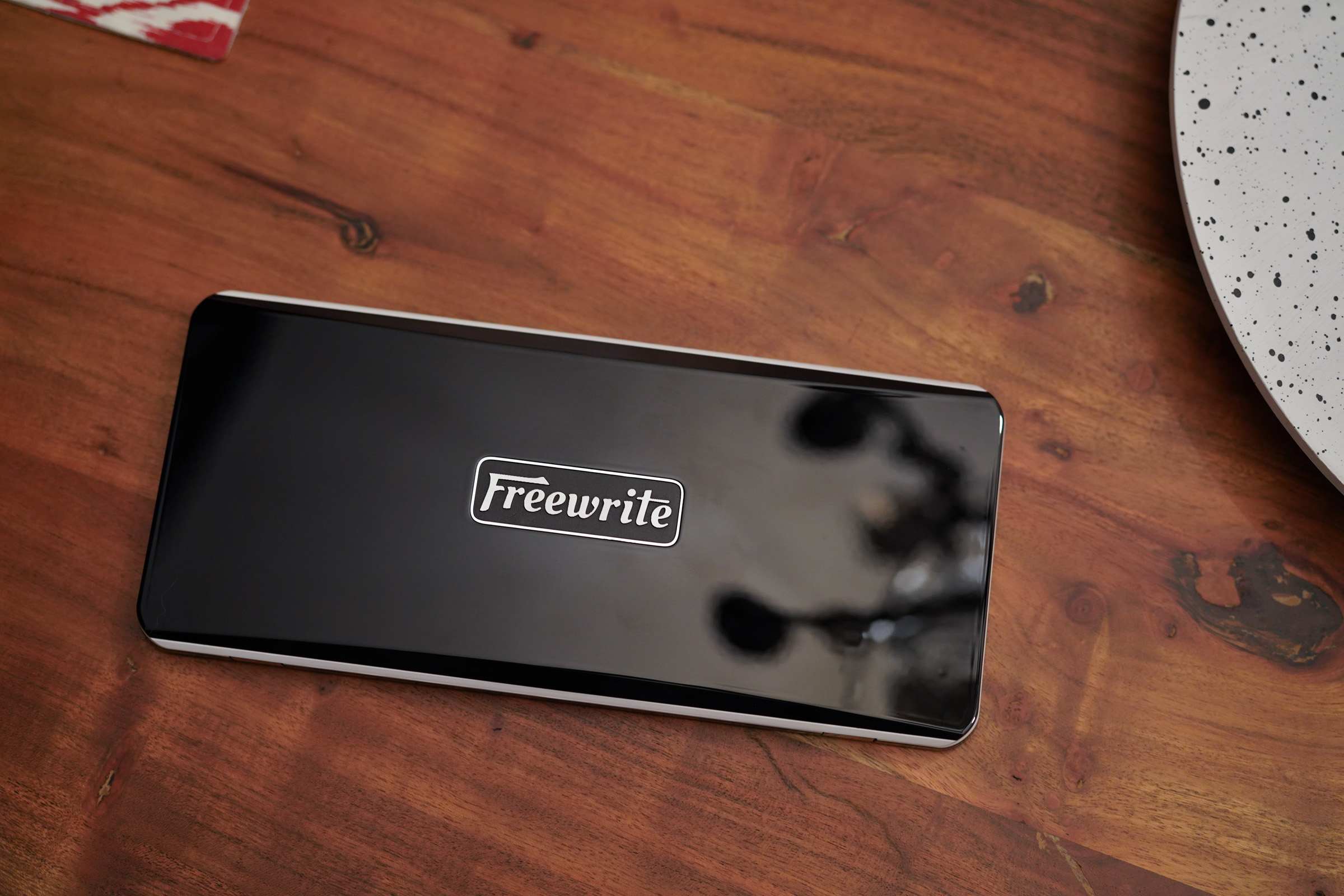
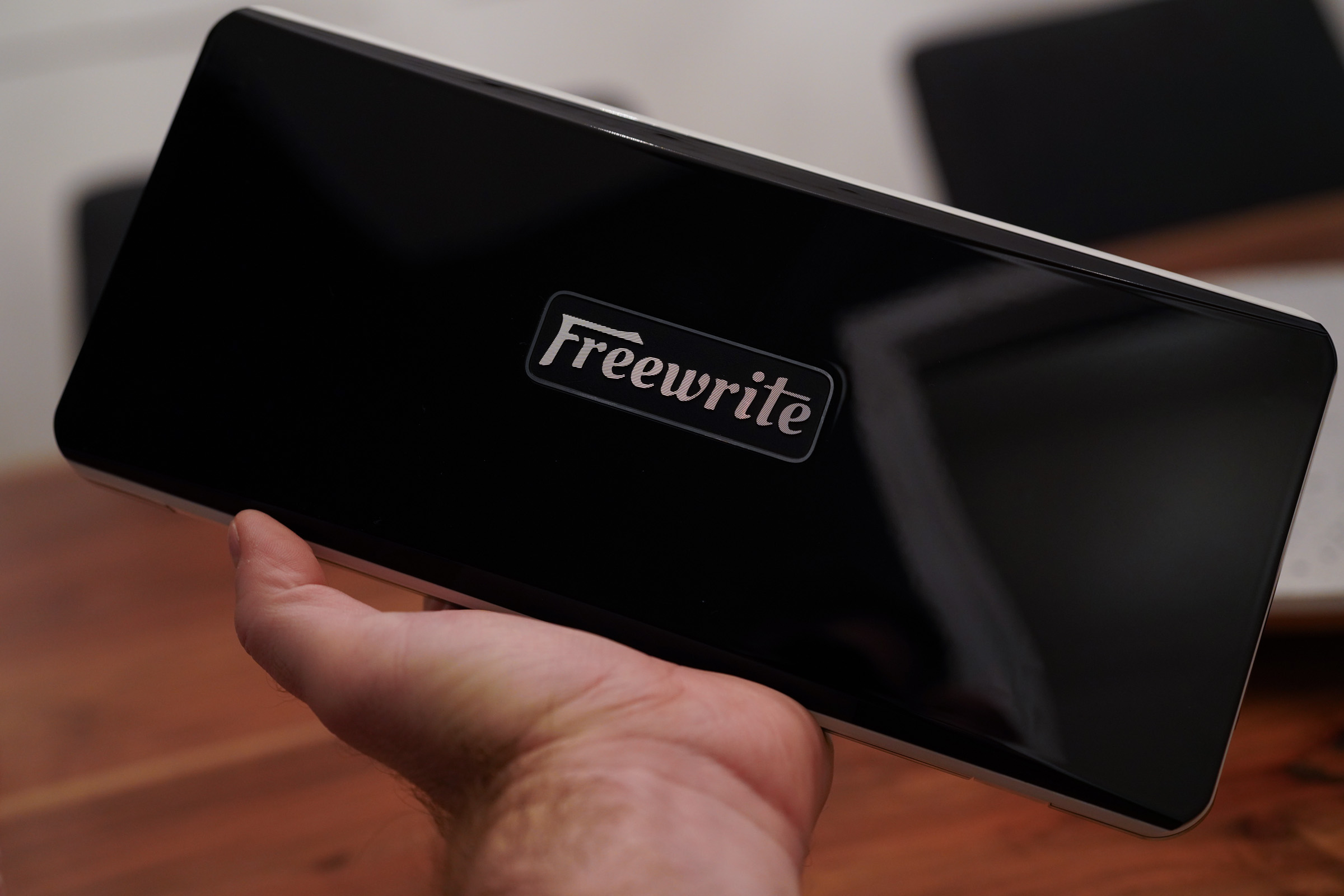
The case is plastic, as are most of the components, and the exterior is a glossy black. The Traveler connects via wifi, like the original Freewrite, and allows you to register an account to sync to up to three separate folders of documents. When out of wifi range, your work is stored locally, and it can sync to the cloud service of your choice via Freewrite’s integrations whenever you’re connected.

Design and features

The Traveler’s design is all about portability and convenience, while retaining the core usability features that make the original Freewrite such an ideal device for focused writing. The clamshell design is intentionally large enough to fit that full-sized keyboard comfortably, but keeps the screen small like with the original, which makes it more portable and ensures that distractions are kept to a minimum – aided by the fact that all you can do on it is type text, since there are no apps, browser or other functions.

Astrohaus has stayed very close to their original vision for the Traveler, with some minor tweaks including the hinge design. The end result is a light and durable-feeling portable digital typewriter, with a keyboard that feels excellent to type on – better than any laptop in my experience. The keyboard is really the star of the show here, since this is a purpose-built device created for typing. The travel feels ample, especially for a notebook-style device, and the raised, rounded keycap wells make it easy to touch type comfortably all day if you want.

Image Credits: Darrell Etherington

The display, while small, provides excellent legibility and contrast, though it’s worth noting that you’ll have to supply your own light source, because as with the original Freewrite, there’s no backlight or frontlight built in, and e-ink doesn’t provide its own light like LED.

E-ink is incredibly power efficient, however, which is why you’ll get so much useful life out of the Traveler. In my testing, it’s been operating on its original charge for nearly two weeks now, which is in line with the Astrohaus estimates.

The Traveler’s case features a piano black glossy exterior, which looks great, but quickly picks up fingerprints. And existing Freewrite users might notice that the display has a slightly glossy sheen as well, where the original was fully matte. That’s because of a thin piece of optically transparent plastic that goes across the entire width of the clamshell to protect the e-ink display against the keyboard, according to Astrohaus. To me, it hasn’t been an issue in terms of usability or quality, just something to note in terms of differences.

Image Credits: Darrell Etherington

Astrohaus has created a design that stands out, regardless of what you think of the piano black finish. The contrast of the black with the white interior gives it a unique, quirky and attractive design that helps ensure you’ll never confuse the Traveler with any other gadget. And the materials keep it lightweight and durable for easily taking it with you anywhere you might want to go.

[gallery ids="2066025,2066026,2066027,2066028,2066029,2066030"]

The Traveler’s hinge allows it it to open up to roughly 135 degrees, which is a good position for laptop typing. It can also be positioned at any angle less than that for when you have it elevated at a table or desk.

Bottom line

The Freewrite Traveler is a unique device, with a special appeal for people who are hyper-focused on a writing tool that offers all the benefits of cloud-connectivity with none of the downsides of a multipurpose tool like a laptop or computer. It can sync to Dropbox, Evernote or Google Drive so that you can easily create a cross-device workflow for finishing up manuscripts and drafts, but on its own, the Traveler will ensure you remain focused on the task at hand – and enjoy yourself while doing so.

A portable, digital writing device like this one isn’t unique in the world – many distraction-free writing enthusiasts use the Pomera line of products from Japan for this purpose. But Astrohaus is unique in providing hardware tailor-made for North American and European markets, and they’ve done an amazing job at delivering on the potential of this device even in a field of relatively few competitors.

The Traveler is fairly expensive at $599, but there’s truly nothing else like it, if what you want is a laser-focused writing device that combines portability with great ergonomics, long-lasting battery and cloud storage convenience.

27 Oct 2020

Top Facebook India executive Ankhi Das leaves the company

Ankhi Das, a top Facebook executive in India, is leaving the company on Tuesday months after she was alleged to interfere in the company’s content moderation policy in the country to show favoritism to the ruling Bharatiya Janata Party.

Facebook has denied the allegations, and people close to Das (pictured above) said her departure was not related to recent stories in the press. Das served as the Public Policy Director for Facebook India, South and Central Asia.

“I have decided to step down from Facebook after long service to its mission of connecting people and building communities to pursue my personal interest in public service. When I joined Facebook in 2011, internet growth in the country was woefully low and I often wondered how social and economic asymmetries will be addressed. We were a small unlisted startup back then guided only by our mission and purpose to connect people in India. After nine long years, I feel that mission has largely been met. There is an enormous amount I have learnt from incredibly smart and talented people in the company, particularly from people on the policy team. This is a special company and a special group of people. Thank you, Mark for creating something beautiful for the world. I hope I have served you and the company well. I know we will be in touch on Facebook,” she wrote in a Facebook post.

In a statement, Ajit Mohan, the head of Facebook India, said Das was leaving Facebook to pursue her “interest in public service.” He added, “Ankhi was one of our earliest employees in India and played an instrumental role in the growth of the company and its services over the last 9 years. She has been a part of my leadership team over the last 2 years, a role in which she has made enormous contributions. We are grateful for her service and wish her the very best for the future.”

This is a developing story. More to follow…


27 Oct 2020

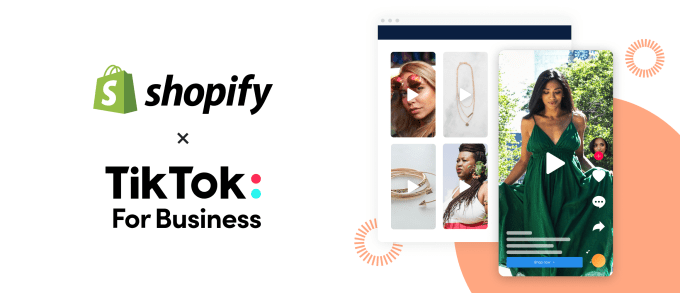
TikTok invests in social commerce via new Shopify partnership

TikTok is further investing in social commerce with today’s announcement of a new global partnership with e-commerce platform Shopify. The deal aims to make it easier for Shopify’s over 1 million merchants to reach TikTok’s younger audience and drive sales. The partnership will eventually expand to include other in-app shopping features, as well, the companies said.

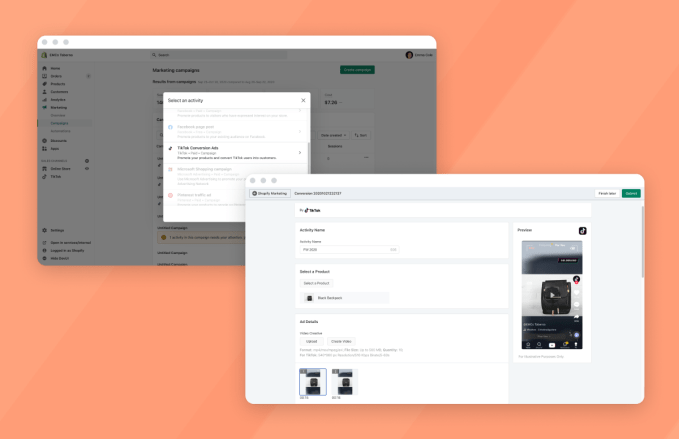
At launch, the agreement allows Shopify merchants to create, run and optimize their TikTok marketing campaigns directly from the Shopify dashboard by installing the new TikTok channel app from the Shopify App Store. Once installed, merchants will have access to the key functions from the TikTok For Business Ads Manager at their disposal.

These ad tools allow merchants to create native, shareable content that turns their products into In-Feed video ads that will resonate with the TikTok community. Merchants will be able to target their audiences across gender, age, user behavior, and video category, and then track the campaign’s performance over time. The campaigns’ costs will vary, based on the merchant’s own business objectives and how much they want to spend.

As a part of this effort, Shopify merchants can also install or connect their “TikTok Pixel” — a tool that helps them to more easily track conversions driven by their TikTok ad campaigns.

Currently, e-commerce merchants can track user actions like a user browsing their page, a registration on a website, adding items to their cart, placing an order, and completing the payment.

Image Credits: Shopify

Shopify tells TechCrunch a small number of merchants previously gained access to these features as part of a beta test. But as of today, Oct. 27, the product is being made available to all merchants across the U.S.

“TikTok is one of the world’s fastest growing entertainment platforms with over 100 million highly engaged users in the U.S. alone,” said Satish Kanwar, Vice President of Product at Shopify, in a statement about the new partnership. “The TikTok channel means Shopify merchants—even those without a strong TikTok following of their own yet—can connect with these new audiences using content that feels authentic and genuine to the TikTok experience,” Kanwar added.

Image Credits: Shopify

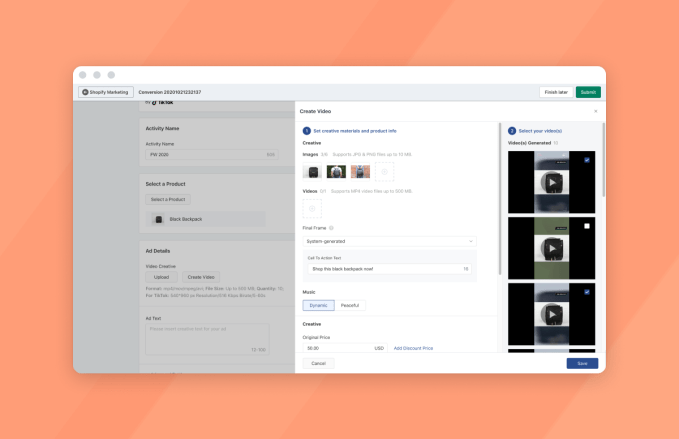
To get started with the new features, merchants who want to advertise on TikTok will first install the TikTok channel app, then create and connect their TikTok For Business account and install the one-click pixel. They can then deploy In-Feed shoppable video ads by selecting the product they want to feature using ad templates specifically designed for commerce. Because these templates use existing imagery or videos, the TikTok channel can work for merchants of any size, Shopify notes.

To kick off the partnership, merchants are being offered a $300 ad credit to get started with their first TikTok campaign.

In addition, the two companies have partnered on their first co-branded Hashtag Challenge Plus campaign, #ShopBlack, to celebrate Black-owned businesses. Shopify had earlier featured Black-owned businesses in its own app, Shop. But from Nov. 10 through Nov. 15, the TikTok community will be able to browse videos from over 40 Shopify merchants via the new hashtag and its accompanying branded effect within TikTok, too.

Shopify and TikTok had been working together to test various social commerce initiatives ahead of today’s announcement.

The companies, for example, had been spotted trialing a new shopping button that allowed TikTok creators to link their Shopify storefront from their videos. (Teespring was also testing this with TikTok). TikTok had offered a TikTok Ads Pixel for Shopify merchants before today, as well.  But the partnership makes the pixel integration a 1-click install, so merchants don’t have to manipulate code.

Image Credits: Shopify

“We are delighted to partner with Shopify and provide a channel for their merchants to reach new audiences and drive sales on TikTok,” said Blake Chandlee, Vice President, Global Business Solutions at TikTok, in a statement. “As social commerce proliferates, retailers are recognizing that TikTok’s creative and highly engaged community sets it apart from other platforms. We’re constantly exploring new and innovative ways to connect brands with our users, and Shopify is the perfect partner to help us grow and expand our commerce capabilities globally,” he said.

TikTok and Shopify’s partnership won’t be limited to the new TikTok channel app, however. That’s just the first step.

We understand the deal will soon expand to other shopping features, too.

TikTok says it plans to start testing new in-app features that will make it easier for users to discover Shopify merchants and their products by expanding their reach through video and on their account profiles. These features will also “let users browse merchant’s products and shop directly through the TikTok app,” a spokesperson said. They didn’t offer specific details about the features or how the payments portion would work, saying that more information would be available when the new tools launched.

However, the features will launch to a limited beta group of testers soon, a TikTok spokesperson confirmed.

Image Credits: TikTok

Shopify isn’t the first to recognize TikTok’s potential as a new type of social shopping platform. Its ability to drive merchant traffic and sales was a key reason for Walmart’s participation in the TikTok-Oracle deal — a deal whose current status is still unknown, of course, given the ongoing TikTok lawsuit and the upcoming Presidential election whose outcome could impact the Trump Administration’s TikTok ban.

TikTok itself has been steadily ramping up its tools for merchants and other social shopping features. To date, it has  experimented with allowing users to add e-commerce links to their bios; launched “Shop Now” buttons for brands’ video ads; and introduced shoppable components to hashtags with the e-commerce feature (soon to be used for #ShopBlack), known as the Hashtag Challenge Plus.

Shopify, meanwhile, has been working to deliver more tools that give smaller businesses the ability to compete against Walmart and Amazon, while at the same time partnering with Walmart to give its merchants broader reach.

The TikTok-Shopify partnership could help the video platform better compete against other sources of social commerce, including the growing number of live stream shopping apps as well as efforts from Facebook and its family of apps. The social giant has recently rolled out a bevy of shopping-focused updates across Facebook, Instagram, and — just last week — WhatsApp, with the goal of directing users to shop in its apps, then check out seamlessly with Facebook Pay.

TikTok’s advantage is that it’s a video-based social network, more like YouTube, rather than a platform whose roots were in editorial-quality imagery, like Instagram. On Instagram, video features have been added in over time. Now, a number of Instagram products include video — like  Feed posts, Stories, Instagram Live, IGTV, and, finally, Instagram’s TikTok rival, Reels. But overall, the impact is that Instagram has started to feel overcrowded.

TikTok says the new TikTok channel for Shopify merchants is available today in the U.S. It will roll out to other markets next year, including elsewhere in North America, Europe and Southeast Asia.

27 Oct 2020

SimilarWeb raises $120M for its AI-based market intelligence platform for sites and apps

Israeli startup SimilarWeb has made a name for itself with an AI-based platform that lets sites and apps track and understand traffic not just on their own sites, but those of its competitors. Now, it’s taking the next step in its growth. The startup has raised $120 million, funding it will use to continue expanding its platform both through acquisitions and investing in its own R&D, with a focus on providing more analytics services to larger enterprises alongside its current base of individuals and companies of all sizes that do business on the web.

Co-led by ION Crossover Partners and Viola Growth, the round doubles the total amount that the startup has raised to date to $240 million. Or Offer, SimilarWeb’s founder and CEO, said in an interview that it was not disclosing its valuation this time around except to say that his company is now “playing in the big pool.” It counts more than half of the Fortune 100 as customers, with Walmart, P&G, Adidas and Google, among them.

For some context, it hit an $800 million valuation in its last equity round, in 2017.

SimilarWeb’s technology competes with other analytics and market intelligence providers ranging from the likes of Nielsen and ComScore through to the Apptopias of the world in that, at its most basic level, it provides a dashboard to users that provides insights into where people are going on desktop and mobile. Where it differs, Offer said, is in how it gets to its information, and what else it’s doing in the process.

For starters, it focuses not just how many people are visiting, but also a look into what is triggering the activity — the “why”, as it were — behind the activity. Using a host of AI tech such as machine learning algorithms and deep learning — like a lot of tech out of Israel, it’s being built by people with deep expertise in this area — Offer says that SimilarWeb is crunching data from a number of different sources to extrapolate its insights.

He declined to give much detail on those sources but told me that he cheered the arrival of privacy gates and cookie lists for helping ferret out, expose and sometimes eradicate some of the more nefarious “analytics” services out there, and said that SimilarWeb has not been affected at all by that swing to more data protection, since it’s not an analytics service, strictly speaking, and doesn’t sniff data on sights in the same way. It’s also exploring widening its data pool, he added:

“We are always thinking about what new signals we could use,” he said. “Maybe they will include CDNs. But it’s like Google with its rankings in search. It’s a never ending story to try to get the highest accuracy in the world.”

The global health pandemic has driven a huge amount of activity on the web this year, with people turning to sites and apps not just for leisure — something to do while staying indoors, to offset all the usual activities that have been cancelled — but for business, whether it be consumers using e-commerce services for shopping, or workers taking everything online and to the cloud to continue operating.

That has also seen a boost of business for all the various companies that help the wheels turn on that machine, SimilarWeb included.

“Consumer behavior is changing dramatically, and all companies need better visibility,” said Offer. “It started with toilet paper and hand sanitizer, then moved to desks and office chairs, but now it’s not just e-commerce but everything. Think about big banks, whose business was 70% offline and is now 70-80% online. Companies are building and undergoing a digital transformation.”

That in turn is driving more people to understand how well their web presence is working, he said, with the basic big question being: “What is my marketshare, and how does that compare to my competition? Everything is about digital visibility, especially in times of change.”

Like many other companies, SimilarWeb did see an initial dip in business, Offer said, and to that end the company has taken on some debt as part of Israel’s Paycheck Protection Program, to help safeguard some jobs that needed to be furloughed. But he added that most of its customers prior to the pandemic kicking off are now back, along with customers from new categories that hadn’t been active much before, like automotive portals.

That change in customer composition is also opening some doors of opportunity for the company. Offer noted that in recent months, a lot of large enterprises — which might have previously used SimilarWeb’s technology indirectly, via a consultancy, for example — have been coming to the company direct.

“We’ve started a new advisory service [where] our own expert works with a big customer that might have more deep and complex questions about the behaviour we are observing. They are questions all big businesses have right now.” The service sounds like a partly-educational effort, teaching companies that are not necessarily digital-first be more proactive, and partly consulting.

New customer segments, and new priorities in the world of business, are two of the things that drove this round, say investors.

“SimilarWeb was always an incredible tool for any digital professional,” said Gili Iohan of ION Crossover Partners, in a statement. “But over the last few months it has become apparent that traffic intelligence — the unparalleled data and digital insight that SimilarWeb offers — is an absolute essential for any company that wants to win in the digital world.”

As for acquisitions, SimilarWeb has historically made these to accelerate its technical march. For example, in 2015 it acquired Quettra to move deeper into mobile analytics and it acquired Swayy to move into content discovery insights (key for e-commerce intelligence). Offer would not go into too much detail about what it has identified as a further target but given that there are quite a lot of companies building tech in this area currently, that there might be a case for some consolidation around bigger platforms to combine some of the features and functionality. Offer said that it was looking at “companies with great data and digital intelligence, with a good product. There are a lot of opportunities right now on the table.”

The company will also be doing some hiring, with the plan to be to add 200 more people globally by January (it has around 600 employees today).

“Since we joined the company three years ago, SimilarWeb has executed a strategic transformation from a general-purpose measurement platform to vertical-based solutions, which has significantly expanded its market opportunity and generated immense customer value,” said Harel Beit-On, Founder and General Partner at Viola Growth, in a statement. “With a stellar management team of accomplished executives, we believe this round positions the company to own the digital intelligence category, and capitalize on the acceleration of the digital era.”

27 Oct 2020

Impact America Fund closes $55M to invest in startups targeting the world’s overlooked

The entire asset class of venture capital is built atop systemic racism. The numbers don’t lie: only 2% of partner-level VCs are Black, and 81% of venture capital firms don’t have a Black partner on board. The lack of diversity in check-writers doesn’t stay in board rooms: homogeneity trickles down to the founders who get mentored and the startups that get funded, excluding an entire population of potentially revolutionary ideas.

Systemic racism is a market inefficiency, according to Kesha Cash, the founder of Impact America Fund. So, Cash, one of the few Black female general partners in venture capital, says she wants to invest in companies that work on solutions for the world’s overlooked and underserved.

Today, Impact America Fund (IAF) announced that it has closed a $55 million investment vehicle to serve this exact purpose. The raise will allow IAF to invest 20 to 25 checks, between the size of $250,000 to $3 million, in early-stage startups. The close marks one of the largest funds ever raised by a sole Black female general partner.

The fund has 67 limited partners, including a number of foundations, large wealth managers and UBS. Cash says that the raise took two years to complete. In June, when George Floyd was murdered by the police, a number of firms rushed to find ways to support Black entrepreneurs. “Society got to see it with their own eyes how big these problems are,” Cash said. The racial reckoning across the country sped up the tail end of IAF’s fundraise close and brought in a ton of inbound interest.

Still, Cash says that IAF had to clarify its focus throughout its fundraising process.

“We’re not just investing in Black and brown people, which I think is a very important thesis, but not our thesis,” Cash said. Instead, Cash says the door-opening conversation for fundraising hinged on a more macro conversation.

“While many of you have been approaching this through your grants and philanthropy, we actually believe there’s a way to continue to invest in software and venture capital businesses to scale and disrupt some of the underlying systemic issues that you and others may not be able to see but are perpetuating,” Cash remembers saying to potential investors. “If you go to that, that opens a lot of doors. That’s the fundraising conversation.”

So far, IAF’s newest fund has invested in 10 companies, including Mayvenn, which supports Black hair stylists; Care Academy, which works with home care employees; and SMBX, a small business bond marketplace.

“We’re trying to get to the root of the problem and create and disrupt systems,” she said.

IAF is also evolving from a structural standpoint. The firm used to be structured as a family office, with flexibility to invest in non-venture-backable businesses across a $10 million fund. The new fund will be a traditional venture capital firm with a 10-year investment return cycle.

Cash says that it could feel like an “anti-social justice move” to apply venture capital, an exclusive asset class, to the issue of racial inequity.

Kesha Cash, the general partner of Impact America Fund. Image Credits: Impact America Fund

The investor became a social justice activist, protesting against California Proposition 209, when she was an undergrad at UC Berkeley. Given her activism, her classmates were surprised when she interned at a Wall Street investment bank. But Cash says that, as a first-generation college student from a low-income household, she wanted to understand the dynamics between finance, money and deal structures.

“While I took down my faux locs and removed my nose ring to intern and then work full time on Wall Street, I didn’t forget my work as a social justice activist and made it my mission to learn and reimagine how finance could be used to empower the overlooked and under-resourced communities I care deeply about,” she said.

Cash thinks that access to capital could be the catalyst needed to give underserved communities the opportunity to experiment and innovate. Cash, who grew up low income and worked on Wall Street, sees an opportunity to bring the two worlds together.

“When we think about disruption and venture capital, people get to dream and make up a new world,” she said. “Well hell, I want to make up the new world for low-income Black and brown people in this country.”