Year: 2020

26 Oct 2020

This startup wants to fix the broken structure of internships

Internships are an opportunity for students to experiment with new career paths and land a full-time offer ahead of graduation. For companies, the weeks-long programs help recruit and train job-ready hires.

While the stakes are high, the coronavirus-spurred office closures and market volatility made a number of tech companies slim down or cancel their internship programs. Similar to remote schooling, the startups that kept their programs had a huge hurdle to face: How do you teach and train students across the world about your company?

That’s where Symba, a Techstars alum, comes in. The 12-person startup created a white-label software tool to help companies, including Robinhood and Genentech, create an online space to communicate and collaborate with their now-distributed interns.

“Every year, organizations are reinventing the wheel and starting their internship program from scratch,” Ahva Sadeghi, CEO of Symba, said. “It’s like, you’re spending so much money, this is a core part of your recruitment, but you’re not invested in an infrastructure to make sure it’s sustainable.”

Symba sells a plug-and-play workspace for both interns and managers. Interns sign into Symba through a branded landing page and are brought into a workspace. They can then toggle between feedback, community, profiles and projects. There’s also an entire area for onboarding tutorials and company history.
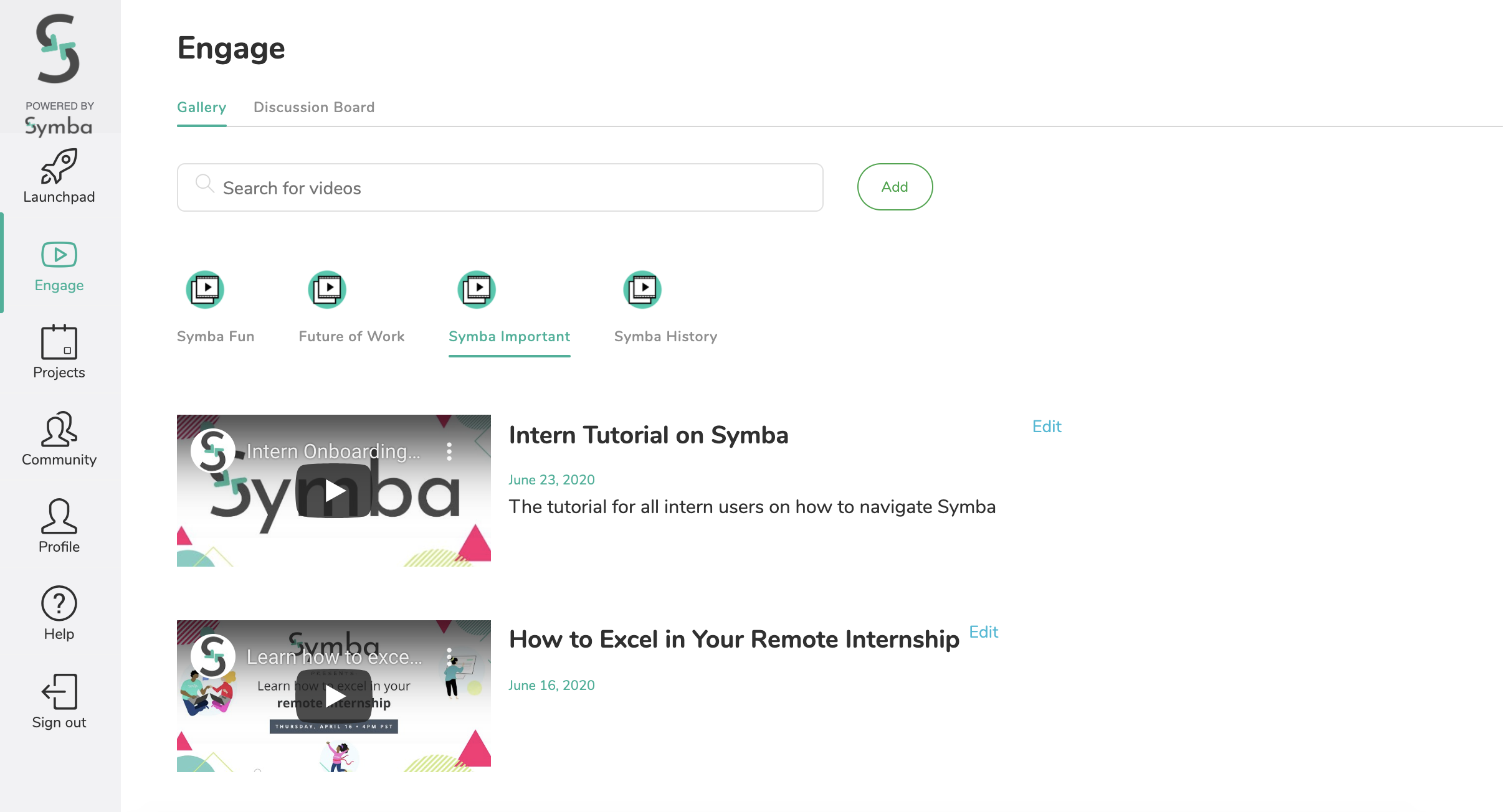
Interns are brought to a workspace upon login. Image via Symba.

Sadeghi is joined by co-founder and CTO Nikita Gupta, who built the entire site from scratch.

Symba was built with a big focus on creating channels for feedback between interns and managers. There is a tab dedicated solely to feedback, where managers can consistently rank their direct reports on a five-star rating scale across various skills. Interns are also able to request feedback.

Each user is invited to create a profile so other interns can reach out and learn about their cohort. While Symba wants to be where interns live during their internship, there’s no direct messaging mechanisms within the web-based platform. Instead, Symba has embedded a Slack integration for users who want to talk directly.
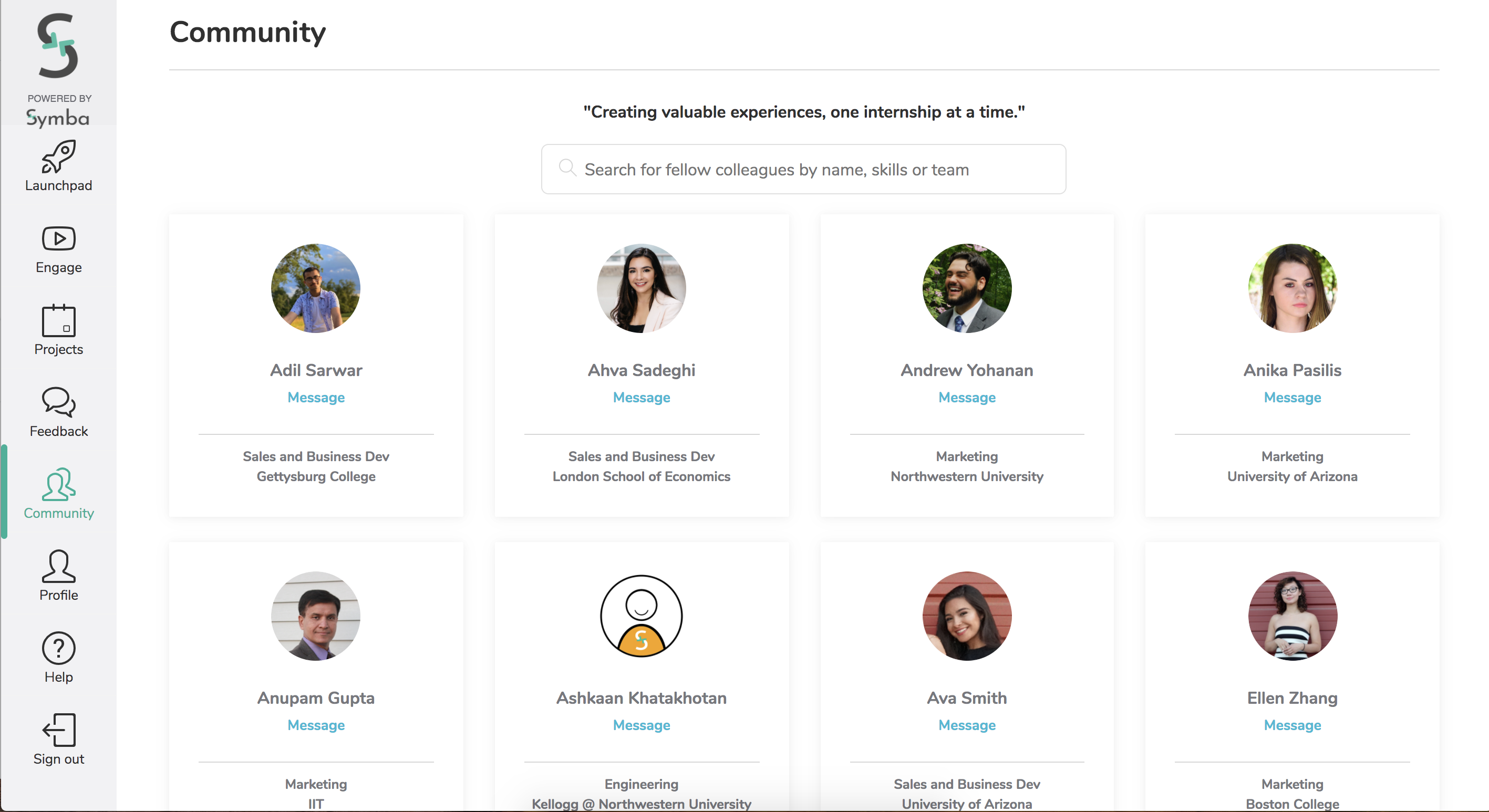
The community board allows interns to meet other interns and chat. Image via Symba.

Managers, on the other hand, are able to log in, assign tasks and check on progress for their direct reports. Feedback is also tracked during the entirety of the internship, to help see who has made progress and deserves a potential return offer.

Because interns come in for only eight to 12 weeks, she says the traditional internship onboarding process — which includes bringing them all onto a company’s full-time tech stack — could create chaos for the organization. Symba wants to be a low-lift alternative.

Sadeghi says that customers have been attracted to the alumni features in their platform, which allow managers to engage interns after the program is complete. The applicant-tracking system works to keep potential hires in the fold of the company.

So far, Symba is optimistic that the tool is working. Users log into the product an average of six to nine times per day, and there have been more than 15,000 intern-projects created on Symba.

The company declined to disclose revenue, citing the stage of its business, but said that it charges companies $30 to $50 per user per month for the product. The average size of a Symba cohort is 80, but they have had customers who bring more than 2,000 interns onto the product. It only works with companies who pay their interns.

A hurdle of Symba will be the seasonality of its revenue. Because most internships are in the summer, Symba will likely find most growth opportunities during that three-month period.

Symba’s early growth is directly related to the pandemic, as the fear of the virus closed offices, and, in turn, shuttered internship programs. Symba’s success will hinge on if the team can convince companies that an online workspace for interns is a necessary product even when offices reopen.

Beyond translating into a post-pandemic world, Symba wants to be a solution for clients such as bootcamps, accelerators or fellowships. If it’s able to land year-round clients, it will be able to balance the seasonality of its current revenue of summer internships.

The success so far is promising: Early momentum has helped Symba raise $750,000 from a number of investors, including 1517 Fund, January Ventures and Hustle Fund.


26 Oct 2020

What would Databricks be worth in a 2021 IPO?

TechCrunch recently covered Databricks’ financial performance in 2020, contrasting its recent performance to some historical 2019 data that the company shared.

The data-and-analysis focused unicorn grew its annual run rate 75% to $350 million, compared to its year-ago quarter, meaning that the firm is growing well at scale. TechCrunch described it as “an obvious IPO candidate” at the time, a little under two weeks ago.


The Exchange explores startups, markets and money. Read it every morning on Extra Crunch, or get The Exchange newsletter every Saturday.


Since that point, Bloomberg reported that Databricks is indeed charging ahead with an IPO, a transaction that could come as soon as the first half of 2021, writing that that it “has held talks with banks but has yet to hire underwriters” for its flotation.

That is enough news for us to have fun with. So, this morning let’s collate all that we know about the company’s financial performance, mix in some current market valuation metrics, and do some light projecting of Databricks’ growth. Our question? What might the company be worth at the end of Q1 or Q2 next year.

Of course, there are some worrying signs on the horizon that the stock market is about to shift lower, but, hey, there’s no need to be a pessimist this early on a Monday morning. Let’s get into the math.

Databricks’ potential IPO valuations

Starting with some history, Databricks was worth $6.2 billion after its September, 2019 Series F round of capital. The company raised $400 million in the transaction, its largest round to-date by $150 million. That capital should get the company to an H1 2020 IPO, provided that its spending didn’t go all old-school Dropbox.

26 Oct 2020

YouTube revamps its mobile app with new gestures, video chapter lists, and more

YouTube today is rolling out a series of updates to its player page on mobile devices. The changes relocate some elements, add new features — like an expanded set of gesture-based navigation options — and update existing ones, like video chapters, among other things.

Video chapters were introduced in May, as an easier way to get to the “good part” of a video, without having to manually fast-forward. Instead, creators can apply timestamps to their videos that allow users to quickly jump to a specific section of a video or backtrack to rewatch a key part.

These chapters are automatically enabled as a line of timestamps and titles, based on chapter information the creator adds to their video’s description, beginning at segment 0:00.

youtube video chapters (gif)

Image Credits: YouTube

Today, YouTube is extending this feature to include a new list view that lets you see a complete list of all the chapters included in the video, each with their own preview thumbnail. You can access this list view by tapping or clicking on the chapter title in the player, then jump to the part of the video you want to see by tapping the video chapter in the list.

This make chapters easier to navigate, as the thumbnails offer a visual guide to the various parts of the video.

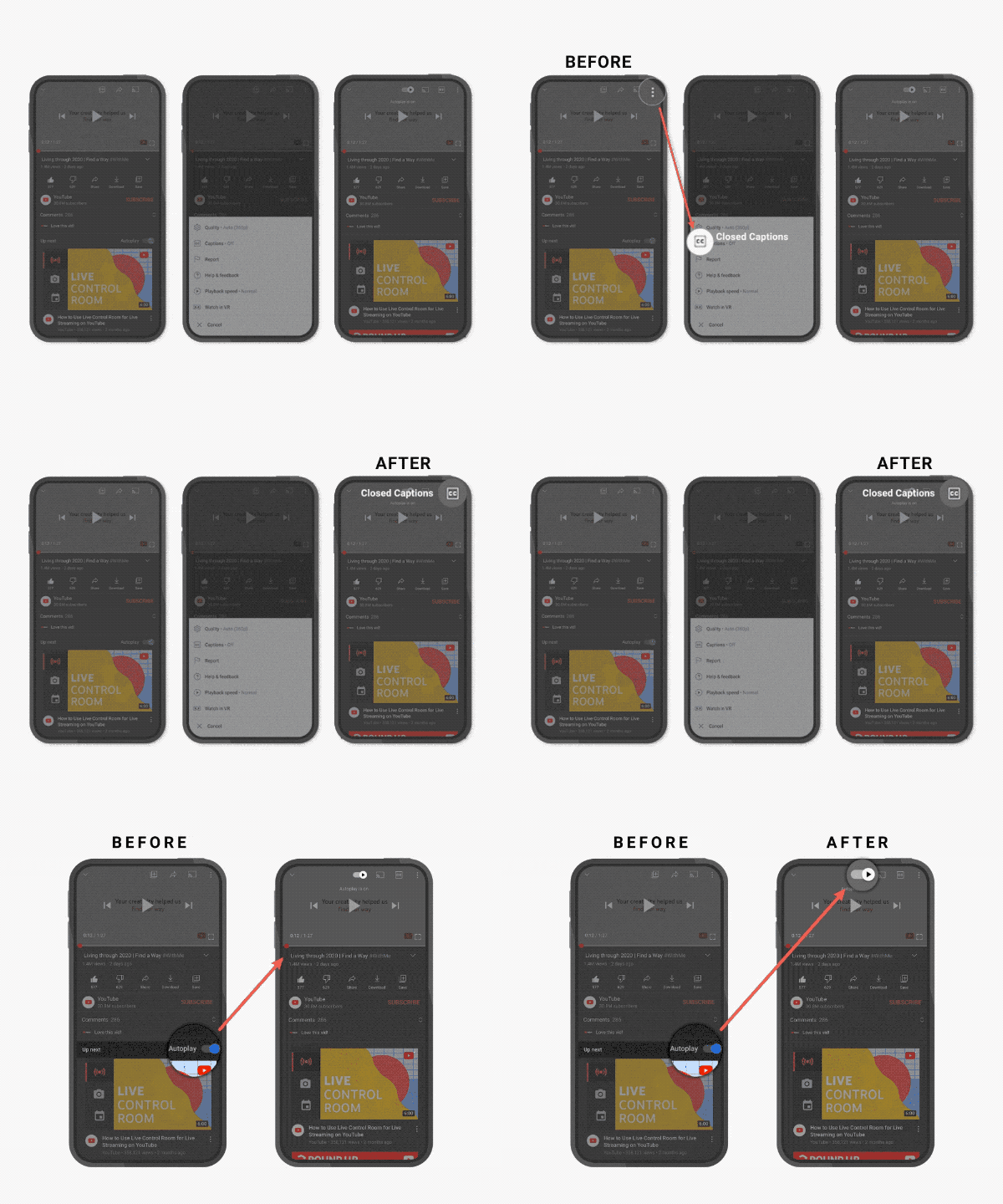
YouTube is also today updating its player page. To make captions more accessible, it’s moving the button to a more prominent position on mobile phones. The auto-play toggle has been moved as well, so it’s easier to turn it on or off while you’re watching a video — a change that will roll out to desktop users soon, too, YouTube says.

youtube caption and autoplay (gif)

Image Credits: YouTube

There are other small improvements on the new player page, including a re-arranged buttons and controls that respond to your input faster than they did before.

Along with the user interface changes, navigation has been updated to include an expanded set of gesture controls. Already, you can double tap on the left or right side of a video to either fast forward or rewind 10 seconds. Now, you’ll be able to swipe up to enter full screen mode and swipe down to exit full screen, too.

youtube gestures (gif)

Image Credits: YouTube

And if you want to see how much time is counting down versus how much time has elapsed in a video you’re watching, you can tap the timestamp to switch back and forth between these numbers.

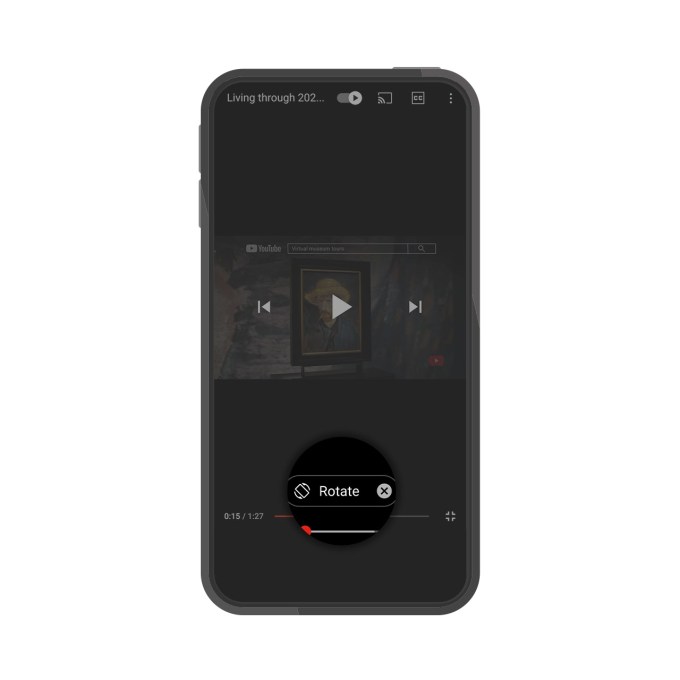
In another change, YouTube will prompt viewers with “suggested actions” when there’s a way to have a better video experience. For example, you may be prompted to rotate your phone for a landscape video, or play a video in VR. Over time, it will roll out more suggestions, as needed.

Image Credits: YouTube

In its announcement today, YouTube mentioned a bedtime reminders feature which actually launched earlier this year. It’s not clear why it was lumped in with the other changes, as it’s already live. (YouTube says it was just a “recap”).

Many of the other changes may not be new to all users, either, however. YouTube confirmed to TechCrunch that some users will already have these features at the time of the announcement, while others will receive them this week.

The updates will roll out across both iOS and Android, starting today.

26 Oct 2020

Mario Kart Live: Home Circuit gets unofficial remote play on Surrogate.tv

Readers of a certain age will no doubt remember some region variation of TV Powww. The syndicated program, which found viewers at home giving directions over the phone to an in-studio operating playing an Intellivision game.

Perhaps the best-known variant is New York’s TV PIXXX, wherein the player would say “PIXX” (a reference to the station’s call letters), in hopes of winning a T-shirt or U.S. Savings Bond. The game was, famously, plagued with the sorts of technical and latency issues one might expect from such an enterprise.

Technology has, thankfully, come a long way since then. Live streaming and cloud gaming in particular have finally started coming into their own in recent years. Founded in 2017, Finnish service Surrogate.tv offers a clever twist on these verticals, offering remote play versions of games with physical elements. Things like pinball, robot fighting and claw machines feature prominently. Naturally, all of that makes Mario Kart Live: Home Circuit a perfect candidate for what the site offers.

Launched last week, Surrogate is currently offering users the chance to play the game remotely during a number of blocks throughout the week (keep in mind that human beings need to be present in-person on the other side). Using the service, four players at a time can control the RC karts, using feeds from the the remote Switches that offer up the AR overlay.

Image Credits: Surrogate

To accomplish the experience (which, Surrogate is quick to note, is in no way affiliate with Nintendo), the site emulated the Switch using the GitHub NSGadgetPi project, which is built with an Adafruit M0 microcontroller. Beyond that, each of the karts, meanwhile, requires the following, per Surrogate,

  • Nintendo Switch – To run the game.

  • Nintendo Mario or Luigi RC Kart – To be driven on the race track.

  • Raspberry Pi 4 – To run SurroRTG and Surrogate’s custom image recognition.

  • HDMI Capture Card – To capture the video feed.

  • USB Sound Card – To capture the sound.

Image Credits: Surrogate

It’s a fun way to experience the game without spending $99 on a kart (and four times that to get the full four-player in-person experience). Though, as anticipated, there are some lag issues, as a few of our staff members who have tried it out can attest. Getting the hang of it takes a few races, and that can eat up some serious time. Depending on when you play, the waiting list gets pretty long — and getting some press coverage will likely only make matter worse.

Image Credits: Surrogate

At very least, however, things have improved tremendously since the days of TV Powww.

26 Oct 2020

Mario Kart Live: Home Circuit gets unofficial remote play on Surrogate.tv

Readers of a certain age will no doubt remember some region variation of TV Powww. The syndicated program, which found viewers at home giving directions over the phone to an in-studio operating playing an Intellivision game.

Perhaps the best-known variant is New York’s TV PIXXX, wherein the player would say “PIXX” (a reference to the station’s call letters), in hopes of winning a T-shirt or U.S. Savings Bond. The game was, famously, plagued with the sorts of technical and latency issues one might expect from such an enterprise.

Technology has, thankfully, come a long way since then. Live streaming and cloud gaming in particular have finally started coming into their own in recent years. Founded in 2017, Finnish service Surrogate.tv offers a clever twist on these verticals, offering remote play versions of games with physical elements. Things like pinball, robot fighting and claw machines feature prominently. Naturally, all of that makes Mario Kart Live: Home Circuit a perfect candidate for what the site offers.

Launched last week, Surrogate is currently offering users the chance to play the game remotely during a number of blocks throughout the week (keep in mind that human beings need to be present in-person on the other side). Using the service, four players at a time can control the RC karts, using feeds from the the remote Switches that offer up the AR overlay.

Image Credits: Surrogate

To accomplish the experience (which, Surrogate is quick to note, is in no way affiliate with Nintendo), the site emulated the Switch using the GitHub NSGadgetPi project, which is built with an Adafruit M0 microcontroller. Beyond that, each of the karts, meanwhile, requires the following, per Surrogate,

  • Nintendo Switch – To run the game.

  • Nintendo Mario or Luigi RC Kart – To be driven on the race track.

  • Raspberry Pi 4 – To run SurroRTG and Surrogate’s custom image recognition.

  • HDMI Capture Card – To capture the video feed.

  • USB Sound Card – To capture the sound.

Image Credits: Surrogate

It’s a fun way to experience the game without spending $99 on a kart (and four times that to get the full four-player in-person experience). Though, as anticipated, there are some lag issues, as a few of our staff members who have tried it out can attest. Getting the hang of it takes a few races, and that can eat up some serious time. Depending on when you play, the waiting list gets pretty long — and getting some press coverage will likely only make matter worse.

Image Credits: Surrogate

At very least, however, things have improved tremendously since the days of TV Powww.

26 Oct 2020

Pinterest’s new widget brings photos from favorite boards to your iOS 14 homescreen

As iPhone owners began customizing their iOS 14 homescreens with new widgets and custom icons, Pinterest iOS downloads and searches surged as the app became a top source for design ideas and inspiration. Today, Pinterest is more directly joining the homescreen customization trend with its own iOS 14 widget of its own.

Last month, Pinterest broke its daily download record when it saw over 600,000+ downloads in a single day. Though third-party estimates disagreed on which day the new record was achieved, multiple firms saw an outsized number of new users downloading the Pinterest mobile app. The demand was directly tied to the #ios14homescreen redesign trend that was also being shared across social media as users showed off how they were using iOS 14’s new widgets, along with matching wallpapers and custom icons for app shortcuts to give their homescreen a new “aesthetic.”

During this time, Pinterest says it saw searches for ideas like “indie ios 14 homescreen” spike by 15x in the week following the iOS 14 launch compared with the week prior, while searches for “iPhone aesthetic” were up by 19x.

The trend also pushed custom widget makers — like Widgetsmith, Color Widgets, and Photo Widget — up to the top of the App Store charts, as they allowed users to add photos and other colorful widgets to their homescreen.

Similarly, the new Pinterest widget launching today could make for a good alternative to a static photo widget.

Instead of choosing a photo or album of photos saved to your Camera Roll to serve as the source for your iOS 14 homescreen photos as with other photo widgets, the new Pinterest widget allows you to select a Pinterest board as your photo source. The board can either be one of your own or one that you follow.

For example, you could add a widget that features your favorite motivational quotes or one that serves of photos of travel inspiration or style ideas. You could also create seasonal boards, like those for Halloween or fall or Christmas or winter, to make it easier to swap between different homescreen “aesthetics” with the changing seasons.

Pinterest says the new widget will update the photo it features on an hourly on daily basis, depending on your preferences. The widget can also be set either as a small photo or large one, but the company notes there’s no medium option as it’s not optimal for Pin length.

The widget is also interactive. When you tap the Pinterest widget, you’ll be launched directly to that Pin in the app.

As you find new photos that fit your homescreen aesthetic, you can add them to your board to keep a fresh set of photos appearing on your homescreen.

The updated app with the widget is rolling out to iOS users worldwide starting today, Pinterest says.


26 Oct 2020

Pinterest’s new widget brings photos from favorite boards to your iOS 14 homescreen

As iPhone owners began customizing their iOS 14 homescreens with new widgets and custom icons, Pinterest iOS downloads and searches surged as the app became a top source for design ideas and inspiration. Today, Pinterest is more directly joining the homescreen customization trend with its own iOS 14 widget of its own.

Last month, Pinterest broke its daily download record when it saw over 600,000+ downloads in a single day. Though third-party estimates disagreed on which day the new record was achieved, multiple firms saw an outsized number of new users downloading the Pinterest mobile app. The demand was directly tied to the #ios14homescreen redesign trend that was also being shared across social media as users showed off how they were using iOS 14’s new widgets, along with matching wallpapers and custom icons for app shortcuts to give their homescreen a new “aesthetic.”

During this time, Pinterest says it saw searches for ideas like “indie ios 14 homescreen” spike by 15x in the week following the iOS 14 launch compared with the week prior, while searches for “iPhone aesthetic” were up by 19x.

The trend also pushed custom widget makers — like Widgetsmith, Color Widgets, and Photo Widget — up to the top of the App Store charts, as they allowed users to add photos and other colorful widgets to their homescreen.

Similarly, the new Pinterest widget launching today could make for a good alternative to a static photo widget.

Instead of choosing a photo or album of photos saved to your Camera Roll to serve as the source for your iOS 14 homescreen photos as with other photo widgets, the new Pinterest widget allows you to select a Pinterest board as your photo source. The board can either be one of your own or one that you follow.

For example, you could add a widget that features your favorite motivational quotes or one that serves of photos of travel inspiration or style ideas. You could also create seasonal boards, like those for Halloween or fall or Christmas or winter, to make it easier to swap between different homescreen “aesthetics” with the changing seasons.

Pinterest says the new widget will update the photo it features on an hourly on daily basis, depending on your preferences. The widget can also be set either as a small photo or large one, but the company notes there’s no medium option as it’s not optimal for Pin length.

The widget is also interactive. When you tap the Pinterest widget, you’ll be launched directly to that Pin in the app.

As you find new photos that fit your homescreen aesthetic, you can add them to your board to keep a fresh set of photos appearing on your homescreen.

The updated app with the widget is rolling out to iOS users worldwide starting today, Pinterest says.


26 Oct 2020

SAP shares fall sharply after COVID-19 cuts revenue, profit forecast at software giant

SAP announced its Q3 earnings yesterday, with its aggregate results down across the board. And after missing earnings expectations, the company also revised its 2021 outlook down. The combined bad news spooked investors, crashing its shares by over 20% in pre-market trading and the stock wasn’t showing any signs of improving in early trading.

The German software giant has lost tens of billions of dollars in market cap as a result.

The overall report was gloomy, with total revenues falling 4% to €6.54 billion, cloud and software revenue down 2%, and operating profit down 12%. The only bright spot was its pure-cloud category, which grew 11% to €1.98 billion.

SAP’s revenue result was around €310 million under expectations, though its per-share profit beat both adjusted, and non-adjusted expectations.

While SAP’s big revenue miss might have been enough to send investors racing for the exits, its revised forecast doubled concerns. Even though the company said that its customers are accelerating their move to the cloud during the pandemic — something that TechCrunch has been tracking for some time now — SAP also said that the pandemic is slowing sales, and large projects.

Constellation Research anayst Holger Mueller says this is resulting in an unexpected revenue slow-down.

“What has happened at SAP is a cloud revenue delay as customers know that SAP is only investing into cloud products, and they have to migrate to those in the future. The news is that SAP customers are not migrating to the cloud during a pandemic,” Mueller told TechCrunch.

In a sign of the times, SAP spent a portion of its earnings results talking about 2025 results, a maneuver that failed to allay investor concerns that the pandemic was dramatically impacting SAP’s business today and in the coming year.

For 2020, SAP made the following cuts to its forecasts:

  • €8.0 – 8.2 billion non-IFRS cloud revenue at constant currencies (previously €8.3 – 8.7 billion
  • €23.1 – 23.6 billion non-IFRS cloud and software revenue at constant currencies (previously €23.4 – 24.0 billion)
  • €27.2 – 27.8 billion non-IFRS total revenue at constant currencies (previously €27.8 – 28.5 billion)
  • €8.1 – 8.5 billion non-IFRS operating profit at constant currencies (previously €8.1 – 8.7 billion)

So, €300 million to €500 million in cloud revenue is now gone, along with €300 million to €400 million in cloud and software revenue, and €600 to €700 million in total revenue. That cut profit expectations by up to €200 million.

The company, however, is trying to put a happy face on the future projections, believing that as the impact of COVID begins to diminish, existing customers will eventually shift to the cloud and that will drive significant new revenues over the longer term. The trade-off is short-term pain for the next year or two.

“Over the next two years, we expect to see muted growth of revenue accompanied by a flat to slightly lower operating profit. After 2022 momentum will pick up considerably though. Initial headwinds of the accelerated cloud transition will start to turn into tailwinds for revenue and profit. […] That translates to accelerated revenue growth and double digit operating profit growth from 2023 onwards,” SAP CFO Luka Mucic said in a call with analysts this morning.

The question now becomes can they meet these projections, and if the longer-term approach during a pandemic will placate investors. As of this morning, they weren’t looking happy about it.

26 Oct 2020

SAP shares fall sharply after COVID-19 cuts revenue, profit forecast at software giant

SAP announced its Q3 earnings yesterday, with its aggregate results down across the board. And after missing earnings expectations, the company also revised its 2021 outlook down. The combined bad news spooked investors, crashing its shares by over 20% in pre-market trading and the stock wasn’t showing any signs of improving in early trading.

The German software giant has lost tens of billions of dollars in market cap as a result.

The overall report was gloomy, with total revenues falling 4% to €6.54 billion, cloud and software revenue down 2%, and operating profit down 12%. The only bright spot was its pure-cloud category, which grew 11% to €1.98 billion.

SAP’s revenue result was around €310 million under expectations, though its per-share profit beat both adjusted, and non-adjusted expectations.

While SAP’s big revenue miss might have been enough to send investors racing for the exits, its revised forecast doubled concerns. Even though the company said that its customers are accelerating their move to the cloud during the pandemic — something that TechCrunch has been tracking for some time now — SAP also said that the pandemic is slowing sales, and large projects.

Constellation Research anayst Holger Mueller says this is resulting in an unexpected revenue slow-down.

“What has happened at SAP is a cloud revenue delay as customers know that SAP is only investing into cloud products, and they have to migrate to those in the future. The news is that SAP customers are not migrating to the cloud during a pandemic,” Mueller told TechCrunch.

In a sign of the times, SAP spent a portion of its earnings results talking about 2025 results, a maneuver that failed to allay investor concerns that the pandemic was dramatically impacting SAP’s business today and in the coming year.

For 2020, SAP made the following cuts to its forecasts:

  • €8.0 – 8.2 billion non-IFRS cloud revenue at constant currencies (previously €8.3 – 8.7 billion
  • €23.1 – 23.6 billion non-IFRS cloud and software revenue at constant currencies (previously €23.4 – 24.0 billion)
  • €27.2 – 27.8 billion non-IFRS total revenue at constant currencies (previously €27.8 – 28.5 billion)
  • €8.1 – 8.5 billion non-IFRS operating profit at constant currencies (previously €8.1 – 8.7 billion)

So, €300 million to €500 million in cloud revenue is now gone, along with €300 million to €400 million in cloud and software revenue, and €600 to €700 million in total revenue. That cut profit expectations by up to €200 million.

The company, however, is trying to put a happy face on the future projections, believing that as the impact of COVID begins to diminish, existing customers will eventually shift to the cloud and that will drive significant new revenues over the longer term. The trade-off is short-term pain for the next year or two.

“Over the next two years, we expect to see muted growth of revenue accompanied by a flat to slightly lower operating profit. After 2022 momentum will pick up considerably though. Initial headwinds of the accelerated cloud transition will start to turn into tailwinds for revenue and profit. […] That translates to accelerated revenue growth and double digit operating profit growth from 2023 onwards,” SAP CFO Luka Mucic said in a call with analysts this morning.

The question now becomes can they meet these projections, and if the longer-term approach during a pandemic will placate investors. As of this morning, they weren’t looking happy about it.

26 Oct 2020

U.S. Space Force Lt. General John F. Thompson will join us at TC Sessions: Space in December

Our first-ever dedicated space event is coming up on December 16 and 17, and we’re thrilled to announce that Lieutenant General John F. Thompson of the U.S. Air Force will join us on our virtual stage at TC Sessions: Space. Thompson is the Commander, Space and Missile Systems Center (SMC) and oversees research, design, development and acquisition of satellites and their associated command and control systems for the U.S. Space Force.

We’re excited to have Thompson joining us because his role puts him directly in contact with some of the country’s most ambitious and technically advanced startups. As the person responsible for ensuring that the U.S. has a commanding position in areas including advanced missile warning, space launch, space superiority in the emerging defense arena and much more. There’s likely no one in the U.S. defense world closer to the space-focused pipeline for emerging and future-focused technology development.

Lt. Gen. John Thompson, U.S. Space Force

Part of what Thompson and the SMC have accomplished under his supervision is the establishment and continued growth of a rich ecosystem of non-traditional space startups, through both contracting and early stage funding to help them develop novel approaches to challenges both new and old. That work will also form the basis of the forthcoming Space Systems Command (SSC), an in-development command that will be responsible for development, acquisition and deployment of in-space capabilities for the U.S. Space Force. SSC will take its cues from the SMC and its Air Force origins, but be a new, overarching acquisitions entity that also incorporates the needs of Army and Navy space acquisition activities.

We’ll talk to Thompson about that work and how it’s progressing, and what changes about his work and the SMC’s mission as the U.S. continues to establish and grow the Space Force as its own, dedicated military branch.

If you want to hear from Lt General Thompson, you can grab a ticket to get exclusive access to watch this session (along with many others) live (with access to video on demand), network with the innovators changing the space industry, discover the hottest early-stage companies, learn how to score grants for your space company, recruit talent or even find a job with an early-bird ticket for just $125 until November 13. And we have discounts available for groupsstudentsactive military/government employees and for early-stage space startup founders who want to give their startup some extra visibility.