
Year: 2020

23 Oct 2020

Nordic challenger bank Lunar raises €40M Series C, plans to enter the ‘buy now, pay later’ space

Lunar, the Nordic challenger bank that started out life as a personal finance manager app (PFM) but acquired a full banking license in 2019, has raised €40 million in Series C funding from existing investors.

The injection of capital follows a €20 million Series B disclosed in April this year and comes on the back of Lunar rolling out Pro paid-for subscriptions — similar to a number of other challenger banks in Europe — personal consumer loans, and the launch of business bank accounts in August.

The latter appears to have been an instant success, perhaps proof there is — like in the U.K. — pent up demand for more accessible banking for sole traders. Just months since launching in Denmark, Lunar Business claims to have signed up more than 50% of all newly founded sole trader businesses in the country.

I’m also told that Lunar has seen “best-in-class” user engagement with users spending €1,100 per month versus what the bank says is a €212 EU average for card transactions. Overall, the bank has 5,000 business users and 200,000 private users across Denmark, Sweden and Norway.

Meanwhile — and most noteworthy — after launching its first consumer lending products on its own balance sheet, Lunar has set its sights on the “buy now, pay later” market, therefore theoretically encroaching on $10.65 billion valued Klarna, and Affirm in the U.S. which just filed to go public. Other giants in the BNPL space also include PayPal.

Lunar founder and CEO Ken Villum Klausen says the “schizophrenic” Nordic banking market is the reason why the challenger is launching BNPL. “It’s the most profitable banking landscape in the world, but also the most defensive, with least competition from the outside,” he says. “This means that the traditional banking customer is buying all their financial products from their bank”.

It is within this context that Lunar’s BNPL products are built as “post-purchase,” where Lunar will prompt its users after they have bought something (not dissimilar to Curve’s planned credit offering). For example, if you were to buy a new television, the app will ask if you want to split the purchase into instalments. “This does not require merchant agreements etc, and will work on all transactions both retail and e-commerce,” explains Klausen.

“We do not view Klarna as a direct competitor as they are not in the Nordic clearing system,” he adds. “Hence, you cannot pay your bills, get your salary and use it for daily banking. Klarna is enormous in Sweden, but relatively small in Denmark, Norway and Finland”.

In total, Lunar has raised €104 million from investors including Seed Capital, Greyhound Capital, Socii Capital and Chr. Augustinus Fabrikker. The challenger has offices in Aarhus, Copenhagen, Stockholm and Oslo, with a headcount of more than 180 employees. It plans to launch its banking app in Finland in the first half of 2021.

23 Oct 2020

France rebrands contact-tracing app in an effort to boost downloads

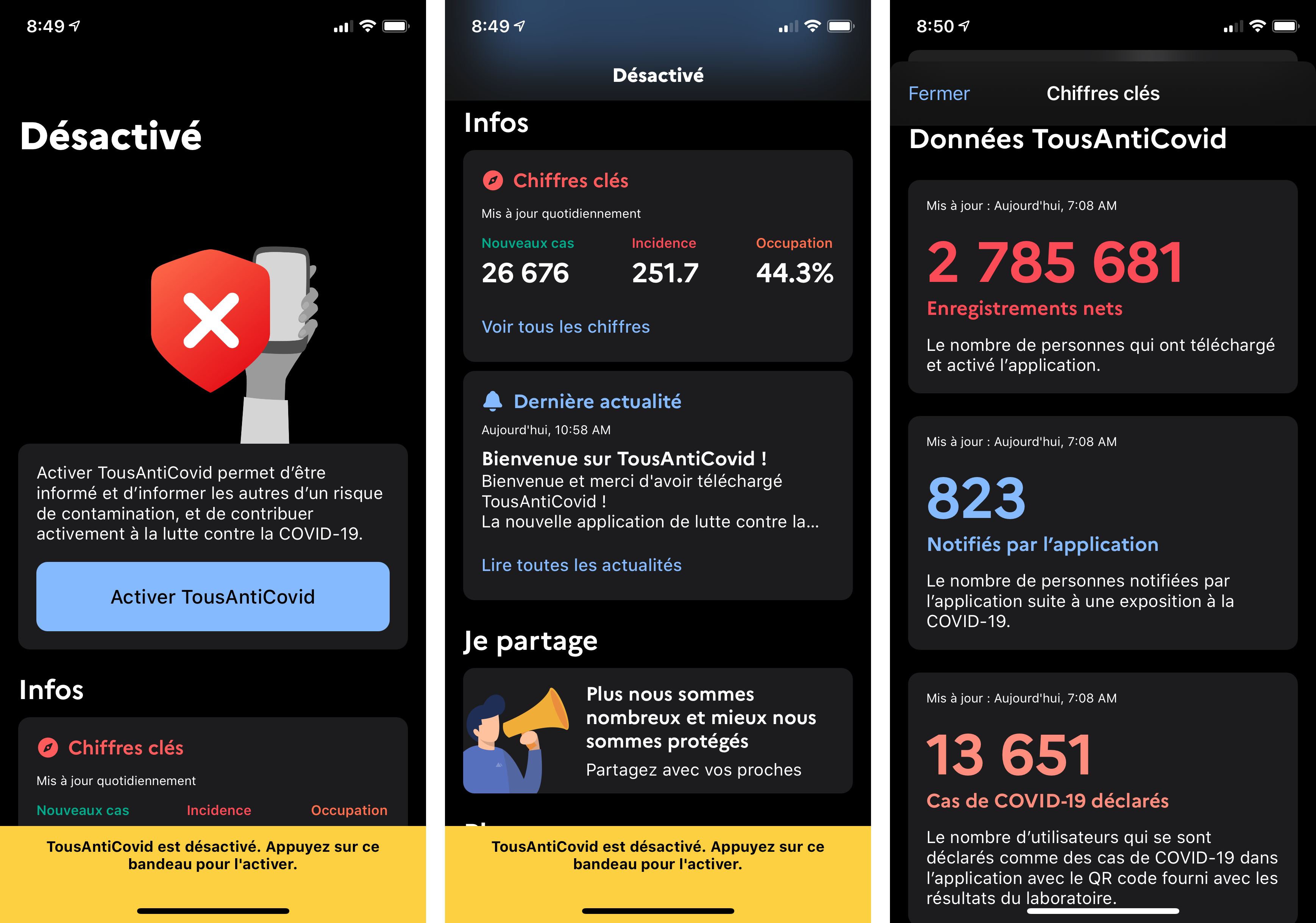
Don’t call it StopCovid anymore. France’s contact-tracing app has been updated and is now called TousAntiCovid, which means ‘everyone against Covid’. The French government is trying to pivot so that it’s no longer a contact-tracing app — or at least not just a contact-tracing app.

Right now, TousAntiCovid appears to be a rebranding more than a pivot. There’s a new name and some changes in the user interface. But the core feature of the app remains unchanged.

StopCovid hasn’t been a success. First, it’s still unclear whether contact-tracing apps are a useful tool to alert people who have been interacting with someone who has been diagnosed COVID-19-positive. Second, even when you take that into consideration, the app never really took off.

Back in June, the French government gave us an update on StopCovid three weeks after its launch. 1.9 million people had downloaded the app, but StopCovid only sent 14 notifications.

Four months later, StopCovid/TousAntiCovid has been downloaded and activated by close to 2.8 million people. But only 13,651 people declared themselves as COVID-19-positive in the app, which led to 823 notifications. Even if you’re tested positive, in most cases, no one is going to be notified.

Hence today’s update. If you’ve been using the app, you’ll receive TousAntiCovid with a software update — the French government is using the same App Store and Play Store listing. When you first launch the app, you go through an onboarding process focused on contact-tracing — activate notifications, activate Bluetooth, etc.

France is using its own contact-tracing protocol called ROBERT. A group of researchers and private companies have worked on a centralized architecture. The server assigns you a permanent ID (a pseudonym) and sends to your phone a list of ephemeral IDs derived from that permanent ID.

Like most contact-tracing apps, TousAntiCovid relies on Bluetooth Low Energy to build a comprehensive list of other app users you’ve interacted with for more than a few minutes. If you’re using the app, it collects the ephemeral IDs of other app users around you.

If you’re using the app and you’re diagnosed COVID-19-positive, your testing facility will hand you a QR code or a string of letters and numbers. You can choose to open the app and enter that code to share the list of ephemeral IDs of people you’ve interacted with over the past two weeks.

The server back end then flags all those ephemeral IDs as belonging to people who have potentially been exposed to the coronavirus. On the server again, each user is associated with a risk score. If it goes above a certain threshold, the user receives a notification. The app then recommends you get tested and follow official instructions.

But there are some new things in the app. You can now access some recent numbers about the pandemic in France — new cases over the past 24 hours, number of people in intensive care unit, etc. There’s a new feed of news items. Right now, it sums up what you can do and cannot do in France

And there are some new links for useful resources — the service that tells you where you can get tested and a link to the exemption certificate during the curfew. When you tap on those links, it simply launches your web browser to official websites.

Let’s see how the app evolves as the government now wants to actively iterate on TousAntiCovid to make it more attractive. If TousAntiCovid can become a central information hub for your phone, it could attract more downloads.

23 Oct 2020

India’s Flipkart buys over $200 million stake in Aditya Birla Fashion and Retail

Flipkart is acquiring a 7.8% stake in Aditya Birla Fashion as the Walmart-owned Indian e-commerce firm makes further push into the fashion category in one of the world’s largest retail markets.

The e-commerce group will pay $203.8 million for its stake in Aditya Birla Fashion and Retail, a conglomerate that operates over 3,000 stores including the Pantaloons brand. As part of the “landmark partnership,” Flipkart will also sell and distribute various Aditya Birla Fashion and Retail’s brands products.

“This partnership is an emphatic endorsement of the growth potential of India,” said Kumar Mangalam Birla, Chairman of Aditya Birla Group, which operates the fashion retail firm in a filing to the stock exchange. “It also reflects our strong conviction in the future of the apparel industry in India, which is poised to touch $100 billion in the next 5 years.”

Kalyan Krishnamurthy, CEO of Flipkart Group, said the two companies will work toward “making available a wide range of products for fashion-conscious consumers across different retail formats across the country. We look forward to working with ABFRL and its well established and comprehensive fashion and retail infrastructure as we address the promising opportunity of the apparel industry in India.”

In July, Flipkart also invested $35 million in $35 million in Arvind Fashions, one of the decades-old Indian firm’s subsidiaries.

More to follow…

22 Oct 2020

Senate subpoenas could force Zuckerberg and Dorsey to testify on New York Post controversy

The Senate Judiciary Committee voted in favor of issuing subpoenas for Facebook’s Mark Zuckerberg and Twitter’s Jack Dorsey Thursday, meaning that there might be two big tech CEO hearings on the horizon.

Republicans in the committee declared their interest in a hearing on “the platforms’ censorship of New York Post articles” after social networks limited the reach of a dubious story purporting to contain hacked materials implicating Hunter Biden, Joe Biden’s son, in impropriety involving a Ukrainian energy firm. Fox News reportedly passed on the story due to doubts about its credibility.

Tech’s decision to take action against the New York Post story was bound to ignite Republicans in Congress, who have long claimed, with scant evidence, that social platforms deliberately censor conservative voices due to political bias. The Senate Judiciary Committee is chaired by Lindsey Graham (R-SC), a close Trump ally who is now in a much closer than expected race with Democratic challenger Jaime Harrison.

Earlier in October, the Senate Commerce Committee successfully leveraged subpoena power to secure Dorsey, Zuckerberg and Alphabet’s Sundar Pichai for testimony for their own hearing focused on Section 230, the critical law that shields online platforms from liability for user created content.

The hearing isn’t scheduled yet, nor have the companies publicly agreed to attend. But lawmakers have now established a precedent for successfully dragging tech’s reluctant leaders under oath, making it more difficult for some of the world’s wealthiest and most powerful men to avoid Congress from here on out.

22 Oct 2020

Senate subpoenas could force Zuckerberg and Dorsey to testify on New York Post controversy

The Senate Judiciary Committee voted in favor of issuing subpoenas for Facebook’s Mark Zuckerberg and Twitter’s Jack Dorsey Thursday, meaning that there might be two big tech CEO hearings on the horizon.

Republicans in the committee declared their interest in a hearing on “the platforms’ censorship of New York Post articles” after social networks limited the reach of a dubious story purporting to contain hacked materials implicating Hunter Biden, Joe Biden’s son, in impropriety involving a Ukrainian energy firm. Fox News reportedly passed on the story due to doubts about its credibility.

Tech’s decision to take action against the New York Post story was bound to ignite Republicans in Congress, who have long claimed, with scant evidence, that social platforms deliberately censor conservative voices due to political bias. The Senate Judiciary Committee is chaired by Lindsey Graham (R-SC), a close Trump ally who is now in a much closer than expected race with Democratic challenger Jaime Harrison.

Earlier in October, the Senate Commerce Committee successfully leveraged subpoena power to secure Dorsey, Zuckerberg and Alphabet’s Sundar Pichai for testimony for their own hearing focused on Section 230, the critical law that shields online platforms from liability for user created content.

The hearing isn’t scheduled yet, nor have the companies publicly agreed to attend. But lawmakers have now established a precedent for successfully dragging tech’s reluctant leaders under oath, making it more difficult for some of the world’s wealthiest and most powerful men to avoid Congress from here on out.

22 Oct 2020

Representatives propose bill limiting Presidential internet ‘kill switch’

A pair of U.S. Representatives — one from each party — are proposing a law that would limit the President’s ability to shut down the internet at will. That may not strike you as an imminent threat, but federal police disappearing protestors into unmarked vans probably didn’t either, until a couple months ago. Let’s keep an open mind.

The President has the power under the Communications Act’s Section 706 to order the shutdown of some communications infrastructure in an emergency. While this was likely intended more for making sure official phonecalls could get through in a national emergency, it’s possible that today it could be used as a measure to tamp down on protests and civil unrest, as we’ve seen in authoritarian regimes around the world.

The Preventing Unwarranted Communications Shutdowns Act, from Rep. Anna Eshoo (D-CA) and Rep. Morgan Griffith (R-VA), doesn’t remove this ability, but adds several layers of accountability to it.

In the first place, the bill would limit Section 706 use to when there is an “imminent and specific threat to human life or national security.” This prevents it from being put into play when there is a more general “threat” such as a major protest that might be too much for local police to handle.

The bill would also require the President to inform the top layer of government officials, including opposition leaders, of any shutdown. Ideally before, but it could be up to 12 hours later (and is illegal if not by then). Any shutdown ends automatically after 48 hours unless 3/5 of Congress vote to continue it.

The U.S. government would also be obligated to compensate providers and customers for the monetary value of the shutdown’s impact. This could end up being quite expensive depending on how it’s calculated.

Lastly, a General Accountability Office report is required after every use of Section 706, and they get to the bottom of everything.

Whether this bill has any chance of becoming law is, like practically everything these days, anyone’s guess. But bipartisan laws limiting potential curtailments of civil rights by the White House are probably going to be fairly popular after the feds’ shenanigans over the summer.

At the very least it has some heavy hitters offering glowing blurbs:

FCC Commissioner Jessica Rosenworcel: “In the United States our laws are dated and they offer virtually unchecked power to the president over our wired and wireless communications when we face peril or national emergency. So kudos to Congresswoman Eshoo for legislation to modernize our laws and put in place safeguards to ensure that the internet stays on when we need it most.”

Former Secretary of Homeland Security Michael Chertoff: “A long overdue check and balance on a President’s authority to shut down or significantly curtail internet communication under the guise of an emergency.”

Former FCC Chairman Tom Wheeler: “in a time of emergency, how the internet operates is in the hands of one person. Defining that authority in a focused manner and adding congressional oversight would bring an old statute into the digital age.”

Cybersecurity mainstay Bruce Schneier: “The Internet is critical infrastructure, and needs to be protected from politically motivated shut-downs. This bill helps ensures that the communications censorship that is increasingly common in other countries doesn’t happen in the US. It adds process, and checks and balances, to what is currently an ad hoc authority.”

You can read more about the bill and read the full text here.

22 Oct 2020

Representatives propose bill limiting Presidential internet ‘kill switch’

A pair of U.S. Representatives — one from each party — are proposing a law that would limit the President’s ability to shut down the internet at will. That may not strike you as an imminent threat, but federal police disappearing protestors into unmarked vans probably didn’t either, until a couple months ago. Let’s keep an open mind.

The President has the power under the Communications Act’s Section 706 to order the shutdown of some communications infrastructure in an emergency. While this was likely intended more for making sure official phonecalls could get through in a national emergency, it’s possible that today it could be used as a measure to tamp down on protests and civil unrest, as we’ve seen in authoritarian regimes around the world.

The Preventing Unwarranted Communications Shutdowns Act, from Rep. Anna Eshoo (D-CA) and Rep. Morgan Griffith (R-VA), doesn’t remove this ability, but adds several layers of accountability to it.

In the first place, the bill would limit Section 706 use to when there is an “imminent and specific threat to human life or national security.” This prevents it from being put into play when there is a more general “threat” such as a major protest that might be too much for local police to handle.

The bill would also require the President to inform the top layer of government officials, including opposition leaders, of any shutdown. Ideally before, but it could be up to 12 hours later (and is illegal if not by then). Any shutdown ends automatically after 48 hours unless 3/5 of Congress vote to continue it.

The U.S. government would also be obligated to compensate providers and customers for the monetary value of the shutdown’s impact. This could end up being quite expensive depending on how it’s calculated.

Lastly, a General Accountability Office report is required after every use of Section 706, and they get to the bottom of everything.

Whether this bill has any chance of becoming law is, like practically everything these days, anyone’s guess. But bipartisan laws limiting potential curtailments of civil rights by the White House are probably going to be fairly popular after the feds’ shenanigans over the summer.

At the very least it has some heavy hitters offering glowing blurbs:

FCC Commissioner Jessica Rosenworcel: “In the United States our laws are dated and they offer virtually unchecked power to the president over our wired and wireless communications when we face peril or national emergency. So kudos to Congresswoman Eshoo for legislation to modernize our laws and put in place safeguards to ensure that the internet stays on when we need it most.”

Former Secretary of Homeland Security Michael Chertoff: “A long overdue check and balance on a President’s authority to shut down or significantly curtail internet communication under the guise of an emergency.”

Former FCC Chairman Tom Wheeler: “in a time of emergency, how the internet operates is in the hands of one person. Defining that authority in a focused manner and adding congressional oversight would bring an old statute into the digital age.”

Cybersecurity mainstay Bruce Schneier: “The Internet is critical infrastructure, and needs to be protected from politically motivated shut-downs. This bill helps ensures that the communications censorship that is increasingly common in other countries doesn’t happen in the US. It adds process, and checks and balances, to what is currently an ad hoc authority.”

You can read more about the bill and read the full text here.

22 Oct 2020

Quibi says it will shut down in early December

Quibi is shutting down — we know that much for sure.

But when? If you’re looking to blast through all 25 episodes of the Reno 911 revival series before Quibi calls its quits, how long do you actually have?

While it seems even Quibi isn’t 100% certain yet, they’ve at least now given users a rough idea of when they expect the plug to be pulled: early December.

As spotted by Variety, a newly published support page on the Quibi site says streaming will end “on or about December 1, 2020.” The “about” suggests that the shutdown date isn’t fully locked quite yet, but it should be sometime around then.

Will any Quibi shows find their way over to Netflix, Hulu, etc.? That’s still up in the air, too. “At this time we do not know if the Quibi content will be available anywhere after our last day of service,” the company writes in a note on the same page.

22 Oct 2020

Extra Crunch Partner Perk: Get 6 months free of Zendesk Support and Sales CRM

We’re excited to announce an update to the Extra Crunch Partner Perk from Zendesk. Starting today, annual and two-year Extra Crunch members that are new to Zendesk, and meet their startup qualifications, can now receive six months of free access to Zendesk’s Sales CRM, in addition to Zendesk Support Suite, Zendesk Explore and Zendesk Sunshine.

Here is an overview of the program.

Zendesk is a service-first CRM company with support, sales and customer engagement products designed to improve customer relationships. This offer is only available for startups that are new to Zendesk, have fewer than 100 employees and are funded but have not raised beyond a Series B.

The Zendesk Partner Perk from Extra Crunch is inclusive of subscription fees, free for six months, after which you will be responsible for payment. Any downgrades to your Zendesk subscription will result in the forfeiture of the promotion, so please check with Zendesk first regarding any changes (startups@zendesk.com). Some add-ons such as Zendesk Talk and Zendesk Sell minutes are not included. Complete details of what’s included can be found here.

22 Oct 2020

Daily Crunch: Facebook Dating comes to Europe

Facebook’s dating feature expands after a regulatory delay, we review the new Amazon Echo and President Donald Trump has an on-the-nose Twitter password. This is your Daily Crunch for October 22, 2020.

The big story: Facebook Dating comes to Europe

Back in February, Facebook had to call off the European launch date of its dating service after failing to provide the Irish Data Protection Commission with enough advanced notice of the launch. Now it seems the regulator has given Facebook the go-ahead.

Facebook Dating (which launched in the U.S. last year) allows users to create a separate dating profile, identify secret chats and go on video dates.

As for any privacy and regulatory concerns, the commission told us, “Facebook has provided detailed clarifications on the processing of personal data in the context of the Dating feature … We will continue to monitor the product as it launches across the EU this week.”

The tech giants

Amazon Echo review: Well-rounded sound — This year’s redesign centers on another audio upgrade.

Facebook adds hosting, shopping features and pricing tiers to WhatsApp Business — Facebook is launching a way to shop for and pay for goods and services in WhatsApp chats, and it said it will finally start to charge companies using WhatsApp for Business.

Spotify takes on radio with its own daily morning show — The new program will combine news, pop culture, entertainment and music personalized to the listener.

Startups, funding and venture capital

Chinese live tutoring app Yuanfudao is now worth $15.5 billion — The homework tutoring app founded in 2012 has surpassed Byju’s as the most valuable edtech company in the world.

E-bike subscription service Dance closes $17.7M Series A, led by HV Holtzbrinck Ventures — The founders of SoundCloud launched their e-bike service three months ago.

Freelancer banking startup Lili raises $15M — It’s only been a few months since Lili announced its $10 million seed round, and it’s already raised more funding.

Advice and analysis from Extra Crunch

How unicorns helped venture capital get later, and bigger — Q3 2020 was a standout period for how high late-stage money stacked up compared to cash available to younger startups.

Ten Zurich-area investors on Switzerland’s 2020 startup outlook — According to official estimates, the number of new Swiss startups has skyrocketed by 700% since 1996.

Four quick bites and obituaries on Quibi (RIP 2020-2020) — What we can learn from Quibi’s amazing, instantaneous, billions-of-dollars failure.

(Reminder: Extra Crunch is our membership program, which aims to democratize information about startups. You can sign up here.)

Everything else

President Trump’s Twitter accessed by security expert who guessed password “maga2020!” — After logging into President Trump’s account, the researcher said he alerted Homeland Security and the password was changed.

For the theremin’s 100th anniversary, Moog unveils the gorgeous Claravox Centennial — With a walnut cabinet, brass antennas and a plethora of wonderful knobs and dials, the Claravox looks like it emerged from a prewar recording studio.

Announcing the Agenda for TC Sessions: Space 2020 — Our first-ever dedicated space event is happening on December 16 and 17.

The Daily Crunch is TechCrunch’s roundup of our biggest and most important stories. If you’d like to get this delivered to your inbox every day at around 3pm Pacific, you can subscribe here.