Year: 2020

20 Oct 2020

Amazon launches a program to pay consumers for their data on non-Amazon purchases

Amazon has launched a new program that directly pays consumers for information about what they’re purchasing outside of Amazon.com and for responding to short surveys. The program, Amazon Shopper Panel, asks users to send in 10 receipts per month for any purchases made at non-Amazon retailers, including grocery stores, department stores, drug stores and entertainment outlets (if open), like movie theaters, theme parks, and restaurants.

Amazon’s own stores, like Whole Foods, Amazon Go, Amazon Four Star and Amazon Books do not qualify.

Program participants will take advantage of the newly launched Amazon Shopper Panel mobile app on iOS and Android to take pictures of paper receipts that qualify or they can opt to forward emailed receipts to receipts@panel.amazon.com to earn a $10 reward that can then be applied to their Amazon Balance or used as a charitable donation.

Amazon says users can then earn additional rewards each month for every survey they complete. The optional surveys will ask about brands and products that may interest the participant and how likely they are to purchase a product. Other surveys may ask what the shopper thinks of an ad. These rewards may vary, depending on the survey.

The program is currently opt-in and invite-only, and is also only open to U.S. consumers at this time. Invited participants can now download the newly launched Shopper Panel app and join the panel. Other interested users can use the app to join a waitlist for an invite.
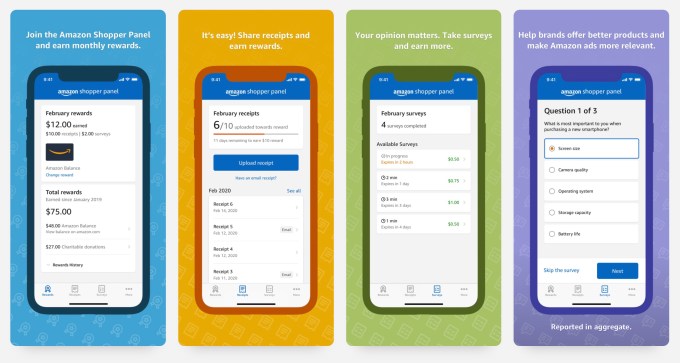
Image Credits: Amazon

Amazon claims it will delete any sensitive information from the receipts users upload, like prescription information. But it doesn’t delete users’ personal information, instead storing it in accordance with its existing Privacy Policy. It will allow users to delete their previously uploaded receipts, if they choose, but it’s not clear that will actually remove collected data from Amazon’s systems.

Consumer research panels are common operations, but in Amazon’s case, it plans to use the data in several different ways.

On the website, Amazon explains it “may use” customer data to improve product selection at Amazon.com and Whole Food Market, as well as to improve the content selection offered through Amazon services, like Prime Video.

Amazon also says the collected data will help advertisers better understand the relationship between their ads and product purchases at an aggregate level and will help Amazon build models about which groups of customers are likely to be interested in certain products.

And Amazon may choose to offer data to brands to help them gain feedback on existing products, the website notes.

The program’s launch follows increased scrutiny over Amazon’s anti-competitive business practices in the U.S. and abroad when it comes to using consumers’ purchase data.

Amazon came under fire from U.S. regulators over how it had leveraged third-party merchants’ sales data to benefit its own private label business. When Amazon CEO Jeff Bezos testified before Congress in July, he said the company had a policy against doing this, but couldn’t confirm that policy hadn’t been violated. The retailer may also be facing antitrust charges over the practice in the E.U..

At the same time, Amazon has been increasing its investment in its advertising business, which grew by 44% year-over-year in Q1 to reach $3.91 billion. That was a  faster growth rate than both Google (13%) and Facebook (17%), even if tiny by comparison — Google ads made $28 billion that quarter and Facebook made $17.4 billion, Digiday reported.

As the pandemic has accelerated the shift to e-commerce by 5 years or so, Amazon’s need to better optimize advertising space has also been sped up — and it may rapidly need to ingest more data that what it can collect directly from its own website.

In a message to advertisers about the program’s launch, Amazon positioned its e-commerce business as a small piece of the overall retail market — a point it often makes in hopes of avoiding regulation:

“In this incredibly competitive retail environment, Amazon works with brands of all sizes to help them grow their businesses not just in our store, but also across the myriad of places customers shop. We also work hard to provide our selling partners—and small businesses in particular—with tools, insights, and data to help them be successful in our store. But our store is just one piece of the puzzle. Customers routinely use Amazon to discover and learn about products before purchasing them elsewhere. In fact, Amazon only represents 4% of US retail sales. Brands therefore often look to third-party consumer panel and business intelligence firms like Nielsen and NPD, and many segment-specific data providers, for additional information. Such opt-in consumer panels are well-established and used by many companies to gather consumer feedback and shopping insights. These firms aggregate shopping behaviors across stores to report data like average sales price, total units sold, and revenue on tens of thousands of the most popular products.”

The retailer then explained that the Shopper Panel could help it to support sellers and brands by offering additional insights beyond its own store.

Amazon doesn’t say when the program waitlist will be removed, but says anyone can sign up starting today.

20 Oct 2020

French TV networks team up to launch streaming service Salto

There’s a new streaming service in France called Salto. The companies behind the new service have been around for a while though. Salto is a joint initiative between TF1, France Télévisions and M6 — three major TV networks.

Those companies already had their own apps with live TV and ad-supported catch-up content. And of course, you can access content from these networks from your set-top box. But they’re trying something new with Salto.

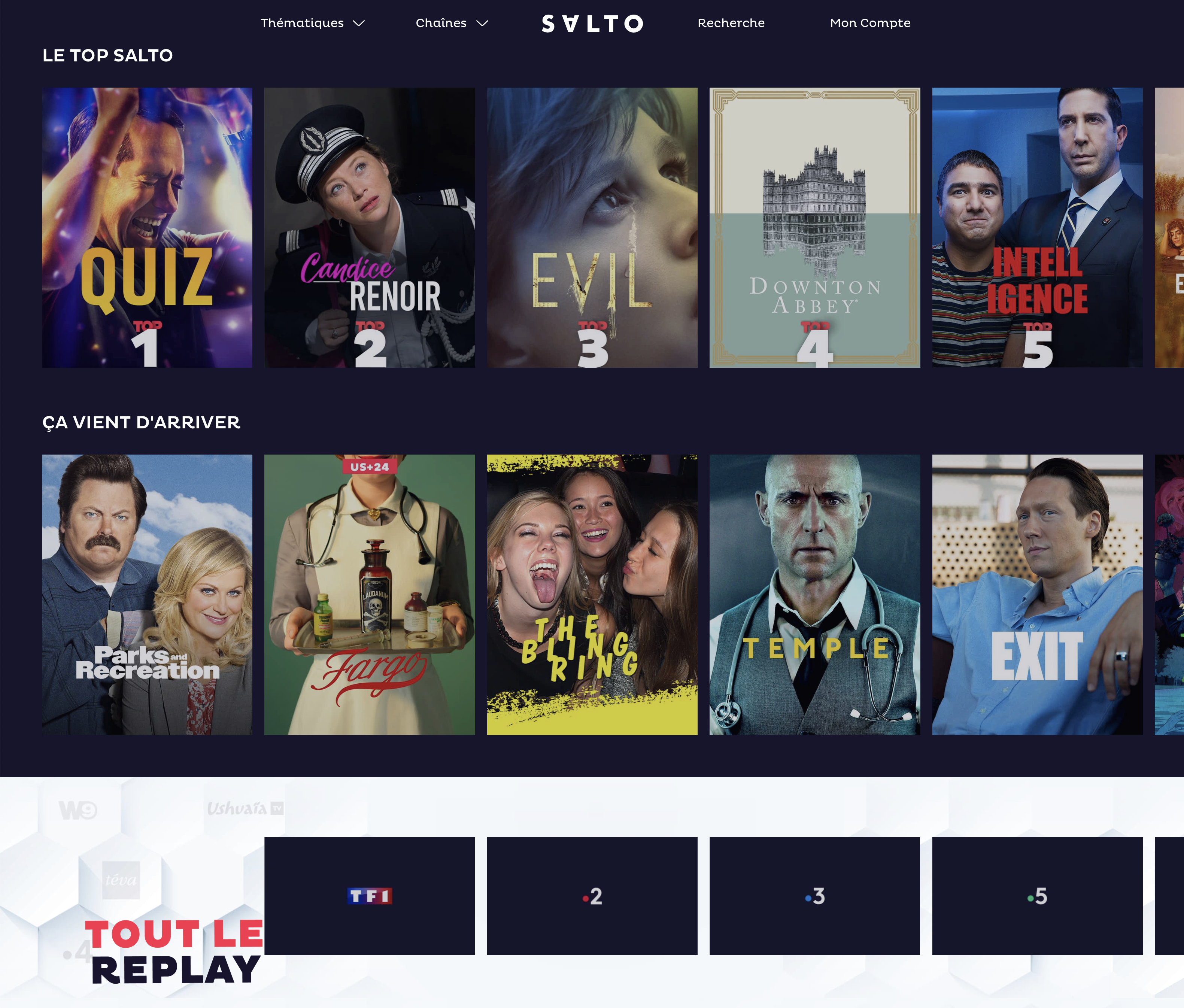
For now, Salto is mostly an ad-free combination of all the individual apps from TF1, France Télévisions and M6. You can watch live TV from 19 different channels. You can play catch-up content from all three networks without any video ad.

It costs €6.99 per month. For €9.99, you can watch on two screens simultaneously. For €12.99 per month, you get four screens. Salto has released apps for Android, Android TV, iOS and tvOS. It also works in a web browser.

Such an offering probably won’t be enough to attract subscribers. That’s why Salto is slowly adding exclusive content to its platform as well. Salto is also going to be a good way to access content for kids in a dedicated section.

You can see some TV shows before they air on TV, such as an adaption from Agatha Christies’ ‘And Then There Were None’, the new season of Fargo. There are also some classic shows, such as Parks & Recreation and Seinfeld.

Who will be subscribing to Salto then? If you mostly watch live TV and you already know how to access catch-up content, Salto isn’t for you. If you already have access to premium content through a Canal+ subscription for instance, Salto isn’t for you.

But if you’re addicted to reality TV and daily soap operas, Salto could be a nice service to consume your favorite show. If you don’t pay for any streaming service, it could be a cheap service to get started and access some basic shows and movies.

Image Credits: Salto

20 Oct 2020

Investors appear to shrug at antitrust lawsuit aimed at Google

Investors do not seem concerned that the Department of Justice filed an antitrust suit against Google earlier today.

The suit, seen by some as a stunt near the election, is one of a multi-part push to change the face of the technology industry, which has seen its wealth and power expand in recent years. For example, technology companies now constitute nearly 40% of the value of the S&P 500, ahead of a 1999-era 37% share, according to The Wall Street Journal.

At the same time, the rising tide lifting many tech boats has provided huge gains to its largest players as well. Alphabet, Microsoft, Amazon and Apple are each worth north of $1 trillion apiece, making them historically valuable companies even amidst an economic downturn.

Those market caps do not appear to be in danger.

Today after lunch during regular trading hours the tech-heavy Nasdaq Composite index is up 0.86%, while Alphabet is up 0.91%, directly in line with broader trading. Shares of Alphabet initially rose this morning before giving back their gains. However, since those morning lows, shares of the tech giant have recovered to edge ahead of the market.

Investor reaction could shift regarding Google’s antitrust liabilities in time. The Department of Justice suit is hardly the only legal issue that the search giant is currently grappling with. But not today.

20 Oct 2020

Meadow launches a powerful mobile marketing tool for cannabis dispensaries

Meadow was once called the Amazon of weed. Now it’s trying to be the Salesforce of weed, too.

Meadow, the maker of a popular point of sale system for cannabis dispensaries, is today launching new tools for its clients. Called the Meadow Platform, it includes two key tools for dispensaries: a customer relationship manager (CRM) and a text messaging platform for mobile marketing. As the company puts it in the news release, this system is designed to let users push a button and sell more weed.

This system is designed to help legal weed proprietors serve its client base with deep insights and targeted marketing — all while abiding by the strict regulations governing the budding industry (pun intended).

Meadow’s POS system is widely used throughout the legal cannabis industry, giving retailers inventory management, analytics, online ordering, and more. Because of regulations, retailers have a wealth of information on their clientele, which Meadow’s system can use for target marketing. Since these new features are built-into the Meadow platform, instead of through a 3rd party add-on, Meadow says it’s protected by the same security used throughout the rest of its platform.

Current regulations make it difficult for dispensaries to market their wares. These retailers cannot fully utilize modern marketing channels such as social media, leaving most retailers with limited options outside of billboards. Meadow’s new solution brings standard marketing tools to dispensaries.

“Marketing is not one-size-fits-all, especially in cannabis. Dispensaries need tools to select which customers they want to talk to in order to send relevant messages and promotions,” said David Hua, CEO and Co-Founder of Meadow, said in a released statement. “Let brand-loyal customers know when their favorite brands release new strains, products, blends, or flavors. Tell customers about new hours or delivery and pick-up options. Send re-engagement offers to customers who have dropped off. Let members of your loyalty program know when they have points to cash in and include their point balance. Tip-off VIPs when a limited-edition strain becomes available and give them first dibs. This is the level of delight and sophistication that has been missing from cannabis marketing, and we’re very excited to debut it to dispensaries across California.”

David Hua, Harrison Lee, Rick Harrison, and Scott Garman founded Meadow in 2014. Since then, the company raised $2.1M and participated in Y Combinator’s Winter 2015 class. The company currently has 14 employees.

Building this product has always been part of Meadow’s goal, Hua tells TechCrunch. COVID-19 helped accelerate the need.

“[Meadow] has always had three core priorities,” Hua said. “The first was compliance, which we had a big checkmark at the beginning of this year. The second was operational efficiency, and now marketing. These dispensary owners, especially in this COVID-19 world, can talk directly to their customers again, bring in more revenue and give them more information on what’s happening. Now they can leverage Meadow’s platform to do promo codes, automated discounts, loyalty rewards; we have all that. So you could have a customer that’s ordering an early bird special at 9:00 am, and that’s a member of your senior group that gets 10% off. You can now send them a message regarding new topicals. Marketing just becomes more engaging.”

20 Oct 2020

Google announces slew of Chrome OS features to help extend enterprise usage

As companies have moved to work from home this year, working on the internet has become the norm, and it turns out that Chrome OS was an operating system built for cloud-based applications. But most enterprise use cases are a bit more complex, and Google introduced some new features today to make it easier for IT to distribute machines running Chrome OS.

While the shift to the cloud has been ongoing over the last few years, the pandemic has definitely pushed companies to move faster, says John Maletis, project manager for engineering and UX for Chrome OS. “With COVID-19, the need for that productive, distributed workforce with some employees in office, but mostly [working from home] is really in the sights of businesses everywhere, and it is rapidly accelerating that move,” Maletis told TechCrunch.

To that end, Cyrus Mistry, group product manager at Google says that they want to make it easier for IT to implement Chrome OS and they’ve added a bunch of features to help. For starters, they have created a free readiness tool that lets IT get the lay of the land of which applications are ready to run on Chrome OS, and which aren’t. The tools issues a report with three colors: green is good to go, yellow is probable and red is definitely not ready.

To help with the latter categories, the company also announced the availability of Parallels for Chrome OS, which will enable companies with Windows applications that can’t run on Chrome OS to run them natively in Windows in a virtual machine. Mistry acknowledges that companies running Windows this way will need to issue higher end Chromebooks with the resources to handle this approach, but for companies with critical Windows applications, this is a good way to extend the usage of Chromebooks to a broader population of users.

To make it easier to issue machines ready to use of the box, Google is also introducing zero touch distribution, which allows manufacturers to set up machines for a domain ready to use out of the box. All the user has to do is turn it on and it’s ready to use.

“We can do what’s called zero touch, which is the devices can be already enrolled by the manufacturers, which means they will know the domain and they can now drop ship directly,” Mistry explained. That means these machines are equipped with the right settings, policies, applications, certificates and so forth, as though IT had set up the machine for the user.

In another nod to making life easier for IT, Google  is offering a new set of certified applications like Salesforce, Zoom and Palo Alto Networks which have been certified to work well on Chrome OS. Finally, the company announced that it will be enabling multiple virtual work areas with the ability to drag and drop between them, along with the ability to group tabs and search for tabs in the Chrome browser, which should be ready in the next couple of months.

As Maletis pointed out, the company may have been ahead of the market when it released Chrome OS almost a decade ago, but this year has shown that companies need the cloud to stay in operation and Chrome OS is an operating system built from the ground up for the cloud.

20 Oct 2020

Microsoft Azure announces its first region in Austria

Microsoft today announced its plans to launch a new data center region in Austria, its first in the country. With nearby Azure regions in Switzerland, Germany, France and a planned new region in northern Italy, this part of Europe now has its fair share of Azure coverage. Microsoft also noted that it plans to launch a new ‘Center of Digital Excellence’ to Austria to “to modernize Austria’s IT infrastructure, public governmental services and industry innovation.”

In total, Azure now features 65 cloud regions — though that number includes some that aren’t online yet. As its competitors like to point out, not all of them feature multiple availability zones yet, but the company plans to change that. Until then, the fact that there’s usually another nearby region can often make up for that.

Image Credits: Microsoft

Talking about availability zones, in addition to announcing this new data center region, Microsoft also today announced plans to expand its cloud in Brazil, with new availability zones to enable high-availability workloads launching in the existing Brazil South region in 2021. Currently, this region only supports Azure workloads but will add support for Microsoft 365, Dynamics 365 and Power Platform over the course of the next few months.

This announcement is part of a large commitment to building out its presence in Brazil. Microsoft is also partnering with the Ministry of Economy “to help job matching for up to 25 million workers and is offering free digital skilling with the capacity to train up to 5.5 million people” and to use its AI to protect the rainforest. That last part may sound a bit naive, but the specific plan here is to use AI to predict likely deforestation zones based on data from satellite images.

20 Oct 2020

Call analytics platform Invoca expands into sales, e-commerce and customer experience

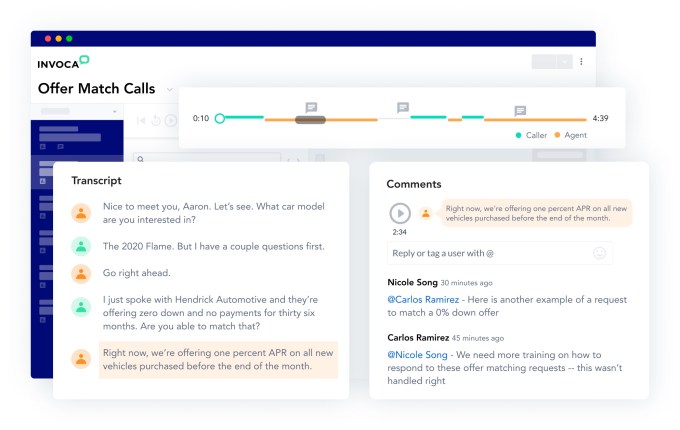
Invoca, which helps companies extract and use data from customer phone calls, is expanding today with the launch of products for e-commerce, customer experience and sales teams, as well as a new Invoca Exchange, where businesses can find all of the platform’s third-party integrations.

The company is making these announcements as part of its virtual Invoca Summit. Ahead of the event, CEO Gregg Johnson (previously an executive at Salesforce) told me that customers have been asking Invoca to expand beyond its previous focus on providing “conversation intelligence” to marketing teams.

“‘We need to get aligned on how we support the revenue journey,'” Johnson recalled businesses telling him. “We were already going down this path, but when COVID hit, we tripled down on it.”

He argued that the data that Invoca provides has become even more important during the pandemic and related lockdowns, when businesses only had “two sources of feedback” — digital interactions and customer conversations. And while there are plenty of analytics tools for tracking online behavior, Johnson said, “Customer conversations are really important because they get at why” people are behaving in a certain way.

And at the same time, Johnson said call center teams have had to shift to working at home, which meant that they had to switch to online software and “everything broke,” while supervisors “no longer had any visibility into how agents were performing.”

Invoca platform

Image Credits: Invoca

Invoca is trying to address these issues by making sure that marketing, sales, customer experience and e-commerce teams all have access to the same call data.

For example, he said that agents at Invoca customer BBQGuys need data to understand what products to recommend for their customers if the specific grill that they want isn’t available. Or a healthcare provider might use call data to predict and prepare when COVID cases might be rising in their area.

“We’ve always viewed ourselves as an application and a platform,” Johnson added. “We already give you ability to use this data at Invoca to automatically apply these insights without any human intervention at all. So for us, we thought through use cases to feed this data into other tools and created four solutions … that are really joined at the hip.”

Invoca for eCommerce, Invoca for Sales and the existing Invoca for Marketing product are all available now, while Invoca for Sales is currently signing up beta testers for NOvember.

The Invoca Exchange, meanwhile, already includes more than 40 integrations, including Google, Salesforce, Facebook, Adobe, Tealium, and Five9. The company is also announcing new partnerships with FullStory and Criteo.


20 Oct 2020

Google calls DOJ’s antitrust lawsuit “deeply flawed” in GIF-laden blog response

Google was clearly anticipating today’s U.S. Department of Justice antitrust complaint filing – the company posted an extensive rebuttal of the lawsuit to its Keyword company blog. The post, penned by SVP of Global Affairs and Google Chief Legal Officer Kent Walker, suggests that the DOJ’s case is “deeply flawed” and “would do nothing to help consumers,” before going into a platform-by-platform description of why it thinks its position in the market isn’t representative of unfair market dominance that would amount to antitrust.

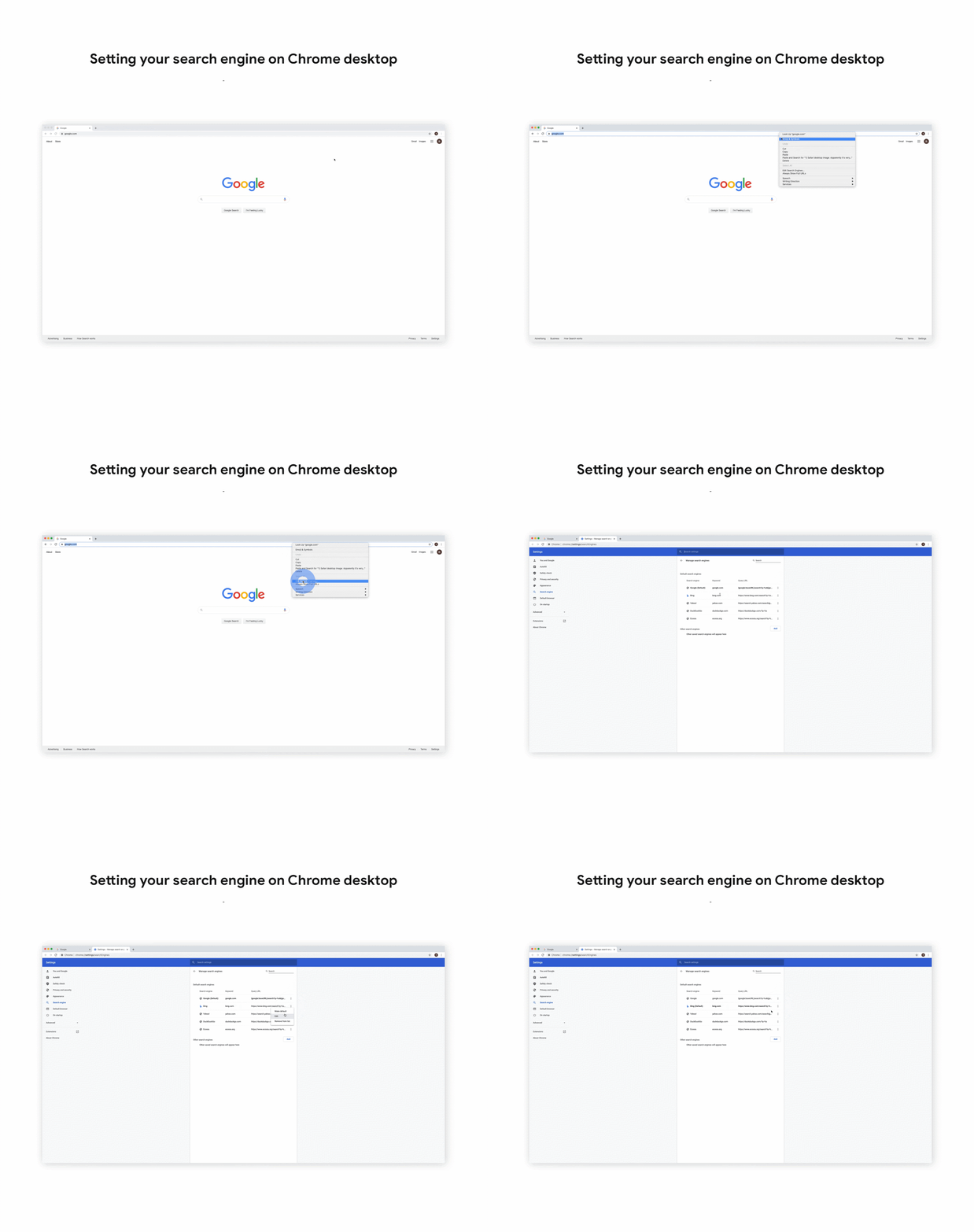
Google’s blog post is even sprinkled with GIFs – something that’s pretty common for the search giant when it comes to its consumer product launches. These GIFs include step-by-step screen recordings of setting search engines other than Google as your default in Chrome on both mobile and desktop. These processes are both described as “trivially easy” by Walker in the post, but they do look like a bit of an own-goal when you notice just how many steps it takes to get the job done on desktop in particular, including what looks like a momentary hesitation in where to click to drill down further for the “Make Default” command.

Image Credits: Google

Google also reportedly makes reference to companies choosing their search engine as default because of the quality of their service, including both Apple and Mozilla (with a link drop for our own Frederic Lardinois). Ultimately, Google is making the argument that its search engine isn’t dominant because of a lack of viable options fostered by anti-competitive practices, but that instead it’s a result of building a quality product that consumers then opt in to using from among a field of choices.

The DOJ’s full suit dropped this morning, and an initial analysis suggests that this scrutiny is perhaps inopportunely timed in terms of its proximity to the election to actually have any significant teeth. There is some indication that a more broad, bipartisan investigation with support from state level attorney generals on both sides of the aisle could follow later, however, so it’s not necessarily all just going to go away regardless of election outcome.

20 Oct 2020

Google Photos revives its prints subscription service, expands same-day print options

Google Photos is reviving its photo printing subscription service and introducing same-day prints. The company earlier this year had briefly tested a new program that used A.I. to suggest the month’s 10 best photos, which were then shipped to your home automatically. But Google ended the test on June 30.

During the trial, Google had offered users a $7.99 per month subscription that would automatically select 10 photos from one of three themes, including people and pets, landscapes, or “a little bit of everything” mix. The 4×6 photos were printed on matte, white cardstock with a 1/8-inch border.

Image Credits: Google

The new subscription, launching soon, leverages feedback from the early tests to now give users more control over which prints they receive and how they look. It also drops the price to $6.99 per month, including shipping and before tax.

With the new Premium Print Series, as the subscription is called, Google Photos will use machine learning techniques to pick 10 of your recent photos to print. But users can edit the photo selection and they can choose either a matte or glossy finish or add a border before the photos ship.

The photos can optionally be turned into postcards, thanks to the cardstock paper backing, Google notes.

Subscribers can also opt to skip a month and can easily cancel the service, if they’re no longer using it.

This updated version of service was recently discovered by reverse engineer Jane Manchun Wong, who detailed the new customization options and the lower price point.

Google says the Premium Print Series will make its ways to Google Photos users in the next few weeks.

The company today is also launching same-day printing at Walgreens, available immediately. This expands Google Photos’ existing same-day options, which already included same-day pickup from CVS and Walmart.

Using the Google Photos app, customers can now order 4×6, 5×7, or 8×10 photo prints for same-day pickup at Walgreens . This nearly doubles the number of stores offering same-day prints to Google Photos users, Google says.

In addition to prints and subscriptions, Google Photos continues to offer canvas prints and photo books — the latter now with up to 140 pages — as part of its online print store.

Image Credits: Google

The launch of the expanded photo printing services and subscription comes at a time when people are traveling less often, due to the pandemic, and are attending fewer large events where photo-taking may take place — like parties or concerts, for example.

But even if times have changed, people are continuing to take photos — though they may not be posting them across social media in order to avoid judgement.The subject of the photos may have changed, too, to now include more family and pets or nature scenes, instead of large, crowded places or big social gatherings, for instance.

The nostalgia for pre-pandemic times could see users turning to prints to help them relive fond memories, too.

Google didn’t say exactly when the new subscription will launch, but said users should be able to access the feature in the coming weeks.


20 Oct 2020

Beam is building a web browser that gathers knowledge from your web activity

Remember Netscape Navigator and Internet Explorer? Those applications from the 1990s used emphatic metaphors in their names to talk about a simple task — browsing the web. Today, nobody would say that Google Chrome is a web explorer.

Browsing the web has become an effortless — and often mindless — task. You grab your phone or computer, you open a new tab and you type a few words in the address bar.

Beam, a new startup founded by Dom Leca and Sébastien Métrot, is working on a brand new app that is both a web browser and a note app. Dom Leca previously founded Sparrow, an email app for macOS and iOS that was acquired by Google in 2012. Sébastien Métrot has been working for Apple for several years.

“Everybody complains that Instagram and Facebook fry your brain and make you waste time,” Leca told me. And yet, web browsers represent infinite knowledge and infinite possibilities.

If you’re very passionate about a niche topic, chances are you can learn a ton of things by reading stuff, watching videos, interacting on forums and more. But when you close your browser window, everything disappears.

Sure, there’s a web history feature — but it’s a long list of links with no connection. Sure, you can bookmark pages or take notes in another app — but it’s a cumbersome process.

More importantly, you might not know what’s important and what’s not. Most passion projects start with meaningless search queries.

Beam’s mysterious logo. Image Credits: Beam

Beam aims to bring meaning to your web history. Every time you search for something, it creates a new note card. Beam passively follows users as they click on links, open new pages and spend time looking at stuff.

When you close the tab, you have a new card — your search query is the title of the card and you can see all links under that note. You can then add text, remove links that weren’t that relevant, etc.

By combining passive note creation with a tiny nudge when you close a tab, you get to reflect on your web activity. It’s a way to learn more about yourself and your habits. Sure, you may realize that you waste a ton of time. But you might also realize that you care more than you thought about cooking and Russian classical music.

“From a certain point of view, I’m designing this for people who don’t take notes,” Leca said.

But even if you use a note app, they interrupt you as you need to switch between multiple apps. Leca invested in Roam Research and likes it a lot. But he doesn’t think it solves that amnesia affect when you browse the web.

The startup is already thinking about ways to expand beyond that simple concept. You could imagine a way to interact with content directly from your notes — click on a YouTube link to view the video directly in your card, click on a podcast link to see an automated transcript, etc.

Eventually, Beam could let you share cards with other users. You could browse other user profiles based on matches with your interests.

Beam is leveraging WebKit as the browser engine and is working on a Mac app for now. It’s going to take a few months before a public release, but it’s going to be an interesting company to follow.

The company raised $3.5 million (€3 million) from Spark, Alven, C4V, Amaranthine, Tiny Capital (Andrew Wilkinson), Tiny vc, Secret Fund, Antoine Martin, Simon Dawlat, Nicolas Cohen and Spetses. Loren Brichter (remember Tweetie for Mac?) and Oliver Reichenstein (iA Writer) are advising the company.