Year: 2020

13 Oct 2020

Live from Apple’s virtual 2020 iPhone event

Apple’s big iPhone event is finally here – virtually, which is to be expected these days. This is already the second virtual event Apple has hosted this fall, following one in September at which it revealed the Apple Watch Series 6 and a new iPad Air. This time around, we’re going to see what the iPhone 12 looks like, as well as how many colors and sizes it comes in.

There’s also supposed to be plenty of other news, including a new smaller HomePod mini, maybe an updated Apple TV, possibly a number of different headphone products and more. Will we get our first glance at the first shipping ARM-based Mac to use Apple’s in-house processors? Probably not, but maybe!

We’re going to be following along live and offering commentary below, and you can also tune in live to the video stream right here. Everything gets underway at 10 AM PT/ 1 PM ET.

13 Oct 2020

WordPress can now turn blog posts into tweetstorms automatically

Earlier this year, WordPress .com introduced an easier way to post your Twitter threads, also known as tweetstorms, to your blog with the introduction of “unroll” option for Twitter embeds. Today, the company is addressing the flip side of tweetstorm publication — it’s making it possible to turn your existing WordPress blog post into a tweetstorm with just a couple of clicks.

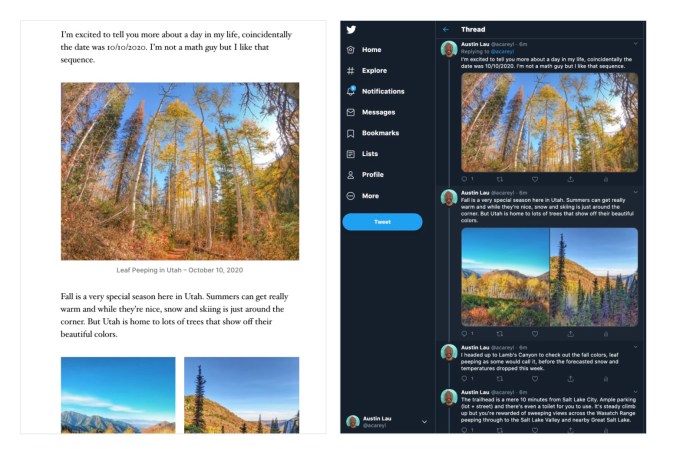
The new feature will allow you to tweet out every word of your post, as well as the accompanying images and videos, the company says. These will be automatically inserted into the thread where they belong alongside your text.

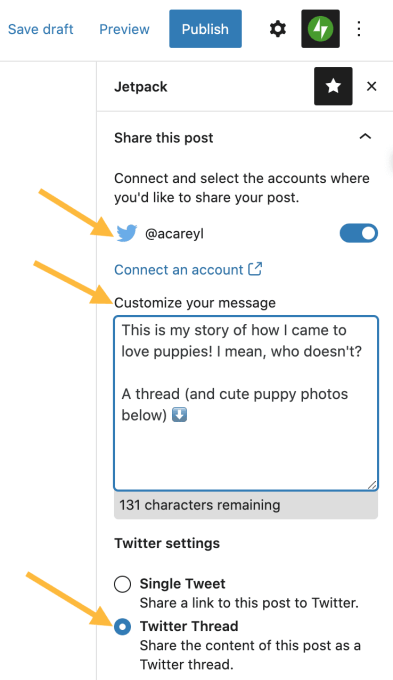
To use the tweetstorm feature, a WordPress user will first click on the Jetpack icon on the top right of the page, then connect their Twitter account to their WordPress site, if that hadn’t been done already.

Image Credits: WordPress.com


The option also supports multiple Twitter accounts, if you want to post your tweetstorms in several places.

Once Twitter is connected, you’ll select the account or accounts where you want to tweet, then choose the newly added option to share the post as a Twitter thread instead of a single post with a link.

Image Credits: WordPress.com

In the box provided, you’ll write an introductory message for your tweetstorm, so Twitter users will know what your Twitter thread will be discussing.

When you then click on the “publish” button, the blog post will be shared as a tweetstorm automatically.

Image Credits: WordPress.com

The feature was also designed with a few thoughtful touches to make the tweetstorm feel more natural, as if it had been written directly on Twitter.

For starters, WordPress says it will pay attention to the blog post’s formatting in order to determine where to separate the tweets. Instead of packing the first tweet with as many words as possible, it places the break at the end of the first sentence, for example. And when a paragraph is too long for a single tweet, it’s automatically split out into as many tweets as needed, instead of being cut off. A list block, meanwhile, will be formatted as a list on Twitter.

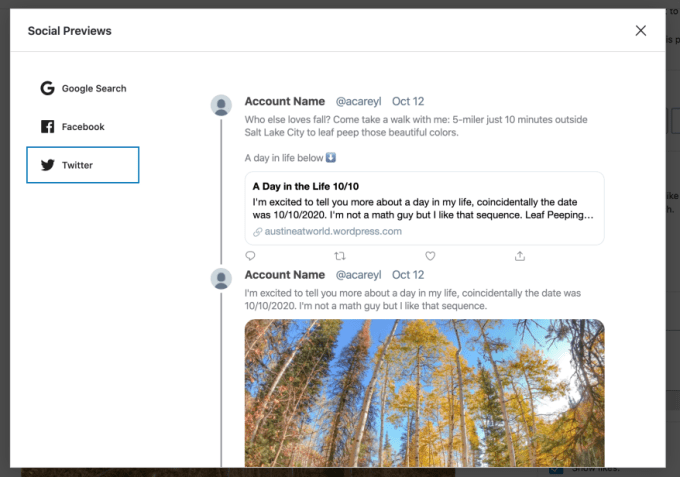
To help writers craft a blog post that will work as a tweetstorm, you can choose to view where the tweets will be split in the social preview feature. This allows WordPress users to better shape the post to fit Twitter’s character limit as they write.

Image Credits: WordPress.com

At the end of the published tweetstorm, Twitter followers will be able to click a link to read the post on the WordPress site.

This addresses a common complaint with Twitter threads. While it’s useful to have longer thoughts posted to social media for attention, reading through paragraphs of content directly on Twitter can be difficult. But as tweetstroms grew in popularity, tools to solve this problem emerged. The most popular is a Twitter bot called @ThreadReaderApp, which lets users read a thread in a long-form format by mentioning the account by name within the thread along with the keyword “unroll.”

With the launch of the new WordPress feature, however, Twitter users won’t have to turn to third-party utilities — they can just click through on the link provided to read the content as a blog post. This, in turn, could help turn Twitter followers into blog subscribers, allowing the WordPress writer to increase their overall reach.

WordPress’ plans to introduce the tweetstorm feature had been announced last month as coming in the Jetpack 9.0 release, arriving in early October.

The feature is now publicly available, the company says.

13 Oct 2020

BLCK VC launches educational initiative to bring more Blacks into investing ecosystem

It is no secret that Black founders face an uphill battle in Silicon Valley with just a sliver of the investment pie being devoted to people of color. BLCK VC along with partners Operator Collective, Salesforce Ventures and Berkeley Haas School of Business are hoping to change that, and today the group announced the Black Venture Institute, an educational initiative dedicated to helping Black operators become angel investors.

The program has a goal of training 300 students over the next three years to create a network of Black investors and advisors, who can begin writing checks to make investments. This is an attempt by these groups to bring some meaningful change to an entrenched investment system. In fact BLCK VC was formed in 2018 with this goal in mind.

Frederik Groce, principal at Storm Ventures and co-founder of BLCK VC, says that venture capital clearly has an access problem, and this program is about trying to open up these closed networks.

“It is these closed networks that have helped contribute to the lack of access for the Black community over the years. Black Venture Institute is a structural attempt to create access for Black operators — from engineers to product marketing managers,” Groce told TechCrunch.

He added that this about helping these operators understand how to have a role in the venture capital ecosystem. “We are attempting to equip Black technologists and tech operators with the knowledge and tools they need to better understand the industry and hopefully begin to engage within it as scouts, limited partners, angel investors — and potentially support career transitions into the industry.”

As Leyla Seka, investment partner at Operator Collective describes it, the idea is to create a curriculum to train Black entrepreneurs on the fundamentals of venture investing by bringing together a group of experienced people to help explain how the system works.

“It takes time to learn the terms, understand the process and make the connections. Some people grew up in that world, absorbing this knowledge through osmosis, but others need a leg up,” she said.

Salesforce Ventures, which launched the $100 million Impact Fund last week to invest in cloud startups focused on social change, says that helping with this venture is part of the firm’s strong commitment to social justice.

“Without intentional action, we are destined to fall into the same insular cycle that has delivered low representation in the past. It is our belief that by making venture capital knowledge and networks more accessible, we can help empower the Black technology community and provide a path to accelerate innovation, opportunity and access,” the firm said in a statement.

To give you a sense of what Black founders are up against, a 2018 Harlam Capital Report found that since 2000 — the previous 18 years to that point — just 105 firms with all Black founders received funding of $1 million or more. These numbers are stark and point to an unequal funding climate and the need for more programs like this one.

13 Oct 2020

HBO is making a limited series about Elon Musk and the founding of SpaceX

HBO is in the process of developing a six-episode limited series about the founding days of SpaceX and Elon Musk, Variety reports. The show will be based on Ashlee Vance’s biography of the Tesla CEO and SpaceX founder, but billionaire entrepreneur himself is not directly involved in the project according to the report.

The limited series will focus on Musk’s recruitment of a small team of engineers, and their development of the first SpaceX rocket, following its construction and launch. The series will be executive produced by Channing Tatum and his production company, as well as Doug Jung, and it will be written by Jung who previously wrote a number of sci-fi films including Star Trek Beyond, as well as Netflix series Mindhunter.

This depiction of SpaceX and Musk should be an interesting one, as it’ll be one of the first times the eccentric billionaire founder has been portrayed in a work of biographical fiction. Musk’s founding of SpaceX is also great fodder, given that it involved approaching Russian space companies to potentially buy a rocket ready-made, before deciding that was too expensive and opting instead to build their own. If you’re curious, you can also check out Kimbal Musk’s Blogspot detailing some of the process of SpaceX and its early days creating its original launch vehicles.

13 Oct 2020

Genemod raises cash for its lab inventory management service used by research institutions around the US

Genemod, a software for laboratory inventory management used by institutions like the University of Washington School of Medicine; the University of California, Berkeley, and the National Institutes of Health; has raised $1.7 million from a clutch of top venture investors.

The small seed round came from Defy.vc, with additional commitments from Omicron, Unpopular Ventures, Underdog Labs and Canaan Partners.

With the capital, the company said it would develop a product management software to compliment its existing inventory management service.

These are small stepping stones on the way to paving a new road to pharmaceutical development based on collaborative data sharing technology, the company said.

It’s a road that companies like Owkin and Within3 have raised big dollars to pave already. They’re just two companies in the market that are building collaborative software for the pharmaceutical industries.

Genemod’s pitch is that it can increase productivity by giving researchers a better window into the tools they have and the tools they need to accelerate the process of experimentation without downtimes while waiting for supplies.

“While the life sciences industry is known for developing inventive solutions to some of the world’s biggest health problems, many scientists are working with manual, siloed and inefficient processes,” said Jacob Lee, the company’s chief executive.

Alongside the funding, Defy.vc will serve as a growth partner for Genemod, supporting the company as it works to roll out its product roadmap for the latter half of the year. Neil Sequeira, co-founder and managing director of Defy.vc, will join Genemod’s Board of Directors.

Founded in 2018, Genemod was part of the first cohort of Venture Out Startups, a pre-seed investment program designed to encourage entrepreneurs to start their own businesses.

13 Oct 2020

London Business School and LocalGlobe launch new VC course aimed at women, Black and Asian candidates

With the UK’s Black Tech Fest on this week it’s timely that a new executive education course aimed at those wanting to enter the venture capital industry has been launched to serve previously under-represented groups, especially women, Black, Asian and other minorities.

London Business School and LocalGlobe, one of Europe’s leading seed investors, worked together to created two new programs to provide formal business education for roles across the VC world. The Newton Venture Program courses will cover the full spectrum of investment roles in the venture ecosystem, from VC investors to Limited Partners, angel investors, accelerators, and tech transfer officers. The aim of the programs is to upskill the venture capital sector while broadening the routes through which people can join the industry. 

The courses will aim for a gender split of 50/50, with at least 50% coming from Black, Asian or other minorities. backgrounds, and will be available to anyone just starting out or mid-career professionals. 

There will be two cohorts a year, of up to 60 students, with the first online program set to start in April 2021. The first on-campus cohort will start in October 2021. Applicants are welcome to apply from anywhere around the world; the majority are expected to be from the UK, the EU, Africa and Israel.  

An online-only program will cost £2,050 or £16,000 for the in-person, on-campus program at London Business School, which is aimed at mid-career professionals. Scholarships of up to 100% will be available for both programs.

The initiative is backed by a grant from Research England, a part of UKRI, and the Newton program will be looking for other institutions or VC firms to under-write the course. LocalGlobe and Phoenix Court Works are committed to sponsoring 20 digital scholarships.

The program will give cohorts direct access to experts from top-performing global VC firms such as a16z, Benchmark, USV, and others and experienced entrepreneurs and their founding teams.  Leading academic authorities on the VC industry – including, for example, Luisa Alemany, Julian Birkinshaw, Gary Dushnitsky and Florin Vasvari — will teach key concepts, lead case-study discussions, and share their latest research insights with participants.

Practicing investors and ecosystem experts will mentor the cohorts on subjects including how to source and win deals, venture financial and legal, fund management, and how to support portfolio companies. Students will also be able to take part in industry roundtables, local city meetups and become part of the Newton Alumni network. 

The on-campus program, with opening and closing weeks at London Business School, is aimed at those with five to 15 years of overall work experience. It will include participants who are already investors as well as those with strong operational backgrounds looking to become investors. The syllabus will include time spent at sponsoring VC firms, experience with top-tier venture capital investors and limited partners, work with tech transfer offices, accelerator offices and other partners and sponsors. Each participant will benefit from one-to-one mentoring and complete deep-dive modules covering specific industries and technologies, from fintech to AI.

According to Atomico’s respected State of European Tech report, just 0.9% of founders in Europe are Black. Nor does the wider IT sector look much better. The Chartered Institute for IT records in 2019 that there were 268,000 Black, Asian and other minority ethnic (BAME) IT specialists in the UK, accounting for 18% of IT workers, a number that has increased by two percent over the past five years from 16% in 2015). 

According to Diversity.VC in 2019, just 30% of those working in venture capital were women. The British Business Bank found in its 2019 report, UK VC Female Founders, that less than 1p of every £1 of venture capital invested in the UK went to all-female founding teams. 

Lisa Shu, Executive Director, Newton Venture Program (pictured) said in a statement: “To find the next generation of world-leading tech businesses, investors need to be more representative of our society…The Newton Venture Program is a chance to train the next generation of investment professionals and open up venture capital investing to a wider, more representative range of voices and experiences.”

Minister for Digital and Culture, Caroline Dinenage MP said: “Investors play a vital part in the tech sector with their financial backing and guidance helping entrepreneurs turn their business dreams into reality. The sector needs to reflect society, not just because it is the right thing to do but because it makes good business sense, so this new course is a welcome step to boost diversity and help create more opportunities for founders from all walks of life to succeed.”


13 Oct 2020

Join Yext’s Howard Lerman for a live Q&A today at 2 pm ET/11 am PT

Today’s the day! This afternoon at 2 pm ET/11 am PT, Yext CEO Howard Lerman will join TechCrunch for a live chat.

The conversation is part of our continuing Extra Crunch Live series, now in its second season. What are we up to in the second installment of the conversations? The same as before, bringing the most interesting founders and investors ’round for a chat that you can contribute to by bringing your own questions. (Make sure you’re signed up so you can jump right in.)

As we wrote last week, Lerman is not just another public company CEO: his company, Yext, has some old-fashioned history with TechCrunch, having pitched at one of our events back in 2009. It went well, with Yext quickly raising money afterwards.

We’ll spend a little bit of time in the past talking about Yext’s history as a startup. I want to know at what stage did Howard begin to consciously prep Yext for an IPO — the company went public in 2017 — and how long until he felt the company was ready? Given that we just came off one of the most active quarters in recent history for technology company’s going public, it’s a good time to dig into the matter.

We’ll also get Howard’s take on the public markets in 2020 and whether he was happy with Yext’s IPO timing.

For the early-stage founders in the crowd, we have stuff prepped for you as well. Yext has moved from a business best known for building a system that helps companies keep their diverse online listings up to date with their most pertinent information, to a search-first company that is leading its customer acquisition cycles with its “Answers” product.

How did the company manage to built the latter while eating off the former, and how has the company balanced its continued development since? What can startups learn from the choices that Yext has made?

And, TechCrunch recently reviewed Howard’s social media posts regarding Black Lives Matter: “As CEO, I will see to it that our company continues to be advocates for equality and justice.” So, how does he view the role of politics inside of tech companies, and what advice does he have for founders who are looking to build a lasting culture?

It’s going to be a great chat. Make sure you’ve signed up for Extra Crunch and I’ll see you in a few hours.

Bring your best questions. Howard is a good chat, so he’ll have something to say if you ask something great. Details after the jump.

Details

Below are links to add the event to your calendar and to save the Zoom link. We’ll share the YouTube link shortly before the discussion:

13 Oct 2020

The iPhone 12 and HomePod mini leak ahead of today’s big Apple event

I guess maybe don’t read this if you like being surprised. Though you already read the headline and saw the first image, so you might as well keep keep going, right? And this is an Apple event we’re talking about, so surely there will be a surprise or two left. What we have here are a bunch of photos of the headliners of today’s big “Hi Speed” Apple event. Courtesy of perennial smartphone leaker Evan Blass, the shots appear to confirm the arrival of the iPhone 12 and HomePod Mini in a matter of hours.

There aren’t a lot of details attached — though, thanks to earlier rumors and leaks we seem to have a pretty good idea of what we’re in for at today’s event. Apple’s long-standing devotion to the notch is still front and center, and the flat-sided, iPad Pro design appears to be present, though we’re looking at the front and back straight on for all of these (more or less the same renderings, with subtle differences).

All four of the expected versions are present and accounted for: the 12, 12 mini, 12 Pro and 12 Pro Max. Prices are expected to range from $699 to $1,099. Screen sizes, meanwhile, go from 5.4 to 6.7 inches (which both the iPhone 12 and 12 Pro sitting in the middle at 6.1 inches). The Pro and Pro Max sport a three camera set up (versus the 12 and 12 mini’s two), along with an additional LiDAR sensor like the kind added to the iPad Pro earlier this year.

There are a number of color to chose from, including black, white and a navy Blue. There’s also a mint green on the lower-end models, along with Product (RED) versions, while the pricier models come in gold and graphite.

Image Credits: Evan Blass

We’ve also got a good look at the profile of the new HomePod mini. Apple delivered great sound with its premium smart speaker, but the $349 Siri system was price prohibitive for many. Rumored to cost $99, the would offer a much more accessible method for getting the HomeKit Hub into homes — or, perhaps, augmenting existing HomePod set ups. Much like the mini versions of Google and Amazon’s own speakers, however, it seems fairly likely some of that room-filling sound will be sacrificed for size and price.

The model is spherical, like the new Echo and sports a similar mesh speaker grille as the standard HomePod. It also borrows that device’s colorful Siri light up top, along with a pair of volume buttons.

13 Oct 2020

Nuvemshop, a Latin American answer to Shopify, raises $30 million

After several failed startup attempts and nine years spent building Nuvemshop into Latin America’s answer to Shopify, the four co-founders of the company have managed to raise $30 million in venture capital funding as they look to expand their business.

The new funding came from previous investor Kaszek Ventures and new lead investor Qualcomm, with participation from FJ Labs, IGNIA, Elevar Equity and Kevin Efrusy, from the longtime Accel Partners investor’s personal wealth.

It’s been a long road since Santiago Sosa, Alejandro Vazquez, Martin Palombo, and Alejandro Alfonso first began working together in Buenos Aires The quartet started off on their entrepreneurial journey trying to develop a marketplace software product for Latin America, but when that didn’t take off, they turned their attention to a more basic problem — how to get small and medium-sized businesses selling online.

Now the company boasts 65,000 businesses that use its platform providing everything from billing and payment processing to logistics and shipping solutions transacting over $100 million per month in sales. Operating as Nuvemshop in Brazil and Tiendanube in the rest of the region, the company has offices in São Paulo, Buenos Aires, and Mexico City with plans to expand into Colombia and Peru in 2021.

Nuvemshop began as more of a consulting business and evolved into the suite of software tools that have managed to attract attention from investors like Qualcomm Ventures.

“Nuvemshop’s platform accelerates a company’s digital transformation and has enabled thousands of SMBs across Latin America to go digital by tapping into the company’s one-stop shop of seamlessly integrated solutions,” said Alexandre Villela, senior director of Qualcomm Technologies Inc. and managing director at Qualcomm Ventures Latin America. “We share their strong engineering focus and look forward to helping them scale their business with our investment.” 

Nuvemshop raised its first money in 2015 from Kaszek Ventures (a $5 million investment) and as the business picked up steam raised $7 million more from local investors.

It makes money by charging a subscription fee that begins at $3 per month and a transaction fee that decreases as customers buy more expensive subscription packages.

Now that the company has an established footprint in the region, it’s going to focus on three new areas of growth, according to chief executive, Santiago Sosa.

Nuvemshop chief executive, Santiago Sosa. Image credit: Nuvemshop

The company plans to launch a payment processing and logistics gateway of its own. That marketplace will give customers access to more robust shipping solutions thanks to the power of bundling lower demand into a single delivery and ordering system. Nuvemshop also pitches its customers an app store for connecting them to new developer tools.

Finally, the company intends to offer a broader array of financial services. It already offers payment processing, but will look to develop additional services around lending based on revenue.

Like Shopify, Nuvemshop provides a necessary ballast to the big e-commerce aggregation sites like MercadoLibre and Amazon . “Everything they do they try to optimize for the buyer,” Sosa said. That places incredible pricing pressure on retailers and Nuvemshop offers a direct sales alternative, with lower fees, according to Sosa.

The pent up demand that Sosa sees, is fairly astonishing.

“People are talking about e-commerce penetration going from [roughly] 10% over total retail sales to [roughly] 20%, as it has happened in other countries. We see it differently, as we envision a massive disruption around commerce in the next 15 years, and are pretty confident that [roughly] 90% of retail will be somehow tech-enabled,” said Sosa, in a statement. 


13 Oct 2020

Ureeka taps Kevin O’Leary (AKA Mr. Wonderful) to launch SMB curriculum

Ureeka, a SMB mentorship platform for next-wave entrepreneurs, has today announced the Kevin O’Leary Bootcamp, which will offer members access to an exclusive curriculum of his knowledge and advice.

The startup, which raised $8.6 million in April, looks to offer a full-scale mentorship platform for underrepresented founders across all industries. Alongside offering a community of other entrepreneurs to bounce ideas off of, Ureeka also gives members free access to mentors (experts who are still active in their industry) and paid access to coaches (who continue with the member to tackle specific issues over the course of six months or more).

With the introduction of the Kevin O’Leary Bootcamp, Ureeka is shining a light on coaching circles. Circles place members into a group of five, plus a coach. That coach leads a group conversation each week that focuses on a different pillar of building a business, with concrete tasks given to members to complete.

In the case of the Kevin O’Leary Bootcamp, Ureeka coaches have been trained in his specific curriculum and framework to lead these weekly meetings and pass along his unique flavor of advice.

“He resonates with our audience because he is an entrepreneur,” said Ureeka cofounder Melissa Bradley . “He’s been there, and he’s done that. Second of all, there are a lot of programs out there that are not driven towards outputs or outcomes. Unfortunately, it’s a vicious business model to get stuck in ongoing consulting and that is not his process. He’s going to tell you what you need to do, tell you how to get it done, and get it done, and you see those results.”

Bradley added that several of O’Leary’s portfolio companies were involved with Ureeka early on in the company, which was the original connective tissue between the startup and Mr. Wonderful.

Here’s what O’Leary had to say in a prepared statement:

Underrepresented entrepreneurs, women, people of color are time and time again barred from the type of access so many take for granted, whether it be financial, educational or otherwise. We have to do better. Ureeka is doing incredible work to make tools and connections that are usually reserved for the big fish, actually accessible and all in one place. I’m thrilled to be working with them and to be able to provide small businesses access to my all-star team and resources.

The Kevin O’Leary Bootcamp is 12 months long and costs a total of $3750 across the year, which works out to $312.50/month.

One of the most unique things about Ureeka is that it gives members a series of levers to pull when they run into a problem. They can go directly to their coach to ask a question, and then to a mentor, and then to the peers in their coaching circle, and finally to the broader community.

Cofounder David Jakubowski and Bradley see the greatest challenges to Ureeka as a matter of building trust with users and managing scale.

“With everything going on in the world right now, there are so many people who need help,” said Jakubowski. “It’s not one quick fix. I can’t jump on the phone with anybody in 30 minutes and fix their business. It’s about systemic focus on doing the right things on a repeated basis that will put your business into the best position. There are just so many people who have such dire need right now, whether it’s getting the funding, or getting advice. There are just so many of them that it’s a bit overwhelming.”