Year: 2020

12 Oct 2020

Nest launches its $129 thermostat with a new design, swipe and touch interface on the side

Google’s Nest unit today launched its newest thermostat. At $129, the new thermostat is the company’s most affordable one yet, but it’s also the first to feature a new swipe and tap interface on its side, as well as Google’s Soli radar technology to sense room occupancy and when you are near the device.

Soli, it is worth noting, is not being used for enabling gesture controls. Instead, because the design team wanted a solid mirror finish on the front, Nest decided to use it purely for motion sensing.

The new thermostat, which is made from 49 percent recycled plastic, will come in four colors, Snow, Charcoal, Sand and Fog. The company is also launching a $14.99 trim kit to help you hide any imperfections in your pain when you install the new thermostat.

Image Credits: Nest

“It has this inviting form with this intuitive swipe up and down control, which lets you interact with this product really naturally, instead of pressing these tiny little buttons that most traditional thermostats have,” Nest product lead Ruchi Desai told me.

It’s worth noting that this new version is mostly meant for users in smaller apartments or condos, as it doesn’t support Nest’s remote sensors. To get support for those, you’ll need a Nest Thermostat E (which can occasionally be found for around $139) or the fully-fledged Nest Learning Thermostat .

Talking about learning, among the feature the team is highlighting with this release is the thermostat’s ability to help you schedule your custom temperature settings for different times of the day — and different days. Nest calls this Quick Schedule.

“Unlike the Nest Learning Thermostat, which has the auto-schedule [feature], this one actually offers the ability to create temperature presets, which gives you the ability to set up a schedule based on your lifestyle, based on your preferences,” Desai said. “It will also give you the flexibility of holding temperatures, which means it’ll override the schedule that you have in times when you need the control and flexibility.”

Image Credits: Nest

That sounds a lot like what you’d find in most of today’s smart thermostats from the likes of Ecobee and other Nest competitors, but it’s a first for Nest.

With its Savings Finder feature, the thermostat can also look for small optimizations and suggest minor tweaks that can result in additional energy savings.

Thanks to the new built-in Soli radar chip, the device can automatically lower the temperature when you’re not home. It’s a shame the team isn’t using the chip for any gesture controls, something Google did with its Pixel 4 phone, but the team tells me that it decided not to do this because it didn’t fit the user profile.

“I think that was a very conscious decision we made while designing this product, because for this product we really have the user in mind and we really wanted to focus on the features that were really important to this user. And these are brand new to smart home, they really wanted app control — it seems so basic to us but it’s a massive upgrade for them, right. And all these energy-saving features that come with the thermostat were something that they valued a lot. So we wanted to focus on the features that these users valued for this product,” Desai explained.

Maybe we’ll see Nest do more with this technology in the next iterations of its more expensive thermostats. For now, it feels like a bit of a missed opportunity, though in all fairness, Soli in the Pixel 4 mostly felt like a gimmick and at least the Nest team is putting it to practical use here.

Image Credits: Nest

Like before, Nest promises that it will only take about half an hour or so to install the new thermostat. The app walks you through the individual steps, which should make the process pretty straightforward, assuming your heating and cooling system follows modern standards.

To control the thermostat remotely, you’ll use the Google Home app, where you’ll also find all of the smart features to help you save more energy.

The new thermostat is now available in the U.S. (for $129.99) and Canada (for $179.99 CAD). In Canada, the trim kit will retail for $19.99 CAD). As the team noted, between various utility rebates and rewards, a lot of users may be able to get theirs for only a few dollars, depending on where they live.

Image Credits: Nest

12 Oct 2020

Equity Monday: Twilio buys Segment, and Airkit raises $28M for its low-code platform

Hello and welcome back to Equity, TechCrunch’s venture capital-focused podcast where we unpack the numbers behind the headlines.

This is Equity Monday, our weekly kickoff that tracks the latest big news, chats about the coming week, digs into some recent funding rounds and mulls over a larger theme or narrative from the private markets. You can follow the show on Twitter here and myself here — and don’t forget to check out last Friday’s episode.

So, what was on our minds this morning?
  • Headlines: The Twilio-Segment deal is real, happening, and is priced about where we expected. Big names in the ex-China Internet want to make encryption worse. And, how the United States government would break up Google is becoming clearer by the week.
  • On the Twilio Segment deal, as TechCrunch and Forbes anticipated, the transaction came in around $3.2 billion, forming something of a API monster from their combined form. As we noted on the show, a lot of investors made a mint from the transaction.
  • Airkit has raised $28 million while in stealth since 2017. What does it do? Per Forbes, it’s a “low-code platform” that wants to “improve customer engagement.” That’s notably similar to what Segment does.
  • Flash Express raised $200 million, as the on-demand and delivery spaces stay hot.
  • And Razorpay raised $100 million at a valuation of $1 billion, meaning that we have just witnessed the birth of yet another fintech unicorn.
  • And, finally, warm public markets mean that the startup and VC game will stay afoot, even if we see a pre-election dip in IPOs.

We hope that you are well and warm and fully of good spirits. Back soon!

Equity drops every Monday at 7:00 a.m. PT and Thursday afternoon as fast as we can get it out, so subscribe to us on Apple PodcastsOvercastSpotify and all the casts.

12 Oct 2020

Twilio confirms it is buying Segment for $3.2B in an all-stock deal

Twilio today announced its biggest acquisition to date, spearheading a strong move into customer data management alongside its existing API-based tools for building and running customer communications services. Twilio is paying $3.2 billion “in Twilio Class A common stock, on a fully diluted and cash free, debt free basis” to acquire Segment, a marketing technology startup that lets organizations pull in customer data from one app into another, by way of APIs, and use its platform to better control the movement of that customer data.

The deal is expected to close in Q4 2020, and Segment will become a division of Twilio, the companies said.

The deal was first reported to be in the works on Friday. (FWIW we’d also gotten the same tip and had been investigating it when that story got published. Our sources had said that the deal was going to be between $3 billion and $4 billion, and announced possibly as soon as Monday.)

“Data silos destroy great customer experiences,” said Jeff Lawson, co-founder and CEO of Twilio, in a statement. “Segment lets developers and companies break down those silos and build a complete picture of their customer. Combined with Twilio’s Customer Engagement Platform, we can create more personalized, timely and impactful engagement across customer service, marketing, analytics, product and sales. We are thrilled to welcome Segment to the Twilio team.”

“Together, Twilio and Segment have an incredible opportunity to build the customer engagement platform of the future,” added Peter Reinhardt, Segment’s co-founder and CEO. “We created Segment to help businesses set themselves apart in the digital age and deliver rich, connected customer experiences built on high-quality data. By joining forces and applying our customer data platform to Twilio’s engagement cloud, we’ll be able to make the entire customer experience seamless from end-to-end.”

This is Twilio’s biggest acquisition since it picked up SendGrid for $2 billion to add email to its range of communications tools back in 2018. Segment was last valued at $1.5 billion at its last raise.

Acquiring Segment is a natural progression of how Twilio has evolved over the last decade.

Twilio first made its name as a startup in 2008 by providing an easy way for companies to integrate text and voice services into their apps. Using APIs and few lines of code, companies could tap into the fast-growing world of smartphone and app usage by putting the tools to communicate with their users directly into their apps.

Over time, those basic tools have taken more shape with a wider range of communications sources such as email and chatbots, and with a more focused set of applications aimed at different verticals using them, and more tools to enable and better manage customer relations.

Using acquisitions to build that part of the business is part of the company’s strategy. One source tells us that Twilio actually tried to acquire Intercom, the customer relations messaging service, back in 2014 and 2015. The companies could not agree on a price at the time, our source said. (Watch this space?)

These days, Twilio’s Solutions business is focused on applications in marketing, customer service and customer identity. All of these are big use cases for Segment, which has some 20,000 customers using its platform to “collect, clean and control” customer data.

Acquiring Segment could potentially bring a lot more customers to the Twilio platform, opening the door to upselling those customers with other services Twilio offers. And given Segment’s stated focus on providing better tools to handle customer data more responsibly, in an environment where awareness (and breaches of this area is only growing by the day, it gives Twilio a much stronger product set to speak to that need.

There are also some interesting synergies already. Not only are both built around the architecture of using APIs to integrate other services/port data from one place to another, but there’s an existing integration between the two, which may be getting used a lot already.

And as one source pointed out to us, there are already a lot of what the source referred to as “Xwilions” (ex-Twilio people) working at the smaller company.

They include CFO Sandy Smith, advisor Sandy O’Gorman, and CSO Colleen Coolidge, who has also hired a number of ex-Twilio engineers.

You might argue that customer service (the main idea of what Twilio has been building) and customer experience (Segment’s jam) are different things, but the two are connected: one of the big by-products of communications is data, and companies will be looking for better ways of linking up the creation of it, with the repurposing/use of it. In other words, the two complement each other.

12 Oct 2020

China’s digital yuan tests leap forward in Shenzhen

Shenzhen, known for its maker community and manufacturing resources, is taking the lead in trialing China’s digital yuan.

Last week, the city issued 10 million yuan worth of digital currency to 50,000 randomly selected residents. The government doled out the money through mobile “red envelopes,” a tool designed to digitize the custom of gifting money in red packets and first popularized by WeChat’s e-wallet.

The digital yuan is not to be mistaken as a form of cryptocurrency. Rather, it is issued and managed by the central bank, serving as the statutory, digital version of China’s physical currency and giving Beijing a better grasp of its currency circulation. It’s meant to supplement, not replace, third-party payments apps like WeChat Pay and Alipay in a country where cash is dying out.

For example, the central government may in the future issue subsidies to local offices by sending digital yuan, which can help tackle issues like corruption.

Shenzhen is one of the four Chinese cities to begin internal testing of the digital yuan, announced a government notice in August without going into the specifics. The latest distribution to consumers is seen as the country’s first large-scale, public test of the centrally issued virtual currency.

Nearly 2 million individuals in Shenzhen signed up for the lottery, according to a post from the local government. Winners could redeem the 200 yuan red envelope within the official digital yuan app and spend the virtual money at over 3,000 retail outlets in the city.

As its next step, Shenzhen will launch a (vaguely defined) “fintech innovation platform” through its official digital currency institute, said a new central government document detailing the city’s five-year development measures, including attracting more foreign investment in cutting-edge technologies. The city will also play a key role in furthering the digital yuan’s research and development, application and international collaboration.

In April, the city’s digital currency vehicle launched a wave of recruiting for technical positions like mobile app architects and Android developers.

Shenzhen was established in 1980 as China’s first special economic zones and is now home to tech behemoths like Tencent, Huawei and DJI and innovation hubs like HAX and Trouble Maker. President Xi Jinping is scheduled to visit the city this week to commemorate the city’s 40th anniversary.

While the central bank provides logic and infrastructure undergirding the digital yuan, there’s much room for commercial banks and private firms to innovate on the application level. Both ride-hailing platform Didi and JD’s fintech arm have recently unveiled steps to help accelerate the digital yuan’s real-life implementation.

12 Oct 2020

Thailand’s logistics startup Flash Express raises $200 million

Flash Express, a two-year-old logistics startup that works with e-commerce firms in Thailand, said on Monday it has raised $200 million in a new financing round as it looks to double down on a rapidly growing market spurred by demand due to the coronavirus pandemic.

The funding, a Series D, was led by PTT Oil and Retail Business Public Company Limited, the marquee oil and retail businesses of Thai conglomerate PTT. Durbell and Krungsri Finnovate, two other top conglomerates in the Southeast Asian country, also participated in the round, which brings Flash Express’ to-date raise to about $400 million.

Flash Express, which operates door-to-door pickup and delivery service, claims to be the second largest private player to operate in this space. The startup, which also counts Alibaba as an investor, entered the market with delivery fees as low as 60 cents per parcel, a move that allowed it to quickly win a significant market share.

The startup has also expanded aggressively in the past year. Flash Express had about 1,100 delivery points during this time last year. Now it has over 5,000, exceeding those of 138-year-old Thailand Post.

Flash Express currently delivers more than 1 million parcels a day, up from about 50,000 during the same time last year. The startup says it has also invested heavily in technology that has enabled it to handle over 100,000 parcels in a minute by fully automated sorting systems.

Komsan Lee, CEO of Flash Express, said the startup plans to deploy the fresh funds to introduce new services and expand to other Southeast Asian markets (names of which he did not identify). “We are also prepared to create and develop new technologies to achieve even greater delivery and logistics efficiency. More importantly we intend to assist SMEs in lowering their investment costs which we believe will provide long-term benefit for the overall Thai economy in the digital era,” he said.

Retail Business Public Company Limited plans to leverage Flash Express’ logistics network as it looks to meet the rising demand from consumers, said Rajsuda Rangsiyakull, Senior Executive Vice President for Corporate Strategy, Innovation and Sustainability at Retail Business Public Company Limited.

Flash Express competes with Best Express — which, like Flash, is also backed by Alibaba — and Kerry Express, which filed for an initial public offering in late August.

Even as online shopping and delivery has accelerated in recent months, some estimates suggest that the overall logistics market in Thailand will see its first contraction in the history this year. Chumpol Saichuer, president of the Thai Transportation and Logistics Association, said last month Thailand’s logistics business has already been hit hard by the slowing global economy.

12 Oct 2020

The Otto Wilde Grill delivers the drama of delicious restaurant steak at home

Like many folks this year, I have been cooking a lot. Though I’ve always loved food and have had a deep and abiding interest for the art of cooking, I’ve definitely pushed myself to learn how to do a lot of things from scratch in the kitchen this year. From cooking a decent CTM to a respectable pie, I have hit a lot of my personal milestones over the past few months.

One of the unforeseen consequences of my culinarily driven efforts to stay sane during quarantine this year has been a foray into testing out purpose driven kitchen devices. Though not quite single use (and actually pretty versatile in their own way) devices like the Ooni pizza oven and the Otto Grill have found their way into my ad-hoc outdoor kitchen and I have had a pretty enjoyable time pushing and prodding on them while simultaneously upping my own cooking game.

Which leads me to this review of the Otto Wilde Grill.

What is it?

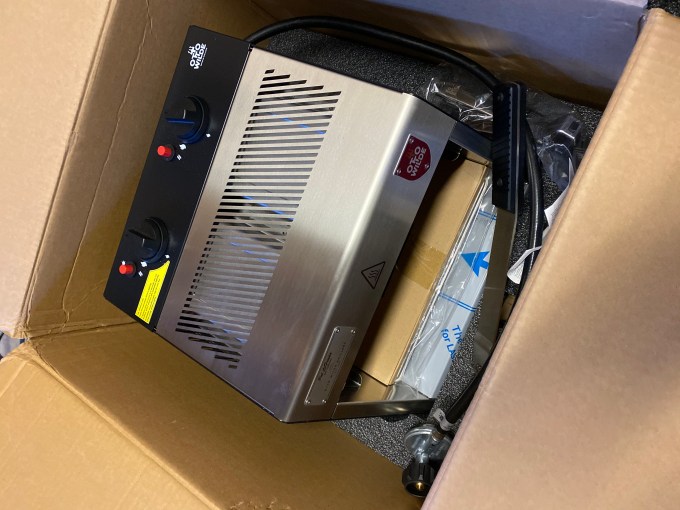
It’s a 16x17x11” self-contained propane broiler that features two top mounted burners that can reach temperatures of 1,500 degrees F. There is an adjustable grille and a catch pan for grease and a dual use arm that acts as a grille tool and a wrench to adjust the distance between the burners and your food.

It’s designed to cook steak that gets you as close to steakhouse taste and texture as possible. It does so by mimicking the kinds of top mounted broilers that you’ll find in many commercial kitchens.

I’m not going to bury the lede, this thing is $1,000. If you don’t have a G to drop on a cooking thing of any sort, then read on for entertainment and edification. If you DO have that much to spend (maybe) and are wondering why the hell you’d want to, and if you should I think I can deliver those things for you here.

But, why

After my Ooni review, Otto Wilde Grills reached out to see if I wanted to try out their over-fired broiler. I love steak, especially steak at the perfect temp with a restaurant-style carmelized crust. I’ve been able to get decent results over the years with my standard grill and a cast iron skillet — and more recently have been very happy with the sous vide bath + skillet method.

But there is just something about the somewhat violent, crispy, high heat broiler style finish that you get at a steakhouse that I have not been able to duplicate at home. 

Very specifically, the reason that a steakhouse steak hits your table with a carmel crust and nicely distributed interior juice is something called the Maillard reaction. Maillard reactions are different than caramelization, which is basically the heat driven decomposition of sugar. Instead, it is the breakdown and combination of sugars and amino acids. It happens during cooking in many foods but is most important in great tasting meat and bread. It begins to occur in most foods above around 280 °F or so but even higher temperatures can emphasize the resulting effects to the point where you get this deliciously beautiful light brown crust that adds a crunch and even slight sweetness to your foods, especially meats. 

The trick of at home Maillard reactions in steak is how to activate and sustain the process long enough to create the desired result while simultaneously not over-cooking your meat. 

A note: I am reviewing the Otto grill several years after it was initially released (though they do have a new ‘Pro’ model with a really handy drawer and a whole grill system hitting the market). But when they offered to send me one I went and checked out the reviews that were out there. Gonna be honest, even the ‘good’ reviews are pretty poorly done. Either they are done on YouTube by clear grillmasters that assume people know a lot about grilling and don’t really explain much beyond running a steak or two through the grill or they are on…ahem…other sites where they quite clearly have no idea what they are doing. Don’t get me started on the results in some of those reviews. I can’t even. I’m not going to blow up anyone’s spot specifically here, but as a bit of meta I can just say that the current state of food appliance reviews is really, really bad. I think a lot of people do pretty decent jobs reviewing, say, phones or game consoles. Not so much in the kitchen.

Anyway, over-fired broilers are extremely common in commercial kitchens, where ‘infrared’ heat (basically high heat gas shot through pinholes in a ceramic sheet) and radiant heat are primary options. The Otto Grill is an infrared style OFB, which means that it can get to high heat extremely quickly (about 3-5 minutes to 1,500 degrees) and that it cooks VERY fast because most of the heat goes right to the meat. 

Fast, high heat cooking means quicker crust, less gas waste and most importantly, juicier steaks that have less time to dry out. 

A quick how-to

One of the things that I found surprising when I started researching the Otto was that there are very few direct examples of how to cook a steak with it. To that end, here is my basic process for most steaks. Prior to beginning any of this I salt my steaks generously with a nice sea salt. I do not use anything else personally and I would say beware of any rubs with pepper or other ingredients because they can burn quickly in an oven as hot as the Otto.

  1. Fill the water tray halfway. This prevents grease fires and makes cleanup better, as well as introducing a bit of moisture to the cooking environment. 
  2. Pre-heat the Otto at full power. This takes as little as 3 minutes and no longer than 5 from zero to 1,500 degrees. 
  3. Remove the grille and place the steak(s) onto it oriented so that they are covered by one or both burners. 
  4. Pop it back in and use the adjustment lever to move them within about a half inch of the bottom edge of the flame at the top. You should see a roiling, sizzling field of flame turbulence just above the top surface of the meat. 
  5. Cook for around 60 seconds to 90 seconds. 
  6. Lower, remove, and flip end over end to sear the other side. 
  7. Raise, and cook for another 60-90 seconds. 
  8. At this point, if your steak is 1” thick or under and you are ok with medium rare, you are likely done. Remove it and check the temp with a meat thermometer to see if it is at your desired temp.
  9. If it is a thicker cut, reduce the heat to ¾ on both burners and drop the grill to the bottom position. Rotate every 2 minutes and periodically check the meat temp (I do it out of the oven because it’s so hot in there) until you hit desired done levels.
  10. Remove the meat to rest, turn off the Otto and let cool somewhat to clean the tray and grille.

This method has enabled me to cook thinner cuts in as little as 3-5 minutes. Larger cuts may require careful rotation and positioning. 

Steak results

I have cooked a lot of steaks on the Otto over the last couple of months. I’ve done ribeye, sirloin, filet mignon, hangar and T-bone

I cooked a wide variety of cuts at a number of different levels of marbling. The fattier cuts obviously benefited much more from the Otto’s high-temp cooking. The way that it absolutely pulverizes fat allows it to crust perfectly across the surface without creating a dry, crumbly texture. Instead it’s crispy and moist at the same time. 

Also, because it’s a top firing burner, the fat seeps downward, through the meat instead of outwards. The resulting exterior is super delicious and produces a nearly perfectly sized rind every time, leaving a to-temp interior. 

It took me a few steaks to get the methodology above down. I burned a few, for sure. This thing is crazy hot and the times involved are hard to wrap your head around at first. But once you have your rhythm, the Otto Grill cooks an insanely tasty steak from nearly any cut or quality of meat. Otto sent me a few frozen steaks to try, but I’ve mostly cooked my own meat purchased locally, which was much better. But even thawed meat was treated pretty well by this grill, the crust makes up for a lot when you’re working with so-so meat. 

For those of you that know steak, you may be wondering whether it is good at grassfed beef. Yes! It’s actually super killer for grassfed because the high, high heat makes the sear happen super fast, locking in the juice which is at a big premium in leaner grassfed cuts. Grassfed suffers with long cook times, which you won’t find in the Otto. You can cook a very nicely juicy medium rare grassfed cut here.

One major comparison that I think many people who might be in the market to buy this thing will be interested in is how it stacks up against the very popular sous-vide + cast iron sear method also referred to as reverse searing. Cooking your steak in a water bath to achieve precise interior temp and then searing it for crust and flavor has become uber popular for at home cooks in recent years due to the wide availability of consumer grade immersion circulators. 

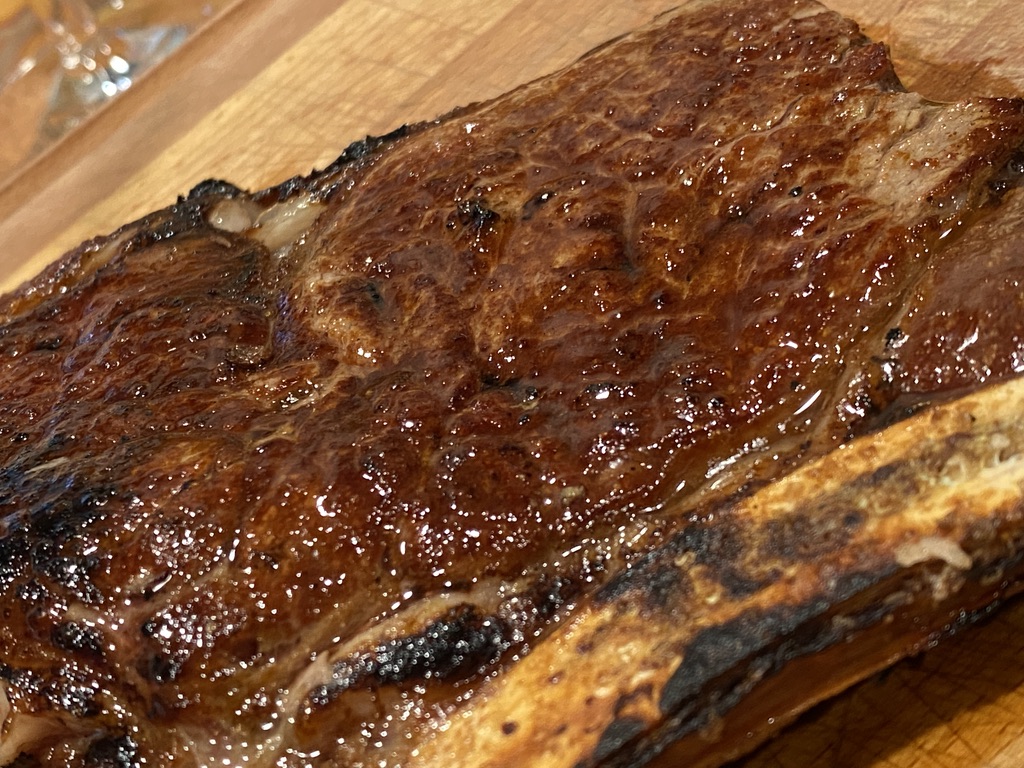
Sous-vide + sear on left, Otto Grill on right

I’ll say this as simply as possible: I think you can get extremely similar results with sous vide + cast iron, with some pretty straightforward caveats. 

  • Your cast iron has to be super hot. I’m talking 2,000 BTUs and up of gas burner hot. You need that high, hot heat to get that sear to lock in your juices and render your fat quickly. 
  • You’re searing it from the bottom by contact rather than the top by proximity, which means that fat will have a tendency to boil away and you need to continuously circulate your juices using butter or another oil. 
  • Smoke and spatter. You’re going to generate plenty of both on a skillet. 

Sous-vide + sear on left, Otto Grill on right

If you’re really used to reverse searing and you love your results, I still do think there are a couple of areas where the Otto can up your game a bit, but the general taste and satisfaction will be in the ballpark. One thing I did try which worked out well is a tri-tip — a huge cut that is popular in California that would not do well normally here. I did a sous-vide bath + reverse sear in the Otto and those turned out really lovely. 

I liked the Otto’s more delineated rind that creates that nice flavor seal along the interior edge of your cut of meat. I also think that it can be very easy to over cook thin steaks while searing if you can’t get your skillet super hot. 

The biggest overall benefit of course, is time. If you write off the resting time to bring your meat to room temp, which is passive cooking time, then you’re looking at anywhere from 1-3 hours to sous vide a thick cut steak. The Otto heats in 3 minutes and cooks in anywhere from 5-10 minutes. It’s a huge time savings for equal or better results.

One design consideration worth mentioning is that because there are two burners with a dead space in between, you must shift larger cuts to allow them to sear evenly if they span two burners. I wouldn’t call it a flaw as it is definitely pushing it to shove a wall-to-wall steak in there. I would love to see future versions of the oven reduce the space between the burners in order to allow more coverage for bigger steaks. This is a non factor if your steak fits under one burner, and most do in general. 

The catch pan, by the way, is pretty instrumental. Filling it with water reduces the chances that your fat will catch on fire, burning portions of your steak, and it makes cleaning up super easy as you can sluice out the still warm grease water and then brush it clean. I will note, at the risk of some ribbing, that I forgot to put some water in the pan once and may have added some…decorative smoke work to my grill’s face. Cook outdoors.

Pizza

Otto says you can make pizza in this thing too — and they even make a stone and peel. Well, you can, but I’d say how enthusiastic you get about it is going to sort of depend on what your standards for pizza are. 

The pizzas that I made in the Otto with the stone are, uh, they’re fine I guess. It’s absolutely, totally possible to do a little personal-sized pizza in the Otto, especially if you par bake the crust. But anything you do in here is going to pale next to the Ooni. I’d actually much rather just gin a up a little pan pizza that you can do in your regular home oven. There are a lot of reasons to buy the Otto, but pizza should not be a primary one, in my opinion.

I did cook a beautiful batch of naan in it though which was lovely. It’s basically common sense. Anything in the flatbread family is going to do wonderful here, but stuff with toppings needs to be par baked because it’s so damn hot.

Other stuff

Can you cook other stuff in the Otto? Yeah, 100%. Basically anything you can throw in a cast iron pan and sear up will do well in the Otto. Examples I’ve tried include peppers and onions, fruit and veg medleys and crispy potatoes drizzled in oil. Because the cast iron gets nice and evenly hot and you have a top broiler it makes for an ideal searing environment. It is hot as hell even at the lower settings though, so you need to keep an eye on it. 

Should you buy it?

Otto Wilde likely have their own ideas about the target market for their grills but for me it’s: has disposable income, loves steak enough to eat it 3x a week and already owns at least one or two other specialty grilling items. Basically, Big Green Egg owners. While something like a BGE is amazing at low and slow and smoking, it takes a hell of a lot to stoke and maintain the heat you’d need to get a caramelizing sear and in the end your steak would definitely be dryer. 

The Otto Grill is basically the consumerized version of a commercial kitchen staple item. Could you buy something like a Salamander for like $1,300? Sure, but at that point you’re a commercial kitchen and you’re gonna need a natural gas plumb and probably a business license. Just rent a strip mall slot or a food truck. 

Overall I found the design to be thoughtful, straightforward and reliable. Though I did have some ignition issues as described earlier, this is frank German engineering at its most utility-driven. The Otto Grill is expensive, but does precisely perform the task that it claims to make possible. I have cooked steaks by many different methods over the years and as I mentioned above, some of them are absolute stand-bys because they are really close to restaurant methodology. But for steakhouse style crust delivered absolutely consistently with the minimum of time and effort, the Otto Grill stands alone.

12 Oct 2020

AC Ventures announces the first close of its $80 million fund for Indonesian startups

As one of the world’s most populated countries, with a fast-growing internet economy, Indonesia offers plenty of opportunity for startups. AC Ventures wants to tap into that with its $80 million ACV Capital III L.P. fund. The firm announced the first close of the fund today, with $56 million already committed.

The capital will be invested into 30 Indonesian startups over the next three years, with first checks of up to $3 million going to seed to Series A-stage companies.

Based in Jakarta with a team of twelve people, ACV is a strategic alliance between AC Ventures and Indies Capital. ACV’s founding partners are Adrian Li and Michael Soerijadji, both founders and managing partners at AC Ventures, and Indies Capital managing partner Pandu Sjahrir. Sjahrir is also on the board of two Indonesian unicorns, Gojek and Sea.

The alliance has already made investments in nine startups: Shipper, Kargo, Stockbit, Bukuwarung, ESB, Co-Learn, KitaBeli, Aruna and Soul Parking. It will focus on e-commerce, financial tech, startups that serve MSMEs (or micro, small and medium-sized enterprises) and digital media-enabled services, which Li told TechCrunch could encompass sectors like education and healthcare, in addition to entertainment.

ACV also plans to work closely with the companies it invests in, guiding them through business development, key executive hires and later rounds of funding. Its also launched programs like AC Academy to coach founders on skills like growth hacking and fundraising.

Internet penetration and online payments have grown a lot over the past five years, but e-commerce still accounts for a tiny fraction of Indonesia’s overall retail market. This gives startups plenty of room to innovate. For example, logistics is very fragmented in Indonesia, because it has 600 inhabited islands. Shipper, another ACV investment, offers a platform to help sellers manage multiple shipments through different providers at once.

Fundraising for ACV Capital III began before the COVID-19 pandemic and despite the crisis’ economic toll, Li said that in countries like Indonesia, it may speed up the adoption of many kinds of technology. For example, BukuWarung, which focuses on digitizing operations for neighborhood shops and other small businesses, recently launched digital payments in response to demand for online orders and contactless payments. Another ACV portfolio company, ESB, is doing the same thing for restaurants, and Li said interest in its services increased as food and beverage businesses turned to online orders and deliveries during social distancing measures.

“We’re really seeing some great opportunities in Indonesia, and we’re seeing more interest globally going into startups in Indonesia,” said Li. “This is the world’s fourth most populous country and there are so many products and services which can be delivered better and more efficiently through technology.”

11 Oct 2020

India’s Razorpay becomes unicorn after new $100 million funding round

Bangalore-headquartered Razorpay, one of the handful of Indian fintech startups that has demonstrated accelerated growth in recent years, has joined the coveted unicorn club after raising $100 million in a new financing round, the payments processing startup said on Monday.

The new financing round, a Series D, was co-led by Singapore’s sovereign wealth fund GIC, and Sequoia India, the six-year-old Indian startup said. The new round valued the startup at “a little more than $1 billion,” co-founder and chief executive Harshil Mathur told TechCrunch in an interview.

Existing investors Ribbit Capital, Tiger Global, Y Combinator, and Matrix Partners also participated in the round, which brings Razorpay’s total to-date raise to $206.5 billion.

Razorpay accepts, processes, and disburses money online for small businesses and enterprises. In recent years, Razorpay has expanded its offerings to provide loans to businesses and also launched a neo-banking platform to issue corporate credit cards, among other products.

Mathur and Shashank Kumar (pictured above), who met each other at IIT Roorkee, started Razorpay in 2014. They began to explore opportunities around payments processing business after realizing just how difficult it was for small businesses such as young startups to accept money online less than a decade ago. There were very few payment processing firms in India then and startups needed to produce a long-list of documents.

The early team of about 11 people at Razorpay shared a single apartment as the co-founders rushed to meet with over 100 bankers to convince banks to work with them. The conversations were slow and stuck in a deadlock for so long that the co-founders felt helpless explaining the same challenge to investors numerous times, they recalled in an interview last year.

To say things have changed for Razorpay would be an understatement. It’s become the largest payments provider for business in India, said Mathur. Razorpay accepts a wide-range of payment options including credit cards, debit cards, mobile wallets, and UPI.

“Razorpay has established itself as a clear leader, with its strong focus on customer experience and product innovation,” said Choo Yong Cheen, Chief Investment Officer for Private Equity at GIC, in a statement. “GIC has a long track record of partnering with leading fintech companies globally and is delighted to partner with Razorpay in its journey to transform payments and banking.”

Some of Razorpay’s clients include budget lodging decacorn Oyo, e-commerce giant Tokopedia, top food delivery startups Zomato and Swiggy, online learning platform Byju’s, ride-hailing giant Gojek, supply chain platform Zilingo, caller ID service Truecaller, travel ticketing firms Yatra and Goibibo, and telecom giant Airtel.

The startup expects to process about $25 billion for nearly 10 million of its customers this year, said Mathur.

He attributed some of the growth to the coronavirus pandemic, which he said has accelerated the digital adoption among many businesses.

On the neo-banking and capital side, Mathur said, Razorpay expects RazorpayX and Razorpay Capital to account for about 35% of the startup’s revenue by the end of March next year.

Mathur said the startup’s payment processing service continues to be its fastest growing business and does not need much capital to grow, so the startup will be deploying the fresh funds to expand its neo-banking offerings to include vendor payment, and expense and tax management and other features.

The startup, which aims to work with over 50 million businesses by 2025, may also acquire a few firms as it explores opportunities around inorganic expansion in the neo-banking category, said Mathur.

“We will continue to make an impactful contribution to the growth of the industry, aid adoption in the under-served markets and drive new practices and a new thinking for the industry to follow. And this investment fits perfectly with our growth strategy,” he said.

11 Oct 2020

Twilio is buying customer data startup Segment for between $3B and $4B

Sources have told TechCrunch that Twilio intends to acquire customer data startup Segment for between $3 and $4 billion. Forbes broke the story on Friday night, reporting a price tag of $3.2 billion.

We have heard from a couple of industry sources that the deal is in the works and could be announced as early as Monday.

Twilio and Segment are both API companies. That means they create an easy way for developers to tap into a specific type of functionality without writing a lot of code. As I wrote in a 2017 article on Segment, it provides a set of APIs to pull together customer data from a variety of sources:

Segment has made a name for itself by providing a set of APIs that enable it to gather data about a customer from a variety of sources like your CRM tool, customer service application and website and pull that all together into a single view of the customer, something that is the goal of every company in the customer information business.

While Twilio’s main focus since it launched in 2008 has been on making it easy to embed communications functionality into any app, it signaled a switch in direction when it released the Flex customer service API in March 2018. Later that same year, it bought SendGrid, an email marketing API company for $2 billion.

Twilio’s market cap as of Friday was an impressive $45 billion. You could see how it can afford to flex its financial muscles to combine Twilio’s core API mission, especially Flex, with the ability to pull customer data with Segment and create customized email or ads with SendGrid.

This could enable Twilio to expand beyond pure core communications capabilities and it could come at the cost of around $5 billion for the two companies, a good deal for what could turn out to be a substantial business as more and more companies look for ways to understand and communicate with their customers in more relevant ways across multiple channels.

As Semil Shah from early stage VC firm Haystack wrote in the company blog yesterday, Segment saw a different way to gather customer data, and Twilio was wise to swoop in and buy it.

Segment’s belief was that a traditional CRM wasn’t robust enough for the enterprise to properly manage its pipe. Segment entered to provide customer data infrastructure to offer a more unified experience. Now under the Twilio umbrella, Segment can continue to build key integrations (like they have for Twilio data), which is being used globally inside Fortune 500 companies already.

Segment was founded in 2011 and raised over $283 million, according to Crunchbase data. Its most recent raise was $175 million in April on a $1.5 billion valuation.

Twilio stock closed at $306.24 per share on Friday up $2.39%.

Neither Segment nor Twilio responded to our request for comment. If that changes, we will update the story.

11 Oct 2020

Hands on with Telepath, the social network taking aim at abuse, fake news and, to some extent, ‘free speech’

There’s no doubt that modern social networks have let us down. Filled with hate speech and abuse, moderation and anti-abuse tools were an afterthought they’re now trying to cram in. Meanwhile, personalization engines deliver us only what will keep us engaged, even if it’s not the truth. Today, a number of new social networks are trying to flip the old model on its head — whether that’s attempting to use audio for more personal connections, like Clubhouse, eliminate clout chasing, like Twelv, or, in the case of new social network Telepath, by designing a platform guided by rules that focus on enforcing kindness, countering abuse, and disabling the spread of fake news.

Many of these early efforts are already facing challenges.

Private social network Clubhouse has repeatedly demonstrated that allowing free-flowing communication in the form of audio conversations is an area that’s notoriously difficult to moderate. The app, though still unavailable to the broader public, courted controversy in September when it allowed anti-Semitic content to be discussed in one of its chat rooms. In the past, it had also allowed users to harass an NYT reporter openly.

Meanwhile, Twelv, a sort of Instagram alternative, ditches the “Like” button concept and all the other features now overloading Instagram, which had once been just a photo-sharing network. But, unfortunately, this also means there’s no easy way to find and follow interesting users or trends on Twelv — you have to push friends to join the app with you or know someone’s username to look them up, otherwise it shows you no content. The result is a social network without the “social.”

Telepath, meanwhile, is a more interesting development.

It’s pursuing an even loftier goal in social networking — creating a hate speech-free platform where fake news can’t be distributed.

No social network to date has been able to accomplish what Telegraph claims it will be able to do in terms of content moderation. Its ambitions are optimistic and, as the network remains in private beta, they’re also untested at scale.

Though positioned as a different kind of social network, Telepath isn’t actually focused on developing a new sharing format that could encourage participation — the way TikTok popularized the 15-second video clip, for example, or how Snapchat turned the world onto “Stories.”

Instead, Telepath, at first glance, looks very much like just another feed to scroll through. (And given the amount of linked Twitter content in Telepath posts, it’s almost serving as a backchannel for the rival platform.)

The startup itself was founded by former Quora employees, including former Quora Business & Community head, Marc Bodnick, now Telepath Executive Chairman; and former Quora Product Lead, Richard Henry, now Telepath CEO. They’re aided by former Quora Global Writer Relations Lead, Tatiana Estévez, now Telepath Head of Community and Safety; and Ro Applewhaite, previously research staff for Pete Buttigieg for America, now Telepath Head of Outreach.

It’s backed by a couple million in seed funding, led by First Round Capital (Josh Kopelman). Other backers include Unusual Ventures (Andy Johns), Slow Ventures (Sam Lessin), and unnamed angels. Bodnick and his wife, Michelle Sandberg, also invested.
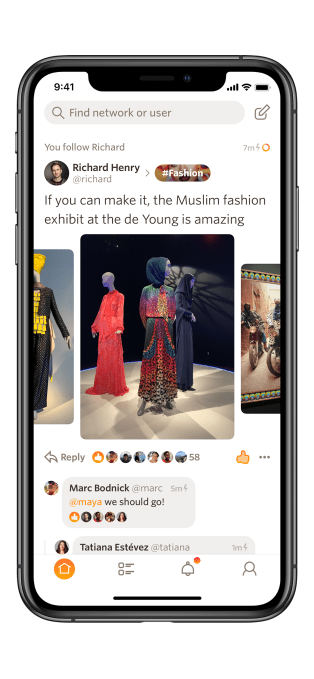
Image Credits: Telepath

When talking about Telepath, it’s clear the founders are nostalgic for the early days of the web — before all the people joined, that is. In smaller, online communities in years past, people connected and made internet friends who would become real-world friends. That’s a moment in time they hope to recapture.

“I’ve benefited a lot by meeting people through the internet, forming relationships and having conversations — that sort of thing,” says Henry. “But the internet just isn’t fun in the ways that it used to be fun.”

He suggests that the anonymity offered by networks like Reddit and Twitter make it more difficult for people to make real-world connections. Telepath, with its focus on conversations, aims to change that.

“If we facilitate a really fun, kind, and empathetic conversation environment, then lots of good things can happen. And it might be that you potentially find someone you want to work with, or you end up getting a job, or you meet new friends, or you end up meeting offline,” Henry says.

Getting Started

To get started on Telepath, you join the network with your mobile phone number and name, find and follow other users, similar to Twitter, then join interest-based communities as you would on Reddit. When you launch the app, you’re meant to browse a home feed where conversation topics from your communities and interesting replies are highlighted — orange for those replies from people you follow and gray for those that Telepath has determined are worth being elevated to the home screen.

As you read through the posts and visit the communities, you can “Thumbs Up” content you like, downvote what you don’t, reply, mute, block, and use @usernames to flag someone.

Image Credits: Telepath, screenshot via TechCrunch

Another interesting design choice: everything on Telepath disappears after 30 days. No one will get to dig through your misinformed posts from a decade ago to shame you in the present, it seems.

What’s most different about Telepath, however, is not the design or format. It’s what’s taking place behind the scenes, as detailed by Telepath’s rules.

Users who join Telepath must agree to “be kind,” which is rule number one. They must also not attack one another based on identity or harass others. They must use a real name (or their preferred name, if transgender), and not post violent content or porn. “Fake news” is banned, as determined by a publisher’s attempts at disseminating misinformation on a regular basis.

Telepath has even tried to formalize rules around how polite conversations should function online with rules like “don’t circle the drain” — meaning don’t keep trying to have the last word in a contentious debate or circumvent a locked thread; and “stay on topic,” which means don’t bombard a pro-x network with an anti-x agenda (and vice versa.)

Image Credits: Telepath

To enforce its rules, Telepath begins by requiring users to sign up with a mobile phone number, which is verified as a “real” number associated with a SIM card, and not a virtual one — like the kind you could grab through a “burner” app.

In order to the create its “kind environment,” Telepath says it will sacrifice growth and hire moderators who work in-house as long-term, trusted employees.

“All the major social networks essentially grew in an unbounded way,” explains Henry. “They had 100 million-plus active users, then were like, ‘okay, now how do we moderate this enormous thing?’,” he continues. “We’re in a lucky position because we get to moderate from day one. We get to set the norms.”

Moderation

“Day one” was a long time in the making, however. The team rebuilt the product four times over a couple of years. Now, they say they’ve developed internal tools that provide moderators with visibility into the system.

According to moderator head Estévez, these include a reporting system, real-time content streams organized in to buckets (e.g. a bucket for “only new users”), as well as various searchable ways to get context around a report or a particular problematic user.

“Really good tools — including real-time streams of content, classifiers for problematic behavior, searchable context, and making it hard for banned users to return — mean that each moderator we hire will be quite scalable. We think that there are network effects around positive behavior,” she says.

Image Credits: Telepath

“It’s our intention to scale up fast and high accuracy moderation decision-making, which means that we’re going to be investing a lot of engineering effort in getting these tools right,” she adds.

The founders have decided not to use any third-party systems to aid in moderation at this time, they told TechCrunch.

“We looked at a bunch of off-the-shelf [moderation systems], and we’re basically building everything that we need from scratch,” says Henry. “We just need more control over being able to tweak how these systems work in order to get the outcome that we want.”

The investment in human moderation over automation will also require additional capital to scale. And Telepath’s decision to not run ads means it will eventually need to consider alternative business models to sustain itself. The company, for now, is interested in subscriptions, but hasn’t made decisions on this front yet.

Banning the trolls

Though Telepath has only 4,000-plus users in its private beta, the two-person moderation team is already tasked with moderating posts from across the thousands of pieces of content shared on a daily basis. (The company doesn’t disclose how many violations it takes action against per day, on average.)

When a user breaks the rules, moderators may first warn them about the violation and may require them to take down or edit a specific post. No one is punished for making a mistake or being unaware of the rules — they’re first given a chance to fix it.

But if a user breaks the rules repeatedly or in a way that seems intentional, such as engaging in a harassment campaign around another user, they are banned entirely. Because of the phone number verification system, they also can’t easily return — unless they go out and purchase a new phone, that is.

These moderation actions don’t necessarily have to follow strict guidelines, like a “three strikes rule,” for example. Instead, the way the rules may be enforced are determined on a case-by-case basis. Where Telepath leans towards stricter enforcement is around intentional and flagrant violations, or those where there’s a pattern of bad behavior. (As with Reply Guys and sealioning behavior.)

In addition, unlike on Facebook and Twitter — platforms that sometimes seem to be caught off guard by viral trends in need of moderation — Telepath intends for nothing to go viral on its platform without having been seen by a human moderator, the company says.

Fake News

Telepath is also working to develop a reputation score for users and trust scores for publishers.

In the case of the former, the goal is help the company determine how likely the user is to break Telepath’s rules. This isn’t developed yet, but would be something used behind the scenes, not put on display for all to see.

For publishers, the trust score will be how factually correct they are what percentage of the time.

Image Credits: Thomas Faull (opens in a new window) / Getty Images

“For example, if the most popular article in terms of views from the publisher is just completely factually incorrect or intentionally misleading…that should have a bigger penalty on the trust score,” explains Henry. “The problem is that the incumbent platforms have rules against disinformation, but the problem is that they don’t enforce them out of this desire to appear balanced.”

Bodnick adds this challenge is not as insurmountable as it seems.

“Our view is that, actually, a handful of outlets are responsible for most of the disinformation…I don’t think our intent is to build out some modern-day truth system that will figure out if The Washington Post is slightly more accurate than The New York Times. I think the main goal will be to identify repeat disinformation publishers — determine that they are perpetual publishers of disinformation, and then crush their distribution,” says Bodnick.

This plan, however, involves setting rules on Telepath that fly in the face of what many today consider “free speech.” In fact, Telepath’s position is that free speech-favoring social networks are a failed system.

“The problem, in our view, is that when you take this free-speech centered approach that sort of says: ‘I don’t care how many disinformation posts Breitbart has published in the last — three years, three months, three weeks — we’re going to treat every new post as if it could be equally likely to be truthful as any other post in the system,'” says Bodnick. “That is inefficient.”

“That’s how we will scale this disinformation rule — by determining which relatively small group of publishers — I’m guessing it’s hundreds, low hundreds — are responsible for publishing lots of disinformation. And then take their distribution down,” he says.

This opinion on free speech is shared by the team.

“We’re trying to build a community, which means that we have to make certain tradeoffs,” adds Estévez. “In the rules we refer to Karl Popper’s paradox of tolerance — to maintain a tolerant society, you have to be intolerant of intolerance. We have no interest in giving a platform to certain kinds of speech,” she notes.

This is the exact opposite approach that conservative social media sites are taking, like Parler and Gab. There, the companies believe in free speech to the point that they’ve left up content posted by an alleged Russian disinformation campaign, saying that no one filed a report about the threat, and law enforcement hadn’t reached out. These MAGA-friendly social networks are also filled with conspiracies, un-fact checked reports, and, frankly, a lot of vitriol.

The expectation is that if you go on their platforms, you’re in charge of muting and blocking trolls or the content you don’t like. But by their nature, those who join these platforms will generally find themselves among like-minded users.

Twitter, meanwhile, tries to straddle the middle ground. And in doing so, has alienated a number of users who think it doesn’t go far enough in counteracting abuse. Users report harassment and threats, then wait for days for their report to be reviewed only to be told the tweet in question didn’t break Twitter’s terms.

Telepath sits on the other end of the spectrum, aggressively moderating content, blocking and banning users if needed, and punishing publications that don’t fact check or those that peddle misinformation.

“Kindness” carve-outs

And yet, despite all this extra effort, Telepath doesn’t always feature only thoughtful and kind-hearted conversations.

That’s because it has carved out an exception in its kindness rule that allows users to criticize public figures, and because it doesn’t appear to be taking action on what could be problematic, if not violating, conversations.

Image Credits: Telepath

A user’s experience in these “gray” areas may vary by community.

Telepath’s communities today focus on hobbies and interests, and can range from the innocuous — like Books or Branding or Netflix or Cooking, for example — to the potentially fraught, like Race in America. In the latter, there have been discussions about the capitalization of “Black” where it was suggested that maybe this wasn’t a useful idea. In another, sympathy is expressed for a person who was falsely pretending to be a person of color.

In a post about affordable housing, someone openly wondered if a woman who said she didn’t want to live near poor people was actually racist. Another commenter then noted that gang members can bring down property values.

A QAnon community, meanwhile, discusses the movement and its ridiculous followers from afar — which is apparently permitted — though supporting it in earnest would not be.

There are also nearly 20 groups about things that “suck,” as in GOPSucks or CNNSucks or QuibiSucks.

Anti-Trump content, meanwhile, can be found on a network called “DumbHitler.”

Meanwhile, online publishers who routinely post discredited information are banned from Telepath, but YouTube is not. So if feel you need to share a link to a video of Rudy Giuliani accusing Biden of dementia, you can do so — so long as you don’t call it the truth.

And you can post opinions about some terrible people in which you describe them as terrible, thanks to the public figure carve-out.

Cheater and deadbeat dad? Go ahead and call them a “disgusting human being.” VP Pence was referred to by a commenter as “SmugFace mcWhitey” and Ronny Jackson is described as “such a piece of sh**.”

Explains Estévez, that’s because Telepath’s “be kind” rule is not intended to protect public figures from criticism.

“It is important to note that toxicity on the internet around politics isn’t because people are using bad words, but because people are using bad faith arguments. They are spreading misinformation. They are gaslighting marginalised groups about their experiences. These are the real issues we’re addressing,” she says.

She also notes that online “civility” is often used to silence people from marginalized groups.

“We don’t want Telepath’s focus on kindness to be turned against those who criticize powerful people,” she adds.

In practice, the way this plays out on Telepath today is that it’s become a private, closed door network where users can bash Trump, his supporters and right-wing politicians in peace from Twitter trolls. And it’s a place where a majority agrees with those opinions, too.

It has, then, seemingly built the Twitter that many on the left have wanted, the way that conservative social media, like Gab and Parler, built what the right had wanted. But in the end, it’s not clear if this is the solution for the problems of modern social media or merely an escape. It also remains to be seen whether a mainstream user base will follow.

Telepath remains in a closed beta of indefinite length. You need an invite to join.