Plaid, the company building a universal banking API that lets you connect an app or service with a bank account, has updated Plaid Link. Plaid Link is the interface that you see when you add your bank account to any app or service that uses Plaid, such as Cash App or TransferWise.
Given that 3,000 apps have been using Plaid, chances are you’ve seen Plaid Link in the past. According to the company, one in four people in the U.S. have used Plaid to connect their accounts.
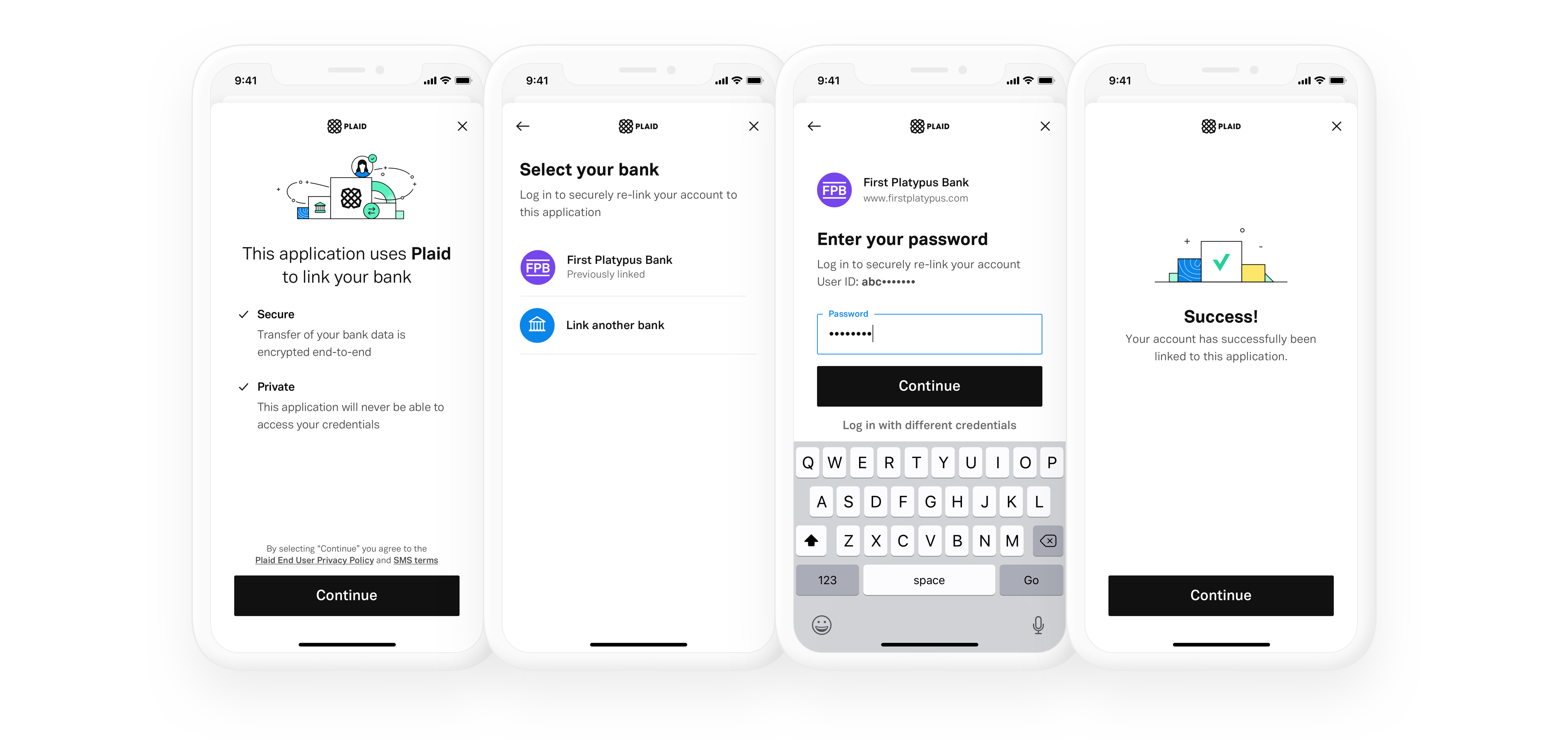
And today’s update is all about using Plaid with multiple apps. The first time you connect your bank account, you search for your bank, you enter your credentials and you log in.
The second time you need to add your bank account, Plaid shows you previously added bank accounts. You don’t have to scroll through a list of financial institutions and you don’t have to enter you user ID. Plaid might ask you for your password again or a one-time code.
Image Credits: Plaid
When you buy something on an e-commerce platform, you can save your card so that you don’t have to enter your card details again. With today’s update to Plaid Link, the company is doing the same thing with bank account information.
Payment cards thrived in part because it is much easier to pay with your card than connecting to your bank account to send money. Polishing Plaid Link could slowly make it easier to skip the card and use money from your bank account directly.
Plaid also says that Plaid Link is a bit faster. Each panel loads 30% faster. The list of banks now changes depending on your location. Local banks appear closer to the top of the list so that you don’t have to scroll as much.
Once you’ve added a bank account, the original app receives a Plaid token to query your bank account through Plaid.
Anyone who writes online or in a word processor has likely gotten used to the inevitable squiggly line denoting a misspelled word or clumsy phrase. But what if you use a word that’s loaded, a phrase that’s too formal or not formal enough, or refer to a group of people in an outdated way? Writer is a service that watches as you type, flagging language that doesn’t match up with your style guide and values, and it just raised $5M to scale up.
Both people and the companies they work for want to improve the way they write, but not just in terms of grammar and spelling. If a company says it’s inclusive, but the language in its press releases or internal blogs are peppered with anachronism and bias, it suggests their concern only goes so far.
“Companies are hungry to put actions behind their words,” said Writer founder and CEO May Habib. “They want to be able to tell a consistent story to their users everywhere that they’re interacting with them. What Writer does is let people know when they’re using insensitive language, or things that could be considered negative, and let companies set brand guidelines.”
Right off the bat let us admit that there is a whiff of the sinister about the idea of a company dictating how its employees speak, though that’s nothing new when it comes to content and official communications. But this isn’t about controlling speech for power — it’s about recognizing that we are all flawed communicators and could use a hand keeping ourselves honest. Less thought police and more a well-informed angel sitting on your shoulder whispering things like, “Hey. Are you sure you want to describe that lawyer as ‘exotic’?”
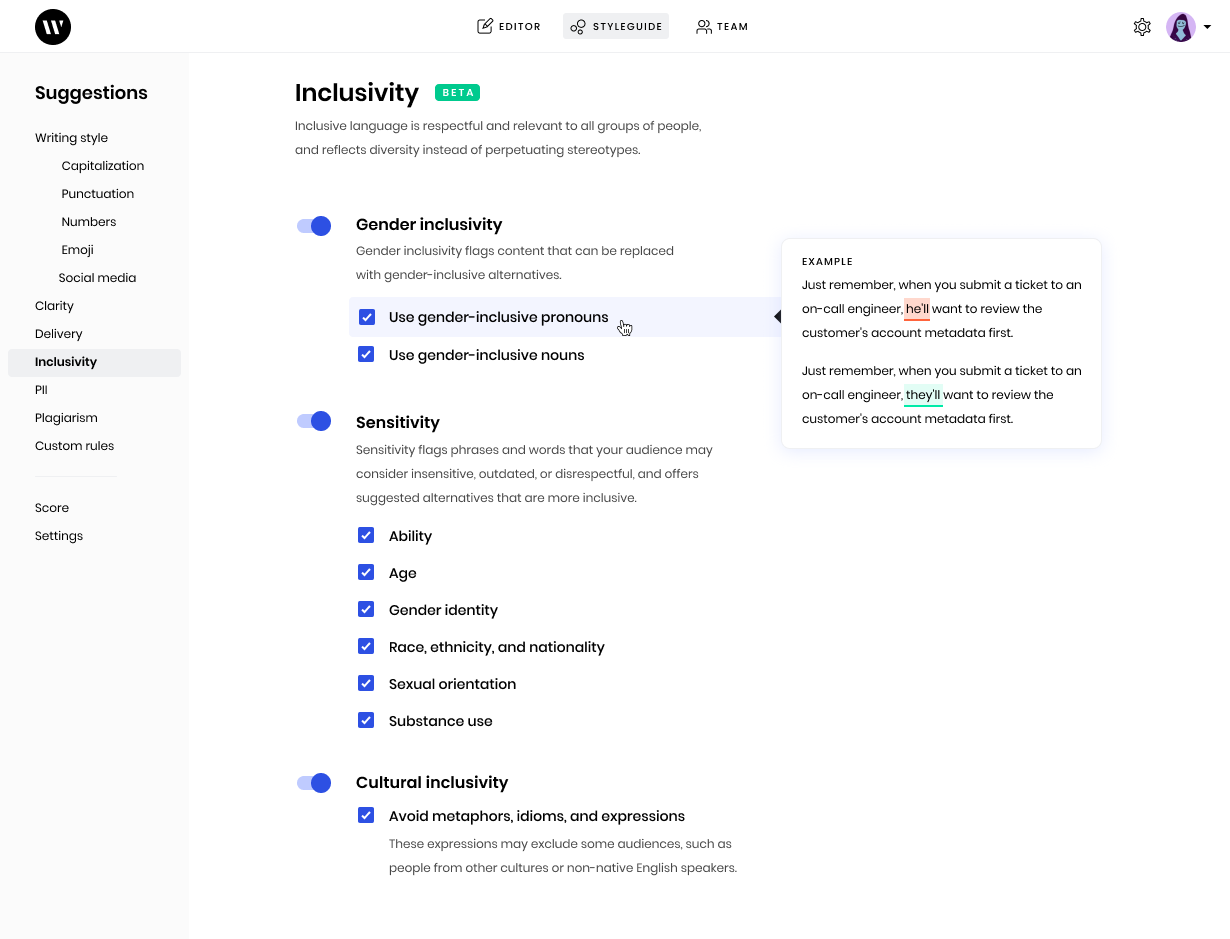
Examples of things Writer checks for.
There are tons of slip-ups we all make along those lines, less obvious but no less potentially offensive. It’s important in public communications, among other things, to refer to a group by the term they prefer, not the first one that pops into your head; Writer has up-to-date libraries of this information sourced from the communities themselves. Some phrases may have become politically loaded in the last couple years, but you’re not aware; No problem, it has alternatives. You want to avoid unnecessarily gendered language, great, but everyone slips up now and then; Writer can spot it — or make the connection with previous pronouns to make sure you don’t, for example, gender an anonymous source.
Accusations of “political correctness” will dog the service, but as Habib put it: “This is beyond politics; This is about respect for people who live a certain way, or are a certain way, and prefer to use certain terms. We’re trying to help companies create communities of belonging.” And as we’ve seen over and over again in tech, there is often a serious disconnect between the stated aspiration of a company and how people are treated within them. Just using the right words is a pretty low bar to start with, honestly.
Image Credits: Writer
Writer isn’t just a growing blacklist of words you should think twice about using, though. The natural language processing engine at the heart of it is also very concerned with things like sentence complexity, paragraph length, and tone. It has to have this deeper understanding, Habib explained, because “it’s not enough to underline — you need to know what to replace it with, and when you replace it, you need to fit it into the sentence. These are actually hard NLP problems.”
That lets it fit into a variety of roles in addition to promoting inclusive language. It can watch for the usual spelling and grammar mistakes, as well as things like formality, active voice, “liveliness” (whatever that is, I don’t have it), and other metrics that help define a brand.
And of course you can bring in your own style guide so your editors don’t have to roll their eyes at serial commas in headlines, double dashes instead of em dashes, e-mail instead of email, and all the rest of the little nips and tucks that keep a brand’s writing in a generally recognizable shape.
Image Credits: Writer
The service can also switch between style guides or adjust or disable itself in different apps and sites — so internal emails aren’t given the same guidelines as press releases, or a blog post’s style can be differentiated from a newsletter’s.
Obviously Grammarly is a big competitor here, but Habib feels that it and the growing number of in-browser or in-app checking services are very focused on the technical piece. Writer is less about preventing an individual writer’s errors, and more about creating consistency among groups of writers and making sure they are working from the same high-level linguistic standards.
Of course security is also a concern — no one wants a keylogger running on their machine, however helpful it may be. Habib was careful to emphasize that Writer runs locally in the browser as a plug-in, integrating with Word or Chrome for now but with other apps and services on the way. “None of that data ever hits a writer server, and no metadata — all the processing is done in the text area,” she said. The only data that’s sent back is the fact that a given suggestion was used, such as changing “should of” to “should have” or “illegal aliens” to “undocumented immigrants.” No user data is used to train the models and no content apart from the correction itself is sent or stored on Writer’s servers.
Writer is available now, for $11/person/month (with the obligatory free trial period, of course) for a basic version and some unspecified amount for enterprise deals with multiple style guides, plagiarism detection, and so on. It’s only available in English, and although there is of course demand for the service in other languages, the depth of the NLP model and the specificity of what it recognizes to the language mean it does not generalize well. To take on Spanish or Korean would be to develop an entirely new product. So English it is for now.
The company is new, and has been developing its NLP engine (on the back of a previous effort, which monitored user-facing language in GitHub repos) for 18 months in something like stealth. The $5M seed round, led by Upfront Ventures, Aspect Ventures, Bonfire Ventures, and Broadway Angels should help the company scale, though it already has some top-tier, household-name customers, so with that and the money its immediate future seems to be secure.
For several years, blockchain technology has been touted as a way to verify the sale of property. Any kind of property. And so entrepreneurs busily began the process of trying to create a startup that could complete a property deal on the blockchain.
One that stood out from the start was Propy which was started by Natalie Karayaneva, an experienced, real-world property developer who had subsequently joined the blockchain world. Propy’s other co-founder is Denitza Tyufekchieva (pictured).
Propy has now raised an undisclosed funding round from venture capitalist investor Tim Draper, best known for his early investments into Tesla, Skype, Twitter, Coindesk and Robinhood. TechCrunch understands this is part of a wider, ongoing fund-raise.
Propy’s platform uses blockchain technology to, it says, simplify the home purchasing experience and eliminate fraudulent transactions. The idea is to close a traditional real estate deal entirely online. Thus, the offer, signed purchase agreements with Docusign, secure wire payments, and title deeds are all taken care of. Propy claims its platforms saves 10 hours of paperwork, per transaction.
“My vision for Propy is to bring self-driving real estate transactions to the world, with all of the logistics seamlessly executed on the back-end”,Karayaneva said in a statement. “Our platform offers a terminal to observe transactions in real-time, making the process transparent for real estate executives, title companies, homebuilders, buyers, and REITs. With this new investment we are excited to bring much-needed change to the industry, satisfy consumers and empower real estate professionals all over the world.”
But this is not some out-there, wacky crypto-play. Most of the transactions are done in dollars on Propy, meaning it could be used by mainstream users from day one, as it’s able to process wire transfers via integration with a money transmitter connected to 70 banks.
Speaking to TechCrunch, Karayaneva added: “We do not replace lawyers, but rather help them, closing attorney’s share documents with consumers and agents via Propy. With DocuSign integrated, they can sign the documents on Propy and all parties get notified. In the US, agents have ready forms in Propy to fill out and they don’t need lawyers in a transaction at all.”
Crucially, Propy has an enterprise play going on here as well. Its platform can provide the back-office system to real estate enterprises with real-time transaction reports and automated compliance.
Draper said: “Propy has the potential to transform Real Estate, making transactions and titles simpler, more secure, and less expensive through innovative use of blockchain technology. [It] eliminates fraud and makes the closing process more secure, effective, and streamlined.”
According to one survey, almost one-fifth of millennials have now thought about buying a home become of the lock-downs induced by the Covid-19 pandemic, meaning that many will be looking for an easy way to transact, especially if it has the ease of use Propy has.
Propy has some fellow-travelers in the blockchain prop-tech space. ShelterZoom is Blockchain platform used for virtual and remote collaboration with offices and clients, while StreetWire is a Blockchain-based data service for the real estate industry.
For several years, blockchain technology has been touted as a way to verify the sale of property. Any kind of property. And so entrepreneurs busily began the process of trying to create a startup that could complete a property deal on the blockchain.
One that stood out from the start was Propy which was started by Natalie Karayaneva, an experienced, real-world property developer who had subsequently joined the blockchain world. Propy’s other co-founder is Denitza Tyufekchieva (pictured).
Propy has now raised an undisclosed funding round from venture capitalist investor Tim Draper, best known for his early investments into Tesla, Skype, Twitter, Coindesk and Robinhood. TechCrunch understands this is part of a wider, ongoing fund-raise.
Propy’s platform uses blockchain technology to, it says, simplify the home purchasing experience and eliminate fraudulent transactions. The idea is to close a traditional real estate deal entirely online. Thus, the offer, signed purchase agreements with Docusign, secure wire payments, and title deeds are all taken care of. Propy claims its platforms saves 10 hours of paperwork, per transaction.
“My vision for Propy is to bring self-driving real estate transactions to the world, with all of the logistics seamlessly executed on the back-end”,Karayaneva said in a statement. “Our platform offers a terminal to observe transactions in real-time, making the process transparent for real estate executives, title companies, homebuilders, buyers, and REITs. With this new investment we are excited to bring much-needed change to the industry, satisfy consumers and empower real estate professionals all over the world.”
But this is not some out-there, wacky crypto-play. Most of the transactions are done in dollars on Propy, meaning it could be used by mainstream users from day one, as it’s able to process wire transfers via integration with a money transmitter connected to 70 banks.
Speaking to TechCrunch, Karayaneva added: “We do not replace lawyers, but rather help them, closing attorney’s share documents with consumers and agents via Propy. With DocuSign integrated, they can sign the documents on Propy and all parties get notified. In the US, agents have ready forms in Propy to fill out and they don’t need lawyers in a transaction at all.”
Crucially, Propy has an enterprise play going on here as well. Its platform can provide the back-office system to real estate enterprises with real-time transaction reports and automated compliance.
Draper said: “Propy has the potential to transform Real Estate, making transactions and titles simpler, more secure, and less expensive through innovative use of blockchain technology. [It] eliminates fraud and makes the closing process more secure, effective, and streamlined.”
According to one survey, almost one-fifth of millennials have now thought about buying a home become of the lock-downs induced by the Covid-19 pandemic, meaning that many will be looking for an easy way to transact, especially if it has the ease of use Propy has.
Propy has some fellow-travelers in the blockchain prop-tech space. ShelterZoom is Blockchain platform used for virtual and remote collaboration with offices and clients, while StreetWire is a Blockchain-based data service for the real estate industry.
Cryptocurrency exchange Coinbase is adding a new way to withdraw funds from your Coinbase account. If you’ve added a compatible debit card to your account, you can transfer USD, EUR or GBP to your bank account nearly instantly.
There are some drawbacks, and the main one is that you’ll pay a lot of fees. In the U.S., Coinbase deducts 1.5% from the transaction, or a minimum $0.55 if it’s a small transaction. In Europe and the U.K., you pay 2% in fees or a minimum fee of £0.45/€0.52.
You also need to have a compatible card. Not all debit cards support incoming transfers. You need to have a Visa card that supports Visa Fast Funds. In the U.S., you can also use a MasterCard card with MasterCard Send.
It’s hard to know whether your bank or card issuer support those features. The best way to figure it out is probably by adding your card to Coinbase and see what Coinbase says.
Coinbase isn’t removing other withdrawal methods. For instance, if you’re looking for a cheaper way to withdraw your funds in Europe, a SEPA bank transfer costs €0.15 per transfer. And Coinbase supports instant SEPA transfers if your bank has enabled that.
The company also lets you link your PayPal account with your Coinbase account. Your funds should hit your PayPal account within a few seconds and there are no fees on Coinbase’s side.
As you can see, there are many ways to move money from your bank account to your Coinbase account. Some of them are slower than others, some of them are more expensive than others. Crypto-to-crypto transactions are a bit simpler by comparison as you only need your recipient’s wallet address to send tokens.
Removing the background of a video you’ve shot can be a real pain if you don’t have the kind of tools and setup used by professionals — and even then it isn’t as easy as it should be. Kaleido’s one-step background removal tool for images, remove.bg, has graduated to full motion video with the company’s new product, Unscreen.
The service itself is simple enough. You drag a video onto the Unscreen webpage, and a few minutes later (depending on the size and resolution of the content) you get it back, with everything gone but the person or object in the foreground.
The company’s first product was remove.bg, which was the same sort of thing but for still images; It was a big hit on Product Hunt. As someone who has to do a bit of work in that line myself now and then, it’s nice to know there’s a very simple, effective web service for snipping out the background quickly and accurately, even though I know I could do the same thing in Photoshop with a bit of work.
After nine months out there remove.bg is serving millions of users monthly, 25,000 of which are actually paying customers. Clearly there is demand for this type of service, and going from stills to video is a natural move, though of course the amount of computing power required is many times more. Kaleido tested the waters with an experimental MVP back in March, and developed Unscreen on the back of that.
The idea is, understandably, to become the go-to tool for creators who have little time to spare or don’t want to deal with heavy-duty options like Premiere. On YouTube and other platforms, speed is paramount if you want to have the first unboxing video or reaction to news, but maintaining production value is important, and people will be put off by janky live background removal that makes the creator look like an amateur.
Speaking of which, Kaleido chose to compete in the offline video processing space because there are entrenched and competitive offerings available from Zoom, Microsoft and others in the video chat space, where “good enough” is just fine. But there are comparatively fewer options for offline video editing, and fewer still that anyone can operate with no expertise at all.
In Hollywood (which is to say in cinema and high-end video production in general) the world of compositing is changing, with LED walls like those used on The Mandalorian an attractive, though expensive and complex, alternative to the standard green screen or frame-by-frame rotoscoping. A simple one-step process to easily remove backgrounds for quick-turnaround shoots, dailies, and other situations could be a godsend for many a VFX tech or production studio.
At all events the market is evolving but clearly exists, as paying customers attest. Kaleido is totally self-funded so far, with no need or desire to take on investors, since its income scales with its expenses and exposure.
As with most media products these days, Unscreen comes in a freemium subscription model. You can try it out with clips up to 10 seconds long for free (but the watermarked, low-resolution files aren’t really suitable for publication), then there are the usual subscription tiers, from $9 to $389 per month depending on how much footage you plan on uploading. 2/3 of its income is from small businesses, but it also counts several major enterprises and media companies among its paying customers.
Of course none of that matters if the product itself doesn’t work. I tested it out on a 5-minute, 720p video of a woman with long hair, and it finished in about 45 minutes. The end result was good, with the hair nicely preserved and only a handful of small glitches that would be easy to paint out if desired. A minute and a half of myself talking into the camera in 1080p took about 33 minutes, and a somewhat clearer 23-second video of a colleague turned out very crisp in about 10 minutes.
I bet at first you thought this still was from Fashion Week too, right?
You might say, why so long? Zoom does it in real time. Yes, but at a low resolution and quality. It’s not the kind of thing you’d want to put online publicly and permanently, or use in a commercial shoot. From what I could tell, the quality of Unscreen’s removal was considerably better, but not straight-to-final good. You’ll want to watch it first to snag any issues.
Users have the option to render the video directly with a still, video, or solid color background, or a two-channel (alpha and color files) version for feeding into an editor. Other options are limited, so if you want to upscale, resize, re-render with a different color, etc, you’re out of luck. This isn’t an online video editing platform — it’s a web-hosted video effect and should be treated as such.
One thing Kaleido has been careful to demonstrate — and it’s sad to think that this is a differentiator — is that its products work with people whose skin tone and hair confound other solutions. The bare fact that some background removal processes work better with light-skinned people than dark-skinned, or with straight hair than curly, is a sad indicator of a lack of diversity in the training set that produced those tools.
Curly hair is notoriously difficult for computer vision algorithms, but Unscreen’s does a decent job of it.
Kaleido’s Bernhard Holzer told me that this was top of mind from the beginning, and that the team has been careful to assemble training data from all over the world to make sure the product works equally well no matter what country or hemisphere the user is in. They keep an eye out for unexpected issues; For instance, it was found that a person with a commencement cap on moving the tassel from one side to the other wasn’t handled well by the system — so they added a bunch of data to fix it. Users are encouraged to give feedback and the system is constantly evolving to take advantage of it.
The company itself is growing, and expects to double in size to about 30 employees this year — and as noted remains funded by its own income. The appetite for web tools is certainly considerable, and until now the idea of a single-click background removal one didn’t exactly make sense. But by being the first Unscreen hopes to become and remain the best.
SpaceX is set to launch a GPS-III satellite for the U.S. Space Force using a Falcon 9 rocket, with a target launch time of 9:43 PM EDT (6:43 PM PDT). That opens a 15-minute launch window, and so far weather is looking relatively good, which will hopefully help SpaceX end a recent string of launch scrubs, including one earlier this week for a reset Starlink mission.
The Falcon 9 used for this launch is a rarity these days – a brand new vehicle, including a booster being used for the first time. The attempt will include a landing of that first stage aboard SpaceX’s ‘Just Read the Instructions’ drone landing ship in the Atlantic Ocean.
There’s a good reason that SpaceX isn’t flying a previously flown booster for this one: The company’s contract with the Space Force stipulates that it can only use new, non refurbished vehicles for National Security Space Launch (NSSL) missions. But they recently announced an updated agreement that will allow SpaceX to use reflown first stages on future flights.
The webcast above will start at around 15 minutes prior to the opening of the launch window, so at around 9:28 PM EDT (6:28 PM PDT).
Long before the coronavirus, Sora, a startup run by a team of Atlanta entrepreneurs, was toying with the idea of live, virtual high school. The program would focus on student autonomy and organize its curriculum around projects that learners wanted to work on, such as finding ways to reduce the impact of climate change on the world. Students and teachers would use Zoom and Slack to communicate with each other, with standups everyday to pulse-check progress.
The pandemic has both undermined and underscored Sora’s focus. On one end, the millions of students that flocked home have shown how hard it is to effectively and accessibly teach in virtual settings. On the other end, the pandemic isn’t going away any time soon. Parents and students are desperate for better options.
Sora co-founder Garrett Smiley thinks he can convince parents to approach virtual high school with optimism, their kids and their checkbooks. It all starts with green algae farms.
Smiley said students turn to Sora so they can “start running instead of walking” in their education. He added how the first students in the program spent time building algae farms in their backyards, working with SpaceX engineers and taking college-level math classes upon entrance.
Smiley, who co-founded the company with Wesley Samples, says that Sora sells best to students who feel stifled or “held back” from traditional educational institutions. Sora’s product, thus, feels more apt for educationally gifted students than students who might need extra help or support.
At Sora’s heart, it is a private school replacement with a project-based curriculum. How it works beyond that is a little bit more confusing to comprehend. Firstly, students upon enrollment embark on two-week learning expeditions, exploring the answers to broad questions like “how do we recreate an alien species.” As time progresses, students are prompted to create their own projects with check-in calls twice a day. Below is an example of a standup:
Beyond the self-directed study, Sora offers a series of Socratic seminars and workshops.
There’s no such thing as science class, but there are workshops such as “the Physics of Sharks.” Here’s an example schedule of a Sora student:
Image Credits: Sora
The organization is unconventional. Smiley is insistent on the fact that students complete core subjects and standards needed for high school transcript and graduation, including math, science, English and history. Students are also required to take the SAT or ACT, with practice resources provided by the school.
Sora also has an in-person, optional element. Cohorts will be designed by geography. Students are encouraged to meet up with each other outside of school, form sports teams and attend a Sora-sponsored meet-up.
Outside of learning, Sora created a network of more than 50 career mentors and has a suite of services, such as SAT prep and counselors to aid with the college admissions process.
Smiley says that Sora hasn’t yet graduated a class, so they do not have data on most common exit paths, but he added that the company does not promote college as the only option for students.
Sora is working on partnering with the “next generation of college and university replacements,” he says, such as boot camps or internships.
The goal of Sora is to create a community of self-directed and motivated learners.
“We don’t believe schools are in the business of content creation anymore, just typing in Google search engine search specifically you’ll probably find world-class resources to learn a subject,” Smiley said. “So for us, as to be a super successful school, we knew our role was creating this super high-quality community.”
The company had seven students in its inaugural class last year. Now, more than 39 students participate in Sora School, with three-full time faculty. Monthly tuition ranges from $300 to $800 per student.
Tuition is charged in relation to parent income by using a sliding scale, which Smiley says is part of their strategy in making sure Sora is an inclusive and diverse school.
The diversity breakdown of Sora is 67% white, 15% Hispanic, 13% African American and 5% Asian/Middle Eastern. The gender split male to female is 54% and 44%, respectively, with 2% of students identifying as non-binary.
From a mental diversity perspective, Sora lacks key resources needed to support students with special needs. Virtual high school as a product isn’t built for adoption en masse, but instead works best for students who can afford to partake in self-directed and independent learning. Similar to pandemic pods, it could exacerbate the widening inequalities between wealthy and low-income students.
Smiley says that they “definitely thought about” accessibility and are working on it. Still, he says that Sora is created for “students who perhaps don’t need the extreme structure of an in-person school,” which he estimates to be 95% of the world’s learners.
As Sora scales, a key aspect of its success will be if it is able to balance its hands-on, hands-off approach. The startup announced this week that it has raised a $2.7 million round, led by Union Square Ventures, to bring on more faculty, software engineers for back-end support and managers to work on curriculum development. Other participating investors in the round include Village Global, ReThink Education, Firebolt Ventures, Peak State Ventures, Contrary Capital and angel investor Taylor Greene.
For the past two years, TechCrunch has brought together the best and brightest minds in mobility at for our TechCrunch Sessions: Mobility event. This year, we are adding a little extra twist. On October 5, the day before Mobility 2020, TC is hosting a pitch-off — which only ticket holders can access — highlighting disruptive startups in the mobility space. Startups from all over the world applied and only 10 made the cut.
Founders will pitch on the virtual TC Stage for one-minute followed by an intense Q&A with our judges. After all 10 companies have pitched, the illustrious set of judges – Shahin Farshchi (Lux Capital), Natalia Quintero (Transit Tech Lab), Rachel Holt (Construct Capital) – will select the top five companies that will go on to pitch at the main event on October 7 in front of investors, press and thousands of online viewers.
To see the startups pitching on October 5, you can snag an exhibitor pass for just $25. It’ll get you access to the pitch-off, breakout sessions from Chargepoint and access to visit all of the early stage mobility startups in the expo for all the days of TC Sessions: Mobility. But if you really want to take it to the next level, get an all-access General Admission ticket for $195 that gives you access to the main stage speakers, networking and a complementary Extra Crunch membership (worth $99). But you’ll need to grab your tickets before Monday, October 5th when prices increase!
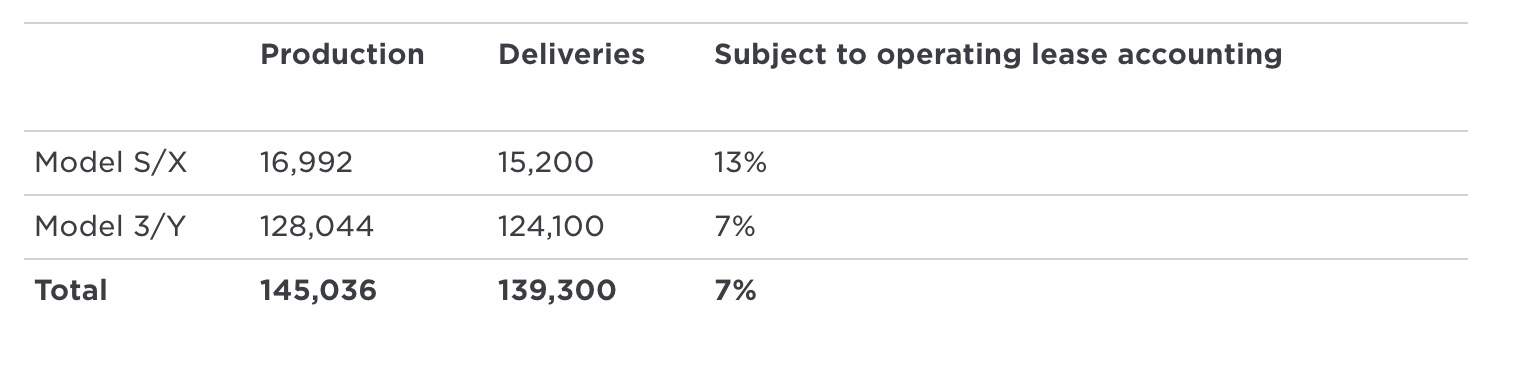
Tesla delivered 139,300 vehicles in the third quarter, slightly above Wall Street’s expectations and a notable improvement from last quarter as well as the same period a year ago.
Tesla’s numbers in the third quarter marked a 43% improvement from the same period last year when the company reported it had delivered 97,000 electric vehicles. The third quarter figures were 53% higher than last quarter when Tesla was still feeling the effects of the COVID-19 pandemic that included suspending production for weeks at its main U.S. factory.
A consensus of analysts from FactSet had expected Tesla to report it had delivered 137,000 vehicles.
Despite the rosy numbers, Tesla shares were down 2.6% Friday morning, a fall likely tied to drops across all of the exchanges caused by the announcement that President Donald Trump had tested positive for COVID-19.
The vast majority of deliveries — some 128,044 — were Model 3 and Model Y vehicles. The remaining 16,992 were its more expensive Model S and Model X vehicles. Tesla doesn’t provide breakdowns of each model separately nor does it give information about regional deliveries.
Image Credits: Screenshot/Tesla
Tesla produced 145,036 electric vehicles in the third quarter, about a 75% improvement from the last quarter as well as the same period last year. In both Q2 and the third quarter in 2019, Tesla produced about 96,000 vehicles.