Year: 2020

01 Oct 2020

Ethel’s Club founder is launching Somewhere Good, a social platform that centers people of color

Naj Austin, founder and CEO of subscription-based physical and digital community Ethel’s Club, is building Somewhere Good to be a one-stop shop for people of color. Beyond being a place for people of color to connect, it’s also about creating a safe space for folks to be their authentic selves.

“A lot of how we’re talking about Somewhere Good with investors is this idea of a new online world where our identities are centered,” Austin told me. “The vision for Somewhere Good is you take your phone out of your pocket and, as a Black person or person of color, all of your needs are met there in that one place.”

That means folks could access communities around things like wellness, art, music and film, and engage in commerce through those groups. It’s not that some of these communities don’t already exist, it’s just that they’re fragmented across the web and not always easy to find.

Through operating wellness community Ethel’s Club, Austin said many members keep asking her if she knows of other types of spaces for Black people and people of color that focus on more granular topics, like jazz music from the eighties or an online space specifically for Black women who don’t want children.

“We’ve had so many of those,” Austin said. “We just need to create a platform where they can do it themselves. It goes back to my core belief of building a company that provides space for people of color. My whole thing is, are we providing more space, are more people of color feeling empowered. As long as that’s a yes, it doesn’t matter the vehicle.”

[gallery ids="2054998,2054999,2055000,2055001,2055009,2055010,2055011"]

When Somewhere Good launches in beta in January, Austin said users will be able to input their general info and then choose a selection of interests. For example, someone could identify themselves as a mother who likes painting, has a dog and works as a baker.

“We would then spit out communities we think are the best fit for you,” Austin said.

That will enable Somewhere Good to foster an additional level of connection for users, Austin said. One way of achieving that extra layer will be through a matchmaking tool.

“We’re trying to give people a more tangible reason for connection,” Austin said. “Other than you’re both Black.”

Ethel’s Club, the wellness platform for people of color that currently lives on Mighty Networks, will be just one of many communities on Somewhere Good. The plan is to bring on a number of other communities to the platform that center Black people and people of color. From there, Austin envisions users of those communities may then create communities of their own on Somewhere Good.

“We want to give space to people who are already creating community, allow people who want community to build it and then for the audience, once they’re feeling empowered, to be able to build community,” she said.

When you go to Somewhere Good right now, you’ll engage in a Stumble Upon-esque experience where you click “Take me somewhere new” to see a brand geared toward Black people or people of color. There are a little over 100 brands currently featured on the site, including Black hair brand Nappy Head Club, Black designer directory Black Fashion Fair and cereal and culture brand OffLimits.

Image Credits: Screenshot

While OffLimits, for example, doesn’t currently have a community, the brand centers around thinking about food differently, Austin said. But OffLimits, which tells its story through “emotionally unstable, counterculture cartoon characters,” could run a community on Somewhere Good centered around product design or food. She also envisions makeup brand Fenty running a community centered around skin care.

Each community on Somewhere Good will have a moderator and all members will need to follow Somewhere Good’s code of conduct. The platform will not allow any hate speech, abusive behavior, bullying or other types of violence.

“Any users acting against out code of conduct will be immediately removed from the Somewhere Good platform,” the platform’s mission statement says.

Somewhere Good will be a 100% ad-free environment and says it will never sell data. Its business model relies on users paying to join communities and then taking a percentage of that transaction.

“That means we have to create a compelling opportunity for people to create communities,” she said.

Down the road, Somewhere Good plans to enable communities to charge for live-streamed events, sell products and enable other types of peer-to-peer transactions. The company would then take a percentage from those transactions, as well.

Somewhere Good soft-launched with a tweet last week and began taking signups. Already, there are more than 2,500 people on the wait list.

“It’s almost the exact strategy I had with Ethel’s Club,” Austin told me. “Though, I don’t know if I would actually call it a strategy but it’s like, I don’t know exactly what it is but I think people should know about it. It shows initial interest in this concept and now it’s up to us to build the thing.”

Ethel’s Club, which got its start as a physical community space in Brooklyn before expanding into the digital realm as a result of the COVID-19 pandemic, has currently raised a little over $1 million from Dream Machine, Shrug Capital, Canvas Ventures, Color, Debut Capital and angel investors like Katie Stanton, Roxane Gay and Hannibal Buress.

Since transitioning into digital, Ethel’s Club has grown to more than 1,500 members. But the biggest issue is that people just want more, Austin said. And Somewhere Good aims to be just that, she said. It aims to be the one platform where people of color can go to for everything.


01 Oct 2020

IonQ claims it has built the most powerful quantum computer yet

Trapped-ion quantum computing startup IonQ today announced the launch of its latest quantum computer, which features what IonQ calls “32 perfect qubits with low gate errors.”

Using IBM’s preferred quantum benchmark, IonQ expects to hit a quantum volume of 4,000,000. That’s a massive increase over the double-digit quantum volume numbers that IBM itself recently announced and it’s a pretty extraordinary claim on IonQ’s side as this would make its system the most powerful quantum computer yet.

The (well-funded) company has never used this metric before. Through a spokesperson, IonQ also noted that it doesn’t necessarily think quantum volume is the best metric, but since the rest of the industry is using it, it decided to release this number. The company argues that its ability to achieve 99.9% fidelity between qubits has allowed it to achieve this breakthrough.

“In a single generation of hardware, we went from 11 to 32 qubits, and more importantly, improved the fidelity required to use all 32 qubits,” said IonQ CEO and president Peter Chapman. “Depending on the application, customers will need somewhere between 80 and 150 very high fidelity qubits and logic gates to see quantum advantage. Our goal is to double or more the number of qubits each year. With two new generations of hardware already in the works, companies not working with quantum now are at risk of falling behind.”

the ion trap at the heart of IonQ's next-generation system

Image Credits: Kai Hudek, IonQ

It’s worth noting that IonQ’s trapped-ion approach is quite different from IBM’s (or D-Wave’s for that matter) which uses a very different technique. That makes it hard to compare raw qubit counts between different vendors. The quantum volume metric is meant to make it easier to compare these systems, however.

“The new system we’re deploying today is able to do things no other quantum computer has been able to achieve, and even more importantly, we know how to continue making these systems much more powerful moving forward,” said IonQ Co-Founder & Chief Scientist Chris Monroe. “With our new IonQ system, we expect to be able to encode multiple qubits to tolerate errors, the holy grail for scaling quantum computers in the long haul.”

Using new error correction techniques, IonQ believes that it will only need 13 qubits to create a “near-perfect” logical qubit.

For now, IonQ’s new system will be available as a private beta and it’ll be interesting to see if its early users will back up the company’s claims. Later, the company will make it available through partners like Amazon with its Braket service and the Microsoft Azure Quantum Cloud.

IonQ Enclosure — the outer enclosure for IonQ's next-generation system. It doesn't just look cool, it also creates a highly stable environment (acoustics, temperature, humidity) for the system.

Image Credits: Kai Hudek, IonQ

01 Oct 2020

Teenage Engineering’s OB-4 ‘magic radio’ is a weird and beautiful wireless speaker

I’ve found a new object of desire which, once acquired, I would probably never use. It’s this OB-4 “magic radio” from Teenage Engineering, a design group that creates tech with a playful but premium approach. This wireless speaker not only looks lovely but has a handful of really interesting features, the most interesting of which has to be letting you, at any time, rewind up to two hours with the spin of a dial.

The truth is I rarely would require the rewinding feature, which seems mainly useful for catching a bit of a podcast you missed or, for those of us who still listen to FM radio now and then, going back to hear the DJ say the name of an artist or piece. You can also slow it down and presumably scratch a bit by spinning the little circle, though again it’s probably more fun in theory than in practice.

But when the thing looks this good, who cares? The design reminds me strongly of TDK’s 3-speaker boombox, which I reviewed way back in 2011, but evolved. The mechanical knobs and buttons look fabulous and I have no doubt turn with a wonderful tactility. I love a good volume knob and this one looks like a winner.

With two larger speakers and two smaller tweeter types, it should be able to create a pretty solid sound. Frequency response goes down to 54 Hz, so you won’t be getting the deepest bass notes possible, but really with drivers this size they wouldn’t be able to move enough air for it to matter. More importantly, it’ll go for 8 hours at max volume or, more likely, 30-50 hours at normal loudness levels.

The built-in little computer and drive have some interesting modes: an adjustable metronome, a 30-channel mantra repeater, and a drone generator that stretches and distorts snippets of radio stations. That last one sounds pretty cool.

The handle has the antenna built into it for FM reception, and folds down to act as a stand if you don’t mind your music blasting into the ground or table.

At $599, it’s not exactly an impulse buy. There’s a cherry red version for $50 more, and a $400 leather case in case you want to make your consumption even more conspicuous. I have a feeling we’ll be seeing these in the backgrounds of influencer videos (or sets).

If you’d like to pick up your own, you can try to squat on the site to pre-order, but you might be better off buying a ticket to New York, London, or Stockholm, where the OB-4 will be on shelves at a handful of design shops. It ships in November.

01 Oct 2020

Facebook Groups to gain suite of new tools for managing discussions, surfacing public content

Facebook is introducing a suite of new features for Facebook Groups, the private social networking product now used by over 1.8 billion people every month. At the company’s digitally hosted Facebook Communities Summit today, Facebook detailed a set of upcoming tools aimed at those who run Groups, designed help them better organize, filter and manage their communities. It also showed off forthcoming features focused on sparking discussions and announced the test of a new feature that will highlight public group discussions to non-group members, including through web searches.

The announcement comes at a time when Facebook Groups are making headlines for their growing use by those looking to spread harmful content and misinformation. Facebook this week said it removed over 6,500 militia groups and pages just last month alone, for example. Facebook Groups have also become the breeding grounds for a wide range of dangerous content, including health misinformation, anti-science movements, and baseless conspiracy theories that brainwash users into thinking there are secret signals hidden on the internet offering insight into an alternate reality that only they can see.

The updates to the Facebook Groups product, announced today, aren’t necessarily focused solving these sorts of issues, however. Instead, they’re largely about making Groups easier to manage and use, in a more general sense.

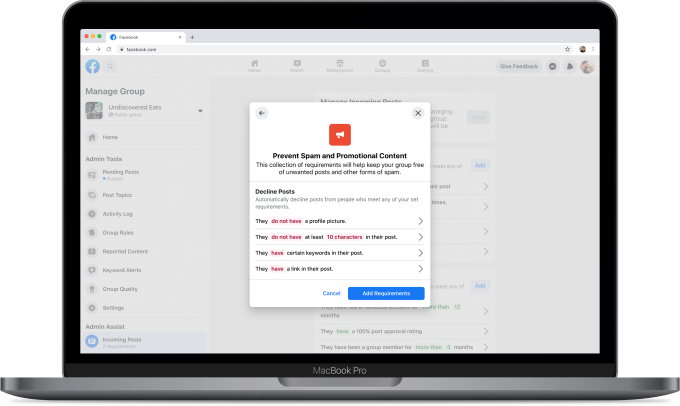
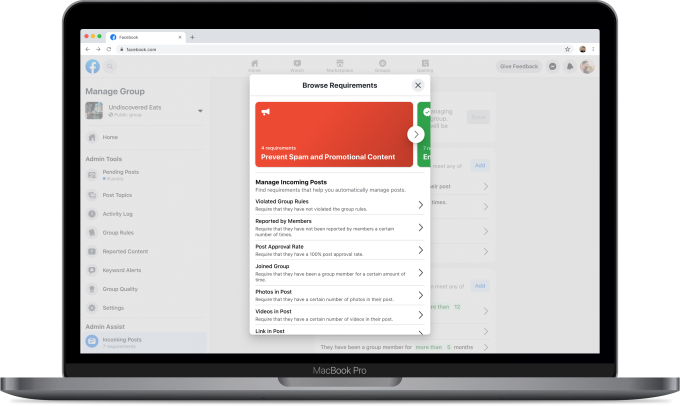
A new “Admin Assist” tool, for example, will help Facebook Group administrators better moderate posts by automatically declining posts that use certain keywords.

Image Credits: Facebook

This could be used to filter out certain inappropriate content, like foul language, but it could also be used to stop the approval of posts that were off-topic, those used words or hashtags associated with dangerous movements, like QAnon, or even just those posts that were attempting to advertise by way of Facebook Groups. For example, many communities have policies banning posts from multi-level marketing firms (MLMs) — like Amway, Herbalife, Young Living, doTERRA, Avon and others– but without switching on post approval for all posts or users, there was no other way to block these attempted ads in an automated way before now.

Image Credits: Facebook

Group admins will also be able to organize content from their community by hashtag, then pin a topic to the top of the Group to highlight it for everyone. This could be helpful for tracking popular topics that get regularly discussed on the group, perhaps. It could also be used to save people from asking the same questions over and over by pointing them to places where the answers were already provided, among other things.

Image Credits: Facebook

Facebook Group admins will also be able to use the Brand Collabs Manager which will allow them to monetize a larger, public groups by working directly with brands who want to promote their products and services to the group’s users. Before today, brands tended to collaborate with influential individuals who had a following, but now they could associate themselves with an influential group instead.

Image Credits: Facebook

Finally, Facebook will introduce a curriculum and exam that will allow people to achieve a certification in Community Management that indicates they understand how to build, grow and support a Facebook Group community.

Other changes arriving in Groups are aimed at better engaging users.

One new feature will allow Groups to feature real-time chats for conversations with other Group users.

Image Credits: Facebook

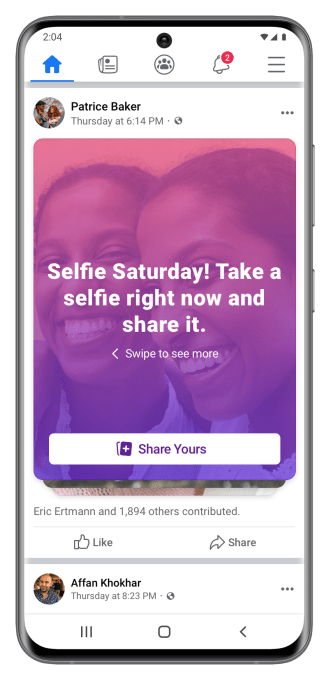
A new collaborative post type, “Prompts,” will encourage also conversations through the use of photos. This capitalizes on a trend already taking place across groups, where an admin will prompt discussion by asking users to share a photo — for instance, a favorite meme, a picture of their pet, a selfie, their last photo in their Camera Roll, and so on. But the new format will turn this activity into a product, allowing users to more easily contribute their response, then flip through the images shared by others.

Image Credits: Facebook

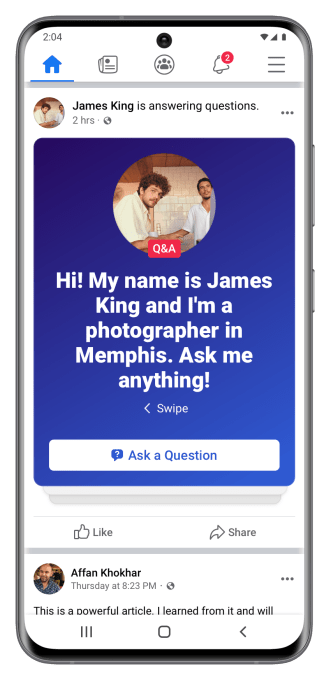
Similarly, admins will be able to encourage discussions through new Q&A sessions which are easier for community members to participate in by not relying on the traditional threaded comment format.

Group members can also choose to customize their profile photo for each group they participate in. This could help users feel more comfortable when contributing to a larger, public community, for example, or it could be just used for fun — like using a photo of your dog in a pet community or your favorite book in your online book club, for example.

Image Credits: Facebook

Related to these changes, Facebook also says it will begin to test new ways for people to discover conversations happening on Public groups.

This will be done by showing something called “Related Discussions” within the News Feed when someone posts a link or reshares a post on Facebook. These discussions will allow users to see what other, Public groups are saying about the same content. In a more radical change, Facebook says these discussions will also be indexed by search engines as users may see these conversations appear when “you’re searching the web.”

Facebook says that it may use this feature to open up users to more “diverse perspectives on the topics they’re into” from others with “different backgrounds and experiences.” That seems to imply the change is an attempt to de-isolate users from the Facebook bubbles they’ve built for themselves. However, it’s unclear how far Facebook will go on this front, as the feature is not yet live. It’s also not clear how users will react to be shown to opposing content — like if posts about the “big team” also included related discussions from the other team’s fan group. And if the feature was leveraged for more controversial discussions, like politics, it could get even worse.

What’s more, Facebook will invite users to join in the conversation at hand, if the Group allows outside participation.

Facebook says the feature will be tested in the U.S. in the “coming months” and admins will be offered the option to allow their groups to be included in the new Public groups experience at that time, where they’ll be able to turn on post-approvals. The feature will expand outside the U.S. next year.

The other features announced today will also begin rolling out in the months ahead.


01 Oct 2020

Ro makes the weight loss product Plenity commercially available to everyone in the U.S.

In what could be the first step in the development of a significant new line of business for the telemedicine prescription provider Ro, the company is finally announcing the general commercial availability of weight loss product, Plenity.

Developed by Gelesis, a biotech company that makes treatments for gastro-intestinal disorders, Plentiy is a weight loss treatment that uses citric acid and cellulose to create a non-toxic paste that makes people feel more full after they ingest it. Taken before meals, the pill becomes a substance that expands to take up about 25% of the stomach, so people eat less.

The product has been approved by the U.S. Food and Drug Administration and is available for a much broader segment of the population than other weight loss products. While most prescription medicines are intended for people who are obese, the Gelesis product is made for people who are overweight, too.

“That’s adults who have a BMI from 25 up to 40. That’s 150 million Americans,” according to Gelesis chief commercial and operating officer, David Pass.

Plenity received FDA approval last April and Gelesis started working with Ro soon after, according to Pass. The idea was to craft a strategy that could get the treatment, which is classified as a medical device and not a drug, in the hands of as many patients as quickly as possible.

For Ro, the agreement with Gelesis is a sign of potential things to come. The company is the exclusive online provider of the Plenity treatment and Ro founder Zachariah Reitano said that there’s an incredible potential to engage in more of these types of deals.

“We would love to be able to partner with pharmaceutical companies to decrease the cost of distribution,” said Reitano. “We were excited to build an exciting treatment solution for weight management. Our high-level mission is to be the patient’s first call.”

With the Gelesis partnership Ro can add another highly desirable treatment to its roster of therapies — and one that can be a contributing factor to increasing the severity of other conditions that the company already provides treatment for, Reitano said. 

“There are a few conditions that we currently treat that are exacerbated by a patient being overweight or obese. People who struggle with weight management will also experience ED. Obesity can lead to heart failure stroke, coronary heart disease, hypetension, depression,” Reitano said. “The breadth of the label is interesting. Only FDA approved with a BMI from 25 to 40. FDA approved treatment have been between 30 and 40. [It] makes the treatment more accessible to a wider variety of people.”

As the only online provider of the treatment, Ro has developed an onboarding process to ensure that the Plenity therapy isn’t abused by people who suffer from eating disorders.

“During our onboarding we not only ask questions to patients about their weight management. There’s a consecutive set of images that need to be uploaded and taken with the provider. That’s something we’ve taken a lot of time and energy to make sure about,” said Reitano. 

Like the other treatments Ro offers, Plenity is a cash pay prescription, because the weight loss treatments aren’t typically covered by insurance, he said.

The benefit of working with an online pharmacy like Ro to provide distribution for a new therapy was obvious to both startups.

“We turned this market on its head by putting the consumer at the heart of everything we do,” said Pass. The treatment costs $98 per month, compared to other therapies or branded medications that could be as much $300 and $350 per month, according to Pass.

One reason that Gelesis is able to reduce the price of the drug is that it won’t have to hire a massive sales force to pitch it. The company has Ro for that.

“Normally you have a pharmaceutical company that would have to hire a sales force and go door to door and it increases the cost of a new drug. [Ro] can make a new, innovative treatment available, like Plenity, available nationwide,” Reitano said. 

01 Oct 2020

Pixie Labs raises $9.15M Series A round for its Kubernetes observability platform

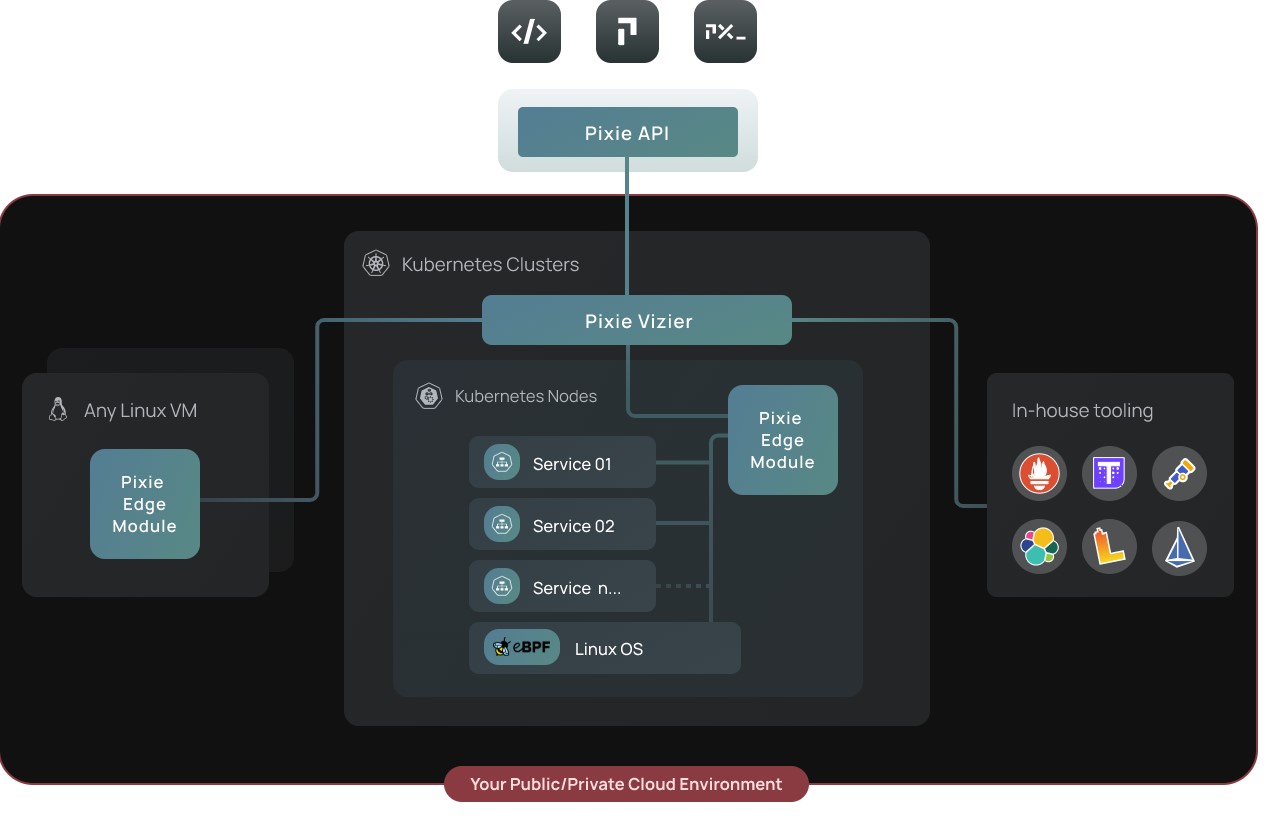
Pixie, a startup that provides developers with tools to get observability into their Kubernetes-native applications, today announced that it has raised a $9.15 million Series A round led by Benchmark, with participation from GV. In addition, the company also today said that its service is now available as a public beta.

The company was co-founded by Zain Asgar (CEO), a former Google engineer working on Google AI and adjunct professor at Stanford, and Ishan Mukherjee (CPO), who led Apple’s Siri Knowledge Graph product team and also previously worked on Amazon’s Robotics efforts. Asgar had originally joined Benchmark to work on developer tools for machine learning. Over time, the idea changed to using machine learning to power tools to help developers manage large-scale deployments instead.

“We saw data systems, this move to the edge, and we felt like this old cloud 1.0 model of manually collecting data and shipping it to databases in the cloud seems pretty inefficient,” Mukherjee explained. “And the other part was: I was on call. I got gray hair and all that stuff. We felt like we could build this new generation of developer tools and get to Michael Jordan’s vision of intelligent augmentation, which is giving creatives tools where they can be a lot more productive.”

Image Credits: Pixie

The team argues that most competing monitoring and observability systems focus on operators and IT teams — and often involve a long manual setup process. But Pixie wants to automate most of this manual process and build a tool that developers want to use.

Pixie runs inside a developer’s Kubernetes platform and developers get instant and automatic visibility into their production environments. With Pixie, which the team is making available as a freemium SaaS product, there is no instrumentation to install. Instead, the team uses relatively new Linux kernel techniques like eBPF to collect data right at the source.

“One of the really cool things about this is that we can deploy Pixie in about a minute and you’ll instantly get data,” said Asgar. “Our goal here is that this really helps you when there are cases where you don’t want your business logic to be full of monitoring code, especially if you forget something — when you have an outage.”

Image Credits: Pixie

At the core of the developer experience is what the company calls “Pixie scripts.” Using a Python-like language (PxL), developers can codify their debugging workflows. The company’s system already features a number of scripts written by the team itself and the community at large. But as Asgar noted, not every user will write scripts. “The way scripts work, it’s supposed to capture human knowledge in that problem. We don’t expect the average user — or even the way above average developer — ever to touch a script or write one. They’re just going to use it in a specific scenario,” he explained.

Looking ahead, the team plans to make these scripts and the scripting language more robust and usable to allow developers to go from passively monitoring their systems to building scripts that can actively take actions on their clusters based on the monitoring data the system collects.

“Zain and Ishan’s provocative idea was to move software monitoring to the source,” said Eric Vishria, General Partner at Benchmark. “Pixie enables engineering teams to fundamentally rethink their monitoring strategy as it presents a vision of the future where we detect anomalous behavior and make operational decisions inside the infrastructure layer itself. This allows companies of all sizes to monitor their digital experiences in a more responsive, cost-effective and scalable manner.”

01 Oct 2020

With $18M in new funding, Braintrust says it’s creating a fairer model for freelancers

Braintrust, a network for freelance technical and design talent that launched over the summer, is announcing that it has raised $18 million in new funding.

Co-founder and CEO Adam Jackson has written for TechCrunch about how tech companies need to treat independent contractors with more empathy. He told me via email that the San Francisco-based startup is making that idea a reality by offering a very different approach than existing marketplaces for freelance work.

For one thing, Braintrust only charges the companies doing the hiring — freelancers won’t have to pay to join or to bid on a project, and Braintrust won’t charge a fee on their project payments. In addition, the startup is using a cryptocurrency token that it calls Btrust to reward users who build the network, for example by inviting new customers and vetting freelance. Apparently, the token will give users a stake in how the network evolves in the future.

“Just imagine if Uber had given all of it’s drivers some ownership in the company what a different company it would be today,” Jackson said. “Braintrust will be 100% user owned. Everyone who participates on the platform has skin in the game.”

And for companies, Braintrust is supposed to allow them to tap freelancers for work that they’d normally do in-house. The startup’s clients already  include Nestle, Pacific Life, Deloitte, Porsche, Blue Cross Blue Shield and TaskRabbit.

According to Jackson, most of the talent on the platform consists of career freelancers, but with many people losing their jobs during the COVID-19 pandemic, “we’ve seen an influx of talent coming looking to join the ranks of the freelancers.”

He added that the startup already became profitable after raising its $6 million seed round, so the new funding will allow it to build the core team and also bring in more work.

“We exist to help companies accelerate their product roadmaps and innovation, and this injection of funding will help us do just that,” Jackson said.

The new funding was led by ACME and Blockchange, with participation from new investors Pantera, Multicoin and Variant.

01 Oct 2020

The Spectrum Equity-backed video education platform Kajabi has already hit $60 million in ARR

Kajabi may not be an American household name, but users of the web hosting and video tech platform are now being seen in a lot of American households.

The company, initially bootstrapped and profitable since its launch, raised a minority investment from Spectrum Equity Partners last November, but that was merely icing on the cake for a business that had seen its user adoption surge.

The COVID-19 pandemic has pushed that adoption even higher as work-from-home gigs yield to work-from-home side hustles and anyone and everyone decides to get in on on the online education and training action, the company said.

In the past year alone, the company has seen its run rate cross $60 million in August and the company hit over $1 billion in recorded transactions milestone in March, according to chief marketing officer Orlando Baeza, who previously served as a marketing executive at Buzzfeed and Paramount Pictures .

Last November, the company took a minority equity investment from Spectrum Equity Partners, the first outside capital the company raised since its inception a bit over a decade ago.

Founded by a former commodities trader, Kenny Rueter, Kajabi is like Thinkific or Patreon primarily for online learning and video-based entrepreneurs.

“It’s not just a way  to sell your content,” said Kajabi President, Jonathan Cronstedt. “It does do your webpage, blog, email marketing, marketing automation, digital delivery. It does the  webinar aspect and the marketing you’d need to build up a list of prospects… It’s a platform from start to finish for an online business.”

If the best way to make money during a gold rush is to sell picks and shovels, then think of Kajabi as the pick and shovel purveyor for the self-help, startup guide, guru advice set.

The company touts its enabling of self-help legends like Brendon Burchard, Danielle Leslie, and Amy Porterfield, and, most recently, Sophia Amoruso, who joined the platform in August.

“We want  to empower entrepreneurs, experts and influencers  who are serious about their business to have success  online,” said Cronstedt in a November interview when the company took its minority investment from Spectrum Equity. 

The company’s toolkit basically serves as an integration of the various bundle of software a business would need to get itself off the ground. Instead of integrating Shopify, Wix, and other platforms to create a full stack of tools, Kajabi does it for a business.

“There’s endless ways you can use duct tape and bailing wire to get all of these solutions together,” said Cronstedt. “[Businesses are] not going to have the chance to get it out there  because they’re too busy trying to be a platform integrator… they never get into creating anything.”

With over 100 employees, the company sees itself on a pandemic-driven trajectory that should set the company up for massive growth.

Indeed, online learning is now a $220 billion global market, and the self-help market alone is $11 billion (people need a lot of help). The company also cites statistics that put the number of Americans pursuing a “side hustle” at roughly 35% with an estimated 40 million “solopreneurs” in the U.S. workforce.

“Since inception, we have helped 41 million users access great educational content and our customers have generated over 1 billion in sales,” said Rueter, in a November statement. “We feel fortunate to partner with incredible entrepreneurs who are sharing their expertise with the world and are excited to help so many more.”

01 Oct 2020

Google takes aim at ‘beauty filters’ with design changes coming to Pixel phones

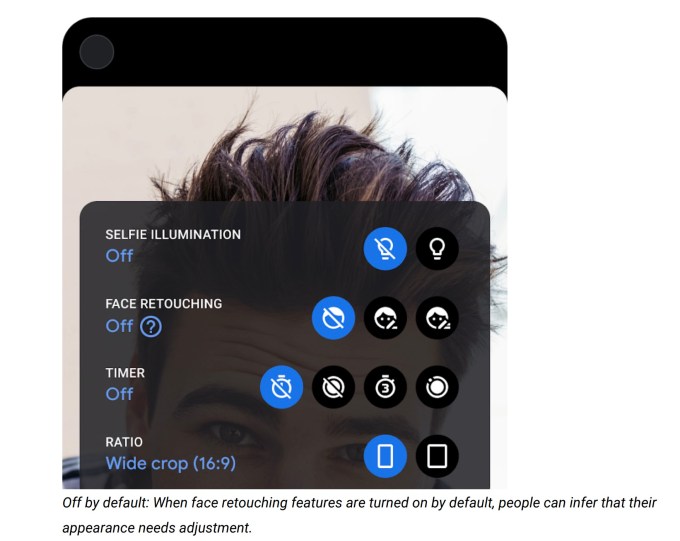
Google is taking aim at photo face filters and other “beautifying” techniques that mental health experts believe can warp a person’s self-confidence, particularly when they’re introduced to younger users. The company says it will now rely on expert guidance when applying design principles for photos filters used by the Android Camera app on Pixel smartphones. In the Pixel 4a, Google has already turned off face retouching by default, it says, and notes the interface will soon be updated to include what Google describes as “value-free” descriptive icons and labels for the app’s face retouching effects.

That means it won’t use language like “beauty filter” or imply, even in more subtle ways, that face retouching tools can make someone look better. These changes will also roll out to the Android Camera app in other Pixel smartphones through updates.

The changes, though perhaps unnoticed by the end user, can make a difference over time.

Google says that over 70% of photos on Android are shot with the front-facing camera and over 24 billion photos have been labeled as “selfies” in Google Photos.

Image Credits: Google

But the images our smartphones are showing us are driving more people to be dissatisfied with their own apparences. According to the American Academy of Facial Plastic and Reconstructive Surgery, 72% of their members last year said their patients had sought them out in order to improve their selfies, a 15% year-over-year increase. In addition, 80% of parents said they’re worried about filters’ impact and two-thirds of teens said they’ve been bullied over how they look in photos.

Google explains it sought the help of child and mental health experts to better understand the impact of filters on people’s well-being. It found that when people weren’t aware a photo filter had been applied, the resulting photos could negatively impact mental well-being as they quietly set a beauty standard that people would then compare themselves against over time.

Image Credits: Google

In addition, filters that use terminology like “beauty,” “beautification,” “enhancement,” and “touch up” imply there’s something wrong with someone’s physical appearance that needs to be corrected. It suggests that the way they actually look is bad, Google explains. The same is true for terms like “slimming” which imply a person’s body needs to be improved.

Google also found that even the icons used could contribute to the problem.

It’s often the case that face retouching filters will use “sparkling” design elements on the icon that switches the feature on. This suggests that using the filter is making your photo better.

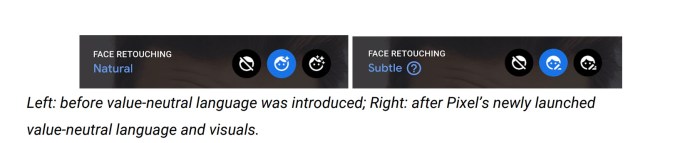
To address this problem, Google will update to using value-neutral language for its filters along with new icons.

For example, instead of labeling a face retouching option as “natural,” it will relabel it to “subtle.” And instead of sparkling icons, it instead shows an icon of the face with an editing pen to indicate which button to push to enable the feature.

Adjustment levels will also follow new guidelines, and use either numbers and symbols or simple terms like “low” and “high,” rather than those that refer to beauty.

Image Credits: Google


Google says the Camera app, too, should also make it obvious when a filter has been enabled — both in the real-time capture and afterwards. For example, an indicator at the top of the screen could inform the user when a filter has been turned on, so users know their image is being edited.

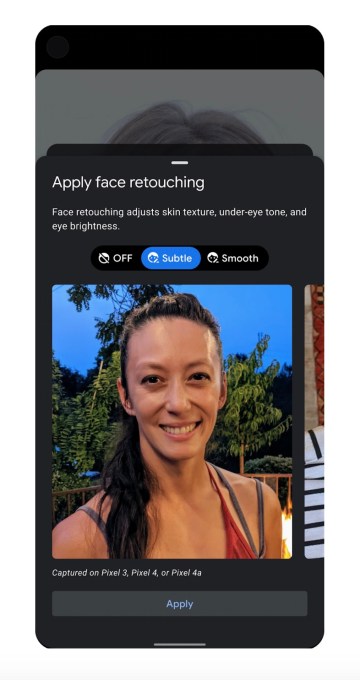
In Pixel smartphones, starting with the Pixel 4a, when you use face retouching effects, you’ll be shown more information about how each setting is being applied and what specific changes it will make to the image. For instance, if you choose the “subtle” effect, it will explain that it adjusts your skin texture, under eye tone, and eye brightness. Being transparent about the effects applied can help to demystify the sometimes subtle tweaks that face retouching filters are making to our photos.

Face retouching will also be shut off in the new Pixel devices announced on Wednesday, including the Pixel 4a 5G and Pixel 5. And the changes to labels and descriptions are coming to Pixel phones through an upcoming update, Google says.

01 Oct 2020

Hear how Porsche is preparing for the electric future at TC Sessions: Mobility

Detlev von Platen is a car guy, and in this age of new mobility, that’s important. Platen has been at Porsche for over 30 years and is currently on Porsche’s executive board as the sales and marketing executive. Before his current role, he lead Porsche North America, where he oversaw incredible growth.

We’re thrilled Platen is speaking at TechCrunch Sessions: Mobility next week.

Porsche is in a curious position. As part of the Volkswagen family, Porsche has the manufacturing might of a giant, but a niche brand’s narrow focus. Right now, its lineup is largely unchanged over the last decade. The iconic 911 sits as Porsche’s halo car. The 718 Boxster sits under the 911 as an enthusiast option. The two SUVs are Porsche’s top-selling models, and the low-slung Panamera is a fantastic option for those looking for a sporty sedan. And then there’s the electric Taycan.

Last year, Porsche pulled the sheet off its first electric option, and so far, the electric Porsche Taycan is well-received. Like the rest of Porsche’s lineup, it’s a sports car first. We’re excited to speak to Platen about how Porsche can maintain and cultivate a strong brand identity even as consumer expectations change.

Porsche has been in this position in the past and excelled. In the late ’90s, the automobile world started turning its collective back on cars in favor of sport utility vehicles. And Porsche didn’t have an SUV. Porsche went on to build and sell the Cayenne starting in 2002 and, now in its third generation, is now the company’s top-selling model by an autobahn kilometer.

With the Cayenne, Porsche demonstrated it could infuse Porsche’s sports car identity into a four-door SUV. Can it do it again with electric vehicles?

The timing is critical. The State of California just announced an ambitious plan to ban the sales of cars powered internal combustion and it’s rumored the European Union will announce a similar deadline. Will Porsche be ready by California’s 2035 deadline? Will Porsche — gasp — sell an electric 911? We have a lot of questions, and we hope Platen has answers.

Please note, Detlev von Platen is replacing Klaus Zellmer at our event.

Three weeks ago, we announced Porsche Cars North America CEO Klaus Zellmer as a speaker at Mobility. Then, one week later, he became VW’s sales chief. Platen is a perfect replacement for our event. Before becoming Porsche’s top sales executive, he held Zellmer’s position as the CEO of Porsche Cars North America and has a great overview of Porsche’s electrification strategy.

TechCrunch Sessions: Mobility runs October 6-7, and tickets are still available. Thanks to COVID-19, the event is virtual, allowing anyone to participate in the interviews, demos, and breakout sessions where attendees can ask speakers questions.

We hope you can join our talk with Platen at TechCrunch Sessions: Mobility 2020. The event is virtual this year, therefore making it more accessible to attendees from around the world. Platen joins other mobility executives, including Bryan Salesky of Argo AI, Peter Rawlinson of Lucid Motors, and Tekedra Mawakana of Waymo.