
Year: 2020

15 Sep 2020

Verkada adds environmental sensors to cloud-based building operations toolkit

As we go deeper into the pandemic, many buildings sit empty or have limited capacity. During times like these having visibility into the state of the building can give building operations peace of mind. Today, Verkada, a startup that helps operations manage buildings via the cloud, announced a new set of environmental sensors to give customers even greater insight into building conditions.

The company had previously developed cloud-based video cameras and access control systems. Verkdada CEO and co-founder of Filip Kaliszan says today’s announcement is about building on these two earlier products.

“What we do today is cameras and access control — cameras, of course provide the eyes and the view into building in spaces, while access control controls how you get in and out of these spaces,” Kaliszan told TechCrunch. Operations teams can manage these devices from the cloud on any device.

The sensor pack that the company is announcing today, layers on a multi-function view into the state of the environment inside a building. “The first product that we’re launching along this environmental sensor line is the SV11, which is a very powerful unit with multiple sensors on board, all of which can be managed in the cloud through our Verkada command platform. The sensors will give customers insight into things like air quality, temperature, humidity, motion and occupancy of the space, as well as the noise level,” he said.

There is a clear strategy behind the company’s product road map. The idea is to give building operations staff a growing picture of what’s going on inside the space. “You can think of all the data being combined with the other aspects of our platform, and then begin delivering a truly integrated building and setting the standard for enterprise building security,” Kaliszan said.

These tools, and the ability to access all the data about a building remotely in the cloud, obviously have even more utility during the pandemic. “I think we’re fortunate that our products can help customers mitigate some of the effects of the pandemic. So we’ve seen a lot of customers use our tools to help them manage through the pandemic, which is great. But when we were originally designing this environmental sensor, the rationale behind it were these core use cases like monitoring server rooms for environmental changes.”

The company, which was founded in 2016, has been doing well. It has 4200 customers and roughly 400 employees. It is still growing and actively hiring and expects to reach 500 by the end of the year. It has raised $138.9 million, the most recent coming January this year, when it raised an $80 million Series C investment led Felicis Ventures on a $1.6 billion valuation.

15 Sep 2020

Researchers ready world-first vision restoration device for human clinical trials

Over a decade’s worth of work by scientists working at Melbourne, Australia’s Monash University has produced a first-of-its-kind device that can restore vision to the blind, using a combination of smartphone-style electronics and brain-implanted micro electrodes. The system has already been shown to work in preclinical studies and non-human trials on sheep, and researchers are now preparing for a first human clinical trial to take place in Melbourne.

This new technology would be able to bypass the damaged optic nerves that are often responsible for what’s definite as technical clinical blindness. It works by translating information gathered by a camera and interpreted by a vision processor unity and custom software, wirelessly to a set of tiles implanted directly within the brain. These tiles convert the image data to electrical impulses which are then transmitted to neurons in the brain via microelectrodes that are thinner than human hair.

There are still a number of steps required before this becomes something that can actually be produced and used commercially – not least of which is the extensive human clinical trial process. The team behind the technology is also looking to secure additional funding to support the eventual ramp of manufacturing and distribution of its devices as a commercial venture. But its early studies, which saw 10 of these arrays implanted on sheep, saw that one the course of a cumulative total of more than 2,700 hours of stimulation, there weren’t any adverse health affects observed.

Animals studies are a very different thing from human studies, but the research team believes their technology has promise well beyond vision. They anticipate the same approach could provide benefits and treatment options for patients with other conditions that have a neurological root cause, including paralysis.

If that sounds familiar, it might be because Elon Musk recently revealed ambitions to use his company Neuralink’s similar brain implant technology to achieve these kinds of results as well. Musk’s project is hardly the first to imagine how devices paired with modern software and technology could overcome biological limitations, and this effort form Monash has a much longer history of working towards turning this kind of science into something that could impact the lives of everyday people.

15 Sep 2020

Mette Lykke on food waste and building a big startup on a big idea

Food has been an ever-present touchpoint in the world of startups, and I don’t mean the free catered lunches, or expansive canteens that you get in bigger places, to keep startup workers sustained but also focused on building, without leaving the building.

There are hundreds, maybe even thousands, of enterprises spun out of the idea of making it easier and faster (but maybe not cheaper) for you to get the food you want to eat or cook; and there are also hundreds of business ideas hatched out of the idea of using tech to create new kinds of foods ways to eat it, ways to prepare it.

Too Good To Go is a different kind of bird. It’s a food startup that’s actually about trying to find a landing place for food that no one seemingly wanted in the first instance, and the lower toll it takes on your conscience is matched by prices that put less pressure on your wallet.

Mette Lykke, the CEO of the startup, sat down with us at Disrupt this year to talk about the company’s mission, the state of play today, and also about the wider opportunities of building startups around big ideas and social good.

Her track record gives her a great perspective. Before taking the helm at Too Good To Go, she was one of the co-founders of Endomondo, the fitness tracking app, which was eventually acquired by Under Armour, part of a bigger move from the fitness apparel company to fill out a bigger strategy around quantified self, and what you do once you put on your fitness gear.

Exercise, staying healthy, saving money, and eating better are all things that have been on a lot of people’s minds of late. We’re living through a global health pandemic that’s impacted us in a lot of different ways, but for many of us, one of the good things that has come out of it has been a set of  salient takeaways about staying in shape, how best to use the time that we have, eating better and generally looking after ourselves and our planet in a more conscientious way.

One-third of food produced today is either lost or wasted, Mette tells us, providing a ripe opportunity to create a way to tap into some of that waste to reduce its financial and environmental impact, and that is what Too Good To Go has set out to do.

Its business is set up as a two-sided marketplace where food “providers” (eg restaurants and producers) contribute surplus food items that “buyers” (eg, consumers) can then browse, purchase and then pick up at cut-down prices — a service that’s now live in 10 countries, she said.

Yet as you might expect, TGTG has definitely seen a major impact from the pandemic, when the basic business model took a huge hit as people were ordered to stay at home, and many restaurants and others simply shut down because staying open to service just a few customers who were venturing out for take-out food simply didn’t make sense. The company saw a 62% drop in revenue as a result.

Over time, though, it started to come up with ways of working with the suppliers, even providing a way for some of them to connect with customers in cases where they had no other means to do so.

That has included working with more suppliers, whose customers (often restaurants) were disappearing; and providing temporary takeaway services for restaurants that didn’t have these in place already, to help get food to people. It also worked “pro bono”, foregoing its commission, for customers just to help keep them afloat and working with TGTG.

It’s not completely back to business as usual now — it is probably still too early to tell how many enterprises will come out of Covid-19 intact, and in the meantime they may get a lot more nervous about the idea of cannibalising their businesses with cut-price goods.

Still, there is hope. Too Good To Go is finding that there is still definitely an appetite (no pun intended) for buying food at lower prices that serves a good purpose: fighting food waste at a time when many are more concerned about how their basic consumer choices can make a difference for the better, or worse.

While fighting food waste and staying in shape (and getting fighting fit) do not seem to have a huge amount in common — besides, of course, pivoting on the role of eating as something that impacts both — there is actually an interesting thread that connects them: they are both focused on activities that consumers can do to improve and feel better about themselves.

There was a time when these kinds of premises might not have held much sway with financiers as solid business ideas: idealism (if it was ever there to begin with) quickly gives way to the bottom line a lot of the time.  But Mette’s success, as a female entrepreneur in Europe no less, is a sign of how things are evolving.

“There are a lot of things starting to happen,” she said both of social goodstartups and their prospects with VCs, an interesting insight also considering that she herself is an occasional investor as well. “I’d love to see more social good businesses getting to scale [even if] we’re still probably in the early days.”

Listen below to hear more of her insights.

15 Sep 2020

Sternum raises $6.5M Series A on its IoT security bet

If we have learned anything from the mass production of cheap internet-connected devices is that security was an afterthought. Default passwords are the norm and security flaws aren’t patched, leaving entire fleets of smart devices vulnerable to attack.

But one Israeli security startup is taking a different approach to protect vulnerable Internet of Things devices.

Sternum, headquartered in Tel Aviv, provides an embedded integrity verification technology, known as EIV, which verifies that the app hasn’t been maliciously altered in some way. Its technology detects code vulnerabilities to prevent attacks before they are exploited. Its advanced detection system, or ADS, brings real-time threat detection, allowing companies to respond to attacks in real-time.

It’s a novel idea for when there is no other way to secure a vulnerable device.

Earlier this year, Sternum was first with a fix for a new wave of vulnerabilities that hit millions of Internet of Things devices. Dubbed Ripple20, the vulnerabilities allow hackers to hijack potentially hundreds of millions of affected devices.

“Patching vulnerabilities is an endless game,” Sternum’s founder and chief executive Natali Tshuva told TechCrunch.

“Unlike many other solutions, we are not focused on patching every vulnerability on a device. We are solely focused on the exploitation stage, or the point at which the hacker takes advantage of a vulnerability to execute an attack,” she said.

Tshuva’s roots are as a security researcher, where she found several previously undiscovered vulnerabilities in Linux, Android and other embedded systems.

“I realized that there are real technological and market challenges to securing these devices properly,” she told TechCrunch. “I wanted to apply my know-how in cybersecurity, research, product and managing talented R&D teams to create innovative solutions that will truly solve the problem, end-to-end.”

It’s a bet that’s paying off.

The company revealed its $6.5 million Series A round, the company announced Tuesday. The round was led by Square Peg with participation from Merle Hinrich and European venture firm BTOV.

Philippe Schwartz, a partner at Square Peg, which led the round, said he was “impressed with Sternum’s innovative products and diverse team, whose technologies will power our connected future with uncompromising security protection and rich, data-driven insights.”

15 Sep 2020

HowGood launches Latis, a sustainability assessment tool for consumer product ingredients

The New York-based startup HowGood, which provides a sustainability database for consumer product ingredients, is publicly launching its product Latis and has already signed an initial customer with Danone North America, the company said.

The company said that its Latis tool can be used to determine the impact of any ingredient or product against environmental and social metrics like biodiversity, greenhouse gas emissions, labor risk, and animal welfare.

“Consumers no longer just want the best product at the best price,” said Alexander Gillett, CEO and founder of HowGood, in a statement. “Today’s shoppers place value on protecting the environment and ensuring that the brands they support align with their personal values.”

Aggregating information from academic papers, industry findings, research from non-governmental organizations, and other sources, Latis can be used by product development groups inside corporations to assess the implications of using certain ingredients.

Since the information is only used by the company to inform product development, there are no guarantees that product developers won’t use toxic or environmentally damaging products — they’ll just have the opportunity to be aware of how those products effect biodiversity, greenhouse gas emissions, labor risk, and animal welfare.

The company currently has data on over 33,000 ingredients, chemicals and materials, according to a statement. HowGood is backed by investors including FirstMark, Great Oaks Venture Capital, High Line Venture Partners, Joanne Wilson and Contour Venture Partners.

“Having an impact assessment tool for our product portfolio is raising the sustainability awareness of our product developers and brand teams,” said Takoua Debeche, SVP of Research and Innovation at Danone, in a statement. “This holistic tool is critical to improving the sustainability impact of our brands.”


15 Sep 2020

Virtual events platform Airmeet raises $12M

Airmeet, a startup that offers a platform to host virtual events, said on Tuesday it has raised $12 million in a new financing round as the Bangalore-headquartered firm demonstrates accelerating growth in its user base.

Sequoia Capital India led the $12 million Series A financing round in one-year-old Airmeet. Redpoint Ventures and existing investors Accel India, Venture Highway, Global Founders Capital (GFC), and Gokul Rajaram (Caviar Lead at Doordash) also participated in the round.

Airmeet allows users and businesses to host interactive virtual events. Its platform intuitively replicates aspects of a physical event, offering a backstage, clubbing people to a table, allowing participants to network with each other, and even enable event organizers to work with sponsors.

In an interview with TechCrunch, Lalit Mangal, co-founder of Airmeet, said the startup’s today hosts more than 1,000 events a day. The platform’s usage has grown 2,000% over the last quarter without any investment in advertisement, he said.

In recent months, Airmeet has worked to expand the use cases of the platform. In addition to hosting large conferences, Airmeet is now also being used for professional meetups at large film festivals, he said. Recently it held university resource fairs and technical industry summits.

“Covid-19 has accelerated a permanent behavioral shift across many industries. With digitization of largely traditional spaces leapfrogging by years, the $800+ billion global offline events space is up for grabs. There is massive potential for players who drive the industry’s transition towards online-events,” said Abhishek Mohan, VP at Sequoia Capital India, in a statement.

Airmeet is built on top of WebRTC, a standard that most modern browsers follow. This has enabled Airmeet to be fully accessible through Chrome and Firefox. All the sessions are also end-to-end encrypted, said Mangal. It does not have a mobile app. Mangal said people tend to use their laptop or desktop or their iPads for professional events. (Users can consume a session through their mobile browser, however.)

The startup, which is in the same space as Hopin and Andreessen Horowitz-backed Run the World, will use the fresh capital to add new features to Airmeet and also scale globally, said Mangal.

“Airmeet’s mission is to create a global platform to enable millions of community managers and event organizers across the world to engage with and expand their audience. And with Lalit and team’s focus, execution and innovative thinking, they are strongly placed to achieve their goal,” said Mohan.

15 Sep 2020

Austin-based EmPath’s employee training and re-skilling service snags seed funding from B Capital

By the time Felix Ortiz III left the Army in 2006, the Brooklyn, NY native had spent time taking classes at the City University of New York and St. John’s. Those experiences led him to found ViridisLearning, which aimed to give universities a better way to track student development to help graduates land jobs.

Now he’s taken the learnings of that attempt to reshape education into the corporate world and raised over $1 million in financing from investors including B Capital, the investment firm launched jointly by the Boston Consulting Group and Facebook co-founder Eduardo Saverin, and Subversive Capital.

The goal of Ortiz’s newest startup, EmPath, is to provide corporate employees with a clear picture of their current skills based on the work they’re already doing at a company and give them a roadmap to up-skilling and educational opportunities that could land them a better, higher paying job.

The company has an initial customer in AT&T, which has rolled out its services across its entire organization, according to Ortiz.

From starting out in a shared apartment in Brooklyn’s Sunset Park, Ortiz’s family history took a turn as his father became assistant speaker of the house in New York’s legislature and his mother operated a mental health clinic in the city.

When Ortiz enlisted in the Army at 17, he continued to pursue his education, and served as a Judge Advocate General for the Army at Fort Bragg in North Carolina. From there, Ortiz launched his first education venture, a failed startup that attempted to teach skills for renewable energy jobs online. The Green University may no longer exist, but it was the young entrepreneur’s first foray into education.

A road that would continue with ViridisLearning and lead to the launch of EmPath.

Along the way, Ortiz enlisted the help of an experienced developer in the online education space — Adam Blum.

The creator of OpenEd, the largest educational open resource catalog online, which used machine learning to infer skills from the online activity of children, and the founder of Auger.ai, a toolkit to bring machine learning and predictive modeling to skill development, Blum immediately saw the opportunity EmPath presented.

“Inferring skills for employees using their corporate digital footprint and inferring those skills for potential jobs… where you identified skill gaps using inferred skills for courses to suggest remedial resources to plug education gaps,” just makes sense, Blum said. “It was a much more powerful vision.”

Blum still holds an equity stake in Auger.ai, but considers the work he’s doing with EmPath as the company’s chief technology officer to be his full time job now. “Building this out with felix was more exciting in terms of the impact it would have,” Blum said. 

EmPath already is fully deployed with AT&T and will be adding three Fortune 1,000 companies as customers by the end of the month, according to Ortiz.

The young startup also has a powerful and well-connected supporter in Carlos Gutierrez, the former chief executive officer of Kellogg, and the Secretary of Commerce in the George W. Bush White House.

“Lacking a college degree throughout my career, I had to develop my own skills to enable my climb up the corporate ladder. The technology didn’t exist to help guide me, but in today’s world, professionals should not have to upskill blindly,” said former Commerce Secretary and EmPath co-founder Carlos Gutierrez, in a statement. “We created a technology platform that can help transform an organization’s culture by empowering employees and strengthening talent development. This technology was a game changer even before the Covid-19 pandemic, and now that corporate budgets are tighter, it is even more important for companies to accelerate skills development and talent growth.” 

15 Sep 2020

Uber wants to help its drivers and delivery workers register to vote

With the 2020 general election coming up in November, Uber has partnered with TurboVote to launch an in-app feature designed to help riders, eaters, drivers and delivery workers register to vote. This comes after Uber CEO Dara Khosrowshahi in August said the company would help every driver register to vote.

Uber will feature in-app banners and send emails giving people information about how to vote. They’ll then be directed to TurboVote to register to vote in their state.

Uber, as usual, also has initiatives to help voters find their polling place and will offer discounted rides to and from the polls. Uber is also asking folks to consider volunteering to be a poll worker, given the shortage this year as a result of COVID-19.

Uber has offered discounted rides to polling places for the last few years but this is the first time Uber has tried to help people register to vote through its app. Earlier this year, Lyft announced it would offer discounted as well as free rides to the polls throughout the general election.

This year, the fate of Uber and Lyft in California is up to voters. Prop 22, which Uber, Lyft, Postmates, DoorDash and Instacart have collectively poured $180 million into, seeks to keep their workers classified as independent contractors.

15 Sep 2020

Facebook announces $4.3 million grant for small businesses in India, introduces support for gift cards

More than a third of small and medium-sized businesses on Facebook in India expect cash flow to be a challenge for them as they navigate through the coronavirus pandemic in the next few months, according to a report by Organisation for Economic Co-operation and Development (OECD) and the World Bank.

Facebook, which reaches nearly every internet users in India and which collaborated with OECD and World Bank for the report, wants to help. The social giant today announced a grant of $4.3 million for more than 3,000 small businesses across Delhi, Gurgaon, Mumbai, Hyderabad, and Bangalore (Indian cities where the company has its offices).

In an interview with TechCrunch, Ajit Mohan, head of Facebook India, said the grant includes both cash and ad credits, with cash constituting the larger share. These businesses don’t have to advertise on Facebook to be eligible for the grant, he said.

The India grant is part of the company’s $100 million global grant for small businesses that it announced in March.

Gift Cards on Facebook and Instagram

Additionally, Facebook and Instagram have also launched capabilities for businesses in India to sell gift cards. “During the pandemic, it’s been inspiring to see how people and businesses have come together on the Facebook family of apps to support their local communities,” said Mohan. (Mohan will be appearing at Disrupt 2020 conference Wednesday.)

These gift cards, which will be issued by startups Quiksilver and PayU, are designed to help businesses get the immediate cash flow to stay afloat. Users can redeem these gift cards at these businesses later on.

The announcement today comes as Facebook begins to engage deeply with small businesses in the country. The company invested $5.7 billion in Jio Platforms earlier this year and said it would work with the Indian giant to explore ways to serve the nation’s 60 million businesses.

“The recovery of small businesses from the pandemic will be critical to the recovery of Indian economy, and we want to do everything we can to help. Today we’re building on our commitment by announcing the small business grant for India,” said Mohan.

Businesses can apply for the grant starting today.

More to follow…

15 Sep 2020

Europe’s top court says net neutrality rules bar ‘zero rating’

The European Union’s top court has handed down its first decision on the bloc’s net neutrality rules — interpreting the law as precluding the use of commercial ‘zero rating’ by Internet services providers.

‘Zero rating’ refers to the practice of ISPs offering certain apps/services ‘tariff free’ by excluding their data consumption. It’s controversial because it can have the effect of penalizing and/or blocking the use of non-zero-rated apps/services, which may be inaccessible while the zero rated apps/services are not — which in turn undermines the principal of net neutrality with its promise of fair competition via an equal and level playing field for all things digital.

The pan-EU net neutrality regulation came into force in 2016 amid much controversy over concerns it would undermine rather than bolster a level playing field online. So the Court of Justice of the EU (CJEU)’s first ruling interpreting the regulation is an important moment for regional digital rights watchers.

Despite the existence of a net neutrality regulation, European carriers have continued offering packages that ‘zero rate’ certain apps, such as Facebook-owned WhatsApp, for example — raising questions over whether such offers comply with the rules. Today’s ruling suggests they do not.

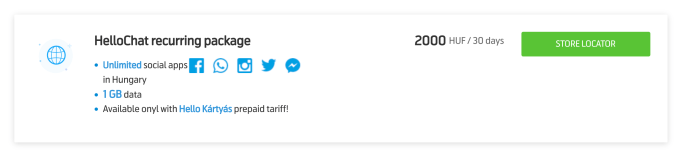
In another example from Hungary, one of carrier Telenor’s 1GB data tariffs (screengrabbed below) touts unlimited domestic data consumption for a number of social apps, including Facebook, WhatsApp, Messenger, Instagram and Twitter — meaning all other apps/services are at a disadvantage as usage is throttled by the user’s 1GB allowance.

A Budapest court hearing two actions against Telenor, related to two of its ‘zero rating’ packages, made a reference to the CJEU for a preliminary ruling on how to interpret and apply Article 3(1) and (2) of the regulation — which safeguards a number of rights for end users of Internet access services and prohibits service providers from putting in place agreements or commercial practices limiting the exercise of those rights — and Article 3(3), which lays down a general obligation of “equal and non-discriminatory treatment of traffic”.

The court found that ‘zero rating’ agreements that combine a ‘zero tariff’ with measures blocking or slowing down traffic linked to the use of ‘non-zero tariff’ services and applications are indeed liable to limit the exercise of end users’ rights within the meaning of the regulation and on a significant part of the market.

“Such packages are liable to increase the use of the favoured applications and services and, accordingly, to reduce the use of the other applications and services available, having regard to the measures by which the provider of the internet access services makes that use technically more difficult, if not impossible. Furthermore, the greater the number of customers concluding such agreements, the more likely it is that, given its scale, the cumulative effect of those agreements will result in a significant limitation of the exercise of end users’ rights, or even undermine the very essence of those rights,” the court writes in a press release.

It also found that no assessment of the effect of measures blocking or slowing down traffic on the exercise of end users’ rights is required by the regulation, while measures applied for commercial (rather than technical) reasons must be regarded as automatically incompatible.

The full CJEU judgement is available here in French and Hungarian.