Year: 2020

31 Aug 2020

Amazon’s Prime Air drone delivery fleet gains FAA approval for trial commercial flights

Amazon has been granted an approval by the U.S. Federal Aviation Administration (FAA) that will allow it to start trialling commercial deliveries via drone, Bloomberg reports. This certification is the same one granted to UPS and a handful of other companies, and while it doesn’t mean that Amazon can immediately start operating a consumer drone delivery service for everyone, it does allow them to make progress towards that goal.

Amazon has said it’ll kick off its own delivery tests, though it hasn’t shared any details on when and where exactly those will begin. The FAA clearance for these trials is adapted from the safety rules and regulations it imposes for companies operating a commercial airline service, with special exceptions allowing for companies to bypass the requirements that specifically deal with onboard crew and staff working the aircraft, since the drones don’t have any.

These guidelines are at best a patchwork solution designed by the agency and its commercial partners to help provide a way for them to get underway with crucial systems development and safety testing and design, but the FAA is working towards a more fit-for-purpose set of regulations to govern drone airline operation for later this year. That will mostly be related to authorizing flights over crowds – but any drone flights will still require constant human observation.

Ultimately, any actual viable and practical system of drone delivery will require fully autonomous operation, without direct line-of-sight observation. Amazon has plans for its MK27 drones, which have a maximum 5 lb carrying capacity, to do just that, but it’ll still likely be many years before the regulatory and air traffic control infrastructure is updated to the point where that can happen regularly.

31 Aug 2020

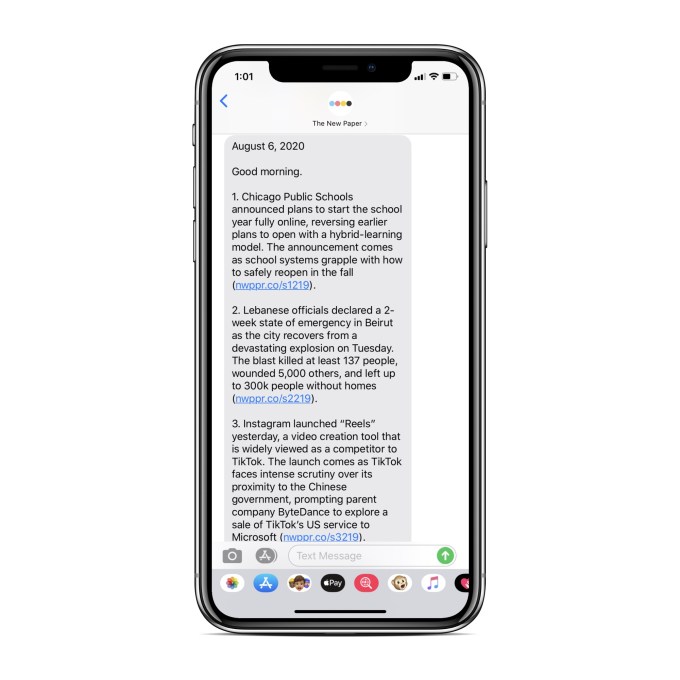
The New Paper offers a ‘fact-first’ news digest in text message form

Tired of signing up for email newsletters? Then maybe it’s time to try out The New Paper‘s news digest, which arrives in the form of a daily text message rounding up the biggest headlines.

The Indianapolis-based startup is announcing that it’s leaving private beta testing. It raised $300,000 in pre-seed funding last year, including $80,000 from a pitch competition held by Elevate Ventures (the VC fund based by Indiana State).

Founders Michael Aft and John Necef told me that they started The New Paper with the intention of creating  email newsletters at first (something Necef has experience with, having served as head of growth at The Hustle), but they decided that text messages offered the best way to, in Aft’s words, “do daily news right.”

“Think about the volume of email you get everyday,” he continued. “It’s this stressful, noisy, environment where you get spam and e-commerce messages. Text is easy, it’s clean, it’s extremely convenient, it’s intimate.”

In fact, Necef said that “a common anecdote” they’ve heard from early subscribers is the fact that they sign up for email newsletters “with the best of intentions” but then those newsletters end up sitting unread in their inboxes. (Think of it as the digital equivalent of those piles of unread New Yorkers.)

Of course, the fact that text messaging is such a personal channel also means that readers aren’t likely to stick around unless they’re actually getting what they want. But Aft said he embraces the challenge of meeting that higher bar: “You’re never going to forget that you subscribed.”

The New Paper

Image Credits: The New Paper

In fact, The New Paper needs to provide value not just because it’s delivered via text message, but because it’s a paid product — after a weeklong free trial, it costs $5 per month. And more than 7,000 paying subscribers have already signed up.

Currently, the digest consists of six headlines, all linking to reporting from other publications, plus a link to The Daily Dash, which provides a high-level snapshot of stock market performance, the current state of the coronavirus pandemic and more.

Both Aft and Necef emphasized that The New Paper’s approach is “fact first.” Of course, there are plenty of news organizations that tout their objectivity and devotion to accuracy, but the pair seemed particularly determined to present their readers with a “common set of facts” about a story that everyone can agree on, regardless of their political leanings.

To illustrate the company’s approach, Aft pointed to the recent report on Russian election interference by the Senate Intelligence Committee. Rather than trying to make any “second order conclusions” about the report — conclusions that could be influenced by a writer or editor’s political beliefs — he said The New Paper focused on what was factually indisputable, namely that the committee had released its report.

As soon as he said that, I imagined editors past and present tearing their hair out — not because they’re liberals determined to make the Trump Administration look bad, but because the report’s findings (that Russian intelligence worked to interfere with the election, and that members of the Trump campaign were happy to accept the help) is the real news, rather than the simple fact of the report’s release.

The New Paper Daily Dash

Image Credits: The New Paper

In other words, emphasizing objectivity and facts sounds good, but it also risks leaving out crucial context or analysis. Plus, it’s become increasingly clear that facts rarely change people’s minds.

Still, despite my quibbles with the approach, I’m happy to report that I’ve been receiving the digest for the past week, and I’ve found it to be a convenient, comprehensive catch-up on the day’s news, with links that make it easy to learn more.

For now, Aft and Necef are writing the digest themselves, though they said much of the ranking and sorting is done by algorithms. Over time, they’re hoping to hire on both the technology side and the editorial side. They also plan to expand into other channels like email and voice.

Asked whether the subscription business model means that they don’t have to pursue a mass audience, Aft replied, “We think it’s so critically important to give people a common set of information. To make this a viable business model, do we need to be 100 million strong? Of course not. Is that the goal we’re targeting? Absolutely, because we are so passionate about the problem.”

31 Aug 2020

Facebook partially documents its content recommendation system

Algorithmic recommendation systems on social media sites like YouTube, Facebook and Twitter, have shouldered much of the blame for the spread of misinformation, propaganda, hate speech, conspiracy theories and other harmful content. Facebook, in particular, has come under fire in recent days for allowing QAnon conspiracy groups to thrive on its platform and for helping militia groups to scale membership. Today, Facebook is attempting to combat claims that its recommendation systems are at any way at fault for how people are exposed to troubling, objectionable, dangerous, misleading, and untruthful content.

The company has, for the first time, made public how its content recommendation guidelines work.

In new documentation available in Facebook’s Help Center and Instagram’s Help Center, the company details how Facebook and Instagram’s algorithms work to filter out content, accounts, Pages, Groups and Events from its recommendations.

Currently, Facebook’s Suggestions may appear as Pages You May Like, “Suggested For You” posts in News Feed, People You May Know, or Groups You Should Join. Instagram’s suggestions are found within Instagram Explore, Accounts You May Like, and IGTV Discover.

The company says Facebook’s existing guidelines have been in place since 2016 under a strategy it references as “remove, reduce, and inform.” This strategy focuses on removing content that violates Facebook’s Community Standards, reducing the spread of problematic content that does not violate its standards, and informing people with additional information so they can choose what to click, read or share, Facebook explains.

The Recommendation Guidelines typically fall under Facebook’s efforts in the “reduce” area, and are designed to maintain a higher standard than Facebook’s Community Standards, because they push users to follow new accounts, groups, Pages and the like.

Facebook, in the new documentation, details five key categories that are not eligible for recommendations. Instagram’s guidelines are similar. However, the documentation offers no deep insight into how Facebook actually chooses how it chooses what to recommend to a given user. That’s a key piece to understanding recommendation technology, and one Facebook intentionally left out.

One obvious category of content that many not be eligible for recommendation includes those that would impede Facebook’s “ability to foster a safe community,” such as content focused on self-harm, suicide, eating disorders, violence, sexually explicit, regulated content like tobacco or drugs, content shared by non-recommendable accounts or entities.

Facebook also claims to not recommend sensitive or low-quality content, content users frequently say they dislike, and content associated with low-quality publishings. These further categories include things like clickbait, deceptive business models, payday loans, products making exaggerated health claims or offering “miracle cures,” content promoting cosmetic procedures, contest, giveaways, engagement bait, unoriginal content stolen from another source, content from websites that get a disproportionate number of clicks from Facebook versus other places on the web, news that doesn’t include transparent information about the authorship or staff.

In addition, Facebook claims it won’t recommend fake or misleading content, like those making claims found false by independent fact checkers, vaccine-related misinformation, and content promoting the use of fraudulent documents.

It says it will also “try” not to recommend accounts or entities that recently violated Community Standards, shared content Facebook tries to not recommend, posts vaccine-related misinformation, has engaged in purchasing “Likes,” has been banned from running ads, posted false information, or are associated with movements tied to violence.

The latter claim, of course, follows recent news that a Kenosha militia Facebook Event remained on the platform after being flagged 455 times after its creation, and had been cleared by 4 moderators as non-violating content. The associated Page had issued a “calls to arms” and hosted comments about people asking what types of weapons to bring. Ultimately, two people were killed and a third was injured at protests in Kenosha, Wisconsin when a 17-year old armed with an AR-15-style rifle broke curfew, crossed state lines, and shot at protestors.

Given Facebook’s track record, it’s worth considering how well Facebook is capable of abiding by its own stated guidelines. Plenty of people have found their way to what should be ineligible content, like conspiracy theories, dangerous health content, COVID-19 misinformation and more by clicking through on suggestions at times when the guidelines failed. QAnon grew through Facebook recommendations, it’s been reported.

It’s also worth noting, there are many gray areas that guidelines like these fail to cover.

Militia groups and conspiracy theories are only a couple examples. Amid the pandemic, U.S. users who disagreed with government guidelines on business closures can easily find themselves pointed towards various “reopen” groups where members don’t just discuss politics, but openly brag about not wearing masks in public or even when required to do so at their workplace. They offer tips on how to get away with not wearing masks, and celebrate their successes with selfies. These groups may not technically break rules by their description alone, but encourage behavior that constitutes a threat to public health.

Meanwhile, even if Facebook doesn’t directly recommend a group, a quick search for a topic will direct you to what would otherwise be ineligible content within Facebook’s recommendation system.

For instance, a quick search for the word “vaccines,” currently suggests a number of groups focused on vaccine injuries, alternative cures, and general anti-vax content. These even outnumber the pro-vax content. At a time when the world’s scientists are trying to develop protection against the novel coronavirus in the form of a vaccine, allowing anti-vaxxers a massive public forum to spread their ideas is just one example of how Facebook is enabling the spread of ideas that may ultimately become a global public health threat.

The more complicated question, however, is where does Facebook draw the line in terms of policing users having these discussions versus favoring an environment that supports free speech? With few government regulations in place, Facebook ultimately gets to make this decision for itself.

Recommendations are only a part of Facebook’s overall engagement system, and one that’s often blamed for directing users to harmful content. But much of the harmful content that users find could be those groups and Pages that show up at top of Facebook search results when users turn to Facebook for general information on a topic. Facebook’s search engine favors engagement and activity — like how many members a group has or how often users post — not how close its content aligns with accepted truths or medical guidelines.

Facebook’s search algorithms aren’t being similarly documented in as much detail.


31 Aug 2020

Lenovo’s Smart Clock Essential is less smart by design

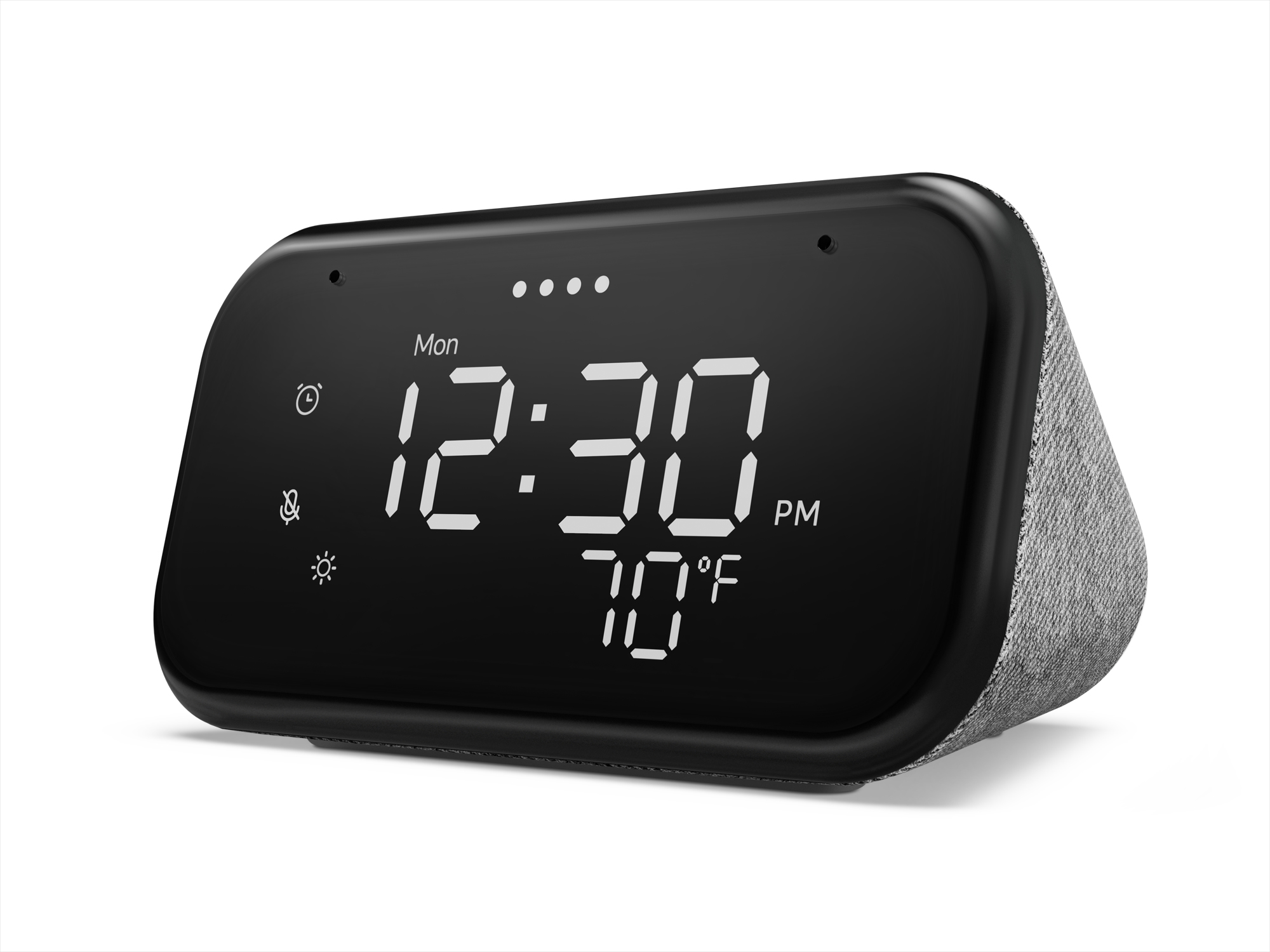
The Smart Clock Essential really blurs smart display lines. Aesthetics aside, Lenovo’s news device probably has more in common with the Echo Dot with Clock than it does the company’s first generation Smart Clock. In fact, at $50, it’s actually $10 less expensive than Amazon’s offering.

Essentially the Essential is a Google Assistant smart speaker with a digital display. Which really makes you wonder what qualifies as “essential” these days. It shows the time and the weather on its LED, but offers none of the kind of touch interaction you’ve come to expect from the form factor. There are still buttons that can be used to set the alarm and “a built-in light that helps you walk around without bumping into things,” which fair enough.

But at the end of the day, it’s more akin to the Google Home Mini than the Nest Hub. And like the former, it’s priced so you can buy a bunch of them to and stick them at various spots throughout your house. There’s a 3W speaker, which is built more for alarm sounds than casual listening, though like other Google Assistant speakers, it can be paired as part of a group. Oh, and like the original Smart Clock, there’s a USB port on board for charging devices while you sleep.

Honestly, that $50 price point is really the biggest seller here, but it’s nice to see hardware makers like Lenovo playing around with the form factor a bit, as voice enabled device take up an increasing amount of real estate on our kitchen counters and bedside tables. Honestly, after testing the original Smart Clock, I’m not sure I want or need more functionality than Lenovo’s offering up here next to my bed.

It’s set to hit retail next month. Just don’t call it a smart display.

31 Aug 2020

Welcome to the most important panel on product development in the history of Disrupt

In a few short weeks, some of the best product developers from some of the world’s most important tech companies will take to the virtual stage of our virtual Disrupt this September 14-18 to share all the tips and tricks they’ve learned over decades spent working at Zoom, Slack, Facebook, Amazon, Hulu, and Oculus.

This isn’t a tribute to the  most important panel on tech development you’ll ever attend… it is the most important panel on tech product development you’ll attend.

Not only do we have Oded Gal, the man responsible for leading Zoom’s product management; not only do we have Eugene Wei, who’s forgotten more about product development in a career spanning Amazon, Hulu, Oculus, and Flipboard than most developers ever knew; not only do we have Julie Zhuo, the co-founder of Inspirit and the former VP of Product Design for the Facebook app; and not only do we have Tamar Yehoshua, who oversees product strategy and development, design and research at Slack, but we have you, our interactive audience to help me question these doyennes of design, these prestigious progenitors of product on their path to product nirvana.

In this session, we’ll discuss how to get not from zero to one, but from one to one billion in industries as diverse as communication, social networking, virtual reality, direct-to-consumer sales, and more.

It’s worth getting those questions ready to share now for this exclusive, incredibly special ExtraCrunch panel. Some things to remember about each of our illustrious and esteemed panelists:

Oded Gal worked at Blue Jeans Network and Cisco Webex before joining Zoom and also served as director of business development at Radvision.

Julie Zhuo was the VP of Product Design for the Facebook app, where she scaled it from 10 million users to over 2 billion. She’s also a bestselling author of the book “The Making of a Manager”, voted one of Amazon’s best business and leadership books of 2019.

Eugene Wei ran product teams at Amazon, Hulu, Flipboard, and Oculus.

Tamar Yehoshua previously worked as a Vice President at Google holding product and engineering leadership roles on Google’s most important products, including Search, Identity and Privacy. And before that, Tamar was the Vice President of Advertising Technologies at Amazon’s A9.

This panel is so good TechCrunch should definitely be getting someone else to lead it. But luckily, y’all will be there to help out.

So don’t delay, get those tickets now!

Disrupt 2020 runs from September 14 through September 18 and will be 100% virtual this year. Get your front row seat to see this panel live with a Disrupt Digital Pro Pass or a Digital Startup Alley Exhibitor Package. We’re excited to see you there.

31 Aug 2020

Apple mistakenly approved a widely-used malware to run on Macs

Apple has some of the strictest rules to prevent malicious software from landing in its app store, even if on occasion a bad app slips through the net. But last year Apple took its toughest approach yet by requiring developers to submit their apps for security checks in order to run on millions of Macs unhindered.

The process, which Apple calls “notarization,” scans an app for security issues and malicious content. If approved, the Mac’s in-built security screening software, Gatekeeper, allows the app to run. Apps that don’t pass the security sniff test are denied, and are blocked from running.

But security researchers say they have found the first Mac malware inadvertently notarized by Apple.

Peter Dantini working with Patrick Wardle, a well-known Mac security researcher, found a malware campaign disguised as an Adobe Flash installer. These campaigns are common and have been around for years — even if Flash is rarely used these days — and most run unnotarized code, which Macs block immediately when opened.

But Dantini and Wardle found that one malicious Flash installer had code notarized by Apple and would run on Macs.

The malicious installer was notarized by Apple, and could be run on the latest versions of macOS. (Image: Patrick Wardle/supplied)

Wardle confirmed that Apple had approved code used by the popular Shlayer malware, which security firm Kaspersky said is the “most common threat” that Macs faced in 2019. Shlayer is a kind of adware that intercepts encrypted web traffic — even from HTTPS-enabled sites — and replaces websites and search results with its own ads, making fraudulent ad money for the operators.

“As far as I know, this is a first,” Wardle wrote in a blog post, shared with TechCrunch.

Wardle said that means Apple did not detect the malicious code when it was submitted and approved it to run on Macs — even on the unreleased beta version of macOS Big Sur, expected out later this year.

Apple revoked the notarized payloads after Wardle reached out, preventing the malware from running on Macs in the future.

In a statement, a spokesperson for Apple told TechCrunch: “Malicious software constantly changes, and Apple’s notarization system helps us keep malware off the Mac and allow us to respond quickly when it’s discovered. Upon learning of this adware, we revoked the identified variant, disabled the developer account, and revoked the associated certificates. We thank the researchers for their assistance in keeping our users safe.”

But Wardle said that the attackers were back soon after with a new, notarized payload, able to circumvent the Mac’s security all over again.

31 Aug 2020

Equity Monday: What if no one gets to buy TikTok?

Hello and welcome back to Equity, TechCrunch’s venture capital-focused podcast where we unpack the numbers behind the headlines.

This is Equity Monday, our weekly kickoff that tracks the latest big news, chats about the coming week, digs into some recent funding rounds and mulls over a larger theme or narrative from the private markets. You can follow the show on Twitter here, and myself here, and don’t forget to check out last Friday’s episode.

This weekend was a welcome reprieve from last week’s insane news cycle inside the world of technology and money. If you are still catching your breath from the Great IPO Wave of last Monday, we feel you. Here’s what we got into this morning:

  • The TikTok sale could be in trouble, this time due to China changing its rules on sales of tech firms that have certain algorithms. TikTok parent company Bytedance intends to comply with the rules, but what impact the news could have the sale of the social service is unclear as of yet, though the developments are not good if you were in favor of a deal.
  • American tech shares are set to rise once again after setting records last week.
  • Equity is back on YouTube, hell yeah!
  • From the weekend: Medium’s growth in both traffic (pageviews) and income (paying subscribers) is super impressive according to its latest reporting. And the publishing platform and media company is doubling-down on product to fend off upstarts like the popular Substack. Per a Bloomberg report, tech IPO fundraising could set a record in 2020. And, to ground us in a macro-economic sense, Chinese banks are being forced to take a profit hit to support other companies.
  • In the funding round domain, Semalytix raised €4.3 million in Series A funding according to TechCrunch for its pharmaceutical-AI service. And India-based Eruditus raised $113 million for its executive-focused education service. That’s a lot of money, but like we’ve been saying, edtech is hot.
  • And, finally, will there be enough horns for all these hot SaaS rounds that are getting done in a blur today? What if SaaS revenue multiples slip by 20%? Then what? When deals go so fast that due diligence suffers, the hangover can last a bit.

And that is the week’s Monday ep, thanks for sticking with through our super-busy week last week. Whew!

Equity drops every Monday at 7:00 a.m. PT and Thursday afternoon as fast as we can get it out, so subscribe to us on Apple PodcastsOvercastSpotify and all the casts.

31 Aug 2020

Google launches Google Kids Space, a ‘kids mode’ feature for Android, initially on Lenovo tablets

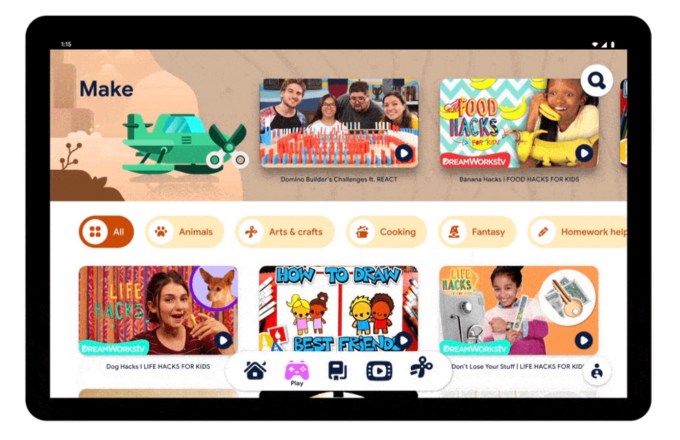
Streaming services have built-in kids’ profiles, so why not devices? Google today is responding to parents’ demand for a better way for their children to interact with technology with the launch of the new “Google Kids Space,” a dedicated kids mode on Android tablets which will aggregate apps, books, and videos for kids to enjoy and learn from. The feature will launch first on the Lenovo Smart Tab M10 HD Gen 2, but Google aims to bring Kids Space to more devices in time.

The concept is somewhat similar to Amazon’s FreeTime, Amazon’s own well-built system for parental controls and access to approved and curated children’s’ apps and media. But in Google’s case, its new kids’ mode is building on top of the company’s earlier efforts focused on designing a safer, more controlled Android experience for families with children.

These efforts began with Family Link, a series of parental control features that’s now built into the Android OS. Family Link already allows parents to set screen time limits, engage content safety filters, set privacy controls, and more. Google then expanded into kids’ app curation with the launch of a Kids tab in Google Play where it can showcase “teacher-approved” mobile apps and games.

Image Credits: Google

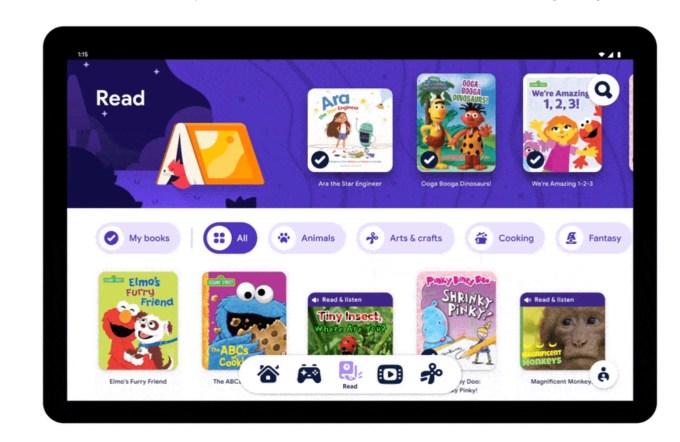
The new Kids Space leverages Google’s earlier work in evaluating Android apps for its “Play” tab, and has expanded its curation to now include other types of quality content. For example, Google worked with publishers to make popular children’s books free of charge in Kids Space, and at launch offers over 400 free books in the “Read” tab for users in the U.S.

In the Kids Space’ “Watch” and “Make” tabs, Google is pulling in creative content from YouTube Kids that encourage off-screen activities.

Image Credits: Google

The feature is ultimately meant to be a selling point for Android devices and a way to lock families into the Google ecosystem. This differentiates it from Amazon’s FreeTime, which only partially has this aim. Amazon’s FreeTime is largely meant to a subscription offering, and it’s one that works across platforms — including Amazon devices like Fire tablets and Echo smart speakers, but also on iOS and Android devices. Google’s Kids Space, meanwhile, is only designed for Android.

Google Kids Space is initially available on on the Lenovo Tab M10 HD Gen 2. The company said it worked with Lenovo to ease the setup process for parents and to ensure that Kids Space is a pre-loaded feature. Google says it aims to bring Kids Mode to more Android tablets soon.

31 Aug 2020

Rocket Lab returns to flight with a successful launch of a Capella Space satellite

Rocket Lab is back to active launch status after encountering an issue with its last mission that resulted in a loss of the payload. In just over a month, Rocket Lab was able to identify what went wrong with the Electron launch vehicle used on that mission and correct the issue. On Sunday, it successfully launched a Sequoia satellite on behalf of client Capella Space from its New Zealand launch facility.

The “I Can’t Believe It’s Not Optical” mission is Rocket Lab’s 14th Electron launch, and it lifted off from the company’s private pad at 11:05 PM EDT (8:05 PM PDT). The Sequoia satellite is the first in startup Capella Space’s constellation of Synthetic Aperture Radar (SAR) satellites to be available to general customers. When complete, the constellation will provide hourly high-quality imaging of Earth, using radar rather than optical sensors in order to provide accurate imaging regardless of cloud cover and available light.

This launch seems to have gone off exactly as planned, with the Electron successfully lifting off and delivering the Capella Space satellite to its target orbit. Capella had been intending to launch this spacecraft aboard a SpaceX Falcon 9 rocket via a rideshare mission, but after delays to that flight, it changed tack and opted for a dedicated launch with Rocket Lab.

Rocket Lab’s issue with its July 4 launch was a relatively minor one – an electrical system failure that caused the vehicle to simply shut down, as a safety measure. The team’s investigation revealed a component of the system that was not stress-tested as strenuously as it should’ve been, and Rocket Lab immediately instituted a fix for both future and existing in-stock Electron vehicles in order to get back to active flight in as little time as possible.

While Rocket Lab has also been working on a recovery system that will allow it to reuse the booster stage of its Electron for multiple missions, this launch didn’t involve any tests related to that system development. The company still hopes to test recovery of a booster sometime before the end of this year on an upcoming launch.

31 Aug 2020

SpaceX successfully launches its first polar orbit mission from Florida

SpaceX performed a milestone first polar orbital launch of a satellite from its East Coast launch facility at Cape Canaveral on Sunday. The Falcon 9 mission carried three payloads, including a SAOCOM-1B synthetic aperture radar satellite which was flown on behalf of the Argentine space agency, and two small satellites for clients Tyvack and PlanetiQ.

The launch took place at 7:18 PM EDT from Florida, and used a first stage booster that SpaceX previously flew on two separate commercial resupply missions on behalf of NASA for the international Space Station, as well as one of SpaceX’s recent Starlink internet satellite launches. SpaceX also recovered the booster again with a controlled landing back at their landing site at Cape Canaveral.

This was originally set to be one of two launches that SpaceX was going to perform on Sunday – both from the same launch facility, though at different pads. That would’ve been a historic first, but weather earlier in the day meant that the first mission on the schedule, a Starlink launch, was cancelled and will be rescheduled.

SpaceX would ultimately like to be launching at a cadence that would include multiple launches per day, and this would’ve been a great test of its ability to operationalize that ambition. Considering how aggressive the company has been with its Starlink launches, however, it seems likely we’ll encounter another opportunity for a double launch day at some point in the future.