Year: 2020

29 Aug 2020

Startups Weekly: With Asana, JFrog, Palantir, Snowflake, Sumo and Unity, we’re in peak season for tech IPOs

Editor’s note: Get this free weekly recap of TechCrunch news that any startup can use by email every Saturday morning (7 a.m. PT). Subscribe here.

Pandemic numbers are looking better, it’s still a couple months before U.S. elections and a growing line of tech companies have already ventured out into public markets successfully this summer. Hard to imagine conditions beating the present any time soon, whether you’re traditionally banked, going with a direct listing or getting inside a SPAC vehicle.

We covered the frenzy this week with an eye toward what other startups can learn about the way these companies have arrived at this point. Here are the headlines for each, from Asana to Unity.

But first, consider this special episode of our Equity podcast from Wednesday, where the team reviews the news. And for a faster(ish) read, Extra Crunch subscribers should also check out Alex Wilhelm’s “super-long roundup” of the companies.

The IPOs:

As losses expand, Asana is confident it has the ticket for a successful public listing

Palantir and the great revenue mystery
The bullish case for Palantir’s direct listing (EC)
Leaked S-1 says Palantir would fight an order demanding its encryption keys
Palantir’s S-1 alludes to controversial work with ICE as a risk factor for its business

Unpacking the Sumo Logic S-1 filing (EC)

A quick peek at Snowflake’s IPO filing
Industry experts say it’s full speed ahead as Snowflake files S-1

Unity’s IPO numbers look pretty … unreal?
Sequoia strikes gold with Unity’s IPO filing

Regarding that last one, EC members should be sure to check out our popular deep dive from last year detailing how Unity came to be a leading gaming engine.

Finally, here’s one last EC headline to get you ready for what is sure to be another week of official S-1s, leaked filing information, rumors of imminent IPO dates, controversies over methods of going public, etc.:

SaaS stocks survive earnings, keeping the market warm for software startups, exits

Image Credits: Getty Images

You don’t know SPACs

Special purpose acquisition companies are an older model of financial vehicle used to take companies public that has become a hot trend in recent years as more tech startups try to figure out liquidity events. Here’s Connie Loizos, who put together a long list of questions and answers about SPACs, concluding that the trend is here for the long-term:

[One] investment banker says he’s seeing less interest from VCs in sponsoring SPACs and more interest from them in selling their portfolio companies to a SPAC. As he notes, “Most venture firms are typically a little earlier stage investors and are private market investors, but there’s an uptick of interest across the board, from PE firms, hedge funds, long-only mutual funds.”

That might change if [A* SPAC founder] Kevin Hartz has anything to do with it. “We’re actually out in the Valley, speaking with all the funds and just looking to educate the venture funds,” he says. “We’ve had a lot of requests in. We think we’re going to convert [famed VC] Bill Gurley  from being a direct listings champion to the SPAC champion very soon.”

In the meantime, asked if his SPAC has a specific target in mind already, Hartz says it does not. He also takes issue with the word “target.”

Says Hartz, “We prefer ‘partner company.’” A target, he adds, “sounds like we’re trying to assassinate somebody.”

Open treasure chest of gold on a deserted beach.

Image Credits: Dougal Waters / Getty Images

Inside the nearly 200 companies of Y Combinator’s Summer 2020 demo day

After YC’s first remote-only demo day this spring, the seed-stage venture firm switched from recorded pitches to live ones. The TechCrunch team was on hand to cover the 192 presentations over Monday and Tuesday this week. We’ve written up these two handy guides to help you find your newest competitors, employers or maybe investment:

The 98 companies from Y Combinator’s Summer 2020 Demo Day 1
The 94 companies from Y Combinator’s Summer 2020 Demo Day 2

The staff also picked out their dozen or so favorites from each day, for Extra Crunch subscribers:

Our 11 favorite companies from Y Combinator’s S20 Demo Day: Part 1
Our 12 favorite startups from Y Combinator’s S20 Demo Day: Part 2

(Check out this special demo day edition of Equity for a free audio rundown.)

One company wasn’t in the mix — a startup called Trove, that provides internal compensation SaaS tools, and has just raised a huge new round from Andreessen Horowitz. Natasha Mascarenhas has more.

What investors are saying about startup cities in 2020: Chicago edition

Cities around the world have developed strong tech scenes, but these startup hubs are at the center of potential disruption from pandemic problems plus the possibilities of remote work. We’re surveying investors around the world about what’s next for their home bases. This week, Matt Burns checks in with top Chicago investors about the tech future of the biggest Midwestern city. Here’s Constance Freedman of proptech-oriented fund Moderne Ventures, who is investing in the middle of all these changes:

World-class startups still need world-class feeders, so I don’t expect expansion to reach all that far, but perhaps density or proximity to work becomes less important for those who work there. This may give more cities a change to rise, including Chicago.

So what does this mean for Chicago startup ecosystem? I think Chicago is poised to come out well. The city is affordable to begin with … like 50% more affordable than the West or East Coast hubs. If I live in Chicago I can afford space, I can enjoy my city and I have good transportation if I want to bail out of the city and move to the suburbs. Chicago has a strong ecosystem of universities and capital that can sustain it and may become more appealing to those (tech people and investors) who moved out to go to the coasts in the first place and now realize they don’t need to be there. As people migrate to live where they really want to live, with the lifestyle they want to have, near family they want to be with, they begin to look for more local opportunities and that may bring some great talent back to Chicago and other markets outside of the coasts.

Chicago has long been known for banking, real estate, health care and insurance. I think these sectors and others are poised to do well. The largest opportunity for us (and any major city) is how to close the education gap, which leads to closing the income gap and from there — the sky is the limit!

Meanwhile, Mike Butcher is working on surveys across Europe, and would like to hear from you if you are an investor in Paris or Warsaw.

Around TechCrunch (Disrupt Time)

Conan is coming to Disrupt 2020

Meet the Disrupt 2020 ‘TC10’

Presenting TechCrunch Disrupt’s Asia sessions

Learn how to scale social impact startups at Disrupt with Phaedra Ellis-Lamkins and Jessica O. Matthews

Benchmark’s Peter Fenton is joining us at Disrupt

Learn why embedded finance is the future of fintech at Disrupt

Laura Deming, Frederik Groce, Amish Jani, Jessica Verrilli and Vanessa Larco are coming to Disrupt

Carbon Health’s Eren Bali and Color’s Othman Laraki will join us at Disrupt 2020

Black founders can get tactical advice at Disrupt

Five real reasons to attend Disrupt 2020 online

Hear from experienced edtech investors on the market’s overnight boom at Disrupt 2020

Startup Alley exhibitors: Register for VC-led Fundraising & Hiring Best Practices webinar

Here’s how you can get a second shot at Startup Battlefield

Two weeks left on early-bird pricing for TC Sessions: Mobility 2020

Grab your student discount pass for TC Sessions: Mobility 2020

Register for our last pitch-off next week on September 2

Extra Crunch discount now available for military, nonprofits and government employees

Across the week

TechCrunch

The pandemic has probably killed VR arcades for good

Femtech poised for growth beyond fertility

Five proven ways to attract and hire more diverse talent

Will automation eliminate data science positions?

Eduardo Saverin on the ‘world of innovation past Silicon Valley’

The H-1B visa ban is creating nearshore business partnership opportunities

Meet the startups from Brinc’s first online Demo Day

Extra Crunch

What can growth marketers learn from lean product development?

Alexa von Tobel: Eliminating risk is the key to building a startup during an economic downturn

As DevOps takes off, site reliability engineers are flying high

How to establish a startup and draw up your first contract

COVID-19 is driving demand for low-code apps

Synthetic biology startups are giving investors an appetite

Funding for mental health-focused startups rises in 2020

Box CEO Aaron Levie says thrifty founders have more control

#EquityPod

From Alex Wilhelm:

Hello and welcome back to Equity, TechCrunch’s venture capital-focused podcast (now on Twitter!), where we unpack the numbers behind the headlines.

This is the fourth episode of the week, pushing our production calendar to the test. Happily, we’ve managed to hold it together amidst the news deluge that the last few days have brought. It was a good week for our scheduling change, with the main episode of the show coming to you on Thursday afternoon versus Friday morning.

Change is good.

But unchanging this time around was our hosting lineup, with Natasha Mascarenhas and Danny Crichton and myself yammering with Chris Gates on the mix. Here’s what we got into:

  • The CEO of TikTok is out, bids are swirling and who will wind up owning a piece of all of TikTok’s global operations is not clear. Walmart is in the mix, apparently, which feels very 2020.
  • The New York Stock Exchange has gotten approval from the SEC for a new type of direct listing, one in which the company going public can sell a bloc of shares during the normal price discovery process. This means that all the banker-faff of setting a price and roadshowing to various investor groups could be going the way of the buffalo.
  • About time, maybe? That was our take after reading this Bill Gurley note and the latest SEC news.
  • But while the direct listing world is getting more interesting, the SPAC world is taking flight. Desktop Metal is going public via a SPAC which is all sorts of fascinating. A younger, Boston-based unicorn going public in this manner is eye catching!
  • And then two funding rounds, the first from Finix, which can’t stop adding to its Series B. And Mural, which raised the largest Series B we can recall.

And with that, we’re all going to bed. We’re tired. No more news, thanks!

Subscribe to us on Apple PodcastsOvercastSpotify and all the casts.

29 Aug 2020

A must-see conversation on the state of VC, this year at Disrupt

On a surface level, the world of venture capital doesn’t look to change much year to year. But in truth, the industry is very much in flux, with many firms grappling with a lack of diversity, dealing with succession questions, and confronting a growing pipeline of aging portfolio companies — to name just a few of the issues of the day.

In fact, one of the biggest shifts in the industry — one that’s years in the making but with no end in sight — is its atomization. Once a clubby industry, the landscape today sees new players, backed up by real dollars, every day, all over the world.

Indeed, at this year’s Disrupt, we’re very excited to be sitting down with three venture investors who spent much of their careers with powerful outfits before more recently — and boldly — striking out on their own to build their own brands.

It’s with their help that we’re going to take stock of many of the trends roiling the industry right now.

Lo Toney was a VP at Cake Financial, a general manager with Zynga, and the CEO of an online coding startup before jumping into the world of venture capital, first at Comcast Ventures and later at GV where he spent several years as a partner.

If he was tempted to stay with Alphabet’s influential venture arm, he didn’t, instead turning his work at GV — which centered increasingly on finding and funding promising and diverse fund managers and startups — into the opportunity to create his own shop. Now, Plexo Capital not only counts Alphabet among its biggest financial backers, but it has amassed stakes in roughly two dozen funds and many more startups. With most of them run exclusively or in part by people of color, Toney has also become a leading light for others who recognize diversity as a competitive advantage.

Then there’s Renata Quintini, who has spent the last year quietly building a new outfit, Renegade Partners, with cofounder Roseanne Wincek. Wincek previously worked at the venture giant IVP. Quintini, similarly, has held a number of investing roles at esteemed institutions. Among them is the Stanford Management Company, where she was an investment manager focused on VC and private equity investments, and Felicis Ventures, where as a general partner she worked with a wide number of rising stars, including the satellite company Planet, the self-driving startup Cruise Automation (now owned by GM), Dollar Shave Club (which sold to Unilever), and Bonobos (snapped up by Walmart).

It wasn’t a surprise when Lux Capital poached Quintini, in fact. But even Lux, which prides itself on the kind of deep science expertise that Quintini shares, couldn’t keep her from leaving to create something all her own.

The story isn’t so dissimilar for Dayna Grayson, who studied systems engineering and worked in product design before jumping into the world of venture capital, first as a principal with the Boston-based firm Northbridge Venture Partners and afterward, as a partner with the venture giant NEA.

There, based in Washington, D.C., Grayson led a wide number of deals for the firm, including in the metal 3D printing company Desktop Metal —  a five-year-old company that, absent an unforeseen development, is soon to be a publicly traded and valued in the multiple billions of dollars.

Undoubtedly Grayson could have stayed longer. Instead, nearly eight years into her career with NEA, she left late last year to cofound the early-stage venture firm Construct Capital with Rachel Holt, one of Uber’s first employees.

There is so much to talk about with these entrepreneurial investors, from how they compete against the heavyweights, to how they think about startups in a post COVID world, to whether or not there VCs have begun to over-index on business-facing investments to their own detriment — or if, conversely that opportunity remains limitless right now. That’s saying nothing about SPACs, rolling funds, and the latest twist in direct listings.

You definitely won’t want to miss this very timely conversation about the state of VC.

Disrupt 2020 runs from September 14 through September 18 and will be 100% virtual this year. Get your front row seat to see Grayson, Quintini and Toney live with a Disrupt Digital Pro Pass or a Digital Startup Alley Exhibitor Package. We’re excited to see you there.

29 Aug 2020

India’s Reliance Retail to acquire Future Group’s retail, wholesale, and logistics businesses for $3.4 billion

Reliance Retail, India’s largest retail chain in the country, has found a much simpler way to expand its dominant position in the country: Acquire most of the second largest chain.

On Saturday evening (local Indian time), Reliance Retail said it has reached an agreement with Future Group to acquire the latter’s retail and wholesaler business, and its logistics and warehousing business for $3.4 billion.

“With this transaction, we are pleased to provide a home to the renowned formats and brands of Future Group as well as preserve its business ecosystem, which have played an important role in the evolution of modern retail in India. We hope to continue the growth momentum of the retail industry with our unique model of active collaboration with small merchants and kiranas as well as large consumer brands. We are committed to continue providing value to our consumers across the country,” said Isha Ambani, Director at Reliance Retail, in a statement.

More to follow…

29 Aug 2020

This Week in Apps: Unreal Engine saved, Fortnite banned and TikTok talks to everyone

Welcome back to This Week in Apps, the TechCrunch series that recaps the latest OS news, the applications they support and the money that flows through it all.

The app industry is as hot as ever, with a record 204 billion downloads and $120 billion in consumer spending in 2019. People are now spending three hours and 40 minutes per day using apps, rivaling TV. Apps aren’t just a way to pass idle hours — they’re a big business. In 2019, mobile-first companies had a combined $544 billion valuation, 6.5x higher than those without a mobile focus.

In this series, we help you keep up with the latest news from the world of apps, delivered on a weekly basis.

This week, two big stories dominated the news: Apple’s fight with Fortnite maker Epic Games and TikTok’s negotiations with top U.S. tech firms over a sale. The former story saw Microsoft coming to Epic Games’ aid in court, in a surprise move.

Meanwhile, TikTok deal talks are happening quickly as both Oracle and Microsoft’s names have emerged as top suitors. But this week, we saw Walmart joining in the talks, too. Yes, Walmart!

One has to wonder if the TikTok that emerges from an acquisition like this will even be the TikTok that people today love to use, what with all these new corporate synergies that come into play.

Top Stories

Apple gets petty in fight with Epic Games

Image credit: Kyle Grillot/Bloomberg via Getty Images

Sorry, Apple, but this is not a good look.

On Friday, the $2 trillion company took its battle with Fortnite maker Epic Games to a whole new level of petty. Just as Fortnite for iOS and Mac was officially blocked from being able to issue updates for its apps, Apple featured Fortnite top competitor PUBG Mobile in the App Store in an editorial story on the Today tab. Apple’s App Store Twitter account also posted about PUBG Mobile’s New Era.

This isn’t coincidental, but a conscious decision on Apple’s part to demonstrate its market power. That is: if you don’t want to play by our rules, fine — we’ll just give business to your competitor instead. Being featured on the App Store drives downloads for an app, which helps an app find new users and reconnect with existing ones.

Apple made its point, but it sure was an ugly way to do it.

In a surprise move, Microsoft came out in support of Epic Games this week. Microsoft GM of gaming developer experiences Kevin Gammill submitted a letter to the court that said Apple’s move to cut ties with Epic would harm game developers. Microsoft uses Epic’s Unreal Engine for its own title, “Forza Street,” but the company understands the damage Apple can do to the gaming industry if it stopped Epic from being able to work on Unreal Engine by disabling its Apple developer account.

Plus, if there’s a battle between the gaming industry and Apple, Microsoft will probably take game developers’ sides these days. After all, Microsoft is in the gaming business and its own cloud gaming service xCloud is banned from the App Store, too, as is Google’s Stadia. Apple’s decision to disallow cloud gaming is anti-consumer and fairly unpopular.

The judge in the Apple v. Epic case this week gave Epic Games a temporary restraining order against Apple, but only to stop Apple from retaliating against Epic Games by blocking the company’s Unreal Engine. Judge Yvonne Gonzalez Rogers also chastised Apple for the move, saying that Epic and Apple were free to litigate against each other, but “their dispute should not create havoc to bystanders.”

It’s becoming pretty clear that Apple’s way of running the App Store is not just a set of rules, it’s become a way for Apple to control other businesses, and even limit their growth. Apple’s ban on cloud gaming looks a lot like a way for Apple to protect its own gaming business at the expense of rivals. In the meantime, a patent reveals Apple is working on its own cloud gaming system. Yikes.

Unfortunately, in battles of this size we’re not exactly left with a hero to root for. Epic Games is no indie underdog being crushed by the big guy. It is the big guy. Microsoft is doing okay too. And when Facebook complains that Apple wouldn’t allow its gaming app into the store, or when it rejected Facebook’s app for informing users of Apple’s 30% cut, it’s easy enough to shrug and move on. Oh poor Facebook is not a sentiment people are capable of feeling these days.

But it’s important to remember that what Apple is doing to these big guys, it’s also doing to the smaller ones. We already saw that with the Basecamp Hey debacle. More recently, Apple rejected the free, open-source WordPress app from the App Store for failing to add Apple’s in-app purchase system and because some of the app’s web views could lead to information about WordPress’s pricing plans.

The issue was resolved and Apple even apologized, but it’s clear that something is very, very broken at the App Store. And the ultimate loser is the consumer. 

In Steve Jobs’ day, GV General Partner M.G. Siegler pointed out in a recent blog post, Apple believed in its App Store and payment systems would win on their own merits, not because they were forced. In Jobs’ own words: “Our philosophy is simple — when Apple brings a new subscriber to the app, Apple earns a 30 percent share; when the publisher brings an existing or new subscriber to the app, the publisher keeps 100 percent and Apple earns nothing.”

How times have changed.

TikTok nears U.S. deal and loses CEO 

TikTok office building

(Photo by CHRIS DELMAS/AFP via Getty Images)

TikTok is busy. On Monday, the world’s biggest app sued the U.S. government over Trump’s executive order, claiming it had been enacted without evidence and without any due process. Meanwhile, Vietnamese technology firm VNG also sued TikTok over music licensing issues and the U.K. began readying governmental restrictions on TikTok’s activities. TikTok is also still trying to come up with a deal that will allow its app to return to India.

On Thursday, things went from bad to worse as TikTok CEO Kevin Mayer resigned. The former Disney executive had joined the social network just over 100 days ago, but said this was not the job he signed up for. His hiring now increasingly looks like a way what many had suspected all along — a way for TikTok’s Chinese parent company, ByteDance, to point to Americans in exec roles at TikTok as a way to reassure U.S. regulators about its business.

According to reports, Mayer was left out of the negotiations to sell TikTok, which were instead headed by ByteDance founder and CEO Zhang Yiming. Mayer was also said to be scheduled to leave TikTok as part of a planned sale, as his role would no longer exist. But the exec’s sudden departure is bad for morale at a time when TikTok’s existence in the U.S. market remains in question.

Meanwhile, the question of who is talking to TikTok would be easier to answer by who is not. Only Apple went on record to say it’s not interested. Microsoft and Oracle have emerged as top suitors in the days since Trump’s E.O. Oracle is reportedly nearing a $20 billion deal. But this week, Walmart also expressed interest in TikTok, teaming up with Microsoft, before trying to first team up with Alphabet and SoftBank. Walmart…yes really. It imagines it could sell to customers on the platform and expand its ad business.

Other News

  • Apple releases new betas. Apple’s 6th developer betas for iOS 14, iPadOS 14, watchOS 7 and tvOS 14 rolled out this week, as did the latest public betas for iOS an iPadOS. The company typically releases its software updates in September, so these are getting close to the final versions.
  • Facebook and Instagram expand Shopping features. Facebook this week introduced a new “Shop” section in its app, which aims to redirect Facebook users to sellers’ storefronts without leaving Facebook, similar to Instagram’s existing shopping experience. Instagram also began testing live shopping, where businesses can show off content in live videos. Dozens of live video shopping startups will be impacted by the new competition.
  • YouTube is testing Picture-in-Picture mode on iOS. But will supporting the feature impact YouTube’s ability to upsell subscriptions to those who want access to background play?
  • Ever shuts down app after building facial recognition tech using customer data. Cloud photo storage app Ever is shutting down. The company last year was the subject of an NBC News report which found Ever had been using its customers’ photos to develop facial recognition technology that it turned around and offered for sale by way of the Ever API to business clients, including law enforcement and the military. Unfortunately, that ill-gotten business lives on, rebranded as Paravision.
  • Amazon launches a fitness band and app called Halo. The service will sell for $64.99 for a six-month membership at launch. Oh, do we trust Amazon with our health data now?
  • Facebook warns Apple’s upcoming ad tracking restrictions will significantly impact app developers’ ability to target ads. The company says that without targeting and personalization, mobile app install campaigns brought in 50% less revenue for publishers and it expects the impact to Audience Network on iOS 14 will be even greater. Consumers, sick of being tracked everywhere on the web, are going to be fine with this. Facebook will also be OK. Small startups that used highly targeted ads to save themselves from having to pay for tons more impressions to reach their desired audience, however…
  • Android security bug let malicious apps siphon user data. Google confirmed the bug was patched in March after a security researcher reported it.

Funding and M&A

  • LaunchNotes raised a $1.8 million seed round to help companies better communicate their software updates. No more “bug fixes and performance improvements.”
  • Berlin-based Delivery Hero acquired InstaShop for $360 million. The latter is based in Dubai and has half a million users in five markets.
  • Unity files to go public. A rival to Epic Games’ Unreal Engine with its own Unity Game Engine, Unity claims its engine powers over half the top games on mobile, PC and consoles, and 53% of the top 1,000 games on iOS and Android. Not surprisingly, its numbers look strong.

Downloads

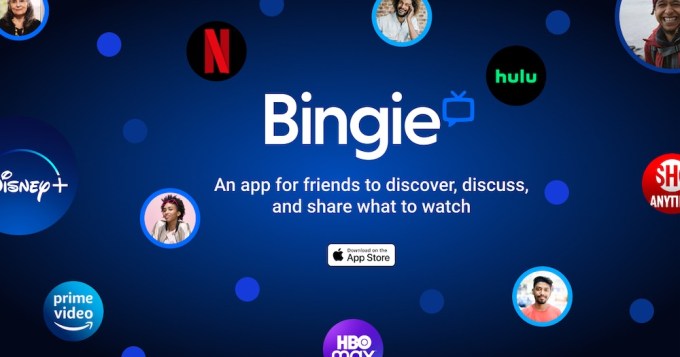
Bingie helps you find new things to watch.

Bingie

Image Credits: Bingie

Bingie aims to turn getting Netflix recommendations from friends into a more structured experience. The app for streamers let them get together with friends to discuss, discover and share recommendations across services. The app looks well-built, but overlooks the fact that not all friend groups share common interests. It would be interesting to see it expand to include fellow fans, like TV Time offers, in a later update. Bingie is free on iOS. Read the full review on TechCrunch.

Firefox Daylight for Android 

Mozilla this week launched Firefox 79 for Android, aka Firefox Daylight, after more than a year of development. The new browser is faster and entirely overhauled, offering a new user interface, Mozilla’s browser engine GeckoView, enhanced tracking protection, a private mode (based on the privacy browser Firefox Focus), a new bookmarking tools, support for add-ons and more.

Flipboard gets into video

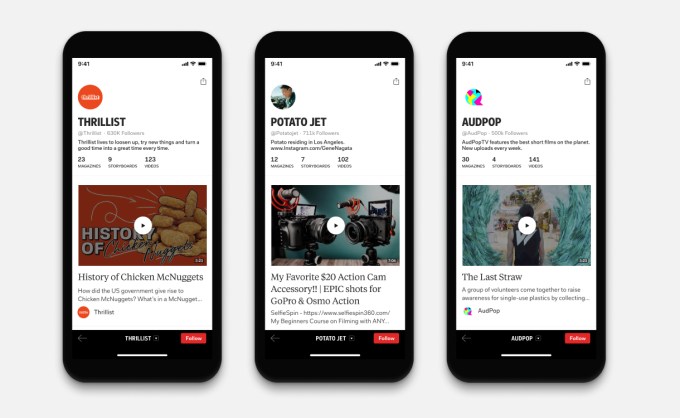
Image Credits: Flipboard

News magazine app Flipboard has been around for years, but its latest update introduces a big change. The app now allows users to follow video content from hundreds of publishers, including national/global news outlets, local news and (carefully vetted) indie producers. Users can even build out their own video-only collections to stay on top of the latest news in the form of video, or they can add video-only feeds into existing magazines. Publishers can also add video to their static round-ups known as Storyboards. Flipboard TV, as the new feature is called, was previously a Samsung exclusive. Now the ad-supported version is available to all.

29 Aug 2020

Walmart-exclusive TrillerTok will run on Azure, or Oracle, or something

If you can’t keep up with the latest rumor mill on TikTok’s impending doom acquisition, my suggestion is simple: don’t. Or instead, enjoy it for what it is: one of the most absurd bakeoff deals in investment banking history.

Walmart and its always low prices are in the fray. Oracle is looking to find synergies to make enterprise resource planning software more enticing to Gen Z workers. Triller — who the hell are they again? — is supposedly teaming up with an asset management firm (and a planet near the Hoth system) called Centricus according to Bloomberg (to which TikTok responded nah). Twitter is in — maybe? — with key corporate strategic advice from Beyoncé on the social network’s debt underwriting strategy.

SoftBank is apparently looking, and also just happened to announce yesterday its intention to sell off $14 billion of its core Japanese mobile services business to net cash quickly. (The upshot is that at least TikTok lost most of its value before SoftBank’s investment!)

Everything here is absurd. TikTok is absurd. The videos of people doing what they are doing on TikTok are absurd. TikTok’s growth is absurd. A president setting a deadline on the sale of a company is absurd. This process is absurd. Selling a company as large as TikTok in 45 days is absurd. Walmart is absurd (and also a mirage, since they are still banned from New York City lest someone gets discounted soap in a pandemic).

I warned a few weeks ago to “beware bankers” peddling TikTok rumors. And that’s still the right answer, in the sense that of course we are going to get to the furthest reaches of the M&A universe as bankers try to salvage TikTok’s final sale price (“We’re approaching the Centricus system, sir!”). But that approach is so much more boring than just assuming that every rumor is true and trying to imagine Wall Street advisors trundling through this morass of bids.

My advice here is simple: let’s all take our analyst hats off for a week and put on our clown costumes, since — and it’s key you don’t work at TikTok for this or have money at stake in the company — this story is actually enjoyable.

COVID-19 is serious, the U.S. presidential election is weeks away, social justice in our cities is critically important. Just in the past few hours, T’Challa passed away, Hurricane Laura ripped up the Gulf Coast, and the longest continuously-serving Japanese prime minister of the post-war era (yes, I know, that’s a lot of qualifiers) just resigned due to health issues. It can get weighty on the front pages of the newspapers these days.

So it’s just nice to know that you can flip to the business pages and get some farce.

Maybe this whole story will eventually turn into the next great business book à la Barbarians at the Gate. But at least the barbarians then knew how to destroy a company with the proper levels of debt leverage. Here, you’ve got the pre-smoldered detritus of a business being bid on by the company that brought us The Greeter.

Whatever this saga brings next (hint: Microsoft buying the company), I’ll just say this: the warmth and cheeriness that TikTok provided millions of teenagers though short videos of awakward dance routines is the same mirth that it provides acerbic financial analysts with a caustic eye on the markets. In what has been a miserable year for all of us, for that small twinkle of amusement, I’m thankful.

29 Aug 2020

Walmart-exclusive TrillerTok will run on Azure, or Oracle, or something

If you can’t keep up with the latest rumor mill on TikTok’s impending doom acquisition, my suggestion is simple: don’t. Or instead, enjoy it for what it is: one of the most absurd bakeoff deals in investment banking history.

Walmart and its always low prices are in the fray. Oracle is looking to find synergies to make enterprise resource planning software more enticing to Gen Z workers. Triller — who the hell are they again? — is supposedly teaming up with an asset management firm (and a planet near the Hoth system) called Centricus according to Bloomberg (to which TikTok responded nah). Twitter is in — maybe? — with key corporate strategic advice from Beyoncé on the social network’s debt underwriting strategy.

SoftBank is apparently looking, and also just happened to announce yesterday its intention to sell off $14 billion of its core Japanese mobile services business to net cash quickly. (The upshot is that at least TikTok lost most of its value before SoftBank’s investment!)

Everything here is absurd. TikTok is absurd. The videos of people doing what they are doing on TikTok are absurd. TikTok’s growth is absurd. A president setting a deadline on the sale of a company is absurd. This process is absurd. Selling a company as large as TikTok in 45 days is absurd. Walmart is absurd (and also a mirage, since they are still banned from New York City lest someone gets discounted soap in a pandemic).

I warned a few weeks ago to “beware bankers” peddling TikTok rumors. And that’s still the right answer, in the sense that of course we are going to get to the furthest reaches of the M&A universe as bankers try to salvage TikTok’s final sale price (“We’re approaching the Centricus system, sir!”). But that approach is so much more boring than just assuming that every rumor is true and trying to imagine Wall Street advisors trundling through this morass of bids.

My advice here is simple: let’s all take our analyst hats off for a week and put on our clown costumes, since — and it’s key you don’t work at TikTok for this or have money at stake in the company — this story is actually enjoyable.

COVID-19 is serious, the U.S. presidential election is weeks away, social justice in our cities is critically important. Just in the past few hours, T’Challa passed away, Hurricane Laura ripped up the Gulf Coast, and the longest continuously-serving Japanese prime minister of the post-war era (yes, I know, that’s a lot of qualifiers) just resigned due to health issues. It can get weighty on the front pages of the newspapers these days.

So it’s just nice to know that you can flip to the business pages and get some farce.

Maybe this whole story will eventually turn into the next great business book à la Barbarians at the Gate. But at least the barbarians then knew how to destroy a company with the proper levels of debt leverage. Here, you’ve got the pre-smoldered detritus of a business being bid on by the company that brought us The Greeter.

Whatever this saga brings next (hint: Microsoft buying the company), I’ll just say this: the warmth and cheeriness that TikTok provided millions of teenagers though short videos of awakward dance routines is the same mirth that it provides acerbic financial analysts with a caustic eye on the markets. In what has been a miserable year for all of us, for that small twinkle of amusement, I’m thankful.

29 Aug 2020

Original Content podcast: Netflix’s ‘High Score’ is a selective tour through video game history

“High Score” is a new Netflix documentary series that looks back at the early years of the video game industry.

Across six episodes, key developers, artists, executives and even players discuss the initial arcade and home console boom, the emergence of Nintendo, the rise of adventure and role-playing games, the battle between Sega and Nintendo, the success and ensuing controversy over fighting games like Mortal Kombat and the development of 3D gameplay in Starfox and Doom.

We review “High Score” on the latest episode of the Original Content podcast, which inevitably leads us to get a little wistful our own relationship with these classic games.

For older gamers, the series provides some pleasant jolts of nostalgia, and it’s also a useful primer for anyone who isn’t familiar with the industry’s history. It also taking time to highlight some lesser-known stories, and it’s full of fun touches, like retro animation illustrated moments that weren’t captured on film.

It’s worth remembering, though, that “High Score” focuses on just a few key figures and a few key games, which means that a number of important developments are ignored or only touched on briefly.

You can listen to our review in the player below, subscribe using Apple Podcasts or find us in your podcast player of choice. If you like the show, please let us know by leaving a review on Apple. You can also follow us on Twitter or send us feedback directly. (Or suggest shows and movies for us to review!)

If you’d like to skip ahead, here’s how the episode breaks down:
0:00 Intro
0:33 “High Score” review

29 Aug 2020

Original Content podcast: Netflix’s ‘High Score’ is a selective tour through video game history

“High Score” is a new Netflix documentary series that looks back at the early years of the video game industry.

Across six episodes, key developers, artists, executives and even players discuss the initial arcade and home console boom, the emergence of Nintendo, the rise of adventure and role-playing games, the battle between Sega and Nintendo, the success and ensuing controversy over fighting games like Mortal Kombat and the development of 3D gameplay in Starfox and Doom.

We review “High Score” on the latest episode of the Original Content podcast, which inevitably leads us to get a little wistful our own relationship with these classic games.

For older gamers, the series provides some pleasant jolts of nostalgia, and it’s also a useful primer for anyone who isn’t familiar with the industry’s history. It also taking time to highlight some lesser-known stories, and it’s full of fun touches, like retro animation illustrated moments that weren’t captured on film.

It’s worth remembering, though, that “High Score” focuses on just a few key figures and a few key games, which means that a number of important developments are ignored or only touched on briefly.

You can listen to our review in the player below, subscribe using Apple Podcasts or find us in your podcast player of choice. If you like the show, please let us know by leaving a review on Apple. You can also follow us on Twitter or send us feedback directly. (Or suggest shows and movies for us to review!)

If you’d like to skip ahead, here’s how the episode breaks down:
0:00 Intro
0:33 “High Score” review

28 Aug 2020

Elon Musk demonstrates Neuralink’s tech live using pigs with surgically-implanted brain monitoring devices

Elon Musk -founded Neuralink has made headlines over the past many years around it efforts to develop a new kind of interface between the human brain and computing devices. On Friday, the company provided a demo of the technology, and Musk kicked off the demo by saying that the purpose of the entire presentation was recruiting – not fundraising or any other kind of promotion.

“We’re not trying to raise money or do anything else, but the the main purpose is to convince great people to come work at Neuralink, and help us bring the product to fruition – make it affordable and reliable and and such that anyone who wants one can have one,” he said.

Musk then went on to say that the reason he wants to make it generally available is that just about everyone will have some kind of neurological problem over time, including memory loss, anxiety, brain damage, depression and a long list of other ailments. Of course, there’s no clear evidence that any of this long list of problems can be quickly and easily ‘solved’ with any one solution, so it’s a bit challenging to see this as a reasonable end goal for the company.

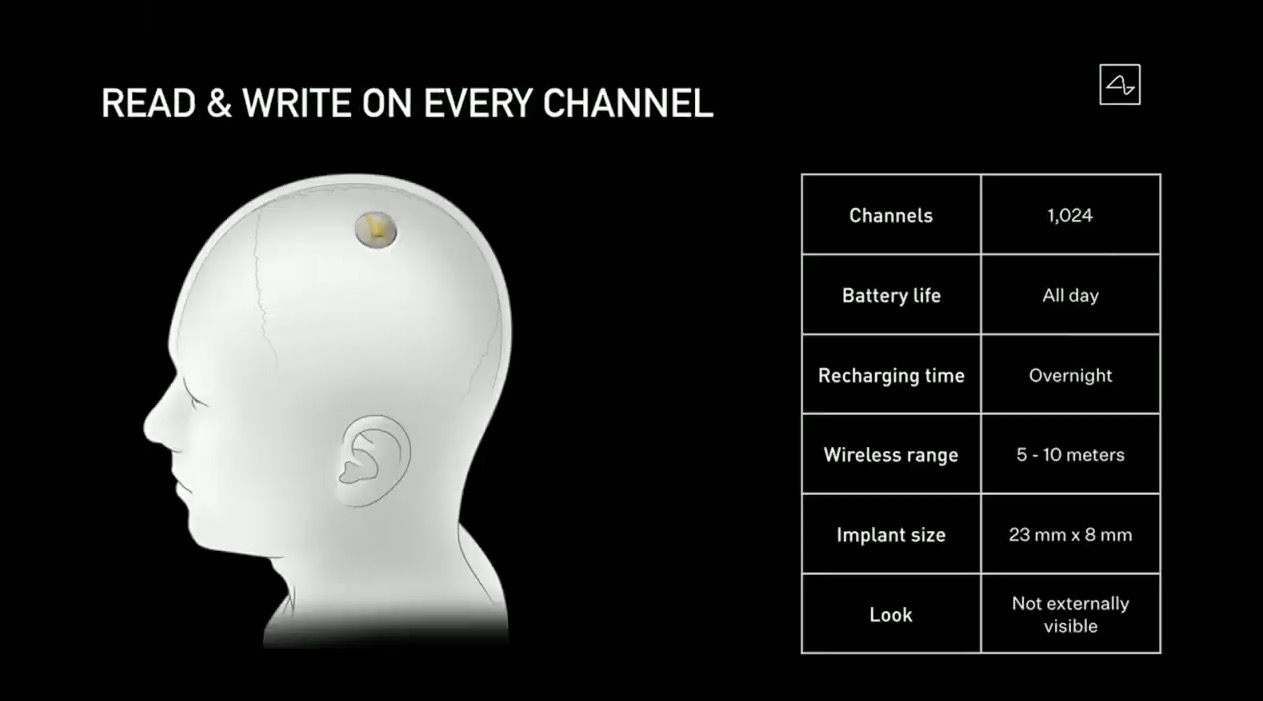
The goal may be ambitious – and definitely subject to a lot of ethical and medical debate – but the technology that Musk actually demonstrated was much less so. Musk first noted that Neuralink had changed design since the reveal last year, with a smaller physical device profile that he said can be fully hidden under hair once installed in the skull. He had a physical device in-hand to show its size.

Image Credits: Neuralink

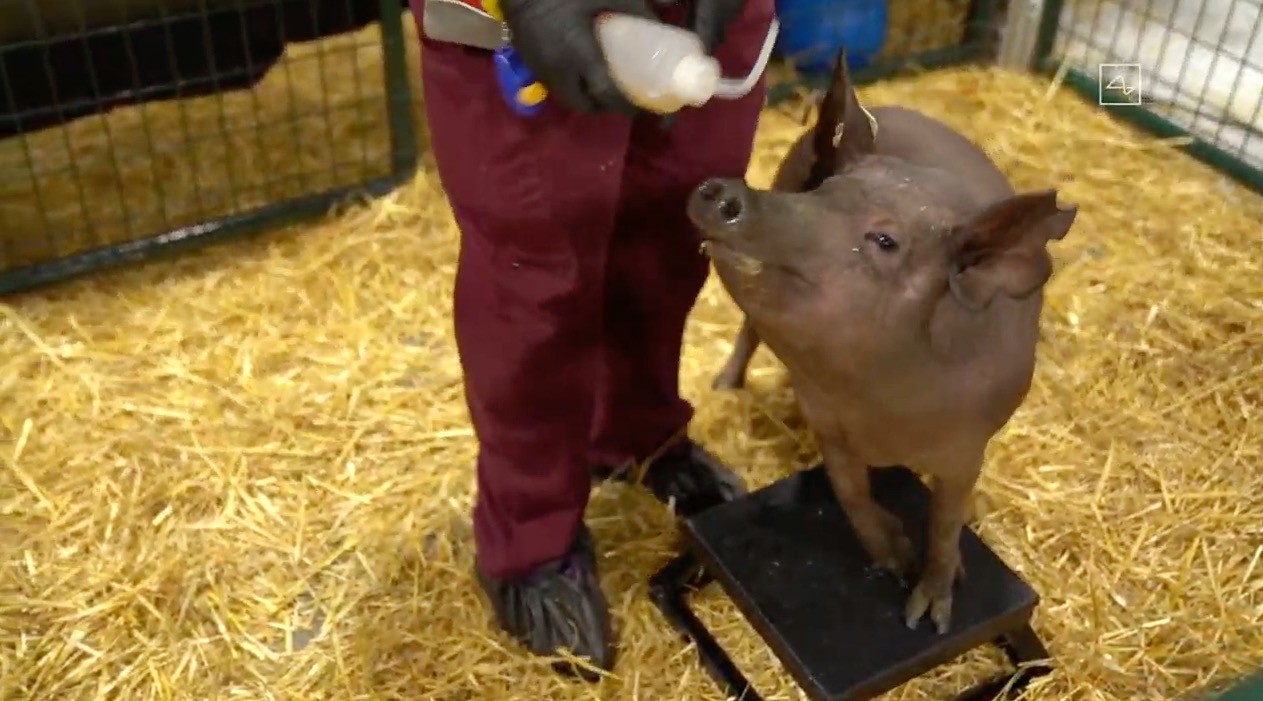
Musk then turned the audience’s attention to three pigs who were in attendance in nearby pens, with handlers nearby. The three pigs were one that was untreated, the second (“Gertrude”) was installed with a Neuralink device, called the ‘Link’,’ and the third had previously had one installed but then subsequently had it removed. Musk at first had trouble coaxing Gertrude to come out and perform for the small, socially-distanced crowd in attendance (who were seated at bar-height tables as if they were at a comedy club). Eventually, however, he skipped Getrude to show that the pig who had her Link removed was very healthy and normal-looking.

Image Credits: Neuralink

Back to Gertrude, Musk showed a display that played a sound and showed a visual spike whenever the Link detected that Gertrude made contact to something with her snout while rooting around for food.

“For the initial device, it’s read/write in every channel with about 1024 channels, all day battery life that recharges overnight and has quite a long range, so you can have the range being to your phone,” Musk said. “I should say that’s kind of an important thing, because this would connect to your phone, and so the the application would be on your phone, and the Link communicating, by essentially Bluetooth low energy to the device in your head.”

Image Credits: Neuralink

Musk closed the prepared portion of the presentation by noting that the company had received a Breakthrough Device designation from the U.S. Food and Drug Administration in July, and that the company is “preparing for first human implantation soon, pending required approvals and further safety testing.”

While the device demonstrated was only a read-device, receiving data from the signals in the pig’s brain, the plan is to provide both read and write capabilities with the goal of being able to address neurological issues as mentioned above. Musk also stressed that why he showed the pig which had had its implant removed safely was because the plan is to provide updates to the hardware over time as better versions become available.

Musk actually referred to the Neuralink devices as a “Fitbit in your skull with tiny wires” at multiple points during the presentation, which actually seems like a pretty dystopian proposition, depending on your perspective. Capabilities he teased eventually include the ability to summon your Tesla with a thought, and video game control interfaces – including complete control of Starcraft. Musk also said in the future he expected people with Link to be able to “save and replay memories,” adding the caveat that “this is obviously sounding increasingly like a black mirror episode, but well, I guess they’re pretty good at predicting.” He even went so far as to say that “you could potentially download [memories] into a robot body.”

The first clinical trial will focus on individuals with paraplegia or tetraplegia, resulting from cervical spinal cord injury. The plan for a first trial is to enroll a “small number” of these individuals in order to test the efficacy and safety of the technology.


[gallery ids="2037762,2037763,2037764,2037765,2037766,2037767,2037768,2037769,2037770,2037771,2037772,2037773,2037777,2037778,2037785,2037784,2037783,2037774,2037786"]

28 Aug 2020

Take a closer look at Elon Musk’s Neuralink surgical robot

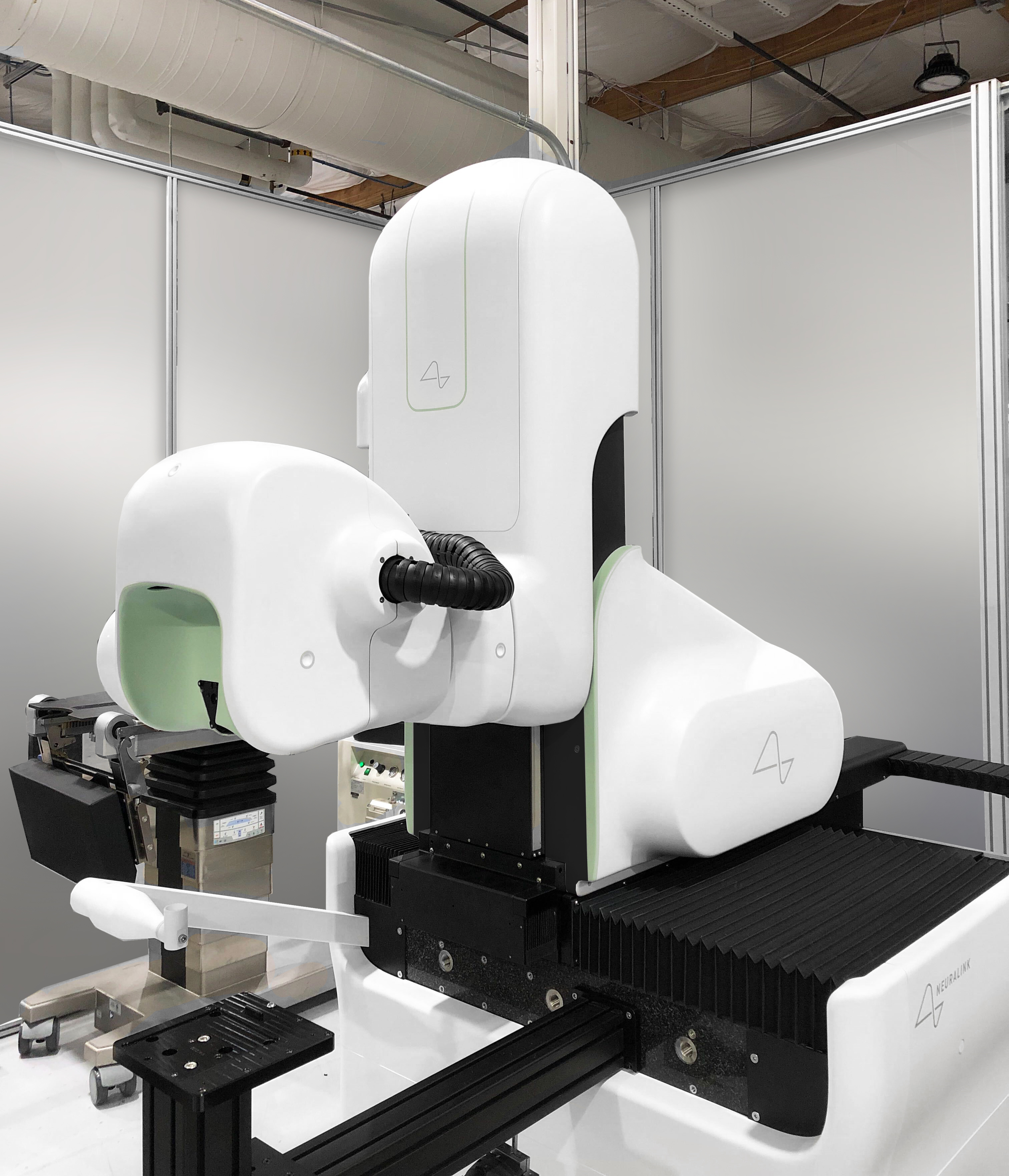
While the science was front-and-center in Elon Musk’s presentation about Neuralink, his human brain computer inference company, the surgical robot the company debuted made a splash of its own. The rounded polycarbonate sci-fi design of the brain surgeon bot looks like something out of the Portal franchise, but it’s actually the creation of Vancouver-based industrial design firm Woke Studio. To be clear, Musk’s engineers and scientists have created the underlying technology, but Woke built the robot’s look and user experience, as well as the behind-the-ear communication end piece that Neuralink has shown in prior presentations.

Neuralink’s bot features clean white (required for ensuring sterility, per Woke), arcing lines and smooth surfaces for a look that at once flags its advanced technical capabilities, but also contains some soothing and more approachable elements, which is wise considering what the machine is intended to do.

“While the patient may not be awake to see the machine in action, it was still important to design a non-intimidating robot that can aesthetically live alongside the iconic machines in Musk’s portfolio,” the company explains in a press release. “It also needed to meet a long list of medical requirements in terms of sterility and maintenance, and provide safe and seamless utilization for its operators.”

Image Credits: Woke Studio

Woke says the Neuralink surgical robot can be separated into three main parts: The head, the body and base. The head of the robot is that helmet-like piece, which actually holds the head of the patient. It also includes a guide for the surgical needle, as well as embedded cameras and sensors to map the patent’s brain. The intent of the design of this piece, which includes a mint-colored interior, is to give the robot “an anthroprmorphic characteristic” that helps distract from the invasive nature of the procedure. There are also single-use disposable bags that line the interior of the helmet for sterile operation.

[gallery ids="2037670,2037663,2037672,2037664,2037671,2037669,2037668,2037667"]

The Neuralink robot also has a “body,” that humped rear assembly, which includes all the parts responsible for the motion of the robot as it sets up from the procedure. The third element is the base, which basically keeps the whole thing from tipping over, and apparently also contains the computing brains of the brain-bot itself.

Neuralink is an Elon Musk-founded company that’s seeking to mitigate what Musk sees as a potential existential threat to human life: The ascendancy of general artificial intelligence. While its near-term goals are aimed at helping address medical conditions incurred by damage to brain tissue, Musk ultimately hopes that Neuralink will be able to help humans keep up with advanced AI by providing them with a latency-free, direct high-bandwidth connection to their computers – using direct thought input.