Year: 2020

20 Aug 2020

Rocket launch in November will test Purdue-developed drag sail that aims to reduce orbital debris

When space launch startup Firefly’s first planned orbital flight takes off in November, it’ll carry an experimental payload developed by engineers from Purdue University: A drag sail that’s designed to haul a rocket back to Earth once it’s fulfilled its mission and deployed its cargo. Safely deorbiting a spent launch vehicle would mean one less large piece of flotsam circling the globe in an increasingly high-traffic orbital area.

Most launch vehicles do safely de-orbit on their own – eventually. But that can take up to a hundred years for rocket stages. Increasingly, spacecraft like satellites are also building in propulsion systems to actively de-orbit at end-of-life, but any time you put an active propellant system on a craft designed to operate in space, that means you need to make space for both the propulsion system and propellant, both of which take up space which means added cost for launch, and less room on the satellite for instrumentation and other mission-critical payloads.

As Purdue points out, propellant-based active propulsion systems also require that a spacecraft is operational in order for them to work. A drag parachute, conversely, is effectively a passive measure that can be triggered via fail-safe to de-orbit even a disabled spacecraft.

A drag sail works by creating drag, reducing the orbital velocity of a launch vehicle or spacecraft much more quickly than would occur without any assistance. Objects orbiting Earth in space are only able to maintain those orbits because they’re moving at very high speeds, which in turn means they can counter the effect of Earth’s gravity, which is continually pulling them back down towards the surface, even beyond Earth’s atmosphere.

The experimental drag sail, called Spinnaker3, spans 194 square feet when unfurled, and is a prototype that is designed to eventually form the basis of a while line of drag sail products to be commercialized by Vestigo Airspace, a startup company founded by Purdue adjust associate professor David Spencer. Eventually, small sats and launch craft equipped with drag sails like these could help ensure that despite increased launch activity in Earth’s orbit, the existing traffic problem isn’t exacerbated anywhere near as much as it would otherwise.

20 Aug 2020

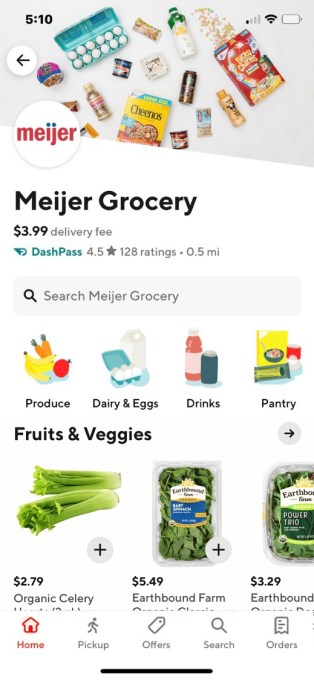
DoorDash expands with on-demand grocery delivery

DoorDash is announcing that customers can now order groceries through the DoorDash app from partners including Smart & Final, Meijer and Fresh Thyme. Additional stores like Hy-vee and Gristedes/D’Agnostino are supposed to be added in the next few weeks.

Through these partnerships, DoorDash says it has a delivery footprint covering 75 million Americans in markets like the San Francisco Bay Area, Los Angeles, Orange County, Sacramento, San Diego, Chicago, Cincinnati, Milwaukee, Detroit and Indianapolis.

DoorDash began delivering from a wide range of convenience stores earlier this year. Fuad Hannon, the company’s head of new verticals, also noted that a number of grocery stores are already part of the DoorDash Drive program, a white-label service where DoorDash handles last-mile delivery.

So Hannon said introducing grocery delivery into the DoorDash app itself is a “natural extension” of those efforts. And in contrast to many other grocery services, the company promises to deliver within an hour of your order.

“There’s no scheduling, no delivery slots, no day-long waits,” he said.

To achieve this, Hannon said DoorDash has created “deep partnerships and commercial relationships” with the grocery stores, coordinating on things like inventory management. “Embedded shoppers” hired from a staffing agency handle the shopping in each store, and the groceries are then delivered by DoorDash’s Dashers.

Meijer DoorDash

Image Credits: DoorDash

Hannon said these deliveries will be handled by “the same pool of Dashers” as restaurant delivery. Individual Dashers will decide for themselves when and if they want to take on groceries as well, but he argued that this provides a new opportunity for them, particularly between mealtimes when there’s not much demand for restaurant delivery.

Asked whether there’s any tension with grocery stores in the Drive program who may prefer bringing in customers through their own websites and apps, Hannon argued that customers in the DoorDash app represent “largely different users,” and he said the company is “philosophically agnostic” about whether customers are making purchases through the grocery store’s website/app or through DoorDash.

“DoorDash provides another convenient way for customers to get the value, selection and quality that Smart & Final offers, especially at a time when some are looking to limit trips outside their homes,” said Navin Cotton, Smart & Final’s director of digital commerce, in a statement. “DoorDash’s on-demand grocery service is a nice addition to our online shopping options and with delivery in under an hour, we know Smart & Final customers are going to appreciate it.”

Grocery prices are set by the merchant and should be the same as what you’d find in-store, Hannon said, though perhaps without buy-one-get-one-free offers and others in-store deals. These deliveries are also included in the company’s DashPass subscription, which offers free delivery and reduced service fees.

DoorDash is also offering prepared meals from a longer list of grocery partners, including Wegmans, Hy-Vee, Gelson’s, Kowalski’s, Big Y World Class Markets, Food City, Village Supermarkets, Save Mart, Lucky, Lucky California and Coborn’s.

20 Aug 2020

AI as a blueprint for fintech startups

While most startup founders would prefer not to pore over laws, regulations and interpretive materials to design a perfect product, it’s an essential exercise for those developing financial services solutions. For fintechs and the other finserv-related startups (e.g., regtech, suptech, etc.) understanding the regulatory obligations of customers and prospects will be core to your mission. In some cases, the process of interpretation and analysis might be a heavy lift involving expert outside counsel, lobbying efforts, and specialized consulting services.

A complicating factor for any fintech looking to solidify its understanding of regulatory paradigms is the gray area where regulators have issued cursory guidance, or no guidance at all. One gray-ish realm where financial services regulators have shown interest, but are largely treading lightly, has been offering guidance about the use of artificial intelligence (“AI”). However, a few regulators are now applying institutional and intellectual rigor to the subject given its use in almost every aspect of banking and finance.

In June, the Financial Industry Regulatory Authority’s (“FINRA”) Office of Financial Innovation issued a report called “Artificial Intelligence in the Securities Industry.”1 FINRA is the self-regulatory organization responsible for oversight of broker-dealers in the United States — in simpler terms, it regulates the big and small brokerage firms that offer financial advice. FINRA has consistently been one of the more technologically engaged regulators — in 2018 they solicited industry comments on AI, which led to the report, and produced reports on the use of regulatory technology and selected cybersecurity practices. (The U.K.’s FCA as well as the CFTC in the U.S. have also been key boosters for innovation in financial services, including the use of AI.)

FINRA’s AI Report is particularly interesting for fintechs since it explores how firms (read: fintech clients) are deploying AI as well as the agency’s expectations for AI oversight. Fintechs can use this report as a blueprint — identifying areas for potential AI product growth and as a guidepost for the regulatory and operational concerns that firms, and by extension fintechs themselves, must manage when implementing AI.

20 Aug 2020

Cobalt.io grabs $29M Series B to continue building out pentesting platform

The promise of SaaS has always been about taking tedious, expensive manual tasks and finding a way to build a platform to automate them. Cobalt.io is doing that with pentesting, the process of testing an application for security vulnerabilities before it goes out the door. Today, the startup announced a $29 million Series B led by Highland Europe.

The company’s platform provides a way to move beyond traditional pentesting consultancies to connect pentesting professionals with companies who need their services. Beyond being a pure employment connection platform, the reports those pros generate, and the issues that need to be fixed get incorporated into the tools developers are using like Jira to help resolve them in the their existing workflow.

Cobalt CEO Jacob Hansen says the company began fundraising at the beginning of the year, just as the pandemic was beginning to take hold in Europe. He saw a lot of those discussions wither as some firms simply stopped investing, but he eventually hooked up with Highland Europe after a strong Q1 and Q2 where the company actually became cash flow positive, an unusual achievement for a startup at this stage.

The company also has 600 customers on the platform and Hansen projects it will be up to 900 by the end of the year. These customers buy a certain number of pentest credits on a subscription basis, based on the number of programs they need to test and the cadence of their testing. So as an example, a company with 4 applications might buy 8 credits to test twice a year.

Hansen says that the company’s retention numbers are comparable with other SaaS businesses. “If you’re a mid-enterprise or enterprise customer we’re at around 120% net dollar retention. And if it’s an SMB below a couple hundred employees, then we’re just below 100%,” he said. He pointed out that small businesses have been particularly hard hit by the pandemic, which probably has had an impact on that number.

The company started the year with 100 employees. Today, it has 105, choosing to keep it lean until it saw how COVID would affect the business, but the plan is to accelerate now with the new capital moving to 150 this year and 200 by next year.

When it comes to building a diverse workforce, Hansen says Chief Strategy Officer Caroline Wong is in charge of the company’s diversity efforts. He admits there is no formula for success, but you obviously know when your company isn’t diverse.

“It’s difficult to measure what success is, other than you don’t want everybody to be the same, but one thing that I’ve tried to do is to build a leadership team with people who have a lot of different perspectives,” he said. The other thing he says, is he tries to make decisions with the understanding of his own privilege through his upbringing in Denmark.

As the company grows, he wants to put more resources into engineering with the goal of making the process of signing up, getting a subscription and using the service to be even simpler. Hansen also hopes to build many more integrations into the platform with the broader applications security ecosystem.

The company was founded in 2013 and has raised $37 million with today’s investment, according to Crunchbase data. As part of the terms of this deal, Highland’s Gajan Rajanathan will be joining the board.

20 Aug 2020

CrunchMatch supercharges virtual networking at TC Sessions: Mobility 2020

Ready for our first virtual TC Sessions Mobility 2020? As we like to say, it’s not just one long webinar. We’re creating the quality production levels you’d expect from our IRL events (thanks, technology). This session spans two days — October 6-7 — to give you more time to take in the speakers, the interviews, the trends and the world-class networking.

We even overhauled CrunchMatch, our AI-powered networking platform, to help bridge the physical distance of a virtual conference. The platform helps you connect and schedule 1:1 video meetings with the people who align with your business goals. Who’s at the top your must-meet list? Investors, founders, engineers, R&D teams, manufacturing mavens, supply-chain experts? An upgraded algorithm makes matching and recommendations faster and more precise — and the more you use CrunchMatch the smarter it gets.

When you register for TC Sessions: Mobility 2020, you’ll answer a few quick questions about your business preferences, and within minutes you’ll be automatically registered for CrunchMatch — and receive an email telling you how and when to access the platform. It’s the tool you want to make your networking more targeted and efficient.

“The CrunchMatch platform, which is basically speed-dating for techies, was very helpful. I scheduled at least 10 short, precise meetings. I learned about startups in stealth mode, what big corporations were up to — things not yet picked up by the press. It was great, and I followed up on three or four of those connections.” — Jens Lehmann, technical lead and product manager, SAP.

We’ve built networking right into the Mobility agenda, so you won’t suffer from acute FOMO. Here’s just a taste of what we have planned.

  • The Next Opportunities in Micromobility: Worldwide, numerous companies are operating shared micromobility services — so many that the industry is well into a consolidation phase. Despite the over-saturation of the market, there are still opportunities for new players. Dor Levi, head of bikes and scooters at Lyft, Danielle Harris, director of mobility innovation at Elemental Excelerator and Dmitry Shevelenko, founder at Tortoise will discuss.
  • Investing in Mobility: Reilly Brennan, Amy Gu and Olaf Sakkers will come together to debate the uncertain future of mobility tech and whether VC dollars are enough to push the industry forward.

Want to save some cash? Buy your TC Sessions: Mobility 2020 early-bird pass before prices go up on September 4 at 11:59 pm PT. Then get your networking on with CrunchMatch and drive (autonomously, or otherwise) your mobility business to the next level.

Is your company interested in sponsoring or exhibiting at TC Sessions: Mobility 2020? Contact our sponsorship sales team by filling out this form.

20 Aug 2020

Humanity Inc. raises funding to allow us to monitor and affect our rate of aging

Most of us are now familiar with apps that track what’s known as our ‘digital biomarkers’. These include the steps, we’ve taken, our heart rate, and our weight. In recent years startups have appeared which can, in a relatively turnkey manner, track our ‘biomedical markers’, such as cholesterol levels, for instance. Few, however, are seeking to combine the two to get a 360-degree view of how our bodies are doing.

Into this gap steps Humanity Inc., which will seek to do exactly that. Founded by two seasoned entrepreneurs, Humanity will combine digital and biomedical biomarkers into a consumer app that will fully launch next year.

Today it announces it’s initial seed fundraise of $2.5m, in a round led by Boston fund One Way Ventures and the legendary and long-time HealthTech Angel investor Esther Dyson, among others.

Serial entrepreneurs Peter Ward (who co-founded early social network WAYN) and Michael Geer (formerly of Badoo) are aiming to “help humanity live healthier, longer lives” with a health and longevity company that will leverage AI to maximize people’s healthspan.

Their aim is to give users the ability to monitor their ‘actual rate of aging’ and show them which actions are working or not working, and how they can even potentially reverse the aging process.

They are attracting some leading names from the world of genetics and the science of aging, including George Church and Aubrey de Grey, to their ‘Science Advisory Board’.

De Grey is best known for co-founding the Methuselah Foundation, which runs the Methuselah Mouse Prize in search of anti-aging technologies.

In a statement, de Grey commented: “The scientists of the world are focusing more and more on aging science, which is thankfully accelerating breakthroughs exponentially. However, we still need better vehicles to deliver these discoveries directly to the people. That is what Humanity is poised to do and why I am so excited to support them on this mission.”

Semyon Dukach, the managing partner of Humanity’s lead investor One Way Ventures, said: “We’re proud to be leading this round and backing this extraordinary team, along with a number of other great investors including leading funds and angels in the consumer tech and health space. We believe in the Humanity mission and clearly the timing could not be better for people to get access to such a product.”

Ward added: “Many people feel helpless when it comes to avoiding disease and slowing down the aging process. In the COVID-19 world, where we all now clearly understand that risk increases significantly with age and poor health, people’s number one question is, rightly, ‘what actions can I take each day to stay healthy and for much longer?”

Geer said: “People have never had an accurate clear feedback loop to help them know whether what they’re doing to be healthier was really working or not. We want to finally give them that superpower.”

Humanity is currently testing its Alpha product on ‘a few hundred users’ and claims to have ‘thousands’ waiting to gain early access. The app will launch in the UK and the US in early 2021, followed by a global rollout in 2022.

20 Aug 2020

Acquiring Wetform, Ecobot offers software and services for the $10 billion wetland environmental survey business

Any time you’re moving dirt you have to have somebody come in and assess it, whether that’s under a state or federal jurisdiction… because of the waters that are present,” says Ecobot co-founder and chief executive, Lee Lance. “It has been a pen and paper process since the Clean Water Act about two decades ago.”

Those assessments amount to a $10 billion industry in wetland environmental impact studies alone, according to Lance. There are actually very few ways to track how much is spent on these environmental assessments, according to a 2014 study from the Government Accountability Office, there’s little oversight or research into the environmental impact surveys or environmental assessments. However, cost estimates for the impact surveys range from $250,000 to $2 million.

It’s in this little known corner of the development and construction business, that Ecobot is looking to make a splash. The company has acquired another company active in the market, called Wetform, and is now hoping to aggressively expand beyond its base in North Carolina.

Ecobot already has 56 customers, according to Lance, and he says that it’s solving the biggest bottleneck in the process, the cost and duration of conducting these environmental surveys and assessments.

“We’re saving employees two-and-a-half hours per-person per-day in the field and what used to be thirty hours of office work is now down to 45 minutes,” says Lance.

Lance estimates that an assessment on a large project can cost up to $1.25 million and that Ecobot’s software can save project developers on the order of $50,000 per day.

Ecobot has already received some backing from investors who see value in the company’s software. It raised roughly $1.1 million from investors in North Carolina led by Cofounders Capital, a Cary, NC-based investment firm.

The company first raised money back in 2018 when Lance and his co-founder Jeremy Shewe, a professional wetlands scientist, met through a mutual friend. Lance had been running a small software development shop in that did projects for regional customers and began talking with Shewe about opportunities.

“I thought maybe this would make an interesting project, but very quickly saw an opportunity for the whole business,” Lance said.

A self-professed student of Jason Lemkin’s model of nail a niche and focus on a sector before expanding into ancillary areas, Lance said that there’s a big market out there that’s relatively untouched by software providers. The 200 largest companies in engineering consulting represent a $60 billion market in the US alone, he said. And that’s the market that Ecobot is hoping to capture.

20 Aug 2020

Patient engagement startup raises $15 million from Google’s Gradient Ventures

Klara, a New York-based healthcare startup that pitches itself as a better tool for patient engagement for doctor’s offices and other clinical practices, has raised $15 million in new financing. 

The money comes as investors continue to pour cash into companies developing new communications, diagnostics and management tools for medical offices as patients look for more virtual care options.

For Simon Bolz and his co-founder Simon Lorenz the aspect of Klara’s business that differentiates it from its many, many competitors is the company’s emphasis on putting patient communications at the center of its user interface.

“The other products, maybe they started with intake or payments and they added messaging as an add-on. Building it that way, like others do, is not the most engaging way,” says Bolz.

Klara focuses on independent practices and practice groups beginning with dermatologists, but the company’s services work with any medical practice.

Integrations with EHRs and communication history are table stakes for most patient engagement services these days and Klara offers those. The company works through a portal on a mobile web browser. Patients are sent a link via text and then interact with the service via text messaging.

It’s that text messaging component that attracted Google’s Gradient Ventures, according to Bolz. The company wants to automate more and more of the medical process and is going to rely on natural language processing technologies to do it.

“We are going more and more into automation. We have started to automate a lot of these processes. Integrating with EHRs and practice management systems,” Bolz said. 

Darian Shirazi, a general partner at Gradient Ventures, and Navid Farzad, a partner at Frist Cressey Ventures, will both take seats on the Klara board.

“The traditional physician practice must transform to improve communication and engagement with their patients — especially in a post-COVID world. Existing practice technology infrastructure is inadequate. Klara’s seamless solution modernizes the practice infrastructure without disrupting workflows.” said Navid Farzad from Frist Cressey Ventures, in a statement.

20 Aug 2020

Further delay to GDPR enforcement of 2018 Twitter breach

Twitter users have to wait to longer to find out what penalties, if any, the platform faces under the European Union’s General Data Protection Regulation (GDPR) for a data breach that dates back around two years.

In the meanwhile the platform has continued to suffer security failures — including, just last month, when hackers gained control of scores of verified accounts and tweeted out a crypto scam.

The tech firm’s lead regulator in the region, Ireland’s Data Protection Commission (DPC), began investigating an earlier Twitter breach in November 2018 — completing the probe earlier this year and submitting a draft decision to other EU DPAs for review in May, just ahead of the second anniversary of the GDPR’s application.

In a statement on the development, Graham Doyle, the DPC’s deputy commissioner, told TechCrunch: “The Irish Data Protection Commission (DPC) issued a draft decision to other Concerned Supervisory Authorities (CSAs) on 22 May 2020, in relation to this inquiry into Twitter. A number of objections were raised by CSAs and the DPC engaged in a consultation process with them. However, following consultation a number of objections were maintained and the DPC has now referred the matter to the European Data Protection Board (EDPB) under Article 65 of the GDPR.”

Under the regulation’s one-stop-shop mechanism, cross-border cases are handled by a lead regulator — typically where the business has established its regional base. For many tech companies that means Ireland, so the DPC has an oversized role in the regulation of Silicon Valley’s handling of people’s data.

This means it now has a huge backlog of highly anticipated complaints relating to tech giants including Apple, Facebook, Google, LinkedIn and indeed Twitter. The regulator also continues to face criticism for not yet ‘getting it over the line’ in any of these complaints and investigations pertaining to big tech. So the Twitter breach case is being especially closely watched as it looks set to be the Irish DPC’s first enforcement decision in a cross-border GDPR case.

Last year commissioner Helen Dixon said the first of these decisions would be coming “early” in 2020. In the event, we’re past the halfway mark of the year with still no enforcement to show for it. Though the DPC emphasizes the need to follow due process to ensure final decisions stand up to any challenge.

The latest delay in the Twitter case is a consequence of disagreements between the DPC and other regional watchdogs which, under the rules of GDPR, have a right to raise objections on a draft decision where users in their countries are also affected.

It’s not clear what specific objections have been raised to the DPC’s draft Twitter decision, or indeed what Ireland’s regulator has decided in what should be a relatively straightforward case, given it’s a breach — not a complaint about a core element of a data-mining business model.

Far more complex complaints are still sitting on the DPC’s desk. Doyle confirmed that a complaint pertaining to WhatsApp’s legal basis for sharing user data with Facebook remains the next most progressed in the stack, for example.

So, given the DPC’s Twitter breach draft decision hasn’t been universally accepted by Europe’s data watchdogs it’s all but inevitable Facebook -WhatsApp will go through the same objections process. Ergo, expect more delays.

Article 65 of the GDPR sets out a process for handling objections on draft decisions. It allows for one month for DPAs to reach a two-thirds majority, with the possibility for a further extension of another month — which would push a decision on the Twitter case into late October.

If there’s still not enough votes in favor at that point, a further two weeks are allowed for EDPB members to reach a simple majority. If DPAs are still split the Board chair, currently Andrea Jelinek, has the deciding vote. So the body’s role in major decisions over big tech looks set to be very key.

We’ve reached out to the EDPB with questions related to the Twitter objections and will update this report with any response.

The Article 65 process exists to try to find consensus across a patchwork of national and regional data supervisors. But it won’t silence critics who argue the GDPR is not able to be applied fast enough to uphold EU citizens’ rights in the face of fast-iterating data-mining giants.

To wit: Given the latest developments, a final decision on the Twitter breach could be delayed until November — a full two years after the investigation began.

Earlier this summer a two-year review of GDPR by the European Commission, meanwhile, highlighted a lack of uniformly vigorous enforcement. Though commissioners signalled a willingness to wait and see how the one-stop-shop mechanism runs its course on cross-border cases, while admitting there’s a need to reinforce cooperation and co-ordination on cross border issues.

“We need to be sure that it’s possible for all the national authorities to work together. And in the network of national authorities it’s the case — and with the Board [EDPB] it’s possible to organize that. So we’ll continue to work on it,” justice commissioner, Didier Reynders, said in June.

“The best answer will be a decision from the Irish data protection authority about important cases,” he added then.


20 Aug 2020

Moon lander startup ispace raises $28 million and launches a new lunar data platform

ispace, one of the startups working on putting a private lunar lander on the Moon sometime in the next few years has raised a $28 million Series B funding round, which will be used to help it continue to develop its commercial lander ahead of planned 2022 and 2023 launches. Alongside the investment, the Japanese startup is also announcing a new data platform business that will leverage the lunar data it will collect to provide other companies, space agencies, research organizations and more with an informed basis for planning their own Moon missions and eventual lunar commercial developments.

The $28 million Series B, which was led by IF SPV 1st Investment Partnership (through Incubate Fund), and includes funding by Space Frontier Fund (a fund whose LPs include Toyota, Mizuho Bank and more), Takasago Thermal Engineering Co and Mitsui Sumitomo, brings the startup’s total funding to date to $125 million. The funds will also be used to help ispace develop a larger version of its HAKUTO-R lunar lander, which is set to be put into use for the company’s third and following Moon missions.

The lunar data business that ispace is developing, which is called ‘Blueprint Moon,’ anticipates increasing investment in human presence on and near the Moon. The commercialization of space thus far has focused on Earth’s own orbital environment, but with NASA planning a spate of lunar missions, as well as an orbital lunar space station and sustained human surface activities, as well as interest and investment from many other space agencies globally.

ispace has managed to attract a lot of strategic commercial partners already to support its lander program, including Takasago Thermal, which will be testing its own electrolysis tech on the Moon on a future mission with ispace, and Mitsui Sumitomo, which is creating a lunar insurance product that will be able to underwrite future commercial Moon missions. Blueprint Moon will use existing publicly available lunar data, along with information collected on future ispace surface missions, to help other businesses and agencies create similar business, research and exploration opportunities in the future, while also generating more near-term revenue for the startup as it continues to focus on its more ambitious launches.