Year: 2020

19 Aug 2020

Just what would an enterprise company like Microsoft or Oracle do with TikTok?

By now you’ve probably heard that under pressure from the current administration, TikTok owner ByteDance is putting the viral video service up for sale, and surprisingly a couple of big name enterprise companies are interested. These organizations are better known for the kind of tech that would bore the average TikTok user to tears. Yet, stories have persisted that Microsoft and even Oracle are sniffing around the video social network.

As TechCrunch’s Danny Crichton pointed out last week, bankers involved in the sale have a lot of motivation to leak rumors to the press to drive up the price of TikTok. That means none of this might be true, yet the rumors aren’t going away. It begs the question why would a company like Oracle or Microsoft be interested in a property like TikTok?

For starters, Oracle is a lot more than the database company it was known for in the past. These days, it has its fingers in many, many pies including marketing automation and cloud infrastructure services. In April, as the pandemic was just beginning to heat up, Zoom surprised just about everyone when it announced a partnership with Oracle’s cloud arm.

Oracle isn’t really even on the board when it comes to cloud infrastructure market share, where it is well behind rivals AWS, Microsoft, Google, Alibaba and IBM, wallowing somewhere in single digit market share. Oracle wants to be a bigger player.

Meanwhile, Microsoft has successfully transitioned to the cloud as well as any company, but still remains far behind AWS in the cloud infrastructure market. It wants to close the gap with AWS and owning TikTok could get it closer to that goal faster.

Simply put, says Holger Mueller, an analyst at Constellation Research, if Oracle combined Zoom and TikTok, it could have itself a couple of nice anchor clients. Yes, like the proverbial mall trying to attract Target and Nordstrom, apparently Oracle wants to do the same with its cloud service, and if it has to buy the tenant, so be it.

“TikTok will add plenty of load to their infrastructure service. That’s what matters to them with viral loads preferred. If Microsoft gets TikTok it could boost their usage by between 2% and 5%, while for Oracle it could be as much 10%,” he said. He says the difference is that Oracle has a much smaller user base now, so it would relatively boost its usage all the more.

As Mueller points out with the government helping push TikTok’s owner to make the sale, it’s a huge opportunity for a company like Oracle or Microsoft, and why the rumors have weight. “It’s very plausible from a cloud business perspective, and plausible from a business opportunity perspective created by the US government,” he said.

While it could make sense to attract a large user base to your systems to drive up usage and market share in that way, Brent Leary, founder and principal analyst at CRM Essentials, says that just by having a large U.S. tech company buy the video app, it could make it less attractive to the very users Microsoft or Oracle is hoping to capture.

“An old guard enterprise tech company buying Tiktok would likely lessen the appeal of current users. Younger people are already leaving Facebook because the old folks have taken it over,” Leary said. And that could mean young users, who are boosting the platform’s stats today could jump ship to whatever is the next big social phenomenon.

It’s worth pointing out that just today, the president indicated support for Oracle, according to a Wall Street Journal report. The publication also reported that Oracle’s billionaire owner Larry Ellison is a big supporter of the president, having thrown him a fundraiser for his reelection bid at his house earlier this year. Oracle CEO Safra Catz also has ties to the administration, having served on the transition team in 2016.

It’s unclear whether these companies have a genuine interest, but the general feeling is someone is going to buy the service, and whoever does could get a big boost in users simply by using some percentage of their cash hordes to get there. By the way, another company with reported interest is Twitter. Certainly putting the two social platforms together could create a mega platform to compete more directly with Facebook.

You might see other big names trying to boost cloud infrastructure usage like IBM or Google enter the fray.  Perhaps even Amazon could make an offer to cement its lead, although if the deal has to go through the federal government, that makes it less likely given the tense relationship between Amazon CEO Jeff Bezos and the president that surfaced during the Pentagon JEDI cloud contract drama.

Apple has already indicated that in spite of having the largest cash on hand of any company with over $193 billion, give or take, it apparently isn’t interested.  Apple may not be, but somebody surely is, even some companies you couldn’t imagine owning a property like this.


19 Aug 2020

Lucid’s new all-electric sedan will let owners send energy to their homes by mid-2021

Lucid Motors said Wednesday that its upcoming all-electric Air sedan will have fast-charging capability that will let owners add 300 miles of range to the battery in 20 minutes and a home-charging unit that will allow owners to send energy from their car to their home.

Lucid said it is able to hit this benchmark because the vehicle has a 900-volt electrical architecture that when combined with its lithium-ion cells, battery and thermal management system and powertrain efficiency. Most electric vehicles — with the exception of the Porsche Taycan and future Kia EVs—  have a 400-volt architecture.

There are limitations to this speedy charging; a driver would need to access the correct DC fast charger, which are not exactly abundant at the moment. However, this capability does check an important box for EV owners. While the Lucid Air will have an eye-popping range of more than 500 miles — if its estimates are verified by EPA — the fast charging capability helps remove any lingering range anxiety and make long-distance travel more desirable.

The company revealed a number of other details surrounding charging, including that the Air will use the universal CCS (combined charging system) connector standard, which makes it compatible to public chargers. The vehicle will have a peak charging rate of over 300kW and a 19.2kW AC onboard charger that can support AC charging speeds up to 80 miles per hour.

Lucid also announced a partnership with Electrify America, VW Group’s U.S.-based charging network. Owners of the Air will be given three years of free charging at Electrify America chargers, which includes DC fast charging.

Lucid also has built out a number of home-based charging features, including a partnership with Qmerit on installation of its connected home charging station. But perhaps the most interesting feature is that Lucid has built in “vehicle-to-everything” charging capabilities into the Air and home charging unit. This means that the vehicle will be able to execute bi-directional charging between vehicles and even from the Air back to the owner’s home. Lucid specifically mentioned that it would allow owners to provide a temporary energy reserve for their homes, including “off grid vacation properties,” a weirdly specific detail that must be popular with the luxury EV owner demographic. Lucid told TechCrunch that this capability will become available in mid 2021.

Lucid said it also plans to repurpose older batteries for energy storage. The first prototype is already installed at Lucid’s Silicon Valley headquarters, where a team is working on producing a range of energy storage products.

19 Aug 2020

NOAA and World View partner on stratospheric composition research

Arizona -based high-altitude balloon startup World View has a new partnership with the National Oceanic and Atmospheric Administration (NOAA) to help the latter collect data to help it deepen its study of the Earth’s stratosphere, the second layer of the Earth’s atmosphere that spans between 4.3 and 12 miles above the surface depending on where you are in the world.

NOAA will be sending up miniaturized instrument hardware that can measure atmospheric particles, or aerosols, in the stratosphere. Studying these can help scientists better understand how the atmospheric layer, and the ozone e that it contains, and human impact on both can affect the transmission of ultraviolet radiation and what kind of chemical interactions are incurring that could present a risk to humans on the surface.

World View’s ‘Stratollites’ balloons will be able to host these instruments at altitudes higher than 55,000 feet (over 10 miles) above the Earth, for trips that can span multiple weeks at a time. Traditional NOAA research has relied on sensors carried by weather balloons, and aircraft, which can’t make those kinds of long-duration data-gathering excursions; or on satellites, which operate at a completely different altitude and can’t provide the same quality of data as an an instrument actually located within the stratosphere itself.

To get a sense of what kind of difference NOAA could realize from using World View’s stratollites, consider that the Administration says that while current weather balloon flights provide around 11 days’ worth of data from a full year of flights, while just a single flight of World View’s vehicle could provide 40 days’ worth of data.

The first Wold View and NOAA flights should take place sometime next year, and the data gathered from the excursions will be made available to the public for general research use after a period of six months, as is standard for the agency.

19 Aug 2020

Twitter claims increased enforcement of hate speech and abuse policies in last half of 2019

Twitter has given its biannual transparency reports a new home with today’s launch of the Twitter Transparency Center, which the company says was designed to make the reporting more easily understood and accessible. The launch was timed alongside the belated release of Twitter’s latest transparency report covering the second half of 2019. The company attributed the delay to the COVID-19 health crisis and its work in getting the new Transparency Center up and running. The report touts Twitter’s increasing efforts in enforcing its policies, including a 95% increase in accounts actioned for violating its abuse policy, a 47% increase in account locks and suspensions, and a 54% increase in accounts actioned for violating hateful conduct policies, among others.

The company claims its ability to “proactively” surface content violations for human review has helped it increase enforcement of its rules, along with more detailed policies, improved reporting tools, and other factors.

As a result, this period saw the largest increase in the number of accounts actioned under Twitter’s abuse policies — a metric that could speak to better technology, as Twitter claims, but also perhaps hints at the devolving nature of online discourse.

Meanwhile, Twitter attributed the increase in actions taken on accounts demonstrating hateful conduct, in part, to its new “dehumanization policy” announced on July 9, 2019.

Twitter increased enforcement of its rules in other areas during this reporting period, including the posting of sensitive media/adult content (enforcement actions were up 39%), suicide & self-harm (enforcement actions up 29%), doxxing (enforcement actions up 41%), and non-consensual nudity (enforcement actions up 109%). The only area to see a decline was violent threats, which saw a 5% decrease in the number of accounts actioned for policy violations.

Twitter also actioned 60,807 accounts for violating policies around regulated goods or services.

Online harassment has been a significant challenge for Twitter as it has grown. The social network now encompasses a wider swath of the general public, compared with its early days when tech enthusiasts knew it as twttr, a sort of public-facing SMS. Today, Twitter’s idealistic goal of being an “online public town square” is bumping up against the limitations of that model, which is also increasingly criticized as a flawed or even delusional sort of analogy for what Twitter has become.

Twitter, like much of social media, can over-amplify fringe beliefs, controversy, and toxic content, to the detriment of conversation health. It can help polarize users’ opinions. And it serves as a breeding ground for cancel culture.

The company itself, as of late, seems to be waking up to the problem of putting the world together in one room to debate ideas, and the ramifications of amplifying misinformation that results in.

It suspended accounts from the fringe conspiracy movement, QAnon, in July. It has also flagged and screened Trump’s tweets and briefly froze his ability to share misinformation. On the product side, Twitter rolled out a tool that let users hide replies that don’t add value to conversations and, just last week, publicly launched a feature that lets users only tweet with friends and followers, instead of with the general public.

Abuse policy enforcement isn’t the only big change that took place in the last half of 2019. Government requests for user data also increased, Twitter found.

Twitter says that the U.S. made up the highest percentage of legal requests for information during the reporting period, accounting for 26% of all global requests. Japan was second, comprising 22% of information requests. Overall, government requests grew 21% in the period July 1 to December 31, 2019, and the aggregate number of accounts specified in the requests grew 63%.

Both metrics were the largest Twitter has seen since it began transparency reporting in 2012, it noted.

Twitter also saw 27,538 legal demands to remove content specifying 98,595 accounts — again, the largest number to date. 86% of these demands came from Japan, Russia, and Turkey.

“Our work to increase transparency efforts across the company is tireless and constant. We will continue to work on increasing awareness and understanding about how our policies work and our practices around content moderation, data disclosures and other critical areas,” the company blog post about the new center explained. “In addition, we will take every opportunity to highlight the actions of law enforcement, governments, and other organizations that impact Twitter and the people who use our service across the world,” it noted.

More metrics, including those focused on spam, terrorism, child exploitation and extremism, are available on the new Twitter Transparency Center.

19 Aug 2020

Max Levchin is looking ahead to fintech’s next big opportunities

Max Levchin needs little introduction in the world of tech. As an entrepreneur, he’s been the co-founder of PayPal (now public), Slide (acquired by Google) and Affirm (reportedly about to go public), some of the hottest startups to have come out of Silicon Valley. And as an investor, he’s applied his power of observation and execution also towards helping many others build huge technology businesses.

We sat down with Levchin for a recent session of Extra Crunch Live, where he spoke at length about what he sees as some of the big opportunities in fintech. Here’s an edited version of the conversation. You can watch and listen to the whole discussion — which includes stories about Levchin’s coffee and cycling habits, and how many times he’s seen “The Seven Samurai” (hint: more than once) — here, also embedded below, and you can check out the rest of the pretty cool ECL program here.

How e-commerce failed to evolve since his days at PayPal

Even going as far back as PayPal I think the industry has devolved. I think fintech had the promise of really bringing simplicity, honesty and transparency to the customer. Instead, we ended up putting a really nice user interface on products that are not designed with the user’s best interest in mind. I’m a big fan of throwing shade on credit cards, because I think fundamentally, their business model is remarkably similar to that of payday loans. You are allowed to borrow some money and don’t really know exactly what the terms are. It’s all in the fine print, don’t worry about it and then you just make the minimum payments and you stay in debt. Potentially forever.

19 Aug 2020

BlackBerry’s brand switches hands again, set to return as a 5G Android handset

A good brand is hard to kill. Over the past several years, the smartphone space has seen a resurgence of once-mighty mobile brands making a comeback with various degrees of success. HMD’s Nokia phones are probably the best and most successful example, but even Palm had a brief moment in the sun.

And then there’s the case of BlackBerry. TCL surprised the mobile world by bringing the brand raring back with an Android handset that re-embraced the QWERTY keyboard. That, in and of itself, wasn’t enough, of course. But TCL has the chops to deliver quality hardware, and certainly did so with the KeyOne. I know I was surprised the first time I saw one in person behind the scenes at CES a few years back.

Early this year, TCL announced the end of the partnership, noting, “We… regret to share… that as of August 31, 2020, TCL Communication will no longer be selling BlackBerry-branded mobile devices.” From its phrasing, it seemed like a less than amicable end for the deal. But TCL has already moved on to producing devices under its own brand name after years of subsidiaries and branded deals.

All of which brings us to this week’s announcement that a company you’ve never heard of, called OnwardMobility, is bringing the BlackBerry name to hardware for North America and Europe (other branding deals have existed in other markets). It’s a strange deal for starters, due to the fact that OnwardMobility is hardly a household name. It’s based in Austin, Texas, has fewer than 50 employees and was founded in March of last year, perhaps with such a partnership in mind.

After all, while a branding deal is far from a guaranteed recipe for success, it is, at least, a way of getting that first foot through the door. I’m not really sure I would be writing anything about OnwardMobility for TechCrunch dot com at the moment, were it not for the promise of reviving the BlackBerry name yet again. So that’s something. The company’s staff also notably involves some former TCL folk, as well as people involved with the BlackBerry software side of things. Another name that pops up a lot is Sonim Technologies, another Austin-based company that is a subsidiary of a Shenzhen-based brand of the same name. They largely specialize in rugged devices for first responders.

CEO Peter Franklin has both Microsoft and Zynga on his resume, and produced this fairly low-fi YouTube video to explain the company’s mission:

OnwardMobility says it’s a standalone startup. No word yet on investments or investors, though it will certainly be interesting to find out who’s backing this latest push to make the BlackBerry name relevant again. Notably, the company’s not sharing renders yet, either, but says it’s bringing a 5G device to market in 2021, with a physical keyboard and the focus on security that’s long been a key differentiator for the BlackBerry brand.

BlackBerry (the software company) certainly seems to be on board with its new partner here. CEO John Chen had this to say about the deal:

BlackBerry is thrilled OnwardMobility will deliver a BlackBerry 5G smartphone device with physical keyboard leveraging our high standards of trust and security synonymous with our brand. We are excited that customers will experience the enterprise and government level security and mobile productivity the new BlackBerry 5G smartphone will offer.

More or less what you’d anticipate on that front. For now, the news is basically OnwardMobility’s entry onto the scene and announcement of its BlackBerry licensing deal. I’m honestly not sure how much clout the BlackBerry name holds in 2020 — nor do I necessarily believe there’s a critical mass of consumers clamoring to return to the physical keyboard. So OnwardMobility has a lot to prove in an extremely crowded mobile market. I guess we’ll see what it has to offer next year. Stay tuned.

19 Aug 2020

Top Facebook executive in India files criminal complaint against a journalist for sharing news report

Ankhi Das, a top Facebook executive in India, has filed a criminal complaint against a journalist who she alleges attempted to defame her in a public Facebook post and made “sexually coloured remarks.”

A review of the journalist Awesh Tiwari’s post, written in Hindi (the most widely spoken language in India), finds that it was merely summarizing a recent WSJ report, which was critical of the way Das oversaw enforcement of Facebook’s hate speech policies on some posts.

The Wall Street Journal reported last week that Das, Facebook’s top public-policy executive in India, had opposed applying the company’s hate-speech rules to a member of Indian Prime Minister Narendra Modi’s party.

The report said that posts from at least three more members of BJP individuals and groups were flagged internally for “promoting or participating in violence.” Punishing those violations by politicians from Modi’s party would damage the company’s business prospects in the country, Das said of those posts, according to the report, which cited current and former employees.

The article erupted a discussion on social media with several Indian politicians — both from Modi’s BJP party and the opposition Congress — criticizing one another and also Facebook for political biasses. Several users also tweeted and submitted posts on Facebook criticizing Das’ decision.

On Monday, she filed a criminal complaint with the cyber unit of the Delhi police against a handful of users, including journalist Tiwari for posts that, she alleged, insulted and intimidated her, and made sexually coloured remarks.

Except, in the case of Tiwari, his post only summarizes WSJ’s report and shares some background information on Das that is in the public domain.

Tiwari told Indian news outlet Newslaundry that Facebook executive’s action was curbing his freedom of speech on Facebook.

If charged and convicted, Tiwari and others stand to face fines and up to two years in prison for sexual harassment, up to two years for defamation, and up to seven years in prison for criminal intimidation, according to the local law.

The Committee to Protect Journalists called on Das Wednesday to withdraw her complaint against Tiwari and respect citizens’ rights to criticize her.

Facebook, a company apparently committed to freedom of speech, did not immediately respond to a request for comment.

Reuters reported on Wednesday that a handful of employees have written a letter asking Facebook to denounce “anti-Muslim bigotry” posts from BJP politicians that Ankhi Das protected and shared herself on the platform.

In a comment posted internally to employees, Ajit Mohan, the head of Facebook in India, said the company was confident that WSJ article’s claim about political affiliations influencing decision making in India is “inaccurate and without merit”, Reuters reported.

Facebook has yet to offer any evidence to dispute the claims made in the WSJ report — and has not disputed them at all in its statements to news outlets. In its public statements, Facebook has said it is making “progress on enforcement and conduct regular audits.”

19 Aug 2020

Join Twilio’s Jeff Lawson for a live Q&A August 25 at 3:30 pm EDT/12:30 pm PDT

As we race toward Disrupt 2020, we’re keeping the Extra Crunch Live train rolling with a big entry next week as Twilio CEO and co-founder Jeff Lawson joins us for a chat.

Lawson is well-known in the tech industry for helping institutionalize API -delivered digital services, a business model variant that has become increasingly popular in recent years. Twilio has become a giant in and of itself, worth more than $37 billion today after going public in 2016.

As always, we’ll take some questions from the audience, so bring your best material.

Considering Twilio, it’s position in the mind of API-focused startups everywhere is notable. You tend to hear API-powered startups mention Twilio and Stripe as the two companies that they are mimicking, albeit usually with a different focus: “We’re building the Twilio for X.”

The power of API-driven startups with usage-based pricing and nearly SaaS-like gross margins is something private investors have certainly noticed and are betting on.

But there’s more to Twilio and Lawson than just that one topic, so we’ll also spend time riffing on when is the right time for a private company to go public, how his life has changed since the IPO, and what advice he might have for the super-late-stage startups who can’t seem to get out of the wings and onto the public markets. And, why, odd duck amongst most of the tech-famous, he doesn’t appear to make many angel investments.

Details follow for Extra Crunch members. If you aren’t one yet, sign up today so you can join our conversation.

Details

19 Aug 2020

Here are four areas the $311 billion CPPIB investment fund thinks will be impacted by COVID-19

The Canadian Pension Plan Investment Board, an asset manager controlling around $311 billion in assets for the Canada’s pensioners and retirees, has identified four key industries that are set to experience massive changes as a result of the global economic response to the COVID-19 pandemic.

The firm expects the massive changes in e-commerce, healthcare, logistics, and urban infrastructure to remain in place for an extended period of time and is urging investors to rethink their approaches to each as a result.

“It really ties into the mandate that we have in thematic investing,” said Leon Pedersen, the head of Thematic Investments at CPPIB.

There was a realization at the firm that structural changes were happening and that there was value for the fund manager in ensuring that the changes were being addressed across its broad investment portfolio. “We have a long term mandate and we have a long term investment horizon so we can afford to think long term in our investment outlook,” Pedersen said.

The Thematic Investments group within CPPIB will make mid-cap, small-cap and private investments in companies that reflect the firm’s long term theses, according to Pedersen. So not only does this survey indicate where the firm sees certain industries going, but it’s also a sign of where CPPIB might commit some investment capital.

The research, culled from international surveys with over 3,500 respondents as well as intensive conversations with the firm’s investment professionals and portfolio companies, indicates that there’s likely a new baseline in e-commerce usage that will continue to drive growth among companies that offer blended retail offerings and that offices are likely never going to return to full-time occupancy by every corporate employee.

Already CPPIB has made investments in companies like Fabric, a warehouse management and automation company.

The e-commerce wave has crested, but the tide may turn

Amid the good news for e-commerce companies is a word of warning for companies in the online grocery space. While usage surged to 31 percent of U.S. households, up from 13 percent in August, consumers gave the service poor marks and many grocers are actually losing money on online orders. The move online also favored bigger omni-channel vendors like Amazon and Walmart, the study found.

The CPPIB also found that there may be opportunities for brick and mortar vendors in the aftermath of the epidemic. As younger consumers return to shopping center they’re going to find fewer retailers available, since bankruptcies are coming in both the US and Europe. That could open the door for new brands to emerge. Meanwhile, in China, more consumers are moving offline with malls growing and customers returning to shopping centers.

Some of the biggest winners will actually be online entertainment and cashless payments — since fewer stores are accepting cash and music and video streaming represent low-risk, easier options than live events or movie theaters.

LOS ANGELES, CA – MAY 30: General views of tourists and shoppers returning to the Hollywood & Highland shopping mall for the first weekend of in-store retail business being open since COVID-19 closures began in mid-March on May 30, 2020 in Los Angeles, California. (Photo by AaronP/Bauer-Griffin/GC Images)

Healthcare goes digital and privacy matters more than ever

Consumers in the West, already reluctant to hand over personal information, have become even more sensitive to government handling of their information despite the public health benefits of tracking and tracing, according to the CPPIB. In Germany and the U.S. half of consumers said they had concerns about sharing their data with government or corporations, compared with less than 20 percent of Chinese survey respondents.

However, even as people are more reluctant to share personal information with governments or corporations, they’re becoming more willing to share personal information over technology platforms. One-third of the patients who used tele-medical services in the U.S. during the pandemic did so for the first time. And roughly twenty percent of the nation had a telemedicine consultation over the course of the year, according to CPPIB data.

Technologies that improve the experience are likely to do well, because of the people who did try telemedicine, satisfaction levels in the service went down.

DENVER, CO – MARCH 12: Healthcare workers from the Colorado Department of Public Health and Environment check in with people waiting to be tested for COVID-19 at the state’s first drive-up testing center on March 12, 2020 in Denver, Colorado. The testing center is free and available to anyone who has a note from a doctor confirming they meet the criteria to be tested for the virus. (Photo by Michael Ciaglo/Getty Images)

Cities and infrastructure will change

“From mass transit to public gatherings, few areas of urban life will be left unmarked by COVID-19,” write the CPPIB report authors.

Remote work will accelerate dramatically changing the complexion of downtown environments as the breadth of amenities on offer will spread to suburban communities where residents flock.  According to CPPIB’s data roughly half of workers in China, the UK and the US worked from home during the pandemic, up from 5 percent or less in 2019. In Canada, four-in-ten Canadian were telecommuting.

To that end, the CPPIB sees opportunities for companies enabling remote work (including security, collaboration and productivity technologies) and automating business practices. On the flip side, for those workers who remain wedded to the office by necessity or natural inclination, there’s going to need to be cleaning and sanitation services and someone’s going to have to provide some COVID-19 specific tools.

With personal space at a premium, public transit and ride hailing is expected to take a hit as well, according to the CPPIB report.

New York City, NY is shown in the above Maxar satellite image. Image Credit: Maxar

Supply chains become the ties that bind in a distributed, virtual world

As more aspects of daily life become socially distanced and digital, supply chains will assume an even more central position in the economy.

“Amid rising labor costs and heightened geopolitical risk, companies today are focused on resilience,” write the CPPIB authors.

Companies are reassessing their reliance on Chinese manufacturing since political pressure is coming from more regions on Chinese suppliers thanks to the internment of the Uighur population in Xinjiang and the crackdown on Hong Kong’s democratic and open society. According to CPPIB, India, Southeast Asia, and regional players like Mexico and Poland are best positioned to benefit from this supply chain diversification. Supply chain management software providers, and robotics and automation services stand to benefit.

“Confined to their homes for months and subjected to a rapid reordering of their perceived health risks and economic prospects, consumers are emerging from a shared trauma that will change their priorities and concerns for years to come,” the CPPIB study’s authors write.

19 Aug 2020

Target sets sales record in Q2 as same-day services grow 273%

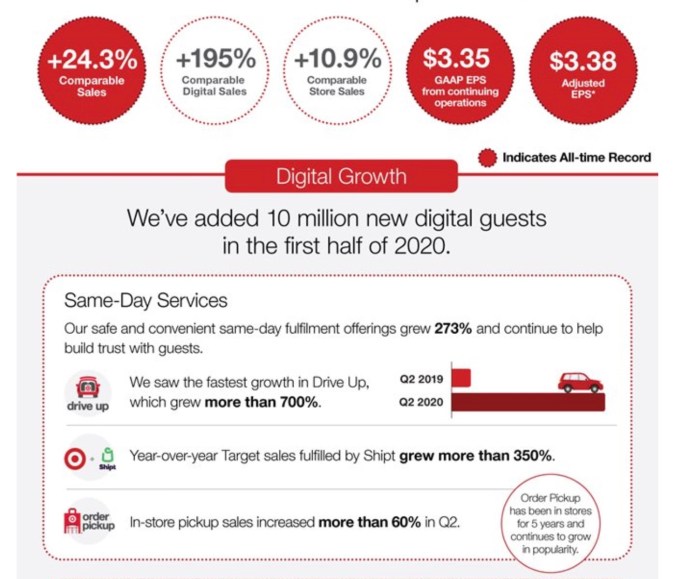
Following Walmart’s pandemic-fueled earnings beat posted on Tuesday, Target today also handily beat Wall St. expectations to deliver a record-setting quarter across a number of key metrics. The retailer on Wednesday announced its strongest quarter to date for comparable sales, which grew 24.3% in Q2, driving Target’s profit up 80.3% year-over-year to $1.69 billion. Online ordering was particularly popular, Target noted, with digital sales growing 195%. Same-day services like Drive Up, Order Pick Up and Shipt also grew by 273%.

In the quarter, Target topped estimates for revenue, same-store sales, adjusted EPS, and gross margin. It reported $23 billion in revenue, vs. estimates of $19.82 billion. Its record-settinbg 24.3% increase in comparable sales was well above the expected 5.8%. Earnings per share came in at $3.38 vs. the $1.58 forecast. And its GM was 30.9% instead of the expected 28.98%.

The company attributed its sales growth to a number of factors, including its ability to remain open amid the pandemic as an essential business, its customers’ overall trust in the Target brand, its ability to get customers to shop across its product categories, its digital services, and most notably, the return of customers to its stores in Q2.

The latter item doesn’t necessarily mean Target shoppers were walking the aisles, however.

Instead, it speaks the investments Target made ahead of the pandemic in bridging the gap between online ordering and its physical stores. In Q2, Target’s In-store Order Pick Up grew more than 60%, as shoppers headed inside Target to pick up their web orders, for example.

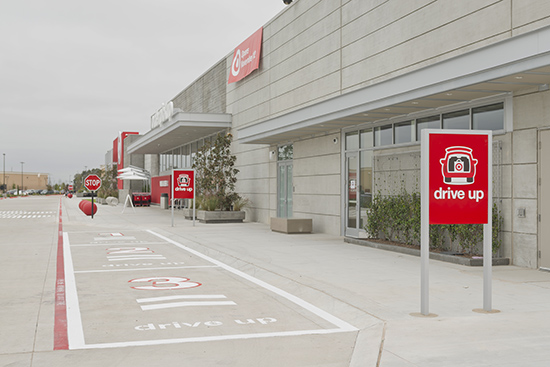
Target’s Drive Up service, which allows customers to shop online then pull up in designated parking spots to have orders brought their car, was up by more than 700% in the quarter.

And Target’s Shipt same-day home delivery service Shipt was up 350% over last year.

That means that for much of what Target customers think of as “online shopping,” their sales were actually being fulfilled by Target’s stores. In fact, Target said its stores fulfilled more than 90% of its second-quarter sales.

Image Credits: Target

To build out its digital fulfillment services, Target took a tech company-like approach in leveraging internal engineering teams capable of iterating quickly on new ideas. A team of eight, including four engineers, originally built Drive Up starting back in April 2017, for instance. By summer 2017, Drive Up was being tested in internally. It then rolled out to Target’s home market by that fall. And as of August 2019, Target’s Drive Up service was available nationwide.

The retailer has also made key acquisitions to aid its e-commerce operations, including its $550 million deal for Shipt in 2017, and more recently, its acquisition of same-day delivery technology from Deliv back in May. It has also integrated Shipt’s same-day service directly into its own website and app, instead of relying only on Shipt’s dedicated brand to reach Target shoppers.

The results of these efforts are now paying off in a pandemic where customers don’t necessarily want to browse stores’ aisles in-person to shop. And that has led to Target seeng what Yahoo Finance today described as “tech company-like growth” for its retail business.

Richmond Drive Up

Store opening at Target Houston – Richmond on Wednesday, Nov. 8, 2017 in South Richmond, Texas. (Anthony Rathbun/AP Images for Target)

Target’s Chairman and CEO Brian Cornell additionally noted the company has added $5 billion in market share in the first 6 months of 2020, during which time it’s added 10 million new digital customers.

“Our second quarter comparable sales growth of 24.3 percent is the strongest we have ever reported, which is a true testament to the resilience of our team and the durability of our business model. Our stores were the key to this unprecedented growth, with in-store comp sales growing 10.9 percent and stores enabling more than three-quarters of Target’s digital sales, which rose nearly 200 percent,” he said. “We also generated outstanding profitability in the quarter, even as we made significant investments in pay and benefits for our team. We remain steadfast in our focus on investing in a safe and convenient shopping experience for our guests, and their trust has resulted in market share gains of $5 billion in the first six months of the year,” Cornell continued.

“With our differentiated merchandising assortment, a comprehensive set of convenient fulfillment options, a strong balance sheet, and our deeply dedicated team, we are well-equipped to navigate the ongoing challenges of the pandemic, and continue to grow profitably in the years ahead,” he said.

The pandemic has played a role in what customers bought, too. Target said its sales were up across all five of its core merchandise categories. This was led by the strongest sales in electronics, a category that was up 70% year-over year due to people staying at home for work, school and entertainment, leading to more purchases of things like computers or gaming systems. Electronics were followed by home products, which were up by 30%, then increases of 20% for the beauty, food & beverages, and essentials categories. Apparel even shifted from a 20% decline in Q1 to double-digit growth in Q2. Customer basket size also grew 18.8%, as people shopped for more items on their Target runs.

Like Walmart, Target also saw a boost from government stimulus checks, which will likely taper off next quarter. But Target declined to offer further 2020 guidance, saying that the COVID-19 crisis makes consumer shopping patterns and government policies unpredictable.