Year: 2020

19 Aug 2020

Scotland spaceport gets full approval, will be able to host up to 12 launches per year

Scotland’s first proposed spaceport has been fully approved to proceed with construction and operation (via The Northern Times). The facility, which will be built in northern Sutherland on a peninsula that extends into the North Atlantic. This will be the future launch site for Orbex, a startup looking to develop the UK’s first re-usable orbital launch vehicle.

This approval follows submission of all the necessary documents, including a full environmental assessment, to local regulators and the Scottish government. Full approval means that construction can proceed, paving the way for launches to begin taking off from the site sometime over the course of the next few years.

Domestic launch capabilities in the UK would provide a significant opportunity for the area’s expansion of its bourgeoning private space industry. Aside from offering the UK government small satellite launch capabilities from local suppliers, including Orbex once its rockets become operational, earlier this year the UK and the US signed an agreement that permits US launch companies to fly missions from UK sites, meaning this Scottish site could potentially host international missions and secure more global business.

The Space Hub Sutherland facility, which will be paid for in part by funding from the UK Space Agency, will be a relatively small spaceport overall, playing host to a single launch pad and covering around 10 acres in total, including a control center and a stretch of road spanning around 1.5 miles. That should still provide plenty of space for the next generation of small orbital launch vehicles, which are designed specifically to fit the needs of small satellite operators and thus require much less infrastructure than launch facilities for existing private vehicles like SpaceX’s Falcon 9.

19 Aug 2020

Facebook Portal gets serious about remote work with BlueJeans, GoToMeeting, Webex and Zoom apps

Facebook’s Portal line didn’t get off to the smoothest start when it launched back in 2018. The company no doubt realized from the outset that it would have a lot to prove on the privacy front when attempting to convince users to essentially invite a Facebook-powered camera into their living quarters. And in the intervening years, it has made a point to demonstrate that it’s privacy and security first for the social media giant.

Recent months have also seen the company looking to branch out from the friends and family angle, into teleconferencing. Certainly it makes sense to strike while the iron is hot on that front, as remote work has become the standard for most office jobs — and will likely continue to remain as such for some time to come.

Following up the recent announcement of the business-themed Workplace on Portal, Facebook this morning announced the smart display will be getting apps from four of the top teleconferencing companies: BlueJeans (now part of our parent company, Verizon), GoToMeeting, WebEx and Zoom . Facebook notes that the apps won’t be coordinated on the same day, but all of the apps will be arriving at some point in September for the Portal Mini, standard Portal and Portal+. Portal TV support is coming later.

It’s a big morning for Zoom, in particular. The popular service made its own separate announcement this morning, noting that — in addition to Portal — its Zoom for Home offering will also be arriving on Amazon’s Echo Show and Google’s Nest Hub Max. That’s a hat trick for the top home smart screens. The other platforms will be getting Zoom after Portal, at some point before the end of the year.

The appeal is clear, of course. Zoom notably has launched its own teleconferencing appliance, as have some third-party hardware companies, like the Y Combinator-backed Sidekick. That solution in particular was an interesting one due to its always-on approach — an attempt to better approximate in-person working conditions. After all, what are these sorts of devices about, if not trying to hammer out what the new normal is going look like moving forward.

For its part, Facebook says it’s actively exploring various ways to convert its device to the work setting. That includes things like custom and blurred backgrounds, which are coming to Workplace and will arrive on WebEx day-of, with additional support for other apps dependent on the developers. If you’ve ever teleconferenced from your living room, you no doubt know what a lifesaver those can be.

What will also be interesting to see is whether companies plan to offer bulk purchasing for these devices for enterprises. Facebook says it currently has nothing to announce on that front (“stay tuned”), but I wouldn’t be surprised to see that sort of feature introduced for some of these products in the not-so-distant future, as they look to compete with more traditional teleconferencing products. Mileage will certainly vary depending on how much trust businesses are willing to put into Facebook/Google/Amazon .

As the pandemic continues to wear on, however, these sorts of devices will only grow more attractive as a method for keeping remote employees always-connected.

19 Aug 2020

MIT and Boston Dynamics team up on ‘Dr. Spot,’ a robot for remote COVID-19 vital sign measurement

One of the most consistent pieces of advice from health organizations about COVID-19 has been that everyone do their utmost to limit contact with people who may have been exposed to the novel coronavirus that causes the disease. That’s difficult in a hospital setting, where medical professionals regularly have to take patient vital sign measurements in order to provide proper care. But a new collaborative effort by MIT, Brigham and Women’s Hospital, Boston Dynamics and others might provide a way to get those measurements without putting frontline healthcare workers directly in harms’ way.

In a new academic paper, MIT researchers describe how they developed and used ‘Dr. Spot,’ a customized version of Boston Dynamics’ four-legged, dog-like robot, to be able to make use of contactless vital sign monitoring equipment for taking measurements. Dr. Spot is also outfitted with a tablet to make it possible for doctors and nurses to have ‘face-to-face’ interviews with patients while they conduct exams. This hyperlocal version of telemedicine has the potential to not only reduce the risk of exposure for medical personnel, but also drastically reduce use of personal protective equipment, conserving resources for when they’re needed most.

Dr. Spot is able to measure vital signs including skin temperature, respiratory rate, heart rate, and blood oxygen saturation all at once. These are all key metrics that healthcare professionals track when determining the progress of COVID-19 in a patient. For the purposes of this study, Dr. Spot was deployed in a hospital setting, but only took measurements from health volunteer research subjects in order to validate the accuracy of its measurement and sensor equipment.

This is just a study to provide some proof as to the potential of actually deploying Dr. Spot or a similar system in an actual clinical study, but the results are promising. Remote vital monitoring isn’t a new concept, but many other systems for accomplishing this require adapting the physical locations where patients are treated to accommodate that kind of distanced measurement, whereas this one could be deployed much more flexibly in existing hospitals and clinics.

19 Aug 2020

PadSplit uses the Airbnb model to tackle the country’s affordable housing crisis

The United States is currently in the middle of an affordable housing crisis that’s putting the nation’s most economically insecure citizens at risk of becoming homeless even as a pandemic continues to spread across the country.

But one Atlanta startup called PadSplit is using the same model that Airbnb created (which ultimately drove up rental and housing prices across the country) to bring down costs for subsidized housing and provide relief for some of the people most at risk.

America’s second housing crisis

Twelve years after the last housing crisis in the United States caused a global economic meltdown, the U.S. is once again on the brink of another real estate-related economic disaster.

This time, it’s not speculators and investors that will carry the weight of the coming collapse, but low income renters faced with still sky-high housing costs and no income thanks to historic unemployment caused by the nation’s COVID-19 epidemic, as Vox reported.

Before COVID-19 swept across the world, half of U.S. renters were spending roughly 30 percent of their income on apartments and homes. One fifth of the population actually spent over half of their income on rent, and now, with roughly 10 percent of the country unemployed, that population faces eviction and the prospect of homelessness.

One third of American families failed to make rent in June, and by September more than 20 million renters could be evicted by landlords.Can an Airbnb model provide relief?

To solve the problem of housing insecurity, PadSplit borrows a page from the Airbnb playbook by creating a marketplace where homeowners can list rooms for rent for long-term stays.

Each room comes furnished with wifi and includes access to laundry facilities. And the company provides access to free telemedicine services and reports weekly payments to credit agencies so renters can build their credit scores.

Currently, the company manages 1,000 units in the Atlanta area and has expanded its presence into Maryland. The company’s renters include teachers, grocery store employees, restaurant workers — all people whose services are considered essential during the COVID-19 epidemic. “40 percent of our population has been functionally homeless,” said company founder, Atticus LeBlanc. “The average income [for our renters] is $25,000 per year.”

The average age of an occupant in a PadSplit room is 39, but renters have been as young as 19 or as old as 77, according to the company.

A quick scan of PadSplit rates in the Atlanta area shows rents of roughly $140 to $250 per week for rooms in existing homes. “We are focused on longer term stays for lower income,” said LeBlanc.

The company screens tenants and landlords, including criminal background checks and employment verification. “We sit between a hotel provider and a longer term apartment,” said Leblanc. “Where we need to both be an immediate housing provider for people who are in difficult situations while also underwriting that [person].” Owners looking to rent on PadSplit also need to prove that they haven’t been convicted of a felony within the last seven years.

GettyImages 117642785

Image Credits: luismmolina (opens in a new window) / Getty Images

Launching PadSplit

LeBlanc, a New Orleans native turned Atlanta entrepreneur was named for Atticus Finch, the fictional lawyer whose fight for social justice in “To Kill A Mockingbird” is a staple of schoolroom lit assignments, and a model for white liberal southern gentry.

“My mother… said she wanted to give me someone to live up to,” says LeBlanc. 

With a degree in architecture from Yale University, LeBlanc has run a real estate development and construction business in Atlanta for over 12 years. He launched PadSplit in 2017, after writing up the idea for the business in response to a competition from the Atlanta housing non-profit, House ATL and the non-profit Enterprise Community Partners.

LeBlanc’s plan was selected as one of the finalists and he received a small grant from the organization and the JPMorgan Chase foundation to pursue the business.

With the help of John O’Bryan, a serial entrepreneur who had built businesses in the vacation rental industry, LeBlanc built up the marketplace that would become PadSplit, starting first in Atlanta and moving out to surrounding suburbs and into Maryland. LeBlanc later brought in Frank Furman, a Naval Academy graduate, US Marine Corps veteran and former McKinsey consultant to help grow the business. 

Now, the company, a Techstars accelerator graduate, has $10 million in new financing from Core Innovation Capital, Alate Partners, the Citi Impact Fund, Kapor Capital, Impact Engine and Cox Enterprises to expand PadSplit into Texas, starting with Houston and quickly ramp up hiring.

“PadSplit provides a truly unique solution to a complicated national problem that’s becoming more dire each day,” said Arjan Schütte, Founder and Managing Partner of Core Innovation Capital, in a statement. “We’re proud to support Atticus and the PadSplit team as they expand into new markets and introduce critical housing supply at a time when so many require affordable housing.”

Making money in affordable housing

According to LeBlanc, affordable housing is built around two things. One is the subsidy owners receive from the federal government and the second is a percentage of the cost of rentals. To convince owners that being in the affordable housing market was a good idea, LeBlanc just proved to them that they could get higher risk-adjusted returns versus other long-term rentals.

So far, that’s been proven out, he says. Through its model of fixed costs and weekly rent payments, PadSplit occupants have been able to save roughly $516 per month, according to data supplied by the company. Lowering rent has also allowed tenants to build credit, move into their own apartments and bought vehicles — or even, in some cases, houses of their own.

The company estimates it has also saved taxpayers over $203 million in subsidies by eliminating the the need to build subsidized housing units. Property owners have also benefited, the company said, increasing revenues on properties by over 60 percent.

And LeBlanc isn’t just the founder of PadSplit, he’s also a customer. “I rent a room downstairs in my personal home,” he said.

Ultimately, LeBlanc sees housing stability and a path to home ownership as one of the key tenets of economic equality in the United States.

“Every zoning law in America was based on a system that had no racial equity. We’re still battling those vestiges that exist in almost every jurisdiction,” he says.

And for LeBlanc the problem goes back to nearly 100 years. “If you acknowledge that racial inequality led to income stratification where it was impossible for returning Black GIs to get access to the same wealth building opportunities that white returning GIs had.. it’s no surprise that you have lower incomes by a substantial margin for African Americans as you do for whites.”

LeBlanc sees his business providing an additional revenue stream for the owners who rent properties, and an on-ramp to the financial system for people who are at risk or historically disenfranchised.

“We wanted to create a value proposition that is valuable to anyone in the housing space,” said LeBlanc. 

19 Aug 2020

Hangar raises $15 million for its venture studio for government technology startups

Josh Mendelsohn, the former Bloomberg digital campaign advisor and venture studio founder, thinks that cash constrained government agencies from the local to the federal level aren’t using technology effectively enough to meet the challenges they face.

That’s why the founder of Engine and former managing director of Hattery launched Hangar with a $15 million commitment from his former boss and the Kresge Foundation to build companies that will help solve problems that governments haven’t tackled effectively.

“We’re at an unprecedented moment for our country, and our companies are addressing several significant challenges all at once, from combatting Covid-19, to rebuilding our economy, to reducing the cost of higher education, to addressing disparate outcomes in healthcare,” said Mendelsohn, in a statement.

The company has already hired an in-house team of technologists and business consultants to build businesses to nab some of the $2 trillion that governments across the U.S. spend every year on information technology.

In the year-and-a-half since Mendelsohn first began operating the company building studio in stealth mode, Hangar has already created four businesses including: Camber, which provides mobility data to governments and is being used by public health researchers to monitor and manage COVID-19 outbreaks,

Camber is currently the authoritative provider of mobility data insights to public health researchers, epidemiologists, and state governments tackling COVID-19; Cornea, a predictive toolkit for disaster planning and management; Outcome, a new service for student loans; and Roster, which uses technology to enhance the efforts of community health workers.

“There are so many areas–from healthcare to disaster planning–that are ripe for innovation and new technologies that help to improve the lives and well-being of people and help solve real problems,” said Brian O’Kelley, a New York-based serial entrepreneur and Hangar investor who previously founded AppNexus (and sold it to AT&T for over $1 billion). “With a veteran team that blends deep Silicon Valley and policy experience, Hangar is already making an impact and I’m proud to be supporting their next phase.”


19 Aug 2020

UK class action style claim filed over Marriott data breach

A class action style suit has been filed in the UK against hotel group Marriott International over a massive data breach that exposed the information of some 500 million guests around the world, including around 30 million residents of the European Union, between July 2014 and September 2018.

The representative legal action against Marriott has been filed by UK resident, Martin Bryant, on behalf of millions of hotel guests domiciled in England & Wales who made reservations at hotel brands globally within the Starwood Hotels group, which is now part of Marriott International.

Hackers gained access to the systems of the Starwood Hotels group, starting in 2014, where they were able to help themselves to information such as guests’ names; email and postal addresses; telephone numbers; gender and credit card data. Marriott International acquired the Starwood Hotels group in 2016 — but the breach went undiscovered until 2018.

Bryant is being represented by international law firm, Hausfeld, which specialises in group actions.

Commenting in a statement, Hausfeld partner, Michael Bywell, said: “Over a period of several years, Marriott International failed to take adequate technical or organisational measures to protect millions of their guests’ personal data which was entrusted to them. Marriott International acted in clear breach of data protection laws specifically put in place to protect data subjects.”

“Personal data is increasingly critical as we live more of our lives online, but as consumers we don’t always realise the risks we are exposed to when our data is compromised through no fault of our own. I hope this case will raise awareness of the value of our personal data, result in fair compensation for those of us who have fallen foul of Marriott’s vast and long-lasting data breach, and also serve notice to other data owners that they must hold our data responsibly,” added Bryant in another supporting statement.

We’ve reached out to Marriott International for comment on the legal action.

A claim website for the action invites other eligible UK individuals to register their interest — and “hold Marriott to account for not securing your personal data”, as it puts it.

Here are the details of who is eligible to register their interest:

The ‘class’ of claimants on whose behalf the claim is brought includes all individuals who at any date prior to 10 September 2018 made a reservation online at a hotel operating under any of the following brands: W Hotels, St. Regis, Sheraton Hotels & Resorts, Westin Hotels & Resorts, Element Hotels, Aloft Hotels, The Luxury Collection, Tribute Portfolio, Le Méridien Hotel & Resorts, Four Points by Sheraton, Design Hotels. In addition, any other brand owned and/or operated by Marriott International Inc or Starwood Hotels and Resorts Worldwide LLC. The individuals must have been resident in England and Wales at some point during the relevant period prior to 10 September 2018 and are resident in England and Wales at the date the claim was issued. They must also have been at least 18 years old at the date the claim was issued.

The claim is being brought as a representative action under Rule 19.6 of the Civil Procedure Rules, per a press release, which also notes that everyone with the same interest as Bryant is included in the claimant class unless they opt out.

Those eligible to participate face no fees or costs, nor do affected guests face any financial risk from the litigation — which is being fully funded by Harbour Litigation Funding, a global litigation funder.

The suit is the latest sign that litigation funders are willing to take a punt on representative actions in the UK as a route to obtaining substantial damages for data issues. Another class action style suit was announced last week — targeting tracking cookies operated by data broker giants, Oracle and Salesforce.

Both lawsuits follow a landmark decision by a UK appeals court last year which allowed a class action-style suit against Google’s use between 2011 and 2012 of tracking cookies to override iPhone users’ privacy settings in Apple’s Safari browser to proceed, overturning an earlier court decision to toss the case.

The other unifying factor is the existence of Europe’s General Data Protection Regulation (GDPR) framework which has opened the door to major fines for data protection violations. So even if EU regulators continue to lack uniform vigour in enforcing data protection law, there’s a chance the region’s courts will do the job for them if more litigation funders see value in bringing representative cases to pursue damages for privacy violations.

The dates of the Marriott data breach means it falls under GDPR — which came into force in May 2018.

The UK’s data watchdog, the ICO, proposed a $123M fine for the security failing in July last year — saying then that the hotel operator had “failed to undertake sufficient due diligence when it bought Starwood and should also have done more to secure its systems”.

However it has yet to hand down a final decision. Asked when the Marriott decision will be finalized, an ICO spokeswoman told us the “regulatory process” has been extended until September 30. No additional detail was offered to explain the delay.

Here’s the regulator’s statement in full:

Under Schedule 16 of the Data Protection Act 2018, Marriott has agreed to an extension of the regulatory process until 30 September. We will not be commenting until the regulatory process has concluded.

19 Aug 2020

Tristan Thomas, Monzo’s long-standing VP of Marketing, is departing the challenger bank

Tristan Thomas, Monzo’s long-standing VP of Marketing — who joined the challenger bank almost five years ago when it had less than 15 employees! — has announced internally that he is departing at the end of the year.

For the time being, his destination is unknown (even to himself, I gather), and once he’s served his notice period, which runs until November, he’ll be taking some time to figure out what’s next. I also understand Thomas will be actively recruiting his replacement and leaves on good terms, after what has undoubtedly been a roller coaster of a ride.

Still only 28 years old, Thomas joined Monzo in September 2015 as its first Community Manager, just before the bank upstart — then called Mondo — began issuing “Alpha” hot coral debit cards (I still have one in a tray on my desk). Since then, the bank has grown to nearly 4.5 million customers and has a headcount of around 1,500.

His original brief was to figure out how Monzo could or should involve customers in what it was building — the beginnings of “community” at Monzo, if you will. This included running its first hackathons and launching the Monzo user forum, before taking the lead on Monzo’s first — and record breaking — equity crowdfunding campaign.


Over on Extra Crunch, we delve into the most recent published financials for U.K. challenger bank rivals, Monzo and Starling.


He was then promoted to a product manager role, heading up Monzo’s first Android app efforts, before taking over the marketing team in January 2017 — the bank’s third head of marketing in 18 months.

Other milestones include two further crowdfunding rounds, and a reportedly successful TV ad, which one source tells me investors and members of the board wrongly predicted would be a dud.

Today, Thomas heads up a team of more than 20 people spanning PR & comms, performance marketing, content & social, and product marketing. He is also involved in policy and financial inclusion, and over the years had established himself as one of Monzo founder Tom Blomfield’s key lieutenants.

(Notably, in May, Blomfield stepped down as CEO of the U.K. challenger bank to take up the newly created role of president. His replacement is current U.S. CEO TS Anil, who now also holds the title of “Monzo UK Bank CEO”.)

Meanwhile, outside of Monzo, the departing marketing exec has been on somewhat of a side project spree — tentatively launching two online offerings of his own, with varying degrees of ambition.

The most recent is a wine subscription service born out of lockdown frustrations, because getting a bottle of the good stuff is high priority during a global pandemic. The other — and by Thomas’ own admission, far less scalable — let’s you print and send things without having to own a printer or walk to a letter box.

You know what they say: don’t quit the day job just yet. Oh, wait…

19 Aug 2020

iKala, an AI-based customer engagement platform, raises $17 million to expand in Southeast Asia

iKala, a Taiwanese startup that offers an artificial intelligence-based customer acquisition and engagement platform, will expand into new Southeast Asian markets after raising a $17 million Series B. The round was led by Wistron Digital Technology Holding Company, the investment arm of the electronics manufacturer, with participation from returning investors Hotung Investment Holdings Limited and Pacific Venture Partners. It brings iKala’s total raised so far to $30.3 million.

The new funding will be used to launch in Indonesia and Malaysia, and expand in markets where iKala already operates, including Singapore, Thailand, Hong Kong, the Philippines, Vietnam and Japan. Wistron Digital Technology Holding Company, which also offers big data analytics, will serve as a strategic investor, and this also marks the Taiwanese firm’s entry into Southeast Asia.

iKala’s products are targeted toward e-commerce companies, and include KOL Radar, for influencer marketing, and Shoplus, a social commerce service focused on Southeast Asian markets.

In a statement about the funding, iKala board member Lee-feng Chien, former managing director at Google Taiwan, said, “Taiwan has an excellent reputation for having some of the best high tech talents in both hardware and software around the region. With Wistron as a strategic partner, iKala can become a major driving force for transforming Taiwan into an AI industry and talent hub in Asia.”

While Taiwan’s technology industry is best-known for hardware, especially semiconductor manufacturers like Foxconn and TSMC, a new crop of startups are helping the country establish a reputation for AI prowess.

In addition to iKala, these include Appier, which also provides a customer analytics, and enterprise translation platform WritePath. Big American tech companies, including Amazon, Google and Microsoft, have also set up AI-focused research and development centers in Taiwan, drawing on the country’s engineering talent and government programs.

19 Aug 2020

India’s first Earth-imaging satellite startup raises $5 million, first launch planned for later this year

Bengaluru-based Pixxel is getting ready to launch its first Earth imaging satellite later this year, with a scheduled mission aboard a Soyuz rocket. The roughly one-and-a-half-year old company is moving quickly, and today it’s announcing a $5 million seed funding round to help it accelerate even more. The funding is led by Blume Ventures, Lightspeed India Partners, and growX ventures, while a number of angel investors participated.

This isn’t Pixxel’s first outside funding: It raised $700,000 in pre-seed money from Techstars and others last year. But this is significantly more capital to invest in the business, and the startup plans to use it to grow its team, and to continue to fund the development of its Earth observation constellation.

The goal is to fully deploy said constellation, which will be made up of 30 satellites, by 2022. Once all of the company’s small satellites are on-orbit, the the Pixxel network will be able to provide globe-spanning imaging capabilities on a daily basis. The startup claims that its technology will be able to provide data that’s much higher quality when compared to today’s existing Earth imaging satellites, along with analysis driven by PIxxel’s own deep learning models, which are designed to help identify and even potentially predict large problems and phenomena that can have impact on a global scale.

Pixxel’s technology also relies on very small satellites (basically the size of a bear fridge) that nonetheless provide a very high quality image at a cadence that even large imaging satellite networks that already exist would have trouble delivering. The startup’s founders, Awais Ahmed and Kshitij Khandelwal, created the company while still in the process of finishing up the last year of their undergraduate studies. The founding team took part in Techstars’ Starubst Space Accelerator last year in LA.

19 Aug 2020

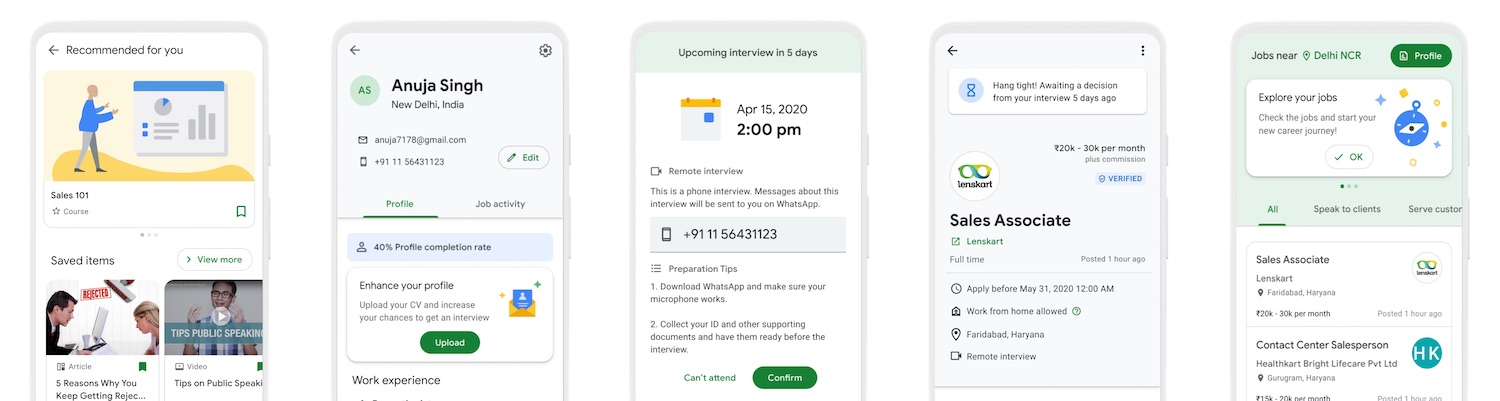
Google launches Kormo app in India to help people find entry-level jobs

Google said on Wednesday it has expanded its jobs app, called Kormo Jobs, to India as the Search giant looks to offer a helping hand to millions looking for entry-level roles and further displace Microsoft’s LinkedIn relevance in the world’s second largest internet market.

The company first launched Kormo Jobs in Bangladesh in 2018 and expanded it to Indonesia last year. Also last year, Google made Kormo available in India under the brand Jobs as a Spot on Google Pay app.

Since making Jobs available as a Spot, Google says a number of companies including Zomato and Dunzo — a Bangalore-based startup it has invested in — have posted over 2 million verified jobs on the platform.

Google said today it is rebranding Jobs Spot on Google Pay as Kormo Jobs in India and also making its standalone Android app available in one of its key overseas markets.

In addition to helping users identify open calls for entry-level roles, Kormo Jobs app is also designed to help them learn new skills, and easily create a CV.

Bickey Russell, Regional Manager and Operations Lead at Kormo Jobs, said the company will continue to invest in bringing new features and jobs to the app in the future.

“In the wake of the pandemic, the jobs landscape stands altered, with demand shifting to new services that require different sets of skills and experience. Businesses of all sizes face the challenges of the new normal, while job seekers are having to adapt to this shift quickly,” wrote Russell in a blog.

“We are heartened to be able to play a helpful role in facilitating connections to impact lives for the better, including introducing important features like remote interviewing earlier this year to ensure social distancing,” he added.

The move further illustrates Google’s growing interest in courting a big slice of the job-related search-queries. The company launched a jobs search search engine in 2017 in the U.S., which it has expanded to several markets since. Earlier this month, it rolled out a virtual visiting card feature in India.

Google’s push into this category stands to hurt LinkedIn, which does not have a strong presence in emerging markets. In India, for instance, LinkedIn had about 24 million monthly active users on Android in the month of July, according to App Annie, up from about 22 million during the same period a year ago. Google reaches about 400 million users in India.