Year: 2020

12 Aug 2020

Duck Creek seeks $3B valuation for its software IPO

American software company Duck Creek has upped the stakes in its impending IPO, raising its price target from a range of $19 to $21 per share to $23 to $25 per share.

The bump comes as software and cloud stocks have fallen more than 10% from recent highs, putting them in technical correction territory.


The Exchange explores startups, markets and money. You can read it every morning on Extra Crunch, or get The Exchange newsletter every Saturday.


The good news for the Boston-based startup focused on the insurance market, however, is that recent technology IPOs have seen strong performance at similar stock market levels. So, the recent market chop for its future cohort of public software companies may not prove too deleterious to its public offering hopes.

This morning let’s calculate an updated valuation range for Duck Creek, re-run our math on its implied revenue multiples and compare those figures to today’s public market averages.

Duck Creek’s products target the property and casualty insurance provider space, serving companies that sell coverage for automobile, rental and homeowners insurance.

When tinkering with Duck Creek’s first IPO price range ($2.44 billion to $2.70 billion), the company appeared to be reasonably priced. Let’s see what happens when it raises its share-price targets.

A new valuation

As before, Duck Creek is selling 15 million shares, a figure that rises to 17.25 million if its underwriters exercise their option to purchase more stock at the IPO price. So, at its new $23 to $25 per-share IPO price range, the company could raise between $396.75 million and $431.25 million.

For a company that had revenue of $153.35 million in the three quarters ending May 31, 2020, it’s a large sum.

Discounting the shares up for purchase by its underwriters, Duck Creek is worth between $2.95 billion and $3.21 billion. Including the extra equity, the figures rise to $3.00 billion and $3.26 billion.

12 Aug 2020

The Oura Ring is the personal health tracking device to beat in 2020

The Oura Ring has been getting a lot of attention lately because of its role in a number of COVID-19 studies, as well as its adoption by both the NBA and WNBA as a potential tool for helping prevent any outbreaks of the novel coronavirus as those two leagues get back to a regular schedule of play. Oura has released multiple generations of the Ring, which is a health and fitness tracker that reports a range of data, and I’ve spent the past month using one to see what all the fuss is about.

The basics

The Oura Ring is a health tracker that’s unlike just about any other wearable with a similar purpose. It’s a ring that’s virtually indistinguishable from an actual ring without any smart features, available in a couple of different designs and multiple finishes. The Ring has sensors located on the inside surface, but these barely add to its overall thickness and are totally hidden when the ring is worn.

Despite its small size and low profile, the Oura Ring is still a connected device, with an internal battery, and the ability to talk to a smartphone via Bluetooth to transmit the data its sensors collect. In the box, you also get a USB-C stand for the Oura Ring that powers it up via induction charging.

The built-in battery is good for up to seven days of continuous use – and that includes wearing the Oura Ring during sleep. During my usage, that seemed to be an accurate estimate. In general, though, the battery life just seemed to be ‘long enough,’ prompting me not to really think about specific spans, and charging is so quick that it’s easy to just remember to put it on the dock occasionally when it’s convenient (I would often do this during the work day while at my desk, where I keep the Oura dock). Oura’s app also sends helpful notifications to remind you to charge before bed when you’re getting close to the end of your ring’s battery life.

Design

Oura’s design for this most recent iteration of their Ring is fantastic – both as just a piece of jewelry, and doubly so as a connected health and activity tracker. It’s available in two styles, called “Balance” and “Heritage,” both of which come in multiple metallic finishes. There’s a polished silver and gloss black option for both, while “Balance” has a premium-priced version with inlaid diamonds, and “Heritage” has a matte black finish option (which I reviewed).

All the various finishes ore made of a lightweight titanium, with a molded plastic inner to protect the sensors and provide transparency for them to work. The exterior finishes are all coated with a scratch-resistant outer layer – but just like with just about any other metal jewelry, scratch-resistant isn’t scratch proof. The matte black finish I reviewed is definitely showing some wear and tear after multiple weeks of use, but that’s something I was fully expecting, and it’s surprisingly resilient given how often it comes in contact with other metal surfaces, stone and whatever else you come in contact with on a daily basis. The minor blemishes that appear lend it a pleasing patina, rather than negatively impacting its aesthetics, in my opinion.

The Oura Ring is also fixed in terms of sizing and fit, and the company has come up with a clever way to handle ensuring a good fit for customers. They offer a free sizing kit that they ship out first so that you can figure out which Oura size is most comfortable, and decide on which finger you want to wear it. Size is important because you want the Oura Ring to fit snugly enough that it won’t fall off or shift around too much, but also not too snugly that it becomes uncomfortable.

Ultimately, the design is fantastic because it’s both an attractive ring, and an incredibly comfortable device to wear all day – and through the night. Unlike even an Apple Watch or other wrist-worn wearable, there’s virtually no adjustment required for getting used to wearing it while sleeping, or any discomfort from various types of bands. It’s the first wearable I’ve used where I truly was able to forget that I was wearing one at all, and it’s one that no one else will realize you’re wearing, either.

Features and performance

So what does the Oura Ring actually track? A lot of things, actually. It measures sleep, as mentioned, as well as various other metrics under two other broad categories: Readiness, and Activity. Sleep, Readiness and Activity all provide one overall summary score out of 100 to give you a topline sense of where you’re at, but each is actually calculated from a range of sub-metrics that add up to that larger score.

Oura’s sleep tracking is much more in-depth than the forthcoming Apple Watch sleep tracking that Apple is releasing with its next watchOS update in the fall. It monitors when you go to sleep, how long you sleep, how much of that qualifies as “deep” and how much is “REM,” and gives you a metric or you sleep efficiency, your time in bed, your total sleep time and more. Readiness tracks your ambient body temperature, heart rate variability, respiratory rate and your resting heart rate, while activity automatically measures calorie burn, inactive time, you steps and how close you are to your overall activity goal.

Image Credits: Darrell Etherington

For all three of these categories, you can dive into each individual sub-metric and see trends over time or individual scores per day, but you can also just look at the overall score, which is provided in a feed-like dashboard in the app and accompanied by practical, actionable advise about what to do with your day, your activity or your sleep habits based on that score and how it’s trending.

It’s at once both the easiest to understand health tracking app I’ve used, and also one of those with the most depth when it comes to digging into what is actually being tracked, and what that means in greater detail. And because the app focuses heavily on establishing a baseline and then monitoring deviations from that baseline and providing advice based on that, it’s more likely to be useful and specifically relevant to you.

Bottom line

With most wearable tech, including the Apple Watch, I periodically have a sort of internal revolt where I end up finding them too much of an intrusion, or too much of a hassle to maintain continuous use. With the Oura Ring, health self-monitoring reaches a perfect pinnacle of combining convenience, with useful and actionable information, with an unobtrusive and attractive design that actually makes me want to put it on.

The jury remains out on whether the Oura Ring can actually accurately detect COVID-19 or anticipate the onset of its symptoms, but regardless, it’s a fantastic personal health tracking device and a great tool for anyone looking to take more control over how they feel on a daily basis. And by actively establishing an individual baseline and comparing your actual overall state to that every day, Oura provides one of the best potential platforms for long-term personal wellness insight out there.


12 Aug 2020

Gong raises another $200M on $2.2B valuation

For the third time since last February, Gong has raised a significant sum. In February, the company scored $40 million. In December, it grabbed another $65 million, and today it was $200 million on a $2.2 billion valuation. That’s a total of $305 million in less than 18 months.

Coatue led today’s cash infusion with help from new investors Index Ventures, Salesforce Ventures and Thrive Capital, and existing investors Battery Ventures, NextWorld Capital, Norwest Venture Partners, Sequoia Capital and Wing Venture Capital. It has now raised a total of $334 million, according to the company.

What is attracting this kind of investor attention? When we spoke to Gong about its Series B round, it had 300 customers. Today it has around 1300, representing substantial growth in that time period. The company reports revenue has grown 2.5x this year alone.

Gong CEO Amit Bendov says his company is trying to create a category they have dubbed “revenue intelligence.” As he explains it, today sales data is stored in a CRM database consisting of descriptions of customer interactions as described by the salesperson or CSR. Gong is trying to transform that process by capturing both sides of the interaction, then using artificial intelligence, it transcribes and analyzes those interactions.

Bendov says that the pandemic and economic malaise has created a situation where there is a lot of liquidity in the market and investors have been looking for companies like his to invest some of it.

“There’s a lot of liquidity in the market. There are very few investment opportunities. I think the Investment community was waiting a little bit to see how the market shakes out […] and they are betting on companies that could benefit long term from the new normal, and I think we’re one of them,” Bendov told TechCrunch.

He says that he wasn’t looking for money, and in fact still is operating off the Series B investment, but when firms come knocking with checkbooks open and favorable terms, he wasn’t about to turn them down. “There are CEOs schools [of thought that] tell you to raise money when you can, not when you need to. It’s not very diluted at this kind of valuation and it was a very easy process. […] The whole deal closed in 14 days from term sheet to money in the bank,” he said.

Bendov said that taking the money was “pretty much a no-brainer.” In fact, he says that the money gives them the freedom to operate and further legitimacy in the marketplace. “It gives us the ability to buy companies, make strategic investment, accelerate plans, and it also, especially since we cater to large enterprise customers, it gives them confidence that this company is here to stay…,” he said.

With around 350 employees today, it hopes to add 100 people by the end of the year. Bendov says diversity and inclusion is a “massive priority” for the company. Among the steps they’ve taken recently is opening a recruiting hub in Atlanta to bring more diverse candidates into the company, working with a company called FlockJay to train and hire underrepresented groups in customer success roles, and in Israel where the company’s R&D center is located, helping members of the Arab community with computer science backgrounds to learn interview skills. Some of those folks will end up working for Gong, and some at other places.

While the company has grown remarkably quickly and has shown great promise, Bendov is not thinking ahead to an IPO just yet. He says he wants to grow the company to at least a couple of hundred million dollars in sales and that’s two-three years away at this point. He certainly has plenty of cash to operate until then.

12 Aug 2020

Personal training sessions come to ClassPass

As the coronavirus hampers the fitness industry, leading to a rapid evolution toward digital classes, ClassPass is pressing onward with its product roadmap, albeit a bit ahead of schedule.

The company, which has raised more than $500 million from investors such as General Catalyst, Thrive, GV, Temasek, Apax Digital and L Catterton, is introducing personal training sessions via a partnership with Fyt.

“We’ve been thinking about adding personal training to the platform for quite a while now, and this seems like an excellent time to do so to really diversify our options to our members and give them a wider set of opportunities to work out and keep their workouts,” said Kinsey Livingston, ClassPass VP of Partnerships. “Especially during quarantine, training sessions can be really interesting and motivating and give them that extra accountability that only comes with a personal trainer.”

Of course, these personal training sessions will be virtual and follow the same UX flow as Classpass’s recently introduced virtual classes. Users can find a trainer on the ClassPass app, use credits to book it, and receive a unique Zoom link for their session.

To start, the personal training program will have 10 trainers, who can manage several hundred sessions per week, and will scale up as needed. The trainers, which are employed as 1099 contractors, are 50/50 gender balanced with 20 percent Black trainers. Fyt has 7,000 trainers total on its platform, and the technical side of deployment is relatively easy and straightforward should ClassPass want to scale up the program.

Each training session lasts one hour and comes with a free 15-minute video chat consultation to go over goals, etc. These sessions are all billed through ClassPass using credits — each session costs 23 credits. Depending on geography, that can range from $35 to $55.

ClassPass introduced virtual credits several years ago to have a way to regulate various factors of the business model, such as dynamic pricing for in-demand trainers, the pricing differences between different geographies, and the actual usage volume of customers.

In the future, ClassPass sees the potential to do in-person training sessions where the trainer would come to the customer’s house or meet up in a park. Of course, that would require a much larger number of trainers on the platform across a wide variety of geographies. For now, however, distance isn’t a factor with virtual sessions, giving the company more flexibility on meeting demand.

I asked David Huang, Fyt cofounder and CEO, about the logistical challenges of virtual personal training. For example, free Zoom sessions cut out after 40 minutes, while these sessions are billed for an hour.

“We’re going to start with 10 paid accounts,” said Huang. “We’ll scale it up. I don’t think we’re necessarily going to give each trainer their paid account. We might do a pool of Zoom accounts to use in facilitated sessions. We’ll play that by ear, based on how we scale up.”

Personal training sessions are available now to ClassPass users on the app.

12 Aug 2020

Adaptive Shield raises $4M for its SaaS security platform

Adaptive Shield, a Tel Aviv-based security startup, is coming out of stealth today and announcing its $4 million seed round led by Vertex Ventures Israel. The company’s platform helps businesses protect their SaaS applications by regularly scanning their various setting for security issues.

The company’s co-founders met in the Israeli Defense Forces, where they were trained on cybersecurity, and then worked at a number of other security companies before starting their own venture. Adaptive Shield CEO Maor Bin, who previously led cloud research at Proofpoint, told me the team decided to look at SaaS security because they believe this is an urgent problem few other companies are addressing.

Pictured is a representative sample of nine apps being monitored by the Adaptive Shield platform, including the total score of each application, affected categories and affected security frameworks and standards. (Image Credits: Adaptive Shield)

“When you look at the problems that are out there — you want to solve something that is critical, that is urgent,” he said. “And what’s more critical than business applications? All the information is out there and every day, we see people moving their on-prem infrastructure into the cloud.”

Bin argues that as companies adopt a large variety of SaaS applications, all with their own security settings and user privileges, security teams are often either overwhelmed or simply not focused on these SaaS tools because they aren’t the system owners and may not even have access to them.

“Every enterprise today is heavily using SaaS services without addressing the associated and ever-changing security risks,” says Emanuel Timor, general partner at Vertex Ventures Israel . “We are impressed by the vision Adaptive Shield has to elegantly solve this complex problem and by the level of interest and fast adoption of its solution by customers.”

Onboarding is pretty easy, as Bin showed me, and typically involves setting up a user in the SaaS app and then logging into a given service through Adaptive Shield. Currently, the company supports most of the standard SaaS enterprise applications you would expect, including GitHub, Office 365, Salesforce, Slack, SuccessFactors and Zoom.

“I think that one of the most important differentiators for us is the amount of applications that we support,” Bin noted.

The company already has paying customers, including some Fortune 500 companies across a number of verticals, and it has already invested some of the new funding round, which closed before the global COVID-19 pandemic hit, into building out more integrations for these customers. Bin tells me that Adaptive Shield immediately started hiring once the round closed and is now also in the process of hiring its first employee in the U.S. to help with sales.

12 Aug 2020

Conduit launches to help founders find actually useful angels and VCs

The bar for being a successful VC just keeps getting higher. With more and more capital sloshing around and not enough founders and startups to invest in, founders are getting the opportunity to be choosier and choosier about who they want to work with on their cap tables. You can’t just bring a checkbook anymore — founders want operational experience and deep domain expertise in critical areas like growth marketing or recruiting.

That’s led to the creation of more service-led VC models like Sweat Equity Ventures, which “earn” their cap table stake through engineering work for startups among other services (while also offering capital). As these operational VC firms and angel investors proliferate though, how do you find the right ones for your startup?

What you need is a Conduit to great investors, and that’s precisely what Edward Lando and Sree Kolli and their team have been building.

Lando and Kolli have been angel investing from New York City together for a number of years, but increasingly felt that they needed a scalable way to connect their startups to quality operational VCs. Starting from their own networks and expanding organically, they slowly built up Conduit in private beta since January, officially launching to the public today.

Conduit founders Edward Lando and Sree Kolli. Photo via Conduit

So what exactly is Conduit? It’s essentially a matchmaking service for founders and investors. Founders looking for investors setup free profiles of their startups on the platform and then can search for investors based on criteria like investment sector (like “Finance” or “E-commerce”), expertise areas (“Business Development” or “Operations”), and which rounds an investor typically participates in. Founders can also include a short video to give their profile more personality.

On the reverse side, investors can setup profiles giving their specializations and investment areas of interest, and then they can browse available startups and click to get introduced.

There are a couple of interesting mechanics here. Whereas the profiles are free for startups, investors either get a limited set of introductions or have to pay a subscription fee to get more introductions to founders. So Conduit’s revenue model relies on the (hopefully more) flush investor side of the marketplace. Right now, there is only one tier of subscription, although the team is thinking about a “super special tier” that might include early access to some startup fundraises.

Second, many of the elements of the marketplace are curated by the Conduit team. Both investors and startups applying for access to the platform go through an application process and are vetted by the Conduit team. On top of that, the team works to optimize introductions — hopefully to increase the rate of success and the quality of matches. Lando described this as a “white-globe approach” that has been helpful to both founders and investors in their initial testing.

Lando described “the jackpot scenario” as “a startup, you get someone who is super knowledgeable about a problem you’re facing to also just wire you money — so they pay you to also just help you.”

Right now, Conduit only helps connect founders and investors together — the platform doesn’t actually facilitate or broker the underlying startup investment.

In addition to the marketplace, Conduit hosts “office hours” with prominent founders like Jennifer Fleiss of Rent the Runway to discuss specific operational challenges and also has compiled a number of market maps and other operational guidebooks for founders to take advantage of.

Lando and Kolli share an ambition of making it easier for founders to secure funding and get back to building. Kolli said that “I think Conduit is uniquely positioned to not only democratize on the founder side but also on the capital front,” pointing out that family offices in particular have been receptive to getting easier access to startups. For his part, Lando emphasized that he believes much of the world’s capital is effectively wasted on “real estate stuff, or bonds or ETFs or what not” and that even fractionally moving more of that capital to venture could dramatically improve the world and the pace of innovation.

Ultimately, Conduit has a bit of the feel of AngelList — but without the crowds. Whether it can scale carefully to maintain quality on both the startup and investor side without diluting that high value will be the company’s biggest challenge going forward. For startups today, assuming you get through the velvet rope line, an investment may well be a click away.

12 Aug 2020

Industrial-grade VR company Varjo picks up ~$52M in Series C funding

Varjo, the Finnish startup that has developed a virtual and mixed reality headset capable of “human-eye resolution” for use in various enterprise applications, has closed a $51.7 million in Series C funding.

Backing the round is Tesi, NordicNinja, and Swisscanto Invest by Zürcher Kantonalbank. Existing investors including Lifeline Ventures, Atomico, EQT Ventures and Volvo Cars Tech Fund have also followed on. It brings total raised by Varjo to around $100 million to date.

The company is also announcing the appointment of Timo Toikkanen, who was previously president and COO of Varjo, as its new CEO. Co-founder and previous CEO, Niko Eiden, becomes CXO where he’ll be tasked with continuing to drive the company’s technology innovations and, notably, remains a board member.

Varjo says the injection of capital will be used to accelerate its global expansion and development of industry-leading hardware and software products. Global enterprise clients using the company’s various headsets include Volvo Cars, Boeing, Audi and Siemens. Applications span immersive astronaut and pilot training, designing “cars of the future”, and streamlining product development.

“We are seeing tremendous demand for virtual and mixed reality use cases, particularly as much of the world continues to work remotely,” says Timo Toikkanen, CEO of Varjo, in a statement. “When you combine the photorealistic resolution and accurate, integrated eye tracking found in our devices with the broad software compatibility we offer, the possibilities for creating, training and running research in immersive environments are endless. With support from our growing group of investors, we look forward to scaling our operations and delivering the cutting-edge technology our customers need to transform the way they work”.

The Series C round follows a number of cited milestones, such as expansion of the company’s global operations and reseller network to over 40 countries in North America, Europe, the Middle East and Asia Pacific. This includes the launch of sales and direct shipping to “key markets” including Singapore, Israel, South Korea, Australia and New Zealand.

Varjo has also signed a commercial partnership with MeetinVR to deliver photorealistic virtual collaboration, a much-needed solution for users to be able to collaborate remotely. Can we say the new normal? (sorry, ed.)

12 Aug 2020


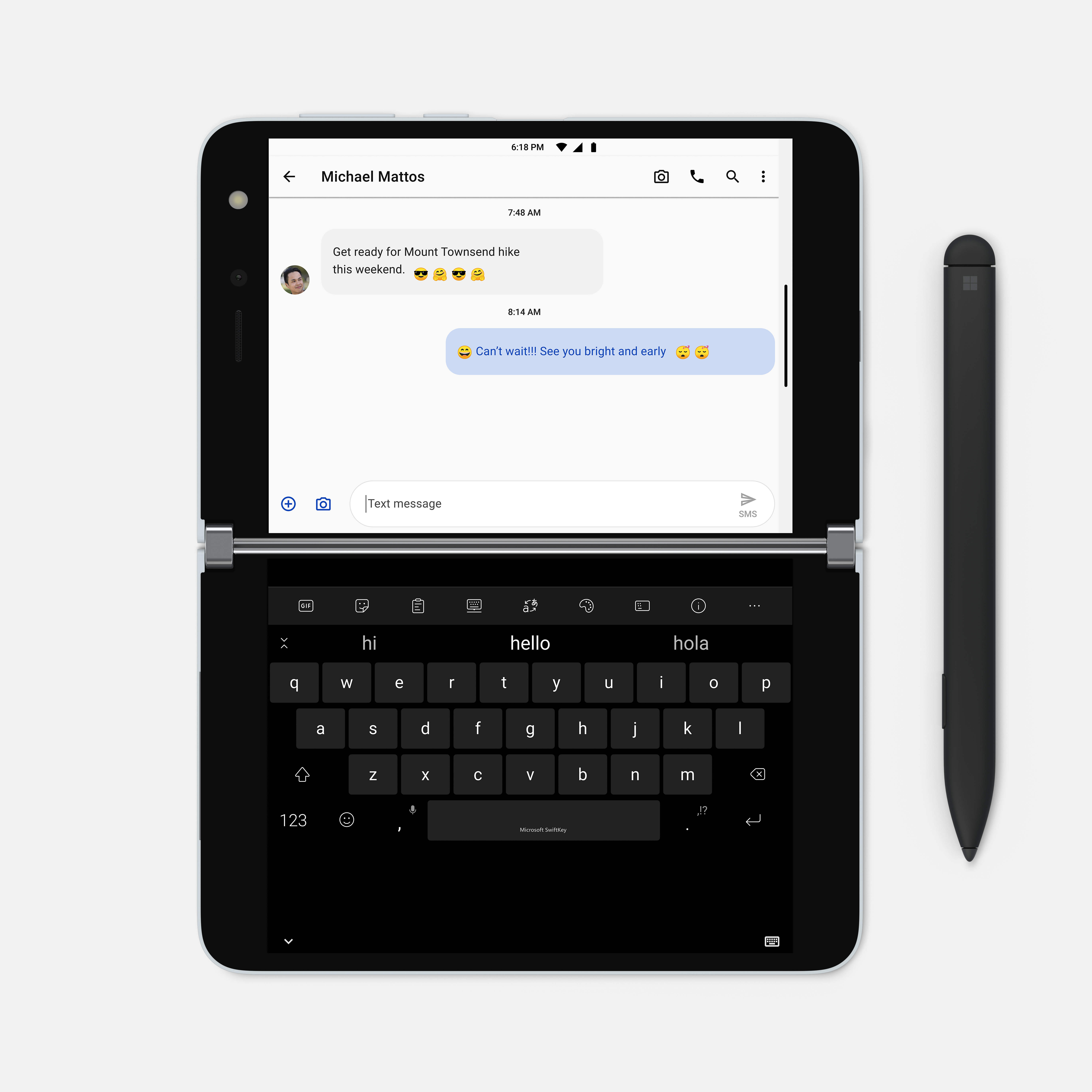
Microsoft’s dual-screen Surface Duo arrives September 10 for $1,399

I can’t recall the last time people were this intrigued by a (non-Xbox) piece of Microsoft hardware. Announced a little under a year ago amid a deluge of new devices, the Surface Duo turned a lot of heads, leaving many wondering whether the product amounted to more than a concept device.

Today, however, the dual-screen mobile device takes an important step closer to reality, with a release date and price. As a matter of fact, the Duo actually goes up for pre-order starting today. It’s set to arrive in stores on September 10. As for how much it costs, well, that’s bound to be a sticking point for some.

Image Credits: Microsoft

In the grand scheme of things, $1,399 isn’t a crazy price to pay for a dual-screen, perhaps. Certainly it pales in comparison to, say, the first generation of foldable mobile devices. But it will probably be enough to deter those who were simply casually interested in the new form factor.

The price tag seems to largely be a product of the Duo very much being a first-generation product for Microsoft. To hear the company, they built the system from the ground up, including the 360-degree hinge and a cabling system that allows for a pair of batteries, each hidden behind one of the screens.

I’ll preface this by saying I have not seen the Duo in person: COVID-19 has really put a damper on my ability to travel to events. That said, the hardware looks slick, and Microsoft has done a good job here building on top of the Android foundation to ensure there’s a dynamic two-screen experience. Again, the important caveat here being that some of those foldable devices also looked slick in the initial videos/demos, so I’m holding off on making any sort of sweeping judgments until I can get my hands on a unit.

Image Credits: Microsoft

Most additions to Android are focused on things like multi-tasking. The most obvious example of this is probably the App Groups, which lets users essentially pair two apps into a single icon on the desktop top. Tapping it will open them both at the same time, so you can, say, have a book open on one display and a note-taking app on the other. Or, perhaps, two social media apps, if you want to punish yourself.

Android is, perhaps, not the most obvious choice for Microsoft, which has devoted so much time to sticking Windows 10 on as many form factors as humanly possible. But it does, perhaps, represent some growth for a company committed to choosing the best software for this specific hardware, a decision that largely came down to the lack of mobile apps on Windows. The Duo is likely to start life as a niche device, but limiting the number of potential apps will only dampen its appeal.

In addition to its own first-party productivity apps, the company has already worked with a number of developers, including Amazon on a Kindle app — that certainly makes perfect sense for the dual-screen form factor, finally realizing some degree of the long-ago abandoned promise of the Courier device. Microsoft says apps will work across the dual-screens regardless, but an API will help developers further customize them for the unique form factor.

[gallery ids="2030165,2030198,2030196,2030195,2030194,2030193,2030189,2030188,2030187,2030186,2030185,2030184,2030183,2030182,2030181,2030180,2030179,2030178,2030177,2030176,2030175,2030174,2030173,2030172,2030171,2030170,2030169,2030167,2030166"]

As for why the company went dual-screen instead of foldable, that appears to mostly come down to materials. A foldable display would have made it much more difficult to cover the product with a sufficiently strong glass covering, which, in turn, would have made a pen input a bit of a non starter. And Microsoft’s Surface Pen is going to be a big part of the puzzle here (even if it’s not actually included in the $1,399 price tag).

There are, of course, trade-offs. Because there are always trade-offs. That’s just how this world works, friend. Here the biggest one seems to be the gap between screens. Sure, the two displays add up to a sizable 8.1 inches, but the gap plus the bezels could be a real pain when it comes to things like watching video on the thing.

Ultimately, I suspect the Duo will very much be a learning experience for Microsoft and the industry at large, but at the very least, it’s going to be one of the more interesting ones we’ve seen from a major vendor in recent years.

12 Aug 2020

TikTok found to have tracked Android users’ MAC addresses until late last year

Until late last year social video app TikTok was using an extra layer of encryption to conceal a tactic for tracking Android users via the MAC address of their device which skirted Google’s policies and did not allow users to opt out, The Wall Street Journal reports. Users were also not informed of this form of tracking, per its report.

Its analysis found that this concealed tracking ended in November as US scrutiny of the company dialled up, after at least 15 months during which TikTok had been gathering the fixed identifier without users’ knowledge.

A MAC address is a unique and fixed identifier assigned to an Internet connected device — which means it can be repurposed for tracking the individual user for profiling and ad targeting purposes, including by being able to re-link a user who has cleared their advertising ID back to the same device and therefore to all the prior profiling they wanted to jettison.

TikTok appears to have exploited a known bug on Android to gather users’ MAC addresses which Google has still failed to plug, per the WSJ.

A spokeswoman for TikTok did not deny the substance of its report, nor engage with specific questions we sent — including regarding the purpose of this opt-out-less tracking. Instead she sent the below statement, attributed to a spokesperson, in which company reiterates what has become a go-to claim that it has never given US user data to the Chinese government:

Under the leadership of our Chief Information Security Officer (CISO) Roland Cloutier, who has decades of experience in law enforcement and the financial services industry, we are committed to protecting the privacy and safety of the TikTok community. We constantly update our app to keep up with evolving security challenges, and the current version of TikTok does not collect MAC addresses. We have never given any US user data to the Chinese government nor would we do so if asked.

“We always encourage our users to download the most current version of TikTok,” the statement added.

With all eyes on TikTok, as the latest target of the Trump administration’s war on Chinese tech firms, scrutiny of the social video app’s handling of user data has inevitably dialled up.

And while no popular social app platform has its hands clean when it comes to user tracking and profiling for ad targeting, TikTok being owned by China’s ByteDance means its flavor of surveillance capitalism has earned it unwelcome attention from the US president — who has threatened to ban the app unless it sells its US business to a US company within a matter of weeks.

Trump’s fixation on China tech, generally, is centered on the claim that the tech firms pose threats to national security in the West via access to Western networks and/or user data.

The US government is able to point to China’s Internet security law which requires firms to provide the Chinese Communist Party with access to user data — hence TikTok’s emphatic denial of passing data. But the existence of the law makes such claims difficult to stick.

TikTok’s problems with user data don’t stop there, either. Yesterday it emerged that France’s data protection watchdog has been investigating TikTok since May, following a user complaint.

The CNIL’s concerns about how the app handled a user request to delete a video have since broadened to encompass issues related to how transparently it communicates with users, as well as to transfers of user data outside the EU — which, in recent weeks, have become even more legally complex in the region.

Compliance with EU rules on data access rights for users and the processing of minors’ information are other areas of stated concern for the regulator.

Under EU law any fixed identifier (e.g. a MAC address) is treated as personal data — meaning it falls under the bloc’s GDPR data protection framework, which places strict conditions on how such data can be processed, including requiring companies to have a legal basis to collect it in the first place.

If TikTok was concealing its tracking of MAC addresses from users it’s difficult to imagine what legal basis it could claim — consent would certainly not be possible. The penalties for violating GDPR can be substantial (France’s CNIL slapped Google with a $57M fine last year under the same framework, for example).

The WSJ’s report notes that the FTC has said MAC addresses are considered personally identifiable information under the Children’s Online Privacy Protection Act — implying the app could also face a regulatory probe on that front, to add to its pile of US problems.

Presented with the WSJ’s findings, Senator Josh Hawley (R., Mo.) told the newspaper that Google should remove TikTok’s app from its store. “If Google is telling users they won’t be tracked without their consent and knowingly allows apps like TikTok to break its rules by collecting persistent identifiers, potentially in violation of our children’s privacy laws, they’ve got some explaining to do,” he said.

We’ve reached out to Google for comment.

12 Aug 2020

Digital mortgage company Habito completes £35M Series C

Habito, the London startup that has spent the last few years moving the mortgage process online, including offering its own mortgages beyond acting as a broker, has completed £35 million in Series C funding.

The newly disclosed round — comprising an earlier Series C equity raise and a more recent Series C extension in the form of a convertible loan note, was led by new investors Augmentum Fintech, SBI Group and mojo.capital, with participation from various existing investors including Ribbit Capital, Atomico and Mosaic Ventures.

The convertible loan was also matched by the U.K. taxpayer-funded Future Fund, set up by the government to help mitigate the coronavirus crisis’ affect on the country’s venture-backed startup ecosystem. It brings the total raised by Habito to just over £63 million since launching in 2016.

In a call, Habito founder Daniel Hegarty that the new investment will be used by the company to continue digitising aspects of home financing and buying which still remain a pain-point for homebuyers and sellers.

The fintech/proptech started out by offering a digital mortgage brokerage, promising to help you secure a new mortgage and monitor the competitiveness of your existing mortgage. The idea was to make applying for or switching mortgages as frictionless as possible.

In July 2019, Habito announced that it would begin direct lending via its own range of mortgages. Starting with ‘buy to let’ mortgages, the move saw the company expand beyond brokerage after it received regulatory approval to become a mortgage lender. By doing so, the aim was to cut the timeframe from mortgage application to offer in half, enabled in part by Habito’s integration with the conveyancing process to add more transparency for the homebuyer, while the number of documents needed was also significantly reduced.

In January this year, Habito launched “Habito Plus,” something getting closer to an end-to-end homebuying service. It brings together a buyer’s mortgage application, conveyancing needs and surveys “under one roof” — which feels less vitamin pill and more actual painkiller for anyone who has ever experienced having to deal with and coordinate all of the various stakeholders and parties involved in buying or selling a property.

Most recently, Habito launched its broker portal, providing more than 3,000 external brokers access to its own buy-to-let mortgage products and “Instant Decision” technology capabilities. Hegarty tells me the company intends to develop a suite of “innovative” residential mortgage products for all types of homeowners, not just ‘buy to let’.

Notably, Habito recently become a “B Corp” certified company, meaning it has made a legal commitment to put “people and planet on the same level as profit”. Resembling somewhat of a movement, there are more than 3,000 accredited B Corp companies globally, including Ben & Jerry’s, Patagonia, and WeTransfer.