Year: 2020

11 Aug 2020

‘Stalkerware’ phone spying apps have escaped Google’s ad ban

Several companies offering phone-spying apps — known as “stalkerware” — are still advertising in Google search results, despite the search giant’s ban that took effect today, TechCrunch has found.

These controversial apps are often pitched to help parents snoop on their child’s calls, messages, apps and other private data under the guise of helping to protect against online predators.

But some repurpose these apps to spy on their spouses — often without their permission.

It’s a problem that the wider tech industry has worked to tackle. Security firms and antivirus makers are working to combat the rise of stalkerware, and federal authorities have taken action when app makers have violated the law.

One of the biggest actions to date came last month when Google announced an updated ads policy, effectively banning companies from advertising phone-snooping apps “with the express purpose of tracking or monitoring another person or their activities without their authorization.”

Google gave these companies until August 11 to remove these ads.

But TechCrunch found seven companies known to provide stalkerware — including FlexiSpy, mSpy, WebWatcher and KidsGuard — were still advertising in Google search results after the ban took effect.

Google did not say explicitly say if the stalkerware apps violated its policy, but told TechCrunch that it removed ads for WebWatcher. Despite the deadline, Google said that enforcement is not always immediate.

“We recently updated our policies to prohibit ads promoting spyware for partner surveillance while still allowing ads for technology that helps parents monitor their underage children,” said a Google spokesperson. “To prevent deceitful actors who try to disguise the product’s intent and evade our enforcement, we look at several signals like the ad text, creative and landing page, among others, for policy compliance. When we find that an ad or advertiser is violating our policies, we take immediate action.”

The policy is evidently far from perfect. Google faced immediate criticism for carving out exceptions to its new policy for “products or services designed for parents to track or monitor their underage children.”

Malwarebytes, one of several antivirus makers that pledged to help fight stalkerware, called the policy “incomplete,” in large part because the “the line between stalkerware-type applications and parental monitoring applications can be blurred.”

In this case, several of the stalkerware apps explicitly state how their apps could be used to spy on spouses.

For instance, mSpy’s website said the app can be used to spy on “your children, wife, or colleagues.” KidsGuard, which had a massive security lapse last year that exposed thousands of surveilled users, explicitly says on its homepage that its app can “catch a cheating spouse.” Two other app makers, Spyic and PhoneSpector, still have dozens of blog posts on their website explicitly referencing spying on spouses.

Last year the Electronic Frontier Foundation founded the Coalition Against Stalkerware, a group of academics, companies and nonprofits to help detect, combat and raise awareness of stalkerware.


Send tips securely over Signal and WhatsApp to +1 646-755-8849 or send an encrypted email to: zack.whittaker@protonmail.com

11 Aug 2020

‘Stalkerware’ phone spying apps have escaped Google’s ad ban

Several companies offering phone-spying apps — known as “stalkerware” — are still advertising in Google search results, despite the search giant’s ban that took effect today, TechCrunch has found.

These controversial apps are often pitched to help parents snoop on their child’s calls, messages, apps and other private data under the guise of helping to protect against online predators.

But some repurpose these apps to spy on their spouses — often without their permission.

It’s a problem that the wider tech industry has worked to tackle. Security firms and antivirus makers are working to combat the rise of stalkerware, and federal authorities have taken action when app makers have violated the law.

One of the biggest actions to date came last month when Google announced an updated ads policy, effectively banning companies from advertising phone-snooping apps “with the express purpose of tracking or monitoring another person or their activities without their authorization.”

Google gave these companies until August 11 to remove these ads.

But TechCrunch found seven companies known to provide stalkerware — including FlexiSpy, mSpy, WebWatcher and KidsGuard — were still advertising in Google search results after the ban took effect.

Google did not say explicitly say if the stalkerware apps violated its policy, but told TechCrunch that it removed ads for WebWatcher. Despite the deadline, Google said that enforcement is not always immediate.

“We recently updated our policies to prohibit ads promoting spyware for partner surveillance while still allowing ads for technology that helps parents monitor their underage children,” said a Google spokesperson. “To prevent deceitful actors who try to disguise the product’s intent and evade our enforcement, we look at several signals like the ad text, creative and landing page, among others, for policy compliance. When we find that an ad or advertiser is violating our policies, we take immediate action.”

The policy is evidently far from perfect. Google faced immediate criticism for carving out exceptions to its new policy for “products or services designed for parents to track or monitor their underage children.”

Malwarebytes, one of several antivirus makers that pledged to help fight stalkerware, called the policy “incomplete,” in large part because the “the line between stalkerware-type applications and parental monitoring applications can be blurred.”

In this case, several of the stalkerware apps explicitly state how their apps could be used to spy on spouses.

For instance, mSpy’s website said the app can be used to spy on “your children, wife, or colleagues.” KidsGuard, which had a massive security lapse last year that exposed thousands of surveilled users, explicitly says on its homepage that its app can “catch a cheating spouse.” Two other app makers, Spyic and PhoneSpector, still have dozens of blog posts on their website explicitly referencing spying on spouses.

Last year the Electronic Frontier Foundation founded the Coalition Against Stalkerware, a group of academics, companies and nonprofits to help detect, combat and raise awareness of stalkerware.


Send tips securely over Signal and WhatsApp to +1 646-755-8849 or send an encrypted email to: zack.whittaker@protonmail.com

11 Aug 2020

‘Stalkerware’ phone spying apps have escaped Google’s ad ban

Several companies offering phone-spying apps — known as “stalkerware” — are still advertising in Google search results, despite the search giant’s ban that took effect today, TechCrunch has found.

These controversial apps are often pitched to help parents snoop on their child’s calls, messages, apps and other private data under the guise of helping to protect against online predators.

But some repurpose these apps to spy on their spouses — often without their permission.

It’s a problem that the wider tech industry has worked to tackle. Security firms and antivirus makers are working to combat the rise of stalkerware, and federal authorities have taken action when app makers have violated the law.

One of the biggest actions to date came last month when Google announced an updated ads policy, effectively banning companies from advertising phone-snooping apps “with the express purpose of tracking or monitoring another person or their activities without their authorization.”

Google gave these companies until August 11 to remove these ads.

But TechCrunch found seven companies known to provide stalkerware — including FlexiSpy, mSpy, WebWatcher and KidsGuard — were still advertising in Google search results after the ban took effect.

Google did not say explicitly say if the stalkerware apps violated its policy, but told TechCrunch that it removed ads for WebWatcher. Despite the deadline, Google said that enforcement is not always immediate.

“We recently updated our policies to prohibit ads promoting spyware for partner surveillance while still allowing ads for technology that helps parents monitor their underage children,” said a Google spokesperson. “To prevent deceitful actors who try to disguise the product’s intent and evade our enforcement, we look at several signals like the ad text, creative and landing page, among others, for policy compliance. When we find that an ad or advertiser is violating our policies, we take immediate action.”

The policy is evidently far from perfect. Google faced immediate criticism for carving out exceptions to its new policy for “products or services designed for parents to track or monitor their underage children.”

Malwarebytes, one of several antivirus makers that pledged to help fight stalkerware, called the policy “incomplete,” in large part because the “the line between stalkerware-type applications and parental monitoring applications can be blurred.”

In this case, several of the stalkerware apps explicitly state how their apps could be used to spy on spouses.

For instance, mSpy’s website said the app can be used to spy on “your children, wife, or colleagues.” KidsGuard, which had a massive security lapse last year that exposed thousands of surveilled users, explicitly says on its homepage that its app can “catch a cheating spouse.” Two other app makers, Spyic and PhoneSpector, still have dozens of blog posts on their website explicitly referencing spying on spouses.

Last year the Electronic Frontier Foundation founded the Coalition Against Stalkerware, a group of academics, companies and nonprofits to help detect, combat and raise awareness of stalkerware.


Send tips securely over Signal and WhatsApp to +1 646-755-8849 or send an encrypted email to: zack.whittaker@protonmail.com

11 Aug 2020

Zin Boats reinvents the electric speedboat in a bid to become the Tesla of the sea

The automotive industry is knee deep in the vast transition to electric, but one place where gas is still going strong is out on the water. Seattle startup Zin Boats wants to start what you might call a sea change by showing, as Tesla did with cars, that an electric boat can be not just better for the planet, but better in almost every other way as well.

With a minimalist design like a silver bullet, built almost entirely from carbon fiber, the 20-foot Z2R is less than half the weight of comparable craft, letting it take off like a shot and handle easily, while also traveling a hundred miles on a charge — and you can fill the “tank” for about five bucks in an hour or so.

Waiting for the other shoe to drop? Well, it ain’t cheap. But then, few boats are.

Piotr Zin, the company’s namesake, has been designing racing sailboats for 20 years, while working in industrial design at BMW, GM, and other major companies. Soon after settling down on a houseboat on Seattle’s Lake Union, he realized that the waterways he had enjoyed his whole life might not exist for the next generation.

(Disclosure: Zin actually moved in next door to my mother, and I happened to find out he was working on this while visiting her.)

“The reason I started working on electric boats specifically is because I had a kid, and I had a come to Jesus moment,” he told me. “I realized: If we’re not going to do something personally about the quality of the water we live in, it’s not going to be here when my kid is my age.”

Illustrious precursors

Traditional gas-powered boats are very much a product of the distant past, like running a ’70s-era car half underwater. Surprisingly, electric boats are equally old. Like electric cars, they enjoyed a brief vogue in the early 20th century. And likewise they were never considered viable for “real” boating until quite recently.
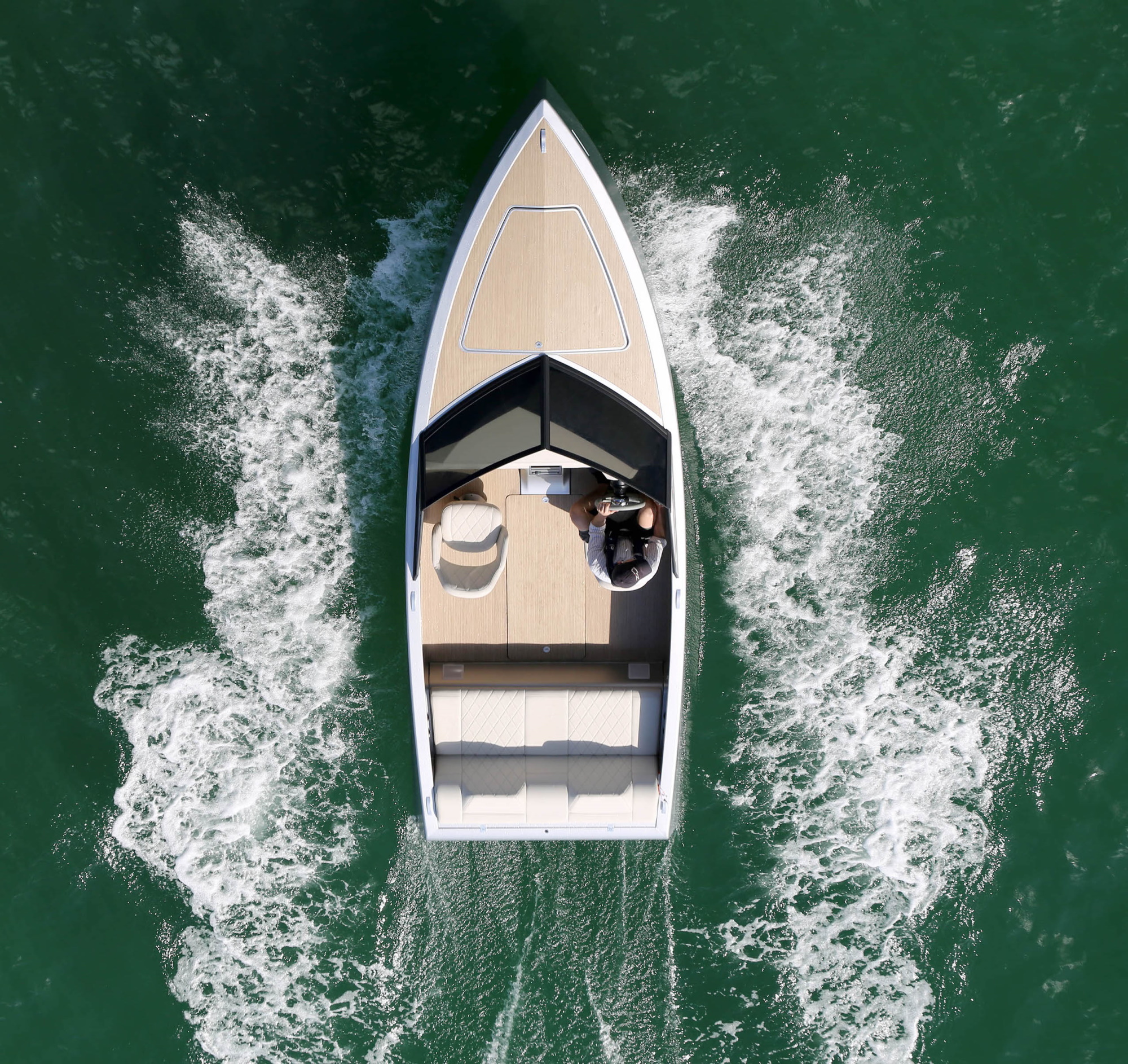
Image Credits: Zin Boats

Like most things, it comes down to physics: “The power required to move a boat, versus the power to move a car, is absolutely enormous,” Zin explained. “It’s like driving a car in first gear at full throttle all the time.”

That level of draw limited electric boats to being the aquatic equivalent of golf carts — in fact, carts and some of the more popular old-school electric boats share many components. If you’ve ridden in one, it was probably a Duffy, which has made models for puttering around lakes at 3-4 knots since the ’60s. Perfectly pleasant, but not exactly thrilling.

“We tested this boat to 55, but decided not to sell that to people. It’s just insane.”
What changed everything was the increasing density and falling cost of lithium-ion batteries. The Z2R uses BMW batteries mated to a custom Torqueedo engine, and at cruising speeds (say 15 knots) can go a hundred miles or more. It recharges using anything from an ordinary wall plug to the high-amperage charging cables found at most marinas (in which case it will put another 50 miles in the tank while you eat a sandwich). Considering traditional boats’ fuel efficiency and the rising price of marine gas, going electric might save a boat owner thousands every year.

But it’s also more than capable of going extremely fast.

“The top speed is way over 30 knots,” Zin noted. “We tested this boat to 55, but decided not to sell that to people. It’s just insane.”

Having ridden in it myself, I can confirm that the Z2R really jumps off the line in a level-bottomed way that, compounded by its near silence, seems impossible. Just as Tesla’s consumer sedans compete with Lamborghinis in 0-60 times, the instantaneous response from is almost frightening.

“The boat was designed around the battery. The unique part of using an electric system is we can put the motor anywhere we want,” Zin said. By sitting it flat on the bottom, the center of gravity is lowered and weight distribution evened out compared to most speedboats. “You look at a lot of traditional boats’ builds, they kind of cram everything in the back. Then when you put the hammer down, you can’t see anything for five seconds. In this boat, there’s no bow rise — it sits flat.”
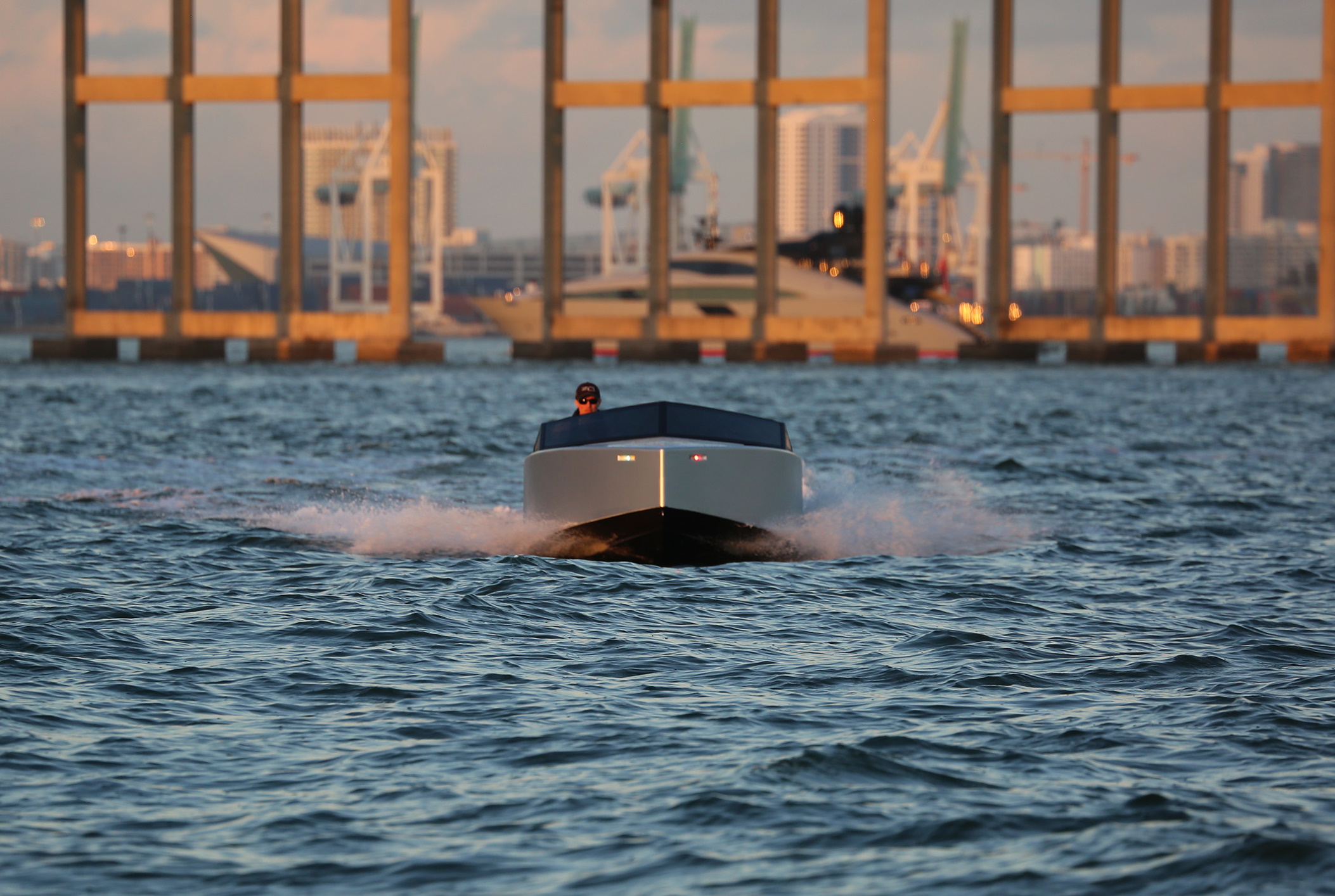
Front view of the electric Z2R boat.

Image Credits: Zin Boats

Being so level means there’s almost no risk of overturning it, or many of the other failure modes resulting from lopsided designs that misbehave at speed. Simplicity of operation and surprising performance seem to be a family characteristic of electric vehicles.

Design by wire

“Most builders aren’t about innovation, they’re about ‘this is how we do it.’ “
Zin is proud to have designed the boat himself from scratch, using both high performance fluid dynamics software and scale models to work out the shape of the hull.

“Boat building is a very traditional business. Most builders aren’t about innovation, they’re about ‘this is how we do it.’ ” Zin said. “But there’s a huge advantage in being able to use these tools. The computing power that we have in video cards just in the last few years, mainly because of the gaming industry, has pushed what’s possible further and further.”

Previously, large computational fluid dynamics suites would have users submit their parameters and pick a few milestone speeds at X thousand dollars per data point — 10 knots, 20 knots, etc. The way the water would react to the boat and vice versa would be calculated at those speeds and extrapolated for speeds in between. But with increases in computing power, that’s no longer necessary, as Zin ended up proving to a commercial CFD software provider when he used a separate compute stack to calculate the water’s behavior continuously at all speeds and in high definition.

“Right now you can run the boat [in the simulation] at any speed you want and see the way the water will spray, including little droplets. And then you can tweak the shape of your hull to make sure those droplets don’t hit the passengers,” he said. “It’s not exactly the way most boat designers would do it. So utilizing high end software that was not really being given its full potential was amazing.”

Building practically everything out of carbon fiber (an ordeal of its own) puts the whole boat at around 1,700 pounds — normally a 20-foot boat would be twice that or more. That’s crucial for making sure the boat can go long distances; Range anxiety is if anything a bigger problem on the water than on the road. And of course it means it’s quick and easy to control.
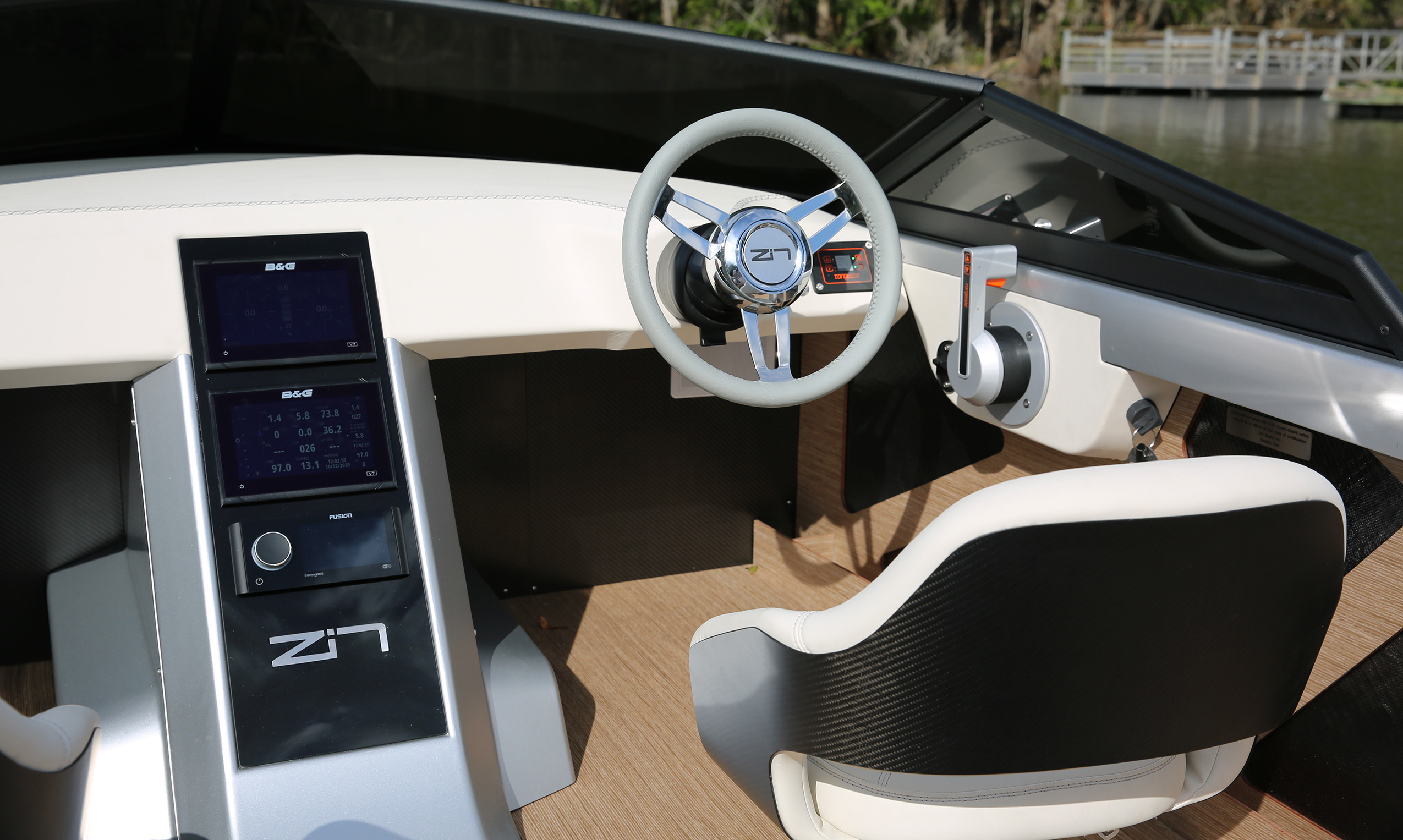
Interior of the Z2R electric boat.

Image Credits: Zin Boats

Yet the boat hardly screams speed. The large open cockpit is flat and spacious, with only a steering wheel, throttle, and screens with friendly readouts for range, media controls, GPS and so on. There’s no vibration or engine roar. No aesthetic choices like stripes or lines suggest its explosive performance. The wood veneer (to save weight — and it’s tuned to the speakers to provide better sound) floor and cream leather upholstery make it feel more like a floating Mercedes.

That’s not an accident. Zin’s first customers are the type of people who can afford a boat that costs $250,000 or so. He compared it to Tesla’s Roadster: A showy vehicle aimed at the high end that will fund and prove out the demand for a more practical one — an open-bow tender model Zin is already designing that will cost more like $175,000.

Conscience with a wallet

The target consumer is one who has money and an eco-conscious outlook — either of their own or by necessity.

“There are a lot of inquiries from Europe, where the environmental restrictions are stricter than in North America. But we also have a number of pristine lakes that are electric only for the purpose of keeping them clean,” Zin explained. “So if you live on a lake in Montana that’s electric only, you have the option to go at five knots, and you can’t even cross the lake because the boat is so slow… or you can have a fully functional powerboat that you can water ski behind, the same speeds you get in a gas power boat, but it’s absolutely emissions free. I mean, this boat is as clean as it gets — there’s zero oil, zero gasoline, zero anything that will get into the water.”

It really made me wonder why the whole industry didn’t go electric years ago. And in fact there are a few competitors, but they tend to be even more niche or piecemeal jobs, mating an electric engine to an existing hull and saying it’s an electric boat that goes 50 knots. And it does — for five or ten minutes. Or there are custom boat builders who will create something quite nice for a Zin-type customer — head on over to Monte Carlo and buy one at auction for a couple million bucks.

Side view at night of the Z2R Electric boat.

Image Credits: Zin Boats

Zin sees his boat as the first one to check every box and a few that weren’t there before. As fast as a powerboat but nearly silent; same range but a fraction of the price to get there; handles like a dream but requires practically no maintenance. It’s as smart as the smartest car, limiting its speed based on the waterway, automatically adjusting itself to stay within range of a safe harbor or charger, over-the-air updates to the software anywhere in the world. I didn’t even get a change to ask about its self-driving capabilities.

As a first time founder, a technical one at that, of a hardware company, Zin has his work cut out for him. He’s raised seed money to get the prototype and production model ready, but needs capital to start filling his existing orders faster. Like many other startups, he was just gearing up to go all out when the pandemic struck, shutting down production completely. But they’re just about ready to start manufacturing again.
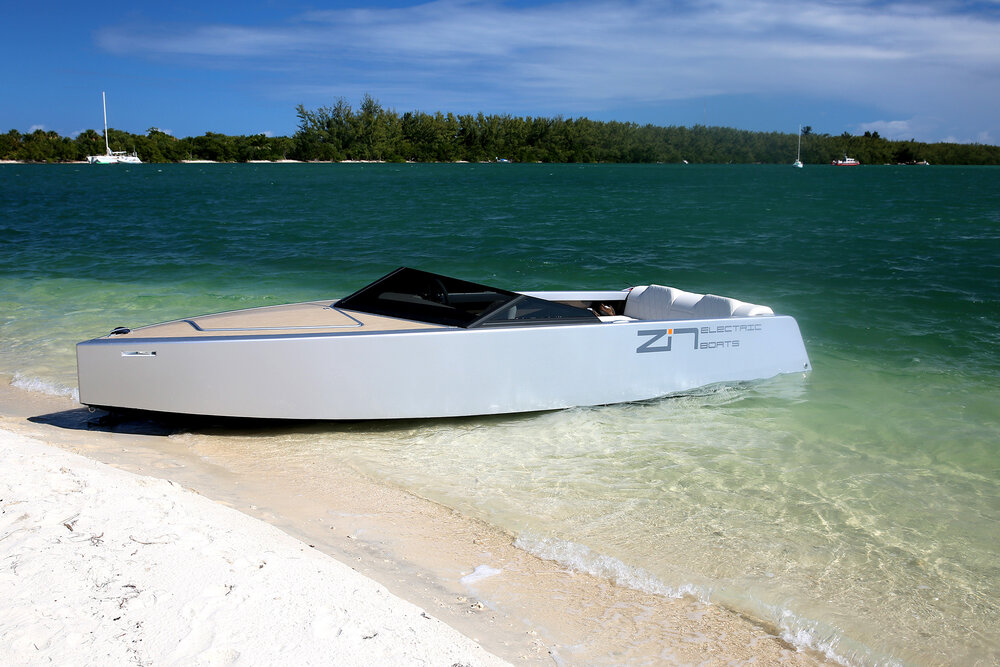
Image Credits: Zin Boats

“I realized that there isn’t such a thing as a boat company any more,” said Zin. “Part of what we do is to build that shell that holds everything, and it happens to be moving through the water, which makes it a boat, but that really where the boating part of it ends. It’s really a technology hub, and my company is not just a boat company, it has to be a technology company.”

He said that his investors understand that this isn’t a one-off toy but the beginnings of an incredibly valuable IP that — well, with Tesla’s success, the pitch writes itself.

“We don’t only have a plan like, just make one really fast boat,” Zin concluded. “We know what we want to do with this technology right now, we know what we’re going to do with this technology in 24 months, and 48 months, I wish I could show you some of this stuff. It’s tough, and we need to survive this year, but this is just the start.”


11 Aug 2020

Zin Boats reinvents the electric speedboat in a bid to become the Tesla of the sea

The automotive industry is knee deep in the vast transition to electric, but one place where gas is still going strong is out on the water. Seattle startup Zin Boats wants to start what you might call a sea change by showing, as Tesla did with cars, that an electric boat can be not just better for the planet, but better in almost every other way as well.

With a minimalist design like a silver bullet, built almost entirely from carbon fiber, the 20-foot Z2R is less than half the weight of comparable craft, letting it take off like a shot and handle easily, while also traveling a hundred miles on a charge — and you can fill the “tank” for about five bucks in an hour or so.

Waiting for the other shoe to drop? Well, it ain’t cheap. But then, few boats are.

Piotr Zin, the company’s namesake, has been designing racing sailboats for 20 years, while working in industrial design at BMW, GM, and other major companies. Soon after settling down on a houseboat on Seattle’s Lake Union, he realized that the waterways he had enjoyed his whole life might not exist for the next generation.

(Disclosure: Zin actually moved in next door to my mother, and I happened to find out he was working on this while visiting her.)

“The reason I started working on electric boats specifically is because I had a kid, and I had a come to Jesus moment,” he told me. “I realized: If we’re not going to do something personally about the quality of the water we live in, it’s not going to be here when my kid is my age.”

Illustrious precursors

Traditional gas-powered boats are very much a product of the distant past, like running a ’70s-era car half underwater. Surprisingly, electric boats are equally old. Like electric cars, they enjoyed a brief vogue in the early 20th century. And likewise they were never considered viable for “real” boating until quite recently.

Image Credits: Zin Boats

Like most things, it comes down to physics: “The power required to move a boat, versus the power to move a car, is absolutely enormous,” Zin explained. “It’s like driving a car in first gear at full throttle all the time.”

That level of draw limited electric boats to being the aquatic equivalent of golf carts — in fact, carts and some of the more popular old-school electric boats share many components. If you’ve ridden in one, it was probably a Duffy, which has made models for puttering around lakes at 3-4 knots since the ’60s. Perfectly pleasant, but not exactly thrilling.

“We tested this boat to 55, but decided not to sell that to people. It’s just insane.”
What changed everything was the increasing density and falling cost of lithium-ion batteries. The Z2R uses BMW batteries mated to a custom Torqueedo engine, and at cruising speeds (say 15 knots) can go a hundred miles or more. It recharges using anything from an ordinary wall plug to the high-amperage charging cables found at most marinas (in which case it will put another 50 miles in the tank while you eat a sandwich). Considering traditional boats’ fuel efficiency and the rising price of marine gas, going electric might save a boat owner thousands every year.

But it’s also more than capable of going extremely fast.

“The top speed is way over 30 knots,” Zin noted. “We tested this boat to 55, but decided not to sell that to people. It’s just insane.”

Having ridden in it myself, I can confirm that the Z2R really jumps off the line in a level-bottomed way that, compounded by its near silence, seems impossible. Just as Tesla’s consumer sedans compete with Lamborghinis in 0-60 times, the instantaneous response from is almost frightening.

“The boat was designed around the battery. The unique part of using an electric system is we can put the motor anywhere we want,” Zin said. By sitting it flat on the bottom, the center of gravity is lowered and weight distribution evened out compared to most speedboats. “You look at a lot of traditional boats’ builds, they kind of cram everything in the back. Then when you put the hammer down, you can’t see anything for five seconds. In this boat, there’s no bow rise — it sits flat.”

Front view of the electric Z2R boat.

Image Credits: Zin Boats

Being so level means there’s almost no risk of overturning it, or many of the other failure modes resulting from lopsided designs that misbehave at speed. Simplicity of operation and surprising performance seem to be a family characteristic of electric vehicles.

Design by wire

“Most builders aren’t about innovation, they’re about ‘this is how we do it.’ “
Zin is proud to have designed the boat himself from scratch, using both high performance fluid dynamics software and scale models to work out the shape of the hull.

“Boat building is a very traditional business. Most builders aren’t about innovation, they’re about ‘this is how we do it.’ ” Zin said. “But there’s a huge advantage in being able to use these tools. The computing power that we have in video cards just in the last few years, mainly because of the gaming industry, has pushed what’s possible further and further.”

Previously, large computational fluid dynamics suites would have users submit their parameters and pick a few milestone speeds at X thousand dollars per data point — 10 knots, 20 knots, etc. The way the water would react to the boat and vice versa would be calculated at those speeds and extrapolated for speeds in between. But with increases in computing power, that’s no longer necessary, as Zin ended up proving to a commercial CFD software provider when he used a separate compute stack to calculate the water’s behavior continuously at all speeds and in high definition.

“Right now you can run the boat [in the simulation] at any speed you want and see the way the water will spray, including little droplets. And then you can tweak the shape of your hull to make sure those droplets don’t hit the passengers,” he said. “It’s not exactly the way most boat designers would do it. So utilizing high end software that was not really being given its full potential was amazing.”

Building practically everything out of carbon fiber (an ordeal of its own) puts the whole boat at around 1,700 pounds — normally a 20-foot boat would be twice that or more. That’s crucial for making sure the boat can go long distances; Range anxiety is if anything a bigger problem on the water than on the road. And of course it means it’s quick and easy to control.

Interior of the Z2R electric boat.

Image Credits: Zin Boats

Yet the boat hardly screams speed. The large open cockpit is flat and spacious, with only a steering wheel, throttle, and screens with friendly readouts for range, media controls, GPS and so on. There’s no vibration or engine roar. No aesthetic choices like stripes or lines suggest its explosive performance. The wood veneer (to save weight — and it’s tuned to the speakers to provide better sound) floor and cream leather upholstery make it feel more like a floating Mercedes.

That’s not an accident. Zin’s first customers are the type of people who can afford a boat that costs $250,000 or so. He compared it to Tesla’s Roadster: A showy vehicle aimed at the high end that will fund and prove out the demand for a more practical one — an open-bow tender model Zin is already designing that will cost more like $175,000.

Conscience with a wallet

The target consumer is one who has money and an eco-conscious outlook — either of their own or by necessity.

“There are a lot of inquiries from Europe, where the environmental restrictions are stricter than in North America. But we also have a number of pristine lakes that are electric only for the purpose of keeping them clean,” Zin explained. “So if you live on a lake in Montana that’s electric only, you have the option to go at five knots, and you can’t even cross the lake because the boat is so slow… or you can have a fully functional powerboat that you can water ski behind, the same speeds you get in a gas power boat, but it’s absolutely emissions free. I mean, this boat is as clean as it gets — there’s zero oil, zero gasoline, zero anything that will get into the water.”

It really made me wonder why the whole industry didn’t go electric years ago. And in fact there are a few competitors, but they tend to be even more niche or piecemeal jobs, mating an electric engine to an existing hull and saying it’s an electric boat that goes 50 knots. And it does — for five or ten minutes. Or there are custom boat builders who will create something quite nice for a Zin-type customer — head on over to Monte Carlo and buy one at auction for a couple million bucks.

Side view at night of the Z2R Electric boat.

Image Credits: Zin Boats

Zin sees his boat as the first one to check every box and a few that weren’t there before. As fast as a powerboat but nearly silent; same range but a fraction of the price to get there; handles like a dream but requires practically no maintenance. It’s as smart as the smartest car, limiting its speed based on the waterway, automatically adjusting itself to stay within range of a safe harbor or charger, over-the-air updates to the software anywhere in the world. I didn’t even get a change to ask about its self-driving capabilities.

As a first time founder, a technical one at that, of a hardware company, Zin has his work cut out for him. He’s raised seed money to get the prototype and production model ready, but needs capital to start filling his existing orders faster. Like many other startups, he was just gearing up to go all out when the pandemic struck, shutting down production completely. But they’re just about ready to start manufacturing again.

Image Credits: Zin Boats

“I realized that there isn’t such a thing as a boat company any more,” said Zin. “Part of what we do is to build that shell that holds everything, and it happens to be moving through the water, which makes it a boat, but that really where the boating part of it ends. It’s really a technology hub, and my company is not just a boat company, it has to be a technology company.”

He said that his investors understand that this isn’t a one-off toy but the beginnings of an incredibly valuable IP that — well, with Tesla’s success, the pitch writes itself.

“We don’t only have a plan like, just make one really fast boat,” Zin concluded. “We know what we want to do with this technology right now, we know what we’re going to do with this technology in 24 months, and 48 months, I wish I could show you some of this stuff. It’s tough, and we need to survive this year, but this is just the start.”
11 Aug 2020

No pen required: The digital future of real estate closings

On a Wednesday at 4 p.m. in June 2017, I was in a small, packed office in midtown Manhattan.

The overcrowded conference room, with at least five more people than any fire marshal would recommend, was stacked comically high with paperwork and an eclectic collection of cheap pens. As I neared the end of the third hour and the ink of my seventh pen, I realized the mortgage closing process may be somewhat antiquated.

After closing on my first home, it was inconceivable to me that every other expense in my life has gone digital, but the most significant purchase I’ve ever made required hundreds of signatures and several handwritten checks delivered in person. By comparison, I have been able to repay my student loans, comparable in magnitude to a down payment, exclusively through online portals.

How COVID-19 is accelerating digital advancements

The COVID-19 pandemic has changed nearly every facet of our lives. One potential silver lining for the real estate world may be a forced reckoning with the mortgage closing process. Technological advances like e-closings are accelerating this arduous process into the digital age. The U.S. Census Bureau released figures in July citing the rise in homeownership across the country as the pandemic fuels the demand for single-family properties outside of urban areas. This is confirmed by the significant spike in mortgage applications seen in the second quarter of 2020.

The first signs of digitization of the mortgage origination process were seen in mid-2010 when lenders began adopting digital disclosures. Despite the availability of technology, the market has been slower to fully embrace digital closings that enable the full loan package to be electronically reviewed, recorded, signed and notarized. A true e-closing includes a digital promissory note (“eNote”), a virtual closing appointment and the electronic transfer and recording of documents by the county, all of which can be remotely coordinated and executed by the parties involved. The market started to pick up pace in recent years, and we’ve seen the number of e-mortgages increase by more than 450% from 2018 to 2019.

11 Aug 2020

Scribd acquires presentation-sharing service SlideShare from LinkedIn

SlideShare has a new owner, with LinkedIn selling the presentation-sharing service to Scribd for an undisclosed price.

According to LinkedIn, Scribd will take over operation of the SlideShare business on September 24.

Scribd CEO Trip Adler argued that the companies have very similar roots, both launching in 2006/2007 with stories on TechCrunch, and both of them focused on content- and document-sharing.

“The two products always had kind of similar missions,” Adler said. “The difference was, [SlideShare] focused on more on PowerPoint presentations and business users, while we focused more on PDFs and Word docs and long-form written content, more on the more general consumer.”

Over time, the companies diverged even further, with SlideShare acquired by LinkedIn in 2012, and LinkedIn itself acquired by Microsoft in 2016.

Scribd, meanwhile, launching a Netflix-style subscription service for e-books and audiobooks, but Adler said that both the “user-generated side” and the “premium side” remain important to the business.

“We get people who come in looking for documents, then sign up for our premium content,” he said. “But they do continue to read documents, too.”

So when Microsoft and LinkedIn approached Scribd about acquiring SlideShare, Adler saw an opportunity to expand the document side of the business. Specifically, he pointed to SlideShare’s content library of 40 million presentations and its audience of 100 million monthly unique visitors.

The deal, Adler said, is fundamentally about tapping into SlideShare’s “content and audience,” though he said there may be aspects of the service’s technology that Scribd could incorporate as well. Scribd isn’t taking on any new employees as part of the deal; instead, its existing team is taking responsibility for SlideShare’s operation.

He added that SlideShare will continue to operate as a standalone service, separate from Scribd, and that he’s hopeful that it will continue to be well-integrated with LinkedIn.

“Nothing will change in the initial months,” Adler said. “We have a lot of experience with a product like this, both the technology stack and with users uploading content. We’re in a good position make slide share really successful.”

Meanwhile, a statement from LinkedIn Vice President of Engineering Chris Pruett highlighted the work that the company has done on SlideShare since the acquisition:

LinkedIn acquired SlideShare in May 2012 at a time when it was becoming clear that professionals were using LinkedIn for more than making professional connections. Over the last eight years, the SlideShare team, product, and community has helped shape the content experience on LinkedIn. We’ve incorporated the ability to upload, share, and discuss documents on LinkedIn.

11 Aug 2020

The robots occupying our sidewalks

The robot, shaped like a large cooler on wheels, zipped along somewhere ahead of me. My left hand clasped the smooth leather harness of my German shepherd guide dog. “Mylo, forward.” The speed of his four short legs complemented the strides of my longer two — call it the six feet fox trot. Together we glided past the competition.

My quarantine buddy stayed behind filming the race. Mylo: 1, Robot: 0.

The Mountain View City Council voted on May 5, 2020 to allow Starship Technologies’ robots on city streets. Founded in 2014, Starship operates no-contact delivery robots in several cities around the world. Customers schedule deliveries of food, groceries or other packages through the Starship app.

My amusement with the little robots shifted to curiosity. Thirty years after the Americans with Disabilities Act of 1990, many tech companies still fail to design for disability. How would the autonomous robots react to disabled pedestrians?

About 10 feet down the sidewalk, I stopped and turned around. Mylo tensed, his alarm crawling up my arm. The white visage of the robot stopped about a foot from his nose.

I hoped the robot would identify a pedestrian and roll away, but it stayed put. Mylo relaxed into a sitting position — guide dog school didn’t teach him about the robot apocalypse. I scratched his ears and he leaned into my hands. The robot was not moved.

More than 61 million people in the U.S. have disabilities, a significant number of whom use wheelchairs, scooters, walkers and other mobility devices. Emily Ackerman, a power wheelchair user and University of Pittsburgh Ph.D. student, encountered a Starship robot while crossing a busy four-lane street; she needed the curb cut it occupied. “I managed to squeeze myself up on the sidewalk in a panic, climbing the curb outside the curb cut in fear of staying in the street any longer — a move that causes a painful jolt and could leave me stuck halfway up if I’m not careful,” wrote Ackerman in a 2019 article.

In the ’60s and ’70s disabled activists protested the lack of accessible sidewalks, then later wielded the ADA to compel cities across the country to install curb cuts and repair broken sidewalks. Wheelchair users, parents pushing strollers, kids with skateboards and now even robots benefit from these hard-won curb cuts. Disability-driven designs improve experiences for the whole community.

My standoff with the robot occurred six months after Ackerman’s article calling out Starship for failing disabled pedestrians. I waited patiently for it to back up, but the rascal remained rooted to the spot. As a deaf-blind person with full mobility, I had the ability to maneuver around the robot. With heavy steps I walked past it, continuing my daily physical distancing walk.

Before the pandemic, Mylo would accompany me to foreign countries, book talks and social dances. Dancing swing and salsa I could sense the beat through my dance partners’ hands and shoulders. Remembering those nights plunges me into nostalgia. So many of my interactions rely on my sharpened tactile intelligence. Our current no-touch world isolates me more than deaf-blindness ever could.

My home centers around touch-based solutions. The tactile stickers I added to my microwave and washing machine allow me to operate them on my own. The coffee machine, blender and stove all have physical controls. Even my phone supports tactile access. VoiceOver on the iPhone reads content out loud, sends dots popping on a connected braille computer and allows for nonvisual touchscreen navigation through gestures. I read the news, conduct research and schedule deliveries on websites and apps compatible with VoiceOver.

Relying on the internet as my primary channel to the outside world constantly throws me against barriers. Many web and app developers ignore accessibility guidelines and the ADA. News feeds are full of images without descriptions, videos without captions or transcripts, and recommendations for new apps to help everyone. In my experience, the word “everyone” means everyone except disabled people.

Thinking the no-contact delivery robots could benefit blind people, I tested the app with VoiceOver on the iPhone. The Starship app refused to fly with VoiceOver, crashing my hopes for a no-contact solution.

During a pandemic disproportionately extinguishing disabled lives, the last thing we need is cities adopting tech that excludes blind people and endangers pedestrians with mobility disabilities. The ADA’s promise of equality depends on enforcement. Advocates have already applied the ADA to Netflix’s video streaming, Scribd’s digital library, Domino’s online ordering and other tech services.

Cities and tech companies need to plan for accessibility early in the design process, include disabled people in solutions and review the many published accessibility guidelines. The next time Mylo and I encounter a robot, it better jump, spin and run.

11 Aug 2020

Emergence’s Jason Green still sees plenty of opportunities for enterprise SaaS startups

Jason Green, co-founder and partner at Emergence, has made some solid enterprise SaaS bets over the years, long before it was fashionable to do so. He invested early in companies like Box, ServiceMax, Yammer, SteelBrick and SuccessFactors.

Just those companies alone would be a pretty good track record, but his firm also invested in Salesforce, Zoom, Veeva and Bill.com. One consistent thread runs through Emergence’s portfolio: They focus on the cloud and enterprise, a thesis that has paid off big time. What’s more, every one of those previously mentioned companies had a great founding team and successful exit via either IPO or acquisition.

I spoke with Green in June about his investment performance with enterprise SaaS to get a sense of the secret of his long-term success. We also asked a few of those portfolio company CEOs about what it has been like to work with him over time.

All in on SaaS

Green and his co-founders saw something when it came to the emerging enterprise SaaS market in the early 2000s that a lot of firms missed. Salesforce co-founder and CEO Marc Benioff told a story in 2018 about his early attempts at getting funding for his company — and how every single Silicon Valley firm he talked to turned him down.

Green’s partner, Gordon Ritter, eventually invested in Salesforce as one of the company’s earliest investments because the partners saw something in the SaaS approach, even before the term entered the industry lexicon.

11 Aug 2020

How Moovit went from opportunity to a $900M exit in 8 years

In May 2020, Intel announced its purchase of Moovit, a mobility as a service (MaaS) solutions company known for an app that stitched together GPS, traffic, weather, crime and other factors to help mass transit riders reduce their travel times, along with time and worry.

According to a release, Intel believes combining Moovit’s data repository with the autonomous vehicle solution stack for its Mobileye subsidiary will strengthen advanced driver-assistance systems (ADAS) and help create a combined $230 billion total addressable market for data, MaaS and ADAS .

Before he was a member of Niantic’s executive team, private investor Omar Téllez was president of Moovit for the six years leading up to its acquisition. In this guest post for Extra Crunch, he offers a look inside Moovit’s early growth strategy, its efforts to achieve product-market fit and explains how rapid growth in Latin America sparked the company’s rapid ascent.


In late 2011, Uri Levine, a good friend from Silicon Valley and founder of Waze, asked me to visit Israel to meet Nir Erez and Roy Bick, two entrepreneurs who had launched an application they had called “the Waze of public transportation.”

By then, Waze was already in conversations to be sold (Google would finally buy it for $1.1 billion) and Uri was thinking about his next step. He was on the board of directors of Moovit (then called Tranzmate) and thought they could use a lot of help to grow and expand internationally, following Waze’s path.

At the time, I was part of Synchronoss Technologies’ management team. After Goldman Sachs and Deutsche Bank took us public in 2006, AT&T and Apple presented us with an idea that would change the world. It was so innovative and secret that we had to sign NDAs and personal noncompete agreements to work with them. Apple was preparing to launch the first iPhone and needed a system where users could activate devices from the comfort of their homes. As such, Synchronoss’ stock became very attractive to the capital markets and ours became the best public offering of 2006.

After six years with Synchronoss while also making some forays into the field of entrepreneurship, I was ready for another challenge. With that spirit in mind, I got on the plane for Israel.

I will always remember the landing at Ben Gurion airport. After 12 hours traveling from JFK, I was called to the front of the immigration line:

“Hey! The guy in the Moovit T-shirt, please come forward!”

For a second, I thought I was in trouble, but then the immigration officer said, Welcome to Israel! We are proud of our startups and we want the world to know that we are a high-tech powerhouse,” before he returned my passport and said goodbye.

I was completely amazed by his attitude and wondered if I really knew what I was getting into.

The opportunity in front of Moovit

At first glance, the numbers seemed very attractive. In 2012, there were roughly seven billion people in the world and only a billion vehicles. Thus, many more people used mass public transport than private and users had to face not only the uncertainty of when a transport would arrive, but also what might happen to them while waiting (e.g., personal safety issues, weather, etc.). Adding more uncertainty: Many people did not know the fastest way to get from point A to point B. As designed, mass public transport was a real nightmare for users.

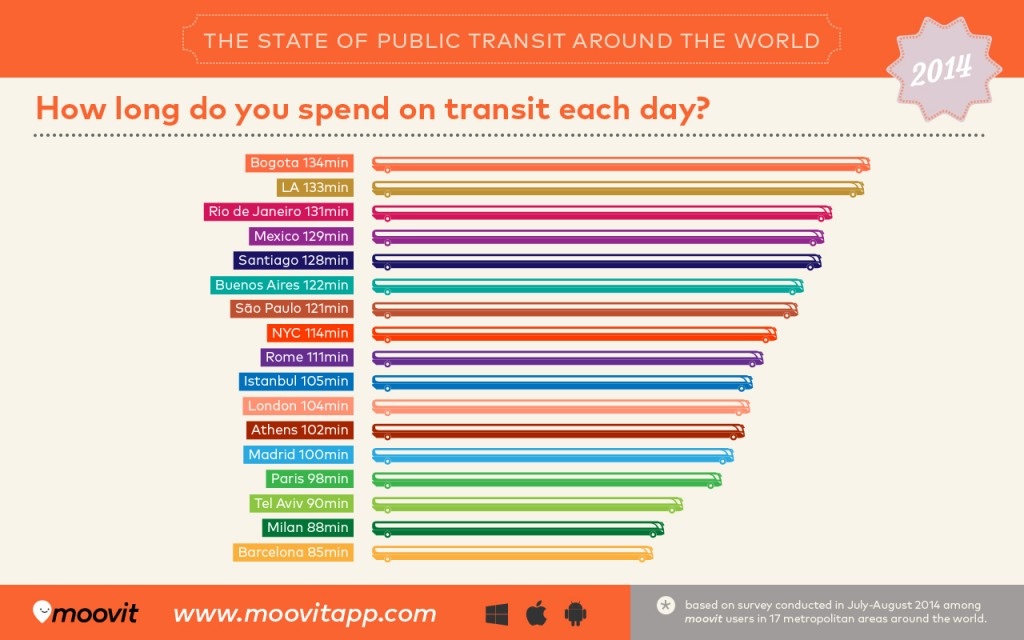
Uri advised us to “fall in love with the problem and not with the solution,” which is what we tried to do at Moovit. Although Waze had spawned a new transportation paradigm and helped reduce traffic in big cities, mass transit was a much bigger monster that consumed an average of two hours of each day for some people, which adds up to 37 days of each year*!

What would you do if someone told you that in addition to your vacation days, an app could help you find 18 extra days off work next year by cutting your transportation time in half?

* Assumes 261 working days a year, 14 productive hours per day.