Year: 2020

06 Aug 2020

Sony’s excellent over-ear headphones get smarter

Sony knows how to make a great pair of headphones. The WH-1000XM3 are one of the best received pairs of over-ear models in recent years. Two years later, the company is ready to unveil their successors, which sport a number of smart connected features.

In fact, the WH-1000XM4 bring all sorts of nice upgrades to the line. Unsurprisingly, a number of them are smart features that more fall into the category of nice to have, rather than essential, but there are a few core updates, as well.

For starters, there’s improved noise canceling, courtesy of the two mics on each ear. Sony says the on-board system-on-a-chip is capable of processing noise 700 times a second, along with a built-in algorithm that’s capable of adjusting the adaptive noise canceling in something akin to real time.

Perhaps the most interesting tidbit here, however, is a feature the company says is capable of “rebuilding” audio lost to compression — a pretty constant presence in the time of streaming everything. The technology was a joint venture with Sony Music Studios Tokyo. I’m definitely excited to hear how it actually sounds in practice — companies tend to make some big promises with these sort of lossless restoring technologies, to limited effect.

Image Credits: Sony

There’s 360 audio on-board, as well, of course. That’s been a big pet project for Sony — and one the company is going to really start pushing with the arrival of the PlayStation 5 later this year. The headphones support both Google Assistant and Alexa and utilize Google’s Fast Pair feature to get the connection up and running immediately. There’s also a feature that will let you ring the headphones when you misplace them.

Other notable additions include a Speak-to-Chat feature that turns down the music when you talk, adaptive sound for location you can pre-program and automate music pausing when you take them off your ears. That last bit will save on battery life. Sony promises up to 30 hours on a charge, though, so you should be good to go for a while. And when you’re in a pinch, 10 minutes of charging gets you five hours of playback.

The headphones up are for pre-order now and will hit retail mid-month, priced at $350.

06 Aug 2020

Google discontinues the Pixel 4, nine months after release

Days after announcing the Pixel 4a, Google has quietly discontinued sales of the Pixel 4 and Pixel 4 XL. The move, noted early by the Verge, represents an extremely truncated lifecycle for a Google flagship — around half of the 18 months the company continued to sell its two predecessors.

Google already announced the imminent arrival of the Pixel 5, when it noted the forthcoming handset would be one of two Pixels devices to sport 5G, along with the Pixel 4a 5G.

The company confirmed the move in a statement, noting, “Google Store has sold through its inventory and completed sales of Pixel 4 [and] 4 XL. For people who are still interested in buying Pixel 4 [and] 4 XL, the product is available from some partners while supplies last. Just like all Pixel devices, Pixel 4 will continue to get software and security updates for at least three years from when the device first became available on the Google Store in the US.”

The Pixel 4 was a largely well-received device, owing mostly to impressive camera work. But the handset was hampered by bad battery life — something Google has since addressed in the 4a. The new budget handset also sports an excellent camera for its price point, making the Pixel 4’s  existence somewhat redundant. Though the end of the Pixel 4 XL does leave Google with a larger option.

The company has clearly been dealing with a kind of identity crisis with its smartphones. A recent management shakeup appears to point to a desire for a new direction for the line, which has long suffered from uneven sales. Among other things, Google entered an already saturated market and has had some trouble distinguishing its offerings from other Android handsets.

It remains to be seen whether the Pixel 5 will be the first device to benefit from the division’s new direction.

06 Aug 2020

Special raises $2.26M to build a subscription platform for online creators

Special is a new startup offering online video creators a way to move beyond advertising for their income.

The service was created by the team behind tech consulting and development firm Triple Tree Software. Special’s co-founder and CEO Sam Lucas told me that the team had already “scrapped our way from nothing to a seven-figure annual revenue,” but when the founders met with Next Frontier Capital (Next Frontier, like Special, is based in Bozeman, Montana) they pitched a bigger idea — an app where creators charge a subscription fee for access to premium content.

While Triple Tree started in the service business, Lucas explained that the goal was also to create “a product company that we could sell for $100 million.” Now Special is announcing that it has raised $2.26 million in seed funding from Next Frontier and other investors.

It’s also built an initial version of the product that’s being tested by friends, family and a handful of creators, with plans for a broader beta test in October.

With online advertising slowing dramatically during the COVID-19 pandemic, YouTube recently highlighted the fact that 80,000 of its channels are earning money from non-ad sources, and that the number of creators who receive the majority of their income from a source other than advertising grew 40% between January and May.

One of the main ways that creators can ask their viewers for money is through Patreon. Lucas acknowledged Patreon as a “very big inspiration” for Special, but he said that conversations with creators pointed to a few key ways that the service falls short.

Special

Image Credits: Special

For one thing, he argued while contributions on Patreon are framed as “donations” or “support,” Special allows creators to emphasize the value of their premium content by putting it behind a subscription paywall. The existing service supports paywalls as well, but that leads to Lucas’ next point — that Patreon was built built for creators of all kinds, while Special is focused specifically on video, and it’s built a high-quality video player into the experience.

In fact, Lucas described Special’s spin on the idea of a white labeled product as “silver label.” The goal is to create “the perfect balance between a platform and a custom app” — creators get their own customizable channels that emphasize their brand identity (rather than Special’s), while still getting the distribution and exposure benefits of being part of a larger platform, with their content searchable and viewable on web, mobile and smart TVs.

Creators also retain ownership of their content, and they get to decide how much they want to charge subscribers — Lucas said it can be anywhere between “$1 or $999” per month, with Special taking a 10% fee. He added that the team has plans to build a bundling option that would allow creators to team up and offer a joint subscription.

Lucas’ pitch reminded me of startups like Vessel (acquired and shut down by TechCrunch’s parent company Verizon in 2016), which previously hoped to bring online creators together for a subscription offering. In Lucas’ view, Vessel was similar to newer apps like Quibi, in that they directly funded creators to produce exclusive content.

“It’s a billion-dollar arms race, with what used to be a technology play but is now a production studio play,” he said. Special doesn’t have the funding to compete at that level, but Lucas suggested that a studio model also provides the wrong incentives to creators, who say “Hell yeah, keep those checks coming in,” but disappear “the moment the checks stop.”

“I almost think it’s an egotistical play,” Lucas added. “The company thinks they know best what a creator should produce for an audience that doesn’t exist yet. We say: Let them do it on Special. Do whatever you want, as long as you follow our terms of service, and own your creative vision.”

It might also seem like a big challenge to recruit creators while based in Montana, but Lucas replied that Special has more access than you might think, especially since the town has become “such a hotspot for extremely wealthy people to buy their third home.”

More broadly, he suggested that the distance from Hollywood and Silicon Valley “allows us to not follow the trends of every new streaming platform and [instead] truly find those independent creators underneath the woodworks.”

06 Aug 2020

Majority of tech workers expect company solidarity with Black Lives Matter

The death of George Floyd and the recent Black Lives Matter protests have drawn widespread attention to the systemic racism within the United States. Millions of individuals across every state have come together to demand change.

Yet, whether companies believe they have a responsibility to respond to, resist and address this racism remains unclear. Do customers expect, or desire, a response? Do the companies’ own employees expect a response? Corporate America has the ability to use its influence for the change many of their employees are demanding; however, historically companies have been wary of inserting themselves into the middle of any conflict.

Now more than ever, it’s important for employers to align themselves with their employees’ expectations, though. Since March 2020 professionals working remotely increased from 30% to 80%, drastically accelerating an already rapidly growing trend. This remote nature has made it increasingly difficult to maintain a strong sense of “corporate community” and trust between leaders and employees.

At Fishbowl, we have been able to observe employees’ sentiments and expectations of their employers during this time.

Fishbowl is a new workplace social network that brings professionals together in a new era of remote work. Fishbowl provides thousands of industry and community-related bowls (aka groups) that allow verified professionals to have more honest and intimate conversations with other people working in roles and industries similar to their own.

Over the past several weeks, we saw a large increase in conversations about employers’ roles in addressing systemic racism and support for the Black Lives Matter cause. Our team decided to quantify the insights from these conversations, and polled employees on whether they expect their companies to speak out. We found that the majority of employees expect a public statement, but it varies significantly by industry.

About the survey

In order to determine how many employees expect their companies to release a statement on recent events, we asked professionals one question:

“Do you expect your company to publicly speak up for the Black Lives Matter cause?”

Professionals could answer with one of two options: (A) Yes or (B) No. The survey ran from June 5 through June 7, 2020 and received responses from over 16,812 verified professionals on the Fishbowl app from across the United States. Respondents included employees at companies such as IBM, JP Morgan, Facebook, McKinsey, Deloitte, Bank of America, Amazon, Edelman, Nike, Google, KPMG and thousands of others.

Here’s what our survey revealed:

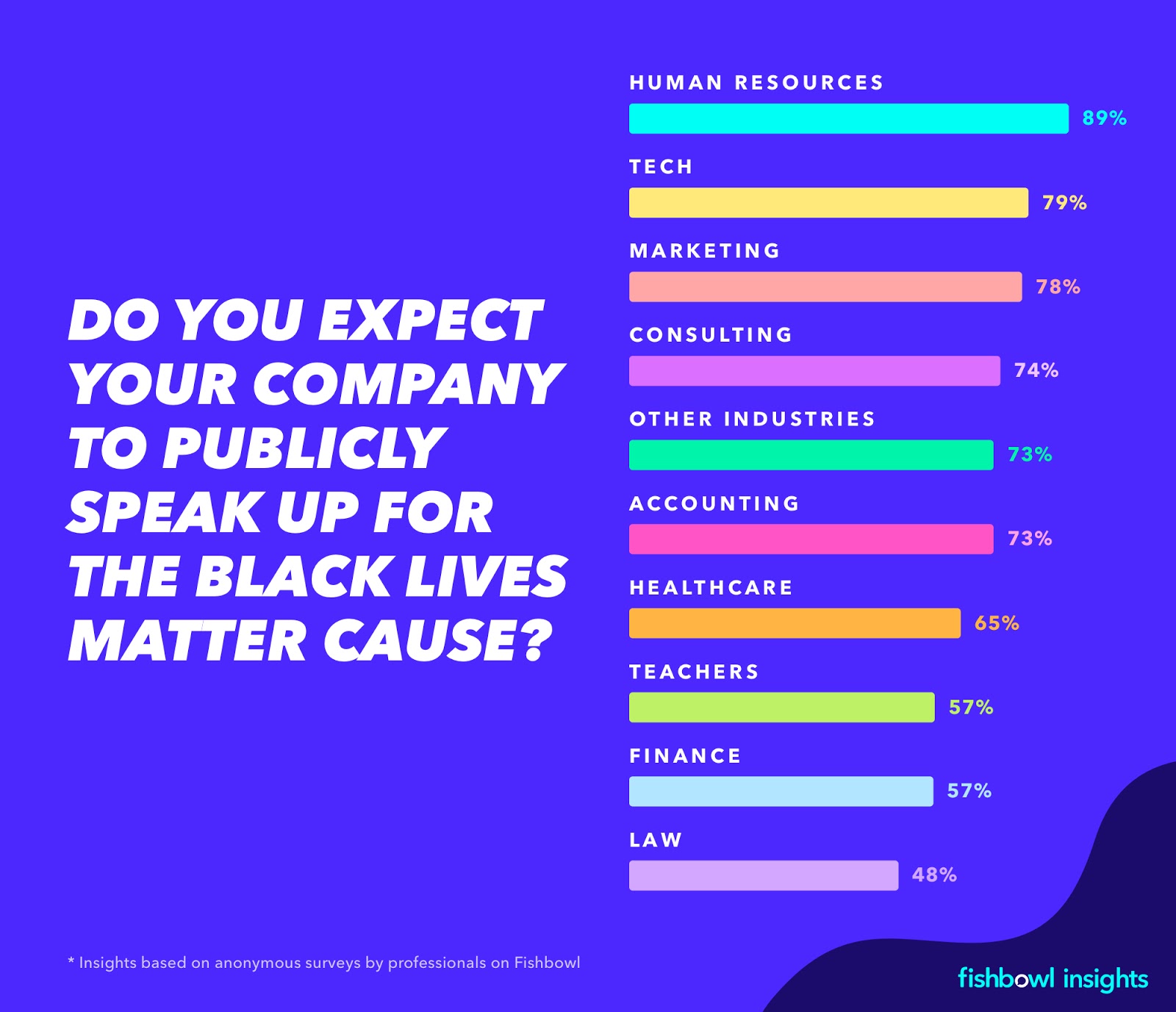
Expected company solidarity with Black Lives Matter by industry. Image Credits: Fishbowl (opens in a new window)

Most expect their company to speak up: Of the 16,812 professionals that responded, 11,638 (69.22%) answered that they expect their company to publicly speak up about the Black Lives Matter cause. A majority of professionals expect a statement of some sort from their employer.

By gender:  76.77% of women and 62.75% of men answered that they expect their company to speak up for the Black Lives Matter movement.

By industry: Human resources employees had the highest percentage of employees expecting their company to publicly respond about BLM, with a vast majority of 88.89%. Tech employees followed with 78.93%, while advertising employees were only marginally behind with 78.42%. Conversely, the law industry had the lowest percentage of employees expecting their company to speak up, with only 48.45%. Following closely behind were finance (56.92%) and teachers (57.21%).

By state: Out of the states with more than 100 responses, Californian participants were the most likely to expect their company to speak up about the movement, with 75.27%. Maryland (74.89%), Washington, D.C. (74.21%) and Massachusetts (74.02%) followed closely behind. Kansas showed the lowest percentage of employees expecting their company to show support for BLM, with 51.46%. Louisiana (57.14%), South Carolina (60.83%) and Missouri (61.93%) trailed behind.

Tech industry professionals expect statements

As noted above, the response varied greatly by industry, with tech standing out toward the top, with 79% of employees expecting public statements from their employer.

Big tech companies and their CEOs command more attention from the media than any other industry. With that attention comes certain expectations and pressure to respond to important causes like BLM from the public and their own employees.

So, when these companies speak out (or don’t), the public takes note. Social networking platforms in particular rely on how the public perceives them for business. Not making a statement could lead to a loss of business for some of these companies. For example, Facebook’s inaction on posts by Trump about the protests led to user and employee backlash last week.

Companies within other industries, on the other hand, such as law firms, are not household names, nor have the same level of scrutiny from the public eye. If anything, law firms and the individuals working there are asked to represent both sides of any argument, supporting the survey results showing less than half of attorneys expected public statements from their employers.

Looking ahead

What companies say (and don’t say) in coming weeks will greatly impact the relationship and trust with their employees. Now that tech giants like Apple, Google, Amazon and even TikTok, have made statements supporting the Black Lives Matter cause, the focus will shift from public statements to action and accountability.

As a recent Washington Post article on diversity in tech reveals, the words from these institutions might not always be representative of their actions. Employees of these companies are now rightfully asking their employers to turn their commitment to the cause into action by looking internally, and to start making the corporate environment more equitable for Black professionals.


06 Aug 2020

Majority of tech workers expect company solidarity with Black Lives Matter

The death of George Floyd and the recent Black Lives Matter protests have drawn widespread attention to the systemic racism within the United States. Millions of individuals across every state have come together to demand change.

Yet, whether companies believe they have a responsibility to respond to, resist and address this racism remains unclear. Do customers expect, or desire, a response? Do the companies’ own employees expect a response? Corporate America has the ability to use its influence for the change many of their employees are demanding; however, historically companies have been wary of inserting themselves into the middle of any conflict.

Now more than ever, it’s important for employers to align themselves with their employees’ expectations, though. Since March 2020 professionals working remotely increased from 30% to 80%, drastically accelerating an already rapidly growing trend. This remote nature has made it increasingly difficult to maintain a strong sense of “corporate community” and trust between leaders and employees.

At Fishbowl, we have been able to observe employees’ sentiments and expectations of their employers during this time.

Fishbowl is a new workplace social network that brings professionals together in a new era of remote work. Fishbowl provides thousands of industry and community-related bowls (aka groups) that allow verified professionals to have more honest and intimate conversations with other people working in roles and industries similar to their own.

Over the past several weeks, we saw a large increase in conversations about employers’ roles in addressing systemic racism and support for the Black Lives Matter cause. Our team decided to quantify the insights from these conversations, and polled employees on whether they expect their companies to speak out. We found that the majority of employees expect a public statement, but it varies significantly by industry.

About the survey

In order to determine how many employees expect their companies to release a statement on recent events, we asked professionals one question:

“Do you expect your company to publicly speak up for the Black Lives Matter cause?”

Professionals could answer with one of two options: (A) Yes or (B) No. The survey ran from June 5 through June 7, 2020 and received responses from over 16,812 verified professionals on the Fishbowl app from across the United States. Respondents included employees at companies such as IBM, JP Morgan, Facebook, McKinsey, Deloitte, Bank of America, Amazon, Edelman, Nike, Google, KPMG and thousands of others.

Here’s what our survey revealed:

Expected company solidarity with Black Lives Matter by industry. Image Credits: Fishbowl (opens in a new window)

Most expect their company to speak up: Of the 16,812 professionals that responded, 11,638 (69.22%) answered that they expect their company to publicly speak up about the Black Lives Matter cause. A majority of professionals expect a statement of some sort from their employer.

By gender:  76.77% of women and 62.75% of men answered that they expect their company to speak up for the Black Lives Matter movement.

By industry: Human resources employees had the highest percentage of employees expecting their company to publicly respond about BLM, with a vast majority of 88.89%. Tech employees followed with 78.93%, while advertising employees were only marginally behind with 78.42%. Conversely, the law industry had the lowest percentage of employees expecting their company to speak up, with only 48.45%. Following closely behind were finance (56.92%) and teachers (57.21%).

By state: Out of the states with more than 100 responses, Californian participants were the most likely to expect their company to speak up about the movement, with 75.27%. Maryland (74.89%), Washington, D.C. (74.21%) and Massachusetts (74.02%) followed closely behind. Kansas showed the lowest percentage of employees expecting their company to show support for BLM, with 51.46%. Louisiana (57.14%), South Carolina (60.83%) and Missouri (61.93%) trailed behind.

Tech industry professionals expect statements

As noted above, the response varied greatly by industry, with tech standing out toward the top, with 79% of employees expecting public statements from their employer.

Big tech companies and their CEOs command more attention from the media than any other industry. With that attention comes certain expectations and pressure to respond to important causes like BLM from the public and their own employees.

So, when these companies speak out (or don’t), the public takes note. Social networking platforms in particular rely on how the public perceives them for business. Not making a statement could lead to a loss of business for some of these companies. For example, Facebook’s inaction on posts by Trump about the protests led to user and employee backlash last week.

Companies within other industries, on the other hand, such as law firms, are not household names, nor have the same level of scrutiny from the public eye. If anything, law firms and the individuals working there are asked to represent both sides of any argument, supporting the survey results showing less than half of attorneys expected public statements from their employers.

Looking ahead

What companies say (and don’t say) in coming weeks will greatly impact the relationship and trust with their employees. Now that tech giants like Apple, Google, Amazon and even TikTok, have made statements supporting the Black Lives Matter cause, the focus will shift from public statements to action and accountability.

As a recent Washington Post article on diversity in tech reveals, the words from these institutions might not always be representative of their actions. Employees of these companies are now rightfully asking their employers to turn their commitment to the cause into action by looking internally, and to start making the corporate environment more equitable for Black professionals.

06 Aug 2020

Crossbeam announces $25M Series B to keep growing partnerships platform

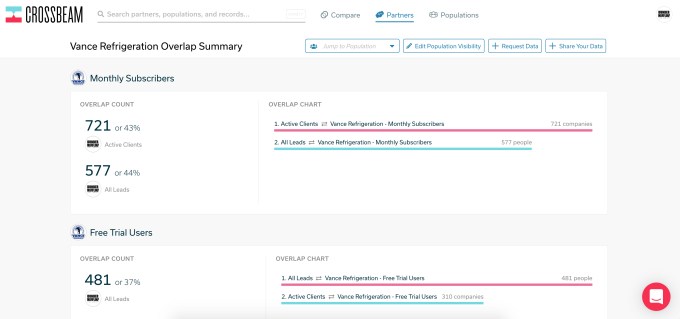
As sales teams partner with other companies, they go through a process called account mapping to find common customers and prospects. This is usually a highly manual activity tracked in spreadsheets. Crossbeam, a Philadelphia startup, has come up with a way to automate partnership data integration. Today the company announced a $25 million Series B investment.

Redpoint Ventures led the round with help from existing investors FirstMark Capital, Salesforce Ventures, Slack Fund and Uncork Capital along with new investors Okta Ventures and Partnership Leaders, a partnership industry association. All in all, an interesting mix of traditional VCs and strategic investors that Crossbeam could potentially partner with as they grow the business.

The funding comes on the heels of a $3.5 million seed round in 2018 and a $12.5 million Series A a year ago. The startup has now raised a total of $41 million.

Crossbeam has been growing steadily and that attracted the attention of investors, whom Moore says approached him. He was actually not thinking about fundraising until next year, but when the opportunity presented itself, he decided to seize it.

The platform has a natural networking effect built into it with over 900 companies using it so far. As new companies come on, they invite partners, who can join and invite more partners, and that creates a constant sales motion for them without much effort at all.

“We didn’t go out fundraising. We caught the eye of Redpoint because they could see the virality of the product and the extent to which it was being used by many of their portfolio companies and companies out in the market […],” CEO and co-founder Bob Moore told TechCrunch.

Image Credits: Crossbeam

To accelerate interest in the product, the company also announced a new free tier, which replaces the limited free trial and a starter level that previously cost $500 per month. Prior to this move, if you didn’t move to the starter tier, you would lose your data when the trial was over.

“The idea here is what we’ve seen in the data is that we can create a whole lot of value for people and demonstrate really strong ROI once they get in the door and actually have access to that data, and they don’t have to worry about a free trial where the data is going away,” Moore explained.

Moore says they currently have 28 employees and have ambitious plans to add new people to the mix in the coming months, expecting to reach 50 employees by early 2021. As the company revs up on the personnel side, Moore says diversity is front and center of their plans.

“As far as Crossbeam specifically goes, we’ve made sure that diversity, equity and inclusion is part of our entire recruiting process and also the cultural experience that we create for people that are at the company,” he said. Although he didn’t discuss specific numbers, he said the company was making progress, particularly in the latest round of hires.

While the company has an office in Philly, even before COVID hit, it was a remote first organization with about half of the employees working from home. “I think a lot of our culture was kind of built to make sure that remote team members are first class citizens in every respect in the company. So we already had all the controls, technology and practices in place, and when we shut the office, it was about as smooth as could be,” he said.

06 Aug 2020

Crossbeam announces $25M Series B to keep growing partnerships platform

As sales teams partner with other companies, they go through a process called account mapping to find common customers and prospects. This is usually a highly manual activity tracked in spreadsheets. Crossbeam, a Philadelphia startup, has come up with a way to automate partnership data integration. Today the company announced a $25 million Series B investment.

Redpoint Ventures led the round with help from existing investors FirstMark Capital, Salesforce Ventures, Slack Fund and Uncork Capital along with new investors Okta Ventures and Partnership Leaders, a partnership industry association. All in all, an interesting mix of traditional VCs and strategic investors that Crossbeam could potentially partner with as they grow the business.

The funding comes on the heels of a $3.5 million seed round in 2018 and a $12.5 million Series A a year ago. The startup has now raised a total of $41 million.

Crossbeam has been growing steadily and that attracted the attention of investors, whom Moore says approached him. He was actually not thinking about fundraising until next year, but when the opportunity presented itself, he decided to seize it.

The platform has a natural networking effect built into it with over 900 companies using it so far. As new companies come on, they invite partners, who can join and invite more partners, and that creates a constant sales motion for them without much effort at all.

“We didn’t go out fundraising. We caught the eye of Redpoint because they could see the virality of the product and the extent to which it was being used by many of their portfolio companies and companies out in the market […],” CEO and co-founder Bob Moore told TechCrunch.

Image Credits: Crossbeam

To accelerate interest in the product, the company also announced a new free tier, which replaces the limited free trial and a starter level that previously cost $500 per month. Prior to this move, if you didn’t move to the starter tier, you would lose your data when the trial was over.

“The idea here is what we’ve seen in the data is that we can create a whole lot of value for people and demonstrate really strong ROI once they get in the door and actually have access to that data, and they don’t have to worry about a free trial where the data is going away,” Moore explained.

Moore says they currently have 28 employees and have ambitious plans to add new people to the mix in the coming months, expecting to reach 50 employees by early 2021. As the company revs up on the personnel side, Moore says diversity is front and center of their plans.

“As far as Crossbeam specifically goes, we’ve made sure that diversity, equity and inclusion is part of our entire recruiting process and also the cultural experience that we create for people that are at the company,” he said. Although he didn’t discuss specific numbers, he said the company was making progress, particularly in the latest round of hires.

While the company has an office in Philly, even before COVID hit, it was a remote first organization with about half of the employees working from home. “I think a lot of our culture was kind of built to make sure that remote team members are first class citizens in every respect in the company. So we already had all the controls, technology and practices in place, and when we shut the office, it was about as smooth as could be,” he said.

06 Aug 2020

WordPress.com launches new P2 to take on internal communication tools

WordPress.com, a division of Automattic, is launching a new product called P2. And this time, it’s all about improving internal communications for private groups. As a remote company, Automattic has been using P2 internally for years to communicate asynchronously. It’s a place to share long-form posts, a repository to keep onboarding documents and other important ever-green documents.

P2 is built on top of WordPress . You can view it as a sort of WordPress for teams that is heavily customized around the concept of sharing ideas with other team members. Companies now rely on multiple internal communication tools. P2 can replace some of them but doesn’t want to reinvent the wheel altogether.

For instance, P2 isn’t a Slack competitor. You can’t use it for real-time chat. But P2 can be used to share important announcements — the kind of announcements that you can find on an intranet portal.

Image Credits: WordPress.com

You can also use it for long-term projects and create your own P2 for your team in particular. In that case, P2 competes more directly with Workplace by Facebook or Yammer. In order to make it more useful for asynchronous communications, P2 has some features that make it more useful than a simple WordPress blog.

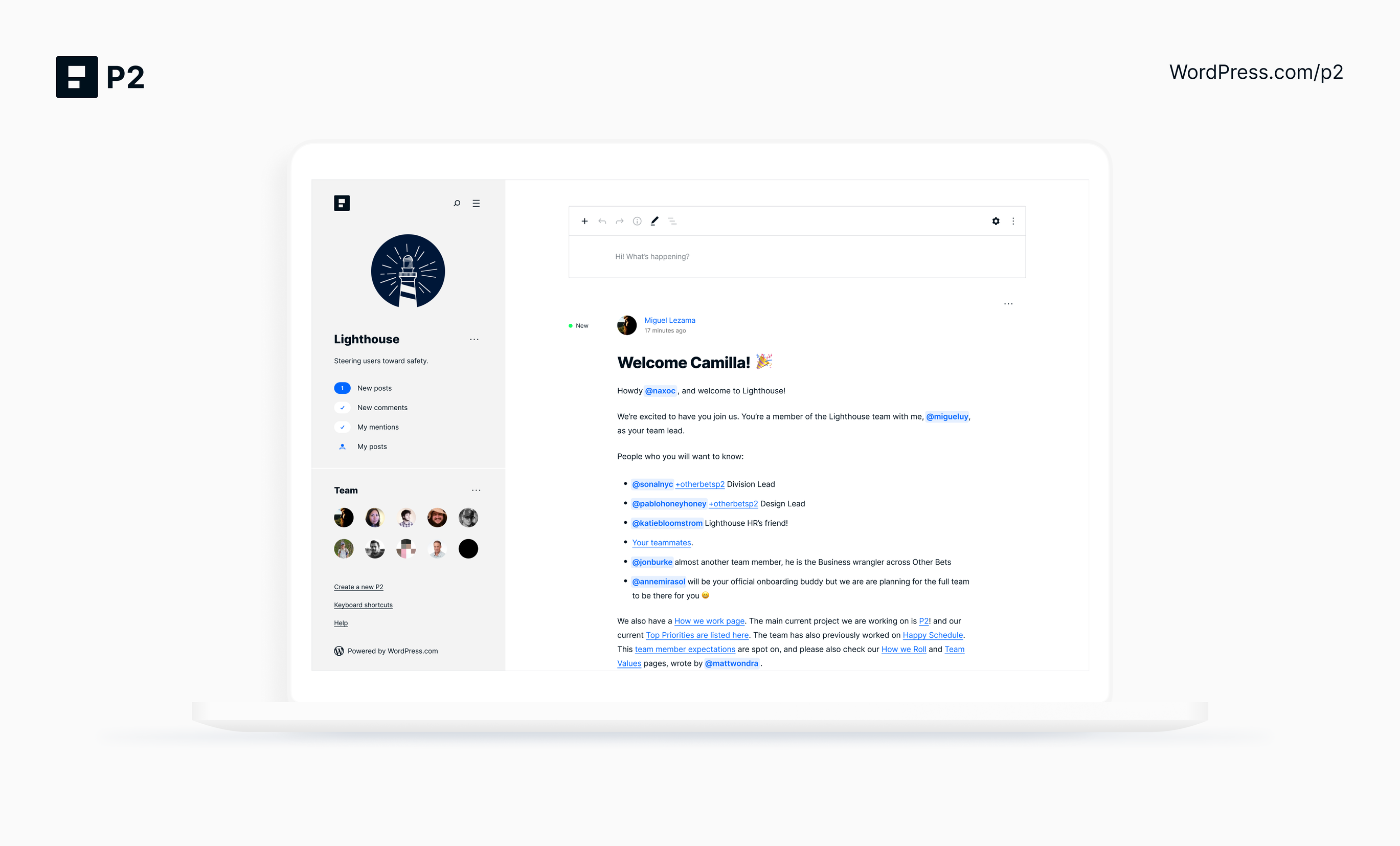
For instance, you can @-mention your coworkers to send them a notification and follow posts to receive updates. You can also create checklists, embed PDF documents, stick important posts at the top of the homepage and stay on top of what happened while you were gone. There are dedicated menus to view new posts, new comments and mentions you’ve received.

While you can theoretically access the classic WordPress back-end, you can write new posts, edit existing posts and write comments without ever leaving P2. The company uses the new block editor that lets you add headings, lists, video embeds and media in a visual way. It works a bit like Squarespace’s editor or Notion, and it makes a ton of sense to leverage the new editor right next to content you’re viewing, commenting on, etc.

For content that always remains relevant, you can create documents, which are pages without a specific publishing date and without comments. These documents are sorted in their own category and can be easily shared across a company. You can use documents for internal policies, guides or important contact information. Many companies rely on Google Docs and shared folders in Google Drive for this kind of documents. P2 could potentially replace those shared folders and become the main information repository.

By default, P2 sites are private but you can make them public in case you want to share updates on your product with clients or use P2 for public events.

If you’re familiar with the WordPress ecosystem, you might already know a WordPress theme called P2. The new P2 announced today is a new product that takes that idea to the next level. Automattic has been iterating on the concept and using it widely with its 1,300 employees across 912 internal P2 sites.

WordPress.com is going to offer hosted P2 instances. Anybody can create a P2 for free and invite other people. Eventually, WordPress.com plans to offer paid subscriptions for advanced features. In other words, P2 is going to be a software-as-a-service product. But there will be a self-hostable, open source version in the future as well.

I played around with a few P2 instances, and the overall impression is that the complexity of WordPress remains hidden by default, which is a good thing. It’s a clean and focused product that would work particularly well in that spot between company-wide emails and announcements getting lost in Slack.

Image Credits: WordPress.com

06 Aug 2020

TikTok announces first data center in Europe

TikTok, the Chinese video sharing app that’s found itself at the center of a geopolitical power struggle which threatens to put hard limits on its global growth this year, said today it will build its first data center in Europe.

The announcement of a TikTok data center in the EU also follows a landmark ruling by Europe’s top court last month that put international data transfers in the spotlight, dialling up the legal risk around processing data outside the bloc.

TikTok said the forthcoming data center, which will be located in Ireland, will store the data of its European users once it’s up and running (which is expected by early 2022) — with a slated investment into the country of around €420M (~$497M), according to a blog post penned by global CISO, Roland Cloutier.

“This investment in Ireland… will create hundreds of new jobs and play a key role in further strengthening the safeguarding and protection of TikTok user data, with a state of the art physical and network security defense system planned around this new operation,” Cloutier wrote, adding that the regional data centre will have the added boon for European users of faster load times, improving the overall experience of using the app.

The social media app does not break out regional users — but a leaked ad deck suggested it had 17M+ MAUs in Europe at the start of last year.

The flipside of TikTok’s rise to hot social media app beloved of teens everywhere has been earning itself the ire of US president Trump — who earlier this month threatened to use executive powers to ban TikTok in the US unless it sells its US business to an American company. (Microsoft is in the frame as a buyer.)

Whether Trump has the power to block TikTok’s app is debatable. Tech savvy teenagers will surely deploy all their smarts to get around any geoblocks. But operational disruption looks inevitable — and that has been forcing TikTok to make a series of strategic tweaks in a bid to limit damage and/or avoid the very worst outcomes.

Since taking office the US president has shown himself willing to make international business extremely difficult for Chinese tech firms. In the case of mobile device and network kit maker, Huawei, Trump has limited domestic use of its tech and leant on allies to lock it out of their 5G networks (with some success) — citing national security concerns from links to the Chinese Communist Party.

His beef with TikTok is the same stated national security concerns, centered on its access to user data. (Though Trump may have his own personal reasons to dislike the app.)

TikTok, like every major social media app, gathers huge amounts of user data — which its privacy policy specifies it may share user data with third parties, including to fulfil “government inquiries”. So while its appetite for personal data looks much the same as US social media giants (like Facebook) its parent company, Beijing-based ByteDance, is subject to China’s Internet Security Law — which since 2017 has given the Chinese Chinese Communist Party sweeping powers to obtain data from digital companies. And while the US has its own intrusive digital surveillance laws, the existence of a Chinese mirror of the US state-linked data industrial complex has put tech firms right at the heart of geopolitics.

TikTok has been taking steps to try to insulate its international business from US-fuelled security concerns — and also provide some incentives to Trump for not quashing it — hiring Disney executive Kevin Mayer on as CEO of TikTok and COO of ByteDance in May, and promising to create 10,000 jobs in the U.S., as well as claiming US user data is stored in the US.

In parallel it’s been reconfiguring how it operates in Europe, setting up an EMEA Trust and Safety Hub in Dublin, Ireland at the start of this year and building out its team on the ground. In June it also updated its regional terms of service — naming its Irish subsidiary as the local data controller alongside its UK entity, meaning European users’ data no longer falls under its US entity, TikTok Inc.

This reflects distinct rules around personal data which apply across the European Union and European Economic Area. So while European political leaders have not been actively attacking TikTok in the same way as Trump, the company still faces increased legal risk in the region.

Last month CJEU judges made it clear that data transfers to third countries can only be legal if EU users’ data is not being put at risk by problematic surveillance laws and practices. The CJEU ruling (aka ‘Schrems II’) means data processing in countries such as China and India — and, indeed, the US — are now firmly in the risk frame where EU data protection law is concerned.

One way of avoiding this risk is to process European users’ data locally. So TikTok opening a data center in Ireland may also be a response to Schrems II — in that it will offer a way for it to ensure it can comply with requirements flowing from the ruling.

Privacy commentators have suggested the CJEU decision may accelerate data localization efforts — a trend that’s also being seen in countries such as China and Russia (and, under Trump, the US too it seems).

EU data watchdogs have also warned there will be no grace period following the CJEU invalidating the US-EU Privacy Shield data transfer mechanism. While those using other still valid tools for international transfers are bound to carry out an assessment — and either suspend data flows if they identify risks or inform a supervisor that the data is still flowing (which could in turn trigger an investigation).

The EU’s data protection framework, GDPR, bakes in stiff penalties for violations — with fines that can hit 4% of a company’s global annual turnover. So the business risk around EU data protection is no longer small, even as wider geopolitical risks are upping the uncertainty for global Internet players.

“Protecting our community’s privacy and data is and will continue to be our priority,” TikTok’s CISO writes, adding: “Today’s announcement is just the latest part of our ongoing work to enhance our global capability and efforts to protect our users and the TikTok community.”

06 Aug 2020

Uber picks up Autocab to push into places its own app doesn’t go

Uber has bought UK based Autocab, which sells SaaS to the taxi and private hire vehicle industry, with the aim of expanding the utility of its own platform by linking users who open its app in places where it doesn’t offer trips to local providers who do.

No acquisition price has been disclosed and Uber declined to comment on the terms of the deal.

Autocab has a SaaS presence in 20 countries globally at this stage, according to an Uber spokeswoman. We’ve asked whether it will be closing a marketplace service which connects local taxi firms with trip bookers in any locations as a result of the Uber acquisition.

The Manchester-based veteran taxi software maker — which sells booking and despatch software as well as operating a global marketplace (iGo) which local firms can plug into to get more trips — was founded back in 1989, per Crunchbase.

Uber’s spokeswoman said it plans to support Autocab’s expansion of SaaS and iGo internationally — suggesting the tech giant hopes to be able to integrate the marketplace across its own global footprint in order to be able to offer users a less patchy service.

The move also looks intended to create more opportunities for Uber drivers to pick up jobs from outside its own platform, including delivery work.

In a press release announcing the acquisition, Uber said “thousands of people” open its app every month in places where they can’t get a trip. It lists 15 UK towns which fall into this category — headed by Oxford (with 67,099 app opens monthly) and Tunbridge Wells (46,150); or at the other end Colchester (16,540) and Ipswich (16,539).

“Through Autocab’s iGo marketplace, Uber will be able to connect these riders with local operators who choose to take their booking. In turn, operators should be able to expand their operations and offer more earnings opportunities to local drivers. Uber will also explore providing drivers with additional revenue opportunities related to its platform for other services, such as delivery,” it added.

According to Bloomberg, Uber won’t be integrating Autocab’s marketplace in markets where it already offers a service, such as London — so there does look to be an element of Uber using the purchase to shore up its own key markets by closing down the chance of a little locally flavored competition.

Uber’s rides business has been hard hit by the coronavirus pandemic, which has squeezed demand for on-demand transportation, as many professionals switching to remote work at home. Social distancing requirements have also hit the nightlife industry, further eating into demand for Uber’s service.

All of which makes life hard for Uber’s ‘self employed‘ drivers — giving the company an incentive to find ways to retain their service during a leaner time for on-demand trips when they may otherwise abandon the platform, damaging its ability to provide a reliable service.

For Autocab’s part, the acquisition offers a road to further global expansion. It will remain independent with its own board after the acquisition, per the pair’s press release — retaining its focus on serving the taxi and private hire vehicle industry globally.

Commenting in a statement, Jamie Heywood, Uber’s regional GM for Northern & Eastern Europe, said: “Autocab has worked successfully with taxi and private hire operators around the world for more than thirty years and Uber has a lot to learn from their experience. We look forward to working with the Autocab team to help local operators grow and provide drivers with genuine earnings opportunities.”

Autocab CEO, Safa Alkatab, added: “Autocab has been working with local operators across the world to provide the technology to make them more efficient and open up a marketplace to provide more trips. Working with Uber we can scale up our ambitions, providing hundreds of thousands of additional trips for our customers, and help cement the place of licenced operators in their local community.”