Year: 2020

31 Jul 2020

Twitter finally bans former KKK leader, David Duke

Twitter has confirmed it has permanently banned the account of David Duke, former leader of white supremacist hate group the Ku Klux Klan.

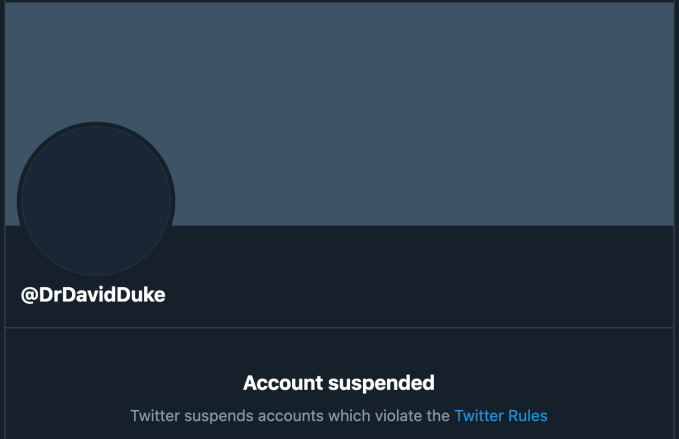
Duke had operated freely on its platform for years — amassing a following of around 53k and recently tweeting his support for president Trump to be re-elected. Now his @DrDavidDuke account page leads to an ‘account suspension’ notification (screengrabbed below).

A Twitter spokesperson confirmed to TechCrunch that the ban on Duke is permanent, emailing us this brief statement:

The account you referenced has been permanently suspended for repeated violations of the Twitter Rules on hateful conduct. This enforcement action is in line with our recently-updated guidance on harmful links.

While the move has been welcomed by anti-nazis everywhere, no one is rejoicing at how long it took Twitter to kick the KKK figurehead. The company has long claimed a policy prohibiting hateful conduct on its platform, while simultaneously carrying on a multi-year journey toward actually enforcing its own rules.

Over the years, Twitter’s notorious passivity in acting on policy-defined ‘acceptable behavior’ limits allowed abuse and toxic hate speech to build and bloom essentially unchecked — eventually forcing the company to commit to cleaning up its act to try to stop users from fleeing in horror. (Not a great definition of leadership by anyone’s standards as we pointed out back in 2017.)

Roll on a few more years and Twitter has been slowly shifting up its enforcement gears, with a push in 2018 toward what CEO Jack Dorsey dubbed “conversational health“, and further expansions to its hateful conduct policy. Enforcement has still been patchy and/or chequered. But appears to have stepped up markedly this year — which kicked off with a ban on a notorious UK right-wing hate preacher.

Twitter’s 2020 enforcement mojo may have a fair bit to do with the pandemic. In March, with concern spiking over COVID-19 misinformation spreading online, Twitter tweaked its rules to zero in on harmful link spreading (aka “malicious URLs” as it calls them), as a step to combat coronavirus scammers.

So it looks like public health risks have finally helped concentrate minds at Twitter HQ around enforcement — and everyone (still) on its platform is better for it.

In recent weeks Twitter has cracked down on the right-wing conspiracy theory group, Qanon, banning 7,000 accounts earlier this month. It also finally found a way to respond to US president Trump’s abuse of its platform as a conduit for broadcasting violent threats and trying to stir up a race war (and spread political disinformation) by applying screens and fact-check labels to offending Trump tweets.

The president’s son, Donald Trump Jr, has also had temporary restrictions applied to his account this month after he shared a video which makes false and potentially life-threatening claims about the coronavirus pandemic.

That looks like a deliberate warning shot across Trump’s bows — to say that while Twitter might not be willing to ban the president himself (given his public office), it sure as hell will kick his son into touch if he steps over the line.

Twitter’s policy on link-blocking states the company may take action to limit the spread of links which relate to a number of content categories, including terrorism, violence and hateful conduct, in addition to those pointing to other bad stuff such as malware and spam. The policy further notes: “Accounts dedicated to sharing content which we block, or which attempt to circumvent a block on the sharing a link, may be subject to additional enforcement action, including suspension.”

Twitter had previously said Duke hadn’t been banned because he’d left the KKK, per the Washington Times. So it looks as if he got the banhammer for essentially being a malicious URL node in slithering human form, by using his account to spread links to content that preached his gospel of hate.

Which makes for a nice silver lining on the pandemic storm cloud.

Much like similar right-wing hate spreaders, Duke also used his Twitter account to bully and harass critics — by being able to direct a nazi troll army of Twitter supporters to target individuals with abuse and try to get their accounts suspended via tricking Twitter’s systems through mass reporting their tweets.

Safe to say, Duke, like all nazis, won’t be missed.

Also doubtless concentrating minds at Twitter on standing up for its own community standards is the #StopHateForProfit ad boycott that’s been taking place this month, with multiple high profile advertisers withdrawing spend across major social media platforms as an objection to their failure to boot out hate speech. 

31 Jul 2020

Twitter says ‘phone spear phishing attack’ used to gain network access in crypto scam breach

Twitter has revealed a little more detail about the security breach it suffered earlier this month when a number of high profile accounts were hacked to spread a cryptocurrency scam — writing in a blog post that a “phone spear phishing attack” was used to target a small number of its employees.

Once the attackers had successfully gained network credentials via this social engineering technique they were in a position to gather enough information about its internal systems and processes to target other employees who had access to account support tools which enabled them to take control of verified accounts, per Twitter’s update on the incident.

“A successful attack required the attackers to obtain access to both our internal network as well as specific employee credentials that granted them access to our internal support tools. Not all of the employees that were initially targeted had permissions to use account management tools, but the attackers used their credentials to access our internal systems and gain information about our processes. This knowledge then enabled them to target additional employees who did have access to our account support tools,” it writes.

“This attack relied on a significant and concerted attempt to mislead certain employees and exploit human vulnerabilities to gain access to our internal systems,” Twitter adds, dubbing the incident “a striking reminder of how important each person on our team is in protecting our service”.

It now says the attackers used the stolen credentials to target 130 Twitter accounts — going on to tweet from 45; access the DM inbox of 36; and download the Twitter data of 7 (previously it reported 8, so perhaps one attempted download did not complete). All affected account holders have been contacted directly by Twitter at this point, per its blog post.

Notably, the company has still not disclosed how many employees or contractors had access to its account support tools. The greater that number, the larger the attack vector which could be targeted by the hackers.

Last week Reuters reported that more than 1,000 people at Twitter had access, including a number of contractors. Two former Twitter employees told the news agency such a broad level of access made it difficult for the company to defend against this type of attack. Twitter declined to comment on the report.

Its update now acknowledges “concern” around levels of employee access to its tools but offers little  additional detail — saying only that it has teams “around the world” helping with account support.

It also claims access to account management tools is “strictly limited”, and “only granted for valid business reasons”. Yet later in the blog post Twitter notes it has “significantly” limited access to the tools since the attack, lending credence to the criticism that far too many people at Twitter were given access prior to the breach.  

Twitter’s post also provides very limited detail about the specific technique the attackers used to successfully social engineer some of its workers and then be in a position to target an unknown number of other staff who had access to the key tools. Although it says the investigation into the attack is ongoing, which may be a factor in how much detail it feels able to share. (The blog notes it will continue to provide “updates” as the process continues.)

On the question of what is phone spear phishing in this specific case it’s not clear what particular technique was successfully able to penetrate Twitter’s defences. Spear phishing generally refers to an individually tailored social engineering attack, with the added component here of phones being involved in the targeting.

One security commentator we contacted suggested a number of possibilities.

“Twitter’s latest update on the incident remains frustratingly opaque on details,” said UK-based Graham Cluley. “‘Phone spear phishing’ could mean a variety of things. One possibility, for instance, is that targeted employees received a message on their phones which appeared to be from Twitter’s support team, and asked them to call a number. Calling the number might have taken them to a convincing (but fake) helpdesk operator who might be able to trick users out of credentials. The employee, thinking they’re speaking to a legitimate support person, might reveal much more on the phone than they would via email or a phishing website.”

“Without more detail from Twitter it’s hard to give definitive advice, but if something like that happened then telling workers the genuine support number to call if they ever need to — rather than relying on a message they receive on the phone — can reduce the likelihood of people being duped,” Cluley added.

“Equally the conversation could be initiated by a scammer calling the employee, perhaps using a VOIP phone service and using caller ID spoofing to pretend to be ringing from a legitimate number. Or maybe they broke into Twitter’s internal phone system and were able to make it look like an internal support call. We need more details!”

31 Jul 2020

Ford Bronco reservations surpass 150,000

The reception to Bronco 2021 — Ford’s flagship series of 4×4 vehicles that were revealed earlier this month — surpassed expectations of the company’s most optimistic initial projections, CEO Jim Hackett said in an earnings call Thursday. 

More than 150,000 customers have plunked down $100 to reserve a spot to order one of the vehicles, according to Ford. 

“We think this family of vehicles has big upside potential in the growing off-road category and this is a category with a leading OEM has not been seriously challenged until now,” Hackett said.

These are, of course, mere reservations, not actual orders. The deposits are refundable. Now, Ford is focused on the due diligence required to determine how many of these reservations will be converted to orders as it lay outs its manufacturing strategy for the brand.

The Ford Bronco 2 and Bronco 4 will be built at Michigan Assembly Plant in Wayne, Michigan. The Bronco Sport will be assembled at plant in Mexico. The company is now determining how many shifts to staff at each factory in order to match actual orders.

“There’s still a lot of work to do,” Ford COO Jim Farley said in a call with analysts Thursday. “But the mix is great.”

The Bronco is a brand that leans heavily on nostalgia, customization, functional design and technology, such as the automaker’s next-generation infotainment system and a digital trail mapping feature that lets owners plan, record and share their experiences via an app.

While the response to the Bronco has been palatable, there are a number of competitors also aiming to win over customers. GM released a video this week teasing its all-electric GMC Hummer. While the video was a promotional mashup of buzzwords, it also showed that GM had clearly identified Ford Bronco and Tesla Cybertruck as its main competitors. Then there’s electric upstart Rivian, which plans to start production of its EV pickup and SUV in 2021.

31 Jul 2020

Self-driving startup Argo AI hits $7.5 billion valuation

Autonomous vehicle technology startup Argo AI is valued at $7.5 billion, just a little more than three years after the company burst on the scene with a $1 billion investment from Ford.

The official valuation was confirmed Thursday nearly two months after VW Group finalized its $2.6 billion investment in Argo AI. Under that deal, Ford and VW have equal ownership stakes, which will be roughly 40% each over time. The remaining equity sits with Argo’s co-founders as well as employees. Argo’s board is comprised of two VW seats, two Ford seats and three Argo seats.

Ford’s announcement in February 2017 that it was investing in Argo AI surprised many. The startup was barely six months old when it was thrust into the spotlight. Its founders, Bryan Salesky and Peter Rander, were known in the tight knit and often overlapping autonomous vehicle industry; prior to forming Argo, Salesky was director of hardware development at the Google self-driving project (now Waymo) and Rander was the engineering lead at Uber Advanced Technologies Group. But even those insiders who knew Salesky and Rander wondered what to make of the deal.

Since then, Argo has focused on developing the virtual driver system — all of the sensors,  software and compute platform — as well as high-definition maps designed for Ford’s self-driving vehicles.

That mission now extends to VW Group as well. Ford and VW will share the cost of developing Argo AI’s self-driving vehicle technology under the terms of the deal. The Pittsburgh-based company also has offices in Detroit, Palo Alto and Cranbury, N.J. It has fleets of autonomous vehicles mapping and testing on public roads in Austin, Miami, Pittsburgh and Washington, D.C.

The investment by VW expands its workforce and operations to Europe. Autonomous Intelligent Driving (AID), the self-driving subsidiary that was launched in 2017 to develop autonomous vehicle technology for the VW Group, is being absorbed into Argo AI. AID’s Munich offices will become Argo’s European headquarters. In all, Argo now employs more than 1,000 people.

While the development and deployment of autonomous vehicles will be a long journey — a remark shared Thursday by Ford CEO Jim Hackett — the Argo investment has already provided the automaker with a short-term and timely gain.

The automaker said Thursday it netted $3.5 billion in the second quarter from selling some of its Argo equity to Volkswagen. That gain gave the automaker a one-time boost in its second-quarter earnings.

Ford posted a $1.1 billion profit in the second quarter, if the Argo transaction is counted. Ford lost $1.9 billion in the quarter before interest and taxes and one-time items. Ford reported a revenue of $19.4 billion, a 50% decrease from the same period in 2019 due to the COVID-19 pandemic which caused the company to idle its factories for weeks.

Still, the result could have been far worse. Ford had previously warned that it could post as much as a $5 billion net loss in the second quarter.

Despite these COVID-19 headwinds, Hackett said Ford is still committed to the long-term pursuit of AVs, a point reiterated by CFO Tim Stone, who said the automaker continues to make investments to commercialize its autonomous vehicle business, including product development, engineering and testing.

“The AV journey will be a long one, but Ford is now well positioned to run this race and compete like few others can,” Hackett added.

30 Jul 2020

Rakuten is shuttering the online shop formerly known as Buy.com

Japanese conglomerate Rakuten has pulled the plug on its U.S. online retail store, originally known as Buy.com, and will wind down its operations over the next two months, the company confirmed to TechCrunch. The shutdown means that the US headquarters will lay off its staff as well, meaning 87 people will lose their jobs, according a source familiar with the developments.

“We have decided to sunset the U.S. Rakuten Marketplace,” a company representative said in an email to TechCrunch. They clarified, however, that the “cash back rewards” referral business the company operates at Rakuten.com (formely Ebates, which it bought for $1B in 2014) “is definitely not shutting down and is stronger than ever.”

Rakuten bought Buy.com for $250M back in 2010 in an attempt to expand its retail business out of its stronghold of Japan. Unfortunately the evolving market, aggressive growth (and targeting of rivals) at Amazon, and likely the choice to rebrand the once well-known site under the Rakuten name, all led to declining business. The original CEO and COO left in 2012.

Customers of the Rakuten US store will be able to place orders for the next two months, after which the site will shutter completely. Users of the rewards and commission business shouldn’t see any major changes, and other businesses (like the Kobo e-reading division) aren’t affected either.

It’s a blow to Rakuten, but hardly one that can have taken them by surprise. The company has diversified and invested in a large number of businesses and verticals around the world (even launching a cryptocoin), so the failure of a marketplace like this, while unfortunate (especially for those laid off), won’t be affecting their bottom line much at this point.

30 Jul 2020

What does accountability look like in 2020?

“What happens after a company gets called out?” he asked over the phone. “Do you know what happens to the people in-house that come forward?”

I didn’t.

A Black male engineer at a fashion tech company who wished to remain anonymous was telling me how he’d been passed over for promotions white counterparts later received after they’d pursued risky and unsuccessful projects. At one point, he said management tasked him with doing recon on a superior who made disparaging comments about women because his subordinates were uncomfortable reporting it directly to HR.

When human resources eventually took up the matter, the engineer said his participation was used against him.

More recently, his company brought furloughed employees back and managers promoted a younger, white subordinate over him. When he asked about the move, his direct supervisor said he was too aggressive and needed to be more of a role model to be considered in the future.

In the absence of industry leadership, there’s no blueprint to remedy institutional problems like these. The lack of substantial progress toward true representation, diversity and inclusion across several industries illustrates what hasn’t worked.

Audrey Gelman, former CEO of women-focused co-working/community space The Wing, stepped down in June following a virtual employee walkout. Three months earlier, a New York Times exposé interviewed 26 former and current employees there who described systemic discrimination and mistreatment. At the time, about 40% of its executive staff consisted of women of color, the article reported.

Within days, Refinery29’s EIC Christene Barberich also resigned after allegations of racism, bullying and leadership abuses surfaced with hashtag #BlackatR29.

In December 2019, The Verge reported allegations of a toxic work environment at Away under CEO Steph Korey. After a series of updates and corrections in reporting, it seemed she would be stepping away from her role or accelerating an existing plan for a new CEO to take over. But the following month, she returned to the company as co-CEO, sharing the statement: “Frankly, we let some inaccurate reporting influence the timeline of a transition plan that we had.”

Last month, after Korey posted a series of Instagram stories that negatively characterized her media coverage, the company again announced she would step down.

Bon Appétit former editor-in-chief Adam Rapaport resigned his position the same month after news broke that the cooking brand didn’t prioritize representation in its content or hiring, failed to pay women of color equally and freelance writer Tammie Teclemariam shared a 2013 photo of Rappaport in brown face.

In a public apology, staffs of Bon Appétit and Epicurious acknowledged that they had “been complicit with a culture we don’t agree with and are committed to change.”

Removing one problematic employee doesn’t upend company culture or help someone who’s been denied an opportunity. But with so much at stake when it comes to employing Instagram-ready branding, the lane is wide open for companies to meet the moment when it comes to doing the right thing.

A 2017 report by the Ascend Foundation found few Asian, Black and Latinx people were represented in leadership pipelines, and at that point, the numbers were actually getting worse. Seemingly, in an effort for transparency and accountability to do better, 17 tech companies shared diversity statistics and their plans to improve with Business Insider in June 2020. The numbers were staggering, especially for an initiative supposedly prioritized industry-wide in 2014:

Underrepresented minorities like Black and Latinx people still only make up single-digit percentages of the workforce at many major tech companies. When you look at the leadership statistics, the numbers are even bleaker.

While tech’s shortcomings show up clearly in a longstanding lack of diversity, companies in other industries polished their brands sufficiently to skate by — until COVID-19 and the call for racial justice after George Floyd’s murder called for lasting change.

In June, Adidas employees protested outside the company’s U.S. headquarters in Portland, Oregon and shared stories about internal racism. Just a year ago, The New York Times interviewed current and former employees about “the company’s predominantly white leadership struggling with issues of race and discrimination.”

In 2000, an Adidas employee filed a federal discrimination suit alleging that his supervisor called him a “monkey” and described his output as “monkey work.” When spokesperson Kanye West said in 2018 that he believed slavery was a choice, CEO Kasper Rorsted discussed his positive financial impact on the brand and avoided commenting on West’s statement.

In response to the internal turmoil at Adidas, the brand originally pledged to invest $20 million into Black communities in the U.S. over the next four years, increasing it to $120 million and releasing an outline of what they plan to do internally, Footwear News reported.

On June 30, Karen Parkin stepped down from her role as Adidas’ global head of HR in mutual agreement with the brand. In an all-employee meeting in August 2019, she reportedly described concerns about racism as “noise” that only Americans deal with. She’d been with the brand for 23 years.

Routinely protecting employees perceived as racist, misogynistic or abusive is bad for business. According to a 2017 “tech leavers” study conducted by the Kapor Center, employee turnover and its associated costs set the tech industry back $16 billion.

POC experience-centered social and wellness club Ethel’s Club invested into its community’s well-being and has not only managed to stay open (virtually) through the COVID-19 pandemic, it has managed to grow. Meanwhile, The Wing lost 95% of its business.

So, what really happens after the companies are called out? Often, the bare minimum. While the perpetrators of the injustice may endure backlash, abusers in corporate structures are often shifted into other roles.

Tiffany Wines, a former social media and editorial staffer at media/entertainment company Complex, posted an open letter to Twitter on June 19 alleging that Black women at the outlet were mistreated, sharing a story in which she claimed to have ingested marijuana brownies left in an office that was billed as a drug-free environment. Wines said she blacked out and accused superiors of covering up the incident after she reported it.

Her decision to speak up prompted other former employees to share stories alleging misogyny, racism, sexual assault and protection of abusers. One anonymous editor said she was asked if she would be comfortable with a workplace that had a “locker room culture” during a 2010 interview. (She did not end up working there.)

Complex Media Group put out a statement four days later on its corporate Twitter account, which had approximately 100 followers — as opposed to its main account, which has 2.3 million followers.

“We believe Complex Networks is a great place to work, but it is by no means perfect,” read the statement. “It’s our passion for our brands, communities, colleagues, and the belief that a safe and inclusive workplace should be the expectation for everyone.” It went on to state that they’ve taken immediate action, but it’s unclear if anyone has been terminated. [Complex is co-owned by Verizon Media, TechCrunch’s parent company.]

Members of the fashion community have formed multiple groups to combat systemic racism, establish accountability and advance Black people in the industry.

Set to launch in July 2020, The Black In Fashion Council, founded by Teen Vogue editor-in-chief Lindsay Peoples Wagner and fashion publicist Sandrine Charles, works to advance Black individuals in fashion and beauty.

The Kelly Initiative is comprised of 250 Black fashion professionals hoping to blaze equitable inroads, and they’ve publicly addressed the Council of Fashion Designers of America in a letter accusing them of “exploitative cultures of prejudice, tokenism and employment discrimination to thrive.”

Co-founders of True To Size, Jazerai Allen-Lord and Mazin Melegy, an extension of the New York-based branding agency Crush & Lovely, started offering their Check The Fit solutions to the brands they were working with in 2019. The initiative is an audit process created to align in-house teams and ensure sufficient representation is in place for brands’ storytelling.

Check The Fit determines who the consumer is, what the internal team’s history is with that demographic and the message they’re trying to communicate to them, and how the team engage’s with that subject matter in everyday life and in the office. Melegy says, “that look inward is a step that is overlooked almost everywhere.”

“At most companies, we’ve seen a lack of coherence within the organization, because each department’s director is approaching the problem from a siloed perspective. We were able to bring 15 leaders across departments together, distill through a list of concerns, find points of leverage and agree on a common goal. It was noted that it was the first time they were able to feel unified in their mission and felt prepared to move forward,” Lord says of their work with Reebok last year.

Brooklyn-based retailer Aurora James established the 15 Percent Pledge campaign, which urges retailers to have merchandise that reflects today’s demographics: 15% of the population should represent 15% of the shelves.

During the melee that transpired largely on Twitter and Instagram only to attempt to be reconciled in boardrooms, one Condé Nast employee and ally has been suspended. On June 12, Bon Appétit video editor Matt Hunziker tweeted, “Why would we hire someone who’s not racist when we could simply [checks industry handbook] uhh hire a racist and provide them with anti-racism training…” As his colleagues shared an outpouring of support online, a Condé Nast representative said in a statement, “There have been many concerns raised about Matt that the company is obligated to investigate and he has been suspended until we reach a resolution.”

Simply reading through accusers’ first-person accounts, it often seems like these stories end up on public forums because little to nothing is done in favor of the people who step forward. The protection has consistently been of the company.

The Black engineer I spoke to escalated his concerns to his company’s CEO and said the executive was unaware of the allegations and seemed deeply concerned.

Seeing someone who seemed genuinely invested in doing the right thing “obviously, means a lot,” he said.

“But at the same time, I’m still really concerned knowing the broader environment of the company, and it’s never just one person.”


30 Jul 2020

Triller sues TikTok over patent infringement

Social video platform Triller has filed a patent infringement lawsuit against its biggest rival TikTok and parent company ByteDance. The suit, which was filed in the U.S District Court for the Western Division of Texas, claims TikTok is infringing on Triller’s U.S Patent No. 9,691,429. The patent covers a “systems and methods for creating music videos synchronized with an audio track.”

The patent credits Triller co-founders David Leiberman and Samuel Rubin as the inventors. It was originally filed on April 11, 2015 and granted on June 27, 2017.

The patent describes a way to create videos syncing to audio, including in some cases, when one or more video takes are captured while the selected audio track plays. The company says TikTok is now infringing on this feature by allowing its own users to stitch together multiple videos together while using the same audio track.

Triller’s filing shows how TikTok works, in terms of choosing a single audio track to play alongside a video. It also points to a TikTok Newsroom blog post dated Dec. 11, 2019, where TikTok introduces a new “green screen video” effect. The post describes the effect as a way users can shoot over videos playing in the background synced to audio. This is presented as an example of the infringing use in the lawsuit.

In the filing, Triller says that TikTok was served notice of its infringement on July 27, 2020 by way of email.

TikTok is not the only company to offer an app with videos synced to an audio track like this, but it is the largest. Today, the TikTok app has over 189M U.S. installs to date, versus Triller’s 23M+, according to data from app store intelligence firm Sensor Tower. The only other competitor to have more installs than Triller is Dubsmash with 41.5M U.S. downloads to date. Lomotif, Likee, and Byte have less traction, with 21.2M, 16M, and 2.5M U.S. installs, respectively.

We understand Triller may be planning to pursue its patent claims against other competitors as well, including Dubsmash, Instagram (for its Reels product), and Lomotif. But these claims may be filed one at a time, rather than all at once, as the lawyers work to detail how each individual app experience infringes.

Reached for comment, Dubsmash said it has not received anything from Triller.

“We would find the claim far fetched considering Dubsmash launched six months prior to their service ever launching on the App Store and Play Store,” noted Dubsmash co-founder and President Suchit Dash. TikTok and Instagram have so far yet to respond to requests for comment.

No other cases from Triller are on file as of the time of writing.

Musical.ly (which ByteDance acquired to turn into TikTok) also has a patent related to “generating and sharing lip-sync videos,” filed in 2016 and granted in 2017, but this patent isn’t referenced in the lawsuit.

Asked how Triller plans to finance such a lawsuit, the company responded that it’s backed by some of the largest institutions in the world, and is prepared to take the matter to court.

Triller, in actuality, is funded by Lowercase Capital, Carnegie Technologies, film-production company Proxima Media, Taiwan’s Fubon Financial Holding Co. and Indonesia’s GDP Venture. The WSJ reported last year Triller had raised $28 million in venture funding, then valuing its business at $130 million. To date, the company has raised $37.5 million, according to Crunchbase.

News of Triller’s lawsuit was first covered by The Wrap and Bloomberg Law. 

The lawsuit arrives at a time when TikTok’s app is coming under increasing scrutiny in the U.S.

Just yesterday, Treasury Secretary Steven Mnuchin confirmed TikTok’s app was being reviewed by the department’s Committee on Foreign Investment in the U.S. His statements followed those of Secretary of State Mike Pompeo, who said earlier this month the U.S. was looking at banning TikTok, as well as other Chinese social media apps, due to national security concerns.

If that were to occur, Triller would likely benefit. And the timing of its filing, given this context, is not at all coincidental.

The company this week was also reported to be raising new funds. Fox Business reported Triller was raising $200-300M amid talk of a TikTok ban.

In particular, Triller’s leadership is aghast that TikTok is incentivizing its users to post videos exclusively on its platform.

“We were shocked to learn TikTok is actually using their influencer funds to pay influencers to actually not post on Triller, in fact to prohibit any posting on Triller,” Triller CEO Mike Lu said. Hoping to capitalize on growing negative sentiment around big tech, as evidenced by yesterday’s antitrust hearings, he also added that such a move was anti-competitive on TikTok’s part.

“It’s neither ethical nor legal in our opinion,” said Lu. “If every 200B company could just pay their customers to not join a startup competitor, entrepreneurship in America would die and no new companies could ever exist.”

Triller v TikTok by TechCrunch on Scribd

30 Jul 2020

Daily Crunch: Apple beats Q3 expectations

Apple has a strong quarter despite coronavirus, Impossible Foods is coming to Walmart and NASA launches a new Mars rover. Here’s your Daily Crunch for July 30, 2020.

The big story: Apple beats Q3 expectations

Apple’s latest earning report suggests that the company is thriving despite COVID-19, with revenue of $59.69 billion in the third quarter of its fiscal year. That’s significantly higher than the $52.25 billion expected by analysts, and it reflects 11% growth year over year.

This isn’t the first time Apple has reported earnings since coronavirus became a part of our lives, but Q3 was its first quarter to occur entirely during the pandemic.

The company also announced a four-for-one stock split scheduled for the end of August, through which Apple investors will receive three more shares for each share they already own, with single shares becoming correspondingly more affordable.

The tech giants

Amazon says police demands for customer data have gone up — The figures show that in the first half of 2020, Amazon received 23% more subpoenas and search warrants compared to the first half of 2019.

PayPal and Venmo QR Code checkout is coming to 8,200 CVS stores in Q4 — CVS will become the first nationwide retailer to allow customers to pay using either their PayPal or Venmo QR code at the register, without fees.

Google is making autofill on Chrome for mobile more secure — The new autofill experience on mobile will use biometric authentication for credit card transactions.

Startups, funding and venture capital

Impossible Foods starts selling in Walmart and expands distribution of its new sausage product — Impossible Foods will now be available at more than 2,000 Walmart stores across the country.

Rocket launch startup Astra readies for orbital test flight as early as Sunday — The startup only incorporated three years ago, and it’s building its rockets in Alameda, California.

We’ve updated The TechCrunch List with 116 new VCs ready to write first and lead checks into startups — Thanks to reader response and recommendations, the list keeps growing!

Advice and analysis from Extra Crunch

Six leading investors assess the remote-work startup landscape — In our latest VC survey, we try to understand if SaaS fatigue is real and where open-space still exists in the remote-work world.

Four keys to building your startup — Insights from Sequoia’s Jess Lee, Initialized’s Garry Tan, Floodgate’s Ann Miura-Ko and Neo’s Ali Partovi.

Jesus, SaaS and digital tithing — Part 1 of a series on “church tech.”

(Reminder: Extra Crunch is our subscription membership program, which aims to democratize information about startups. You can sign up here.)

Everything else

NASA successfully launches its Mars 2020 Perseverance rover using an Atlas V rocket — The Perseverance rover is equipped with sensors specifically designed to help it find evidence of ancient, microbiotic life on Mars.

CBS All Access adds 3,500 new episodes before rebranding in 2021 — ViacomCBS had previously announced plans to launch an expanded and rebranded version of CBS All Access this summer, to better compete against streaming offerings like Disney+ and HBO Max.

Just 48 hours left on early-bird passes to Disrupt 2020 — Less than 48 hours now!

The Daily Crunch is TechCrunch’s roundup of our biggest and most important stories. If you’d like to get this delivered to your inbox every day at around 3pm Pacific, you can subscribe here.

30 Jul 2020

Lyft expands its rental business with Sixt partnership

Lyft continues to expand beyond its core ride-hailing business into bikes, scooters, transit and now rental cars. The company said Thursday that it’s taking Lyft Rentals, a pilot program that launched in December, and expanding it through a partnership with Sixt.

Lyft Rentals initially gave folks in Los Angeles and San Francisco the ability to rent vehicles through its app, which might be traditionally used to hail a ride or grab a shared scooter. The pilot was successful enough to warrant an expansion, but with one notable change. Lyft owns and operates the rental fleet in Los Angeles and San Francisco. The new partnership will shift that responsibility to Sixt, a global rental car company with more than 70 locations in the United States. Lyft said it will continue to own and operate the rental fleet in Los Angeles and San Francisco.

The car rental option via the Sixt partnership will initially expand to Las Vegas, Miami and Seattle. Lyft said it plans to expand to all cities within the Sixt rental network in the U.S. in the coming months.

Customers can open the Lyft app to find a selection of cars that can be rented directly from the “Rentals” tab. From here, users can select their vehicle class, reservation dates, location and an option to add insurance coverage. Customers also have the option to select the exact make and model of their vehicle. Lyft said it will provide a $10 credit to be used to hail a ride after dropping the car back at the Sixt lot.

Lyft-Rentals-gif

Image Credits: Lyft

Lyft Rentals shouldn’t be confused with the company’s Express Drive program, which gives people who want to drive on the Lyft ride-hailing app a way to gain access to a vehicle. Express Drive, which is in partnership with Hertz, is aimed at drivers. Lyft Rentals is a consumer product.

Lyft is betting that the partnership with Sixt will allow it to scale quickly without taking on the high capital costs of buying, owning and maintaining the actual vehicles, not to mention the burden of managing the various permits required to operate a rental car company in cities and at airports.

Lyft will receive a commission from each rental made through the app, according to the company.

30 Jul 2020

Apple says next iPhones will launch later than usual

Users gearing up to buy the latest iPhones are going to have wait longer than they did last year.

In a call following the release of Apple’s Q3 earnings, the company’s CFO Luca Maestri shared that compared to the September 2019 release of iPhone 11 models, Apple is expecting this year’s supply of new iPhone “to be available a few weeks later.”

The coronavirus pandemic hasn’t knocked Apple’s share price or revenue growth, but the admission is one sign that it did halt momentum in its product pipelines in delivering another September release.

On Thursday, Apple shared quarterly earnings results from the third-quarter which smashed Wall Street expectations delivering revenue of $59.69 billion, up 11 percent year-over-year.