Year: 2020

28 Jul 2020

Dawn Aerospace unveils the Mk II Aurora suborbital space plane, capable of multiple same-day flights

Just like we enjoy a range of different possible modes of transportation on Earth, the potential of the space economy allows for many different types of of vehicles and launch systems. Dawn Aerospace took the wrapper off one today, a suborbital spaceplane called the Dawn Mk-II Aurora that’s smaller than a compact car and that will be capable of making multiple return trips to suborbital space per day.

The Mk-II is, as its name suggests, a second iteration of the concept created by Dawn. The Mk-I was actually built and flew in May 2018, demonstrating its ability to fire up its rockets during flight after taking off horizontally from a traditionally airstrip. One of the Mk-II’s key capabilities is its ability to take-off and land at conventional runways, obviating the need for specialized and expensive vertical launch compounds.

Dawn Aerospace was founded in Delft, in the Netherlands, with ties to the Technical University of Delft, and also operates out of New Zealand, which has a growing reputation in the New Space industry stemming from being the home of Rocket Lab, one of the most successful new companies operating commercial launch services. The company’s entire mission is built around sustainable space-based economy, and it also has a thriving business in CubeSat propulsion, building systems that use food-grade propellants for safe fuels that don’t carry as much of an environmental cost.

Image Credits: Dawn Aerospace

The Mk-II Aurora approaches the goal of sustainable commercial spaceflight in a different way, promising flights to 60 miles and above for payloads of 3U, which is small but perfectly suitable for a range of scientific experiments. It’ll be able to fly and return for multiple trips per day, at a cost of roughly $50,000 per flight, with realtime downlink communications capabilities.

Dawn has plans for a Mk-III iteration of its space plane that will be 60 feet long and be able to carry payloads weighing between 110 and 220 lbs all the way to orbit. Combined with its ability to do multiple daily flights and take off and land from conventional runways anywhere in the world, that would be a game-changer for the small satellite launch industry.

28 Jul 2020

Advertima rings up $17.5M for computer vision-powered behavioral analytics for in-store retail

Swiss computer vision startup, Advertima, has raised a €15 million Series A (~$17.5M) to build out a machine learning platform for physical retail stores to ‘upgrade’ the shopping experience via real-time shopper behavior analytics. The round is led by existing shareholder, Fortimo Group, a Swiss real estate company.

Fed by visual sensors, Advertima’s platform provides physical retail spaces with a real-time view of what’s going on in store — comprised of AI-powered behavioral and demographic analysis, as shoppers move through the space — with the aim of helping retailers better understand and respond dynamically to customers in store.

The startup calls this its “Human Data Layer” — noting that the tech can support features like smart inventory management and autonomous checkout.

Throw in digital signage (which it also offers) and its platform can be used to serve contextually relevant messaging intended for one or just a few pairs of nearby eyeballs — such as product offers for a particular gender or age bracket, or discounts for families — depending on who’s in proximity of the given digital eye.

Albeit ‘relevancy’ depends upon the calibre of the AI and the quality of the underlying training data. So certainly isn’t a given. Ads that seem to personally address you when you make eye contact, meanwhile, have been a sci-fi staple for years, of course. But the reality of ‘smart’ ads informed by AI analytics could very quickly stray into creepy territory.

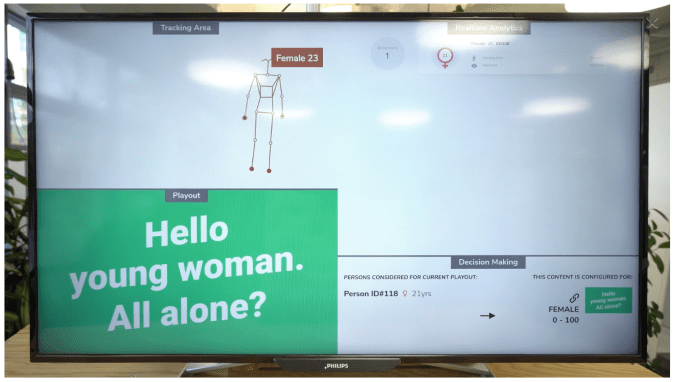
An example message shown in a demo video on Advertima’s website isn’t great in this regard — as the system is shown IDing a stick woman and popping up a targeted message that reads: “Hello young woman. All alone?” (uhhh ?). So retailers plugging such stuff into their stores need to be hyper sensitive to tone and context (and indeed take a robust approach to assessing how accurate the AI is, or isn’t).

Or, well, they could find shoppers fleeing in horror. (tl;dr no one likes to feel watched while they’re shopping. And if the AI misgenders a potential customer that could be a disaster.)

One flashy pledge from Advertima is that its approach to applying AI to guestimate who’s in the shop and what they’re doing is ‘privacy safe’ — with the startup noting there’s no facial recognition nor biometric detection involved in its system, for one thing.

It also specifies that the visual sensors required for the analytics to function do not store any image or video recordings. Instead it claims to “only process minimal anonymized data” — and only evaluate that in “aggregated form”.

“This means that the unintentional identification of a person is technically impossible,” is the top-line claim.

With long-standing data protection laws covering Europe, and EU lawmakers actively considering new rules to wrap around certain applications of artificial intelligence, there’s a legal incentive not to push such tech’s intrusiveness too far (at least for local use-cases). While Switzerland, which is not a Member of the EU (though it is part of the bloc’s single market), also has a reputation for strict domestic privacy laws — so this homegrown startup’s pitch at least reflects that context.

That said, its system appears to generate a “Person ID” (see below screengrab) — so we’ve asked how long it retains these individual-linked IDs for; and whether or not it links (or enables the linking of) the Person ID with any other data that might be gathered from the shopper, such as an email or a device ID. If the Person IDs are persistent it could enable a retailer to re-identify an individual via the Advertima visually tracked behavioral data — and then be in a position to plug these offline shopping behavior ‘insights’ into an identity-linked customer database or link it to an ad profile that’s maintained by a tracking giant or data broker for ad targeting purposes. All of which would be the opposite of ‘privacy safe’ — so we do have questions. We’ll update this report with any response from Advertima to this.

Image credit: Advertima marketing video

Advertima was founded back in 2016 and has so far forged partnerships with Switzerland’s largest retailer, Migros and the international grocer SPAR, to deploy its tech. It says the system is being used by 14 companies across eight countries at this stage.

It says the new funding will go on further developing its platform, and on scaling so the business can better address the global market for smart retail solutions. Although it’s competing in a space that includes Amazon’s cashierless tech so that’s one Goliath-sized big tech competitor to Advertima’s David.

In a press release announcing the Series A it notes it will be ploughing in €10M of its own revenue too — so touts a total spend of €25M over the next two years on building out its platform.

“We see a world where the physical and digital layers are merged to enhance our daily professional and private lives,” said Advertima Co-Founder and CEO, Iman Nahvi, commenting in a statement.

In a blog post announcing the Series A, he also talked up the autonomous store product — suggesting it will “change how people experience grocery shopping, cinemas, DIY stores, and a whole range of retailers”.

“Delivering smart inventory management, autonomous checkout, in-store analytics, and contextual content on smart digital screens will allow grocers and other retailers to maximize the efficiency of their stores, increase their revenues, and generate greater returns per square meter,” he wrote.

“Retailers can actualize an omnichannel strategy to orchestrate better experiences and relationships with their audience. Soon the standard for retailers will be holistically customer-centric: Cashierless checkouts, no lines, individualized experiences, and real-time product recognition for fast, easy, and fun shopping.”

Given that Amazon began licensing its ‘Just Walk Out’ cashierless tech to other retailers earlier this year, and various tech startups have sprung up to chase the potential of similar systems — such as AiFi, Grabango, Standard Cognition and Zippin — Advertima’s global growth ambitions are tempered by plenty of competition.

Physical retail has also taken a battering from the coronavirus pandemic. Although COVID-19 may, paradoxically, drive demand for cashierless tech — as a way to reduce the risk of viral exposure for staff and shoppers. AI technology being applied to eliminate retail jobs does raise wider socioeconomic questions too.

Also commenting in a supporting statement, Fortimo Group founder Remo Bienz added: “It is clear that the rapid digitalisation of our society is going to have an impact on consumer habits, especially in the retail sector. Advertima is at the cutting-edge of technology in the retail space. As a long-standing shareholder, we know how visionary their technology is, but also how it has been successfully adopted by major, global organisations and already generated significant revenues. We’re excited to be part of Advertima’s journey.”

28 Jul 2020

SpaceX offers an inside look at how it created its futuristic Dragon space suits

When SpaceX set out to fly humans on board its spacecraft, it decided to create its own spacesuit in-house. That’s a very different approach from most spacesuit projects, including those at NASA, which typically involve tapping in outside specialist contractors with a long history of experience to help with the work. In a new video, SpaceX provides a look at why they took on that task themselves, and how their unique and modern-looking spacesuits are designed to be the perfect complement to their Dragon spacecraft, both aesthetically and functionally.

SpaceX’s Chris Trigg, Space Suits and Crew Equipment Manager, and Maria Sundeen, Leed Space Suit Specialist take you through the concept, design and production process for the SpaceX suit, which was worn by NASA astronauts Bob Behnken and Doug Hurley on their launch to the International Space Station aboard Dragon at the end of May. They’ll don them again later this week for the return trip.

Trigg notes that the suit is really one part of a system that includes the Dragon crew seat, and is designed to plug in and provide them everything they need automatically. He also explains the thinking behind the helmet design, and why they needed to create gloves that provide pressurization and protection while also offering touchscreen compatibility to work with the Dragon’s control surfaces.

As mentioned, Dragon is set to come back from the ISS on August 1, splashing down in the Atlantic Ocean with astronauts on board on August 2, provided weather and everything else cooperates.

28 Jul 2020

ClimaCell raises $23M Series C for its weather intelligence platform

ClimaCell, the weather forecasting and intelligence service that is using a number of interesting new techniques to gather weather data, today announced that it has raised a $23 million Series C round co-led by new investor Pitango Growth and existing investor Square Peg Captial. With this new round, the Boston- and TelAviv-based company’s total funding now exceeds $100 million.

As ClimaCell co-founder and CEO Shimon Elkabetz told me, the round came together well after the worldwide COVID-19 lockdowns had started and the team never met with its new investors in person. Because the pandemic affected many of ClimaCell’s customers in the travel industry, in recent months, the company did take some steps to reduce cost and expand its overall runway, but Elkabetz stressed that the company didn’t need to raise this new round and that the investors approached the company.

“We took some aggressive but respectful actions around reducing our expenses and created a significant runway,” Elkabetz explained. “We didn’t really need to raise money now, but this opportunity came to us and we decided to take it, because it gives us a significant opportunity to invest in strategic things.”

Image Credits: ClimaCell

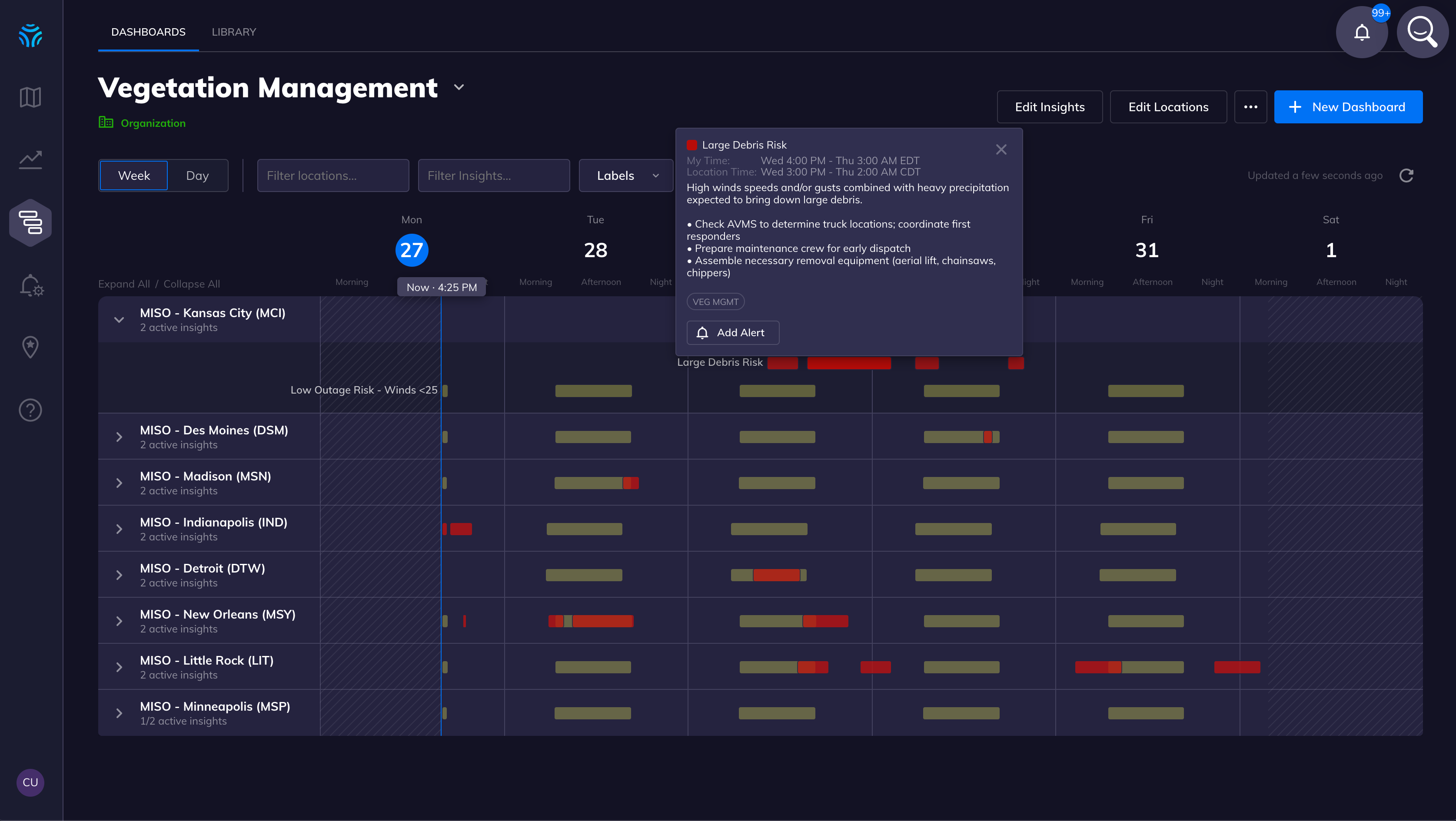
Given the changing business climate, the company did double down on its efforts to brand its service as an intelligence platform that helps businesses make smart decisions about the operations, even if they are not meteorologists. In practice, this means a stronger focus on its Insights service, which helps operators in various industries to make smart decisions based on the company’s forecasts. With this, ClimaCell can help a construction company ensure that a worksite is safe when a storm is coming and when it should shut down its crane operations because of wind, for example, or when a logistics company should expect slowdowns because of heavy rains. Instead of just giving its users a weather forecast, the company’s tools provide actionable suggestions instead.

“65% of the world’s GDP is being impacted by weather events. ClimaCell is the only SaaS company that enables actionable items ahead of weather events rather than reacting to them and their implications and ramifications,” said Aaron Mankovski, Managing General Partner at Pitango Growth, in today’s announcement. “The opportunities coming to ClimaCell across industries including supply chain and logistics, railroads, trucking, shipping, on-demand, energy, insurance, and more represent a complete upending of the existing competitive landscape and is a testament to being laser-focused on customer value.”

Image Credits: ClimaCell

Elkabetz noted that the company plans to use the new funding to expand both its go-to-market efforts and to focus on the fundamental R&D that makes its platform work. He wasn’t quite ready to share what those R&D efforts will look like, but he expects to be able to announce these new capabilities “soon.”

The company also expects to launch some updates to its consumer mobile app soon. While the consumer app may not be ClimaCell’s main focus, it uses the same technology in the backend, including a version of Insights for leisure activities, for example. For Elkabetz, the consumer app helps spread the ClimaCell brand but he also expects that it can become a real business in its own right.

28 Jul 2020

Nanox raises $59M more for low-cost, downsized scanning tech to replace X-rays

Israeli startup Nanox has big ambitions to take on the world of medical imaging and imaging analytics with hardware that reduces the size and cost of scanning equipment, plus software that improves the quality of images and the insights you can gain from them. Today, Nanox is announcing another big step ahead in that plan: it’s raised another $59 million in funding, closing out its Series B at $110 million, to continue building its full-body scanning hardware and securing more customers.

The money is coming from a range of strategic investors that include SK Telecom, Industrial Alliance (the Canadian insurance group), Foxconn and Yozma Korea, and it has arrived swiftly on the heels of $51 million delivered in two tranches, the most recent being in June from strategic investor SK Telecom, which is building a factory to manufacture Nanox hardware in South Korea.

The company is not disclosing its valuation but in June, it was $600 million, and from what we understand this is likely to be the company’s last fundraise before it goes public, although a timeline for the latter has not been set (and never say never in the world of startup funding, of course).

Ran Poliakine, Nanox’s founder and CEO, said in an interview that today the startup makes the majority of its revenues from licensing deals: it provides IP to manufacturers like Foxconn, SK and Fuji (another investor) to build devices based on its concepts, and the plan is to have some 15,000 scanners out in the market over the next several years.

The plan longer term is to get regulatory approval across all markets where the machines are in place to start to roll out the services side of its business, providing insights into the imaging that is sourced by way of the hardware — a process that is in play but has been delayed due to the spread of the coronavirus (and the subsequent slowdown of many processes, such as getting regulatory approvals and clearance).

This services aspect of Nanox’s business is particularly interesting, as it underscores a major shift in how medical services are delivered and will be delivered in the future.

Namely, the rise of more powerful communications networks, and better technology for imaging, and the high overhead of employing people and keeping costly equipment up to date, has led to a wave of deals where hospitals and others are outsourcing some of the analytics work away from on-site labs to remote facilities. And that has led to a surge of businesses looking to tap into the new opportunities arising out of that.

“Telecoms carriers are looking for opportunities around how to sell 5G,” said Ilung Kim, SK Telecom’s president, in an interview in June. “Now you can imagine a scanner of this size being used in an ambulance, using 5G data. It’s a game changer for the industry.”

This means that, even as it is waiting for regulatory clearance, Nanox is already signing on customers for this service — a sign of the times and the demand in the market. Most recently, it inked a deal with USA Radiology, which will be using the tech for a scan-as-a-service business across the US as well as in 15 other countries.

Nanox, of course, benefits on two sides with those deals: not only is it licensing its tech for the services, but it’s getting licensing fees connected to the hardware that’s being built to use them.

As we have described before, the Nanox system is based around proprietary digital X-ray technology, a relatively new area in imaging that relies on digital scans rather than X-ray plates to capture and process images. Nanox’s flagship ARC hardware comes in at 70 kg compared to 2,000 kg for the average CT scanner, and production costs are around $10,000 compared to $1-3 million for the CT scanner.

In addition to being smaller (and thus cheaper) machines with much of the processing of images done in the cloud, the Nanox system, according to CEO and founder Ran Poliakine, can make its images in a tiny fraction of a second, making them significantly safer in terms of radiation exposure compared to existing methods. This makes it easier and cheaper to own the machines, as well as to take regular scans with them, covering not just one small area of the body but the full length of it, which opens the door also to gaining more insights.

Nanox’s proposition is particularly compelling at the moment. As we’ve pointed out before, imaging has been in the news a lot of late because it has so far been one of the most accurate methods for detecting the progress of COVID-19 in patients or would-be patients in terms of how it is affecting patients’ lungs and other organs. But on the other hand, the global health pandemic, and the push to keep people physically away from each other, has also pointed to a big need in the healthcare community for services that make it easier to diagnose patients remotely, putting Nanox and its approach right at the heart of how all of medicine and healthcare seem to be evolving.

That’s provided that it gets the necessary approvals and takes its business to the intended next level.

“It is easy to say that we are aiming to change the world,” Poliakine said in a statement. “The main challenge with such statements is always the execution. We have a bold vision of helping to eradicate cancer and other disease by means of early detection. We are actively working for the deployment of a global medical imaging service infrastructure that may turn this dream into reality.”

28 Jul 2020

ComplyAdvantage nabs $50M for an AI platform and database to detect and stop financial crime

The growth of digital banking has opened up a wealth of opportunities for making the world of finance more accessible and transparent to a greater number of people. But the darker underbelly is that it has also created more avenues for illicit activity to flourish, with some $2 trillion laundered annually but only 1-3% of that sum “caught”.

To help combat that, a London-based startup called ComplyAdvantage, which has built an AI platform and wider database of some 10 million entities to help identify and track those involved in financial crime, is today announcing a growth round of funding of $50 million expand its reach and operations.

Specifically, the plan will be to use the funding for hiring, to invest in the tools it uses to detect entities and map the relationships between them, and to bring on more clients.

“We’ve been focused on more granular analysis and being able to scale to hundreds of millions of searches across our database,” said Charles Delingpole, founder and CEO, said in an interview. “The next phase is more around the network of contacts and more enhanced diligence.” The company today has some 250 staff, mainly in the UK and Romania.

The Series C is being led by Ontario Teachers’ Pension Plan Board (Ontario Teachers’), a huge pension plan out of Canada (US $155 billion) that is known as a prolific growth-stage tech investor.  Previous backers Balderton and Index are also in the round. The company has raised $88 million to date, and while it’s not disclosing its valuation, for some context, it was last valued at around $141 million its last round a year ago, per PitchBook data.

Today, ComplyAdvantage has over 500 customers, primarily financial institutions using it to meet regulatory compliance requirements as well as to reduce their own exposure and risk, providing some automated services to complement (and potentially replace) some of the manual checks that they make to prove you are who you say you are.

It also has a growing business with other groups that are tracking fraud for their own ends, such as insurance companies trying to stem fraudulent claims and government entities. It also has a number of partners that access its database and use that as part of their own solutions (Quantexa, which announced a big funding round of its own last week, is one of those licensing partners).

“A lot of companies in the wider identity space are powered by our data, even if they don’t disclose it,” Delingpole said.

The company had its start originally focusing on the process of helping banks meet regulatory compliance around fraud detection by ingesting and analysing documents provided by customers ahead of opening accounts, initiating larger transactions with new entities and so on. That has taken on a more targeted purpose in recent years as ComplyAdvantage’s database has grown deeper.

Today the core of the business is based around a central database of known money launderers, human traffickers, terrorists, drug lords, and others who exploit financial rails to run illegal operations and make a profit from them.

It’s formed, Delingpole said, by way of “automatically ingesting tens of thousands of datapoints, from websites, national warning lists, linked real-time databases of companies, and various other applications on top of that.” That central database is still growing and Delingpole believes that it’s not unrealistic for it to run to a much higher number in order to get the most accurate picture possible.

“Although we have 10 million today, we want to cover every company and person one day. We think the right number is 8 billion” — that is, the world’s population. “With that larger database we can solve other kinds of crimes too.”

The startup already has a straight channel through to government agencies, reporting connections and discoveries on behalf of their clients directly to them. And to be clear, although there are now strong data protection measures in place in Europe, when people are linked to illegal activity, that puts them on a list that supersedes that. When someone is suspected and is tipped to authorities, that information is kept private.

While all institutions will continue to have teams of people dedicated to risk analysis and investigations into activity, the idea here is to supercharge that work with more data that helps those investigators tackle the greater scale of data in the world today.

“Detecting financial crime in billions of transactions that take place around the globe has become nearly impossible without the application of data science and machine learning. It is this approach that has made ComplyAdvantage into a leader in the category, and the go-to partner for organizations who seek to automate what are still very often manual or inadequate processes,” said Jan Hammer, a partner at Index Ventures, in a statement.

The longer-term opportunity is to build out ComplyAdvantage’s customer base by leveraging information that the company is already surfacing that might be relevant to other verticals.

Insurance is a key example, Delingpole said. “We already see a mention of a person having defaulted on a loan then making an insurance claim,” he said. “We see credit, fraud and ownership data together.”

This, of course, puts the company into close competition not just with others building credit databases but those building strong AI platforms to leverage data to gain deeper insights into seemingly disparate digital actions and to build better pictures of activity on behalf of their clients. That includes not just partners like Quantexa but others like Palantir.

The strength here, said Delingpole, is the sheer size of ComplyAdvantage’s database and its very specific focus on financial crime and how that sits for companies that need to police that, both for their own business health and for regulatory reasons. It’s that focus that has attracted investment.

“ComplyAdvantage offers mission-critical technology solutions for combating financial crime and keeping pace with an ever-evolving regulatory landscape,” said Olivia Steedman, Senior Managing Director, TIP, at Ontario Teachers’. “The company is well positioned to continue its rapid growth as its powerful technology platform transforms the compliance and risk management process for its clients.”


28 Jul 2020

All dogs in Shenzhen, China will get microchipped by 2020

The world’s hardware haven is taking a digital leap for pets. In May, China’s southern city Shenzhen announced that all dogs must be implanted with a chip, joining the rank of the U.K., Japan, Australia and a growing number of countries to make microchips mandatory for dogs.

This week, city regulators began to set up injection stations across their partnering pet clinics, according to social media posts from the Shenzhen Urban Management Bureau.

The chip, which is said to last for at least 15 years and comes in the size of a grain of rice, is implanted under the skin of a dog’s neck. Each chip, when scanned by authorized personnel, reveals a unique 15-digit number matching the dog’s name and breed, as well as its owner’s identity and contact information — which will help reduce strays. The microchip, a radio-frequency identification (RFID) chip, doesn’t track the dog’s location; nor does the authority store its owner’s personal information, according to a local media report.

While Shenzhen’s poster child of technology Huawei is striving to phase out foreign semiconductor parts amid U.S. trade sanctions, the city is procuring imported pet chips, including American and Sweden brands, said the same report.

The Shenzhen government is footing the bill for all the implants as it aims to seize more regulatory oversight over the city’s growing pet population. Those who don’t get their dogs microchipped by November will face a fine or have to turn their pets over to regulators. The city of over 20 million residents owned around 200,000 dogs and cats in 2019, according to official data. The total number of dogs and cats nationwide grew 8.4% year-over-year to nearly 1 billion in 2019, an industry white paper showed.

28 Jul 2020

All dogs in Shenzhen, China will get microchipped by 2020

The world’s hardware haven is taking a digital leap for pets. In May, China’s southern city Shenzhen announced that all dogs must be implanted with a chip, joining the rank of the U.K., Japan, Australia and a growing number of countries to make microchips mandatory for dogs.

This week, city regulators began to set up injection stations across their partnering pet clinics, according to social media posts from the Shenzhen Urban Management Bureau.

The chip, which is said to last for at least 15 years and comes in the size of a grain of rice, is implanted under the skin of a dog’s neck. Each chip, when scanned by authorized personnel, reveals a unique 15-digit number matching the dog’s name and breed, as well as its owner’s identity and contact information — which will help reduce strays. The microchip, a radio-frequency identification (RFID) chip, doesn’t track the dog’s location; nor does the authority store its owner’s personal information, according to a local media report.

While Shenzhen’s poster child of technology Huawei is striving to phase out foreign semiconductor parts amid U.S. trade sanctions, the city is procuring imported pet chips, including American and Sweden brands, said the same report.

The Shenzhen government is footing the bill for all the implants as it aims to seize more regulatory oversight over the city’s growing pet population. Those who don’t get their dogs microchipped by November will face a fine or have to turn their pets over to regulators. The city of over 20 million residents owned around 200,000 dogs and cats in 2019, according to official data. The total number of dogs and cats nationwide grew 8.4% year-over-year to nearly 1 billion in 2019, an industry white paper showed.

28 Jul 2020

As remote work booms, Everphone grabs ~$40M for its ‘device as a service’ offer

The latest startup to see an uplift in inbound interest flowing from the remote work boom triggered by the coronavirus pandemic is Berlin-based Everphone, which sells a ‘mobile as a service’ device rental package that caters to businesses needing to kit staff out with mobile hardware plus associated support.

Everphone is announcing a €34 million Series B funding round today, led by new investor signals Venture Capital. Other new investors joining the round include German carrier Deutsche Telekom — investing via its strategic investment fund, Telekom Innovation Pool — US-based early stage VC AlleyCorp and Dutch bank NIBC.

The Series B financing will go on expanding to meet rising demand, with the startup telling TechCrunch it’s expecting to see a 70-100% increase in sales volume vs the pre-crisis period, thanks to a doubling of inbound leads during the pandemic.

“The global pandemic has been a catalyst for growth in the field of digitization,” said CEO and co-founder, Jan Dzulko, in a statement. “We are currently experiencing a significant increase in demand at home and abroad, which is why we are aiming for European expansion with the funding.”

Everphone describes its offer as a one-stop-shop, with the service covering not just the rental of (new or refurbished) smartphones and tablets but an administration and management wrapper that covers support needs, including handling repairs/replacements — with the promise of replacements within 24 hours if needed and less client risk from not having to wrangle traditional rental insurance fine print.

Other touted pluses of its “device as a service” approach include flexibility (users get to choose from a range of iOS and Android devices); lower cost (pricing depends on customer size, device choice and rental term but starts at €7,99 a month for a refurbished budget device, rising up to €49,99 a month for high end kit with a 12-month upgrade); and rental bundles which can include standard mobile device management software (such as Cortado and AirWatch) so customers can plug the rental hardware into their existing IT policies and processes.

Everphone reckons this service wrapper — which can also extend to including paid apps (such as Babbel for language learning) as an employee on-device perk/benefit in the bundle — differentiates its offer vs incumbent leasing providers, such as CHG-Meridian or De Lage Landen, and from wholesale distributors.

It also touts its global rollout capability as a customer draw, checking the scalability box.

While its investors (including German carrier, DK) are being fired up by the conviction that the COVID-19 induced shift away from the office to home working will create a boom in demand for well managed and secured work phones to mitigate the risk of personal devices and personal data mingling improperly with work stuff. (On that front Everphone’s website is replete with references to Europe’s data protection framework, GDPR, repurposed as scare marketing.)

“Everphone envisions that every employee will one day work via their smartphone,” added Marcus Polke, partner at signals Venture Capital, in a supporting statement. “With this employee-centric approach and integrated platform, everphone goes far beyond the mere outsourcing of a smartphone IT infrastructure.”

The 2016-founded startup has more than 400 customers signed up at this point, both SMEs and multinationals such as Ernst & Young. It caters to both ends of the market with an off-the-shelf package and self-service device management portal that’s intended for SMEs of between 100 and 1,500 employees — plus custom integrations for larger entities of up to 30,000 employees.

It says it’s able to offer “highly competitive” prices for renting new devices because it gives returned kit a second life, refurbishing and reselling devices on the consumer market. “Thanks to this profitable secondary lifespan, we are able to offer highly competitive prices and extensive service levels on our rental devices,” Everphone writes on its website.

The second hand smartphone market has also been seeing regional growth. Swappie, a European ecommerce startup that sells refurbished iPhones, aligning with EU lawmakers’ push for a ‘right to repair’ for electronics, raised its own ~$40M Series B only last month, for example. Its secondhand marketplace is one potential outlet for Everphone’s rented and returned iPhones.

28 Jul 2020

India’s Flipkart gives hyperlocal delivery service another try

Flipkart on Tuesday launched a hyperlocal service in suburbs of Bangalore, four years after the e-commerce group abruptly concluded its previous foray into this category.

The e-commerce group, owned by Walmart, said Flipkart Quick leverages the company’s supply chain infrastructure and a new location mapping technology framework to deliver more than 2,000 products across grocery, perishables, smartphones, electronics accessories, and stationary items within 90 minutes to customers.

Flipkart Quick — initially operational in Whitefield, Panathur, HSR Layout, BTM Layout, Banashankari, KR Puram and Indiranagar among other suburbs of Bangalore — allows customers to book a convenient two-hour slot between 6am to midnight for delivery. The company is levying a delivery charge starting 29 Indian rupees (39 cents) on servicing these orders, it said.

The launch of Quick stands to provide Flipkart an opportunity to reach a new set of users, especially those who otherwise see no reason to buy online, and also become a headache for some existing startups such as Dunzo that already operate in a similar space. It also marks Flipkart’s foray into servicing fresh fruits, vegetables, meats, and milk orders.

“This is a great model for India as households of all sizes are already used to their neighbourhood Kirana stores. In fact, Indian families are so comfortable with what we call the ‘hyperlocal context’, that there is a tendency to develop deep, familial ties with vendors, shopkeepers and service providers – now with the convenience of e-commerce,” said Sandeep Karwa, a VP at Flipkart, in a statement.

“While we start with our dark store (no-walkin) model, wherein we enable sellers to store inventory close to the consumer; this model has the potential of encouraging local entrepreneurship and enabling new business strategies and partnerships. Today, with Flipkart Quick – our Hyperlocal capability, we have the potential to bring together the whole network of neighbourhood Kirana stores onto our platform with just a click,” he added.

This isn’t the first time Flipkart has explored the hyperlocal delivery category. In late 2015, Flipkart launched Nearby to deliver perishables, grocery, wellbeing, and household items within 60 minutes. But the company abruptly discontinued Nearby reportedly because of poor demand and thin margin.

Flipkart did not reference Nearby today, but talked about the efforts it has made to build Quick and the opportunities it sees in the market. A Flipkart spokeswoman told TechCrunch that the company plans to expand Quick hyperlocal delivery service outside of Bangalore in a few months.

Flipkart said for Quick, it is also moving away from the traditional model of using zip code system to identify delivery location and instead using a latitude and longitude approach. This model enables the company to “not only narrow down the location” but also be “more precise” and deliver more efficiently.