Year: 2020

24 Jul 2020

Tech at Work: Black gig workers speak out, Uber’s commitment to being anti-racist and Facebook’s diversity report

Welcome back to Tech at Work, a bi-weekly roundup and analysis of labor, and diversity and inclusion in tech. 

This week, we’re looking at Uber’s anti-racism commitment, Shipt shoppers walking off the job, Facebook’s diversity report and Black gig workers organizing against tech companies. Also, hear from CODE2040 CEO Karla Monterroso on tech’s response to the recent racial justice uprising in the U.S.

“There are a lot of really well-intentioned people, but they’re like, ‘Hey, put me in touch with all your Black and Latinx people,” Monterroso told me. “We have definitely gotten requests for free access to our talent pool. What we are talking through with people is even if you had access to that, your ability to make something of that is incredibly limited because the competencies needed to get people into the workforce, promote and retain them are not had by tech companies at this moment.”


Stay woke


Uber commits to being an anti-racist company

Uber’s track record with diversity and inclusion was especially rocky in the days of former CEO Travis Kalanick. The company’s new CEO Dara Khosrowshahi seems to recognize that, saying “you’re probably thinking that Uber is not exactly the company you’d expect to be speaking up on this front.” Still, Uber has made a number of commitments on its journey to being an anti-racist company.

But first, let’s define anti-racist. From Ibram X. Kendi’s book, How to Be An Antiracist:

To be antiracist is to think nothing is behaviorally wrong or right — inferior or superior — with any of the racial groups. Whenever the antiracist sees individuals behaving positively or negatively, the antiracist sees exactly that: individuals behaving positively or negatively, not representatives of whole races. To be antiracist is to deracialize behavior, to remove the tattooed stereotype from every racialized body. Behavior is something humans do, not races do.

Here are some of the most notable of Uber’s commitments:

  • Double Black representation in leadership (director roles and higher) by 2025. Currently, Black people make up just 3.3% of Uber’s leadership team, while white people make up 59.9% of it.
  • Expand diversity report to include data on intersectionality and self-identification. Race, gender, class, sexual orientation and disability status are highly connected for folks. Intersectionality is the concept that people face multi-faceted layers of discrimination as a result of these intersecting identities.
  • Create more opportunities for drivers, delivery people and support staff to advance their careers. Uber has been talking about this at least since 2018.

Related: This past year marked the most interest in anti-racism in the last five years, according to Google Search Trends. 

Image Credits: Google Trends/MRD

24 Jul 2020

Building your startup’s customer advisory board

A customer advisory board (CAB) can be an invaluable resource for startups, but many founders struggle with putting together the right group of advisors and how to incentivize them. At our TechCrunch Early Stage event, Saam Motamedi, a general partner at Greylock Partners, talked about how he thinks about putting together the right CAB.

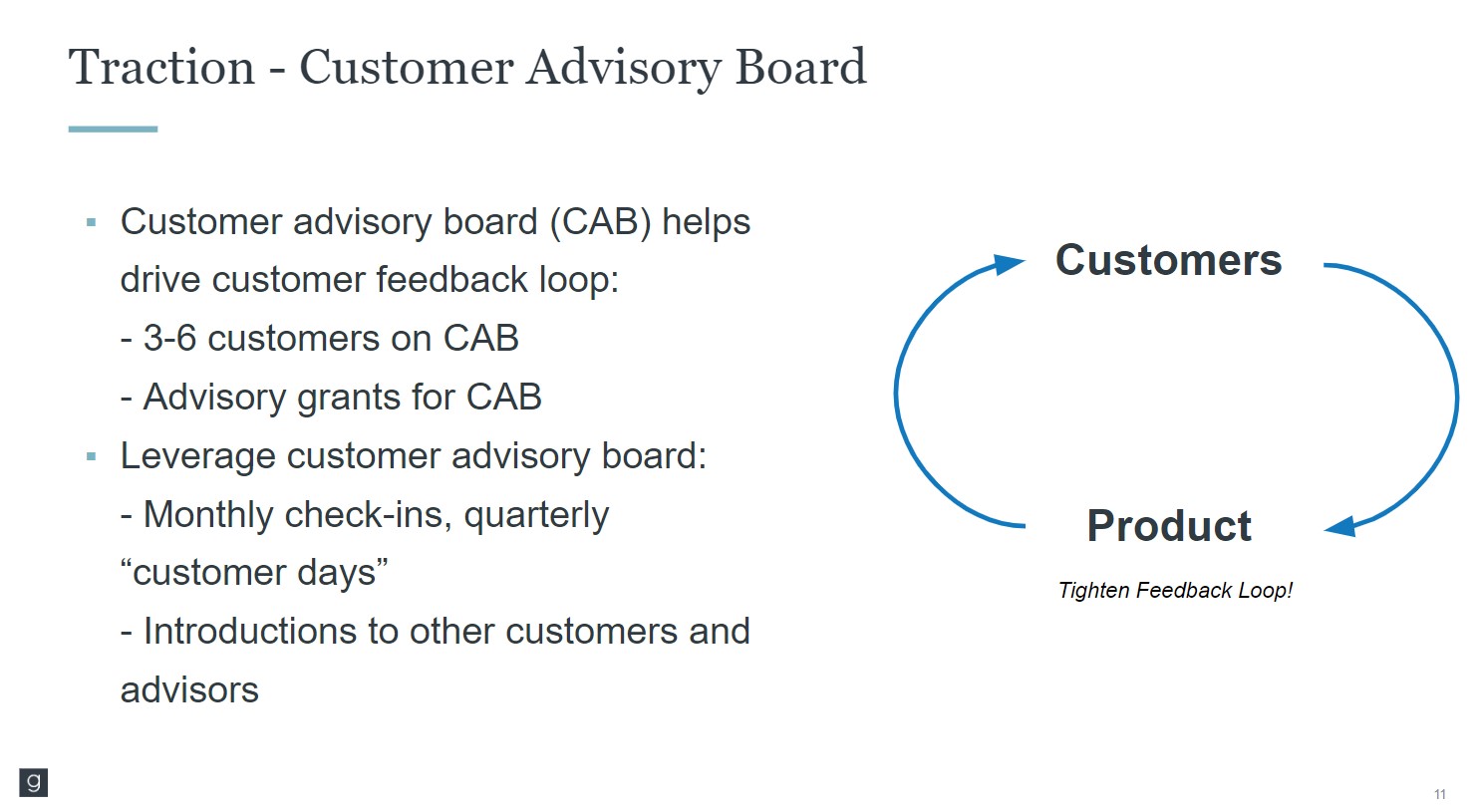
“We encourage all of our early-stage companies to put this in place,” Motamedi said. The goal here is to speed up the process to get to product/market fit since your CAB will provide you with regular feedback.

“The idea here is [that] you have this feedback loop from customers back to your product where you build, you go get feedback, you iterate — and the tighter this feedback loop is, the faster you’ll get to product-market fit. And you want to do things structurally to make this feedback loop tighter, starting with a CAB.”

Motamedi said a CAB should consist of about three to six customers. These should be “luminaries or forward thinkers” in the market you are serving. “You add them to the CAB — you might give them small advisory grants — and they become stakeholders and give you feedback as you work through the early stages of product development.”

Image Credits: Greylock Partners

As for the people who you put on the CAB, Motamedi suggests first setting the right expectations for the board.

“There are three components. Number one, the most valuable thing you can get from these customer advisors is their time. So the first piece is you want them to commit to a monthly cadence, that could be 60 minutes, it could be 90 minutes, where you’re going to say, ‘Hey, I’m going to come to the meeting, I’m going to bring two of my teammates, we’re going to show you the latest product demo, and you’re going to drill us with feedback. We’re going to do that once a month.’  […] And then piece two is this notion of customer days, you could do quarterly, you could also do twice a year.

“The idea is you want to bring the customers together. Because if you and I are both CIOs at Fortune 500 companies and we independently react to a product, that’s one thing, but if we sit in a room together, we all look at the product together, there’s going to be interesting data amongst us as customers and the founder is going to learn a lot from that.[…] And I think the third piece is just an expectation that as the company progresses and product maturity increases, that folks on the CAB are going to be advocates and evangelists for the company with their customer networks.”

Motamedi recommends outlining those expectations in a short document.

24 Jul 2020

Space Force debuts official logo and motto, both reminding you that it’s ‘always above’

Earlier this year, the oft-mocked but actually pretty important new branch of the military, the Space Force, revealed an image that was suspiciously reminiscent of Star Trek. Now the Space Force has revealed a new, sharper graphic that is the force’s actual logo — and a motto to go with it: “Semper Supra,” or “always above.”

To be clear, the image revealed in January, which everyone thought looked quite a bit like Starfleet’s, is the seal for the Space Force branch of the military. The new, simpler one is the logo for the organization as a whole, which is the one we’ll see communications and recruiting branded with.

In a series of tweets, the Space Force explained the various elements of the logo. It’s not exactly esoteric stuff, but it’s nice to know the chrome is there for a reason and not just because it looks cool.

Image Credits: U.S. Space Force

The silver border of the skyward-pointing delta shape, they said, “signifies defense and protection from all adversaries and threats emanating from the space domain.”

The middle part is black because it “embodies the vast darkness of deep space. Some feel fear and dread but we prefer to be inspired and stand up to the challenge.”

And in the very center is a star. It’s Polaris, the north star, which “guides. That’s why it is in the center of our logo.”

The “beveled elements,” being quadpartite, symbolize the four armed forces supporting the branch: Air Force, Army, Navy, and Marines. They’re spiky because it makes them look a bit like rockets shooting into space.

As for the motto: “Semper Supra,” meaning “always above,” could be construed as either reassuring or menacing, depending on which end of the Space Force you’ve got pointing at you. It represents “establishing, maintaining, and preserving” the U.S. presence in space, and of course to a soldier on the ground, it’s nice to think that they have operational support from the always-above Space Force. For others, it brings to mind spy satellites or orbital lasers.

Expect to see this logo a lot over the next for years as this new branch matures and recruits.

More importantly, the Space Force has horses:

Congratulations to the Space Force on their new logo, and to Ghost for being beautiful and strong.

24 Jul 2020

Space Force debuts official logo and motto, both reminding you that it’s ‘always above’

Earlier this year, the oft-mocked but actually pretty important new branch of the military, the Space Force, revealed an image that was suspiciously reminiscent of Star Trek. Now the Space Force has revealed a new, sharper graphic that is the force’s actual logo — and a motto to go with it: “Semper Supra,” or “always above.”

To be clear, the image revealed in January, which everyone thought looked quite a bit like Starfleet’s, is the seal for the Space Force branch of the military. The new, simpler one is the logo for the organization as a whole, which is the one we’ll see communications and recruiting branded with.

In a series of tweets, the Space Force explained the various elements of the logo. It’s not exactly esoteric stuff, but it’s nice to know the chrome is there for a reason and not just because it looks cool.

Image Credits: U.S. Space Force

The silver border of the skyward-pointing delta shape, they said, “signifies defense and protection from all adversaries and threats emanating from the space domain.”

The middle part is black because it “embodies the vast darkness of deep space. Some feel fear and dread but we prefer to be inspired and stand up to the challenge.”

And in the very center is a star. It’s Polaris, the north star, which “guides. That’s why it is in the center of our logo.”

The “beveled elements,” being quadpartite, symbolize the four armed forces supporting the branch: Air Force, Army, Navy, and Marines. They’re spiky because it makes them look a bit like rockets shooting into space.

As for the motto: “Semper Supra,” meaning “always above,” could be construed as either reassuring or menacing, depending on which end of the Space Force you’ve got pointing at you. It represents “establishing, maintaining, and preserving” the U.S. presence in space, and of course to a soldier on the ground, it’s nice to think that they have operational support from the always-above Space Force. For others, it brings to mind spy satellites or orbital lasers.

Expect to see this logo a lot over the next for years as this new branch matures and recruits.

More importantly, the Space Force has horses:

Congratulations to the Space Force on their new logo, and to Ghost for being beautiful and strong.

24 Jul 2020

Extra Crunch Live: Join Playground Global co-founder Peter Barrett for a live Q&A on July 28

Peter Barrett might be best known today as co-founder and CTO of Playground Global. But his experience in the technology world stretches back to when he was a teenager.

Barrett’s first security program got the attention of the NSA when he was just 19 years old. His career has been an adventure ever since, starting with his first company Rocket Science Games. Barrett went on to build an IPTV platform at Microsoft, cloud intelligence for automotive at CloudCar and now quantum and optical computing, robotics and artificial intelligence at Playground. Barrett also holds more than 100 patents.

Despite all of the technological progress the industry has made in the past three decades, Barrett believes the computing revolution has yet to begin — hence his interest in startups, particularly around robotics, automation and AI. Playground, which has $825 million under management and 39 active portfolio companies, has made more than 20 investments in robotics and automation. The five-year-old firm has chalked up at least 10 exits, including Canvas Technology to Amazon, DeepScale to Tesla, zippy to Cruise, Lighthouse to Apple and Nervana, which was acquired by Intel.

Barrett also is on the boards of PSIQuantumFathomLacuna, Anjuna, Artificial, Next Silicon, NVision, and a board observer of Virta. Despite all of this investor activity, Barrett says he still finds time to code everyday. Perhaps it’s because Barrett believes code is the new concrete, essentially becoming the basis of tomorrow’s infrastructure. Plus, he says coding is fun.

These are just a few of the reasons why we’re thrilled to have Barrett join us 11 a.m. PT/ 2 p.m. ET July 28 as part of our Extra Crunch Live series, which connects some of the best and brightest minds in tech with our Extra Crunch audience. We’ve had a stacked agenda of speakers, a group that has included Mark Cuban, Aileen Lee and Ted Wang, Aaron Levie of Box, Julia Hartz of Eventbrite and Hans Tung and Jeff Richards at GGV Capital.

Barrett will sit down with us virtually to discuss a multitude of topics from future of computing, life sciences and automation and why robotics is misunderstood to the potential for automation beyond humanoid robots and whether quantum computing is ready for the spotlight. 

We’ll also talk about today, namely COVID-19 and the affect it’s had on his portfolio companies, the challenges of investing entrepreneurs remotely and how venture capitalists are chasing the wrong kinds of companies and not prioritizing real progress.

In short, we plan to cover a lot and you don’t want to miss it.

Scheduling details

Date/Time: July 28, 11am PT/2pm ET

Zoom Link: https://zoom.us/j/99320626734

Add this call directly to your calendar. 

24 Jul 2020

SaaS startup Swoop raises $3.2M to modernize mom-and-pop transportation companies

Chauffeured group transportation — the vehicles used for corporate outings, special events, and even weddings — is a fragmented industry with hundreds of small operators that rely on analog systems to book customers. Now in this era of COVID-19, these operators are being squeezed as travel and tourism has dwindled and companies have opted to have employees work from home.

One Los Angeles-based transportation booking startup called Swoop aims to bring these small, local operators into the digital age with a new software-as-a-service platform that it says is helping them adapt in this COVID-19 era. The startup, loaded with an injection of capital, is ramping up its SaaS product in hopes of tapping into a marketplace where customers spent $40 billion annually.

Swoop has raised $3.2 million in a seed funding round led by Signia Venture Partners, South Park Commons and several angel investors, including former Uber CPO Manik Gupta, Kevin Weil, co-creator of Libra at Facebook, Kim Fennel, a former Uber executive and Elizabeth Weil, former partner at Andreessen Horowitz, 137 Ventures.

“I’m fascinated about how operators are still running most of their business with pen and paper,” Swoop CEO and co-founder Amir Ghorbani said in a statement. Ghorbani has witnessed first hand the constraints of these small operators. During high school and college, Ghorbani helped with his parents’ limousine business. The experience prompted him to seek a solution. 

“I saw a huge opportunity to help these small mom and pop shops, in an under-digitized industry, where no operator has more than 1% market share,” Ghorbani added.

Ghorbani began by building a group transportation booking platform used by companies like Airbnb, Google and Nike. Through those bookings the companies saw an opportunity to build business management software for vehicle operators.

Swoop’s SaaS platform lets companies book and dispatch rides, track vehicles and communicate with customers. It also acts as a central hub for payments and other bookkeeping. The tool is designed to smooth out the booking process as well as increase vehicle utilization, which is currently at 4.9%, according to the company. Swoop also passes on leads from companies that use the booking platform to the operators using its SaaS tool.

For now, the focus is on local transportation companies, not public transit, which is a sector that Uber is chasing after.

COVID-19, which has suspended most group outings, has upended these local transportation operators. Swoop says it has adjusted its platform to help these operators survive. The company told TechCrunch that it is helping operators repurpose their vehicles to ship goods rather than people. For instance, large vans once used for corporate outings can now be marketed to food wholesalers or companies that need local package delivery. The platform is also being used to connect operators with companies like Amazon that provide transportation to shuttle essential factory workers.

Swoop said COVID-19 might end up accelerating its business ramp as operators are being forced to evaluate their businesses and seek out new ways to generate revenue and reduce costs.
24 Jul 2020

Lo Toney’s product manager playbook for pitch deck success

The cold email worked — you’ve landed a meeting with your dream investor. Hell, you even set aside $40,000 for a pitch deck consultant to make sure your presentation looks suave.

One thing to figure out before you pick out a Zoom background: what information actually goes into those slides?

Lo Toney, founding managing partner at Plexo Capital, has advice for founders looking to raise money: think like a product manager while crafting your pitch deck. Toney has helped shape products at Zynga, Nike and eBay, and currently serves as both a GP and an LP at Plexo Capital, which invests in funds and startups. He’s done a ton of pitching and gotten pitched himself, which is why we invited him to TechCrunch Early Stage 2020.

“The framework of product management is very similar to the same playbook used by an early-stage investor and early-stage investors in the absence of an abundance of data,” Toney said. “They’re really thinking very similar to a product manager to evaluate an opportunity.”

Crafting a solid pitch deck is critical to the success of a startup seeking venture capital. Investors, however, spend less than four minutes on average per deck, and some even tell you that you have half that much time (so either talk fast or pick your favorite slides). Even if you have the business to prove that you’re the next Stripe, if you butcher the story behind the numbers, you could lose the potential to get the capital you need.

Toney said adopting a product manager mindset helps refine what that story looks and feels like.

“The story is not your product. It’s not your company, and it’s not the entrepreneur. It’s how your customer’s world is going to be better when your product has solved their problem,” he said, quoting Rick Klau from GV.

In action, Toney broke down the framework into four key slides: problem, market, solution and, of course, team.

Problem

First up, most investors say they want to see the problem you’re trying to solve up high. Toney is no different.

“I like to see an entrepreneur describing the desired outcome first, and then what are some of those roadblocks that come along the way to that desired outcome?” he asked. Similar to a product manager, founders could illustrate the different challenges that could come to executing a solution on a specific problem.

24 Jul 2020

Four steps for drafting an ethical data practices blueprint

In 2019, UnitedHealthcare’s health-services arm, Optum, rolled out a machine learning algorithm to 50 healthcare organizations. With the aid of the software, doctors and nurses were able to monitor patients with diabetes, heart disease and other chronic ailments, as well as help them manage their prescriptions and arrange doctor visits. Optum is now under investigation after research revealed that the algorithm (allegedly) recommends paying more attention to white patients than to sicker Black patients.

Today’s data and analytics leaders are charged with creating value with data. Given their skill set and purview, they are also in the organizationally unique position to be responsible for spearheading ethical data practices. Lacking an operationalizable, scalable and sustainable data ethics framework raises the risk of bad business practices, violations of stakeholder trust, damage to a brand’s reputation, regulatory investigation and lawsuits.

Here are four key practices that chief data officers/scientists and chief analytics officers (CDAOs) should employ when creating their own ethical data and business practice framework.

Identify an existing expert body within your organization to handle data risks

The CDAO must identify and execute on the economic opportunity for analytics, and with opportunity comes risk. Whether the use of data is internal — for instance, increasing customer retention or supply chain efficiencies — or built into customer-facing products and services, these leaders need to explicitly identify and mitigate risk of harm associated with the use of data.

A great way to begin to build ethical data practices is to look to existing groups, such as a data governance board, that already tackles questions of privacy, compliance and cyber-risk, to build a data ethics framework. Dovetailing an ethics framework with existing infrastructure increases the probability of successful and efficient adoption. Alternatively, if no such body exists, a new body should be created with relevant experts from within the organization. The data ethics governing body should be responsible for formalizing data ethics principles and operationalizing those principles for products or processes in development or already deployed.

Ensure that data collection and analysis are appropriately transparent and protect privacy

All analytics and AI projects require a data collection and analysis strategy. Ethical data collection must, at a minimum, include: securing informed consent when collecting data from people, ensuring legal compliance, such as adhering to GDPR, anonymizing personally identifiable information so that it cannot reasonably be reverse-engineered to reveal identities and protecting privacy.

Some of these standards, like privacy protection, do not necessarily have a hard and fast level that must be met. CDAOs need to assess the right balance between what is ethically wise and how their choices affect business outcomes. These standards must then be translated to the responsibilities of product managers who, in turn, must ensure that the front-line data collectors act according to those standards.

CDAOs also must take a stance on algorithmic ethics and transparency. For instance, should an AI-driven search function or recommender system strive for maximum predictive accuracy, providing a best guess as to what the user really wants? Is it ethical to micro-segment, limiting the results or recommendations to what other “similar people” have clicked on in the past? And is it ethical to include results or recommendations that are not, in fact, predictive, but profit-maximizing to some third party? How much algorithmic transparency is appropriate, and how much do users care? A strong ethical blueprint requires tackling these issues systematically and deliberately, rather than pushing these decisions down to individual data scientists and tech developers that lack the training and experience to make these decisions.

Anticipate – and avoid – inequitable outcomes

Division and product managers need guidance on how to anticipate inequitable and biased outcomes. Inequalities and biases can arise due simply to data collection imbalances — for instance, a facial recognition tool that has been trained on 100,000 male faces and 5,000 female faces will likely be differently effective by gender. CDAOs must help ensure balanced and representative data sets.

Other biases are less obvious, but just as important. In 2019, Apple Card and Goldman Sachs were accused of gender bias when extending higher credit lines to men than women. Though Goldman Sachs maintained that creditworthiness — not gender — was the driving factor in credit decisions, the fact that women have historically had fewer opportunities to build credit likely meant that the algorithm favored men.

To mitigate inequities, CDAOs must help tech developers and product managers alike navigate what it means to be fair. While computer science literature offers myriad metrics and definitions of fairness, developers cannot reasonably choose one in the absence of collaborations with the business managers and external experts who can offer deep contextual understanding of how data will eventually be used. Once standards for fairness are chosen, they must also be effectively communicated to data collectors to ensure adherence.

Align organizational structure with the process for identifying ethical risk

CDAOs often build analytics capacity in one of two ways: via a center of excellence, in service to an entire organization, or a more distributed model, with data scientists and analytics investments committed to specific functional areas, such as marketing, finance or operations. Regardless of organizational structure, the processes and rubrics for identifying ethical risk must be clearly communicated and appropriately incentivized.

Key steps include:

  • Clearly establishing accountability by creating linkages from the data ethics body to departments and teams. This can be done by having each department or team designate its own “ethics champion” to monitor ethics issues. Champions need to be able to elevate concerns to the data ethics body, which can advise on mitigation strategies, such as augmenting existing data, improving transparency or creating a new objective function.
  • Ensuring consistent definitions and processes across teams through education and training around data and AI ethics.
  • Broadening teams’ perspectives on how to identify and remediate ethical problems by facilitating collaborations across internal teams and sharing examples and research from other domains.
  • Creating incentives — financial or other recognitions — to build a culture that values the identification and mitigation of ethical risk.

CDAOs are charged with the strategic use and deployment of data to drive revenue with new products and to create greater internal consistencies. Too many business and data leaders today attempt to “be ethical” by simply weighing the pros and cons of decisions as they arise. This short-sighted view creates unnecessary reputational, financial and organizational risk. Just as a strategic approach to data requires a data governance program, good data governance requires an ethics program. Simply put, good data governance is ethical data governance.


24 Jul 2020

Snoop Dogg’s Casa Verde gets into the sleep space, backing NY-based Proper

Helping Americans get their forty winks has never been more necessary as the country faces what some health experts have called a sleep epidemic, and Snoop Dogg’s cannabis-focused firm Casa Verde Capital wants to help.

The firm is leading a $9.5 million investment into a company called Proper, which is launching with a combination of sleep coaching and supplements, pitching a “holistic” sleep health solution.

One-third of US adults don’t get enough sleep according to Proper’s estimates, and the company’s chief executive, Nancy Ramamurthi, says that the COVID-19 epidemic has only made the problem worse.

“Proper aims to help solve what the CDC has identified as a public health crisis – insufficient sleep — with a truly more holistic and personalized solution,” said Ramamurthi, founder and CEO of Proper, in a statement. “Proper has combined the best of natural, safe, evidence-based sleep supplements with expert behavioral coaching, which consumers have not traditionally been able to access. Now, thanks to the increasing popularity of telehealth, sleep coaching can be delivered online.”

The sleep coaching services from Proper are provided by board-certified health and wellness coaches under the guidance of a clinical psychologist and behavioral sleep medicine specialist, according to a statement from the company.

Ramamurthi said that clinical validation is a core component of the company’s business. Indeed, the company is currently running its formulations through a clinical trial to prove their efficacy. It’s an additional step that the company doesn’t need to take, she said, because the supplements have all been studied with clinical trials supporting the use of the ingredients as treatments for sleep therapy. “That’s in addition to them being used for thousands of years,” said Ramamurthi.

Proper was incubated within the consumer health venture studio Redesign Health and will use the new capital from investors led by Snoop Dogg’s Casa Verde to boost its sales and marketing efforts and continue its research and development activities.

While sleep aids may seem like a strange market for a cannabis-focused investment firm, Casa Verde partner Karan Wadhera says it’s a highly strategic investment for the firm.

[Cannabis] is an input as well and its use case will go beyond how people think of cannabis stigmatically,” Wadhera said. “At its core, [Proper] is a company that’s helping us target this sleep epidemic. We think CBD and cannabis at large can play a big role in addressing that in a way that traditional products haven’t been able to.”

The investment in Proper, then, points to a maturation of the cannabis industry, as investors look at the various chemical components of the cannabis plant and try to tease out a broader range of health and wellness applications. “We are starting to shift how we think about the business. It doesn’t have to be a core, specific cannabis product,” Wadhera said. 

Ramamurthi says that her company will be exploring applications for cannabinoids in its supplements later. “As we continue our product development process one of the things we are looking at is CBD,” she said. “CBD is one of the more effective ingredients at reducing stress and anxiety and stress and anxiety are one of the main reasons why people can’t get to sleep.”

Proper’s studies are supported by a scientific advisory board that includes Dr. Adam Perlman, the director of integrative health and wellbeing at the Mayo Clinic, and Dr. Allison Siebern, a clinical psychologist and board-certified sleep medicine specialist at the VA Medical Center in North Carolina.

There’s a reason why sleep is so poorly understood and ignored as a health issue in America. Around 90 percent of primary care physicians rate their understanding of sleep’s impact on the body as “poor to fair” and there’s only one board-certified sleep specialist for every 43,000 Americans, according to Proper’s data.

Customers who sign up for Proper’s service can select one of five sleep formulations available for $39.99 per bottle or for a subscription with a ten percent discount. New users also get a free 30-minute consultation with a Proper sleep coach, the company said.

The five versions of Proper’s sleep products include a core sleep product made from GABA, valerian root extract, rafuma leaf extract, and ashwagandha root and leaf extract; a sleep and restore product that includes melatonin; a calming pill with L-theanine added to the core sleep product; and a clarity product that includes concentrated grape extracts; and, finally, an immunity product with added zinc, vitamin C, B6, and D.


24 Jul 2020

Neo’s Ali Partovi on best practices for hiring early-stage startup engineers

On day one of TechCrunch’s Early Stage virtual conference, Ali Partovi joined us to discuss best practices for startups looking to hire engineers.

It’s a subject that’s near and dear to his heart: Partovi is co-founder and CEO of Neo, a venture aimed at including young engineers in a community alongside seasoned industry vets. The fund includes top executives from a slew of different industry titans, including Amazon, Airbnb, Dropbox, Facebook, Google, Microsoft and Stripe.

Partovi is probably best known in the Valley for co-founding Code.org with twin brother, Hadi. The nonprofit launched in 2013 with a high-profile video featuring Mark Zuckerberg, Bill Gates and Jack Dorsey, along with a mission to make coding education more accessible to the masses.

It was a two-summer internship at Microsoft while studying at Harvard that gave Partovi an entrée into the world of tech. And while it was clearly a formative experience for the college student, he advises against prospective startup founders looking to large corporations as career launch pads.

“I spend a lot of time mentoring college students, that’s a big part of what I do at Neo,” Partovi said.

“And for anyone who wants to be a founder of a company, there’s a spectrum, from giant companies like Microsoft or Google to early-stage startups. And I would say, find the smallest point on that spectrum that you’re comfortable with, and start your career there. Maybe that’s a 100-person company or maybe for you, it’s a 500-person company. But if you start at Microsoft, it’ll be a long time before you feel comfortable doing your own startup. The skills you gain at a giant company are very valuable for getting promoted and succeeding in giant companies. They’re not often as translatable to being your own founder.”