Year: 2020

23 Jul 2020

Understanding Hippo’s valuation in a post-Lemonade IPO world

Startups that fit under the broad umbrella of insurance technology are having quite a year.

In early 2020, insurtech marketplaces raised hundreds of millions of dollars, and as the year continued, more insurtech startups saw their fortunes rise. But these busy and lucrative recent quarters are perhaps best demonstrated by Lemonade’s IPO.

The rental and home-insurance startup went public in early July, pricing at $29 per share ahead of its raised IPO range, which valued it at around $1.6 billion.

Despite a strong IPO pricing run, Lemonade was still worth less than the $2 billion valuation it had previously earned from private investors. The debut looked like an example of public markets taking a bite out of private investor enthusiasm, a cooling off for a hot startup.


The Exchange explores startups, markets and money. You can read it every morning on Extra Crunch, or receive it for free in your inbox. Sign up for The Exchange newsletter, which drops Saturdays starting July 25.


But when Lemonade began to trade, its shares soared 139% on their first day, closing at $69.41 per share and valuing the company far above its final private price. No matter what price bankers and institutional investors had managed to agree on, the investing public had quickly repriced the company for a multiple of its IPO price.

Today, Lemonade is worth $78.50, or around $4.31 billion, according to Google Finance.

This week, fellow insurance-selling insurtech player Hippo announced that it had raised a Series E worth $150 million at a $1.5 billion post-money valuation.

But while the moment appeared laudable, Hippo also announced that it had gross written premium — the value of insurance products sold, before certain deductions — of $270 million in the preceding 12 months, a figure that had grown 140% over the prior year.

Lemonade, in contrast, had gross written premium of $116 million in 2019, up around 147% from its 2018 result, and $38 million in Q1 2020, putting it on an annualized pace of $152 million at the end of March. It was worth $1.6 billion at IPO, and north of $4 billion today. The mismatch in the size and value of the companies was interesting to say the least.

To explore both Hippo’s round and the apparent pricing discrepancy between this private firm and the public Lemonade, The Exchange got on the phone with Hippo’s CEO Assaf Wand to dig in.

Are the public markets too frothy? Are private investors too conservative? Both? Let’s find out.

Hippo

Hippo offers homeowners’ insurance, which Lemonade also offers, though the latter has a historical focus on renters’ insurance. Regardless, the firms are sufficiently related to warrant comparison.

TechCrunch spoke with Wand about his round, learning that it was raised during COVID-19, which meant that some VCs were effectively offline, or tending to their own portfolio companies. Still, after fundraising over Zoom, Hippo and Wand aligned terms, investors and valuation in a way that it felt made the sense and put the capital together.

23 Jul 2020

Arrive Outdoors, the gear rental platform for outdoor adventures, raises $4.75 million

Camping has been on the rise, especially among younger people, for the past couple years. Even during a pandemic, camping represents a relatively safe way to get back on the road again.

Arrive Outdoors, a startup based out of Santa Monica, is looking to capitalize on the growing popularity of camping and interest in outdoor activities with its gear rental platform.

The company was cofounded by married couple Rachelle Snyder and Ross Richmond who had experienced the problem of wanting to do outdoor activities, particularly while traveling, but not having access to quality gear. The only options for an adventurer are to schlepp their own gear around, or rely on a local gear rental store, many of whom do not offer reservations.

Simply put, Arrive Outdoors brings the internet into the equation.

The company, which just raised $4.75 million in seed funding led by Freestyle Capital, allows users to choose gear on an a la carte basis, or choose a pre-packaged kit of items, and reserve their gear for free. The equipment is shipped in a box with a pre-paid return label, and can be sent back to the company once the trip is over.

For a weekend, the usual rental period for users, the cost of the equipment is approximately 10 percent of the retail price of the gear.

This gear includes hiking and backpacking apparel, camping gear, and snow and ski equipment/apparel. The most popular product on the site, according to Snyder, is the Camping Set for Two, which includes a tent, two sleeping bags and pads, headlamps, a lantern, a cooler, a stove and pot, and a couple chairs.

Image Credits: Arrive Outdoors

Arrive Outdoors partners with around 40 premium brands, and offers different types of partnerships depending on the size and goals of the brand itself. With smaller brands, the company buys the gear wholesale, while bigger brands that are looking to ‘advertise’ their products may partner with Arrive Outdoors to get those products in the hands of customers.

The company also partners with state parks, including Washington State Parks, Michigan State Parks, and Utah State Parks who refer campers to Arrive Outdoors for their camping gear.

All gear is held in the company’s California warehouse and is cleaned between uses per the CDC’s Recreate Responsibly guidelines and the National Park Service’s recommendations.

Alongside Freestyle Capital, Science Inc., Corigin Ventures, Narrative Fund, AVG Basecamp Fund, James Reinhart and John Voris have also invested in the company. As part of the deal, John Felser (Freestyle Capital cofounder) and Mike Jones (cofounder and CEO of Science Inc.) have joined the board.

Our biggest challenge is that we are growing at a rate that is fairly unexpected this summer,” said Snyder. “COVID hit and it was a low point in March and April and then it shot up. So, for us, it’s all about catching up and trying to run as fast as we can to make sure that we can supply everybody who wants gear.”

Snyder added that it’s a challenge the company feels very fortunate to be faced with.

The company plans on using the funding to grow the team (currently at 12). Women make up 46 percent of the team, and people of color represent 46 percent of the team.

23 Jul 2020

Gorilla Glass Victus can survive a two-meter drop and is set to arrive on a Samsung device soon

You might not know Gorilla Glass by name, but odds are pretty good you own at least one device sporting Corning’s chemically strengthened glass composite. It’s been a ubiquitous feature of consumer products ranging from smartphones to wearables for more than a decade now, courtesy of excellent drop and scratch resistance. All in all, it has made its way onto north of eight billion devices over the years.

Corning just announced the latest version of the glass — Victus. In drop tests, the glass has managed to survive drops of up to two meters onto hard, rough surfaces. It’s also 2x more scratch resistant than Gorilla Glass 6. All good news from the sound of it.

The new glass bucks the standard numbering sequence (leaving off with 6 back in 2018). Here’s some stuff I found out about the word “victus” on Wikipedia (see? I research):

  1. It’s derived from the Latin word vīvō (to live, survive)

  2. It means living, way of life or lifestyle

  3. It’s a 2014 historical novel by Catalan anthropologist Albert Sánchez Piñol (honestly, the first two seem more relevant here).

Image Credits: Corning

Here’s what a Corning spokesperson said about the shift away from from the far more straightforward naming scheme, “This glass is a significant improvement compared to our previous flagship, Gorilla Glass 6, for both drop and scratch. We felt a glass this good deserved a name that made clear the significance was beyond incremental.”

So, will we see a Victus 2 in 18-24 months? Perhaps a different Latin name? Only time will tell.

Meanwhile, the glass is set to debut on Samsung products “in the near future,” which almost certainly means one of the five “power devices” the company has promised to deliver at its upcoming Unpacked event. The Galaxy Note 20 seems like a pretty solid candidate on that front. And back, for that matter.

23 Jul 2020

Taking on the perfect storm in cybersecurity

The cybersecurity industry is at a turning point.

Traditional security approaches were already struggling to deal with rising cyberattacks, a shift to cloud and explosive growth in Internet of Things (41.6 billion IoT devices by 2025, anyone?).

Then came the COVID-19 pandemic and all the changes that were fomenting for years accelerated, with remote work becoming the norm and digital transformation taking on urgency. New levels of complexity are piling on top of an environment that was already too overwhelming for most organizations.

To me, the biggest risk in cybersecurity today is that organizations can’t keep up with the amount of work it takes to be secure. The people on your cybersecurity teams are drowning under an impossible amount of manual work. When people are asked to use manual processes against machines, they can’t keep up. Meanwhile, the hackers are getting smarter every day. They use machine learning (ML) algorithms to scale attacks that can only be successfully prevented by comparable techniques.

Under these conditions, you’ve got a perfect storm brewing.

That’s the bad news. The good news is that these challenges can be addressed. In fact, now is the right time to fix things. Why? Because everything is in transition: cloud adoption, a mobile workforce, the proliferation of IoT, etc.

In this sophisticated threat landscape, you can’t be reactive — you must be proactive. You need integrated machine learning to lift the burden off cybersecurity teams, so that they can be faster and more effective in dealing with attacks. At the same time, you must embrace cloud delivery and a holistic approach to cybersecurity.

Where’s the core foundation?

A popular expression from a few years back was “the cloud changes everything.” OK, it doesn’t change everything, but it does change a lot.

When organizations move to the cloud, they’re often unprepared. Staking critical pieces of their business on a cloud future without understanding the full implications of cloud can be challenging. And it doesn’t help that they are inundated with so many disparate products on the market that don’t work easily together.

If your security teams are drowning now, the cloud will hit them like a tsunami.

Automation can help ease the burden. But it’s nearly impossible for security teams to operate successfully when there are multiple vendors that need to be manually integrated and managed.

Most organizations have taken a stopgap approach to cybersecurity over the years. Each time there is a new type of threat, a new set of startups are founded to come up with a solution to counter it.

I have seen companies with dozens, or hundreds, of disparate security products that don’t interoperate and don’t even offer the possibility of a holistic approach to cybersecurity. This has become a house of cards. One product piled on top of another, with no core foundation to hold everything together.

It’s time to act. The technology to do cybersecurity right is available. It’s all about how you deploy it.

A new model for cybersecurity

The future of cybersecurity depends on a platform approach. This will allow your cybersecurity teams to focus on security rather than continue to integrate solutions from many different vendors. It allows you to keep up with digital transformation and, along the way, battle the perfect storm.

Our network perimeters are typically well-protected, and organizations have the tools and technologies in place to identify threats and react to them in real-time within their network environments.

The cloud, however, is a completely different story. There is no established model for cloud security. The good news is that there is no big deployment of legacy security solutions in the cloud. This means organizations have a chance to get it right this time. We can also fix how to access the cloud and manage security operations centers (SOCs) to maximize ML and AI for prevention, detection, response and recovery.

Cloud security, cloud access and next-generation SOCs are interrelated. Individually and together, they present an opportunity to modernize cybersecurity. If we build the right foundation today, we can break the pattern of too many disparate tools and create a path to consuming cybersecurity innovations and solutions more easily in the future.

What is that path? With an integrated platform, organizations can still use a wide range of tools, but they can coordinate them, manage them centrally, eliminate silos and ensure that all across the organization they are fighting machines with machines, software with software.

Only with an integrated platform can cybersecurity teams leverage automation to rapidly monitor, investigate and respond across multicloud environments and distributed networks that encompass users and devices around the globe.

2020 is a year of accelerated transformation. You can break the old cybersecurity way of doing things and embrace a new approach — one driven by machine learning, cloud delivery and a platform model. This the future of cybersecurity. It is a future that, by necessity, has come upon us faster than we would have ever imagined.

23 Jul 2020

The New York Times is buying the production studio behind ‘Serial’ for $25M

In a bid to further expand into the world of audio production, the paper of record has acquired the one podcast (other than your own) that your parents have definitely heard of. The New York Times Company issued a press release last night noting that has entered into an agreement to purchase Serial Productions, the podcasting house behind the wildly popular reported show of the same name.

The deal, which the paper later reported is valued at around $25 million, brings the podcast into the same department that has produced The Daily since early 2017. Serial’s creators Julie Synder and Sarah Koenig will become Times staff members as the Executive Editor and Executive Producer of Serial Productions, respectively.

The acquisition also finds perennial favorite PRX show This American Life “partnering” with The Times. The Ira Glass-hosted radio show served as a launching pad for the podcast-first Serial, and like Serial, there’s no doubt considerable overlap between the show’s listenership and The Times’ readership. The Venn diagram isn’t a circle, but it’s probably about as close as you’re going to get. As far as content and tone are considered, honestly, there probably couldn’t have been a more appropriate acquisition.

The deal also follows the NYT’s acquisition of Audm, a startup makes audio content out of longform journalism. The company will be going toe to toe with Spotify, which has been spending money hand over fist to purchase podcast exclusivity. Last year the streaming service purchased Gimlet and Anchor for a combined $340 million and more recently acquired exclusive rights to the controversial Joe Rogan Experience

23 Jul 2020

StuffThatWorks nabs $9M for crowdsourced insights on health conditions

Waze upended the world of navigation when it took the approach of blending basic mapping data with crowdsourced feedback on the best routes, annoying traffic and other road conditions. Now, one of the founding employees of Waze is applying a similar concept to the world of healthcare.

StuffThatWorks, an Israeli startup that has built a platform for people look up various health conditions, and then contribute their own experiences and treatment approaches while researching what others have done, has raised $9 million in a seed round from Bessemer Venture Partners, 83North, and Ofek Ventures.

Even though this is the first funding its announcing and the first time that StuffThatWorks is getting its name out there, the startup has been quietly building its audience of users through word of mouth, specifically through tapping other networks where people are congregating to talk about health issues, such as Groups on Facebook (about half of which, it turns out, are related to medical conditions). To date, and with relatively little effort, it has amassed nearly 180,000 contributors around 110 conditions, totalling nearly 10 million data points.

The challenge that StuffThatWorks is tackling is the problem and prevalence of chronic conditions.

Yael Elish, the co-founder and CEO, estimates that there are about 10,000 chronic conditions that have been identified to date in the world of medicine, but only about 40 of them have had really extensive research and established treatments. That leaves a long tail of “orphan” rare diseases and conditions that simply have not had a critical mass of affected patients, and subsequent attention and funding from the world of medicine, to be properly addressed.

On top of that, there to date has been no centralised, organised place where you can go to look at real world evidence and patient-reported outcomes related to them.

Elish discovered this issue first-hand when her daughter developed a chronic condition, and it was through trawling a number of community forums and other resources — none of which are really optimised for data extraction, and much more for just sharing anecdotal moments — that she started to discover other people with the same condition and to see the different approaches various doctors were taking to help them.

One day, she managed to come across a treatment she hadn’t seen before, which helped her daughter, but it could have just as easily eluded her.

“That was my a-ha moment,” she said.

She was still working at Waze at the time, which had by that point been acquired by Google. But she realised the opportunity of how to apply some of the crowdsourcing dynamics that had been used to build Waze’s data set to this conundrum, to build a centralised place, a repository for patient-generated experience and knowledge that could be shared with others facing the same problems as them.

She eventually left and founded StuffThatWorks with two others, CTO Ron Held, and Chief Data Scientist, Yossi Synett. Held, a trained mathematician, is a former head of an IDF intelligence team. And Synett is an expert in machine learning, AI, and hands-on analysis, and between the three of them, they have built an AI platform that ingests lots of data points, combines them into actionable data for people to use, and lets them — the users — build out more frontiers in that effort.

The interface for building up the StuffThatWorks’ dataset comes in the form of a series of questions that people answer. These, Elish makes it clear, are not multiple choice but intentionally left for people to answer in their own words, so that people have the chance to really express themselves and be as accurate as possible.

“That was important, for the crowdsourcing to be successful,” she said. Natural language algorithms “read” the responses and help to start ordering the data, and weeding out what might be aberrant (accidental or otherwise) inaccuracies — just like we’ve seen with Waze.

The premise is that people are opting in when they provide their data, and you can post anonymously — just as with Waze — but in any case it remains anonymised in the company’s platform and you can remove it yourself at any time. However, the company also says it collaborates with “a limited number of researchers, medical organizations, and patient advocacy groups on Patient Reported Outcome (PRO) research” so caveat emptor on how and if that will pose longer-term issues in terms of data protection.

The data then goes through a series of “stretch goals” as it were as it grows: First the condition is established with a profile on StuffThatWorks. Then after 100 contributors, you can start to see initial insights about the condition including age of onset, symptoms, aggravating factors and treatments can begin to be shared and browsed. After several hundred, the machine learning starts to be able to rank different treatments by effectiveness. After thousands of contributors the algorithms are able to predict for you the visitor what the most effective treatments might be for you.

Other startups have started to explore how to leverage the power of AI, crowdsourcing and simply the internet to better tackle the issue of the vast amount of permutations that exist with chronic and unsolved conditions. RDMD, itself founded by Onno Faber, who suffered from his own rare condition, also uses crowdsourcing to help connect people with rare conditions to researchers who are developing drugs and treatments to address them, bypassing some of the same walled gardens that StuffThatWorks is addressing in its efforts.

Others like Paige are applying AI to “read” and better understand cancer pathology, which has its own vast trove of permutations, foxing many attempts to treat it across the wider population.

The bigger challenges still remain, of course, but these types of approaches feel like a critical step to trying to address them.

“With more than half of the world’s populations suffering from at least one chronic condition, chronic illness is a rapidly growing global epidemic, ” said Adam Fisher, partner at Bessemer Venture Partners, in a statement. “We believe that StuffThatWorks can not only help millions of people get access to valuable knowledge on treatment effectiveness but also disrupt and innovate the way data from patients in the real world is collected and analyzed today.”’


23 Jul 2020

Plex launches a live TV service with over 80 free channels, most available worldwide

Streaming media platform Plex announced today it’s further expanding into live TV with the addition of over 80 free live TV channels accessible by free users and subscribers alike. The company had already allowed consumers to capture and record live TV by way of a digital antenna and tuner connected to a Plex media server, but this had required investment in additional hardware and involved a more complicated setup process.

The new Live TV service, meanwhile, will offer easier access to a broad range of free content across categories like news, sports, film, classic TV, comedy, game shows, anime, kids, entertainment, esports, and more.

The channel lineup include Reuters TV, Yahoo Finance, Toon Goggles, Kidoodle TV, KidsFlix,
fubo Sports Network, Cooking Panda, DrinkTV, IGN TV, AFV Family, Tastemade, Revry, FailArmy, Dove Channel, Docurama, The Pet Collective, WeatherSpy, Made in Hollywood, and others. There are also channels dedicated to individual programs, like The Bob Ross Channel or Deal or No Deal, for example. Others are more thematic in nature, like Surf TV, the Law & Crime Trial Network, Game Show Central, Retro Crush, Gravitas Movies, and more. A range of music video channels, also genre-based, fill out the selection.

While none of these are big names, they expand Plex’s service with a range of free content where you might catch something interesting upon browsing — like a cooking show, old movie, classic TV episode, funny video, or kids cartoon, for instance.

Initially, Plex users will access the service from a new section called “Live TV On Plex.” From here, you’re taken to a more traditional grid guide that shows you what’s currently airing on each channel and what’s coming up in the hours ahead. In the future, Plex says it aims to integrate the free live channels with its existing product for recording from live TV via the over-the-air antenna, in order to simplify navigation.

Unlike with its current Live TV product, you can only tune into and watch the free live TV programs — you can’t record the shows or movies. However, in true Plex fashion, it’s making it easy to customize the guide to your particular interests, by allowing you to do things like reorder channels to your liking or even hide those you don’t care about.

Though there are several “free TV” services on the market today, Plex aims to differentiate its offering by making over 80% of the live channels available to users outside the U.S., where “free TV” services are more limited.

The free content is supported by programmatic advertising, which also supports Plex’s on-demand Movies & TV library and its free News offering. The company says it has no plan to directly sell its own ads for any of these properties, but its continued expansions into ad-supported content have begun to return revenue.

The company declined to speak to its specific revenue situation. But Plex co-founder and Chief Product Officer Scott Olechowski described the numbers as getting “interesting.”

“It’s now becoming interesting enough that we’re able to expand this footprint, the licensing we’re doing, the resources we’re putting into it, and the marketing we’re doing it around it,” he explains. “Because of [Plex’s] independence, the quality of the catalog, and the quality of the app, the amount of interest we’re getting from demand partners is pretty impressive,” Olechowski adds.

Plex may also benefit from the increasing battles between media giants to run their own, competing free TV platforms. For example, Fox Corp. acquired free streaming service TUBI in March and ViacomCBS now runs the free service Pluto.TV, acquired last year. As these services now operate as an arm of corporate giants, it makes sense for them to highlight and promote the parent company’s own content over niche, third-party channels, where the revenue take is smaller.

Now that the service has launched, Plex says the plan is to further expand its lineup with more channels in time, potentially including those it programs itself using content from its existing free Movies & TV library. Longer-term, Plex envisions creating even more personalized channels for its users which would include content from its free services combined with content from your own media library.

More broadly, the company sees live TV as another hole to plug on its way to becoming a comprehensive media platform that includes not only access to users’ personal libraries, but also live and on-demand TV and movies, podcasts, music, news, web shows, and more. The company is still working to add a movies and TV rental and purchase library, and is figuring out a way to direct users to off-platform content, perhaps by way of its movie and TV database, Plex Mediaverse.

The new live TV channels are rolling out now in the U.S. and other international markets, where supported.

23 Jul 2020

Tiger Global-backed SirionLabs launches SirionAE to make contract management easier for SMEs

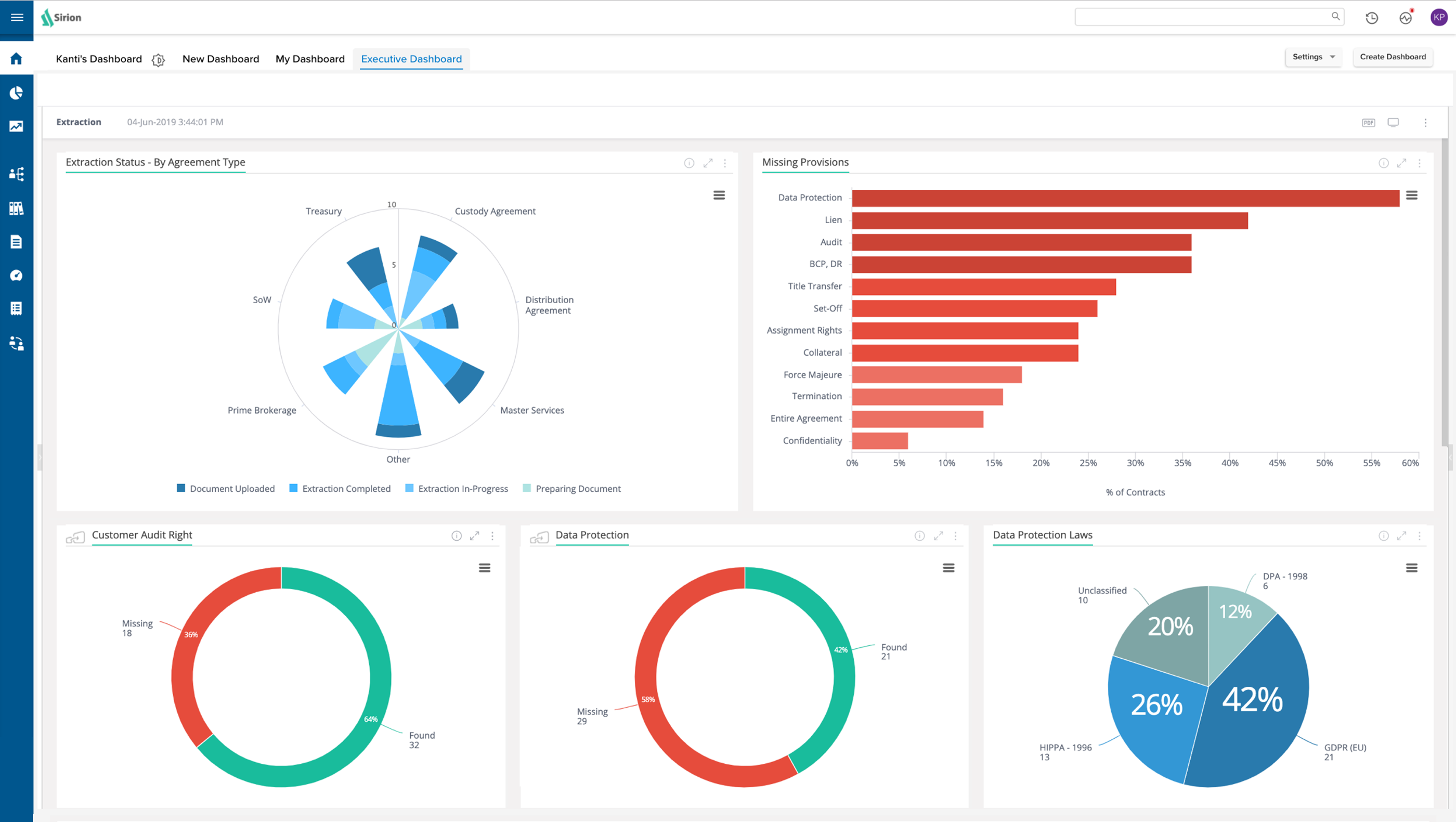
Contracts contain a lot of easy-to-miss details, especially for companies that need to deal with high volumes of paperwork. At the same time, many lack access to software that makes the process easier by digitizing contracts. SirionLabs, the contract management software startup backed by Tiger Global, wants to help with a new product called SirionAE. While SirionAE is integrated into SirionLabs’ flagship contract lifestyle management (CLM) platform, it is also available as a standalone product.

Founder and chief executive officer Ajay Agrawal told TechCrunch that his company decided to offer SirionAE on its own because many clients need to create a central repository of their contract backlog before they are able to fully take advantage of CLM software.

SirionAE is meant to be a cost-effective way for companies to address that gap and “immediately democratize access to a larger set of mid-market companies who’ll now be able to avoid the high costs and durations associated with risk analysis, diligence and compliance,” Agrawal said.

Companies are already using SirionAE include Vodafone, Unilever, Credit Suisse and the Greater Toronto Airports Authority (GTAA). Founded in 2012, SirionLabs’ last round of funding, a $44 million Series C led by Tiger Global and Avatar Growth Capital, was announced in May, and brought the Seattle-based startup’s total raised so far to $66 million.

Close analysis of contracts is always important when doing due diligence, adhering to privacy regulations like the European Union’s General Data Protection Regulation, and managing routine legal and operational obligations to customers and vendors.

During COVID-19, digitizing contracts into a central database has also become more important because team members are often working remotely. Parsing contracts is also especially crucial to the logistics industry because of disruptions to the global supply chain, which means suppliers and buyers who are located in different countries need to keep in close contact about their obligations to one another.

Missing contractual obligations can also be an expensive headache. SirionLabs points to research by the International Association for Contract and Commercial Management (IACCM) that shows poor contract management can lose companies 9% in annual revenue.

SirionLabs claims that SirionAE is able to deliver more detailed insight than competing products from other CLM providers, like Cognitiv+, Docusign’s Seal Software or Eigen Technologies, because it can capture data from more than 100 out-of-the-box fields. While some types of contracts, including non-disclosure agreements and master service agreements, are fairly standardized, others, including ones for IT services, tend to be more complex and include statement of work, appendices and other documents.

Agrawal said SirionAE’s technology, which uses neural-network based technology to constantly refine its performance, makes it easier for companies to track crucial information like obligations, service levels and pricing tables. He added that SirionAE can also effectively extract data from multi-column pages, documents written in multiple languages and even handwritten notes. That information, including risks, entitlements and obligations, is then presented on a central dashboard.

For example, a client in the telecom sector uses SirionAE to identify and help their customers understand minimum spend commitment clauses in their contracts, helping the company’s top-line and reducing disputes. Another client is using SirionAE to find volume discounts in their procurement contracts, which Agrawal said has already helped them save hundreds of thousands of dollars.

23 Jul 2020

Pandora launches interactive voice ads into beta testing

Pandora is launching interactive voice ads into wider public testing, the company announced this morning. The music streaming service first introduced the new advertising format, where users verbally respond to advertiser prompts, back in December with help from a small set of early adopters, including Doritos, Ashley HomeStores, Unilever, Wendy’s, Turner Broadcasting, Comcast and Nestlé.

The ads begin by explaining to listeners what they are and how they work. They then play a short and simple message followed by a question that listeners can respond to. For example, a Wendy’s ad asked listeners if they were hungry, and if they say “yes,” the ad continued with a recommendation of what to eat. An Ashely HomeStores ads engaged listeners by offering tips on a better night’s sleep.

The format is meant in particular to aid advertisers in connecting with users who are not looking at their phone. For example, when people are listening to Pandora while driving, cooking, cleaning the house, or doing some other hands-free activity.

Since their debut, Pandora’s own data indicated the ads have been fairly well-received, in terms of the voice format. 47% of users said they either liked or loved the concept of responding with their voice, and 30% felt neutral. The stats paint a picture of an overall more positive reception, given that users don’t typically like ads at all. In addition, 72% of users also said they found the ad format easy to engage with.

However, Pandora cautioned advertisers that more testing is needed to understand which ads get users to respond and which do not. Based on early alpha testing, ads with higher engagement seemed be those that were entertaining, humorous, or used a recognizable brand voice, it says.

As the new ad format enters into beta testing, the company is expanding access to more advertisers. Advertisers including Acura, Anheuser-Busch, AT&T, Doritos, KFC, Lane Bryant, Purex Laundry Detergent, Purple, Unilever, T-Mobile, The Home Depot, Volvo, and Xfinity, among others, are signed up to test the interactive ads.

This broader test aims to determine what the benchmarks should be for voice ads, whether the ads need tweaking to optimize for better engagement, and whether ads are better for driving conversions at the upper funnel or if consumers are ready to take action, based on the ads’ content.

Related to the rollout of interactive voice ads, Pandora is also upgrading its “Voice Mode” feature, launched last year and made available to all users last July. The feature will now offer listeners on-demand access to specific tracks and albums in exchange for watching a brand video via Pandora’s existing Video Plus ad format, the same as for text-based searches.


23 Jul 2020

Levitate raises $6M for its ‘keep-in-touch’ email marketing solution aimed at smaller businesses

Levitate, a Raleigh-based marketing platform and customer relationship solution provider, has raised an additional $6 million for its A.I.-powered software offering small businesses and alternative to mass blast emailing. To date, the startup has raised $12 million from investors including Tippet Venture Partners, Durham, N.C.-based Bull City Venture Partners, and angel investor Peter Gassner, the co-founder and CEO of Veeva Systems, and investor in Zoom.

The company was founded in late 2017 by serial entrepreneur Jesse Lipson, who sold his previous cloud storage and file sharing startup ShareFile to Citrix for $93 million in 2011. Lipson continued to work at Citrix post-acquisition, most recently as Corporate Vice President and General Manager of Citrix Cloud Services business unit.

Itching for an escape from the corporate world, Lipson left the position in 2017 to build Levitate, which has now scaled its service to reach over 1,000 businesses, who pay for its service on a subscription basis.

Levitate’s software plays in the same general ballpark as buzzy startup Superhuman, which also provides a set of advanced email tools for inbox triage and managing important relationships. But Superhuman does so by offering its own (pricey) email app which includes wider range of features for inbox triage and email efficiency, beyond those that typically fall under a CRM or marketing automation umbrella, like customer insights, email tracking, or follow-up reminders, for example.

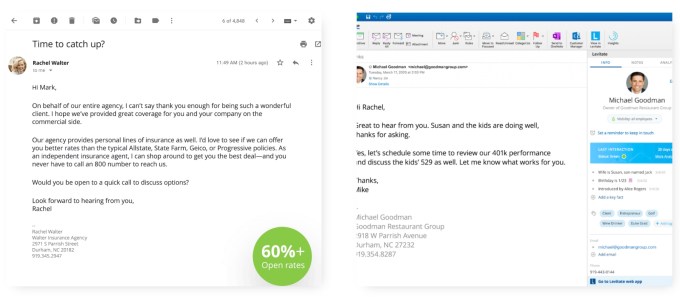
Levitate, by comparison, focuses more specifically on a toolset designed to help businesses or even individual entrepreneurs keep in touch with clients, prospects and other referral sources. This includes tools that let you create rules about who you want to stay in touch with and how, reminders that push you to keep up with your relationships, customizable email templates, relationship analytics, and others.

Image Credits: Levitate

Lipson says he doesn’t think of the software as a CRM.

“We’re not really a CRM. We’re trying to create this new category that we call ‘keep-in-touch marketing,’ which is contrasting to email marketing,” he explains. Email marketing involves blasting out impersonal business emails, often with lots of colors and pictures, to users who can’t reply. “Keep-in-touch marketing is more about quality over quantity. Not building the biggest list. It’s about curating your list of people who you truly know,” says Lipson.

The software itself works both as an email add-on that integrations with major email providers, like Microsoft and Google, as well as a standalone iOS or Android app.

For business customers, expanded options are available, like the ability to import contacts from Excel or .CSV files, as well as from CRM and AMS systems, including Salesforce, Hubspot, Dynamics, AMS 360, QQCatalyst, Cigita, TAM, Epic, Hawksoft, EZLynx, and Partner XE. In some cases, particularly with the insurance and financial advisory industries, API integrations are also offered.

The contacts, once imported, are enhanced with publicly available information, like photos, social media links, company information, website address, bio and other details.

Businesses with 5 users pay $150 per month, which comes out to $30 per seat. However, Levitate offers a free personal plan for one user that has a more limited feature set. Larger businesses can upgrade to a $199 per month plan that includes live onboarding, training and support as well as a personal marketing coach.

With the additional funding, Levitate aims to build out its A.I. technology, which today makes suggestions about who to keep in touch with and when. More recently, it rolled out automations which allow users to create workflows around particular types of activities — like sending out a welcome kit to new customers, for instance. The A.I. also more newly is able to decide if someone’s name is correct — as in, if it’s a real first nam, or if it’s a company name — so emails don’t sound impersonal because of bad data.

Longer-term, Lipson envisions a system where emails can write themselves using technology like OpenAI’s new GPT-3 language-generating A.I. 

“I thought that’s what we’d be starting to bring in five years from now, but it could be something that we could maybe bring in a little bit sooner,” he says. “People are so overwhelmed and busy but they do know they want to keep in touch. Our role is not to fully automate it but just help them with that process,” Lipson adds.

Ahead of its latest round, Levitate was named one of the Triangle’s most promising new startups. It raised $6 million last year, then did again just now, amid the coronavirus pandemic.  The company plans to use the new funds to invest further in the product and raising awareness about its solution in the market. It’s also planning to hire around 30 this year across sales, customer success, support and engineering. Currently, the Raleigh-based company is a team of 80.