Year: 2020

16 Jul 2020

EU antitrust lawmakers kick off IoT deep dive to follow the data flows

The potential for the Internet of Things to lead to distortion in market competition is troubling European Union lawmakers who have today kicked off a sectoral inquiry.

They’re aiming to gather data from hundreds of companies operating in the smart home and connected device space — via some 400 questionnaires, sent to companies big and small across Europe, Asia and the US — using the intel gleaned to feed a public consultation slated for early next year when the Commission will also publish a preliminary report. 

In a statement on the launch of the sectoral inquiry today, the European Union’s competition commissioner, Margrethe Vestager, said the risks to competition and open markets linked to the data collection capabilities of connected devices and voice assistants are clear. The aim of the exercise is therefore to get ahead of any data-fuelled competition risks in the space before they lead to irreversible market distortion.

“One of the key issues here is data. Voice assistants and smart devices can collect a vast amount of data about our habits. And there’s a risk that big companies could misuse the data collected through such devices, to cement their position in the market against the challenges of competition. They might even use their knowledge of how we access other services to enter the market for those services and take it over,” said Vestager.

“We have seen this type of conduct before. This is not new. So we know there’s a risk that some of these players could become gatekeepers of the Internet of Things, with the power to make or break other companies. And these gatekeepers might use that power to harm competition, to the detriment of consumers.”

The Commission recently opened up a consultation on whether regulators needs new powers to address competition risks in digital markets, including being able to intervene when they suspect digital market tipping.

It is also asking for views on how to shape regulations around platform governance.

The IoT sectorial enquiry adds another plank to its approach towards reformulating digital regulation in the data age. (Notably competition chief Vestager is simultaneously the Commission EVP in charge of pan-EU digital strategy.)

On the IoT front, risks Vestager said she’s concerned about include what she couched as familiar antitrust behaviour such as “self-preferencing” — i.e. a company directing users towards its own products or services — as well as companies inking exclusive deals to send users “preferred” provider, thereby locking out more open competition.

“Whether that’s for a new set of batteries for your remote control or for your evening takeaway. In either case, the result can be less choice for users, less opportunity for others to compete, and less innovation,” she suggested.

“The trouble is that competition in digital markets can be fragile,” Vestager added. “When big companies abuse their power, they can very quickly push markets beyond the tipping point, where competition turns to monopoly. We’ve seen that happen before.  If we don’t act in good time, there’s a serious risk that it will happen again, with the Internet of Things.”

The commissioner’s remarks suggest EU lawmakers could be considering regulations that aim to enforce interoperability between smart devices and platforms — although Vestager also said they will be asking about any barriers to achieving such cross-working.

“For us to get the most out of the Internet of Things, our smart devices need to communicate. So if the devices from different companies don’t work together, then consumers may be locked in to just one provider.  And be limited to what that provider has to offer,” she said.

“We’re asking about the products they sell, and how the markets for those products work. We’re asking about data – how it’s collected, how it’s used, and how companies make money from the data they collect. And we’re asking about how these products and services work together, and about possible problems with making them interoperable.”

Vestager has raised concerns about the potential for voice assistant technology to lead to market concentration and distortion before — saying last year that they present an acute challenge to regulators who she said then were “trying to figure out how access to data will change the marketplace”.

The question of how access to digital data feeds platform monopolies has been a long standing preoccupation for the now second term competition chief.

The Commission’s work on figuring out how data access changes marketplace function remains something of a work in progress. Vestager has an open investigation into Amazon’s use of third party data on her plate, for example. It also inked a first set of rules on ecommerce platform fairness last year.

More rules may be incoming in a draft proposal for reformulating wider liability rules for platforms that’s slated to land by the end of this year, aka the forthcoming Digital Services Act.

The Commission noted today that a prior sector inquiry — into ecommerce markets — helped shape new rules against “unjustified geoblocking” in the EU, although it has not yet been able to dismantle geoblocking barriers to accessing digital services across the Single Market’s internal borders.

Last year privacy concerns raised in Europe around how tech giants operate voice assistant ‘quality grading’ programs, which involved human contractors listening in to users’ recordings, led to a number of changes — including the previously non-transparent programs being publicly disclosed, and choice/controls being provided to users.

16 Jul 2020

Google’s latest R&D project is Shoploop, a mobile video shopping platform

Google’s latest experiment is a video shopping platform designed to introduce consumers to new products in under 90 seconds. The company today is launching Shoploop, a project from Google’s internal R&D division, Area 120, where it tests out new ideas with a public user base.

Shoploop’s founder, Lax Poojary, had previously worked on online trip planner, Touring Bird, also at Area 120. Last year, that effort became one of a small number of R&D projects to graduate and become a part of Google itself. 

Poojary says his new idea for interactive shopping was inspired by how consumers today use a combination of social media and e-commerce sites together when considering purchases. For example, users will pop between a social media app, like Instagram, then head to YouTube to see a tutorial or demo, then — if they like what they saw — actually make a purchase.

Of course, video shopping is not a novel idea. A number of startups, and even large companies, have already embraced a combination of video and commerce.

Image Credits: Google

Amazon, for example, runs a livestreaming platform, Amazon Live, on its retail site. YouTube this year introduced a new shoppable ad format and is placing products to buy underneath videos. Facebook has enabled live shopping, as well, and made an acquisition in this area in 2019. Instagram now has its own Shop destination, too.

There are also a number of mobile shopping startups that have embraced video, like Dote, which raised $12 million last year. Popshop Live raised $3 million in January. NTWRK combines shopping and live events. Depop sells with both photos and videos, similar to Instagram.There’s also Yeay, Spin, and other apps. And there are startups focused on providing technology for brands and influencers engaging in this space, like Bambuser, MikMak, and Buywith, to name a few.

That is to say, Shoploop hasn’t discovered a new, untapped trend. It’s simply joining in.

The shopping experience on Shoploop is interactive. Users don’t just scroll through images and text, but instead watch videos where creators show off things like  nail stickers,  hair products or makeup. The team says it’s starting with products in categories such as makeup, skincare, hair and nails and its working with creators, publishers and store owners in this market for the app’s content.

The experience is similar to watching YouTube tutorials, but distilled down to the best bits. (Or perhaps it’s more like TikTok, in that case) The demos are meant to be relatable, giving consumers a feel for the brands and products in real life. When consumers find a product they like, they can save it for later or click to be directed to the merchants website to complete the purchase. The app also allows you to follow your favorite Shoploop creators and share videos with friends and family.

Such a product could prove important to Google’s larger mission around Shopping, if it gains traction. Google recently redesigned its Shopping vertical and shifted it to include mostly free listings, in response to Amazon’s growing ad business. Finding more ways to engage online consumers could be beneficial to the internet giant, and this video-slash-influencer fueled shopping experience appeals to a younger demographic, in particular.

Shoploop is launching today on mobile and is working on a desktop version. You can reach it via https://shoploop.app from your smartphone.

16 Jul 2020

Instagram confirms its TikTok rival, Reels, will launch in the US in early August

Instagram confirmed it’s preparing to soon launch its TikTok competitor, known as Reels, in the U.S. The company expects to bring the new video feature — which is designed specifically for short-form, creative content — to its platform in early August, according to a spokesperson. The U.S. launch comes shortly after Reels’ arrival in India this month, following a ban of TikTok in that market. Reels has also been tested in Brazil, France, and Germany.

NBC News reported this morning Instagram would arrive in the U.S. and more than 50 other countries in a matter of weeks, citing sources familiar with the matter.

A Facebook spokesperson confirmed the U.S. launch, saying “We’re excited to bring Reels to more countries, including the U.S., in early August,” without providing specific details of which further markets will be added.

“The community in our test countries has shown so much creativity in short-form video, and we’ve heard from creators and people around the world that they’re eager to get started as well,” the spokesperson added.

Reels was designed to directly challenge TikTok’s growing dominance. In a new area in the app, users are able to create and post short, 15-second videos set to music or other audio, similar to TikTok. Also like TikTok, Reels offers a set of editing tools — like a countdown timer and tools to adjust the video’s speed, for example — that aim to make it easier to record creative content. Instagram, of course, doesn’t have the same sort of two-tabbed, scrollable feed, like TikTok offers today.

The move to more quickly roll out Reels to more markets comes as TikTok has come under intense scrutiny for its ties to China. India banned the app, along with 58 other mobile applications designed by Chinese firms, in June. The Trump administration more recently said it was considering a similar ban on TikTok, for reasons related to national security. Yesterday, it said such a decision could be just weeks away.

Since the news of a possible ban hit, other TikTok rivals got a boost in the charts, including Byte, Triller, Dubsmash, and Likee, for example. Snapchat also began testing a TikTok-like navigation for its public video content, and YouTube is running a smaller test. Because of Instagram’s reach, it has a shot at stepping in to pick up tens of millions of U.S. users if TikTok disappears. But TikTok users may not jump en masse to a single new app if a ban occurs. Already there are signs of the community splintering — dancers prefer apps like Dubsmash and Triller, while young Gen Z’ers like Byte, for example.

No exact launch date for Instagram Reels in the U.S. was provided.

16 Jul 2020

Game developer poll suggests longer hours and less productivity as the industry adapts to remote work

Ahead of the upcoming online-only version of its big annual conference, GDC commissioned a survey of 2,500 game developers to determine how the industry is coping with the ongoing impact of the COVID-19 pandemic. While gaming sales are up as many turn to the medium to cope with stay-at-home orders, the virus appears to be impacting devs in similar (if somewhat blunted) fashion to innumerable other industries.

For starters, 32% find themselves being less productive, in spite of working longer hours. That no doubt sounds familiar to anyone who has attempted to transition to a home office amid the pandemic. Some 70% of developers say they’ve moved to working from home — if that number seems relatively low, that’s only because 27% of those surveyed say they were already working from home. That leaves some 3% in the office, I suppose.

One-quarter of respondents say their household income has declined, while a third say their business has declined over the last few months. A third also say they’ve had a project delayed. That could certainly complicate the upcoming schedules of the latest version of the Xbox and PlayStation, both due out at the end of the year.

The shift toward moving online found many companies scrambling to update their workflows, including a shift to different cloud services. Though, the nature of the industry means that many were already accustomed to having a distributed workforce prior to the pandemic. While two-thirds say their company has a plan to return to the office, only 12% feel safe returning to the office right now.

The majority of respondents added that they believe the pandemic will permanently change some aspect of their workplace, going forward. “We had to make some changes on our daily tasks to compensate not being at our office working physically together, but those have proven to increase our efficiency and productivity,” one developer responded. “Lately we have even talked about embracing the home office configuration even after the pandemic.”

16 Jul 2020

Twitter introduces a new, fully rebuilt developer API, launching next week

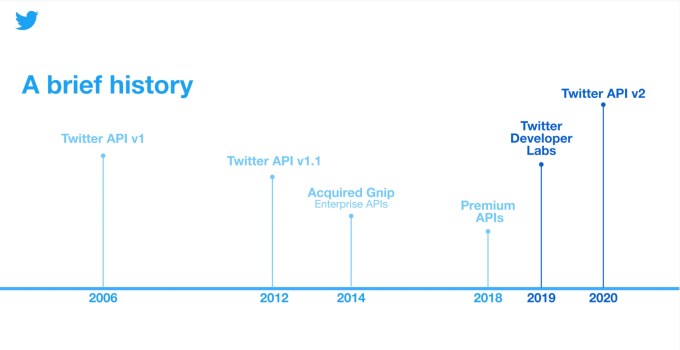
Twitter is still recovering from the fallout of yesterday’s sizable attack on high-profile accounts, but it’s continuing to move forward with its plans to roll out a new version of its developer API. Today, the company is announcing its new Twitter API v2, rebuilt from the ground up. The new foundation, which has been rebuilt for the first time since 2012, includes features that were missing from the earlier API, like conversation threading, poll results in tweets, pinned tweets, spam filtering and more powerful stream filtering and search query language. It has also been designed in a way that will allow Twitter to release new functionality faster than in years past, the company claims.

Though Twitter says it has no evidence that yesterday’s security incident had anything to do with its API, actually turning it on today, as was planned, had to take a backseat to its focus on making sure Twitter and its accounts are safe and secure. The company plans to now roll out API v2 and other content, like its new support center, documentation and other blog posts with details sometime next week.

Twitter’s API v2 will introduce multiple access levels, to replace the earlier three-tiered system in the current API (v1.1).

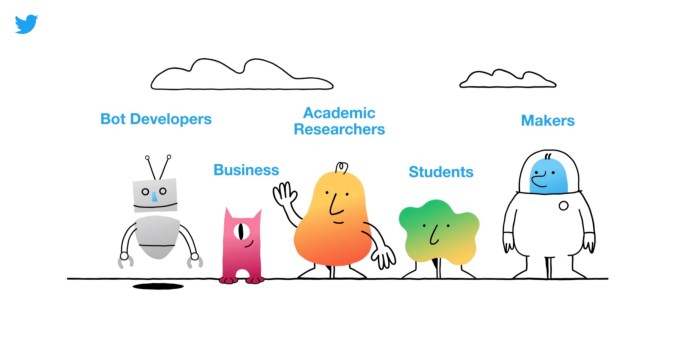
Today, Twitter’s API is separated into three platforms: Standard (free), Premium (self-serve paid) and Enterprise. But this has made it difficult for developers to migrate from one tier to another. The new API will eventually — and fully — replace all three, and will instead serve all users across three different product tracks, designed to accommodate different groups of developers. These tracks include the Standard track, which is launching today, while the Business and Academic/Research tracks will arrive soon. Within each track there will also be Basic, Elevated or Custom access levels available.

“We definitely know that one size does not fit all, and we wanted to make it easier for more developers to be successful building with us,” explains Twitter Developer Platform product head, Ian Cairns. One of those tracks will always be free, he added. “Twitter exists to serve the public conversation, and keeping a free, open API is really important to us,” he said.

The Standard track’s Basic access level will always be free, Twitter says, and is designed for developers just starting out.

Image Credits: Twitter

The company hasn’t finalized its pricing for other tiers but says through its conversations with developers, it has come to understand how its pricing and its rate limit model were limiting developers, particularly researchers and those building for fun. The new pricing is expected to take different types of developer needs into consideration, and will offer free and paid tiers within the Elevated level within the Academic Research track.

The Standard product track could enable common Twitter tools, utilities and fun bots, like BlockParty, TweetDelete, Tokimeki Unfollow, HAM: Drawings bot, Hansard House of Lords bot and Emoji Mashup bot.

Image Credits: Twitter

The Business API, meanwhile, will support businesses that “serve innovative use cases,” says Twitter.

This is an area where Twitter has a complicated history, as it has in the past pulled out the rug from under the feet of developers building alternative Twitter clients and even shafted its own partners. Twitter today defines the use cases it’s aiming to support as those offering things like “social prediction of future product trends, AI-powered consumer insights, and FinTech market intelligence,” such as Black Swan, Spiketrap, and Social Market Analytics.

However, Twitter clarified in a call with press that it has spoken with the makers of third-party clients to figure out how it can better work with them in the future, and noted it’s not changing any policy related to its support right now. Those clients will also be able use the new features in v2. The company still has not said, clearly and definitively, that it has no plans to change how these businesses today operate.

Instead, Twitter explained to TechCrunch it believes these clients “deserve clarity on how to operate” with the new API. But this clarity may require Twitter to take a fresh look at its policy and product access details, Twitter said, adding it’s looking ahead to determine how to best work with this group. Given the API has been in development for more than a year, this is a disappointing answer for Twitter’s power users who prefer third-party clients, like Tweetbot, Twitterific, Echofon and others. Twitter has had plenty of time to take that “fresh look,” and has still not made a decision, it seems.

In addition, the Business API will serve Twitter Official Partners like Brandwatch, Sprinklr and Sprout Social, and Twitter’s enterprise data customers. This track in the future will include Elevated and Custom access to relevant endpoints.

The upcoming Academic/Research track, meanwhile, will allow qualified researchers to learn what’s happening in Twitter’s public conversation.

Developers are today using Twitter data to research a range of topics, like people’s attitudes about COVID-19, the social impact of floods and climate change and the prevalence of hate speech online. This will also later add Elevated and Custom access to relevant endpoints, and will be the first time Twitter has built a product tailored toward researchers’ specific needs, it says.

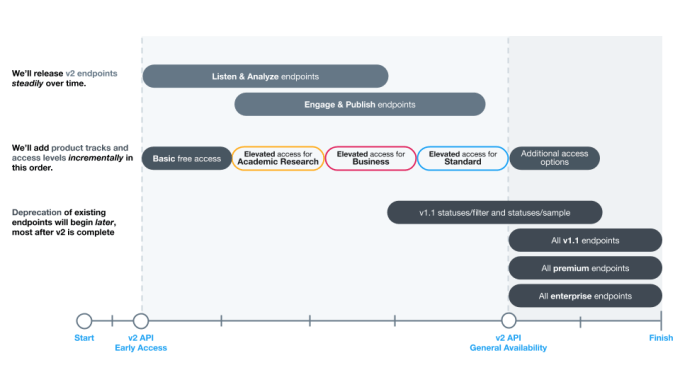
Of all these, only the Standard API product is ready to ship next week, with a new set of features offered for free at the Basic level. Its launch will be followed by the Academic/Research product track, and Twitter will then continue to release the new API incrementally in the months ahead. It will take some time to shift developers from v1.1 to v2, however, so Twitter’s API roadmap and documentation can help guide them as to when changes will occur.

Twitter “firehose” data (the full stream) will continue to be available only in limited partnerships, as today. Twitter says most developers don’t want this, even when they have high-data access needs, because firehose data is difficult to work with.

Image Credits: Twitter

The company says the decision to rebuild its developer platform came about because Twitter needs to more easily scale a large number of API endpoints for both planned and new functionality going forward. (Perhaps related: a Twitter job description that mentioned its plans to “build a subscription platform.” That could require a new API?)

In the current version of the API, endpoints are implemented by a large set of HTTP microservices — a decision Twitter made when it re-architectured from Ruby in 2013. This ended up creating a disjointed product where independent teams worked on their endpoints without coordinating with others.

Image Credits: Twitter

Twitter has been testing new API features for over a year as part of its Twitter Developer Labs program, a shift toward building in public. This change allowed the company to gain real-time feedback from the developer community as the product was built in the open. Developers told Twitter they wanted better documentation, access to an engaged community, a sandbox for testing, easier onboarding and other features.

Twitter specifically responded to these requests for a new developer portal, which has also been redesigned. The portal will offer an onboarding wizard to simplify getting API keys. The portal also allows developers to manage their apps, understand their API usage and limits, access a new support center, find documentation and more. Developers will additionally be able to view Twitter’s public roadmap and read through a forthcoming “Guide to the future of the Twitter API,” which arrives next week when v2 launches, for more about what to expect.

Next week, Twitter will launch “Early Access” to an initial set of new endpoints. Unlike Twitter Developer Labs, Early Access will be production-ready and fully supported. The new endpoints will allow developers to stream tweets in real time, analyze past conversations, measure Tweet performance, listen for important events and explore tweets from any account. In later weeks, Twitter will decide which other new features it may move to the API — like voice tweets or allowing only select audiences to reply to your tweets, for example.

Twitter says it will continue to share updates on v2 before deprecating any existing products.

“Our intent is to provide plenty of migration time — along with resources to help — when we deprecate existing endpoints. We know migrations can be challenging and we’re committed to doing our part to make migrating to our new API as easy as we can,” a spokesperson said.

There will be some exceptions, however. For instance, later this year, Twitter will announce a shorter deprecation window for v1.1 status/sample and statues/filter endpoints. Their replacements are rolling out next week in v2.

Developers can get started with Early Access by way of the Developer Portal, when the API v2 launches.

16 Jul 2020

With 600+ more founder recommendations, the second revision of The TechCrunch List is coming next week

Let’s just say it’s been busy times over here (Twitter being completely unusable has helped productivity though!)

On Tuesday, we launched the first draft of The TechCrunch List, a verified, curated list of investors who have demonstrated a commitment to first checks and leading rounds from seed through growth, organized by market vertical. We constructed that list off of the recommendations of more than 1,200+ founders who had submitted their information to TechCrunch over the past month. We also published a list of the 11 investors with the most positive founder recommendations.

Well, the launch was a great success, with tens of thousands of people using the List on just the first day. Our hope is that it becomes a permanent tool in the chest for every founder looking to raise capital.

Now, we need to further revise it. In the 24 hours after we published the first draft of the List, we received another 600 founder recommendations, or about 50% of the total we received over the entire past month before launch. If you were one of these founders: thank you for helping other founders identify the VCs that are willing to take the ambition to be first and/or to lead a venture round.

If you are a founder and want to submit a recommendation, please do so! The more information we have available, the better we can help everyone fundraise.

All that said though, we have a lot of work to do to catch up. We carefully consider every recommendation and all the comments we receive to select each investor on The TechCrunch List. That makes the List valuable, but it takes serious time to make changes and ensure their accuracy.

We intend to launch our second revision of the List next week, which will likely have at least a couple of dozen new investors that have come to our attention.

In the meantime, we have posted a FAQ page with a bunch of answers to questions we received about the List. If you have questions, it is a great first place to start.

16 Jul 2020

Revel lands permit to bring hundreds of electric mopeds to San Francisco

Shared electric moped startup Revel received a permit that will allow it to operate in San Francisco, beginning in August.

The startup will start with a fleet of 432 mopeds featuring a new paint scheme and a more powerful engine to help riders get up and over the city’s infamously steep hills. For now, the service area will cover certain neighborhoods of San Francisco, including Cow Hollow, Dogpatch, Financial District, Golden Gate Heights, Haight-Ashbury, Mission District, Outer Mission,Pacific Heights, Richmond District, Tenderloin, and The Castro. The service area will expand in the “near future,” Revel said. 

Only licensed drivers with the Revel app can rent the mopeds. Each Revel can carry up to two riders, is limited to local streets, and is capped at a speed of 30 miles per hour. Revel rides will cost $1 per person to start, followed by $0.39 per minute to ride.

Each Revel moped is equipped with two U.S. DOT-certified helmets that must be worn at all times. The company also provides third-party liability insurance automatically to all riders.

Revel, founded in March 2018 by Frank Reig and Paul Suhey, started with a pilot program in Brooklyn and later expanded to Queens. Revel has been on a fast-paced growth track, expanding to Austin, Austin, Miami, Washington, D.C in its first 18 months of operation. In January, the company launched in Oakland.  The company also operates in upper Manhattan down to 65th street, an allowance issued amid the COVID-19 pandemic to provide free rides to healthcare workers. 

Revel is a bit different than some of the shared mobility startups out there. The company doesn’t rely on gig economy workers to charge its mopeds — a method used by e-scooter companies like Bird. Instead, Revel has full-time workers that maintain the mopeds and swap out the batteries as needed.

The company said it will begin hiring workers in San Francisco once it launches in August. Revel said it is participating in the First Source Hiring Program find local employees.

The startup raised $27.6 million in capital last October in a Series A round led by Ibex Investors — funds required to fuel its expansion plans. The equity round included newcomer Toyota AI Ventures and further investments from Blue Collective, Launch Capital and Maniv Mobility.

16 Jul 2020

Nextdoor launches Sell for Good for easy donations to local nonprofits

Nextdoor is launching a new feature called Sell for Good, allowing uses to sell items on the neighborhood-focused social network and donate the proceeds to local nonprofits.

CEO Sarah Friar said that since the pandemic started, conversations about donations have increased 7x on Nextdoor .

“Communities are hurting,” Friar said. “People are looking to go donate, but things like Goodwill and so on are closed.”

At the same time, nonprofits are struggling. Pointing to a recent survey from the Nonprofit Finance Fund, she explained, “A lot of them depend on in-person events — the race that you might do, the book drive they always have, all of that has dried up.”

One way to support those nonprofits is to sell goods (perhaps the very same goods you were planning to give to Goodwill) on Nextdoor’s For Sale and Free section and then donate the money from the sale. In fact, Product Manager Rhett Angold said that users have already been doing this — for example, someone in Berkeley raised thousands of dollars for a local animal shelter by selling homemade masks.

So Sell for Good is designed to make this process as straightforward as possible. Nextdoor has partnered with the PayPal Giving Fund to support nonprofits in different cities, including A Better Chicago, LA Voice, New York Cares, Operation HOPE, Spark, The Hidden Genius Project and ViBe Theater Experience.

Sellers can choose which organization to support, then their sale will be identified as a donation. Once an item has been purchased, the seller can approve the donation and they’ll receive a receipt for their tax-deductible contribution.

And while the feature currently donates the full sale proceeds (minus the “typical PayPal processing fees”), Angold said his team is working on giving sellers the ability to donate a smaller portion as well.

Sell for Good is currently available to all Nextdoor users in the United States.

16 Jul 2020

As VCs favor B2B startups, B2C upstarts’ venture activity falls

The Q2 2020 venture capital market did not bring a catastrophic slowdown to either the global private investment scene or the U.S.’s own VC scene. But inside the rosier-than-anticipated private capital results of the second quarter, there were pockets of weakness, and strength, that we should understand as we look to the rest of 2020 and the continuance of the pandemic-driven economy.


The Exchange explores startups, markets and money. You can read it every morning on Extra Crunch, and you can now receive it in your inbox. Sign up for The Exchange newsletter, which will drop Saturdays starting July 25.


This morning we’re exploring trends detailed in the PitchBook-NVCA Q2 venture report, adding to our coverage of similar data sets produced by competing venture and private business information sources CB Insights and Crunchbase.

The NVCA data provides a useful cross section of venture activity beyond the usual quarterly totals, allowing us to better understand the diverging fortunes of domestic venture investment into business-serving startups (which appear strong), and investments into consumer-serving startups (which appear weak).

It also provides a peek into AI/ML-focused investing, a topic that TechCrunch has covered extensively this year. And, finally, we have a lens into recent U.S. VC results for startups that have at least one female founder, or were founded by all-women teams.

Some of the news is positive, and some of it is less so. But we owe it to ourselves to understand all of it. So to wrap up our week’s dive into Q2 VC activity, let’s get into our final look at the data, focusing today on the nuances of the United States’s own venture results.

B2B’s rise continues

As 2019 came to a close, TechCrunch wrote about a notable trend: Seed investors shifted their attention from consumer-focused startups to business-focused startups. Seed deals had moved from majority-B2C to majority-B2B, in other words.

16 Jul 2020

Activ Surgical raises $15 million to advance autonomous and collaborative robotic surgery

Boston-based startup Activ Surgical has raised a $15 million round of venture funding led by ARTIS ventures, and including LRVHealth, DNS Capital, GreatPoint Ventures, Tao Capital Partners and Rising Tide VC. The round will help Activ continue to develop and expand availability of its software platform, which it launched to market in May.

Activ Surgical’s ActivEdge platform uses data collected from surgical implements, outfitted with sensors created by the company to collect real-time data during the actual surgical process. That data is then used to inform the development of machine learning and AI-based visualizations that can provide guidances to surgeons and surgical systems to help them reduce the occurrence of potential errors, and ultimately improve outcomes for patients.

The company’s primary aim is to bring technological innovation to the sphere of surgical vision, which still relies primarily on methods like using fluorescent dyes that date back more than 70 years. Activ wants to use computer vision to provide real-time visual insight into things that surgeons wouldn’t be able to see on their own – and ultimately to use those insights to power the next generation of both collaborative surgical robots, and eventually even fully autonomous robotic surgical procedures.

ActivSight is the company’s first product in its ActivEdge platform offering, and is a small, connected imaging coddle that can be attached to existing laparoscopic and arthroscopic surgical instruments. The company is currently tracking towards getting their hardware cleared by the FDA for use by Q4 this year, and are working with eight hospital partners for pilot projects in the U.S.

The company has raised a total of $32 million in funding to date.