Year: 2020

16 Jul 2020

Meditation app Meditopia secures $15M Series A co-led by Creandum and Highland

The coronavirus continues to hit people hard mentally, and this has meant a boom for mental death and meditation apps. According to a recent report from app store intelligence firm Sensor Tower, the world’s 10 largest English-language mental wellness apps in April saw a combined 2 million more downloads during the month of April 2020 compared with January, reaching close to 10 million total downloads for the month. The charts were dominated by market leaders such as Calm, Headspace and others such as “Relax: Master Your Destiny”.

However, a slightly lesser know app called Meditopia featured, and that’s because it’s become a big leader non-English speaking markets.

Today it’s announced a Series A investment of $15M co-led by Creandum, and Highland Europe . Carl Fritjofsson of Creandum and Fergal Mullen of Highland Europe will join Meditopia’s Board of Directors. Total funding prior to this round was $3.2m. This new round takes the total to $18.2m.

Based between Istanbul and Berlin, Meditopia has majored on localization for 75 global markets, in 10 languages, with a focus on long-term mental wellbeing programs. Since launching in 2017 Meditopia has grown to 14M users across 75 countries.

Until recently, most meditation and mental health apps were built to suit the needs of English-speaking, Western culture, especially in the way these apps dealt with topics such as gender.

The startup was founded by Fatih Celebi, Berk Yilmaz and Ali Murat Ceylan.

In a statement, Murat said: “Mental wellness is something everyone should be able to achieve, regardless of their country of origin, native language, socio-economic status, ethnicity, or religion. We first focused our efforts on our home country Turkey before expanding worldwide so whether you are Latino, Japanese, Russian, North American, or Arab, you can find support and coaching in our global community.”

Carl Fritjofsson, Partner at Creandum commented: “We’ve followed Meditopia for the past two years and have been incredibly impressed by how they’ve been able to capture this opportunity across the world, all while being one of the most capital-efficient run companies around.”

Fergal Mullen, Founding Partner at Highland Europe said: “For too long, the technology available was created for English-speaking groups alone. Meditopia provides the alternative; a solution that helps its members get to the heart of what they need in a way that suits them. We’re thrilled to be a part of getting this vital service to those people.”

16 Jul 2020

Indian online tutoring platform Vedantu raises $100 million

Investors are becoming more bullish on online education platforms in India as startups demonstrate growth at the height of a global pandemic that has severely impacted other industries.

Bangalore-based startup Vedantu said on Thursday it has raised $100 million in its Series D financing round, just five months after it closed its Series C funding.

U.S. based Coatue led the six-year-old Vedantu’s new financing round, with participation from some existing investors. The new funds valued Vedantu at $600 million, up from $275 million in February this year, when the startup closed its extended Series C round.

Vedantu offers live and interactive courses for students in grades 6 though 12 — and in recent months it has expanded its catalog to serve students in grade one to five as well, said Vamsi Krishna, co-founder and CEO of the startup, in an interview with TechCrunch.

Students who have enrolled for the interactive sessions are required to answer questions every few minutes by tapping on their smartphone screen or on the desktop. They also can raise their doubts at the end of the session. Some of these sessions are free for students, but a selection of it requires a subscription, said Krishna.

Vedantu today serves 25 million students each month. The startup has added more than 2 million users in recent months as schools closed across the nation after New Delhi enforced a lockdown.

Krishna said Vedantu is adding more than 20,000 paying subscribers each month to the platform.

More to follow…

16 Jul 2020

UK’s Drover raises $26M for to take its car subscription marketplace to Europe

The future of transportation is in a moment of flux, and that continues to provide opportunities for startups to build solutions provide new ways for us to get from A to B. In the latest development, a startup out of the UK called Drover that provides access to flexible car subscriptions for private users — longer than a typical rental, shorter than a lease or purchase, and easy to shorten or extend as needed — is announcing some funding to continue its growth.

The company has picked up £20.5 million ($25.7 million) in a round of funding co-led by three firms:  Target Global, RTP Global (the Russian company formerly known as ru-Net) and Autotech Ventures. New investors Channel 4 Ventures and Rider Global, as well as previous backers Cherry Ventures, BP Ventures, Partech, Version One and Forward Partners all also participated. Drover is not disclosing its valuation. It’s raised £27.5 million to date.

The plan, CEO and founder Felix Leuschner said in an interview, is to use the money to continue investing in the technology it uses to calibrate prices and personalise offers for individuals, as well as to hire more talent and gear up for more expansion. Founded in the UK, Drover opened France earlier this year. In theory, wherever cars are sold and used is game, and Drover’s growth to date seems to point to it being a strong candidate for driving ahead to new frontiers.

That’s because despite the huge drop in the economy in the last several months because of COVID-19, perhaps because of its flexible model (fitting for when you don’t know what is coming around the corner) Drover has seen business go up. “May and June have been our best two months on record for us since launching three years ago,” said Leuschner, who added that it is continuing to see an acceleration in the business, doubling in revenues year on year. “Every month should be the best month when you’re a growing startup, but we’ve seen acceleration even beyond that.”

Car ownership is going through an interesting phase at the moment. It was not that long ago when many people believed that the Ubers of the world, combined with other innovations in transportation like autonomous driving, improved public and communal transport models, on-demand rentals and new vehicles like electric bikes and scooters, would all combine to make it easier for individuals to forego traditional private car ownership altogether — the idea being that collectively, they would provide an economical, convenient and eco-friendly enough mix to make buying and maintaining a car obsolete.

That idea might still have some mileage longer term (excuse the pun!), but current events have thrown it for a loop: the COVID-19 pandemic has meant that people are staying at home a lot more, and when they do go out, many are proactively eschewing transportation forms that involve sharing space or touching surfaces that others have touched.

“We think this will lead to a renaissance for cars,” Leuschner said — a fact echoed by its investors.

“Drover offers an attractive and affordable alternative to car ownership, which has proven to be extremely robust during the recent COVID-19 crisis with record high subscriber bookings,” said Anton Inshutin, partner at RTP Global, in a statement. “We fully share in Felix’s vision for Drover as the future European leader in the car-as-a-service market, and offered our support to the company in both Series A and Series B financings.”

But even without a global health pandemic, there were a number of signals that pointed to the fact that “disruption” might not have been a quick and seamless transition anyway. We’re a long way off from actual autonomous cars (you know, the ones that are predicted to be so expensive and tricky to maintain that most will not own them but will subscribe to services to be driven around). The Ubers of the world haven’t actually sorted out their unit economics. Scooters can be dangerous. Etc.

For better or worse, all of that brings us back to private cars, and the opportunity to play around with different ways of providing these to individuals, opening the door to companies like Drover to tap those who may have started to part with the idea of owning a car outright, but have yet to let go of the idea of using a private car altogether.

Target demographics, Leuschner said, are people in their 20s and 30s who have some disposable income for a car and are more likely to be keen to pay the premium on incremental ownership to forego total cost of ownership, if it proves to be cheaper than leasing for the one-month minimum of usage on Drover (which appears to be Drover’s main competitor).

Not all is Fair

Others have attempted to tackle the subscription car market before, also focusing on customers that want to have the use of cars for more than just an hour or a day or even a week but don’t want to pay out to own them outright or get locked into long leases.

One of those — Fair in the US — looked to be especially promising with big-name founders raising hundreds of millions of dollars in equity and debt from companies including Softbank. But it ultimately faced a spectacular implosion, unable to get the business model right.

Leuschner contends that while Drover might sound like the same model as Fair, it’s actually a very different vehicle on the inside. For starters, some two-thirds of its inventory is sourced from dealerships, OEMs and others that distribute cars.

They use Drover as another channel, in part to diversify distribution, and in part as a way of tapping stock that it’s not able to sell through other channels. The remaining one-third is bought in by Drover, which means that the startup gets better margins on those vehicles as the owner of the vehicles, but also means higher risk for the startup — one of the areas where Drover’s technology comes into play.

“It’s an optimisation game for us,” said Leuschner. “When you have open inventory you get a better margin but more risk. We are at that point where we know what the best vehicles are for our customer base and we have a lot of data and trading history. We’re comfortable taking some risk and higher margin structure in those cases.”

Another key difference is that Drover is also only focusing squarely on private individuals, rather than working on subscriptions for professional drivers. That has meant that the drop off in business from those users, which some car leasing companies have seen as a knock-on effect from the fall in demand on ridesharing platforms, hasn’t had an impact for Drover.

It’s nonetheless a big market with many opportunities for growth. Online car sales are still only one percent of all sales in the UK, he said, which is far below the rate of sales for retail goods at 20% (one reason that might be obvious: the bigger the ticket, the more likely people will want to see the goods in person). All of that is gradually shifting — not least because more recognised names are coming into the fold, and providing more legitimacy and guarantees in the process, and that opens the door to companies like Drover, too

“By tapping into ongoing digitalisation and on-demand trends in tandem, Felix and his team are well poised to aggressively seize market share from traditional car retailers,” said Ben Kaminski, partner at Target Global, in a statement. “This new capital injection is a testament to both the team and the tech behind Drover which is disrupting the car-ownership model for the better. We’re excited to offer our support as Drover continues to scale throughout Europe.”

Daniel Hoffer, MD at Autotech Ventures added in his own statement: “After studying the European landscape closely, we believe that Drover’s unique focus on a next-generation customer experience enabled by an asset-light approach has the potential to revolutionize how Europeans relate to car ownership. Bolstered by strong execution, Drover is poised to emerge stronger as a result of COVID-19 and recession-driven changes to consumer preferences in the ground transportation domain.”

16 Jul 2020

UK’s Drover raises $26M for to take its car subscription marketplace to Europe

The future of transportation is in a moment of flux, and that continues to provide opportunities for startups to build solutions provide new ways for us to get from A to B. In the latest development, a startup out of the UK called Drover that provides access to flexible car subscriptions for private users — longer than a typical rental, shorter than a lease or purchase, and easy to shorten or extend as needed — is announcing some funding to continue its growth.

The company has picked up £20.5 million ($25.7 million) in a round of funding co-led by three firms:  Target Global, RTP Global (the Russian company formerly known as ru-Net) and Autotech Ventures. New investors Channel 4 Ventures and Rider Global, as well as previous backers Cherry Ventures, BP Ventures, Partech, Version One and Forward Partners all also participated. Drover is not disclosing its valuation. It’s raised £27.5 million to date.

The plan, CEO and founder Felix Leuschner said in an interview, is to use the money to continue investing in the technology it uses to calibrate prices and personalise offers for individuals, as well as to hire more talent and gear up for more expansion. Founded in the UK, Drover opened France earlier this year. In theory, wherever cars are sold and used is game, and Drover’s growth to date seems to point to it being a strong candidate for driving ahead to new frontiers.

That’s because despite the huge drop in the economy in the last several months because of COVID-19, perhaps because of its flexible model (fitting for when you don’t know what is coming around the corner) Drover has seen business go up. “May and June have been our best two months on record for us since launching three years ago,” said Leuschner, who added that it is continuing to see an acceleration in the business, doubling in revenues year on year. “Every month should be the best month when you’re a growing startup, but we’ve seen acceleration even beyond that.”

Car ownership is going through an interesting phase at the moment. It was not that long ago when many people believed that the Ubers of the world, combined with other innovations in transportation like autonomous driving, improved public and communal transport models, on-demand rentals and new vehicles like electric bikes and scooters, would all combine to make it easier for individuals to forego traditional private car ownership altogether — the idea being that collectively, they would provide an economical, convenient and eco-friendly enough mix to make buying and maintaining a car obsolete.

That idea might still have some mileage longer term (excuse the pun!), but current events have thrown it for a loop: the COVID-19 pandemic has meant that people are staying at home a lot more, and when they do go out, many are proactively eschewing transportation forms that involve sharing space or touching surfaces that others have touched.

“We think this will lead to a renaissance for cars,” Leuschner said — a fact echoed by its investors.

“Drover offers an attractive and affordable alternative to car ownership, which has proven to be extremely robust during the recent COVID-19 crisis with record high subscriber bookings,” said Anton Inshutin, partner at RTP Global, in a statement. “We fully share in Felix’s vision for Drover as the future European leader in the car-as-a-service market, and offered our support to the company in both Series A and Series B financings.”

But even without a global health pandemic, there were a number of signals that pointed to the fact that “disruption” might not have been a quick and seamless transition anyway. We’re a long way off from actual autonomous cars (you know, the ones that are predicted to be so expensive and tricky to maintain that most will not own them but will subscribe to services to be driven around). The Ubers of the world haven’t actually sorted out their unit economics. Scooters can be dangerous. Etc.

For better or worse, all of that brings us back to private cars, and the opportunity to play around with different ways of providing these to individuals, opening the door to companies like Drover to tap those who may have started to part with the idea of owning a car outright, but have yet to let go of the idea of using a private car altogether.

Target demographics, Leuschner said, are people in their 20s and 30s who have some disposable income for a car and are more likely to be keen to pay the premium on incremental ownership to forego total cost of ownership, if it proves to be cheaper than leasing for the one-month minimum of usage on Drover (which appears to be Drover’s main competitor).

Not all is Fair

Others have attempted to tackle the subscription car market before, also focusing on customers that want to have the use of cars for more than just an hour or a day or even a week but don’t want to pay out to own them outright or get locked into long leases.

One of those — Fair in the US — looked to be especially promising with big-name founders raising hundreds of millions of dollars in equity and debt from companies including Softbank. But it ultimately faced a spectacular implosion, unable to get the business model right.

Leuschner contends that while Drover might sound like the same model as Fair, it’s actually a very different vehicle on the inside. For starters, some two-thirds of its inventory is sourced from dealerships, OEMs and others that distribute cars.

They use Drover as another channel, in part to diversify distribution, and in part as a way of tapping stock that it’s not able to sell through other channels. The remaining one-third is bought in by Drover, which means that the startup gets better margins on those vehicles as the owner of the vehicles, but also means higher risk for the startup — one of the areas where Drover’s technology comes into play.

“It’s an optimisation game for us,” said Leuschner. “When you have open inventory you get a better margin but more risk. We are at that point where we know what the best vehicles are for our customer base and we have a lot of data and trading history. We’re comfortable taking some risk and higher margin structure in those cases.”

Another key difference is that Drover is also only focusing squarely on private individuals, rather than working on subscriptions for professional drivers. That has meant that the drop off in business from those users, which some car leasing companies have seen as a knock-on effect from the fall in demand on ridesharing platforms, hasn’t had an impact for Drover.

It’s nonetheless a big market with many opportunities for growth. Online car sales are still only one percent of all sales in the UK, he said, which is far below the rate of sales for retail goods at 20% (one reason that might be obvious: the bigger the ticket, the more likely people will want to see the goods in person). All of that is gradually shifting — not least because more recognised names are coming into the fold, and providing more legitimacy and guarantees in the process, and that opens the door to companies like Drover, too

“By tapping into ongoing digitalisation and on-demand trends in tandem, Felix and his team are well poised to aggressively seize market share from traditional car retailers,” said Ben Kaminski, partner at Target Global, in a statement. “This new capital injection is a testament to both the team and the tech behind Drover which is disrupting the car-ownership model for the better. We’re excited to offer our support as Drover continues to scale throughout Europe.”

Daniel Hoffer, MD at Autotech Ventures added in his own statement: “After studying the European landscape closely, we believe that Drover’s unique focus on a next-generation customer experience enabled by an asset-light approach has the potential to revolutionize how Europeans relate to car ownership. Bolstered by strong execution, Drover is poised to emerge stronger as a result of COVID-19 and recession-driven changes to consumer preferences in the ground transportation domain.”

16 Jul 2020

VC Josh Stein talks power dynamics: ‘I don’t think this has been a mustache-twisting moment for investors’

Josh Stein has been an investor for the past 16 years, joining the firm DFJ as a young operator, rising through its ranks, and ultimately, along with fellow managing director Emily Melton, becoming the most senior member of the firm, which was last year renamed Threshold Ventures.

Stein, who sat on Box’s board for the last 14 years, has always focused primarily on enterprise companies and helps out with a number of companies at Threshold, including Doximity (an online networking service for medical professionals), Rippling (HR) and Front (which makes tools for sharing inboxes with teammates), among others.

When we caught up with Stein this week, we wanted to talk more broadly about the venture industry, four months after much of the U.S. shut down due to the pandemic. We zipped through everything from his current investing pace to a possible liquidity crunch to the zany public markets. Our chat has been edited lightly.

TechCrunch: A lot of very nascent companies are getting funded. Is that because, whether or not VCs have met the founders, they see seed-stage startups as lower risk?

Josh Stein: It’s a trap, thinking that smaller checks are lower risk. They still require a lot of time — even more in some cases.

We’re four months into this pandemic in the U.S. Do you think the impacts of COVID are becoming clearer?

16 Jul 2020

Europe’s top court strikes down flagship EU-US data transfer mechanism

A highly anticipated ruling by Europe’s top court has just landed — striking down a flagship EU-US data flows arrangement called Privacy Shield.

The case — known colloquially as Schrems II (in reference to privacy activist and lawyer, Max Schrems, whose original complaints underpin the saga) — has a long and convoluted history. In a nutshell it concerns the clash of two very different legal regimes related to people’s digital data: On the one hand US surveillance law and on the other European data protection and privacy.

Putting a little more meat on the bones, the US’ prioritizing of digital surveillance — as revealed by the 2013 revelations of NSA whistleblower, Edward Snowden; and writ large in the breadth of data capture powers allowed by Section 702 of FISA (Foreign Intelligence Surveillance Act) — collides directly with European fundamental rights which give citizens rights to privacy and data protection.

The Schrems II case also directly concerns Facebook, while having much broader implications for how large scale data processing of EU citizens data can be done.

At specific issue are questions of legality around a European data transfer mechanism used by Facebook (and many other companies) for processing regional users’ data in the US — called Standard Contractual Clauses (SCCs).

Schrems challenged Facebook’s use of SCCs at the end of 2015, when he updated an earlier complaint on the same data transfer issue related to US government mass surveillance practices with Ireland’s data watchdog.

He asked the Irish Data Protection Commission (DPC) to suspend Facebook’s use of SCCs. Instead the regulator decided to take him and Facebook to court, saying it had concerns about the legality of the whole mechanism. Irish judges then referred a large number of nuanced legal questions to Europe’s top court, which brings us to today. It’s worth noting Facebook repeatedly tried and failed to block the reference to the Court of Justice.

The referral by the Irish High Court also looped in questions over a flagship European Commission data transfer agreement, called the EU-US Privacy Shield. This replaced a long standing EU-US data transfer agreement called Safe Harbor which was struck down by the CJEU in 2015 after an earlier challenge also lodged by Schrems. (Hence Schrems II.)

So part of the anticipation associated with this case relates to whether Europe’s top judges would choose to weigh in on the legality of Privacy Shield — a data transfer framework that’s being used by more than 5,300 companies at this point. And which the European Commission only put in place a handful of years ago.

Critics of the arrangement have maintained that it does not resolve the fundamental clash between US surveillance and EU data protection.

In the event the CJEU has sided with critics who have long maintained that Privacy Shield is the equivalent of lipstick on a pig. It’s certainly not a good day for the Commission (which also had a very bad day in court yesterday). We’ve reached out to the EU executive for comment.

Privacy Shield had also been under separate legal challenge — with the complainant in that case (La Quadrature du Net) arguing the mechanism breaches fundamental EU rights and does not provide adequate protection for EU citizens’ data.

On SCCs, the judges have not taken issue with the mechanism itself — but impress the obligation on data controllers to carry out an assessment of the data protection afforded by the country where the data is to be taken. If the level is not equivalent to that offered by EU law then the controller has an obligation to suspend the data transfers.

Commenting on the ruling in a statement, Schrems said: “I am very happy about the judgment. At first sight it seems the Court has followed us in all aspects. This is a total blow to the Irish DPC and Facebook. It is clear that the US will have to seriously change their surveillance laws, if US companies want to continue to play a role on the EU market.”

We’ve also reached out to Facebook and the Irish DPC for comment.

This is a developing story… 

16 Jul 2020

Uber picks new India and South Asia president

Uber has named Prabhjeet Singh as the new president of its India and South Asia business, filling a role vacated weeks ago after Pradeep Parameswaran was promoted to be the regional general manager in the region.

Singh, who joined the ride-hailing firm five years ago, has helped Uber manage operations in dozens of cities in India and South Asia in recent years. His new job is to oversee the next phase of growth in what Uber sees as one of its “fastest growing and most strategic markets.”

“Prabhjeet is a passionate and innovative leader and has been instrumental in helping build Uber from the ground up and establishing our category leadership in the ride-sharing market. I’m confident Prabh will exceed our expectations by leading Uber India SA on to the path of profitability, further consolidate our partnership with public transport authorities, continue our growth trajectory by expanding Auto and Moto to the next batch of cities, and build iconic teams.,” said Parameswaran in a prepared statement.

Singh, pictured above, will report to Parameswaran.

India and South Asia offer a huge opportunity to Uber, which in recent years has retreated from Southeast Asia and China as the heavily-funded, loss-making company struggled to compete with just as heavily-backed and loss-making local startups in recent years.

More to follow…

16 Jul 2020

VPN providers rethink Hong Kong servers after China’s security law

In recent decades, Hong Kong has been considered a haven for data centers given its strategic location in Asia, a legal system trusted by international businesses, and reliable internet connectivity. Many virtual private network (VPN) operators keep servers in the city, serving mainland users who want to conceal their internet activity or access websites blocked by the Chinese authority.

But some VPN providers are reevaluating the risks of keeping their servers in Hong Kong upon the enactment of the national security law, which critics warn could compromise user privacy and have a chilling effect on free speech. Under the new legal framework, internet service providers will be required to turn over user data to the authorities.

VPN services are gaining ground globally as they claim to provide better privacy from users’ internet providers and sites visited, although they could be vulnerable to attacks if not properly secured.

In response to the new security rules, TunnelBear, a Toronto-based VPN service acquired by McAfee in 2018, announced it will remove all of its Hong Kong servers “to ensure the safety” of its users.

The company stressed that it does not store any personally identifiable information on its servers, so the decision to remove Hong Kong from its server list is to “protect our configuration keys” and “monitor the reach of the new security law on technical ecosystems in Hong Kong.”

Other popular VPN services we contacted said they will keep their servers in Hong Kong for now. ProtonVPN, operated by the same Swiss company that owns ProtonMail, said although it’s not removing its Hong Kong-based servers, it has changed the designation of the region to a high-risk jurisdiction, giving it the extra layer of privacy protection as countries like Russia, Turkey, and Vietnam.

“Our use of full disk encryption and a strict no-logs policy greatly limits the potential risk to activists and dissidents if the Chinese government were to move against our servers in Hong Kong,” Proton’s spokesperson Edward Shone told TechCrunch, adding that users who connect to Hong Kong are advised to activate a special feature that makes it “far more difficult” to locate their true IP address.

Panama-headquartered NordVPN will also keep its servers in Hong Kong. “All of our servers are either diskless or encrypted, so even a physical takeover wouldn’t compromise our users’ privacy,” said NordVPN spokesperson Laura Tyrell. The company observed a huge spike in inquiries for its service in Hong Kong — by a factor of 120 times — shortly after China announced the upcoming law in May. It has since added more servers in the surrounding regions, including Hong Kong, to “keep up with the velocities.”

A spokesperson for ExpressVPN, which is based in the British Virgin Islands, told TechCrunch it currently doesn’t have plans to remove Hong Kong as a server location option for users because its “VPN servers are already specifically architected not to contain personal or sensitive data on customers.”

Its proprietary technology ensures servers run only on volatile memory (RAM), not on hard drives. “As a result, no data, including certificates or credentials, can persist after a system is powered down, whether because it is rebooted or physically removed from a data center,” added the spokesperson.

But all the VPN companies we contacted said they are closely monitoring the impact and enforcement bodies of Hong Kong’s new security law and will react accordingly to safeguard user interests.

Apple removal?

The VPN providers we spoke to are still accessible in Hong Kong, but it’s not inconceivable to see app stores start removing VPNs from the city under the new legal framework, as Apple did during a crackdown back in 2017 to comply with Chinese regulations that illegalized VPNs without official approval.

As Shames Abdelwahab, the spokesperson for TunnelBear, observed: “We can speak to the fact that distribution is often hit first as the first stage of cyber censorship.”

“We are, of course, concerned about users’ ability to access privacy and security services like VPNs, and we have experienced our app being removed from app stores in countries like China,” said the ExpressVPN spokesperson.

Apple, whose business heavily depends on China, has drawn a barrage of criticism in recent years for accommodating Beijing’s censorship demands. Besides banning VPNs, it has also restricted Chinese and foreign podcasts. Chinese users can still retrieve these apps by switching to a different regional app store, but the registration process is cumbersome, as it usually requires a foreign address, phone number, and credit card.

Apple cannot be immediately reached for comment on the story.

Proton’s Shone echoed the concern over an Apple ban: “Our worry is that the Hong Kong authorities will begin demanding the removal of news apps, communications apps and VPNs and Apple will obey to maintain market access to mainland China. Tim Cook and others are due to give evidence on Capitol Hill later this month as part of an antitrust investigation into big tech.”

“We sincerely hope that this issue of censorship will form part of the questioning,” he said.

16 Jul 2020

Monzo launches new Monzo Plus with software features it hopes users will want to pay for

Can a bank charge for software? That’s the existential question Monzo appears to be asking itself with its second — or, possibly, third — attempt at launching Monzo Plus, a premium version of its popular current account.

In an uncharacteristic (and very public) misstep, Monzo originally launched a version of Monzo Plus in 2019, only to can it five months later and go back to the drawing board, reportedly dispensing much of the team in the process. Monzo Plus version two was then developed and reportedly “oven ready,” to borrow a phrase from British Prime Minister Boris Johnson, only for it to be placed in the deep freeze after the coronavirus pandemic took hold. The new Monzo Plus was heavy on travel perks, but with travel restrictions and lockdown policies in much of the world, product-market fit was abruptly left wanting.

Enter the new new Monzo Plus, a pandemic-proof deviation from the more traditional packaged bank account. Costing £5 per month, rather than bundle a host of perks that might otherwise be up-sold individually, such as travel or gadget insurance or additional cash-back and merchant discounts, as many other banks and fintechs do, this third Monzo Plus attempt is more akin to a paid-for software upgrade. Think a SaaS model versus cable TV where you typically pay for a bunch of channels, including ones you probably never watch, although Monzo isn’t ruling out a packaged bank account product in the future, perhaps along the lines of the one it originally had planned.

In the challenger bank’s own words, the new Monzo Plus offering being rolled out gradually from today is designed to give customers “full financial visibility and control over their money” and includes a host of additional and sometimes power-user features that it thinks a proportion of customers will be happy to pay for.

These include third-party bank account aggregation, virtual debit cards, custom transaction categories, spreadsheet export and credit score updates. Monzo Plus customers can also earn interest on their balances of up to £2,000, and there are a number of more traditional perks, such as discounts at partner merchants and £400 of fee-free withdrawals abroad.

“I think it’s very obvious that we’ve tried this a few times and it hasn’t worked out,” Mike Hudack, Monzo’s recently recruited chief product officer, tells TechCrunch. “I think there are a lot of reasons for that, but I think the biggest lesson for us as an organisation to take away is that we need to fulfill Monzo’s promise of creating something really polished [and] well thought through, which creates a lot of value for customers. And that’s what people expect from us.”

After being brought on full-time in February and consulting for the upstart bank 11 months prior, Hudack says the product team decided to spend a lot of time trying to understand why people love Monzo in the first place. “Why do people use us? Why do they participate? And the answer is very clear from [the] research, we give people more visibility and control over their money. It’s really that simple,” he says.

On trying to bring what I frame as a SaaS model to consumer banking, Hudack says it’s clear that there is software in the world that is worth paying for and he doesn’t see any reason why that should be different for a bank, especially one like Monzo that acts like a software company as much as it does a financial institution.

“This software has the potential to really meaningfully change people’s relationship with their finances and help them manage their money better, and help them, you know, save towards a house and and save towards the downpayment and understand that the credit is in good shape to get that mortgage,” he argues. “And I think that is a package of value, which is super compelling and the sort of thing that we can provide fairly uniquely in the market. I think that’s an important thing for us to do. And again, it doubles down on something that people already love us for.”

The new new Monzo Plus, in its chief product officer’s own (on the record) words

Account aggregation

“The first thing we’re doing is we’re giving people tons of visibility over their other bank accounts within Monzo. If you think about the thing that people say about us, giving people ‘visibility and control over their money,’ we think that in order to do that, we have to bring all your accounts in, you have to be able to see everything in the app.

“I’ve had this set up in the app for a long time. I think it changes your relationship with Monzo; it becomes more of a financial hub. And it gets further to fulfilling our mission. And it’s incredibly easy to set up, you just go, you tap a few times, you fast switch between apps and then you’ve got it. And this, again, is building on part of our redesign in terms of being able to swipe back and forth between accounts very easily.”

Disposable virtual debit cards

“The next thing we’re doing in order to give people more control is we’re giving them disposable card numbers. So the ability to just go in to Uber, to Netflix, and use a different physical card. If you’re transacting somewhere else where you think you might have to delete the card number later, I think that’s a very powerful thing, but also if you lose your physical card, all your subscriptions, keep working forever.”

Custom categories and Google Sheets export

“Customers have been asking for custom categories, [and] for more powerful budgeting features. Custom categories give the ability to split individual transactions across multiple categories. And then there are people who really want to go to town with budgeting. This is something that I used to do, that I no longer have enough time for. But I used to export everything, put it in Google Sheets, build charts and graphs and sit down with my wife and drive her crazy with our monthly burn rate and what we’re doing and that we’re spending, you know, an absolutely absurd amount of money on Ubers every month. And there’s a set of people who love this, who really want this and who find value in the budgeting features that we offer in the app, but really want to geek out on this. And for them, we’re now doing auto exporting to Google Sheets. In real time, you can go in and you can do whatever you want there.

“And I think this, combined with connected accounts, combined with custom categories, the ability to split transactions across multiple categories, and the ability to keep your subscriptions going or turn off a subscription at any point, together gives people a huge amount of additional control over their money.”

Out with hot coral, in with holographic blue

Image Credits: Monzo

“The other part of this, which I think is incredibly important, is we have this really iconic hot coral card. And, you know, I think it’s a big part of our growth story. And, you know, to a certain degree, Monzo is fashion, you go to a pub, you pull out your credit card, you tap it and people know that you’re part of the tribe. And so it was an incredibly huge challenge for us to figure out how to build on that [and] give people a premium card that lives up to that promise of hot coral. And we spent so much time on this, we went to so many card manufacturers, created a huge number of different prototypes and samples, the amount of time that we’ve spent passing different versions back and forth. And the thing that has come out of that, I think is absolutely beautiful. As beautiful and more beautiful than the coral card. I’ve had in my wallet now for weeks, and it’s just, it’s beautiful. Like it glints in the sunlight, you kind of move it around, and it’s holographic. And you see it kind of three dimensions, the light just shimmering off of it. And it has taken first position in my wallet. You pull it out and go to a restaurant and people just comment on it. And I think that that’s going to be a huge thing for people as well.”

Interest rate, credit score tracking, supercharged roundups, fee free cash withdrawals and offers

“I think that if you put all this together, you’ve got a really beautiful picture, but we’re also offering people interest on their balance, incredibly competitive interest at this point. We’re adding to the full picture of your finances by adding regular credit tracking. And then we’re helping people save on a regular basis more powerfully by doing advanced roundup, supercharging the roundups and then additional fee-free cash abroad on cash deposits and offers.

“I think that one of the things that you’ll find about this is it feels good in the hand. Like everything about it, the interactions, the way that you feel it. It’s a polished, complete proposition for people in a way that I think that we could have done better in the past, if you’ll allow me to say that.”


16 Jul 2020

A hacker used Twitter’s own ‘admin’ tool to spread cryptocurrency scam

A hacker allegedly behind a spate of Twitter account hacks on Wednesday gained access to a Twitter “admin” tool on the company’s network that allowed them to hijack high-profile Twitter accounts to spread a cryptocurrency scam, according to a person with direct knowledge of the incident.

The account hijacks hit some of the most prominent users on the social media platform, including leading cryptocurrency sites, but also ensnared several celebrity accounts, notably Bill Gates, Jeff Bezos, Elon Musk and Democratic presidential hopeful Joe Biden.

Vice earlier on Wednesday reported details of the Twitter admin tool.

A Twitter spokesperson, when reached, did not comment on the claims. Twitter later confirmed in a series of tweets that the attack was caused by “a coordinated social engineering attack by people who successfully targeted some of our employees with access to internal systems and tools.”

A person involved in the underground hacking scene told TechCrunch that a hacker, who goes by the handle “Kirk” — likely not their real name — generated over $100,000 in the matter of hours by gaining access to an internal Twitter tool, which they used to take control of popular Twitter accounts. The hacker used the tool to reset the associated email addresses of affected accounts to make it more difficult for the owner to regain control. The hacker then pushed a cryptocurrency scam that claimed whatever funds a victim sent “will be sent back doubled.”

The person told TechCrunch that Kirk had started out by selling access to vanity Twitter accounts, such as usernames that are short, simple and recognizable. It’s big business, if not still illegal. A stolen username or social media handle can go for anywhere between a few hundred dollars or thousands.

Kirk is said to have contacted a “trusted” member on OGUsers, a forum popular with traders of hacked social media handles. Kirk needed the trusted member to help sell stolen vanity usernames.

In several screenshots of a Discord chat shared with TechCrunch, Kirk said: “Send me @’s and BTC,” referring to Twitter usernames and cryptocurrency. “And I’ll get ur shit done,” he said, referring to hijacking Twitter accounts.

But then later in the day, Kirk “started hacking everything,” the person told TechCrunch.

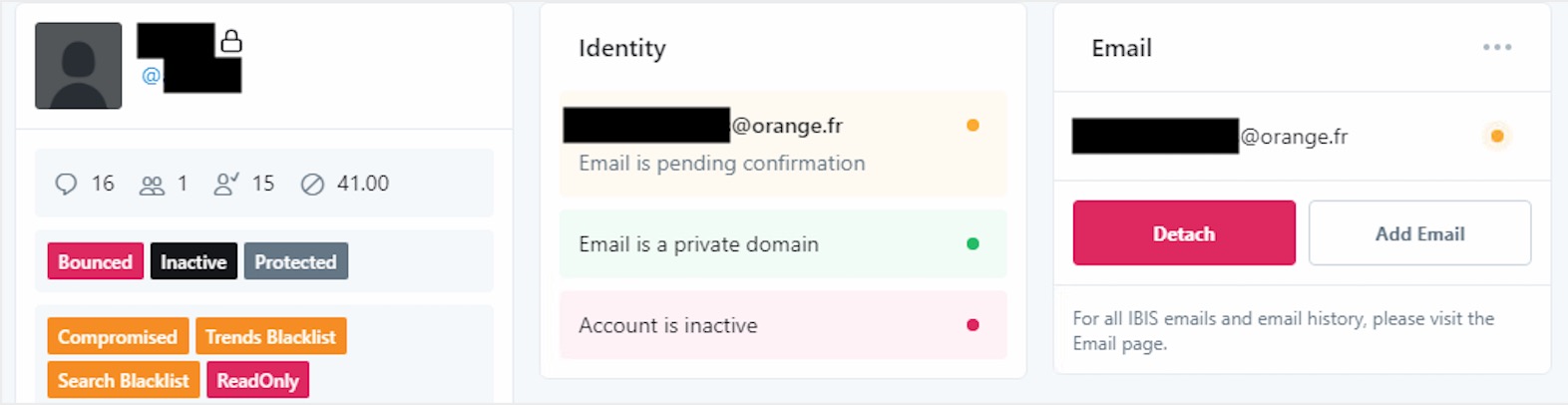
Kirk allegedly had access to an internal tool on Twitter’s network, which allowed them to effectively take control of a user’s account. A screenshot shared with TechCrunch shows the apparent admin tool. (Twitter is removing tweets and suspending users that share screenshots of the tool.)

A screenshot of the alleged internal Twitter account tool. (Image supplied)

The tool appears to allow users — ostensibly Twitter employees — to control access to a user’s account, including changing the email associated with the account and even suspending the user altogether. (We’ve redacted details from the screenshot, as it appears to represent a real user.)

The person did not say exactly how Kirk got access to Twitter’s internal tools, but hypothesized that a Twitter employee’s corporate account was hijacked. With a hijacked employee account, Kirk could make their way into the company’s internal network. The person also said it was unlikely that a Twitter employee was involved with the account takeovers.

As part of their hacking campaign, Kirk targeted @binance first, the person said, then quickly moved to popular cryptocurrency accounts. The person said Kirk made more money in an hour than selling usernames.

To gain control of the platform, Twitter briefly suspended some account actions — as well as prevented verified users from tweeting — in an apparent effort to stem the account hijacks. Twitter later tweeted it “was working to get things back to normal as quickly as possible.”