
Year: 2020

08 Jul 2020

As media revenue struggles, subscription startups see growth

The COVID-19 pandemic hasn’t been a friend to the media business. Its economic impacts slashed advertising budgets, diminishing a key revenue plank for many publications. The results of falling ad spend have been felt across the industry, with a wave of layoffs hitting publications large and small, niche and general.


The Exchange explores startups, markets, and money. You can read it every morning on Extra Crunch, and now you can receive it in your inbox. Sign up for The Exchange newsletter, which drops every Friday starting July 24.


Other forms of publisher income, like events, have also been reduced. But the pain of 2020’s media downturn hasn’t been felt equally in the industry. Publications that had built subscription revenue bases were in a better position to weather declines in other media incomes than peers who hadn’t; revenue diversification can provide real shelter when the economy rapidly shifts.

Subscription incomes are not enough for publications to avoid all pain; The Atlantic’s subscription base famously surged during the early months of COVID-19, but the company still saw layoffs. The Athletic’s subscription business was predicated on sports events taking place — it too underwent cuts despite a membership-first model.

In this era, the healthiest publications tend to have a subscription component. The paywalled New York Times and Wall Street Journal are hiring, as is Business Insider, which launched a membership service in 2017. But not all subscription publications that are succeeding are large. Indeed, thanks to a growing set of publisher-friendly subscription services, there are a number of options in the market for supporting publications as small as a single author.

Perhaps most famously, Substack has seen good growth in the last year. The venture-backed newsletter-and-blogging service provides authors with the ability to charge for their writing. But other startups are competing in the space, helping publications derive more income directly from readers.

Pico, which provides paid-subscription tooling for publishers, has seen strong growth in the COVID-19 era. TechCrunch caught up with its co-founder Jason Bade to chat about what his company has seen in recent months. And a few months ahead of COVID-19’s arrival, publishing platform Ghost launched its paid subscription product into beta. TechCrunch asked Ghost about the reception, and growth of the membership portion of its business to better understand today’s media market.

What emerges from data and conversations concerning the startup-supported media membership landscape is something hopeful. Some writers are going to build micro-pubs that can finance their existence. And larger publications have never had more available help to wean their businesses off of ads, pageviews, and Google’s favor.

08 Jul 2020

Asus and Lenovo among the first to launch Qualcomm Snapdragon 865 Plus devices

Qualcomm just revealed initial details around the Snapdragon 865 Plus. Like the 855 Plus before it, the upcoming chip represents a mid-year performance boost to the company’s mobile flagship. Think of it as a kind of halfway refresh between major updates designed to keep things fresh in the back half of the year.

The top line updates here including performance enhancements to the CPU (Kryo 585 Prime) and GPU (Adreno 650), which offer 10% increases in clock speed and graphics rendering, respectively. The familiar X55 5G Modem-RF System is on-board, to deliver on the chipmaker’s push toward universal next-gen wireless adoption. That’s coupled with improvements to Wi-Fi connectivity, with the promise of speed up to 3.6 Gbps by way of the FastConnect 6900.

Both Asus and Lenovo get some face time in the press release. Asus says its ROG Phone 3 will sport the chips with more details in the coming weeks. If it is, indeed, the first smartphone to get the chip, it’s not exactly a high profile launch. That said, the current 865 is on more than 140 current or announced devices according to Qualcomm, so the Plus will no doubt be making its way to some higher-profile names in the not so distant future. Asus is expected to offer up more detail at a July 22 event.

The Lenovo device is an even more interesting addition. The company is widely expected to add a new gaming handset to its Legion line, and it seems it will be sporting the new chip.

“Three years after the launch of the Lenovo Legion PC portfolio, we’re bringing our beloved gaming sub-brand’s core values of speed and powerful performance to 5G mobile gaming – where Lenovo Legion will be amongst the first to offer the new Snapdragon 865 Plus in our expanding family of gaming devices this year,” VP Jerry Tsao said in a release. That’s certainly in line with Qualcomm’s increased focus on mobile gaming this time out. For that reason alone, the partnership seems like a no-brainer.

Samsung’s upcoming Galaxy Note 20 is also rumored to be receiving the upgrade, as well. That device is expected to be announced at an event on August 5. The first devices sporting the 865 Plus are due to arrive in Q3.

08 Jul 2020

Nauta Capital launches fifth fund with €120M to back early-stage European B2B startups

Nauta Capital, the pan-European venture capital firm that invests in B2B technology startups at seed and Series A, is launching its fifth fund.

The new vehicle has an initial close of €120 million and is expected to surpass the VC’s 2016 fund, which topped out at €155 million.

With offices in London, Barcelona and Munich, Nauta Capital has over half a billion under management and is supported by a team of 24 people, making it one of Europe’s largest B2B focused VCs. The firm invest in companies mainly based in the U.K., Spain, and Germany, as well as those based in other continental European countries with plans to significantly increase their presence in one of its key geographical hubs.

Describing itself as “sector-agnostic,” Nauta Capital’s main areas of interest include B2B SaaS solutions with “strong network effects”, vertically focused enterprise tech that is attempting to transform large industries, and deep tech applications that solve an array of challenges faced by large enterprises. More broadly, it says it targets “capital-efficient” B2B software companies.

In total, Nauta has led investments in more than 50 companies. They include Brandwatch, a U.K. digital consumer intelligence company with $100 million ARR; Onna, a knowledge integration platform that unifies workplace knowledge platforms for the likes of Facebook and Dropbox; PromoteIQ which was acquired by Microsoft in 2019; zenloop, a Berlin-based experience management platform; and MishiPay, a mobile self-checkout technology.

LPs in this fifth fund’s first close include both existing and new investors from continental Europe and America. They span fund of funds, financial institutions, insurance companies, and large family offices that lead large corporates with “strong synergies” with Nauta’s portfolio.

“We have doubled the first close compared to our 2016 fund in record time against a backdrop of a global pandemic,” says Carles Ferrer, Nauta’s London-based General Partner, in a statement. “With more than 80% of the contributions received from existing LPs, we are humbled to see that our thesis has resonated with so many of our current LPs who have joined us again”.

That thesis has seen Nauta have the discipline to back companies that take a leaner approach, including during fundraising or leveraging cash efficiently to achieve growth, according to Carles. “At a time when we are navigating a global pandemic, where the global economy has taken a severe hit, it’s more apparent than ever that our conviction in capital-efficiency maximises sustainability and leads to greater long-term outcomes for entrepreneurs, regardless of their stage,” he says.

Meanwhile, Nauta is disclosing that the first company to be backed from its new fund is NumberEight, which has raised a $2.3 million seed round led by the VC. Based in the U.K., NumberEight offers a “contextual intelligence” platform for mobile devices that predicts consumer context to “enable the delivery of the right content at the right time,” while claiming to preserve user privacy by not sending or storing sensor data beyond the user’s device.

“The startup leverages advanced context recognition and on-device AI techniques to predict over 100 contextual signals such as ‘travelling to work on a bicycle’, thus providing mobile apps with real-time behavioural and situational consumer insights,” explains Nauta.

08 Jul 2020

Slack snags corporate directory startup Rimeto to up its people search game

For the second time in less than 24 hours, an enterprise company bought an early stage startup. Yesterday afternoon DocuSign acquired Liveoak, and this morning Slack announced it was buying corporate directory startup Rimeto, which should help employees find people inside the organization who match a specific set of criteria from inside Slack.

The companies did not share the purchase price.

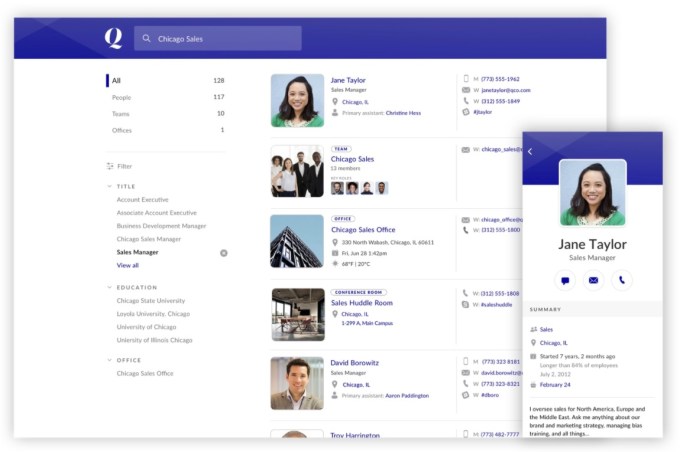
Rimeto helps companies build directories to find employees beyond using tools like Microsoft Active Directory, homegrown tools or your corporate email program. When we covered the company’s $10 million Series A last year, we described what it brings to directories this way:

Rimeto has developed a richer directory by sitting between various corporate systems like HR, CRM and other tools that contain additional details about the employee. It of course includes a name, title, email and phone like the basic corporate system, but it goes beyond that to find areas of expertise, projects the person is working on and other details that can help you find the right person when you’re searching the directory.

In the build versus buy equation that companies balance all the time, it looks like Slack weighed the pros and cons and decided to buy instead. You could see how a tool like this would be useful to Slack as people try to build teams of employees, especially in a world where so many are working from home.

While the current Slack people search tool lets you search by name, role or team, Rimeto should give users a much more robust way of searching for employees across the company. You can search for the right person to help you with a particular problem and get much more granular with your search requirements than the current tool allows.

Image Credit: Rimeto

At the time of its funding announcement, the company, which was founded in 2016 by three former Facebook employees, told TechCrunch it had bootstrapped for the first three years before taking the $10 million investment last year. It also reported it was cash-flow positive at the time, which is pretty unusual for an early stage enterprise SaaS company.

In a company blog post announcing the deal, as is typical in these deals, the founders saw being part of a larger organization as a way to grow more quickly than they could have alone. “Joining Slack is a special opportunity to accelerate Rimeto’s mission and impact with greater reach, expanded resources, and the support of Slack’s impressive global team,” the founders wrote in the post.

The acquisition is part of a continuing trend around enterprise companies buying early stage startups to fill in holes in their product roadmaps.

08 Jul 2020

Google launches the Open Usage Commons, a new organization for managing open-source trademarks

Google, in collaboration with a number of academic leaders and its consulting partner SADA Systems, today announced the launch of the Open Usage Commons, a new organization that aims to help open-source projects manage their trademarks.

To be fair, at first glance, open-source trademarks may not sound like it would be a major problem (or even a really interesting topic), but there’s more here than meets the eye. As Google’s director of open source Chris DiBona told me, trademarks have increasingly become an issue for open-source projects, not necessarily because there have been legal issues around them, but because commercial entities that want to use the logo or name of an open-source project on their websites, for example, don’t have the reassurance that they are free to use those trademarks.

“One of the things that’s been rearing its ugly head over the last couple years has been trademarks,” he told me. “There’s not a lot of trademarks in open-source software in general, but particularly at Google, and frankly the higher tier, the more popular open-source projects, you see them more and more over the last five years. If you look at open-source licensing, they don’t treat trademarks at all the way they do copyright and patents, even Apache, which is my favorite license, they basically say, nope, not touching it, not our problem, you go talk.”

Traditionally, open-source licenses didn’t cover trademarks because there simply weren’t a lot of trademarks in the ecosystem to worry about. One of the exceptions here was Linux, a trademark that is now managed by the Linux Mark Institute on behalf of Linus Torvalds.

With that, commercial companies aren’t sure how to handle this situation and developers also don’t know how to respond to these companies when they ask them questions about their trademarks.

“What we wanted to do is give guidance around how you can share trademarks in the same way that you would share patents and copyright in an open-source license […],” DiBona explained. “And the idea is to basically provide that guidance, you know, provide that trademarks file, if you will, that you include in your source code.”

Google itself is putting three of its own open-source trademarks into this new organization: the Angular web application framework for mobile, the Gerrit code review tool and the Istio service mesh. “All three of them are kind of perfect for this sort of experiment because they’re under active development at Google, they have a trademark associated with them, they have logos and, in some cases, a mascot.”

One of those mascots is Diffi, the Kung Fu Code Review Cuckoo, because, as DiBona noted, “we were trying to come up with literally the worst mascot we could possibly come up with.” It’s now up to the Open Usage Commons to manage that trademark.

DiBona also noted that all three projects have third parties shipping products based on these projects (think Gerrit as a service).

Another thing DiBona stressed is that this is an independent organization. Besides himself, Jen Phillips, a senior engineering manager for open source at Google is also on the board. But the team also brought in SADA’s CTO Miles Ward (who was previously at Google); Allison Randal, the architect of the Parrot virtual machine and member of the board of directors of the Perl Foundation and OpenStack Foundation, among others; Charles Isbel, the dean of the Georgia Institute of Technology College of Computing, and Cliff Lampe, a professor at the School of Information at the University of Michigan and a “rising star,” as DiBona pointed out.

“These are people who really have the best interests of computer science at heart, which is why we’re doing this,” DiBona noted. “Because the thing about open source — people talk about it all the time in the context of business and all the rest. The reason I got into it is because through open source we could work with other people in this sort of fertile middle space and sort of know what the deal was.”

08 Jul 2020

Lucid to open 20 customer locations to help sell and service its electric vehicle

The Lucid Air electric sedan will debut on September 9, 2020 and today the company is detailing its plan to sell and service those vehicles. The company says it will open 20 so-called ‘studio’ and service locations through 2021. These locations will be located throughout North America and feel similar to Tesla’s customer locations.

Right now, the company is only revealing the location of eight studio and service centers: two in Beverly Hills, CA, San Jose, West Palm Beach, New York City, DC metro area, and at Lucid’s Silicon Valley headquarters in Newark, CA

Lucid is clearly careful about not calling these sales locations. To do so would require the company to comply by different state regulations around dealerships. In many states automakers are barred from selling vehicles to customers directly through a physical location. Instead, state regulations require automakers to use a 3rd party — an independent dealership — to make the transaction. As is the case with Tesla, these locations by Lucid will help build brand awareness and assist customers in their online purchase.

As for service Lucid is assembling a network of approved service centers including mobile service providers and collision repair centers.

08 Jul 2020

Watch SpaceX launch Starlink satellites equipped with ‘sun visors’ live

SpaceX has a launch schedule for today, for a combined payload that includes 57 of its Starlink satellites, as well as two satellites it’s flying on behalf of BlackSky. The launch is set to take off at 11:59 AM EDT (8:59 AM PDT), from Launch Complex 39A at Kennedy Space Center in Florida. The launch broadcast above will go live at around 15 minutes prior to that window, so at around 11:44 AM EDT (8:44 AM PDT).

This mission will increase the size of SpaceX’s Starlink constellation to 536 active production satellites, helping it move closer to its goal of launching an active consumer broadband internet service by later this year. The 57 satellites being launched today are all also equipped with a new ‘sun visor’ system devised by SpaceX to block reflections from the Sun on the Starlink satellite radio surfaces, which is a measure put in place to help limit their impact on night sky observation from Earth by scientists.

SpaceX previously launched one test satellite with the system installed, but this will be the first time all satellites on a Starlink flight will use the system. Alongside its own satellites, SpaceX is also making use of its new rideshare program to also loft satellites on behalf of BlackSky, which will join that company’s existing Earth observation network.

The Falcon 9 booster being used for this mission has flown on four prior missions, including SpaceX’s first demonstration mission for Crew Dragon to the International Space Station. It’ll attempt a landing again today aboard SpaceX’s floating landing barge in the Atlantic Ocean.

08 Jul 2020

Tinder now testing video chat in select markets, including U.S.

Tinder announced this morning it will begin to test video chat in its mobile dating app with some members in select worldwide markets, including in the U.S. The feature, which allows Tinder matches to go on “virtual” dates when both opt in, will first be available to users in Virginia, Illinois, Georgia and Colorado in the U.S., as well as in Brazil, Australia, Spain, Italy, France, Vietnam, Indonesia, Korea, Taiwan, Thailand, Peru and Chile, also with some members.

Parent company Match had first promised it would introduce video chat in Tinder as part of its Q1 2020 earnings report and touted the feature as a way Tinder was evolving its business in the face of the coronavirus pandemic. The company had also then detailed the pandemic’s impact on its app, which had slowed Tinder user growth in the quarter as social distancing requirements and government lockdowns went into effect.

Tinder ended Q1 with 6 million subscribers, up from 5.9 million in December 2019 — meaning it only added 100,000 paid subscribers during the quarter. For comparison, in the year-ago quarter it added 384,000 paid users. Tinder’s average revenue per user (ARPU) also grew just 2%, mainly due to purchases of à la carte features, not subscriptions.

Tinder says it had tested video at various times before the COVID-19 outbreak, but said it never saw significant adoption. The pandemic has changed things, however. Today, Tinder allows users to search for matches worldwide through its Passport feature, making its dating app more of a social network. Meanwhile, Tinder users who do want to date now feel almost forced to use video for their early interactions instead of going on briefer “getting to know you” coffee or drink dates, as before.

Without a video option in the app, these users often turned to third-party apps like Snapchat or other video chat apps for these early connections. Meanwhile, daters who prioritized a video option may have even made the switch to rival Bumble, which has offered video for a year. Facebook also recently said it would add video for its Facebook Dating users, as a result of the coronavirus pandemic, forcing Tinder’s hand.

Image Credits: Tinder

The new feature itself is simple to use. Once two people have matched and are chatting in the app, they can indicate they’re ready to move to a video session by tapping the new video icon. The clever part is that the feature itself isn’t enabled until both matches opt in. The company notes that Tinder users won’t be informed if a match toggles on the video chat feature. The idea is to wait until the discussion comes up naturally, as it often does in a text-based chat.

When both users have toggled on video chat, they have to agree to ground rules before the chat begins. Tinder says calls should remain “PG,” with no nudity or sexual content. The chats are also supposed to stay “clean,” meaning no harassment, hate speech, violence or other illegal activities. Users also agree calls will need to be age-appropriate, meaning without minors involved.

The feature, which Tinder calls “Face to Face,” is enabled on a match-by-match basis, not universally for all matches.

How exactly Tinder plans to properly moderate what appears to be a fantastic new solicitation platform remains less clear. In addition, Tinder’s move to embrace video means it could be putting sex offenders in front of the camera. As an investigative report last year from ProPublica found, most of the Match-owned dating apps, including Tinder, were not screening for sexual predators.

For now, Tinder says users are asked to review the call when it wraps.

In a pop-up, users who finish a video call will be asked whether they would go Face to Face again. Here, they’ll also have the option to report the user, if needed. These sorts of retroactive rating systems don’t do much for anyone who feels unsafe in the moment, of course, and it’s not clear to what extent Tinder will step in to police calls in progress.

Asked for specifics, Tinder declined to share. (In an earlier report, Tinder CEO Elie Seidman suggested Tinder would use machine learning models to monitor chats.)

Also unclear is to what extent Tinder would step into to stop what may otherwise be consensual sexual activity, including of the paid variety.

Tinder doesn’t seem worried about these off-brand use cases for video chat, however. It says it recently surveyed around 5,000 members in the U.S. and around half of them have already had video dates with a match off its platform over the past month, indicating a willingness to try video for online dating. In addition, 40% of Gen Z members said they wanted to keep using video as an initial step before agreeing to meet in real life, even when places like restaurants and bars were re-opened.

“Connecting face-to-face is more important than ever, and our video chat feature represents a new way for people to get to know one another in-app no matter their physical distance,” said Rory Kozoll, head of Trust and Safety Products at Tinder, in a statement about the launch. “Face to Face prioritizes control to help our members feel more comfortable taking this next step in chats if and when it feels right for them. We’ve built a solid foundation, and look forward to learning from this test over the coming weeks,” Kozoll added.

The feature is launching in testing only starting today, in select markets.

08 Jul 2020

SUSE acquires Kubernetes management platform Rancher Labs

SUSE, which describes itself as ‘the world’s largest independent open source company,’ today announced that it has acquired Rancher Labs, a company that has long focused on making it easier for enterprises to make their container clusters.

The two companies did not disclose the price of the acquisition, but Rancher was well funded, with a total of $95 million in investments. It’s also worth mentioning that it’s only been a few months since the company announced its $40 million Series D round led by Telstra Ventures. Other investors include the likes of Mayfield and Nexus Venture Partners, GRC SinoGreen and F&G Ventures.

Like similar companies, Rancher’s original focus was first on Docker infrastructure before it pivoted to putting its emphasis on Kubernetes once that became the de facto standard for container orchestration. Unsurprisingly, this is also why SUSE is now acquiring this company. After a number of ups and downs — and various ownership changes — SUSE has now found its footing again and today’s acquisition shows that its aiming to capitalize on its current strengths.

Just last month, the company reported that the annual contract value of its booking increased by 30% year over year and that it saw a 63% increase in customer deals worth more than $1 million in the last quarter, with its cloud revenue growing 70%. While it is still in the Linux distribution business that the company was founded on, today’s SUSE is a very different company, offering various enterprise platforms (including its Cloud Foundry-based Cloud Application Platform), solutions and services. And while it already offered a Kubernetes-based container platform, Rancher’s expertise will only help it to build out this business.

“This is an incredible moment for our industry, as two open source leaders are joining forces. The merger of a leader in Enterprise Linux, Edge Computing and AI with a leader in Enterprise Kubernetes Management will disrupt the market to help customers accelerate their digital transformation journeys,” said SUSE CEO Melissa Di Donato in today’s announcement. “Only the combination of SUSE and Rancher will have the depth of a globally supported and 100% true open source portfolio, including cloud native technologies, to help our customers seamlessly innovate across their business from the edge to the core to the cloud.”

The company describes today’s acquisition as the first step in its ‘inorganic growth strategy’ and Di Donato notes that this acquisition will allow the company to “play an even more strategic role with cloud service providers, independent hardware vendors, systems integrators and value-added resellers who are eager to provide greater customer experiences.”

08 Jul 2020

SetSail raises raises $7M to change how sales teams are compensated

Most sales teams earn a commission after a sale closes, but nothing prior to that. Yet there are a variety of signals along the way that indicate the sales process is progressing, and SetSail, a startup from some former Google engineers, is using machine learning to figure out what those signals are, and how to compensate salespeople as they move along the path to a sale, not just after they close the deal.

Today, the startup announced a $7 million investment led by Wing Venture Capital with help from Operator Collective and Team8. Under the terms of the deal, Leyla Seka from Operator will be joining the board. Today’s investment brings the total raised to $11 million, according to the company.

CEO and co-founder Haggai Levi says his company is based on the idea that commission alone is not a good way to measure sales success, and that it is in fact a lagging indicator. “We came up with a different approach. We use machine learning to create progress-based incentives,” Levi explained

To do that they rely on machine learning to discover the signals that are coming from the customer that indicate that the deal is moving forward, and using a points system, companies can begin compensating reps on hitting these milestones, even before the sale closes.

The seeds for the idea behind SetSail were planted years ago when the three founders were working at Google tinkering with ways to motivate sales reps beyond pure commission. From a behavioral perspective, Levi and his co-founders found that reps were taking fewer risks with a pure commission approach and they wanted to find a way to change that. The incremental compensation system achieves that.

“If I’m closing the deal, I’m getting my commission. If I’m not closing the deal, I’m getting nothing. That means from a behavioral point of view, I would take the shortest path to win a deal, and I would take the minimum risk possible. So if there’s a competitive situation I will try to avoid that,” he said.

They look at things like appointments, emails and call transcripts. The signals will vary by customer. One may find an appointment with CIO is a good signal a deal is on the right trajectory, but to avoid having reps gaming the system by filling the CRM with the kinds of positive signals the company is looking for, they only rely on objective data, rather than any kind of self-reporting information from reps themselves.

The team eventually built a system like this inside Google, and in 2018, left to build a solution for the rest of the world that does something similar.

As the company grows, Levi says he is building a diverse team, not only because it’s the right thing to do, but because it simply makes good business sense. “The reality is that we’re building a product for a diverse audience, and if we don’t have a diverse team we would never be able to build the right product,” he explained.

The company’s unique approach to sales compensation is resonating with customers like Dropbox, Lyft and Pendo, who are looking for new ways to motivate sales teams, especially during a pandemic when there may be a longer sales cycle. This kind of system provides a way to compensate sales teams more incrementally and reward positive approaches that have proven to result in sales.