Year: 2020

07 Jul 2020

‘No code’ will define the next generation of software

It seems like every software funding and product announcement these days includes some sort of reference to “no code” platforms or functionality. The frequent callbacks to this buzzy term reflect a realization that we’re entering a new software era.

Similar to cloud, no code is not a category itself, but rather a shift in how users interface with software tools. In the same way that PCs democratized software usage, APIs democratized software connectivity and the cloud democratized the purchase and deployment of software, no code will usher in the next wave of enterprise innovation by democratizing technical skill sets. No code is empowering business users to take over functionality previously owned by technical users by abstracting complexity and centering around a visual workflow. This profound generational shift has the power to touch every software market and every user across the enterprise.

The average enterprise tech stack has never been more complex

In a perfect world, all enterprise applications would be properly integrated, every front end would be shiny and polished, and internal processes would be efficient and automated. Alas, in the real world, engineering and IT teams spend a disproportionate share of their time fighting fires in security, fixing internal product bugs and running vendor audits. These teams are bursting at the seams, spending an estimated 30% of their resources building and maintaining internal tools, torpedoing productivity and compounding technical debt.

Seventy-two percent of IT leaders now say project backlogs prevent them from working on strategic projects. Hiring alone can’t solve the problem. The demand for technical talent far outpaces supply, as demonstrated by the fact that six out of 10 CIOs expect skills shortages to prevent their organizations from keeping up with the pace of change.

At the same time that IT and engineering teams are struggling to maintain internal applications, business teams keep adding fragmented third-party tools to increase their own agility. In fact, the average enterprise is supporting 1,200 cloud-based applications at any given time. Lacking internal support, business users bring in external IT consultants. Cloud promised easy as-needed software adoption with seamless integration, but the realities of quickly changing business needs have led to a roaring comeback of expensive custom software.
07 Jul 2020

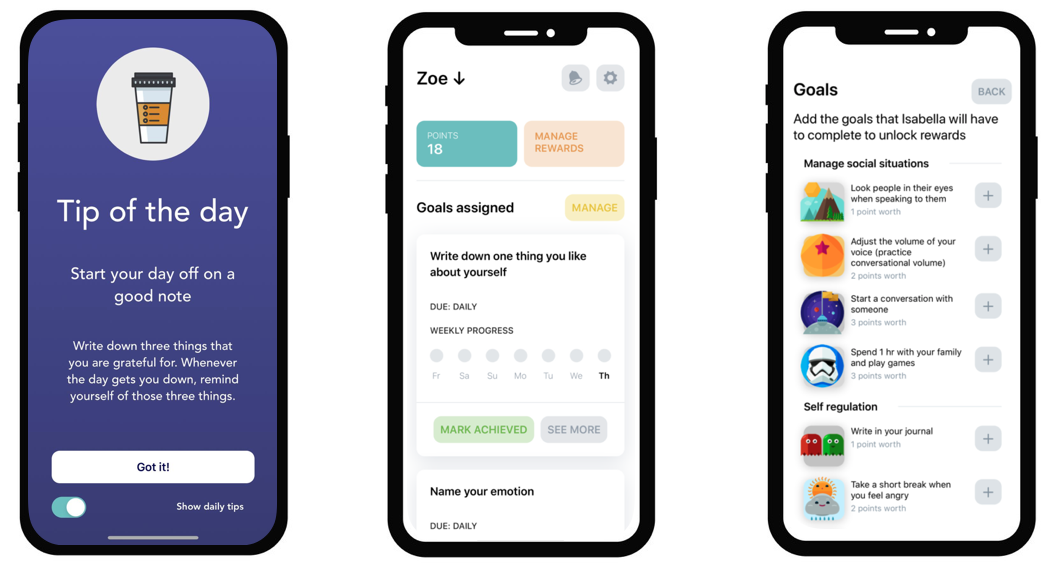
With partnerships at major children’s hospitals, Manatee seeks clinical validation of its CBT-based app

When Manatee founder Damayanti Dipayana’s brother was diagnosed with autism spectrum disorder, the family took all the steps to ensure that he was properly cared for. All of the things that could have been an obstacle to getting treatment weren’t for Dipayana’s family.

A comfortably middle class background, a supportive family and ready access to care were all available, but still the therapy didn’t take. For Dipayana, it was witnessing the breakdown between the care provided at sessions and the differences in treatment at home, that led her to create Manatee.

“Therapy just sucks for kids,” Dipayana said. “My brother hated it.. It can’t be the best thing for children to put them in a room with an adult and have them talk about their problems for an hour.”

Now the graduate from Techstars Los Angeles has $1.5 million in funding from investors including the Michigan-based investment firm, Grand Ventures; Telosity, a fund launched by Vinaj Ventures & Innovation, that invests in companies improving children’s and young adult’s mental health; and the American Family Insurance Institute for Corporate and Social Impact, will pursue clinical validation for its suite of apps and services to provide a continuum of care for children with cognitive and behavioral disorders. 

Beginning with Children’s Hospital Los Angeles, Manatee has started a trial with ten clinicians and fifty families to evaluate the commercial use case for Dipayana’s service.

The first targets for care are anxiety and oppositional disorder, Dapayana said.

Image credit: Manatee

“I really want to focus on children. From a social [return on investment] perspective it seems insane to me that we don’t invest more in the early wellbeing of children,” said Dipayana. “If we did then we probably wouldn’t have to deal with a  ballooning juvenile detention system.”

From the company’s earliest days the stars seemed to align for Dipayana. She found her technical co-founder, Shawn Kuenzler, thanks to a post on AngelList. A veteran in the health tech startup world, Kuenzler ran engineering at Health Language and Zen Planner and has two exits under his belt. If that wasn’t serendipitous enough, Kuenzler’s wife is a clinical psychologist.

The two Denver-based entrepreneurs then took their startup on the road to the Techstars Los Angeles accelerator. It was there that they were introduced to contacts at companies including Headspace and LA Children’s Hospital that are paving the way for clinical validation of digitally delivered cognitive behavioral healthcare.

“We’re going to spend money and resources on launching our research with Children’s LA to understand the impact for a health system,” Dipayana said. “We position it as everyday therapy for kids. We provide the platform for providers to make it the day-to-day therapy for kids.” 

Manatee sells its services directly to healthcare systems to ensure that it can reach the broadest population of users rather than just ones who could afford to access the company’s app-based offerings. Doctors use Manatee as a clinical dashboard and way to communicate to both a child and their family around care plans and treatment.

“I thought about this really long and hard… Looking from my personal experience. Parents and families that have kids with autism… there’s so much snake oil that gets pushed down their throat that they’ll try anything,” Dipayana said. “It was very important to me that one i understand the clinical workflow and understood how the workforce manages behavioral healthcare and whether the work we were doing was valuable.”

07 Jul 2020

Autonomous driving startup turns its AI expertise to space for automated satellite operation

Hungarian autonomous driving startup AImotive is leveraging its technology to address a different industry and growing need: autonomous satellite operation. AImotive is teaming up with C3S, a supplier of satellite and space-based technologies, to develop a hardware platform for performing AI operations onboard satellites. AImotive’s aiWare neural network accelerator will be optimized by C3S for use on satellites, which have a set of operating conditions that in many ways resembles those onboard cars on the road – but with more stringent requirements in terms of power management, and environmental operating hazards.

The goal of the team-up is to have AImotive’s technology working on satellites that are actually operational on orbit by the second half of next year. The projected applications of onboard neural network acceleration extend to a number of different functions according to the companies, including telecommunications, Earth imaging and observation, autonomously docking satellites with other spacecraft, deep space mining and more.

While it’s true that most satellites operate essentially in an automated fashion already – mean gin they’re not generally manually flown at every given moment – true neural network-based onboard AI smarts would provide them with much more autonomy when it comes to performing tasks, like imaging a specific area or looking for specific markers in ground or space-based targets. Also, AImotive and C3S believe that local processing of data has the potential to be a significant game-changer when it comes to the satellite business.

Currently, most of the processing of data collected by satellites is done after the raw information is transmitted to ground stations. That can actually result in a lot of lag time between data collection, and delivery of processed data to customers, particularly when the satellite operator or another go-between is acting as the processor on behalf of the client rather than just delivering raw info (and doing this analysis is also a more lucrative proposition for the data provider, or course).

AImotive’s tech could mean that processing happens locally, on the satellite where the information is captured. There’s been a big shift towards this kind of ‘computing at the edge’ in the ground-based IoT world, and it only makes sense to replicate that in space, for many of the same reasons – including that it reduces time to delivery, meaning more responsive service for paying customers.

07 Jul 2020

Kerry Washington is coming to Disrupt 2020

Kerry Washington’s fingerprints are all over Hollywood. The Emmy, SAG and Golden Globe nominated actor, director and producer has touched myriad projects, from her role as Olivia Pope on “Scandal” (where she was the first African-American woman since 1974 to headline a network drama) to her production of Hulu’s “Little Fires Everywhere” and Netflix’s AMERICAN SON (she starred in both, as well). And let’s not forget her many director credits, including on “SMILF”, “Scandal”, and “Insecure”.

But Washington is much, much more than a Hollywood superstar.

She’s gotten deeper into the tech realm over the past few years, and not only by writing a check.

Washington participated in the $75 million investment in The Wing, a members’ only coworking space for women. She also invested in Community, the platform that gives stars and celebrities a more direct connection with their fans (you can ‘text’ her using the number in her Twitter bio) and she invested in Byte, a D2C teeth-straightening platform (where she serves as Creative Ambassador).

Washington told TechCrunch in May that her portfolio is all about companies that she can be proud to be associated with.

“That pride comes from the quality of the product and how it improves the quality of people’s lives,” said Washington. “The idea of having a voice is really important.”

Whether it’s through creating space to come together, straightening a smile, or giving people a more direct connection to their icons, her portfolio is exclusive when it comes to empowering people to use their voices.

Washington is also an activist.

She was honored with the NAACP’s President’s Award in 2013, and received the GLAAD Media Vanguard Award in 2015, as well as the ACLU Bill of Rights Award in 2016. In 2018, when the world went through a huge change in the form of #MeToo, Washington joined Natalie Portman, America Ferrera, Reese Witherspoon and others as a leader of the Time’s Up movement within Hollywood.

She’s also the co-chair of Michelle Obama’s “When We All Vote” campaign and the founder of Influence Change 2020, an initiative that partners with non-profit organizations with the goal of increasing voter turnout.

It should go without saying, we’re absolutely thrilled to sit down for a conversation with Washington at Disrupt 2020.

We’ll ask her about her recent move towards tech investment and operations, and which sectors are most exciting to her as we head into the next couple years. We’ll also talk about the rapidly changing media landscape as platforms like Netflix, Hulu, Quibi, Disney+ and HBO take up more space in the ecosystem and networks look to evolve alongside the shift in user behavior.

As we head into a presidential election, in a year where the Black Lives Matter movement has risen to the forefront, we’ll also talk about her activism work and get her insights on where the tech world is falling short with regards to diversity, equity and inclusion, and how it can do better.

There will be no shortage of topics to cover with Washington and we’re very excited about this conversation.

Disrupt 2020 runs from September 14 – September 18 and will be virtual this year. Get your front row seat to see Kerry Washington speak with a Disrupt Digital Pro Pass or a Digital Startup Alley Exhibitor Package before prices increase in a few short weeks. Can’t wait to see you there!

07 Jul 2020

How European seed firm Connect Ventures finds ‘product-first’ founders

Connect Ventures, the London-based seed-stage VC that was an early investor in Citymapper and Typeform announced a new $80 million fund last month to continue investing in “product-led” founders.

Launched back in 2012, when there was a shortage of institutional capital at seed stage in Europe and micro VC was a novelty in the region, Connect Ventures invests in B2B and consumer software across Europe, including SaaS, fintech, digital health and “future of work.”

Running throughout the firm’s investment thesis is a product focus, with the belief that product-led — or “product-first” — software entrepreneurs are the kinds of founders most likely to transform the way we live and work at scale.

Connect Ventures does fewer deals per year than many seed-stage firms, promising to place bets in a smaller number of early-stage companies. It recently backed scaling startups such as Curve and TrueLayer. Keeping a compact portfolio lets the shop throw more support behind its investments to help tip the scales toward success.

To learn more about Connect’s strategy going forward, I put questions to partners Sitar Teli, Pietro Bezza and Rory Stirling. We covered what makes a product-first founder, the upsides and downside of “conviction investing,” and the next digital product opportunities in fintech, health and the future of work.

TechCrunch: Connect Ventures positions itself as a pan-European VC investing in “product-led” founders at seed stage. Can you be more specific with regards to check size, geography and the types of startups you look for?

Sitar Teli: Of course, I know it can be hard to differentiate seed funds at first glance, so it’s worth digging in one layer down. Connect is a thesis-led, seed stage, product-centric fund that invests across Europe. I know we’re going to dive into some of those parts later, so I’ll focus on our investment strategy and what we look for. We lead seed rounds of £1-£2 million (sometimes less, sometimes more) and make 8-10 investments a year. Low volume, high conviction, high support is the investment strategy we’ve executed since we started eight years ago.

07 Jul 2020

Sunrun’s $3.2 billion Vivint Solar bid challenges Tesla’s energy ambitions

Tesla’s 2014 acquisition of SolarCity turned the electric vehicle manufacturer into the undisputed largest player in residential solar, but that lead has steadily eroded as its major competitor, Sunrun, surged ahead with more aggressive plans. Now with the $3.2 billion dollar acquisition of the residential solar installation company, Vivint Solar, Sunrun looks to solidify its place in the top spot.

From Tesla’s very early days Elon Musk has tried to define the company as an energy company rather than just a manufacturer of electric vehicles. When Tesla made its $2.6 billion bid for SolarCity the move was viewed as the culmination of the first phase of its “master plan,” which called for Tesla to “provide zero emission electric power generation options.”

Now that plan faces a major test from a publicly traded competitor that’s focused solely on providing residential solar power and the ability to lower costs for its panels through greater efficiencies of scale, according to analysts who track the solar energy sector.

Sunrun will be freaking big,” Joe Osha, an analyst at JMP Securities, told Bloomberg News. “They are clearly looking for ways to get scale and efficiency.”

Indeed, the combined companies will save roughy $90 million per year thanks to operational efficiencies, according to a statement from Sunrun. And the economies of scale will give the companies even more leverage when they contract with utilities on feeding power into the electric grid.

As Sunrun acknowledged in the announcement of its acquisition of the Blackstone-backed Vivint, the combined customer base of 500,000 homes represents over 3 gigawatts of solar assets. That figure still is only 3% penetration of the total market for residential solar in the United States.

Sunrun had already edged out Tesla for the top spot in residential solar installations and together the two companies account for 75% of new residential solar leases each quarter, according to data from Bloomberg NEF.

“Americans want clean and resilient energy. Vivint Solar adds an important and high-quality sales channel that enables our combined company to reach more households and raise awareness about the benefits of home solar and batteries,” Sunrun CEO and co-founder Lynn Jurich said in a statement. “This transaction will increase our scale and grow our energy services network to help replace centralized, polluting power plants and accelerate the transition to a 100% clean energy future.”

Even as Sunrun’s $1.46 billion stock (and the assumption of about $1.8 billion in debt) creates a massive competitor to Tesla’s solar business, there’s an opportunity for Tesla to sell more batteries through its residential solar competitor.

Sunrun and Vivint will likely be pushing their customers to add energy storage to their solar installations and that means using either Tesla’s Powerwall batteries or its own Brightbox batteries manufactured in partnership with LG Chem .

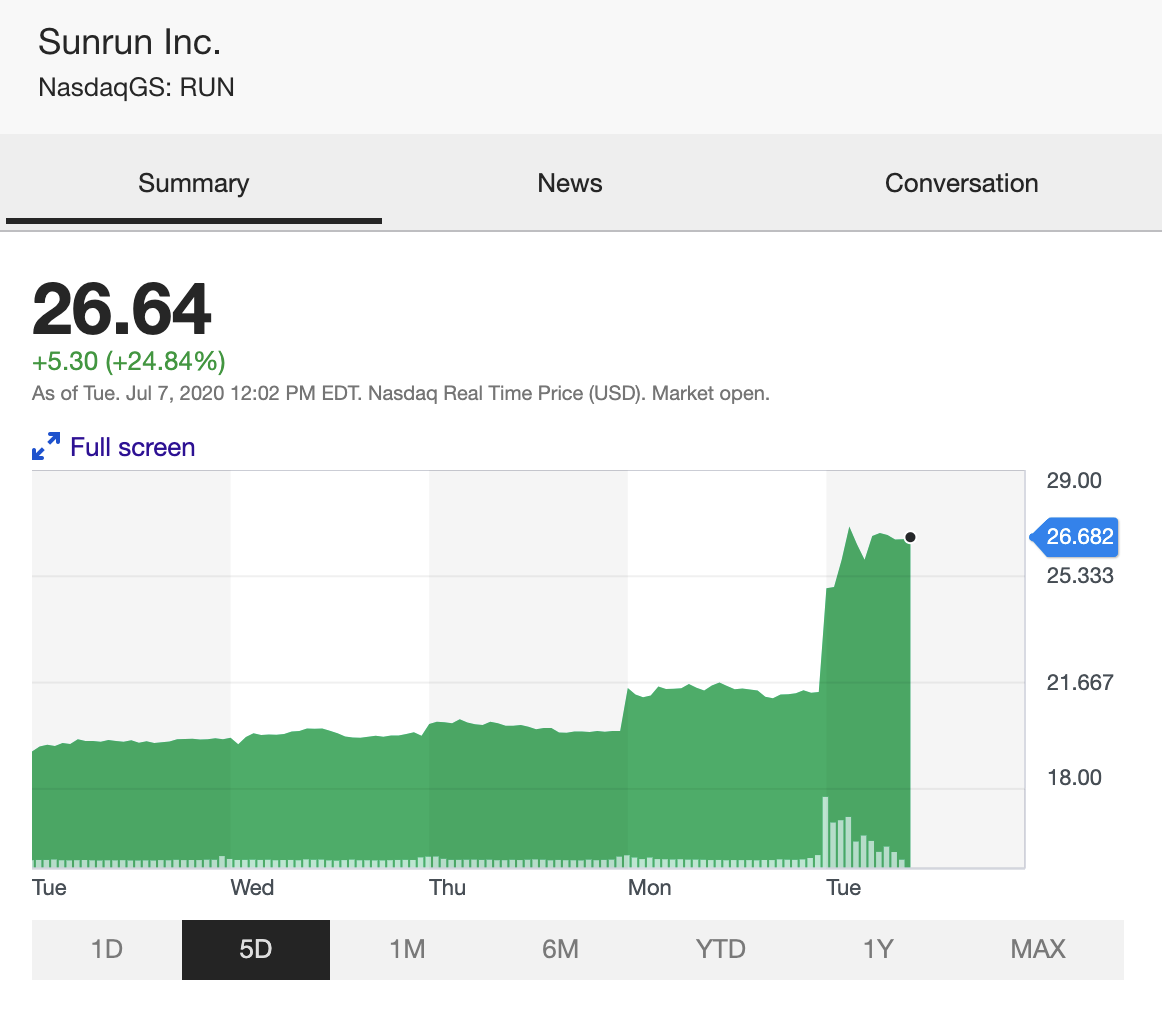
Investors have responded to Sunrun’s latest maneuver by pouring money into the stock. Sunrun’s shares were up over $5 in midday trading.

Image Courtesy: Yahoo Finance

“Vivint Solar and Sunrun have long shared a common goal of bringing clean, affordable, resilient energy to homeowners,” said David Bywater, Chief Executive Officer of Vivint Solar, in a statement. “Joining forces with Sunrun will allow us to reach a broader set of customers and accelerate the pace of clean energy adoption and grid modernization. We believe this transaction will create value for our customers, our shareholders, and our partners.”

07 Jul 2020

Adobe tests an AI recommendation tool for headlines and images

Team members at Adobe have built a new way to use artificial intelligence to automatically personalize a blog for different visitors.

This tool was built as part of the Adobe Sneaks program, where employees can create demos to show off new ideas, which are they showcased (virtually, this year) at the Adobe Summit. And while the Sneaks start out as demos, Adobe Experience Cloud Senior Director Steve Hammond told me that 60% of Sneaks make it into a live product.

Hyman Chung, a senior product manager for Adobe Experience Cloud, said that this Sneak was designed for content creators and content marketers who are probably seeing more traffic during the coronavirus pandemic (Adobe says that in April, its own blog saw a 30% month-over-month increase), and who may be looking for ways to increase reader engagement while doing less work.

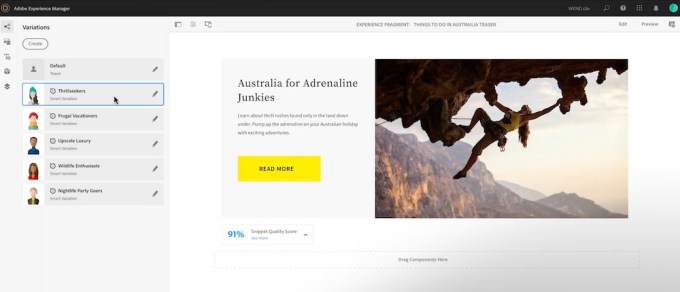
So in the demo, the Experience Cloud can go beyond simple A/B testing and personalization, leveraging the company’s AI technology Adobe Sensei to suggest different headlines, images (which can come from a publisher’s media library or Adobe Stock) and preview blurbs for different audiences.

Adobe AI

Image Credits: Adobe

For example, Chung showed me a mocked up a blog for a tourism company, where a single post about traveling to Australia could be presented differently to thrillseekers, frugal travelers, partygoers and others. Human writers and editors can still edit the previews for each audience segment, and they can also consult a Snippet Quality Score to see the details behind Sensei’s recommendation.

Hammond said the demo illustrates Adobe’s general approach to AI, which is more about applying automation to specific use cases rather than trying to build a broad platform. He also noted that the AI isn’t changing the content itself — just the way the content is promoted on the main site.

“This is leveraging the creativity you’ve got and matching it with content,” he said. “You can streamline and adapt the content to different audiences without changing the content itself.”

And from a privacy perspective, Hammond noted that these audience personas are usually based on information that visitors have opted to share with a brand or website.

07 Jul 2020

Decrypted: Police hack criminal phone network; Randori raises $20M Series A

Last week was, for most Americans, a four-day work week. But a lot still happened in the security world.

The U.S. government’s cybersecurity agencies warned of two critical vulnerabilities — one in Palo Alto’s networking tech and the other in F5’s gear — that foreign, nation state-backed hackers will “likely” exploit these flaws to get access to networks, steal data or spread malware. Plus, the FCC formally declared Chinese tech giants Huawei and ZTE as threats to national security.

Here’s more from the week.


THE BIG PICTURE

How police hacked a massive criminal phone network

Last week’s takedown of EncroChat was, according to police, the “biggest and most significant” law enforcement operation against organized criminals in the history of the U.K. EncroChat sold encrypted phones with custom software akin to how BlackBerry phones used to work; you needed one to talk to other device owners.

But the phone network was used almost exclusively by criminals, allowing their illicit activities to be kept secret and go unimpeded: drug deals, violent attacks, corruption — even murders.

That is, until French police hacked into the network, broke the encryption and uncovered millions of messages, according to Vice, which covered the takedown of the network. The circumstances of the case are unique; police have not taken down a network like this before.

But technical details of the case remain under wraps, likely until criminal trials begin, at which point attorneys for the alleged criminals are likely to rest much of their defense on the means — and legality — in which the hack was carried out.

07 Jul 2020

NY-based autonomous reusable rocket startup lands Air Force contract

New York-based startup iRocket has landed a contract award from the U.S. Air Force to develop and build its fully autonomous small payload rockets, which the company says will be able to launch and propulsively land both its first and second stages, with the potential of launching small payloads on demand in as little as 24 hours.

iRocket is one of a few different companies looking to provide quick turnaround, rapid-response launch capabilities to serve a growing need among defense customers, particularly in the U.S., for those services. U.S. defense agencies are seeking this specifically to help them send up small satellites in greater numbers, with greater frequency, in order to help provide redundancy and address specific needs as they arise.

The iRocket Shockwave launch vehicles are intended to carry a payload with maximum size of around 1,500 kg (around 3,300 lbs) and are best to take off from sites inlacing Spaceport Oklahoma and potentially Launch Complex 48 at Kennedyy Space Cetner in Cape Canaveral. Flexibility in terms of launch sites, including inland in the continental U.S., is another way they can support for flexibility and responsive operations for the Department of Defense and others.

iRocket plans to fly its first launch in just under three years’ time, with a plan to begin offering on-orbit satellite servicing as one of its products by 2025. It has a long way to go before that, but there’s definitely plenty of institutional interest in this from deep-pocketed government and defense customers.

07 Jul 2020

Everything you need to know about the virtual TC Sessions: Mobility 2020

You may have heard that we’re taking our events virtual this year. And that means TC Sessions: Mobility is going virtual as well.

This won’t just be one long webinar. We have some technical tricks up our sleeves that will bring all of what you’d expect from our in-person events from the informative panels and provocative one-on-one interviews to the networking and even a pitch-off session. While virtual isn’t the same as our events in the past, it has provided one massive benefit: democratizing access.

If you’re a startup or investor based in Europe, Africa, Australia, South America or another region in the U.S., you can listen in, network and connect with other participants here in Silicon Valley.

The virtual edition of TechCrunch Sessions: Mobility will occur over two days, October 6-7 and will build off of last year’s inaugural event. If you weren’t there, it was a massive success. This year we are shooting higher.

Here’s what we can share, so far.

For the first time, we will host a pitch-off for early-stage mobility companies during the show and talk to some of the most innovative startups and leaders from established tech firms. Stay tuned for more announcements as the date approaches. You can pick up a virtual ticket for as little as $145 to the show here.

On the speaker front, we have the best and brightest minds in mobility. Argo AI founder and CEO Bryan Salesky will join us for a one-on-one interview that we expect to be particularly interesting. Argo AI has gone from unknown startup to a company providing the autonomous vehicle technology to Ford and VW — not to mention billions in investment from the two global automakers. Co-founder and CEO Bryan Salesky will talk about the company’s journey, what’s next and what it really takes to commercialize autonomous vehicle technology.

Other headliners include Waymo Chief Operating Officer Tekedra Mawakana, who stands at the center of Waymo’s future, Ike co-founder and chief engineer Nancy Sun and Porsche North America CEO Klaus Zellmer. We have panels focused on cities, autonomous vehicle regulations, new opportunities in micromobility and the future of trucking. Plus a few other panels and speakers we have yet to announce.

Our announced panelists include Trucks VC general partner Reilly Brennan, Dor Levi, who heads up bikes and scooters at Lyft, Danielle Harris, director of mobility innovation at Elemental Excelerator, Dmitry Shevelenko, founder at Tortoise, Spin co-founder Euwyn Poon and Uber Director of Policy, Cities and Transportation Shin-pei Tsay.

As the dates get closer, we’ll share more information. In the meantime, here is how to stay up to date on TC Sessions: Mobility 2020.

You can attend both days of TC Sessions: Mobility at the early-bird price of $145 with group discounts available when you buy in bulk with others from your office. If you’re a student, you can get in for just $50. Early stage startups can get additional exposure for their company and the ability to generate leads with a virtual startup exhibition package which includes 3 tickets for $335. Reserve your place today for TC Sessions: Mobility and save.