Year: 2020

01 Jul 2020

Unpacking how Dell’s debt load and VMware stake could come together

Last week, we discussed the possibility that Dell could be exploring a sale of VMware as a way to deal with its hefty debt load, a weight that continues to linger since its $67 billion acquisition of EMC in 2016. VMware was the most valuable asset in the EMC family of companies, and it remains central to Dell’s hybrid cloud strategy today.

As CNBC pointed out last week, VMware is a far more valuable company than Dell itself, with a market cap of almost $62 billion. Dell, on the other hand, has a market cap of around $39 billion.

How is Dell, which owns 81% of VMware, worth less than the company it controls? We believe it’s related to that debt, and if we’re right, Dell could unlock lots of its own value by reducing its indebtedness. In that light, the sale, partial or otherwise, of VMware starts to look like a no-brainer from a financial perspective.

At the end of its most recent quarter, Dell had $8.4 billion in short-term debt and long-term debts totaling $48.4 billion. That’s a lot, but Dell has the ability to pay down a significant portion of that by leveraging the value locked inside its stake in VMware.

Yes, but …

Nothing is ever as simple as it seems. As Holger Mueller from Constellation Research pointed out in our article last week, VMware is the one piece of the Dell family that is really continuing to innovate. Meanwhile, Dell and EMC are stuck in hardware hell at a time when companies are moving faster than ever expected to the cloud due to the pandemic.

Dell is essentially being handicapped by a core business that involves selling computers, storage and the like to in-house data centers. While it’s also looking to modernize that approach by trying to be the hybrid link between on-premise and the cloud, the economy is also working against it. The pandemic has made the difficult prospect of large enterprise selling even more challenging without large conferences, golf outings and business lunches to grease the skids of commerce.

01 Jul 2020

Google brings its AI-powered SmartReply feature to YouTube

Google’s SmartReply, the four-year old, A.I.-based technology that helps suggest responses to messages in Gmail, Android’s Messages, Play Developer Console, and elsewhere, is now being made available to YouTube Creators. Google announced today the launch of an updated version of SmartReply built for YouTube which will allow creators more easily and quickly interact with their fans in the comments.

The feature is being rolled out to YouTube Studio, the online dashboard creators use to manage their YouTube presence, check their stats, grow their channel, and engage fans. From YouTube Studio’s comments section, creators can filter, view and respond to comments from across their channel.

For creators with a large YouTube following, responding to comments can be a time-consuming process. That’s where SmartReply aims to help.

Image Credits: Google

Instead of manually typing out all their responses, creators will be able to instead click one of the suggested replies to respond to comments their viewers post. For example, if a fan says something about wanting to see what’s coming next, the SmartReply feature may suggest a response like “Thank you!” or “More to come!”

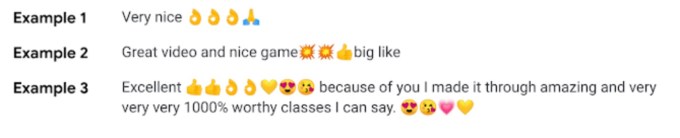
Unlike the SmartReply feature built for email, where the technology has to process words and short phrases, the version of SmartReply designed for YouTube has to also be able to handle a more diverse set of content — like emoji, ASCII art, or language switching, the company notes. YouTube commenters also often post using abbreviated words, slang, and inconsistent use of punctuation. This made it more challenging to implement the system on YouTube.

Image Credits: Google

Google detailed how it overcame these and other technical challenges in a post on its Google AI Blog, published today.

In addition, Google said it wanted a system where SmartReply only made suggestions when it’s highly likely the creator would want to reply to the comment and when the feature is able to suggest a sensible response. This required training the system to identify which comments should trigger the feature.

At launch, SmartReply is being made available for both English and Spanish comments — and it’s the first cross-lingual and character byte-based version of the technology, Google says.

Because of the approach SmartReply is now using, the company believes it will be able to make the feature available to many more languages in the future.

01 Jul 2020

Extra Crunch is now available in Greece, Ireland and Portugal

We’re excited to announce that we’ve added Extra Crunch support in Ireland, Portugal and Greece. That adds to our existing support in Europe as we are already in Austria, Belgium, France, Germany, Italy, the Netherlands, Poland, Romania, Spain and the U.K.

Portugal’s 10 million citizens are no strangers to startup investment, with the country totting up 813 to date, according to Crunchbase. Notably, of that total, 113 have been announced in 2020 thus far.

That means that in 2020, despite COVID-19 and its ensuing economic impacts, Portugal is on track to best its 2019 startup round total of 206. And it’s not just small companies that Portugal is building. OutSystems, now based in Boston and worth north of $1 billion, was founded in the country, for example. As Europe recovers from COVID-19, perhaps Portugal can take a larger share of the continent’s startup activity. It appears to have the momentum it would need to do so.

There’s been data from the last few years to indicate that the Greek startup scene is also growing nicely. With larger seed deals and more deal volume, Greece has seen its startups raise more money, more quickly in recent years. It appears that 2020 is no exception to the trend. With 43 known startup rounds in the country so far in 2020, Greece is set to storm its 2019 total of 59. Indeed, the country could nearly double the number of startup deals it saw in 2019 during a pandemic-disrupted year.

In the past 18 months, the country has seen around 38% of its all-time total known startup deals. Surely that means the country is at a local maxima when it comes to startup activity.

Ireland is a startup powerhouse. Crunchbase has 2,327 known rounds for companies based in the country, including 539 in 2019 and 335 so far this year. So like our other two countries, we can spot acceleration in deal volume. Irish startups raised over $5 billion in 2020 so far, according to Crunchbase. There are going to be more names bubbling up from the island that are worth getting to know.

As a nation, Ireland has a history of startup successes. Software company FINEOS was founded in Ireland back in 1993, and today it’s a public company worth more than a billion dollars. Havok, another software company from the country sold to Microsoft in 2015. And Ireland has other neat tech startups that are still coming up, like Farmflo, to pick one from the list we made this morning.

We’re excited to welcome readers from Greece, Portugal and Ireland to our growing community of startups, investors and entrepreneurs.

You can sign up for Extra Crunch here.

What is Extra Crunch?

Extra Crunch is a membership program from TechCrunch featuring market analysis, weekly investor surveys and interviews on growth, fundraising, monetization and other work topics. Members can save time with access to an exclusive newsletter, no banner ads or video pre-rolls on TechCrunch.com, Rapid Read mode and our List Builder tool.

Committing to an annual and two-year plan will save you a few bucks on the membership price and unlock access to TechCrunch event discounts and Partner Perks. The Partner Perks program features discounts and savings on services from AWS, DocSend, Crunchbase and more.

Thanks to everyone who voted on where to expand next. If you haven’t voted and you want to see Extra Crunch in your local country, let us know here.

You can sign up or learn more about Extra Crunch here.

01 Jul 2020

BMW wants to sell you subscriptions to your car’s features

BMW today announced a number of updates to its in-car software experience during a VR press event, complete with a virtual drive through Munich to show off some of these features. These new updates will come to most recent BMWs that support the company’s Operating System 7 later this year — and new cars will already have them built-in.

The company is able to launch these regular updates because it is now able to not just update the car’s infotainment system but virtually every line of code that’s deployed to the various compute systems that make up a modern vehicle. And because of this, the company is now also able to bring a couple of features to market that it has long talked about.

One of those features — and maybe the key announcement from today’s event — are updates to BMW program for subscribing to specific hardware features that are may already be built into your car, like heated seats or advanced driver assistance systems, but that you didn’t activate when you bought the car. BMW has talked about this for a while, but it is now making this a reality. That means if you didn’t buy the heated seats and steering wheel, for example, your new BMW may now offer you a free three-month trial and you can then essentially buy a subscription for this feature for a set amount of time.

Image Credits: BMW

“We offer maximum flexibility and peace of mind to our customers when it comes to choosing and using their optional equipment in their BMWs, whether this BMW is new or used,” a company spokesperson said during today’s press event. “So flexible offers, immediate availability, simpler booking and easy usability for choice, at any time, when it comes to your optional equipment. We already started connectivity over 20 years ago and since 2014, we are online with our Connected Drive Store, where digital services can already be booked.”

Those were very much infotainment features, though. Now, BMW will let you enable vehicle functions and optional equipment on demand and over the air. The company started offering some features like active cruise control with stop and go functionality, a high beam assistant and access to the BMW IconicSounds Sport. The carmaker will add new features to this line-up over time.

Surprisingly, it’s often easier and cheaper for car manufacturers to build some hardware into cars, even if it is not activated, simply because it removes complexity from the production process. A lot of the features that BMW is talking about consist of a combination of software and hardware, though.

What’s new here is the ability to only subscribe to some features for a short time. “In the near future, we will not only be able to add more functions here, but we will also be able to add even more flexibility for our customers with temporary bookings so booking of options for three years, for one year, or even shorter periods of time, like a few months,” a spokesperson said.

Image Credits: BMW

The company also notes that this will give somebody who buys a used car a lot more flexibility, too. It’s worth noting that Apple CarPlay support was also originally a subscription feature in new BMWs, costing $80 a year. The company’s customers were not very happy about this, though, and the company reversed that decision last December. That really felt like nickel-and-diming drivers, though, since none of BMW’s competitors charged for this. It’ll be interesting to see how drivers will react to additional subscription services, but the focus now is more on convenience features that would usually be an option when you buy a new car, so my guess is that this will be less of an issue.

Among the other new and updated digital services the company showcased today is support for Apple’s new ‘Car Keys,’ which BMW brands as the BMW Digital Key, as well as an updated BMW Personal Assistant. Some of these new Assistant features are more cosmetic and about how it is showcased on the in-car display. But one nifty new Assistant feature here, for example, is a kind of IFTTT for your car, where you can easily program it to automatically roll down your windows when you enter your company’s parking garage, for example, so that you can easily scan your badge to open the boom gate.

Image Credits: BMW

Other updates include the new BMW Maps, the company’s built-in GPS system, which the company described as a ‘major leap.’ This cloud-based service can now find routes faster, has more granular traffic data and also includes the ability to find parking spaces for you — and that parking feature itself is based on a lot of work the company is doing in aggregating sensor data from across its fleet, which already covers and maps close to 99% of the German highway system once a day in HD.

Image Credits: BMW

Talking about maps, the company, which is still in the middle of the roll-out of its hybrid-electric vehicles, BMW also today announced that its hybrid fleet will make it easier for drivers to find charging stations and will automatically switch to electric driving when they enter low-emission zones in 80 European cities, with support for additional cities coming over time.

“Digital technologies belong to the core of BMW – because hardware and software are of
equal importance for premium cars,” said Oliver Zipse, the Chairman of the Board of Management of BMW. “Our mission is to integrate advanced digital technologies with highest product excellence to enhance our customers’ experience and driving pleasure even more.”


01 Jul 2020

Insurtech unicorn Lemonade raises IPO range ahead of debut

Ahead of its expected IPO pricing later today, SoftBank -backed insurtech startup Lemonade has raised its expected price range. After initially targeting $23 to $26 per share in its debut, Lemonade now intends to sell its equity for $26 to $28 per share.


The Exchange is a daily look at startups and the private markets for Extra Crunch subscribers; use code EXCHANGE to get full access and take 25% off your subscription.


The new range boosts Lemonade’s expected value, a boon for insurtech startups like Root, Kin, MetroMile, Hippo and others. Had Lemonade been forced to reduce its pricing, the valuations of its contemporaries could have come under pressure when they went to raise more capital. But with Lemonade noting that the market will bear a higher price for its equity, it’s a good day for startups looking to rebuild insurance products in a digital-first manner.

This morning, let’s work out the Lemonade’s new valuation range, compare it to the company’s final private valuation and figure out if we can understand why the stock market may support the company at its new price. After that, we’ll share a few notes from folks about the IPO and how they think it might go, just for fun.

Upward

Lemonade intends on selling 11 million shares as before, so the company is not targeting a larger bloc of shares to disburse. At its new price range, Lemonade will sell shares worth between $286 million and $308 million, a few dozen million more at the top end of its new range than it had anticipated with its first IPO pricing interval ($253 million and $286 million).

The company has two valuation ranges: one without the 1.65 million shares its underwriters may purchase at its IPO price if they choose, and one including those shares. Without the extra equity, Lemonade is aiming at a $1.43 billion to $1.54 billion valuation; including the extra equity, Lemonade is worth $1.47 billion to $1.58 billion.

01 Jul 2020

Google confirms US offices will remain closed until at least September, as COVID-19 spikes

A few months back, Google announced plans to reopen some U.S. offices after the July 4th holiday. But the best laid plans, and all of that. Things have obviously not been going great in terms of the United States’ battle with COVID-19, and Google once again finds itself proceeding on the side of caution.

As was first reported by Bloomberg, Google has since confirmed with TechCrunch that it will be pushing back reopening at least until September 7, after the Labor Day holiday in the States. Along with other tech giants like Facebook, Google has noted that it will continue to offer employees the option of working from home through the reminder of the year.

It’s a smart choice, as many no doubt still feel uncomfortable returning to an office situation — not to mention questions around the public transit that may use to get there. Twitter, meanwhile, made waves in May by announcing that employees would be allowed to indefinitely work remotely.

Yesterday, the United States reported more than 47,000 new COVID-19 cases, marking the biggest single day spike since the beginning of the pandemic. Arizona, Florida and Texas have all become epicenters as many other states have seen their own increases in recent weeks. Reopening plans have been put on hold or rolled back in many locales, amid increased concern over the virus’s continued spread. It seems likely other big tech companies will delay their own reopening plans. In most cases, shifting back to the office simply isn’t worth the risk. 

01 Jul 2020

Daily Crunch: Tesla becomes the most valuable automaker in the world

Tesla hits a financial milestone, Discord is now valued at $3.5 billion and we unpack the ??? phenomenon.

Here’s your Daily Crunch for July 1, 2020.

1. Tesla blows past Toyota to become most valuable automaker in the world

In 10 years, Tesla has gone from public market newbie to the most valuable automaker in the world. The electric automaker had long since passed the valuations of Ford and GM — and in January, it became the most valuable U.S. automaker ever when its market capitalization hit $81.39 billion.

Still, a few automakers remained ahead of Tesla globally, until today. Tesla shares popped this morning, and the company’s market cap now stands at nearly $208 billion, surpassing Toyota.

2. Discord now has a $3.5B valuation and $100M for a sales pitch lighter on the gaming

“It turns out that, for a lot of you, it wasn’t just about video games anymore,” wrote co-founders Jason Citron and Stanislav Vishnevskiy in a blog post. Discord, they said, is “a place to have genuine conversations and spend quality time with people, whether catching up, learning something or sharing ideas.”

3. What ???.fm means for Silicon Valley

In 36 hours, a diverse group of young entrepreneurs and technologists used a mysterious meme to raise more than $200,000 for three charities supporting people of color and the LGBTQ community: The Okra Project, The Innocence Project and The Loveland Foundation.

4. Facebook bans ‘violent network’ of far-right boogaloo accounts

Facebook took action to remove a network of accounts Tuesday related to the “boogaloo” movement, a firearm-obsessed anti-government ideology that focuses on preparing for and potentially inciting a U.S. civil war.

5. Dear Sophie: Is immigration happening? Who can I hire?

Lawyer Sophie Alcorn lays out the current immigration landscape for a Bay Area recruiter. (Extra Crunch membership required.)

6. YouTube TV hikes price to $64.99 per month following new channel additions

The bump in pricing is now one of several price increases YouTube TV has seen since its debut, due to the rising costs of programming for the streaming TV service — with the cord cutting trend now accelerating due to the pandemic.

7. NASA pays out $51 million to small businesses with big ideas

NASA has announced its latest batch of small business grants, providing more than 300 businesses a total of $51 million in crucial early-stage funding. These “phase I” projects receive up to $125,000 to help bring new technologies to market.

The Daily Crunch is TechCrunch’s roundup of our biggest and most important stories. If you’d like to get this delivered to your inbox every day at around 9am Pacific, you can subscribe here.

01 Jul 2020

Mexico City’s Jüsto raises a $12 million bridge round for its delivery-only grocery stores

Jüsto, the Mexico City-based delivery only grocery store chain, has raised another $10 million in financing as it looks to expand its now pandemically-relevant business of “dark stores” across the country.

The COVID-19 pandemic is changing consumer habits and increasing the use of delivery services across the world, and consumers n Mexico are no different.

A recent Nielsen study cited by the company found that 11 percent of respondents had purchased fresh food online for the first time in 2020, as lockdowns in cities across the world restricted movement for everyone but essential workers — with 70 percent of those surveyed saying they’d do it again within the year.

“Despite Covid-19 dramatically accelerating the curve of adoption of e-commerce, the penetration rate of e-grocers is still less than 1 percent,” in Latin America, according to Jüsto founder and chief executive, Ricardo Weder, in a statement. “That means there’s an enormous opportunity—and all the right conditions—to disrupt the grocery industry in Latin America.”

With the new bridge round Jüsto’s financing has hit just over $20 million in less than a year. Part of that can be attributed to the pedigree of the company’s founder. Weder was instrumental to Cabify’s growth in Latin America, according to Rodolfo Gonzalez, a partner at Foundation Capital, who led the firm’s investments into Jüsto. And Gonzalez also saw the opportunity in the company’s business model.

“We’ve seen that type of model of warehouse and D2C for groceries be very successful in other geographies,” Gonzalez told Crunchbase, when Jüsto announced its previous $10 million seed round. “But that model didn’t quite exist in Mexico yet.”

Other investors in Jüsto’s round include Mountain NazcaFEMSA VenturesQuiet Capital, and 500 Startups.

The Mexican company prides itself on selling both local and international brands in categories including: fresh produce, dry goods, personal hygiene and beauty care, home and cleaning goods, beverages, organic food, and pet supplies.

“We have these darkstores and hold the delivery,” says Manolo Fernandez, a spokesperson and member of Jüsto’s founding team. “At traditional supermarkets the fill rates are lower and the product is less fresh. One of our core tenets is to reduce waste. We don’t have fruits and vegetables sitting outside in the store.”

Jüsto also claims that it’s prices come in at roughly equivalent to those of a regular supermarket. The company has delivery options ranging from express delivery, same day, and next day delivery.

The company isn’t the first startup to look at unused real estate and internet shopping habits and see an opportunity. Darkstore is a company that has raised nearly $30 million to convert empty space into third-party fulfillment centers. Istanbul’s Getir, which recently raised $25 million from Sequoia’s Michael Moritz, is doing the same thing. And Samokat has adopted a similar strategy in Russia, promising over 3,000 SKUs and an under 45 minute delivery time fulfilled via their urban darkstores.

These companies are focused on being third party logistics players for delivery rather than creating their own brands, but Jüsto shows that there’s an opportunity for purpose built direct to consumer grocery businesses to use the same infrastructure and create actual brand loyalty.

We have the technology, talent, and infrastructure to scale our expansion to more cities in Mexico and begin our international expansion, beginning with Colombiam” Weder said. 

01 Jul 2020

VCs see much to like in Democrats’ $1.5 trillion Moving Forward Act

“The Moving Forward Act reads like a $1.5 trillion validation of our fund’s thesis — that upgrading cities and related infrastructure is key to fighting the existential threat of climate change and improving lives,” said Stonly Baptiste, co-founder and partner at venture capital fund Urban Us.

Democrats in Congress are wrestling with the twin problems of mass unemployment and a long-delayed need to rebuild America’s crumbling infrastructure. Now, with just 124 days until the election, the party is building a platform that supports national funding to boost employment and develop more sustainable infrastructure heavily focused on renewables.

Some venture investors have long supported aspects of the bill, but persistent gridlock made any movement on new policy unlikely — at least in the near term. The proposed legislation contains provisions that would use $1.5 trillion to overhaul the nation’s transportation infrastructure, schools, affordable housing, renewable energy capacity and postal service.

“[In] this time of strong political division in Washington, D.C., we’ll have to see what if anything can get done on this topic in the Senate. I do have some hope that as we get closer to the election, standing in the way of clean energy is going to be seen by many in the Senate as a vote-loser, and that could sway some votes to support something bipartisan,” said Rob Day, a longtime investor in sustainable technologies and a general partner at Spring Lane Capital. “But I’m not really expecting anything to come close to what’s in this House bill. So as an investor I support what they’re doing here, but I’m not yet changing any investment strategies around it.”

Baptiste said investors already support many of the initiatives under the Moving America Forward Act, but the incentives proposed under the Democratic plan could redouble those efforts.

“In general, it seems like it would incentivize private capital to further align and mobilize in the climate-change battle,” Baptiste said. “Over the last 10 years, VC capital has been increasingly invested in transit in general and there is a 20-year history in the clean energy sector.”

01 Jul 2020

Twitch breaks records again in Q2, topping 5B total hours watched

Twitch had already broken viewership records in the first quarter of 2020 amid coronavirus lockdowns, surpassing 3 billion total hours watched in a single quarter for the first time. In the second quarter, it appears that Twitch has broken that record and several others once again. According to a new report from Streamlabs and Stream Hatchet, Twitch saw a massive 62.7% increase in hours watched from Q1 2020 reach 5 billion hours watched in the second quarter.

This figure was also up by 83.1% year-over-year and helps to cement Twitch’s place as the leader among gaming streaming services, with a 67.6% market share.

Twitch also broke records for hours streamed, unique channels, and average concurrent viewership in Q2, the report found.

In terms of streaming, Twitch jumped 58.7% from 121.4 million hours in Q1 to 192.7 million in Q2. Unique channels increased from 63.9% quarter-over-quarter from 6.1 million in Q1 to nearly 10 million in Q2. And average concurrent viewership, meaning the number of viewers watching Twitch at the same time, grew 63.4% over last quarter to reach 2.4 million in Q2.
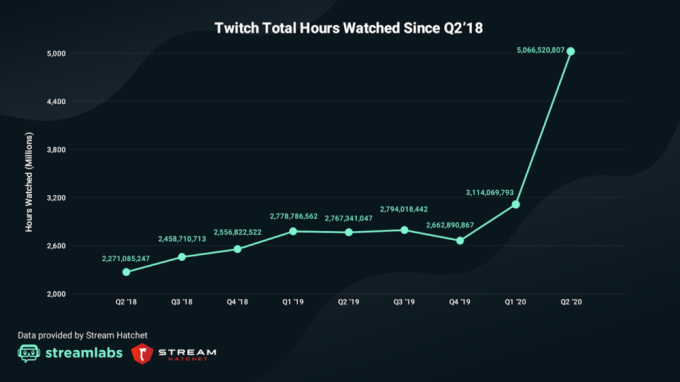
Image Credits: Streamlabs & Stream Hatchet

Of course, the headline news this quarter was Microsoft’s announcement about its plans to shut down its game streaming service Mixer.

The service will wind down on July 22, and Microsoft has teamed up with Facebook to give users a new home. But that doesn’t guarantee Mixer users will make the switch — and Mixer’s exit may instead help propel Twitch to acquire even more market share than it does today.
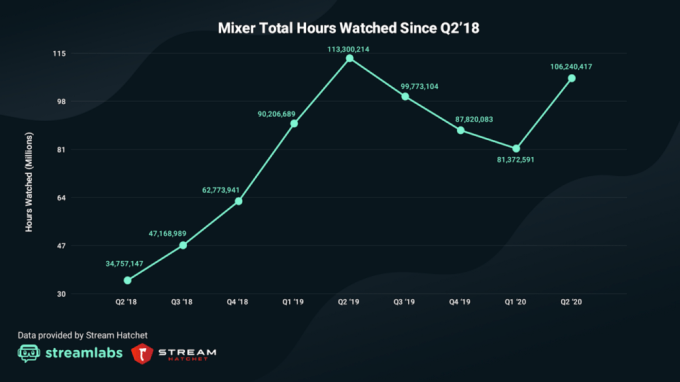
Image Credits: Streamlabs & Stream Hatchet

Though Mixer is soon exiting, it had one of its best quarters to date in Q2, reaching 106 million hours watched, up 30.6% from Q1. It also grew its lineup to over 5 million channels. But in context of the broader market, Mixer wasn’t making a dent — it only managed to secure 1.4% market share by Q2, a figure than had actually fallen by over half a percentage point from the prior quarter.

Meanwhile, YouTube Gaming Live increased its hours watched 39.6% from Q1 to Q2 to reach 1.5 billion. To some extent, the growth stems from recent acquisitions of top talent, including Jack “CouRage” Dunlop and Rachell “Valkyrae” Hofstetter, as well as the continued success of CouRage, noted the report.
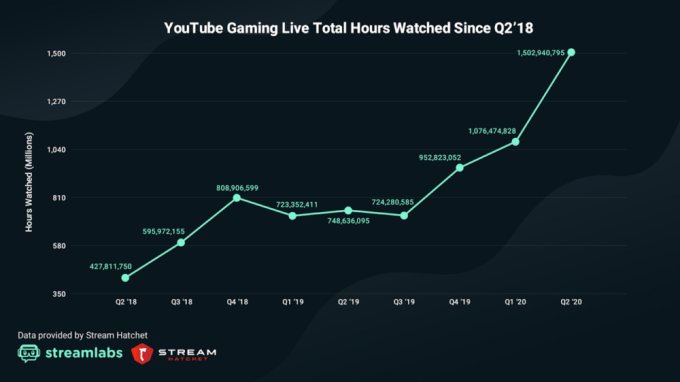
Image Credits: Streamlabs & Stream Hatchet

YouTube Gaming Live also saw a 19.1% increase in hours streamed in the quarter to reach 16.9 million and unique channels grew 22.7% in the quarter to 1.1 million.

It’s still too early to know if Facebook Gaming will end up benefiting from Mixer’s exit, as planned. But hours watched on the service grew 48.5% quarter-over-quarter to reach 822 million; hours streamed hit 6.1 million; and unique channels reached 203,554. However, Facebook still only has an 11% share of the market and that hasn’t changed since Q1, the report found.
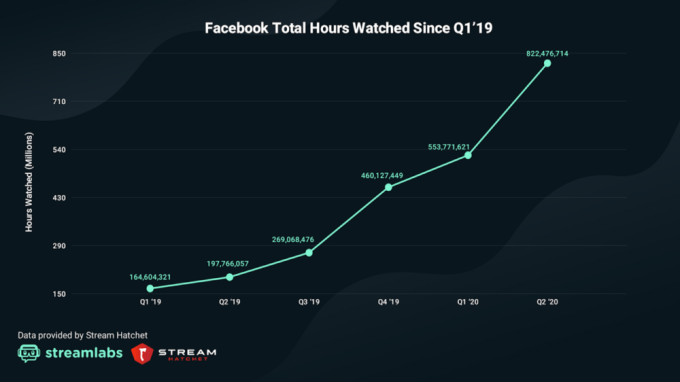
Image Credits:

Though Twitch — and to a lesser extent, other game streaming services — have clearly gained in usage as more consumers look for ways to be entertained at home amid the coronavirus pandemic, it hasn’t been all smooth sailing for the Amazon-owned game streaming site this year.

In recent days, Twitch streamers were hit with a deluge of new RIAA takedown notices that required creators to painstakingly dig through hundreds of hours of past footage to find the infringing content, as Twitch didn’t offer robust search tools or bulk deletion capabilities.

But more concerning is that Twitch has come under fire for its failures to properly protect its community members from abuse and harassment, predatory behavior from adult streamers towards children, and other issues. In June, over 70 people in the gaming industry came forward with allegations of gender-based discrimination, harassment and sexual assault. Twitch vowed to do better, but its failure to set the proper tone for its community in the early days may work against it.

To date, these problems haven’t dampened Twitch’s growth from a viewership or market share perspective, but they could handicap its potential as an revenue-generating business. Already, Twitch has been struggling to generate ad revenue, and its failures to detoxify its community could only make things worse.

Marketers today are growing increasingly concerned about having their messages positioned next to hate speech and other divisive and toxic content. Currently, an ongoing Facebook ad boycott has grown to now officially include over 400 advertisers and has pushed giants like Unilever, Coca-Cola, and Pfizer to pause their ad spend on Facebook’s social network. These same advertisers won’t likely jump at the chance to market their products and services on a game streaming site that can’t control sexual abuse, either.

The full Streamlabs and Stream Hatchet report is here.