Year: 2020

25 Jun 2020

TikTok launches TikTok For Business for marketers, takes on Snapchat with new AR ads

TikTok is announcing to advertisers that it’s open for business. The company is today officially introducing a new brand and platform called “TikTok For Business” that will serve as the home for all its current and future marketing solutions for brands. At launch, the site will include access to TikTok ad formats, including its marque product, TopView, which is the ad that appears when you first launch the TikTok app. Other products under this TikTok For Business umbrella include Brand Takeovers, In-Feed Videos, Hashtag Challenges, and Branded Effects.

Brand Takeovers are the 3-5 second ads that can be either a video or image. In-Feed Videos can be up to 60 seconds in length and run with the sound on. Hashtag Challenges allow brands to participate in the user community by inviting TikTok users to create content around a hashtag of their choice. This includes Hashtag Plus, which also adds a shopping feature to this experience.

Meanwhile, Branded Effects allow brands to insert themselves more directly into the content creation experience. The effects allow a brand or product to be added to a video in a 2D, 3D, or now AR format in either the foreground or background of the video. These can also be combined with Hashtag Challenges to boost engagement with the brand.

The new AR effect, “Brand Scan,” is being added today alongside the formal launch of TikTok For Business itself. Digiday had previously scooped TikTok’s AR ad plans, noting how these would present a direct challenge to Snapchat’s Sponsored Lens and Word Lenses AR formats.

Except for the AR effect, most of the marketing products on TikTok For Business were offered before today, but the new platform organizes them under one roof and provides a place to introduce new products, as they arrive.

In addition, the platform is launching a new e-learning center that will help marketers learn about TikTok and its ad offerings. This center will include product guides, resources and creative best practices to help them launch successful campaigns or learn about the Branded Effects Partner Program.

TikTok doesn’t publicly disclose the pricing for its ad tools and solutions, but says pricing is based on what the brand wants to achieve and the scope of its campaign. Its own website details some of its budgeting requirements, like a $50 minimum on both daily campaign budgets and total budgets, for example. Digiday recently reported TikTok’s ad rates on a CPM basis have been cheap amid the recession, in comparison with Facebook.

Image Credits: TikTok

Today, the brands work closely with TikTok on buying and managing their campaigns and on performance reporting. But TikTok is working to roll out new solutions that will make this process easier.

The launch of the new platform aims to move TikTok from being a place where marketers can experiment, to one that demands a seat at the table alongside other social platforms, like Facebook, Instagram, Twitter and Snapchat.

The company will present the platform to brands and advertisers at the IAB’s NewFronts later this afternoon, where it will position itself as a place where marketers create work that becomes a part of the TikTok community, instead of being separate from it. On TikTok, some marketing campaigns were so successful that TikTok users made their own version of it, for instance.

The presentation will also pitch the idea that the TikTok platform is a place where culture and trends are created and shared globally, and where content can go viral in hours across a diverse audience.

Related to this, TikTok also noted it’s testing a new platform called Creator Marketplace in select regions. This platform, introduced last year, allow brands to discover and partner with TikTok content creators on paid brand campaigns, similar to YouTube’s BrandConnect (which recently changed its name from FameBit).

TikTok’s revenue had been growing ahead of today’s format debut of its platform for marketers. This January, reports claimed its revenue was on track to skyrocket over 300% by Q4 2020. The Information more recently reported TikTok’s U.S. revenue was expected to hit $500 million this year.

“With the launch of TikTok For Business, we set out to embrace the creative, positive, and real moments that make our community so special with solutions for businesses to connect and grow with our wonderfully expressive community,” said TikTok’s Managing Director for Global Business Marketing, Katie Puris, in an announcement.

“As we continue to build a platform where brands bring immense value to the user experience, we’re excited to continue investing in solutions that give brands a platform to inspire others, be discovered, and meaningfully connect with the TikTok Community,” she added.

25 Jun 2020

Connect Ventures outs $80M third fund to back ‘product-led’ seed-stage founders

Connect Ventures, the London-based seed-stage VC that was an early investor in Citymapper and Typeform — and more recently backed scaling startups such as Curve and TrueLayer — is announcing a new $80 million fund to continue investing in “product-led” founders.

Backing the new fund is a combination of existing and new LPs including Top Tier Capital Partners, Isomer Capital, the U.K. taxpayer’s British Patient Capital, De Agostini, Big Society Capital, Draper Esprit and Korelya Capital. Connect’s last fund, raised in 2016, was around $62 million based on today’s exchange rate, so this is a slightly larger amount of deployable capital.

Launched back in 2012 when there was still a very limited supply of institutional capital at seed-stage in Europe (and when seed cheques were often called Series A!), Connect Ventures is pan-European and invests in B2B and consumer software categories including SaaS, fintech, digital health and “future of work”.

Running throughout the firm’s investment thesis is a product focus, with the belief that “product-led, software entrepreneurs” are the kinds of founders most likely to transform the way we live and work at scale.

You can see this digital product bent throughout a lot of its portfolio companies. For example, as B2B SaaS companies go, Typeform is about as product-focused as they come. More obviously, consumer fintech plays such as finance app Emma, and all-your-cards-in-one app Curve, also live and die by their respective apps — a theme that will continue going forward with this third fund.

“We’re interested in building long term relationships with founders who have the obsession and focus required to build product-led companies, and the ambition to build category leaders,” says Sitar Teli, general partner at Connect Ventures, in a statement.

One other notable thing about Connect Ventures is that it has always and continues to do fewer deals per year than many seed-stage firms — so-called “conviction investing”, as it is often referred to today. In other words, the opposite to a spray ‘n’ pray approach that favours diversification. That means not only placing bigger (and therefore riskier) bets in a smaller number of early-stage companies, but also throwing more support behind those investments, including taking a board seat, in a bid to help tip the scales towards success.

“We’ve intentionally created a low volume, high conviction, high support investment firm to back these founders,” adds Teli. “That’s why we’ll be targeting the same curated number of seed investments with this fund, using the larger fund size to provide the right capital and support on our journey together”.

On that note, Connect says it has already started deploying this fund with recent investments. They include BSit (the subscription-based childcare and babysitting platform), Oyster (the distributed talent enablement platform), and, as already mentioned, fintech Emma.

Alongside Teli, Connect Ventures’ two other general partners are Pietro Bezza and Rory Stirling (see TechCrunch’s previous coverage of Stirling’s recruitment). The firm has backed over 50 startups to date.

25 Jun 2020

Masayoshi Son resigns from board of Alibaba; defends SoftBank Group’s investment strategy

SoftBank Group founder Masayoshi Son said on Thursday he is leaving the board of Jack Ma’s Chinese e-commerce giant Alibaba Group today, a month after Ma left the board of Son’s technology group.

Son said he sees the move as “graduating” from Alibaba Group’s board, his most successful investment to date, as he swiftly moved to defend the Japanese group’s investment strategy, which has been the subject of scrutiny and public mockery in recent quarters.

Son said his conglomerate’s holding has recovered to the pre-coronavirus outbreak levels. The firm has benefited from the rising value of Alibaba Group and its stake in Sprint, following the telecom operator’s merger with T-Mobile. Son said his firm has seen an internet rate of return (or IRR, a popular metric used by VC funds to demonstrate their performance) of 25%.

In a shareholder meeting today, he said he was worried that many people think that SoftBank is “finished” and are calling it “SoftPunku,” a colloquial used in Japan which means a broken thing. All combined, SoftBank’s shareholder value now stands at $218 billion, he said.

Son insisted that he was leaving the board of Alibaba Group, a position he has held since 2005, on good terms and that there hadn’t been any disagreements between him and Ma.

Son’s move follows Jack Ma, who co-founded Alibaba Group, leaving the board of SoftBank last month after assuming the position for 13 years. Son famously invested $20 million in Alibaba 20 years ago. Early this year, SoftBank still owned shares worth $100 billion in Alibaba.

A range of SoftBank’s recent investments has spooked the investment world. The firm, known for writing big checks, has publicly stated that its investment in ride-hailing giant Uber, office space manager WeWork, and a range of other startups has not provided the return it had hoped.

Several of these firms, including Oyo, a budget-lodging Indian startup, has moreover been hit hard by the pandemic.

Son, who has raised $20 billion by selling T-Mobile stake, said after factoring in other of his recent deals SoftBank had accumulated $35 billion or 80% of the total planned unloading of investments.

25 Jun 2020

France’s api.video raises $5.5M to make it easier for developers to add video features

Api.video, a “developer-first” video platform that makes it easier for websites and apps to video features, has raised $5.5 million, in a seed round led by London venture capital firm Blossom Capital. Also participating is Kima Ventures and a number of angel investors.

Previous backers include Octave Klaba (founder of OVH), Eduardo Ronzano (founder of KelDoc), Thibaud Elzière (founder of Fotolia), Nicolas Steegmann (founder of Stupeflix), Julien Romanetto & Frédéric Montagnon (co-founders of Teads) Florian Douetteau (founder of Dataiku) and Michaël Benabou and Dominique Romano (Veepee).

Founded in 2019 by Cédric Montet, the former founder and CEO of Libcast’s live streaming and on-demand SaaS video platform, api.video aims to do a lot of the heavy lifting required to incorporate modern video functionality into websites and mobile apps, and in turn help grow the market for what it calls “transactional video communications”.

“This could include video reviews filmed by holidaymakers uploaded to the likes of airbnb; clips posted to peer-learning, educational sites that help explain complex parts of a curriculum; or audiovisual contents in collaborative platforms that are usually text-oriented,” explains the French company.

To make this possible, api.video’s platform promises to abstract the multi-step processes of modern online video into a a single API that offers transcoding, hosting, delivery and analytics. Or, put simply, the startup wants to become the Twilio for video.

“Most apps and websites today are based around sharing text and images, because video – until now – has simply been too complex to implement,” Montet tells me. “Whether it’s for hotel reviews, dating sites, e-learning, collaborative and customer service platforms or online marketplaces, video offers the ability to convey depth beyond what text and images can”.

However, the problem that many companies, particularly those that don’t have video at the core of the business, have held back from introducing such features due to complexity and despite increasing demand from audiences.

“Api.video solves these problems by not only enabling developers within any company, of any size and type, to unlock the potential of video with only a few lines of code. But it offers a complete end-to-end solution with a transparent pricing plan and a single bill,” explains Montet.

The result is that developers can build transactional video communications “at scale,” he says, regardless of the systems their companies use or the type of content they need.

To that end, Montet says the funding from Blossom Capital and Kima Ventures will be used to grow the api.video team internationally and to “penetrate new markets”.

“We’re also looking to hire the best talent to achieve our tech goals of ultra-low latency streaming and building a global EDGE Infrastructure. We’ll add open-source plugins for popular platforms, such as WordPress, e-learning environments and collaborative platforms. We aim to keep providing an excellent documentation and native SDK in the most popular languages to help our users to integrate video without hassle”.

25 Jun 2020

Slice raises $6M to help young Indians pay digitally and build credit score

The streets of Koramangala, one of the largest neighborhoods in Bangalore, are plastered with hoardings and banners of digital payment services. Every few steps, you find a bank, and offices of fintech startups.

But when Mohammed Nayeem wanted to get a credit card, he realized his options were limited. He applied for a credit card at RBL Bank, a Mumbai-headquartered bank that has been around for more than 70 years. In the days that followed, he answered many of their questions over phone calls and provided them with a number of documents.

The calls kept coming, but the card never did.

Nayeem works as a freelance interior designer and earns an average of $580 each month, he told TechCrunch in an interview last year. Though this is more than enough for most banks in the nation to issue him a credit card, the fact that he does not have a traditional kind of job was off-putting to all of them.

Tens of millions of people like Nayeem in India today can’t get a credit card. They have lived much of their lives on debit cards and with little to no credit score. There are close to 1 billion debit cards in use in India today, but only about 50 million credit cards in circulation.

Eventually, Nayeem came across a startup called Slice, which provided him with a Slice Card that for all intent and purpose, serves as a credit card. For more than a year now, he has been using Slice’s offering and his experience has been “wonderful,” he told TechCrunch.

Slice offers a prepaid card that comes with a pre-approved credit line, Rajan Bajaj, co-founder and CEO of the four-year-old startup, told TechCrunch in an interview. The Koramangala-headquartered startup focuses on people like Nayeem — young demography comprising mostly of students, freelancers, startup employees and blue-collar workers.

Bajaj said more than 250,000 customers use Slice’s card today. In the course of a month, an average user performs about 10 transactions to digital services such as Swiggy and music apps and spends about Rs 25,000 ($330). As users spend more, Slice increases their monthly limit to up to Rs 100,000 ($1,320).

Employees at Slice, a Bangalore-based fintech startup

But giving these users a card is only part of the value proposition. The biggest attraction perhaps for users is that they are able to build credit scores, which would eventually make them eligible for better credit cards from other firms and banks, and enable them to secure loans for various purposes. In about six months with Slice, most users have a credit score of more than 700, said Bajaj.

The startup also offers users the ability to secure small sachet of loan products and pay them at zero-cost interest and track their expenses.

On Thursday, Slice announced it had raised $6 million in a pre-Series B financing round. The round was led by Japan-based Gunosy, while the U.S.-headquartered EMVC, Kunal Shah of CRED, Better Capital, and existing investor Singapore-headquartered Das Capital participated in it. It also counts Blume Ventures, Traxcn Labs, and China’s Finup among its investors.

Bajaj said Slice plans to deploy the fresh capital to expand its reach. It plans to reach 500,000 young customers in the next one year.

Raising capital at the height of a global pandemic is a testament to Slice’s technology to determine the creditworthiness of customers and its underwriting methodology, he said. But Bajaj cautioned that he expects to see slightly more number of defaults in the coming months due to local conditions and new rules.

But for Slice, that figure would still remain below 5%, and the startup, which has been profitable since last year, is well positioned to navigate it.

“We believe slice has a sustainable advantage as it has decoded young credit users’ demands and has built a deep understanding of credit risk and low-cost distribution using technology,” said Yuki Maniwa, Director of Gunosy, in a statement.

25 Jun 2020

Cambricon, once Huawei’s core AI chip supplier, eyes $400M IPO

One of China’s most valuable artificial intelligence chipmakers Cambricon is one step closer to its initial public offering, and its prospectus reveals a rare snapshot of where Chinese companies stand in relation to their international counterparts in this critical field.

Cambricon got the nod in early June to list on the Star Market, China’s new Nasdaq-like stock exchange conceived to attract high-potential tech startups. This week, the chipmaker received the final green light from the China Securities Regulatory Commission, the stock market watchdog, for its first-time sale.

The company is aiming to raise 2.8 billion yuan ($400 million) from its IPO and spend the proceeds on cloud-based algorithm training and inference, edge computing, and cash flow boost. It was last valued at 2.5 billion yuan in 2018 and expects its market cap to exceed 1.5 billion yuan when it floats.

Cambricon began life in a lab within the Chinese Academy of Sciences (CAS), the national institute for science and technology backed by government money. In 2016, the project spun out as a separate entity, making money by licensing intellectual property and selling chips for deep-learning acceleration. Before long, it had made its name as a major supplier of Huawei’s first AI chip-powered smartphones and other flagship models later on.

But the partners’ ties have weakened ever since Huawei began doubling down on its own semiconductor arm — HiSilicon — to hedge against U.S. sanctions. The direct consequence is a substantial revenue drop for Cambricon’s licensable IP, which slumped to an estimated 16-18 million yuan in 2018, down from 117 million yuan in 2018.

“Huawei Silicon has chosen to develop its own AI chips for end devices and has not extended the partnership with our company, and our AI chip business with other clients remains relatively small,” the company replied to regulators during the vetting process for its listing. Finding new clients at Huawei’s enormous scale is also challenging, as “most of the other well-known Chinese smartphone makers are using established handset chips and solutions from Qualcomm and MediaTek,” Cambricon noted.

The chipmaker also flagged that it remains “well behind” international competitors such as Nvidia, Intel, AMD in areas including “overall scale, capital reserve, resources for research and development and sales channels.” It’s also well aware of rising domestic competition from its old ally, Huawei, which has opted for chips from its home-grown HiSilicon unit.

Cambricon’s co-founders Chen Tianshi and Chen Yunji both hail from academia. The company still maintains close relationships with CAS and also works closely with Olivier Temam, a researcher at Inria, the French national institute for computer science and applied mathematics.

Cambricon is still operating in the red, adding up to a total loss of 1.6 billion yuan ($230 million) in the last three years in part due to large sums spent on research and development, according to its prospectus. It generated revenues of 444 million yuan ($63 million) in 2019, up from 7.84 million yuan in 2017.

The chipmaker is backed by a lineup of storied investors across the board. Besides the 41.7% stake Chen Tianshi commands, other shareholders include Zhongke Suanyuan, an asset management firm set up by CAS; Aixi Partners, an entity owned by Cambricon employees and controlled by Chen Tianshi; SDIC Venture Capital, a state-owned investment firm approved by China’s state council; e-commerce titan Alibaba; and voice recognition provider iFlytek.

24 Jun 2020

Why AWS built a no-code tool

AWS today launched Amazon Honeycode, a no-code environment built around a spreadsheet-like interface that is a bit of a detour for Amazon’s cloud service. Typically, after all, AWS is all about giving developers all of the tools to build their applications — but they then have to put all of the pieces together. Honeycode, on the other hand, is meant to appeal to non-coders who want to build basic line-of-business applications. If you know how to work a spreadsheet and want to turn that into an app, Honeycode is all you need.

To understand AWS’s motivation behind the service, I talked to AWS VP Larry Augustin and Meera Vaidyanathan, a general manager at AWS.

“For us, it was about extending the power of AWS to more and more users across our customers,” explained Augustin. “We consistently hear from customers that there are problems they want to solve, they would love to have their IT teams or other teams — even outsourced help — build applications to solve some of those problems. But there’s just more demand for some kind of custom application than there are available developers to solve it.”

Image Credits: Amazon

In that respect then, the motivation behind Honeycode isn’t all that different from what Microsoft is doing with its PowerApps low-code tool. That, too, after all, opens up the Azure platform to users who aren’t necessarily full-time developers. AWS is taking a slightly different approach here, though, but emphasizing the no-code part of Honeycode.

“Our goal with honey code was to enable the people in the line of business, the business analysts, project managers, program managers who are right there in the midst, to easily create a custom application that can solve some of the problems for them without the need to write any code,” said Augustin. “And that was a key piece. There’s no coding required. And we chose to do that by giving them a spreadsheet-like interface that we felt many people would be familiar with as a good starting point.”

A lot of low-code/no-code tools also allow developers to then “escape the code,” as Augstin called it, but that’s not the intent here and there’s no real mechanism for exporting code from Honeycode and take it elsewhere, for example. “One of the tenets we thought about as we were building Honeycode was, gee, if there are things that people want to do and we would want to answer that by letting them escape the code — we kept coming back and trying to answer the question, ‘Well, okay, how can we enable that without forcing them to escape the code?’ So we really tried to force ourselves into the mindset of wanting to give people a great deal of power without escaping to code,” he noted.

Image Credits: Amazon

There are, however, APIs that would allow experienced developers to pull in data from elsewhere. Augustin and Vaidyanathan expect that companies may do this for their users on tthe platform or that AWS partners may create these integrations, too.

Even with these limitations, though, the team argues that you can build some pretty complex applications.

“We’ve been talking to lots of people internally at Amazon who have been building different apps and even within our team and I can honestly say that we haven’t yet come across something that is impossible,” Vaidyanathan said. “I think the level of complexity really depends on how expert of a builder you are. You can get very complicated with the expressions [in the spreadsheet] that you write to display data in a specific way in the app. And I’ve seen people write — and I’m not making this up — 30-line expressions that are just nested and nested and nested. So I really think that it depends on the skills of the builder and I’ve also noticed that once people start building on Honeycode — myself included — I start with something simple and then I get ambitious and I want to add this layer to it — and I want to do this. That’s really how I’ve seen the journey of builders progress. You start with something that’s maybe just one table and a couple of screens, and very quickly, before you know, it’s a far more robust app that continues to evolve with your needs.”

Another feature that sets Honeycode apart is that a spreadsheet sits at the center of its user interface. In that respect, the service may seem a bit like Airtable, but I don’t think that comparison holds up, given that both then take these spreadsheets into very different directions. I’ve also seen it compared to Retool, which may be a better comparison, but Retool is going after a more advanced developer and doesn’t hide the code. There is a reason, though, why these services were built around them and that is simply that everybody is familiar with how to use them.

“People have been using spreadsheets for decades,” noted Augustin. “They’re very familiar. And you can write some very complicated, deep, very powerful expressions and build some very powerful spreadsheets. You can do the same with Honeycode. We felt people were familiar enough with that metaphor that we could give them that full power along with the ability to turn that into an app.”

The team itself used the service to manage the launch of Honeycode, Vaidyanathan stressed — and to vote on the name for the product (though Vaidyanathan and Augustin wouldn’t say which other names they considered.

“I think we have really, in some ways, a revolutionary product in terms of bringing the power of AWS and putting it in the hands of people who are not coders,” said Augustin.

24 Jun 2020

New York City could have an e-scooter pilot program by March

New York City is on the verge of approving a shared electric scooter pilot program, opening up a potentially lucrative market and new micromobility battleground in the United States.

The New York City Council is expected Thursday to vote on a bill that will require the New York Department of Transportation to create a pilot program for the operation of shared electric scooters in the city. The proposed legislation will first be taken up by the Committee on Transportation at 10 a.m. ET before moving to the full council, which has a meeting scheduled for 1:30 p.m. ET. The committee is expected to approve the measure.

The proposed legislation would require the DOT to issue by October 15, 2020 a request for proposals to participate in a shared e-scooter pilot program. The pilot program would need to launch by March 1, 2021.

“New Yorkers need more sustainable and safe ways to commute and get around during this pandemic–and that is especially true for our essential delivery workers who deserve our gratitude and our support for keeping this city running even through the darkest days of this crisis,” New York Council speaker Corey Johnson said in an emailed statement ahead of tomorrow’s vote. “E-bikes and scooters are going to be a major part of our city’s transit future, and I’m proud of the council’s work to ensure that future arrives safely and equitably.”

Lime is among several shared electric scooter companies eager to participate in the pilot. The micromobility company has spent the past two years working with elected officials, social justice organizations and advocates to finally make scooters available to New Yorkers, Phil Jones, the senior director of government relations for Lime, told TechCrunch in an email.

“The newfound urgency to offer car-alternative transportation options seems to have gotten us to this point,” Jones said.

A recent survey conducted by the New York League of Conservation Voters, the Tri-State Transportation Campaign and shared micromobility company Lime suggests there is support for electric scooters in New York City. The survey, which was administered between June 15 to June 19, found 92% of respondents would choose to use scooters as an alternative to cars during the COVID-19 crisis. (It should be noted that the survey was sent to more than 30,000 New Yorkers who are part of the NYLCV, TSTC and Lime networks; 394 people responded).

Spin confirmed that if approved, it plans to apply for a permit. TechCrunch reached out to a number of other e-scooter rental companies, including Bird, Lyft and Skip. The article will be updated if these companies respond.

While the proposed legislation was first introduced two years ago, a pilot program wasn’t technically feasible until this April when New York Gov. Andrew Cuomo signed a bill to legalize the use of throttle-based electric scooters and bikes in the state. Under the state law, shared scooters will not be allowed in Manhattan and a pilot program must be approved by the NY City Council before shared scooter services can operate in the remaining boroughs of Brooklyn, the Bronx, Queens and Staten Island.

The proposed local law places some requirements on how the pilot program is structured. Neighborhoods that lack access to existing bike-share programs will be given priority in determining the geographic boundaries of the pilot program. Companies that receive permits will be required to meet operating rules, such as providing accessible scooter options.

It’s not clear how many companies will be issued permits or if there will be restrictions on the number of scooters in each fleet. Jones over at Lime said that “successful scooter programs strike a careful balance that allows for competition between a handful of operators, but not so many as it becomes oversaturated and unruly.”

In Lime’s view, a successful scooter program will allow for demand to dictate fleet size, include service zones in denser communities with nearby transit options, ensure the zones are expansive enough to connect residential and commercial districts, guarantee access for lower-income neighborhoods as well as provide and capitalize on its unprecedented growth of the bike lane network, Jones added.

The committee on transportation and full council is also expected to discuss and possibly approve rules about private use of electric bikes and scooters. One proposed law would allow for privately owned scooter use in Manhattan. Shared scooters are prohibited in Manhattan in accordance with state law.

24 Jun 2020

New York City could have an e-scooter pilot program by March

New York City is on the verge of approving a shared electric scooter pilot program, opening up a potentially lucrative market and new micromobility battleground in the United States.

The New York City Council is expected Thursday to vote on a bill that will require the New York Department of Transportation to create a pilot program for the operation of shared electric scooters in the city. The proposed legislation will first be taken up by the Committee on Transportation at 10 a.m. ET before moving to the full council, which has a meeting scheduled for 1:30 p.m. ET. The committee is expected to approve the measure.

The proposed legislation would require the DOT to issue by October 15, 2020 a request for proposals to participate in a shared e-scooter pilot program. The pilot program would need to launch by March 1, 2021.

“New Yorkers need more sustainable and safe ways to commute and get around during this pandemic–and that is especially true for our essential delivery workers who deserve our gratitude and our support for keeping this city running even through the darkest days of this crisis,” New York Council speaker Corey Johnson said in an emailed statement ahead of tomorrow’s vote. “E-bikes and scooters are going to be a major part of our city’s transit future, and I’m proud of the council’s work to ensure that future arrives safely and equitably.”

Lime is among several shared electric scooter companies eager to participate in the pilot. The micromobility company has spent the past two years working with elected officials, social justice organizations and advocates to finally make scooters available to New Yorkers, Phil Jones, the senior director of government relations for Lime, told TechCrunch in an email.

“The newfound urgency to offer car-alternative transportation options seems to have gotten us to this point,” Jones said.

A recent survey conducted by the New York League of Conservation Voters, the Tri-State Transportation Campaign and shared micromobility company Lime suggests there is support for electric scooters in New York City. The survey, which was administered between June 15 to June 19, found 92% of respondents would choose to use scooters as an alternative to cars during the COVID-19 crisis. (It should be noted that the survey was sent to more than 30,000 New Yorkers who are part of the NYLCV, TSTC and Lime networks; 394 people responded).

Spin confirmed that if approved, it plans to apply for a permit. TechCrunch reached out to a number of other e-scooter rental companies, including Bird, Lyft and Skip. The article will be updated if these companies respond.

While the proposed legislation was first introduced two years ago, a pilot program wasn’t technically feasible until this April when New York Gov. Andrew Cuomo signed a bill to legalize the use of throttle-based electric scooters and bikes in the state. Under the state law, shared scooters will not be allowed in Manhattan and a pilot program must be approved by the NY City Council before shared scooter services can operate in the remaining boroughs of Brooklyn, the Bronx, Queens and Staten Island.

The proposed local law places some requirements on how the pilot program is structured. Neighborhoods that lack access to existing bike-share programs will be given priority in determining the geographic boundaries of the pilot program. Companies that receive permits will be required to meet operating rules, such as providing accessible scooter options.

It’s not clear how many companies will be issued permits or if there will be restrictions on the number of scooters in each fleet. Jones over at Lime said that “successful scooter programs strike a careful balance that allows for competition between a handful of operators, but not so many as it becomes oversaturated and unruly.”

In Lime’s view, a successful scooter program will allow for demand to dictate fleet size, include service zones in denser communities with nearby transit options, ensure the zones are expansive enough to connect residential and commercial districts, guarantee access for lower-income neighborhoods as well as provide and capitalize on its unprecedented growth of the bike lane network, Jones added.

The committee on transportation and full council is also expected to discuss and possibly approve rules about private use of electric bikes and scooters. One proposed law would allow for privately owned scooter use in Manhattan. Shared scooters are prohibited in Manhattan in accordance with state law.

24 Jun 2020

The Loupedeck CT is a fantastic, flexible editing console for Mac and PC

For photographers and videographers spending a lot less time on location and a lot more time at the desk right now, one great use of time is going back through archives and backlogs to find hidden gems, and hone those edit skills. One recently-released device called the Loupedeck CT can make that an even more enjoyable experience, with customizable controls and profiles that work with just about all your favorite editing apps – and that can even make just using your computer generally easier and more convenient.

The basics

Loupedeck’s entire focus is on creating dedicated hardware control surfaces for creatives, and the Loupedeck CT is its latest, top-of-the-line editing panel. It’s essentially a square block, which is surprisingly thin and light given how many hardware control options it provides. On the surface itself, you’ll find six knobs with tactile, clicky turning action, as well as 12 square buttons and eight round buttons, each of which features color-coded backlighting. There’s also a large central control dial, with a touch-sensitive display in-set, and a 4×3 grid of touch-sensitive display buttons up top – each of which also includes optional vibration feedback when pressed.

Loupedeck CT connects via an included USB-C cable (though you’ll need an adapter or your own USB-C to USB-C cable if you’re using a modern MacBook) and it draws all the power it needs to operate from that connection. Small, rubberized pads on the back ensure that it won’t slip around on your desktop or table surface.

When you first set up the Loupedeck, you’ll need to download software from the company’s website. Once that’s installed, the setup wizard should see your Loupedeck CT hardware when it’s connected, and present you with configuration options that mirror what will show up on your device. By default, Loupedeck has a number of profiles for popular editing software pre-installed and ready to use, and it’ll switch to use that profile automatically upon opening those applications.

The list is fantastic, with one notable (and somewhat painful) exception – Lightroom CC. This isn’t Loupdeck’s fault: Adobe has changed the way that Lighroom is architected with the CC version such that it no longer offers as much interoperability with plugins like the ones that make Loupedeck work with such high integration. Loupedeck offers a Lightroom Classic profile, and one of the reasons Classic is still available is its rich support for these plugins, so you can still access and edit your library with Loupedeck CT. Plus, you can still use it to control Lightroom CC – but you’ll have to download a profile that essentially replicates keystrokes and keyboard shortcuts, or create your own, and it won’t be nearly as flexible as the profiles that exist for Photoshop, Photoshop Camera Raw, and Lightroom Classic.

That one exception aside, there are profiles for just about any creative software a creative pro would want to use. And the default system software settings are also very handy for when you’re not using your computer for doing anything with image, video or audio editing. For instance, I set up basic workflows for capturing screenshots, which I do often for work, and one for managing audio playback during transcription.

Design

I mentioned it briefly above, but the Loupedeck CT’s design is at first glance very interesting because it’s actually far smaller than I was expecting based on the company’s own marketing and imagery. It’s just a little taller than your average keyboard, and about the same width across, and it takes up not much more space on your desk than a small mousepad, or a large piece of toast. Despite its small footprint, it has a lot of physical controls, each of which is actually potentially many more controls though software.
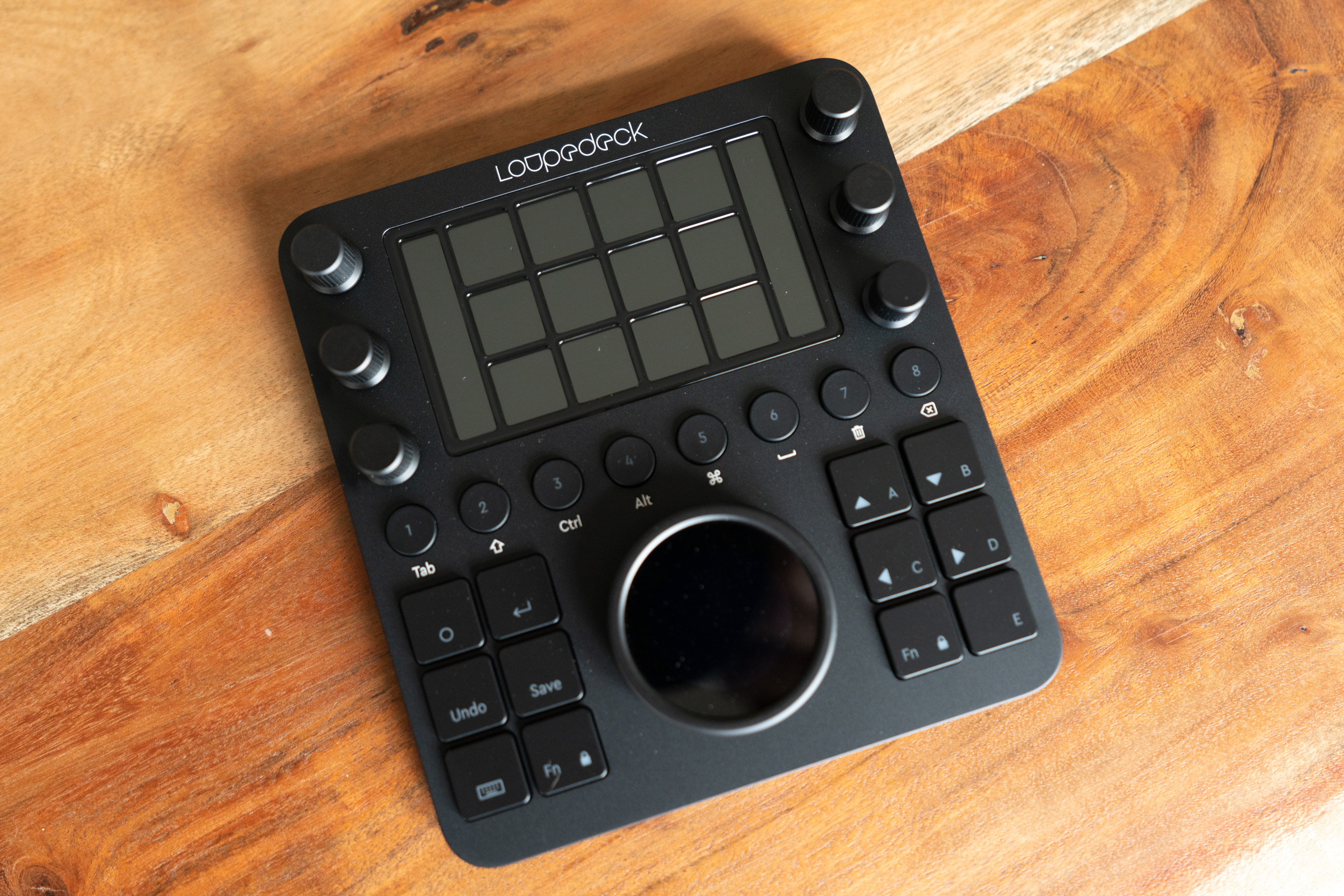
The matte black, slightly rubberized finish is pleasing both to look at and to the touch, and the controls all feel like there was a lot of care put into the tactile experience of using them. The graduated clicks on the knobs let you know when you’ve increased something by a single increment, and the smooth action on the big dial feels delightfully analog. The buttons all have a satisfying, fairly deep click, and the slight buzz you get from the vibration feedback on the touchscreen buttons are a perfect bit of haptic response, which, combined with the raised rows that separate them, mean you can use the Loupedeck CT eyes-free once you get used to it. Each knob is also a clickable button, and the touchscreen circular display on the large central dial can be custom configured with a number of different software buttons or a scroll list.

Despite its small size, the Loupedeck CT doesn’t feel fragile, and it has a nice weight to it that feels reassuring of its manufacturing quality. It does feel like a bit of a compromise when it comes to layout to accommodate the square design vs. the longer rectangle of the Loupedeck+, which more closely resembles a keyboard – but that has positives and negatives, since the CT is easier to use alongside a keyboard.

Ultimately, the design feels thoughtful and well-considered, giving you a very powerful set of physical controls for creative software that takes up much less space on the desk than even something like an equivalent modular system from Palette would require.

Features

The Loupedeck CT’s primary benefits are found in its profiles, which set you up out of the box to get editing quickly and effectively across your favorite software. Each feels like a sensible set of defaults for the software they’re designed to work with, and you can always customize and tweak to your heart’s content if you’ve already got a set of standard processes that doesn’t quite match up.

Loupedeck’s software makes customization and addition of your own sets of tools a drag-and-drop process, which helps a lot with the learning curve. It still took me a little while to figure out the logic of where to find things, and how they’re nested, but it does make sense once you experiment and pay around a bit.
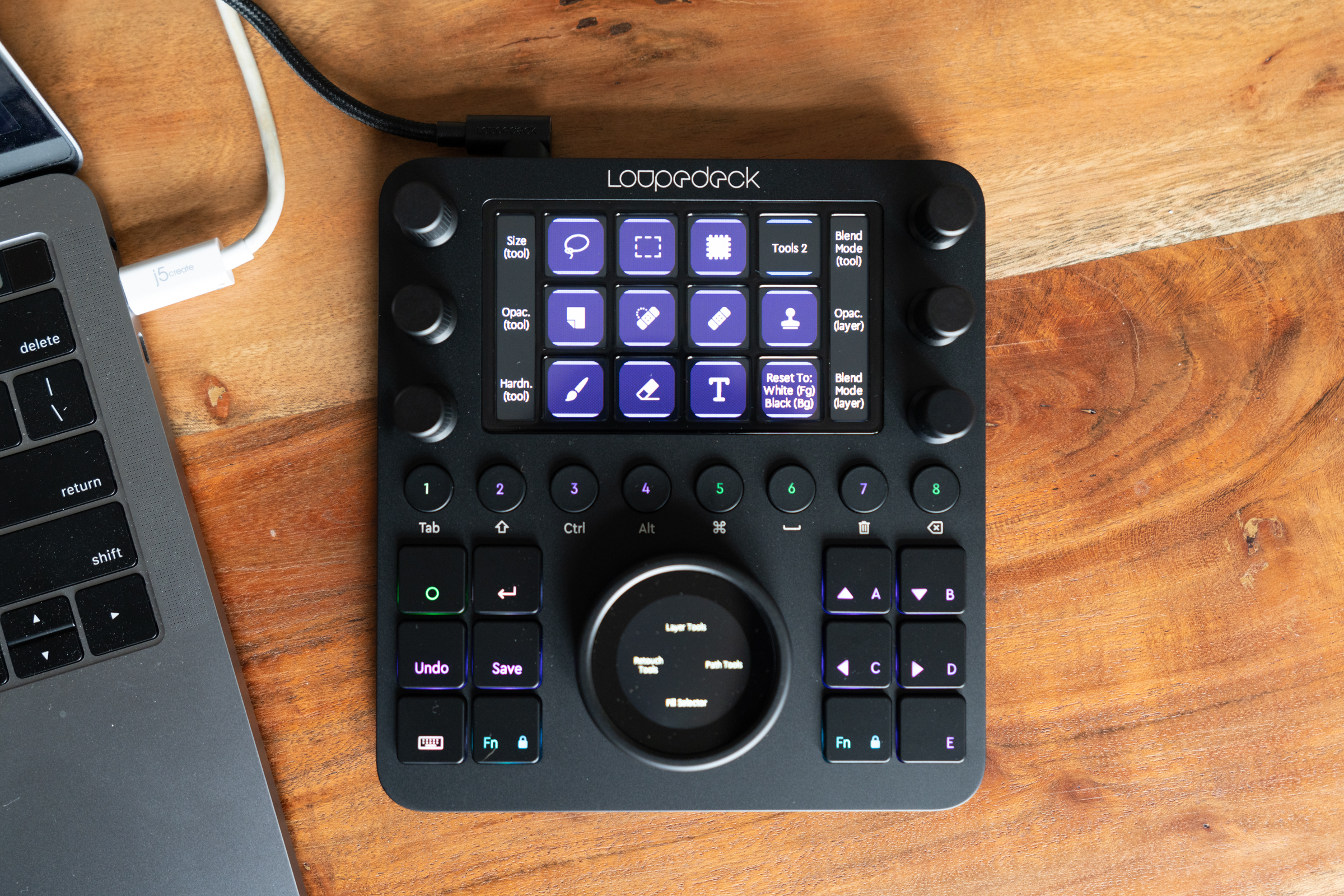
Similarly, Loupedeck uses a color-coding hierarchy system in its interface that takes some getting used, but that eventually provides a handy visual shortcut for working with the Loupedeck CT. There are green buttons and lights that control overall workspaces, as well as purple actions that exist within those workspaces. You can set up multiple workspaces for each app, letting you store entire virtual toolboxes for carrying out specific tasks.

This allows the CT to be at once simple enough to not overwhelm, and also rich and complex enough to offer a satisfying range of control options for advanced pros. As mentioned, everything is customizable (minus a few buttons like the o-button that you can’t remap, for navigation reasons) and you can also export profiles for sharing or for use across machines, and import profiles, including those created by others, for quickly getting set up with a new workflow or pice of software.

The Loupedeck CT even has 8GB of built-in storage on board, and shows up as a removable disk on your computer, allowing you to easily take your profiles with you – as well a tidy little collection of working files.

Bottom Line

At $549, the Loupedeck CT isn’t for everyone – even though the features it offers provide efficiency benefits for many more than just creatives. It’s like having an editing console that you can fit in the tablet pocket of most backpacks or briefcases – and it’s actually like having a whole bunch of those at once because of the flexibility and configurability of its software. Also, comparable tools like the Blackmagic Design DaVinci Resolve Editor keyboard can cost over twice as much.

If your job or your passion involves spending considerable time adjusting gradients, curves, degrees and sliders, than the Loupedeck CT is for you. Likewise, if you spend a lot of time transcribing or cleaning up audio, or you’re a keyboard warrior who regularly employs a whole host of keystroke combos even for working in something like a spreadsheet app, it could be great for you too.

I’ve tested out a lot of hardware aimed at improving the workflow of photographers and video editors, but none has proven sticky, especially across both home and travel use. The Loupedeck CT seems like the one that will stick, based on my experience with it so far.