Year: 2020

27 May 2020

Docker expands relationship with Microsoft to ease developer experience across platforms

When Docker sold off its enterprise division to Mirantis last fall, that didn’t mark the end of the company. In fact, Docker still exists and has refocused as a cloud-native developer tools vendor. Today it announced an expanded partnership with Microsoft around simplifying running Docker containers in Azure.

As its new mission suggests, it involves tighter integration between Docker and a couple of Azure developer tools including Visual Studio Code and Azure Container Instances (ACI). According to Docker, it can take developers hours or even days to set up their containerized environment across the two sets of tools.

The idea of the integration is to make it easier, faster and more efficient to include Docker containers when developing applications with the Microsoft tool set. Docker CEO Scott Johnston says it’s a matter of giving developers a better experience.

“Extending our strategic relationship with Microsoft will further reduce the complexity of building, sharing and running cloud-native, microservices-based applications for developers. Docker and VS Code are two of the most beloved developer tools and we are proud to bring them together to deliver a better experience for developers building container-based apps for Azure Container Instances,” Johnston said in a statement.

Among the features they are announcing is the ability to log into Azure directly from the Docker command line interface, a big simplification that reduces going back and forth between the two sets of tools. What’s more, developers can set up a Microsoft ACI environment complete with a set of configuration defaults. Developers will also be able to switch easily between their local desktop instance and the cloud to run applications.

These and other integrations are designed to make it easier for Azure and Docker common users to work in in the Microsoft cloud service without having to jump through a lot of extra hoops to do it.

It’s worth noting that these integrations are starting in Beta, but the company promises they should be released some time in the second half of this year.

27 May 2020

Angling to be eyewear’s next big thing, Futuremood launches with mood-altering sunglasses

Austin Soldner and Michael Schaecher, the co-founders of the new sunglasses brand Futuremood, met at the newly formed San Francisco research and development lab created by the high end audio tech developer Bose.

The two were tasked with working on Bose’s sunglasses wearable and bonded over a shared interest in sneakers and fashion. Over many conversations the two men realized that there was an opportunity to use technology to rewrite the sunglasses playbook and launch the first new brand to the market since Oakley came on the scene.

There was also an opportunity to bring the materials science and tech-forward strategies that sneaker companies have developed to an industry that hadn’t seen any real technical revolutions in decades.

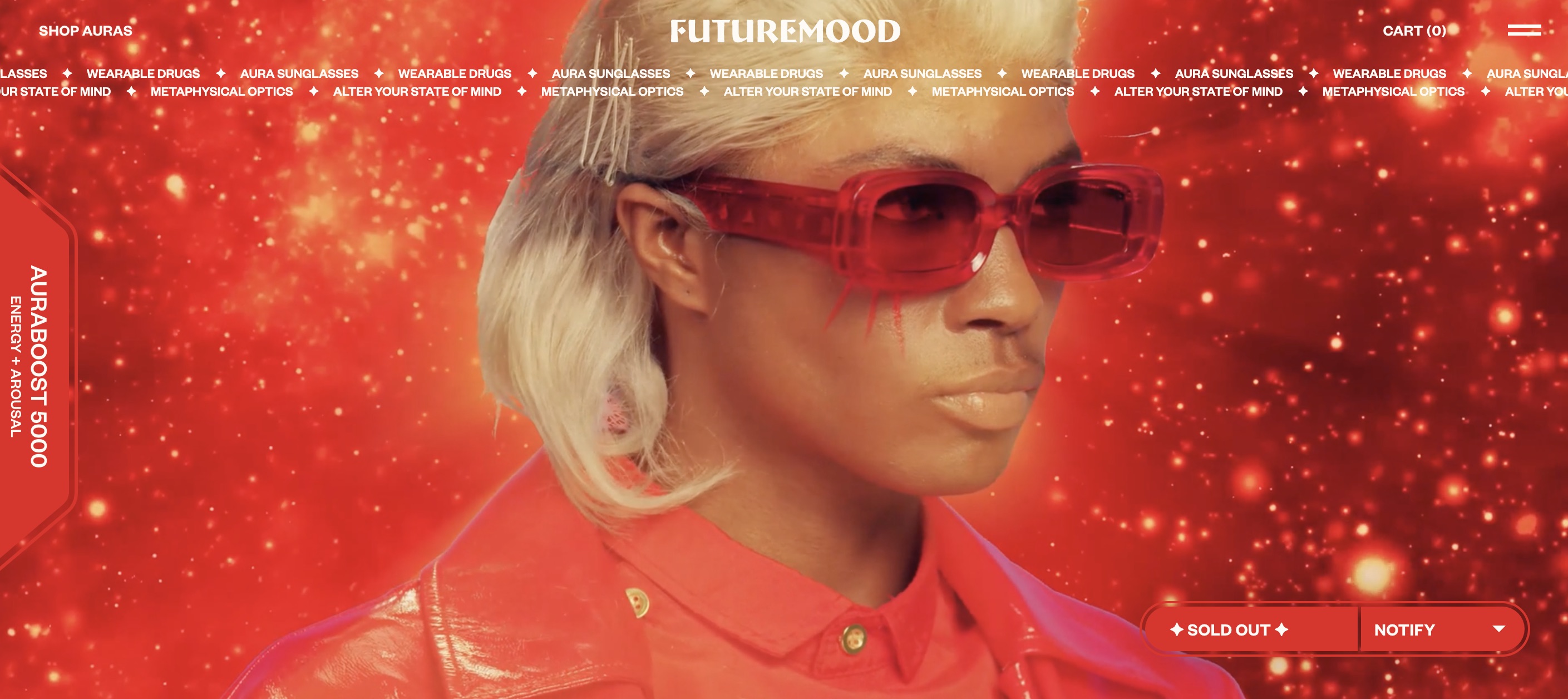
Enter Futuremood “Auras”, which the company bills as the first glasses scientifically tested and proven to alter your mood.

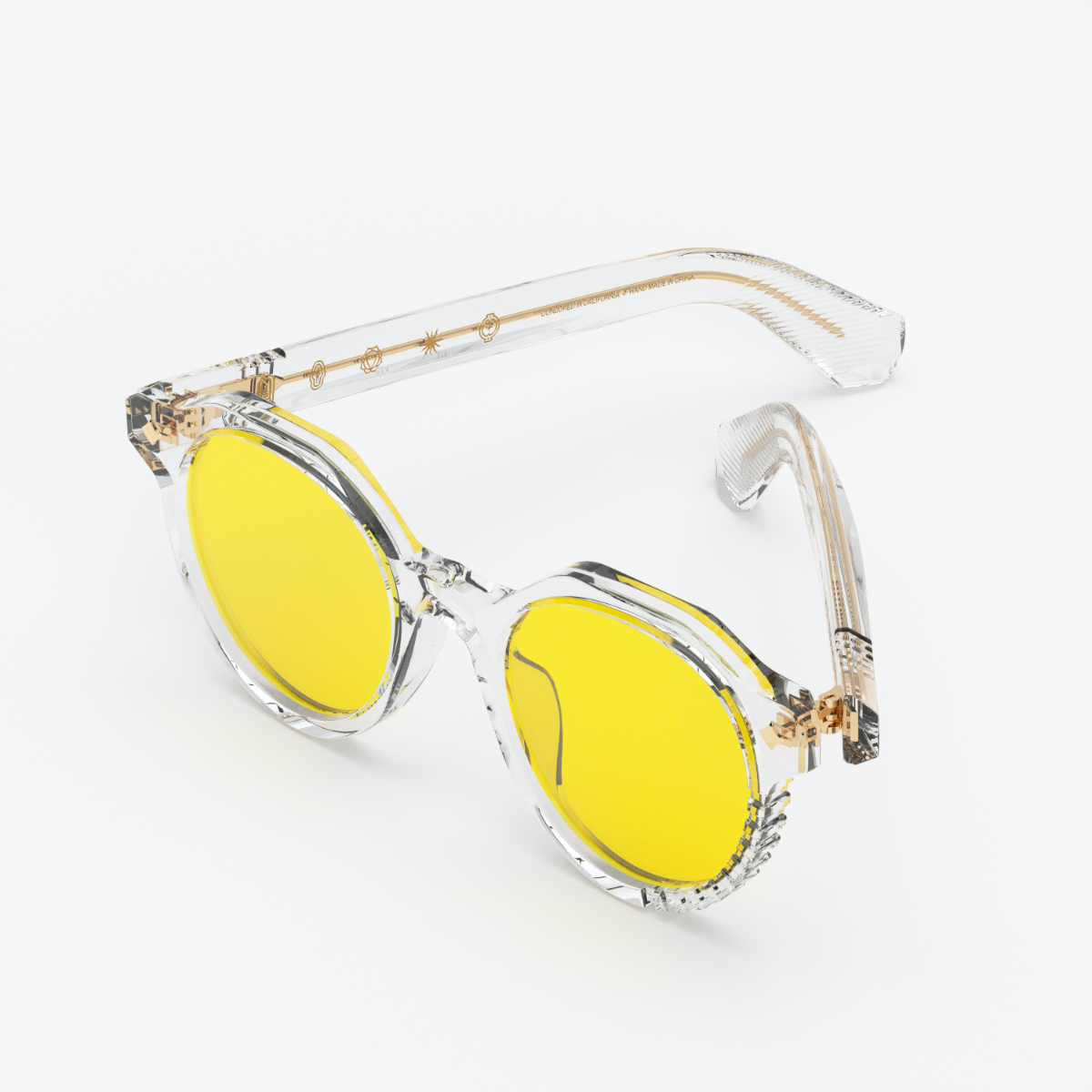
Using technology developed by the lens manufacturer Zeiss, Futuremood’s first glasses come in four different colors — a relaxing green, a refreshing blue, an energizing red, and a focusing yellow. The company is launching its eyewear in two different styles a boxy, chunky frame and a more traditional rounded frame.

Any mood altering effects are thanks to Zeiss’ halochrome lens technology, which the lens manufacturer has been working with — and publishing papers on — to suss out the science behind its claims that the use of filtered light can change the way folks feel.

There’s some preliminary research that the company has done, but the science is still largely unproven (Zeiss conducted two studies at European universities). 

Schaecher and Soldner are believers and the two longtime tech execs see these lenses as a window into a wider world of material science experimentation and product development that they’re hoping to bring to market with Futuremood.

“If you think about sneakers and where Nike and Adidas got to where they are today, it was through innovation in product design and materials and branding and marketing and all of that had been missing from the sunglasses space,” Schaecher said.

The second marketing hire at Airbnb and the first marketing hire at the now-defunct Munchery, Schaecher knows a thing or two about branding. Meanwhile, Soldner, the founder of Playground.fm, and a former product designer at Jawbone, is the technical expert and lead designer for all of Futuremood’s frames.

“We really saw an opportunity to push the envelope in technical innovation and product innovation,” said Schaecher. “We have a backlog of stuff to push the envelope of what sunglasses are.”

One thing sunglasses are is a very very big business. Consumers spent $14.5 billion on sunglasses in 2018, according to the market research firm, Grand View Research.

If Futuremood can capture even a fraction of that market with its unique spin on sunglasses, it’ll be in good shape.

As with any good direct to consumer product, Futuremood’s difference begins with its packaging. Tapping in to the mood-altering “wearable drugs” aesthetic, the company’s product is packaged in boxes with the same bright hues as the sunglasses. Inside there’s a cloth to clean the glasses, a velvet pouch to hold them and a scented pack of incense matches and a vaguely tarot-esque card with information on the glasses and the sensation they’re meant to evoke (there’s even a Spotify playlist to listen to).

In an email, Scaecher described the sensation as “not as subtle as CBD, but not as s trong as a shot of tequila or glass of Rosé.

“Austin and I are really into different ways of self care and taking moments and… we thought there was an opportunity to bring delight and joy,” with the packaging, Schaecher said. “We don’t expect people to be firing up Spotify playlists and incense matches every time they wear things.”

Futuremood has been mostly bootstrapped to date, and like everything else in the year of our lord 2020, the company’s plans were pushed back by the coronavirus pandemic.

“Our lenses are made in Zeiss’ Italian factory and the glasses were made outside of Shenzhen,” said Schaecher. “We quarantined the first order for two weeks. Zeiss was right in that region of Italy was getting hit hard. We’ve been delaying since then.. It’s hard to put into words what it’s like to grind on something for eighteen months… and then have to delay launching.”

Even with the pandemic, though, the company moved ahead with the design for its second product and that gives a hint for where Schaecher and Soldner want to go with their business. “We have our second product line and that is not mood-altering glasses,” said Schaecher. “That’s a traditional sunglasses line that uses titanium alloy metals that are more commonly seen in aerospace than in eyewear.”

The design aesthetic is also more in the luxury vein, which Schaecher teased was akin to something that would be more at home in a Cartier showroom rather than a direct to consumer brand’s digital storefront.

Right now, the company is going direct to consumers through its website, but it’s looking at the potential for some retail collaborations and field marketing when the country opens back up for business.

As for the mood-altering effects and whether “wearable drug” can win market share, Schaecher is pretty optimistic. “People definitely have reactions,” he said. “It’s a fun, new thing that’s never existed before.”


Image Credits: Futuremood

27 May 2020

Up close with the fresh new spacesuits astronauts will soon wear in orbit for the first time

Inside the first American spacecraft to take humans to orbit since the Space Shuttle launching today are, well, humans. And those humans are wearing brand new spacesuits that are also making a historic debut. Ahead of today’s launch (which you can watch here), NASA and SpaceX gave a fresh look at the new suits, which we may be seeing much more of soon.

The spacesuits were designed by SpaceX in collaboration with NASA and the astronauts going up today, Bob Behnken and Doug Hurley. They’re intended to bring modern materials and technology to a comfortable form factor that integrates seamlessly with the Crew Dragon capsule.

These aren’t, it is important to note, a replacement for the familiar EVA suits that have been in use for decades, though those are also being redesigned in-house. The ones Behnken and Hurley will wear are pressure suits, akin to what fighter jet pilots wear. These custom-fitted garments are meant to provide protection against the dangers of launch, but not outer space.

The SpaceX suits are heat- and impact-resistant and have communications and climate control built right in. The helmet has the radio and mics, naturally, and air and electricity flow through a single umbilical cable that connects to the wearer’s seat in the spacecraft.

“One of the things that was important in the development of this suit was to make it easy to use, something that the crew just has to literally plug in when they sit down, and then the suit kind of takes care of itself from there,” said SpaceX’s Chris Tripp in the NASA video highlighting the suits. “It’s really part of the vehicle, so we think of it as a kind of suit-seat system.”

Considering the advances that have been made over the last decade in electronics and software, astronauts and mission control should expect improved and simplified communications — the kind of noise reduction and voice detection we expect in our video calls nowadays is also very useful in aerospace.

Another interesting change is in the gloves, which must be durable yet flexible, and at the same time conductive — because the astronauts operate the Dragon capsule via touchscreen. It would be no good if they had to take off a glove to make a selection.

“[We] worked with them to define the way you interface with it — the way your touches actually registered on the display, in order to be able to fly it cleanly and not make mistakes touching it, not potentially putting in a wrong input,” Behnken said in a recent NASA press conference.

Like everything else aboard the capsule, the suits will be put to their first full-scale test today, though of course they’ve been through all kinds of in-house evaluations before.

27 May 2020

Canada court finds against Huawei CFO Meng Wanzhou on double criminality; extradition trial to continue

In a closely-watched decision today, the Supreme Court of British Columbia published a key decision in the extradition case of Meng Wanzhou, the CFO of Huawei Technologies, China’s largest telecommunications company and a frequent target of U.S. policymakers.

In its ruling, the court said that the case met the standard for “double criminality,” and thus the extradition hearing will be allowed to continue. That decision represents a major blow to Huawei, which had hoped to end the suit and bring Meng home back to China.

It’s a pivotal moment in the long-running saga over the fate of Meng and Huawei itself. She was arrested at Vancouver International Airport on December 1, 2018 at the request of U.S. authorities, who eventually indicted her and Huawei itself with a bevy of fraud charges.

Those charges stemmed from an investigation by the U.S. Department of Justice looking into Huawei’s ties with a number of affiliates including Skycom Tech Co Ltd, which is alleged to have sold telecommunications equipment to Iran in violation of U.S. sanctions. Huawei uses American technology in its products, and under U.S. export laws, companies are forbidden from transferring that technology to countries under sanction. Huawei has previously denied that it controlled the companies, and has vigorously defended itself in the case.

Meng has been under house arrest in Vancouver for almost a year and a half pending deliberations of the Canadian courts. The case has seen intense scrutiny from China, the U.S. and Canadian authorities, and has become a symbol of the continuing trade fight between the U.S. and China.

Today’s decision comes from a narrowly focused court hearing in January on a Canadian legal doctrine known as “double criminality,” which states that a subject needs to face criminal charges in both Canada and the receiving country in order for an extradition to be approved. While courts generally handle all aspects of extradition at once, the judge in this case, associate chief justice Heather Holmes, decided to split Meng’s extradition hearing into phases, given that without double criminality, the case would be automatically closed.

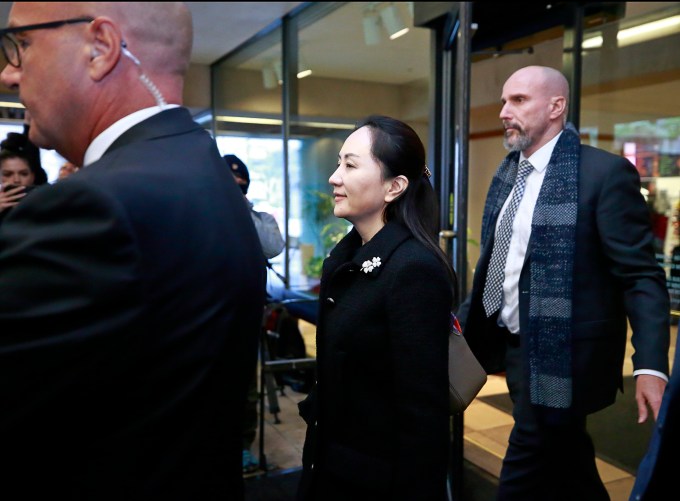
VANCOUVER, BC – JANUARY 20: Huawei Technologies Chief Financial Officer Meng Wanzhou is escorted by her security personnel as she leaves court during a break for lunch on the first day of her extradition trial on January 20, 2020 in Vancouver, Canada. (Photo by Jeff Vinnick/Getty Images)

The decision on Meng, who is the daughter of Huawei’s founder and CEO Ren Zhengfei, is just one of many different battles that Huawei has faced in recent months.

Over the weekend, the company faced a new blow to its prospects in the West after the United Kingdom, which had been a lukewarm but steady supporter of using Huawei’s equipment in its next-generation 5G networks, announced that it was reversing its decision and would wean itself off of Huawei equipment over the coming years.

Meanwhile in the U.S., the Trump administration has focused intently on the company as it attempts to shift the balance of power in the United States’ trade relations with China. Two weeks ago, the Trump administration extended its technology export restrictions on Huawei, endangering the company’s ability to product its chips and smartphones. TSMC, the world’s largest contract semiconductor fab, said that it wasn’t accepting new orders from Huawei in light of the new restrictions. At the same time, TSMC announced a massive, $12 billion manufacturing facility in Arizona.

While the Trump administration has made economic combat with Huawei a policy priority, that strategy has not been endorsed by the entire federal government, with departments and agencies like the Department of Defense worried that the restrictions on export licenses could ultimately have deleterious, second-order effects on American industrial competitiveness.

Indeed, given the continuing situation with the U.S., Huawei itself has said that one of its most important missions is to build its equipment using entirely domestic Chinese components, veering around U.S. export controls and breaking free of their confines. Assisting on that front is China’s government itself, which has put up billions of dollars in new funding to build up its domestic chipmaking capabilities.

It’s a complex situation, and one that Western policymakers have struggled to come to a unified approach on. As our writer Scott Bade described a few weeks ago, countries like Australia, the United Kingdom, and the United States are struggling to come to agreement on Huawei and China’s tech forays more generally, with each country approaching the issue from its own point-of-view and from different levels of engagement with the Chinese mainland.

While the Meng case is just the latest salvo in the on-going battle here, expect more skirmishes ahead.

27 May 2020

Take a look inside Crew Dragon, SpaceX’s first human spacecraft, ahead of its historic launch

SpaceX is in the process of preparing for its historic first astronaut launch, with a mission to demonstration its human spaceflight capabilities by flying NASA astronauts Doug Hurley and Bob Behnken to the International Space Station. That flight is set to happen at 4;33 PM EDT (1:33 PM PDT), wether permitting, but meanwhile SpaceX has provided a closer look at Crew Dragon and what went into its design.

Crew Dragon is based on the design of SpaceX’s original Dragon cargo capsule, which is currently in service providing operational resupply services to the Space Station . SpaceX’s design team was focused entirely on converting it for human use and comfort, with an emphasis on ensuring it felt like a genuine, 21st-century modern vehicle, with excellent usability and user experience, from its touchscreen control system to its custom-molded seating.

Check out the launch livestream here, as the astronauts and crew continue to ready for launch.

27 May 2020

Tesla cuts prices across EV line up, ends free supercharging for Model S, Model X

Tesla slashed prices across its electric vehicle portfolio overnight as the automaker aims to boost sales in an economy beaten down by the COVID-19 pandemic.

Reuters and Electrek were the first to report the changes. The base price of Model 3 standard range plus is now $37,990, a $2,000 reduction. But the biggest cuts were made to Tesla’s more expensive, luxury vehicles, the Model S sedan and the Model X SUV.

The Model S long range plus now starts at $74,990, a decrease of $5,000. The more expensive Model S performance as well as the two Model X configurations also saw prices slashed by $5,000.

The price cuts come as automakers seek ways to attract buyers after months of a lockdown prompted by the COVID-19, which has dampened demand and upended the economy. The traditional big three U.S. automakers Ford, GM and Fiat Chrysler Automobiles have turned to 0% financing rates as well as deferred or longer term payment options. Other automakers including Hyundai Motor America, Kia Motors America, Nissan North America, Toyota Motor Sales U.S.A, and Volkswagen of America have also announced incentives and payment plans aimed at preventing existing owners from defaulting on loans as well as incentivizing new buyers.

Tesla has also removed mention of free unlimited supercharging for new Model S and Model X sales along with the price cuts.

The company has waffled on the free supercharging incentive before, removing it and bringing it back over the past several years.

In the early days, free unlimited supercharging was part of the package of buying a Tesla vehicle. The automaker began phasing out free unlimited access to its supercharger network when it announced that customers who buy cars after January 1, 2017 will have 400 kilowatt-hours, or about 1,000 miles, of free charging every year. Once owners surpassed that amount, they would be charged a small fee.

Tesla then narrowed the free unlimited access to superchargers through a referral program and only to buyers of performance versions of the Model S, Model X and Model 3. The free unlimited supercharger referral program is now set to end September 18.

Tesla CEO Elon Musk, who has called the perk “unsustainable” has brought back the perk several times since to drive sales. In August 2019, the company resurrected the benefit in an effort to boost sales of its more expensive electric vehicles.

27 May 2020

Siren raises $11.8M for its limb-saving smart socks

Can a pair of socks help those with diabetes avoid foot amputations?

That’s one of the ideas behind Siren, a company that’s building smart, washable fabric wearables – the first of which is a pair of socks meant to help those with diabetes monitor their foot health and detect dangerous injuries early. They’ve just a raised $11.8M Series B to help get it done.

The round was led by Anathem Ventures, and backed by Khosla, DCM, and Founders Fund. As part of the raise, DCM’s Jason Krikorian (co-founder of Slingbox maker Sling Media) will be joining Siren’s board.

Siren co-founder Ran Ma tells me that amputations in patients with diabetes are largely the result of injuries that go undetected for too long. Over time, diabetes can cause nerve damage; when this nerve damage impacts the feet, patients can develop injuries and ulcers without noticing – out of sight, out of mind. Left untreated, these injuries can grow worse or become infected to the point that amputation is required. Tens of thousands of these amputations occur each year in the US alone.

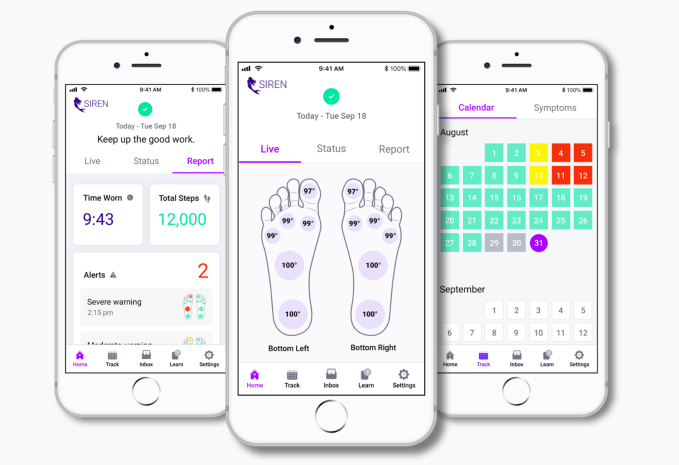
Siren’s socks help detect injuries that might otherwise go unnoticed by monitoring the temperature of six regions of the wearer’s foot. If one region seems to be getting considerably warmer than those around it, it could indicate ongoing inflammation caused by an injury. The socks can connect to the patient’s phone via Bluetooth to help them keep an eye on their feet – and, importantly, that information is beamed to their doctors who can keep an eye out for red flags.

That last bit is particularly key right now. With the ongoing COVID-19 pandemic, many are avoiding doctors offices and hospitals in fear of being exposed to the virus; meanwhile, many offices have been limiting their more routine/less urgent or “non-essential” appointments – including, in this case, routine foot exams. Siren’s socks let a patient’s doctors monitor their foot health from afar.

We first met Siren back in 2017 when the company won the TechCrunch Hardware Battlefield at CES. Since then, the company has raised around $22 million in funding; this $11.8M Series B, a previously undisclosed $6.5M Series A in 2018, and a $3.4M seed round.

Ran tells me that they’ve made Siren Socks available in ten states so far, with plans to expand nationwide by the end of this year.

27 May 2020

CryptoKitties developer launches NBA Top Shot, a new blockchain-based collectible collab with the NBA

When Dapper Labs launched CryptoKitties back in November 2017, the company’s take on Tamagotchi was seen as the first popular use of blockchain-based applications. It was the first popular use case outside of Bitcoin as a speculative investment.

Like all fads, CryptoKitties didn’t last, but the app proved that Dapper Labs could build a compelling collectible — and that brought the company the attention of the National Basketball Association.

Now Dapper Labs is finally launching a beta version of the NBA Top Shot app it has worked on since it began discussions with the league and Players Association back in 2018.

Built on the company’s own blockchain, the app is the latest attempt from blockchain companies to take on the sports world’s fixation with collectibles. Bayern Munich signed an agreement with Sryking Entertainment to create digital tokens of its players — and that company is developing a fantasy sports platform called Football-Stars, according to the Website SportsTechie. Even the Sacramento Kings even have their own blockchain powered auction platform.

“At its core it’s digital collectibles,” said Caty Tedman, the vice president of partnerships at Dapper Labs. “They’re multimedia and data smashed together into a token. That includes heroic photography and a video as well through a partnership with SportRadar. We have all the metadata from the game. The box score … the context. Any everyday block might not be as memorable as when Lebron put someone on a poster.”

The collectible component is only one aspect of the game which will include opportunities to showcase collections, get new tokens by completing in-app challenges and a challenge feature where players can use their team to engage in one-on-one games using the collective skills from the roster of NBA stars that a user has collected.

The first iteration is 2019 to 2020 moments of the season, but Dapper Labs expects to reach back into the archive to use historical all stars.

The tokens will be sold in packs that range in price from $9 to the mid-$200 range, according to Tedman. The game will also include a peer-to-peer marketplace for trading the tokens.

“These digital moments are much closer to physical trading card collecting as opposed to an in-app purchase… they have that same,” said Tedman.

27 May 2020

Gmail’s new feature makes it easier to personalize your inbox

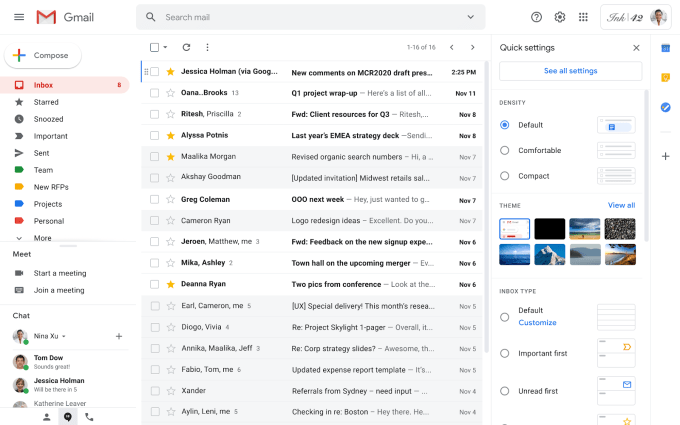
Google is introducing a new “quick settings” menu in Gmail aimed at helping users browse, discover, and use different themes and settings to customize their Gmail experience. These options include the ability to change the density of text, select from different inbox types, add reading panes, and options to theme your inbox. They are not new features, but before had been buried in Gmail’s settings. Many users may have not even known the options existed, unless they went digging.

From the new Quick Settings menu, Gmail will pop up these various options on the right side of the inbox for easier access. And as you make a selection, you can see your inbox update with the change immediately, allowing you to try out new settings and themes before making a commitment.

Included at launch is the ability to customize the density of the text and the information displayed and the ability to choose from different types of inbox layouts such as Priority Inbox, favored by powered users, Gmail’s default tabbed experience, or those where you want to see certain types of emails first — like unread or important.

You can also opt to turn on reading panes, to give your inbox more of the feeling of a traditional desktop client or you can choose to apply one of Gmail’s colorful themes to brighten your space and personalize the look-and-feel.

The Quick Settings menu doesn’t disrupt access to Gmail’s full settings screen — that’s still available upon an extra click on the “See all Settings” button at the top of the new Quick Settings menu.

“We’re making these options easier to find, and letting you explore them in real-time, so your actual inbox will update immediately to show you exactly what the setting will do. We hope this makes it easier to set up Gmail the way that works best for you,” the company said, in an announcement about the new feature.

The Quick Settings menu is rolling out to all G Suite customers, where it’s enabled by default, as well as all Gmail users with personal accounts.

Google began the release for G Suite customers on Rapid Release domains on May 26, 2020 with the rollout completing within 15 days. Those on Scheduled Release domains will see the feature rolling out starting on June 22, 2020. The company didn’t say when personal Gmail users would get the update, but they should soon.


27 May 2020

French contact-tracing app StopCovid passes first vote

Following a debate in the National Assembly, the lower house of the French parliament, deputies have voted in favor of the release of contact-tracing app StopCovid and the decree related to the app.

While a vote in the parliament wasn’t a mandatory step, the government wants to rally as many people as possible around the contact-tracing app. At first, French President Emmanuel Macron said there would be a debate, but not necessarily followed by a vote. The government then reversed its stance and said deputies would vote.

“If members of the parliament vote against the release of the application, we won’t release StopCovid,” France’s digital minister Cédric O said in a radio interview earlier today.

It’s still unclear whether a contact-tracing app is efficient. But there’s one thing for sure — the app would be inefficient if only a small fraction of people living in France choose to download it. Hence today’s debate.

There were two important points discussed in the National Assembly. First, is StopCovid a surveillance app and is there a risk when it comes to privacy? Second, is StopCovid useful and efficient?

Privacy

“Tomorrow, I want to be free to download or not to download the application. I want to be free to protect myself,” France’s minister of health Olivier Véran said. It doesn’t really answer the privacy risks of a contact-tracing app but it’s true that the government changed the decree at the last minute to say that there won’t be any negative consequence if you’re not using StopCovid, nor any privilege if you’re using it.

“StopCovid isn’t a project for peacetime. It’s a project for a historical crisis — it wouldn’t exist without it and it’s not going to exist after it,” Cédric O said.

StopCovid relies on Bluetooth like most contact-tracing app. But a group of research institutes and private companies have worked on a homemade solution that doesn’t rely on Apple and Google’s contact-tracing API. It is based on a centralized contact-tracing protocol that computes matches on a central server. It isn’t anonymous but pseudonymous.

It has been a controversial topic over the past few weeks. Cédric O defended France’s centralized solution by saying it guarantees the digital sovereignty of the country.

“22 countries have chosen to develop a contact-tracing app that relies on the interface developed by Apple and Google. 22 countries, but not France and the U.K. And it’s not a coincidence because those two countries also have nuclear weapons,” Cédric O said.

Paula Forteza, a deputy from the same party who recently created a separate parliamentary group due to recent disagreements, rightfully said that isn’t as straightforward as that.

“No, the debates on the centralized and decentralized design of the protocol don’t overlap with debates on digital sovereignty and reliance on tech giants,” Forteza said.

Effectiveness

Once again, the government and opponents didn’t have the same take on the potential effectiveness on an optional contact-tracing app.

“The app is systematically and linearly efficient as soon as a few percentage points activate it,” Cédric O said.

“It’s inefficient because 50 to 60% of French people have to install the application. It’s inefficient because 25% of French people don’t have a smartphone, unless you have decided to offer them one,” leader of far-left party La France Insoumise Jean-Luc Mélenchon said.

On this point, nobody really had a clear answer. Contact-tracing using Bluetooth is still uncharted territory. Moreover, on iOS, you’ll have to leave the app open to enable Bluetooth.

“The only ones who are able to decide whether this applications is efficient, useful or not useful, are epidemiologists,” Cédric O concluded after the debate.

Next steps

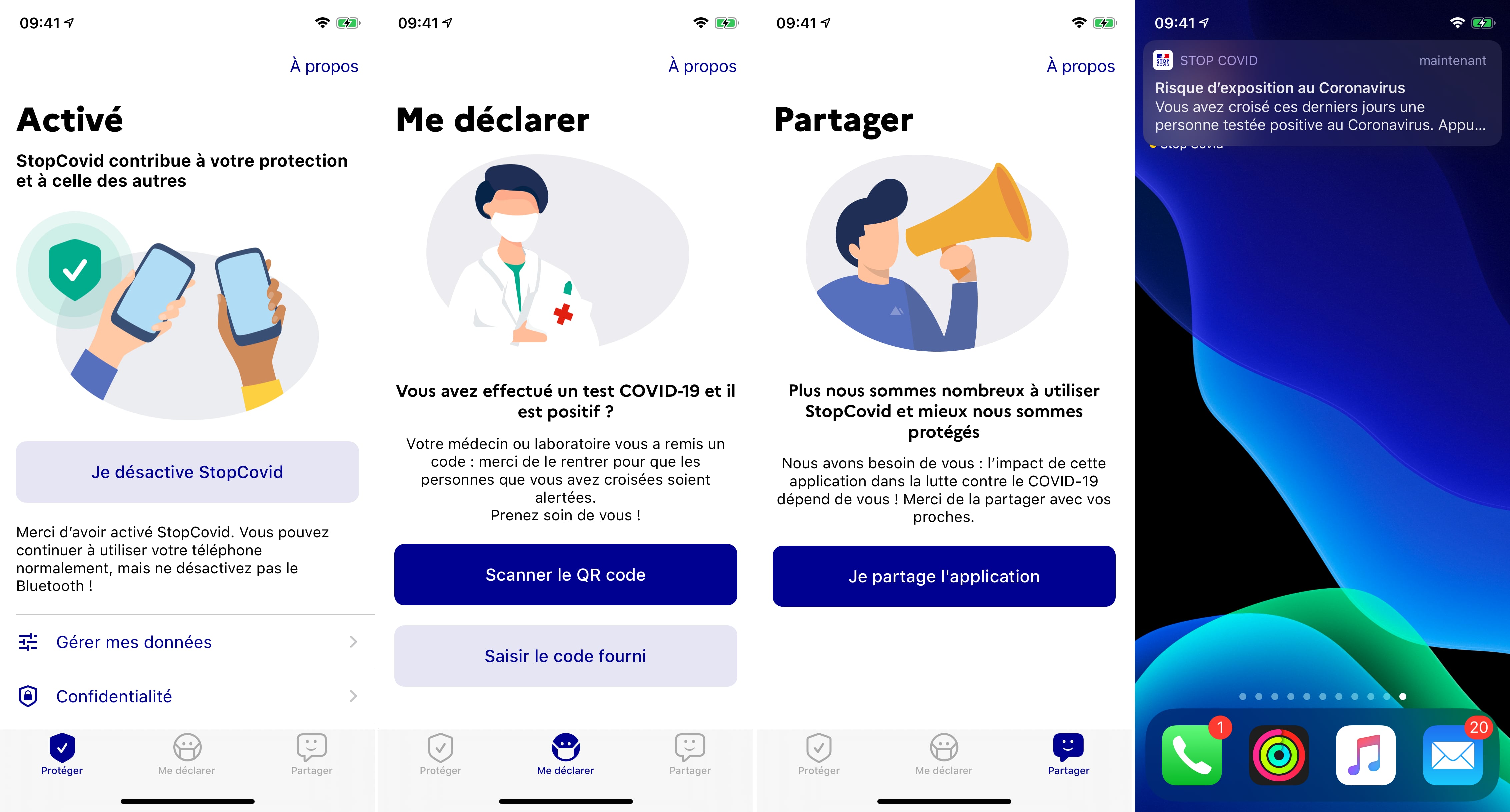
Later today, the upper house of the French parliament, the Senate, will also discuss the pros and cons of StopCovid and vote. After that, StopCovid will be released on the App Store and Play Store early next week.

Here’s what it looks like: